Europe in Summer: The Complete 2026 Guide

I have spent fifteen summers working across this continent, and I can tell you the exact moment my advice changed. It was a July afternoon in Rome, standing in a queue on the shadeless side of a piazza, watching a family from Ohio realise their eight-year-old had stopped complaining, which is much worse than complaining. Nobody had told them that the afternoon was not for sightseeing. Nobody had told them the museum they had booked shut at one. They had planned a European summer from photographs taken in May.
Europe in summer is still the most rewarding trip on earth if you plan for the continent as it actually is now: hotter than the brochures, more regulated than it was two years ago, and split into three completely different climates that get flattened into one word. Go in with real temperatures, real rules and real dates, and June to August is glorious. Go in with vibes, and you will spend a lot of money being uncomfortable.
The short answer
Europe in summer means three separate seasons happening at once. The Mediterranean south runs 30°C to 32°C and is best treated as a morning-and-evening destination. The continental middle sits in the low to mid twenties and works all day. The north and the Atlantic fringe stay between 13°C and 21°C, which in 2026 is a feature rather than a compromise. June is the sweet spot; late August into September is the value play.
Everything below is built from figures I could source and check. Where I could not source something, I say so rather than guessing, which happens more often in this article than I would like and is itself worth knowing.
What summer 2026 actually did, and why it matters for your trip
This is not an abstract climate section. It changes what you should book.
Western Europe recorded its hottest June and July on record in 2026, averaging 21.62°C, roughly 2.79°C above the long-term average and beating the previous record set in 2022. Records fell across a long list of countries over the course of the summer, from Ireland and Belgium to Romania and Spain, though the exact count is reported differently in different places. Compiled national estimates put heat-related deaths across the continent in the tens of thousands by early August, with Germany alone at roughly 11,900 on Robert Koch Institute figures. Drought pushed the Danube low enough that Hungarian and Romanian operators curtailed output at reactors that rely on it for cooling.
That follows a 2025 that was itself the European Union’s most destructive wildfire season on record, with around 1,034,552 hectares burned across 25 member states, nearly double the 2006 to 2024 average. Iberia carried most of it: over 500,000 hectares burned in Portugal and Spain in the twelve days between 8 and 19 August 2025 alone, with 22 very large fires running almost simultaneously.
Worth saying plainly, because it cuts against the mood: on burnt area, 2026 has so far run below 2025. The European Forest Fire Information System had the EU at 568,415 hectares to 13 August 2026 against 775,748 hectares by the same date in 2025. The heat records are the story of 2026; the fire records belong to 2025.
Three practical consequences follow, and they are the spine of this guide.
First, the June heatwave that began around 22 June 2026 forced emergency measures on rail operators in Belgium, France, the Netherlands, the UK and Luxembourg. Overhead lines sag, lineside vegetation catches, and rails buckle. Above about 35°C you also start seeing signal failures and softened asphalt. If your itinerary depends on a tight train connection in a heatwave week, build in slack.
Second, air conditioning is not a given. Around 20 percent of European homes have it, against roughly 90 percent in the United States. Hotels vary enormously by building age, country and category, and budget hotels, hostels and apartments frequently offer a fan and an apology. Filter for it and read recent reviews rather than trusting the amenity checkbox.
Third, the crowds have not gone anywhere. One European Commission-linked survey put travel intention for spring and summer 2026 at 82 percent, an all-time high since 2020, with Spain, Italy and France the top intra-European destinations. Hotter and busier at the same time is the defining condition of a European summer now.

Average summer temperatures across Europe in 33 cities
This is the table I rebuild for myself every spring. Average monthly highs for June, July and August, sorted from hottest August to coolest. Averages, note, not peaks: a 32°C average August in Athens contains plenty of 38°C days.
| City | Country | June avg high | July avg high | August avg high | Band | What that means on the ground |
|---|---|---|---|---|---|---|
| Athens | Greece | 29°C | 32°C | 32°C | Very hot | Plan around the heat: mornings, evenings, air-conditioned afternoons |
| Rome | Italy | 28°C | 32°C | 32°C | Very hot | Plan around the heat: mornings, evenings, air-conditioned afternoons |
| Madrid | Spain | 27°C | 31°C | 31°C | Very hot | Plan around the heat: mornings, evenings, air-conditioned afternoons |
| Valletta | Malta | 28°C | 31°C | 31°C | Very hot | Plan around the heat: mornings, evenings, air-conditioned afternoons |
| Naples | Italy | 27°C | 30°C | 30°C | Very hot | Plan around the heat: mornings, evenings, air-conditioned afternoons |
| Marseille | France | 27°C | 30°C | 30°C | Very hot | Plan around the heat: mornings, evenings, air-conditioned afternoons |
| Istanbul | Turkey | 27°C | 29°C | 29°C | Hot | Comfortable early and late, draining from noon to 17:00 |
| Milan | Italy | 26°C | 29°C | 29°C | Hot | Comfortable early and late, draining from noon to 17:00 |
| Lisbon | Portugal | 25°C | 28°C | 28°C | Hot | Comfortable early and late, draining from noon to 17:00 |
| Barcelona | Spain | 24°C | 28°C | 28°C | Hot | Comfortable early and late, draining from noon to 17:00 |
| Nice | France | 24°C | 27°C | 28°C | Hot | Comfortable early and late, draining from noon to 17:00 |
| Budapest | Hungary | 25°C | 27°C | 27°C | Hot | Comfortable early and late, draining from noon to 17:00 |
| Vienna | Austria | 24°C | 27°C | 26°C | Warm | Pleasant most days, with short spikes into the mid-thirties |
| Zagreb | Croatia | 25°C | 27°C | 26°C | Warm | Pleasant most days, with short spikes into the mid-thirties |
| Ljubljana | Slovenia | 24°C | 27°C | 26°C | Warm | Pleasant most days, with short spikes into the mid-thirties |
| Sarajevo | Bosnia and Herzegovina | 23°C | 26°C | 26°C | Warm | Pleasant most days, with short spikes into the mid-thirties |
| Paris | France | 23°C | 25°C | 25°C | Warm | Pleasant most days, with short spikes into the mid-thirties |
| Berlin | Germany | 22°C | 24°C | 24°C | Warm | Pleasant most days, with short spikes into the mid-thirties |
| Zurich | Switzerland | 23°C | 25°C | 24°C | Warm | Pleasant most days, with short spikes into the mid-thirties |
| London | United Kingdom | 21°C | 23°C | 23°C | Mild | Sightseeing weather all day, occasional warm week |
| Prague | Czechia | 21°C | 23°C | 23°C | Mild | Sightseeing weather all day, occasional warm week |
| Warsaw | Poland | 22°C | 23°C | 23°C | Mild | Sightseeing weather all day, occasional warm week |
| Amsterdam | Netherlands | 20°C | 22°C | 22°C | Mild | Sightseeing weather all day, occasional warm week |
| Vilnius | Lithuania | 21°C | 22°C | 22°C | Mild | Sightseeing weather all day, occasional warm week |
| Copenhagen | Denmark | 19°C | 21°C | 21°C | Mild | Sightseeing weather all day, occasional warm week |
| Helsinki | Finland | 20°C | 23°C | 21°C | Mild | Sightseeing weather all day, occasional warm week |
| Riga | Latvia | 20°C | 22°C | 21°C | Mild | Sightseeing weather all day, occasional warm week |
| Stockholm | Sweden | 21°C | 22°C | 20°C | Cool | Layers and a rain jacket, no heat planning required |
| Oslo | Norway | 20°C | 22°C | 20°C | Cool | Layers and a rain jacket, no heat planning required |
| Tallinn | Estonia | 19°C | 21°C | 20°C | Cool | Layers and a rain jacket, no heat planning required |
| Dublin | Ireland | 18°C | 20°C | 19°C | Cool | Layers and a rain jacket, no heat planning required |
| Glasgow | United Kingdom | 18°C | 19°C | 19°C | Cool | Layers and a rain jacket, no heat planning required |
| Reykjavik | Iceland | 12°C | 13°C | 13°C | Cool | Layers and a rain jacket, no heat planning required |
The spread is the story. Reykjavik’s August average high of 13°C sits about 19°C below Rome and Athens at 32°C. That is not a difference in degree, it is a different holiday. You can pack for one or the other, and the phrase “Europe in summer” covers both, so packing advice only means something once you have picked a band. If you want the same comparison for the other eleven months, our month-by-month weather guide runs the temperature, rainfall, sunshine and sea tables across all thirty-five cities.
A few notes on that table. Athens holds the World Meteorological Organization record for the highest temperature recorded in Europe at 48.0°C, and one alternative dataset puts its July daily average high as high as 34.4°C, so treat 32°C as the conservative end. Stockholm, Oslo and Helsinki all peak in July and fall back in August, which is unusual and useful: for the Nordics, July is genuinely the warm month, not a hotter version of August. And Ljubljana at 26°C is a warning about a common recommendation, because Slovenia gets sold as a cool-summer alternative when it runs only about 6°C below Rome.
The three summers of Europe
Before you choose a destination, choose a climate. Almost every regret I hear from readers traces back to picking the wrong one of these three. Each city in the table above falls into exactly one of them.
1. The hot band: 27°C to 32°C in August
Athens and Rome at 32°C, Madrid and Valletta at 31°C, Naples and Marseille at 30°C, Istanbul and Milan at 29°C, Lisbon, Barcelona and Nice at 28°C, Budapest at 27°C. Mostly the Mediterranean, plus the inland furnaces of Madrid, Milan and Budapest that people do not expect to be in the same category as Athens.
This band has a daily rhythm and it is not negotiable. You sightsee from 08:00 to about 12:30, you disappear from 13:00 to 17:00, and you come back out for a long evening that runs to midnight. Trying to keep Northern European hours in Seville or Athens in August is the single most common mistake I see, and it ruins otherwise excellent trips.
Book accommodation with genuine air conditioning here and treat it as a requirement rather than a preference. Book the big timed-entry sites for the 08:00 or 09:00 slot. Accept that lunch is at 14:30 and dinner at 21:30, because that is when the good places fill up.
2. The temperate band: 22°C to 26°C in August
Vienna, Zagreb, Ljubljana and Sarajevo at 26°C, Paris at 25°C, Berlin and Zurich at 24°C, London, Prague and Warsaw at 23°C, Amsterdam and Vilnius at 22°C.
This is the sweet spot for city sightseeing, because you can walk all day without planning around the sun. The catch is that these are the cities least likely to have air conditioning in older accommodation, and they now get proper heatwave weeks that push into the mid-thirties for three or four days at a time. Vienna at a 26°C average sounds gentle until you land during the week it hits 37°C.
The other catch is that this band empties out in August. Berlin, Vienna and Paris in August are pleasant, uncrowded and slightly hollow, with a noticeable share of the good restaurants shut. That trade is worth making if you like a quiet city and a disappointment if you came for the food.
Note that Ljubljana at 26°C sits at the top of this band, not in the cool one. Slovenia gets recommended as a heat escape and it runs only about 6°C below Rome.
3. The cool band: 13°C to 21°C in August
Copenhagen, Helsinki and Riga at 21°C, Stockholm, Oslo and Tallinn at 20°C, Dublin and Glasgow at 19°C, Reykjavik at 13°C. Beyond the main dataset, Bergen sits at about 19°C, Tromsø about 15°C and Tórshavn in the Faroes about 12°C, though those three come from a single weather source, so treat them as indicative rather than equivalent.
Long light, low heat, and in 2026 an increasingly obvious answer to the question of where to go when the south is on fire. Note that Stockholm, Oslo and Helsinki all peak in July and fall back in August, which is unusual and useful: for the Nordics, July is the warm month rather than a milder version of August. Inland Vilnius at 22°C sits just outside this band despite being Baltic, which is the sort of detail that catches people who book by region rather than by number.
The daylight is the real draw. Tromsø has midnight sun from roughly 20 May to 22 July, and Nordkapp from around mid-May to late July. Reykjavik’s sun barely sets around the solstice. Edinburgh’s latest sunset in 2026 was 22:03 on 22 June, and Stockholm’s June sunsets shift from 21:48 to 22:07 across the month. You get a fourteen-hour sightseeing day if you want one.
The trade is rain, wind and a swimming season that mostly is not one. The North Sea maxes out around 18°C in summer. Pack for a British autumn and be pleasantly surprised.

June, July or August: the honest comparison
August is the weakest of the three months for most kinds of trip, and I would rather lead with that than bury it at the bottom.
| June | July | August | Early September | |
|---|---|---|---|---|
| Heat in the south | Hot but manageable (Rome 28°C, Athens 29°C) | Peak (Rome and Athens 32°C) | Peak. On the longer-run monthly series August edges July in Rome, 30.6°C against 30.3°C, while the rounded normals in the table above show both at 32°C | Easing, sea still warm |
| Crowds | Building, manageable before the 20th | Heavy | Heaviest, plus European domestic holidays | Falls off sharply after the first week |
| Prices | High | Very high | Highest | Airfares 30 to 50 percent below August, holding into late October |
| Daylight | Longest of the year | Very long | Shortening noticeably | Normal |
| Sea temperature | Athens 22°C, still cool in the Atlantic | Athens 24°C, Lisbon 18.3°C | Warmest across the Med, Adriatic 23 to 24°C, Aegean 22 to 25°C | Lisbon’s best swimming month at 19.9°C |
| Local life | Fully open | Fully open | Italian and Southern European shutdown, roughly 1 to 20 August | Everything reopens |
| Best for | Cities, hiking, the Nordics, festivals | Beaches, Nordic midnight sun, big festivals | Beach resorts, quiet northern cities, the Baltics | Almost everything, at lower cost |
If I get one sentence: go the first three weeks of June, or go the first two weeks of September. If your dates are fixed by school holidays and August is the only option, spend the money on air conditioning and a northern or Atlantic destination rather than fighting the south.
The cost gap is real and well documented. Estimates vary by source and by route, but they all point the same way. KAYAK data puts shoulder-season airfares around 37 percent below peak summer; the European Travel Commission puts flights and hotels 20 to 30 percent lower; hotel rates alone fall 20 to 50 percent. From North America, August flights run 20 to 40 percent above shoulder season. One analysis put the total saving on a ten-day trip at €800 to €1,500 per couple at equivalent quality, which is the right order of magnitude even if your mileage differs.
The rules changed: what is new for summer 2026
This is the part of European summer travel that has changed fastest since last year. If you read only one section of this article, read this one.
The EU Entry/Exit System is live
The EES began a progressive rollout on 12 October 2025 across 29 European countries and became fully operational on 10 April 2026. If you are a non-EU traveller on a short stay, your passport is no longer stamped. Instead the system records your facial image, fingerprints and travel-document data at the border. By 30 March 2026 it had registered over 45 million border crossings and produced over 24,000 entry refusals, including more than 600 people flagged as security risks.
What it means in practice: your first crossing after registration takes longer, because biometrics are captured. Subsequent crossings should be quicker. Member states retain the ability to temporarily suspend EES processing when queues become unmanageable, so the experience will vary by airport and by day. Build an extra hour into a tight connection at a major Schengen entry point in July or August.
ETIAS is not in force yet
ETIAS, the travel authorisation for visa-exempt nationals, is not required for a summer 2026 trip. As of late September 2026 it has no start date: it was pencilled in for the last quarter of 2026, but the EU’s official ETIAS pages now say only that the date will be announced several months before launch, and trade reports point to 2027. A transition period of at least six months will follow the launch before it becomes mandatory. The fee is €20, confirmed by the European Commission’s Directorate-General for Migration and Home Affairs on 17 July 2025. Travellers under 18 and over 70 are exempt from the fee but still need an approved authorisation.
If a website is currently selling you an ETIAS for a summer 2026 trip, it is selling you something you do not need. Check our guide to the Schengen visa and ETIAS for the current position before you pay anyone.
Britain now needs an ETA, and it went up in April
Easy to miss because it is not an EU scheme. The UK Electronic Travel Authorisation is required for nationals of the visa-exempt countries, which includes EU, EEA and Swiss citizens as well as American, Canadian and Australian visitors. The fee rose from £16 to £20 on 8 April 2026. It covers multiple trips of up to six months at a time for two years or until your passport expires, whichever comes first, and it applies from the date you submit.
If your summer includes London, the Edinburgh Fringe, Notting Hill Carnival or a Scottish road trip, apply before you fly. There is no refund if you get it and then do not travel.
The 90/180 rule has not changed
Non-EU visitors can spend 90 days in any rolling 180-day period in the Schengen area. EES makes this much easier to enforce, because your entries and exits are now recorded automatically rather than depending on a legible stamp. If you are doing a long summer in Europe and then returning in the autumn, count the days properly. Ireland and the UK sit outside Schengen and do not count towards it, which is a useful release valve on a long trip.
A note on currency
Most of the prices in this article are in euros, but a good European summer often crosses out of the eurozone. Britain, Switzerland, Norway, Sweden, Denmark, Poland, Czechia, Hungary, Romania and Iceland all keep their own currencies. Bulgaria does not any more: it joined the euro on 1 January 2026, with the lev ceasing to be legal tender on 1 February 2026 at a fixed 1.95583 lev to the euro. Any 2026 guide still quoting Bulgarian prices in leva is quoting a currency you cannot spend.
Venice: the access fee has ended
This one is worth its own paragraph because almost every article still gets it wrong. Venice ran its access fee on 60 non-consecutive days between 3 April and 26 July 2026, at €5 if paid by the fourth-last day before your visit and €10 if paid within three days, applied only between 08:30 and 16:00, with overnight guests and under-14s exempt but required to register. From 27 July 2026 that trial ended and the fee no longer applies. Whether it returns is undecided and rests with the City of Venice’s governing bodies.
Venice still charges its ordinary accommodation tax of €1 to €4.50 per person per night depending on property type, capped at five nights. If you are going, our guide to things to do in Venice covers the parts of the city worth the August heat.
Caps, timed entry and cruise limits
| Place | Rule in force | What you need to do |
|---|---|---|
| Acropolis, Athens | 20,000 visitors per day, mandatory hourly timed-entry slots. Summer hours April to October, 08:00 to 20:00, last entry 19:30. Ticket €30. | Book 7 to 10 days out. Slots reportedly sell out 5 to 7 days ahead in peak summer. Take the earliest slot. |
| Pompeii | 20,000 per day with mandatory timed entry from 16 March to 14 October, split roughly 15,000 morning and 5,000 afternoon. | Book ahead and take a morning slot. There is very little shade on site. |
| Sagrada Família, Barcelona | Nearly 5 million visitors a year, over 13,000 a day. Daily numbers are capped and all tickets are now nominative, requiring photo ID. The exact numeric cap is not published. | Book with the correct name on the ticket. Bring ID. |
| Dubrovnik Old Town | Around 4,000 visitors inside at once, monitored by cameras at the gates. Cruise ships limited to two per day, roughly 4,000 disembarking passengers, under the Respect the City agreement. | Visit before 09:00 or after 18:00. Timed advance booking for the city walls is expected during 2026. |
| Santorini | 8,000 cruise passengers per day. | Stay overnight rather than day-tripping. The island transforms after the ships leave. |
| Amsterdam | Sea-cruise calls capped at 100 per year from 2026, down from 190, with the main sea cruise terminal closing. From April 2026 holiday rentals are limited to 15 nights per year in eight busy neighbourhoods, down from 30, and 30 nights elsewhere. | Expect thinner short-let supply and higher hotel prices. Book earlier than you would have in 2024. |
| Barcelona | Cruise terminal capacity is being reduced, with demolition of the old Terminal C expected complete by end of 2026. Over 10,000 short-term rental permits to be revoked by 2028. | Hotel-first is now the safer booking strategy. |
| Louvre, Paris | Ticket €32 for non-EEA visitors from 14 January 2026, up 45 percent from €22. EEA residents still pay €22. | Budget for it, and book a timed slot. |
| Alhambra and Cinque Terre | Both operate access controls, but I could not source a current published daily cap figure for either. | Book directly on the official site well ahead and check the rules yourself close to travel. |

Tourist taxes in summer 2026
These are charged locally, usually at the property, and rarely appear in the price you booked. On a two-week trip for two people they add up to real money.
| Where | Rate | Notes |
|---|---|---|
| Rome | €4 (1★), €5 (2★), €6 (3★), €7.50 (4★), €10 (5★), €6 short-term rentals, €3 campsites, per person per night | Capped at 10 consecutive nights. Under-10s exempt |
| Florence | €3.50 (1★) up to €8 (5★), €5.50 short-term rentals, per person per night | Payable for up to 7 nights |
| Venice | €1 to €4.50 per person per night | Capped at 5 nights. The separate day-tripper access fee ended 27 July 2026 |
| France | National bracket €0.20 to €4.90 per person per night; up to €15.93 all-in once departmental and regional additional taxes are stacked, which happens in Paris and Île-de-France | The 2026 barème was indexed at 1.8 percent |
| Barcelona | Catalan regional levy (up to €7 for five-star, €4.50 for tourist apartments) plus a municipal surcharge of €5 per night from 1 April 2026, so up to about €12 per person per night | The surcharge rises by €1 a year to €8 by 2029. Among the highest in Europe already |
| Balearic Islands | €0.25 to €4 per person per day plus 10 percent VAT, by season and accommodation type | A June to August increase has been agreed in principle but the amount is not yet set. Revenue rose 6 percent in the first half of 2026 |
| Basque Country | €0.75 to €7.50 per person per night, with up to a 50 percent municipal surcharge in San Sebastián | Starts 1 January 2027, so it does not affect summer 2026 |
| Amsterdam | 12.5 percent of the overnight price excluding VAT | Proposed to rise to 16 percent next year and by one point a year to 20 percent by 2030. Cruise day passengers pay €15 |
| Greece | Climate Crisis Resilience Levy, per room per night, seasonal. April to October: €2 (1 to 2★), €5 (3★), €10 (4★), €15 (5★); rooms and apartments €2; short-term rentals €8, or €15 for a detached house over 80 m²; villas €15. November to March drops to roughly €0.50 to €4 | Paid at the property, not through the booking platform |
| Greek cruise levy | €20 per disembarking passenger at Mykonos and Santorini and €5 at other ports, 1 June to 30 September. Shoulder months €12 and €3; winter €4 and €1 | In effect since 21 July 2025 |
| Norway | Enabling law took effect 1 July 2026 allowing municipalities to opt into a 3 percent visitor levy | Not payable anywhere yet. 2027 at the earliest, and only where a municipality gets ministry approval. Tromsø has applied |
| Portugal, Croatia, Iceland | All charge accommodation or tourist taxes, but I could not source current, authoritative 2026 rates | Ask your accommodation directly rather than trusting a secondary figure |
Note what is happening to Barcelona’s cruise passengers specifically: the city has moved to pursue a much higher municipal tax on cruise visitors who stay under twelve hours, with reported combined figures around the €30 mark. Check what your cruise line has actually quoted you for Barcelona, because these figures have moved twice in two years.
Where to go in Europe in summer, by what you want from it
I have stopped writing ranked lists of summer destinations. What matters is matching a place to a climate band and a tolerance, not to a position on a countdown. All of the temperature figures below come from the table above.
If you want heat, sea and long evenings
Greece and the islands. Athens at 32°C in July and August, sea at 22°C in June rising to 24°C in July and warmest in August. Greece has 658 Blue Flag sites in 2026, second in the world. The islands solve the heat problem the mainland cannot, because there is always a breeze and always water. Stay overnight on Santorini rather than arriving by ship, given the 8,000-passenger daily cap and the levy that comes with it. Our Greece travel guide and best beaches in Europe go deeper.
Coastal Croatia. Adriatic sea temperatures run 23°C to 24°C in August, easing to 21°C to 23°C along most of the coast. Dubrovnik’s Old Town caps simultaneous visitors at about 4,000 and limits cruise ships to two a day, which has genuinely improved the experience if you time it. Go before 09:00 or after 18:00. The Croatia travel guide has the island-hopping logistics.
Southern Italy. Naples at 30°C, Sicily and Puglia hotter still. The compensation is that Southern Italy is the part of Europe that most enjoys its own summer, and August evenings in a Pugliese piazza are worth the afternoons. See the Amalfi Coast and Sicily guides, and read the Ferragosto section below before you book mid-August.
Malta. Valletta at 31°C in July and August, with almost no shade in the old city and swimming everywhere. A three-day city break here in August is a mistake; a week with a base near water is not.
Coastal Turkey. Istanbul at 29°C, and Turkey holds 628 Blue Flag sites, third in the world. The Turkey travel guide covers the coast properly.
If you want cities without the heat
Paris at 25°C and Berlin at 24°C are the two big ones that work in summer, with the caveat that older Paris apartments are brutal in a heatwave week. Prague, London and Warsaw all sit at 23°C. Amsterdam at 22°C is the most comfortable major city on the list and also the one whose accommodation supply is shrinking fastest under the new rental rules.
For an August city trip specifically, the northern capitals are underrated precisely because they are quiet: Copenhagen, Helsinki and Riga at 21°C, Stockholm, Oslo and Tallinn at 20°C. See best cities to visit in Europe and European city breaks.

If you want to escape the heat entirely
This is the fastest-growing summer trip in Europe, and it deserves numbers rather than adjectives. The arithmetic:
| Destination | August avg high | Degrees cooler than Rome (32°C) | The trade |
|---|---|---|---|
| Reykjavik, Iceland | 13°C | 19°C cooler | Genuinely cold and often wet. Bring a proper jacket in August |
| Tórshavn, Faroe Islands | about 12°C | about 20°C cooler | Single-source figure. Fog and wind are the default weather |
| Tromsø, Norway | about 15°C | about 17°C cooler | Single-source figure. Midnight sun ends 22 July |
| Bergen, Norway | about 19°C | about 13°C cooler | Single-source figure. One of the wettest cities in Europe |
| Glasgow and the Scottish Highlands | 19°C | 13°C cooler | Midges from June to August. Long daylight compensates |
| Dublin and Ireland | 19°C | 13°C cooler | Rain is not seasonal. Dublin prices in August are not cheap |
| Oslo, Norway | 20°C | 12°C cooler | Expensive. July is actually warmer than August here |
| Stockholm, Sweden | 20°C | 12°C cooler | July averages 22°C, so go in July if you want warmth |
| Tallinn, Estonia | 20°C | 12°C cooler | Old Town gets cruise crowds in the middle of the day |
| Copenhagen, Denmark | 21°C | 11°C cooler | Expensive. Excellent swimming in the harbour anyway |
| Helsinki, Finland | 21°C | 11°C cooler | July is warmer at 23°C |
| Riga, Latvia | 21°C | 11°C cooler | Best value of the Baltic capitals |
| Vilnius, Lithuania | 22°C | 10°C cooler | Inland, so it warms up more than the coast |
| Warsaw and the Polish Baltic coast | 23°C | 9°C cooler | Warsaw is the inland proxy; the coast itself runs cooler |
| Zurich and the Alps | 24°C | 8°C cooler | Valley figure. Altitude is the real cooling, not latitude |
Two honest caveats on that table. The Bergen, Tromsø and Tórshavn figures come from a single weather source rather than the multi-city dataset behind everything else, so I have flagged them rather than presenting them as equivalent. And Zurich at 24°C is a valley reading: the reason the Alps work in summer is that you shed roughly 6°C for every thousand metres you climb, so a village at 1,500 metres is a different proposition from the lake.
I could not source reliable August averages for the Azores, Galicia, Brittany, Transylvania or the Tatras, all of which get recommended as cool-summer escapes. They may well be excellent. I am not going to put a number next to them that I did not read on a page. Bucharest at 29°C and Bratislava at 27°C are lowland readings and are not valid proxies for Transylvania or the Tatras.
For the mountain version of this trip, see hiking in Europe, the Switzerland travel guide, the Austria travel guide and best lakes in Europe. For the far north, the Scandinavia travel guide and Iceland travel guide.

If you want value
The Baltics, Poland, the Western Balkans and inland Portugal and Spain. Sarajevo at 26°C is one of the most interesting summer city trips in Europe and one of the cheapest. Our guides to the cheapest places to travel in Europe, stretching a budget and Eastern Europe cover the ground. If your dates are flexible, the cheapest time to visit Europe is not summer at all, and that article makes the case.
The summer 2026 festival and event calendar
Dates matter twice over: once because you might want to be there, and once because if you do not, every bed within thirty kilometres is booked and priced accordingly. Every date below is for 2026.
| Event | Where | 2026 dates | Worth knowing |
|---|---|---|---|
| Primavera Sound | Barcelona | 4 to 6 June | Parc del Fòrum |
| Arena di Verona Opera Festival | Verona | 12 June to 12 September | 103rd edition, and the longest run on this list |
| Sónar | Barcelona | 18 to 20 June | Fira Gran Via |
| Roskilde Festival | Denmark | 27 June to 4 July | One of the largest in Northern Europe |
| Palio di Siena | Siena | 2 July and 16 August | Two races, both in Piazza del Campo. Siena is unbookable around both |
| Festival d’Avignon | Avignon | 4 to 25 July | 80th edition. Provence accommodation tightens sharply |
| San Fermín | Pamplona | 6 to 14 July | Bull runs every morning 7 to 14 July at 08:00 |
| Bastille Day | France, nationwide | 14 July | Fixed national holiday |
| Salzburg Festival | Salzburg | 17 July to 30 August | The city runs at capacity for six weeks |
| Tomorrowland | Boom, Belgium | 17 to 19 July and 24 to 26 July | Two weekends |
| Festa del Redentore | Venice | Third Sunday of July | Shapes Venice accommodation for the whole weekend |
| Bayreuth Festival | Bayreuth | Opens 24 July, opera productions 29 July to 23 August | Tickets are famously difficult |
| Guča Trumpet Festival | Guča, Serbia | 7 to 9 August | 65th edition |
| Edinburgh Festival Fringe | Edinburgh | 7 to 31 August | Book beds by January. Edinburgh roughly doubles in population |
| Sziget | Budapest | 11 to 15 August | Multi-day passes, priced in the hundreds of euros |
| Way Out West | Gothenburg | 13 to 15 August | Swedish August at 20°C, which is ideal festival weather |
| Ferragosto | Italy, nationwide | 15 August | National public holiday and a near-total shutdown |
| La Tomatina | Buñol, Spain | 26 August | Ticketed and capped |
| Notting Hill Carnival | London | Sunday 30 and Monday 31 August, warm-up Saturday 29 | Europe’s largest street festival |
| Oktoberfest | Munich | 19 September to 4 October | 191st edition. Mostly September, despite the name |
| La Mercè | Barcelona | 23 to 27 September | The best time to be in Barcelona all year, and free |
| Venice Biennale | Venice | 9 May to 22 November | 61st International Art Exhibition, “In Minor Keys”, curated by Koyo Kouoh. An art year; architecture returns in 2027 |
Two traps in that list. Glastonbury does not happen in 2026. It is a fallow year, and the next edition runs 23 to 27 June 2027. And EXIT Festival has left Serbia, becoming a global touring event with Croatian and Macedonian dates in June, Egypt in October and India in November. Both still turn up on European summer festival lists.

Ferragosto and the August shutdown
Around 15 August, Catholic Europe stops. In Italy this is Ferragosto, a national public holiday and the anchor of a shutdown that runs roughly from 1 to 20 August, with 15 August itself close to total in most cities.
What closes: small shops, family-run restaurants, dentists, doctors, notaries and tradespeople, frequently for ten to twenty days. Confcommercio’s Tourism Observatory has estimated that around 13 million Italians travel during Ferragosto week. What stays open: tourist restaurants, hotels, the major museums and island ferry services. The pattern repeats across Catholic Europe around Assumption Day, and French August closures are planned months ahead in the same way.
The practical read is straightforward. If you want the resort version of an Italian August, mid-August is fine, because the coast is where everyone has gone. If you want the city version, with neighbourhood restaurants and normal life, go before 1 August or after 20 August. Milan and Rome in the second week of August are strange places: hot, half-shut and oddly beautiful, which some travellers love and most did not sign up for.
I could not find a sourced list of specific Spanish or French cities that shut down in the same wholesale way, so I am not going to name any. The Italian pattern is well documented; extrapolating it city by city across the rest of Southern Europe is not something I can do honestly.
The sea: where you can swim and where you cannot
Summer swimming in Europe is far less uniform than the photographs suggest.
| Water | Summer temperature | Verdict |
|---|---|---|
| Mediterranean, basin-wide summer peak | Basin-wide daily average peaked at 28.7°C on 13 August in the most recent full Copernicus assessment | Bath-like at the peak. Not refreshing |
| Aegean, August | 22 to 25°C, cooler in the north, warmer in the south | The best all-round swimming in Europe |
| Adriatic, August | 23 to 24°C, easing to 21 to 23°C along most of the Croatian coast | Clear, calm and reliably warm |
| Athens coast | 22°C June, 24°C July, warmest in August | Swimmable from a city base, which few European capitals offer |
| Atlantic, mainland Europe | Around 20°C | Bracing. Fine for an hour, not for lounging |
| Lisbon and the Portuguese coast | 18.3°C in July, best in September at 19.9°C | Colder than people expect. The Algarve runs colder than comparable Mediterranean resorts |
| North Sea | Maximum around 18°C | A dip, not a swim |
| Baltic Sea | I could not source a reliable August figure | Anecdotally swimmable in a warm August. Check locally |
On beach quality, the 2026 Blue Flag programme certified 5,274 sites across 53 countries: 4,371 beaches, 745 marinas and 158 tourism boats. Spain leads the world with 794 certified sites, a record, of which 677 are organised beaches. Greece follows with 658, then Turkey at 628, Italy at 612, France at 488 and Portugal at 438. Sources differ by a site or two on some of these, so treat the ranking as solid and the individual counts as approximate.
I could not source anything authoritative on jellyfish patterns or on how national beach-flag systems differ, which is a real gap in this guide. Check the flags at the beach and ask, because the colours do not mean identical things in every country.
Surviving a European heatwave, practically
Heatwave weeks are now a normal feature of a European summer rather than an anomaly, and the difference between a ruined week and a slightly adjusted one is mostly logistics.
Reverse your day. Out by 07:30, back indoors by 12:30, out again at 17:30 and eat at 21:00. That is not an inconvenience, it is the local schedule, and it exists because it works. Southern European cities are at their best in the two hours after sunset anyway.
Put the air-conditioned attractions in the middle. Museums, galleries, churches with thick stone, department stores, cinemas. The Louvre at €32 hurts less when you treat it as five hours of shelter rather than two hours of art.
Track water, not steps. European cities are dense with public fountains, and Rome’s nasoni run cold all summer. Carry an insulated bottle and refill constantly. If you are drinking and still feel awful, you need salt as well as water, which is what electrolyte sachets are for.
Move the strenuous thing to another day. Pompeii has almost no shade and is busy all summer. Climbing anything in a Mediterranean city at 15:00 in a 38°C week is how holidays end in a clinic. Timed-entry tickets are usually rebookable if you ask early.
Check for fire and rail alerts in the morning. Spain, Portugal, Greece, France and Italy all publish daily fire risk levels in summer, and trail closures happen at short notice. Rail operators post heat-related speed restrictions the same way.
Know the buildings you are sleeping in. A thick-walled old townhouse with shutters stays cooler than a glass-fronted new-build without air conditioning. If your accommodation has shutters, close them at 09:00 and leave them closed. Opening the windows at midday in a 35°C city actively makes the room worse.
Swaps: the same trip, done better
Most summer disappointment is not a bad destination, it is a good destination visited in the wrong month or at the wrong scale. These are the substitutions I make myself.
| If you had planned | Consider instead | Why |
|---|---|---|
| Santorini in August | Naxos, Milos or Santorini with an overnight stay | The daily cruise cap plus the €20 peak levy means the day-trip version is the crowded, expensive one. The island empties in the evening |
| Rome in August | Rome in early June, or Bologna and Turin in August | August is marginally Rome’s hottest month and the city is half-shut |
| Amalfi Coast in August | Puglia, or the Amalfi Coast in late September | Same sea, a small share of the road traffic, and beds you can still book |
| Barcelona city break | Barcelona in late September for La Mercè | Free citywide festival, 23 to 27 September, and the accommodation squeeze from the permit revocations bites hardest in summer |
| Dubrovnik day trip | Two nights in Dubrovnik, or Kórcula and Hvar | The Old Town caps entry at about 4,000 at once. Staying lets you use the 07:00 and 19:00 windows |
| Paris in July | Paris in June, or Lyon and Bordeaux in July | Paris carries the €15.93 all-in tax ceiling and the highest Louvre ticket price yet, and July is when the queues are worst |
| Mykonos | Paros or Sifnos | The same Cycladic architecture and better food without the €20 cruise levy crowd |
| Venice in midsummer | Venice in the first week of June, or Chioggia and the lagoon islands | The access fee has ended, so crowd pressure is back to unmanaged levels on peak days |
| Cinque Terre | Levanto or Portovenere as a base | Access controls are in place and I could not source the current caps. A base outside the five villages removes the problem |
| Iceland’s Golden Circle | The Westfjords or East Iceland | Same 13°C August, an order of magnitude fewer people |
| Prague, Vienna, Budapest triangle | Add Ljubljana and Zagreb, or swap in Sarajevo | Same rail spine, far lower prices, and Sarajevo at 26°C in August is comfortable |
| A Mediterranean beach holiday in a heatwave week | The Baltic coast or the Norwegian fjords | Nine to twelve degrees cooler on the nearest proxies, with sixteen hours of daylight |
Getting around in a European summer
Trains remain the right default, with two summer-specific caveats.
The first is heat. The June 2026 heatwave forced emergency measures on operators in five countries at once, and the failure modes are physical: sagging overhead lines, lineside fires and buckled rail. Extreme heat increasingly forces services to slow or stop. Do not build a day where a missed connection breaks the whole itinerary, and do not book the last train of the day for an onward flight.
The second is passes. A Eurail or Interrail Global Pass covers 33 countries. Only non-European residents may use Eurail; European residents use Interrail. Youth pricing covers ages 12 to 27 inclusive, Senior is 60 and over, under-4s travel free without a pass, and 4 to 11 year olds travel free on a Child Pass with a maximum of two per adult. On 2026 pricing I found roughly €283 for four days within a month, €381 for seven days within a month and €476 for a continuous month in second class as an adult, but those come from a third-party guide because the official pricing module would not load for me, so check the official site before you budget around them.
A pass beats point-to-point tickets or loses to them almost entirely on one variable: how far ahead you book. Advance fares on high-speed routes in France, Spain and Italy are frequently cheaper than the pass plus its compulsory seat reservations. Our guides to train travel in Europe, moving between countries and the Europe train itinerary work through the maths.
On flights, intra-European budget fares in peak summer vary too wildly for me to give you a useful typical figure, and I could not source one. What I can tell you is the direction: fares fall 30 to 50 percent after the first week of September and hold there into late October.
If you are driving, the Europe road trips guide covers the routes, and the Alpine passes in particular are at their best from late June once the snow clears.

Europe in summer by traveller type
First-timers
Two or three cities, not six. Take the temperate band, book air conditioning, and go in June. Paris at 23°C in June is a different city from Paris at 25°C plus a heatwave in late July. Start with the first-time Europe itinerary and best places for a first trip.
Families
You are locked into July and August, so optimise the destination rather than the dates. Copenhagen, Helsinki and Riga at 21°C, Stockholm, Oslo and Tallinn at 20°C, Dublin and Glasgow at 19°C: long daylight, short queues and no heat management. If you want a beach, a Croatian or Greek island with a pool at the accommodation beats a hot city every time. See our family guide.
Couples
Late June or the first half of September. The Italian lakes, the Dalmatian islands, Provence outside the Avignon festival window, and the Alps for the hiking. Our Europe honeymoon guide has the specifics.
Solo travellers
Summer is the easiest season to travel alone in Europe: hostels are full, walking tours run daily and the evenings are long. The Baltics, Portugal and the Balkans give you the best social density per euro. See travelling alone and the backpacking guide.
Hikers and outdoor travellers
This is peak season and the only season for the high Alps and Norwegian mountains. Altitude does the cooling that latitude cannot: Zurich sits at 24°C, but the trailheads above it are five to eight degrees cooler. See hiking in Europe and best lakes in Europe.
Budget travellers
Go east and north-east. Riga at 21°C, Vilnius at 22°C, Warsaw at 23°C and Sarajevo at 26°C all deliver a full summer city trip at a fraction of Western European prices, in temperatures better suited to sightseeing than anything in the hot band. Belgrade and Kraków belong on the same list, though neither is in the dataset behind my table. See our budget guide.
What to pack for Europe in summer
Packing advice for “Europe in summer” is meaningless without a climate band, so here it is by band.
| Band | August range | The non-obvious items |
|---|---|---|
| Hot band | 27 to 32°C | A wide-brimmed hat, an insulated water bottle, electrolyte sachets, shoulder-and-knee cover for churches, and shoes you can walk 20,000 steps in on hot stone |
| Temperate band | 22 to 26°C | A light rain layer, one warm layer for evenings, and a portable fan if your accommodation has no air conditioning |
| Cool band | 13 to 21°C | A waterproof shell, a fleece, an eye mask for the midnight sun, and midge repellent for Scotland and Scandinavia |
Three things that apply everywhere. A refillable bottle, because most European cities have free public fountains and bottled water in tourist areas is a tax on the unprepared. A power bank, because heat destroys phone batteries faster than you expect and everything is a QR code now. And a printed or offline copy of your timed-entry tickets, because the Acropolis, Pompeii and the Sagrada Família all run on prebooked slots and phone signal in a long queue is theoretical. Full list in our Europe packing list.
Nine mistakes I see every summer
1. Sightseeing between 13:00 and 17:00 in the south. The locals are not indoors because they are lazy. Move your museums to the afternoon and your walking to the morning.
2. Booking accommodation without confirming air conditioning. Around 20 percent of European homes have it. Do not assume, and do not trust an amenity tick box on an aggregator without a recent review that mentions it working.
3. Buying an ETIAS for a 2026 summer trip. It is not in force, and as of late September 2026 it has no start date; even once it launches, a transition period of at least six months follows before it becomes mandatory. Anyone charging you now is charging you for nothing.
4. Not budgeting for tourist taxes. Two people in a four-star Rome hotel pay €7.50 each per night, capped at ten consecutive nights, so €150 in city tax on top of the room rate. Amsterdam’s 12.5 percent of the room rate is larger still on an expensive booking.
5. Turning up to a capped site without a slot. The Acropolis takes 20,000 a day in hourly slots that reportedly go 5 to 7 days ahead in peak summer. Pompeii takes 20,000 with timed entry from 16 March to 14 October. There is no walk-up plan.
6. Booking mid-August in an Italian city and expecting normal life. The shutdown covers most of the first three weeks, with 15 August nearly total. Coast yes, city no.
7. Treating the Atlantic like the Mediterranean. Lisbon’s sea is 18.3°C in July. The Algarve runs colder than comparable Mediterranean resorts. Beautiful beaches, brief swims.
8. Building an itinerary with no slack during a heatwave. Rail operators in five countries took emergency measures during the June 2026 heatwave. Leave a buffer before flights and before anything non-refundable.
9. Assuming shoulder season means bad weather. The first half of September gives you a warmer Mediterranean sea than June, thinner crowds and a large drop in airfares. It is the best value window of the year, and it holds into late October.
A one-week and a two-week template
Two frames I use constantly, both designed around heat rather than distance.
One week, heat-avoidant, late June
Copenhagen (19°C in June) two nights, Stockholm (21°C in June) three nights, then a night in the archipelago. Sunset around 22:07 in Stockholm in late June, so the days are enormous. Trains throughout, no air conditioning anxiety, and a swimming harbour in Copenhagen that most visitors never use.
Two weeks, Mediterranean, early September
Athens three nights, then a ferry to two islands, five and four nights. Sea at its warmest, Acropolis slots easier than in August, and flights well below peak. Book the Acropolis for the 08:00 slot on your first full morning and everything else falls into place.
For longer frames see our 10-day, two-week and three-week itineraries, plus how to plan a trip to Europe and picking a base.
Frequently asked questions about Europe in summer
Is Europe too hot in August?
In the hot band, effectively yes for all-day sightseeing. Rome and Athens both average 32°C highs in July and August. Western Europe recorded its hottest June and July on record in 2026 at 21.62°C, about 2.79°C above average. It is not too hot for a beach or island holiday, and it is not too hot at all in the cool band, where Reykjavik sits at 13°C and the Nordic capitals at 20°C to 21°C.
Is it worth visiting Europe in August?
Yes, if you pick the right Europe. August is excellent for the Baltics, Scandinavia, Ireland, Scotland and Iceland, and for beach and island holidays anywhere. It is the weakest month for Southern European city breaks, because you get maximum heat, maximum prices and a partial shutdown of local life at the same time.
What is the best month to visit Europe in summer?
June, and specifically the first three weeks. You get the longest daylight of the year, temperatures a few degrees below the July and August peak, and crowds that have not fully arrived. If you can stretch outside summer proper, the first half of September beats all three months on value and on sea temperature.
Which is hotter, July or August in Europe?
It depends where. Across most of the Mediterranean the two are effectively tied: Rome and Athens both average 32°C highs in each month on the rounded normals, and on the longer-run monthly series Rome’s August edges its July by three tenths of a degree. In the Nordics the answer is clearly July: Stockholm drops from 22°C in July to 20°C in August, Oslo from 22°C to 20°C, and Helsinki from 23°C to 21°C.
Is September cheaper than August in Europe?
Substantially. Airfares run 30 to 50 percent below August prices from early September and hold through late October. KAYAK data puts shoulder-season fares 37 percent below peak, the European Travel Commission puts flights and hotels 20 to 30 percent lower, and hotel rates alone fall 20 to 50 percent. One analysis put the total saving on a ten-day trip at €800 to €1,500 per couple.
Where should I go in Europe in summer to avoid the crowds?
The Baltic states, the Western Balkans, inland Portugal and Spain, the Faroe Islands, the Westfjords of Iceland, and continental capitals during August when locals leave. If crowd avoidance is the whole point of the trip, our guide to the least crowded time to visit Europe makes the case for moving the dates rather than the destination. Riga at 21°C, Vilnius at 22°C and Sarajevo at 26°C all give you a full summer city trip without the queues. See the underrated list.
Do European hotels have air conditioning?
Often, but far from always, and the variation is by building age, country and category rather than by price alone. Around 20 percent of European homes have air conditioning against roughly 90 percent in the United States, and that culture carries into accommodation. Budget hotels, hostels and apartments frequently provide a fan instead. Confirm it before booking anywhere in the hot band.
What closes in Europe in August?
In Italy, small shops, family restaurants, dentists, doctors, notaries and tradespeople commonly close for ten to twenty days, concentrated between 1 and 20 August, with 15 August a near-total shutdown. Around 13 million Italians travel during Ferragosto week. Tourist restaurants, hotels, major museums and ferries stay open. The pattern repeats around Assumption Day across Catholic Europe, and French closures are planned equally far ahead.
Do I need to book museums in advance for a summer trip?
For the capped ones, yes, and there is no alternative. The Acropolis runs 20,000 a day in mandatory hourly slots, Pompeii 20,000 a day with timed entry from 16 March to 14 October, and the Sagrada Família caps daily numbers with nominative tickets that require photo ID. The Louvre now costs €32 for non-EEA visitors and also runs on timed slots.
Is the sea warm enough to swim in Europe in summer?
In the Mediterranean, yes, and by August almost too warm: the basin peaked at 28.7°C in the reference year, with the Adriatic at 23 to 24°C and the Aegean at 22 to 25°C. On the Atlantic coast it is around 20°C, and Lisbon is 18.3°C in July, rising to a best-of-year 19.9°C in September. The North Sea maxes out near 18°C.
Do I still have to pay to enter Venice?
No. The access fee applied on 60 non-consecutive days between 3 April and 26 July 2026 and ended on 27 July 2026. Whether it returns is undecided and sits with the City of Venice. The separate accommodation tax of €1 to €4.50 per person per night still applies if you stay overnight.
Do I need a UK ETA as well as an EU authorisation?
If your trip includes Britain, yes. The UK ETA costs £20 as of 8 April 2026 and is separate from anything the EU requires. ETIAS, the EU equivalent, is not in force for summer 2026 at all. The two schemes are unrelated and neither substitutes for the other.
How many days can I stay in Europe in one summer?
Non-EU visitors get 90 days in any rolling 180-day period across the Schengen area. Now that EES records entries and exits automatically, that limit is enforced by a database rather than by whether a border officer can read a stamp. Time in Ireland and the UK does not count towards it.
Is Europe crowded everywhere in summer, or just the famous places?
Overwhelmingly the famous places. The pressure is concentrated on a short list of sites and old towns: the Acropolis, Pompeii, the Sagrada Família, Dubrovnik’s Old Town, the Cinque Terre villages, Santorini’s caldera rim. Two streets away from any of them, and in most of the Baltics, the Balkans and inland Iberia, a European August is calm. The crowding is a geography problem, not a season problem.
What should I book first for a summer trip?
In order: flights, then accommodation in anywhere capped or supply-constrained (Amsterdam, Barcelona, Dubrovnik, the Greek islands), then the timed-entry sites, then trains. Acropolis slots reportedly go five to seven days ahead in peak summer, and Edinburgh beds for the Fringe go in January.
Final thoughts
Europe in summer is not one trip, it is three, and the whole game is picking which one you are taking before you book anything. The south is a morning-and-evening destination that rewards patience and punishes a Northern European schedule. The middle is the best city sightseeing in the world for eleven months of the year and gets awkward for three or four days when a heatwave lands. The north and the Atlantic fringe have quietly become the smartest summer trip on the continent, and 13°C in Reykjavik against 32°C in Rome is the entire argument in one line.
If your dates are free, go in the first three weeks of June or the first half of September. If they are not, spend the flexibility you do have on the destination instead. And book the capped sites the moment your dates are fixed, because the queue you cannot join is the only one you cannot solve on the day.
Next, work through the best time to visit Europe for the full year-round picture, compare against the winter picture, Europe in spring and Europe in autumn, and if the temperatures above have you rethinking your list, our guide to the best places to visit in Europe in summer takes it destination by destination. For everything else, start at our general travel tips.
Hannah Brooks has spent fifteen years travelling, living and writing across Europe, from the Arctic tip of Norway to the south of Sicily. She has planned hundreds of European itineraries for readers and is Senior Europe Editor at EuropeanTourism.org.
Photo credits
- Europe in summer: the pebble spit of Zlatni Rat beach at Bol on Brac island, Croatia · Photo: Jeroen Komen from Utrecht, Netherlands / CC BY-SA 2.0 via Wikimedia Commons
- Pink-tinged sand and shallow turquoise lagoon at Elafonisi beach on Crete, Greece · Photo: trolvag / CC BY-SA 3.0 via Wikimedia Commons
- Kvalvika beach framed by steep green peaks in the Lofoten islands, Norway · Photo: www.Pixel.la Free Stock Photos (CC0) via Wikimedia Commons
- Crowds of visitors packed around the Trevi Fountain in Rome · Crowds at the Trevi Fountain, Rome · Photo: Ypsilon from Finland (CC0) via Wikimedia Commons
- Colourful townhouses along the Nyhavn harbourfront in Copenhagen, Denmark · Photo: Sven Lindner from Lund, Sweden / CC BY 2.0 via Wikimedia Commons
- Hikers beside the Bachalpsee with snow peaks reflected, Bernese Oberland, Switzerland · Photo: Maru Bern / CC BY-SA 4.0 via Wikimedia Commons
- A square in the Gracia district dressed for the Festa Major street festival, Barcelona · Photo: Pere López Brosa / CC BY-SA 4.0 via Wikimedia Commons
- A red Rhaetian Railway train curving across the Landwasser Viaduct in Switzerland · Photo: Daniel Schwen / CC BY-SA 3.0 via Wikimedia Commons
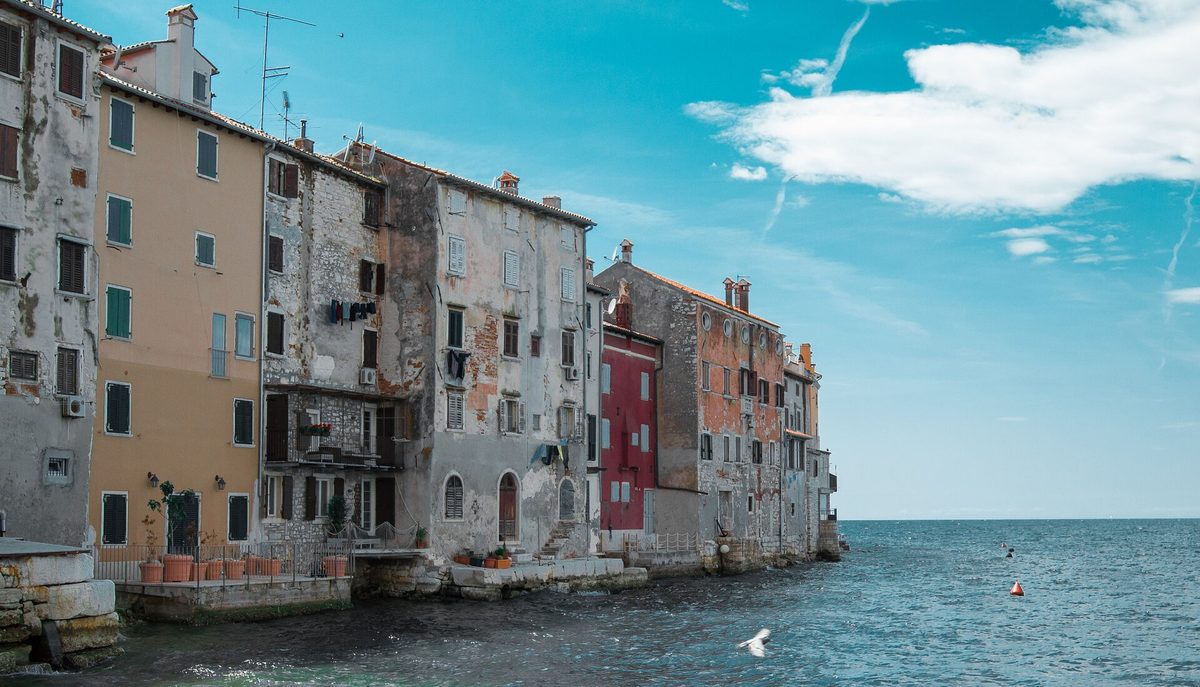
- Rovinj old town rising straight out of the Adriatic in Istria, Croatia · Rovinj, Istria · Photo: Nils Söderman (CC0)