Greece Itinerary: The Best 7, 10 and 14-Day Routes
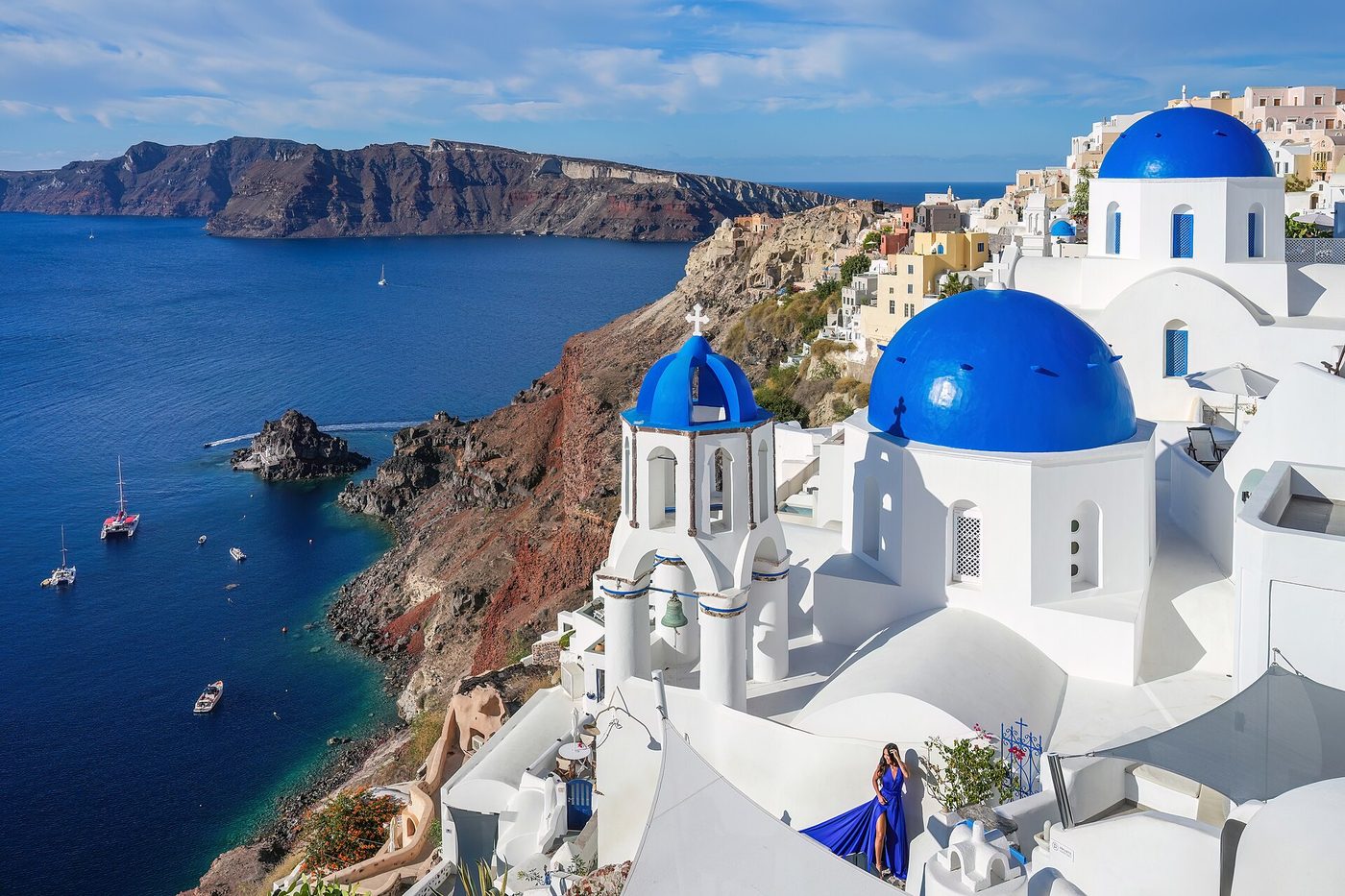
The first Greece itinerary I ever wrote, back in 2011, had six islands on it in twelve days. I was proud of it. It was a disaster. We spent four of those days sitting in ports, I saw more ferry waiting rooms than churches, and by the time we reached Milos I could not have told you which island I had woken up on. Every trip I have planned since has been an argument with that version of myself.
A good Greece itinerary is mostly a subtraction problem. Greece has around 6,000 islands and islets, roughly 227 of them inhabited, plus a mainland with Delphi, Meteora and the whole Peloponnese on it, all of which our Greece travel guide covers in more depth. You are not going to see it. The job is choosing two or three places that connect well, giving each of them enough nights to stop feeling like a transit stop, and knowing which ferry actually runs on the day you need it. If you are still deciding which islands, start with our guide to the best Greek islands and come back here to build the route.
The short answer: the best Greece itinerary for a first trip is 10 days split three ways, Athens for three nights, Naxos or Paros for three, Santorini for three, moving by ferry in that order and flying home from Santorini. Seven days works if you drop to two stops. Fourteen days lets you add the mainland loop or a third island without rushing.
What changed in Greece for 2026, and why it matters to your itinerary
Greece has had a busy two years of rule changes, and several of them will quietly break a route that looked fine last year. Read this section even if you skip the rest.
- The Athens combined ticket is gone. The €30 five-day pass that covered the Acropolis plus six other sites was discontinued on 1 April 2025. You now buy each site separately. Third-party resellers still advertise multi-site passes, and multi-site tickets survive at Olympia, Delphi, Mycenae and Aegae, but the classic Athens combo is not one of them.
- The Acropolis runs on timed entry with a hard cap. Twenty thousand visitors a day, allocated in hourly slots, 3,000 admitted between 08:00 and 09:00 and 2,000 between 09:00 and 10:00. You choose a one-hour window when you book on the official platform, hhticket.gr. In peak summer the site sells out roughly a week ahead and the first slot goes weeks in advance.
- Santorini has active Civil Protection restrictions. Announced 28 April 2026 and in force until 31 March 2027, they close the Ammoudi to Agios Nikolaos trail, restrict the Old Port of Fira, ban vehicles on the Ammoudi road and control traffic at Athinios. The cable car and the Fira to Old Port path are explicitly not restricted. Full detail further down.
- There is no direct train to Meteora. The Palaiofarsalos to Kalambaka line has been closed since the 2023 flood damage and is suspended until at least mid-2027. Any itinerary that puts you on an Athens to Kalambaka train is describing a service that does not exist.
- The EU Entry/Exit System is live. EES became fully operational across the Schengen Area on 10 April 2026. Fingerprints and a facial scan replace the passport stamp at Athens airport. ETIAS is not required, and as of late September 2026 it has no start date; trade reports point to 2027.
- Two taxes that will reach your bill. A climate resilience fee of €0.50 to €15 per room per night depending on your accommodation and the season, and, if you arrive by cruise ship, a €20 per-passenger levy at Santorini and Mykonos between 21 July and 30 September.
Every Greece itinerary in this guide at a glance
Six routes. Nights rather than days, because nights are what you book and days are what people miscount.
| Itinerary | Nights | Route shape | Moves | Best for | Season it works |
|---|---|---|---|---|---|
| The classic 10 days | 9 | Athens 3 → Naxos 3 → Santorini 3 | 2 | A first trip to Greece, with a mix of ruins, a real working island and the caldera | Late April to late October |
| Seven days, two stops | 6 | Athens 3 → Santorini 3 | 1 | A week off work, or a Greece leg bolted onto a longer European trip | April to October |
| Ten days, Crete instead of the Cyclades | 9 | Athens 2 → Chania 4 → Heraklion 3 | 2 | Drivers, hikers, food travellers and anyone who wants one island rather than three | April to early November |
| Ten days, mainland only | 9 | Athens 3 → Delphi 1 → Meteora 2 → Nafplio 3 | 3 | Shoulder season, winter, ancient history, and anyone who dislikes boats | Year-round, best March to May and October to November |
| Fourteen days, three islands | 13 | Athens 3 → Paros 3 → Naxos 3 → Santorini 4 | 3 | Beach-first trips, second visits, and travellers who want to swim every day | Late May to early October |
| Fourteen days, mainland and islands | 13 | Athens 3 → Nafplio 2 → Meteora 2 → Naxos 3 → Santorini 3 | 4 | The most complete picture of Greece you can get in two weeks | May, June, September and early October |
How many days do you actually need in Greece?
Two numbers govern every Greece itinerary. The first is that a “10-day trip” is nine nights, and your arrival and departure days are rarely full days. The second is that every destination needs a minimum of two nights before it stops being a photograph and starts being a place. The single exception I make is Delphi, which works as an afternoon and an early morning. Do the arithmetic and 10 days gives you three stops, comfortably. Four stops is possible and I would not do it.
Here is how the days ladder up in practice:
- Five days. One island, or Athens plus one very close island. Do not island-hop.
- Seven days. Two stops. Athens and one island, or two islands if you fly into one and out of the other.
- Ten days. Three stops, or four if one of them is a single night. This is the first length where Greece stops feeling compressed.
- Fourteen days. Four or five stops, or three with real breathing room and a day trip or two. Four islands in two weeks turns too much of the holiday into transportation, which is a different problem from four stops.
- Twenty-one days. Mainland and islands together, or two island groups, or Crete properly.
My honest view: if you have seven days and you are agonising over whether to squeeze in a third island, do not. The night you save is worth more than the island you add, because on a short trip a single cancelled ferry costs you a disproportionate share of the whole holiday. That is not a hypothetical. The meltemi wind blows through the Cyclades from June to September and cancels fast ferries at around 8 Beaufort.
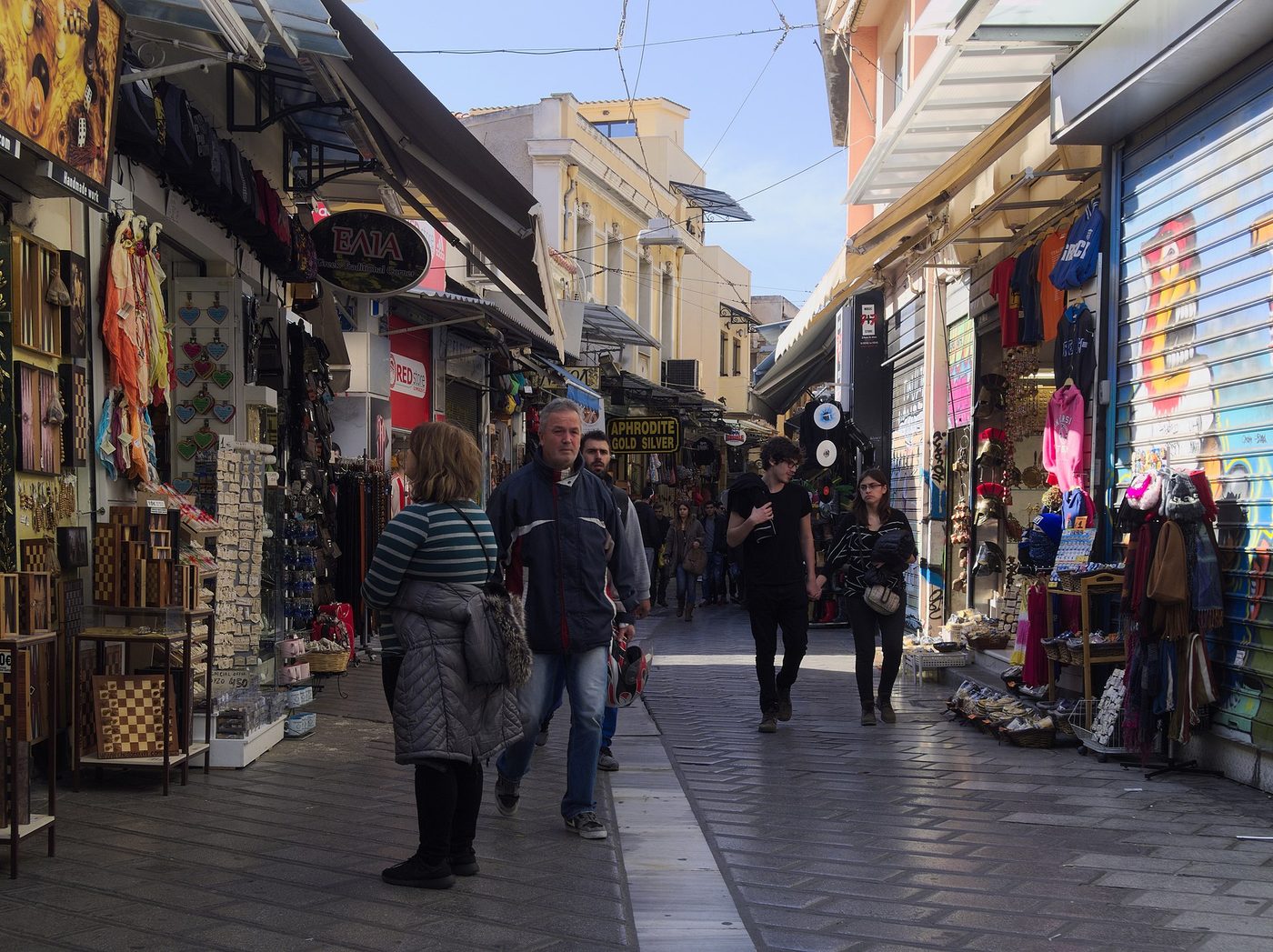
The 10-day Greece itinerary, day by day
This is the route I recommend more than any other, and it is also roughly the consensus among the guides that know Greece well: Athens for three nights, a mid-sized Cycladic island for three, Santorini for three, in that direction. Athens first, because you land there anyway and jet lag is better spent on ruins than on a beach. Santorini last, because it has flights home and because the caldera is a better final image than an airport hotel.
Why Naxos and not Mykonos. Naxos has a proper town, a mountain interior with villages that are not tourist constructions, the best beaches in the group for families, and a food culture that exists independently of visitors. It also costs a fraction of what Mykonos and Santorini cost. If your priority is nightlife or a specific beach club, swap it for Mykonos and accept the bill. If you want fewer people and a shorter ferry from Athens, take Paros instead. Our roundup of the best Greek islands to visit walks through the alternatives properly.
Days 1 to 3: Athens
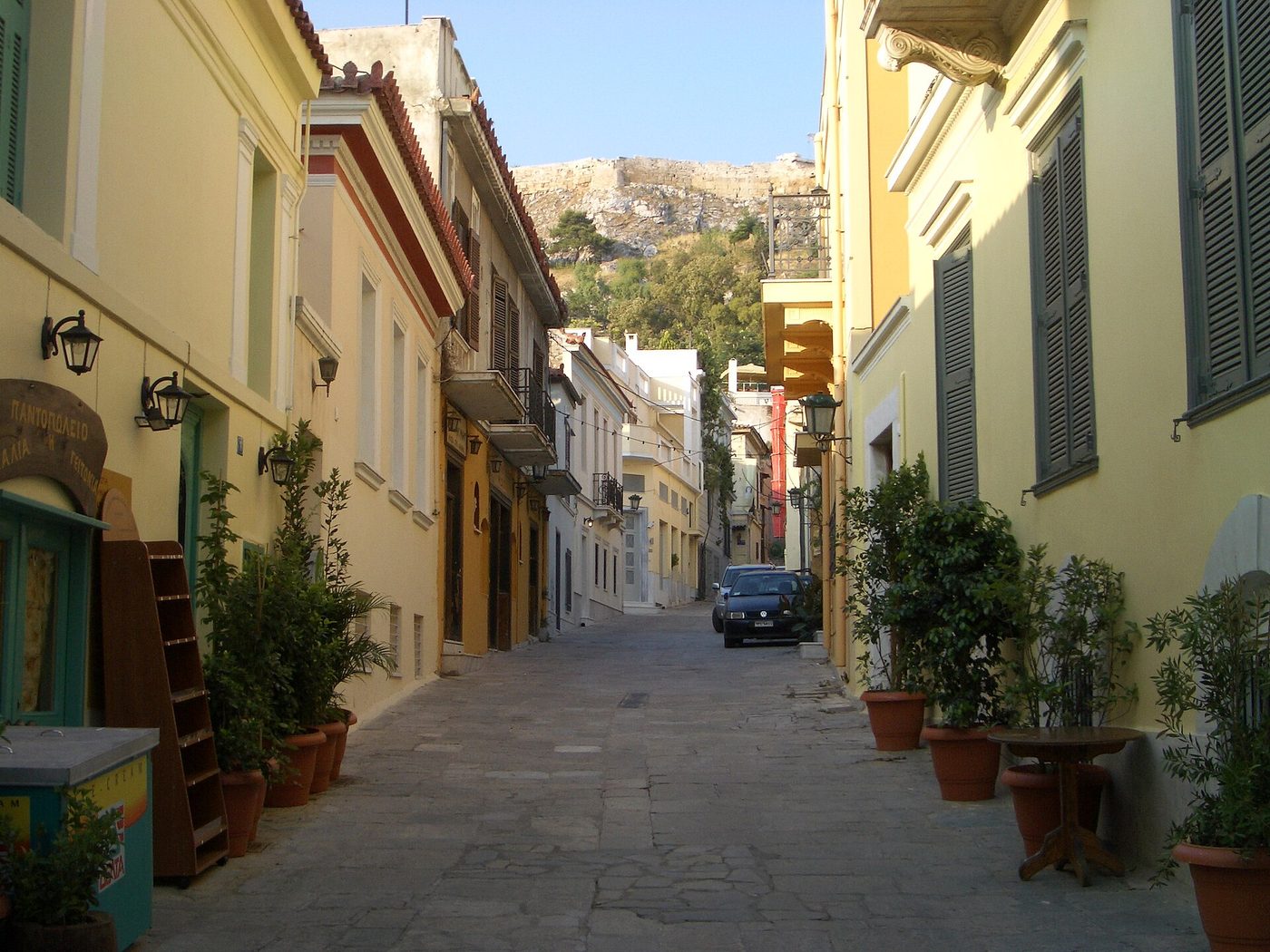
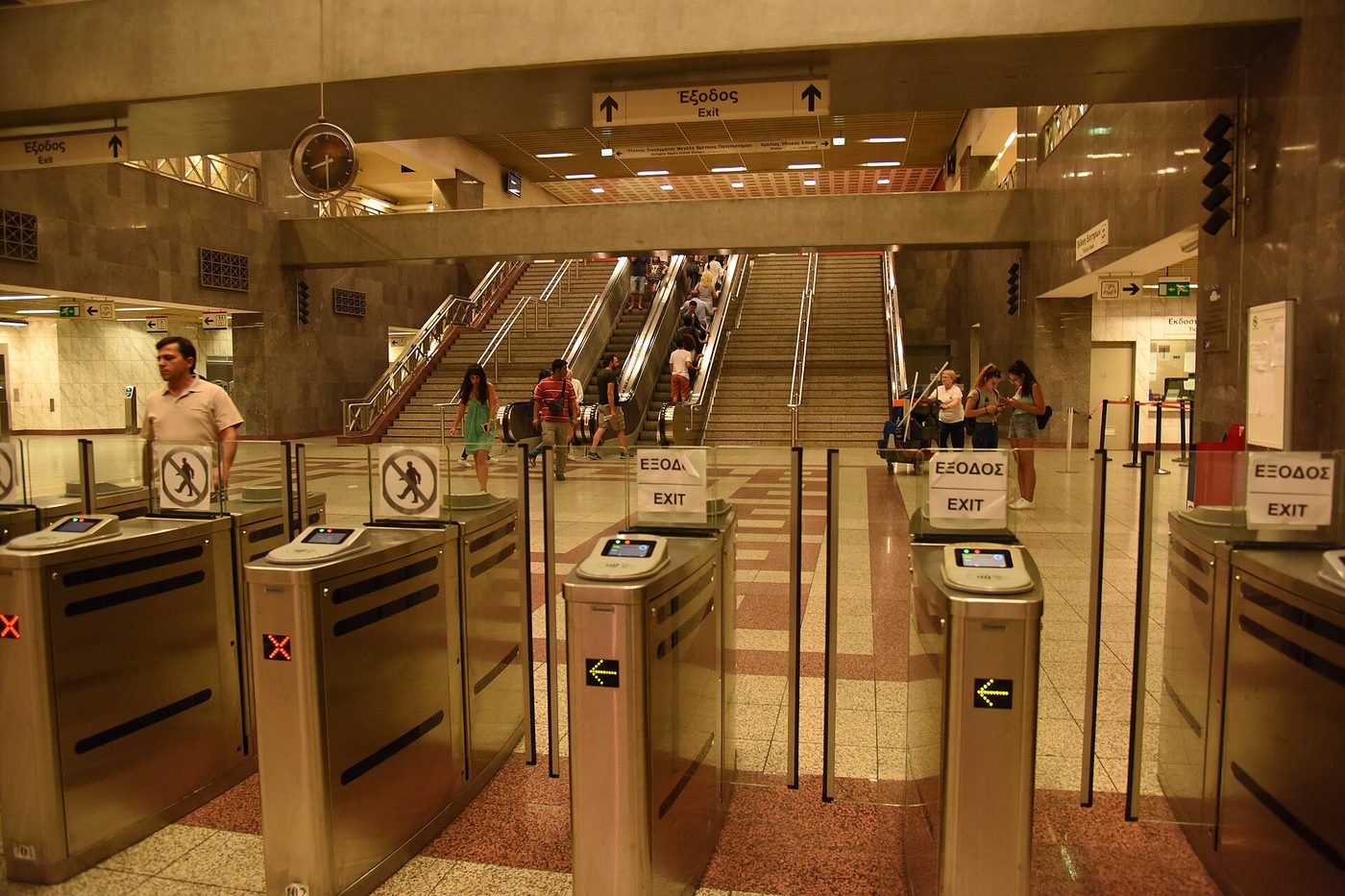
Day 1. Land at Athens International, take the Line 3 metro into town, about 40 minutes to Syntagma for €9, or the X95 bus for €5.50 in around an hour if you land outside metro hours. The metro runs roughly 06:30 to 23:30; the bus runs 24 hours, which is the only reason to choose it. Check in, then walk. Plaka and Anafiotika in the late afternoon, dinner in Psyrri or Koukaki. Do not attempt the Acropolis on a travel day.
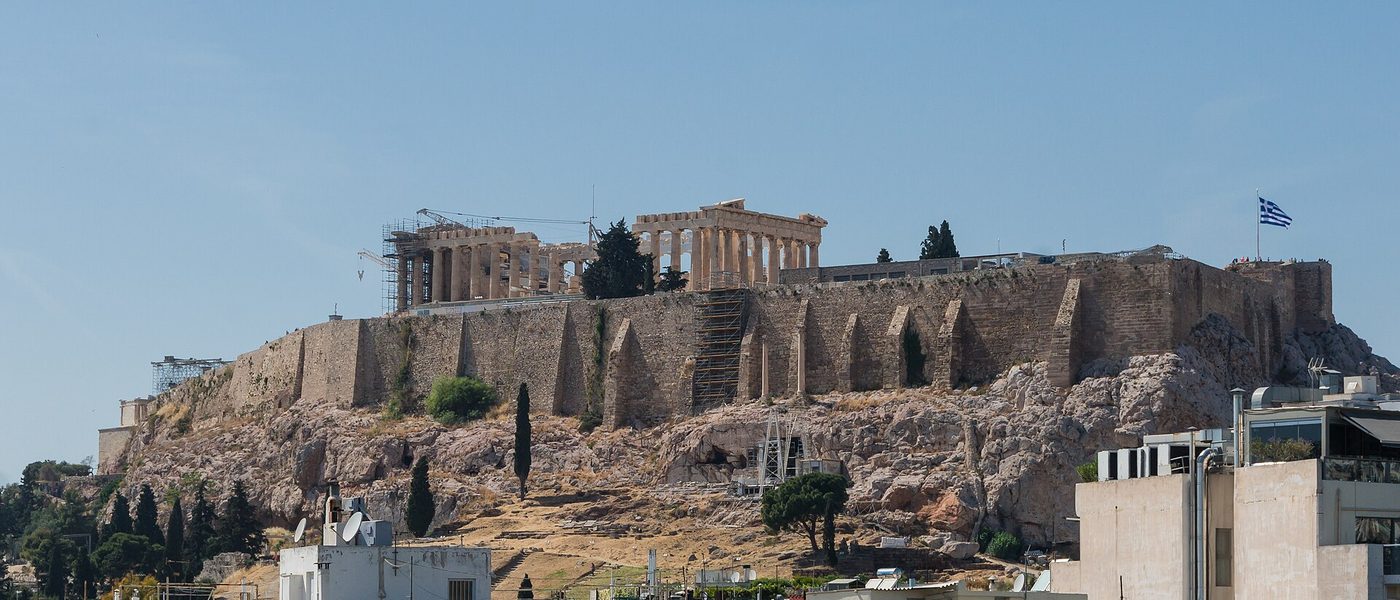
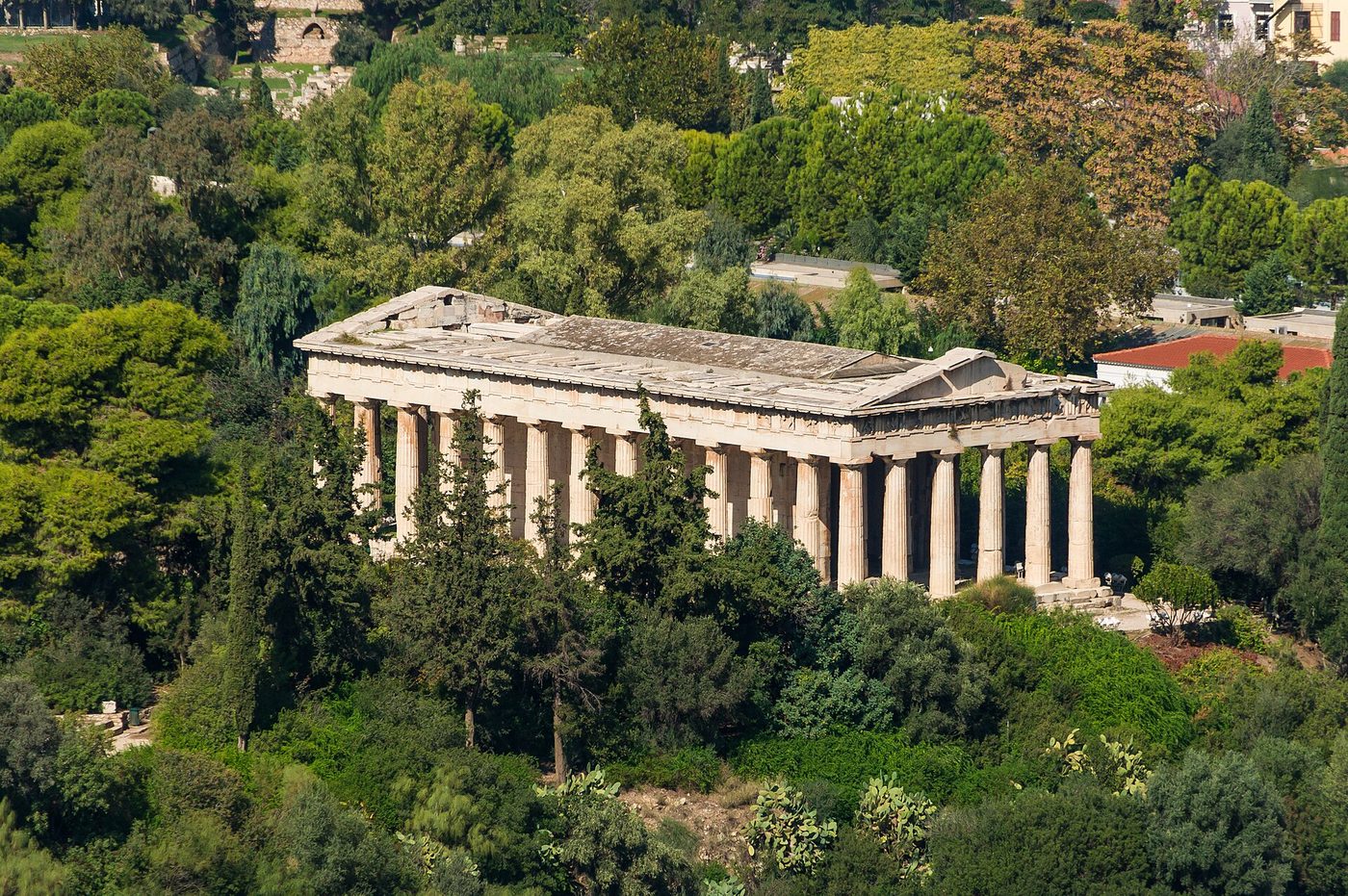
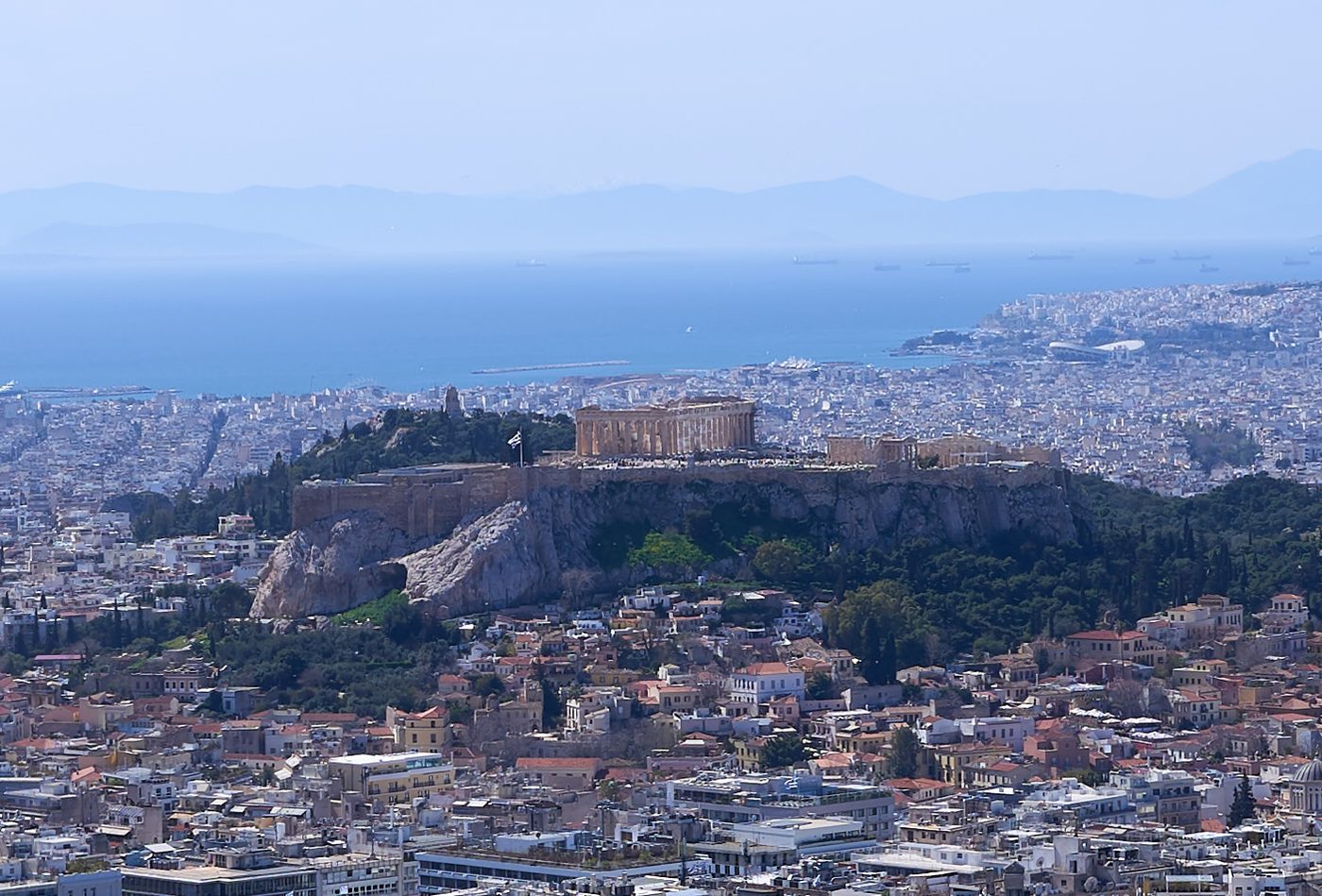
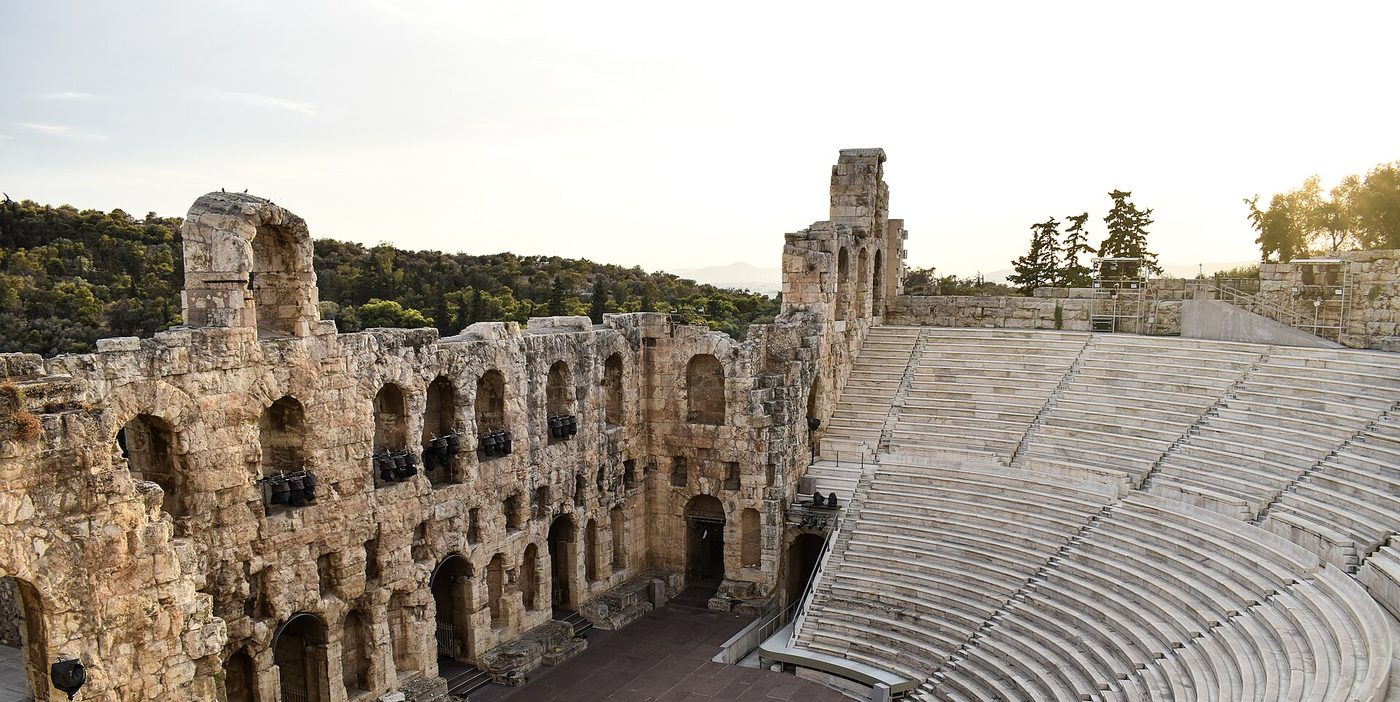
Day 2. Acropolis at 08:00, booked weeks ahead, no exceptions in summer. You are on the rock before the cruise groups and before the marble starts radiating heat. Come down through the south slope past the Odeon of Herodes Atticus, then the Acropolis Museum, which is where the sculptures live and which is air-conditioned. Afternoon: the Ancient Agora and the Temple of Hephaestus, the best-preserved Doric temple in Greece and consistently the quietest good thing in central Athens. Sunset from Lycabettus or from a rooftop bar in Monastiraki. Our things to do in Athens guide has the full list.
Day 3. The National Archaeological Museum in the morning, which holds one of the great collections of the ancient world. Afternoon options, pick one: the coast at Vouliagmeni for a swim, Cape Sounion for the Temple of Poseidon at sunset, or the Stavros Niarchos park and the Varvakios market if you want the modern city instead. Buy your ferry tickets before bed if you have not already.
Days 4 to 6: Naxos
Day 4. Morning ferry from Piraeus. Blue Star’s direct sailing is around 5 hours 20 minutes; a high-speed catamaran does it in about 3 hours 15. Fares start around €43. Take the conventional ferry if you get seasick, because the big Blue Star vessels are far more stable and the deck is a pleasure. Afternoon in Naxos Chora, up through the Venetian kastro, out to the Portara at sunset.
Day 5. Rent a car and cross the island. Chalki for the old distillery and the Byzantine churches, Filoti and Apiranthos in the mountains, the kouros of Flerio lying unfinished in a garden where a sculptor abandoned it 2,500 years ago. Swim at Plaka or Agios Prokopios on the way back. Naxos car hire runs from roughly €24 a day in March to around €79 in August.
Day 6. Beach day, or a boat to the Small Cyclades. Koufonisia and Iraklia are €6 to €8 per person from Naxos and are as close to the Greece of forty years ago as you will get this easily.
Days 7 to 10: Santorini, and home
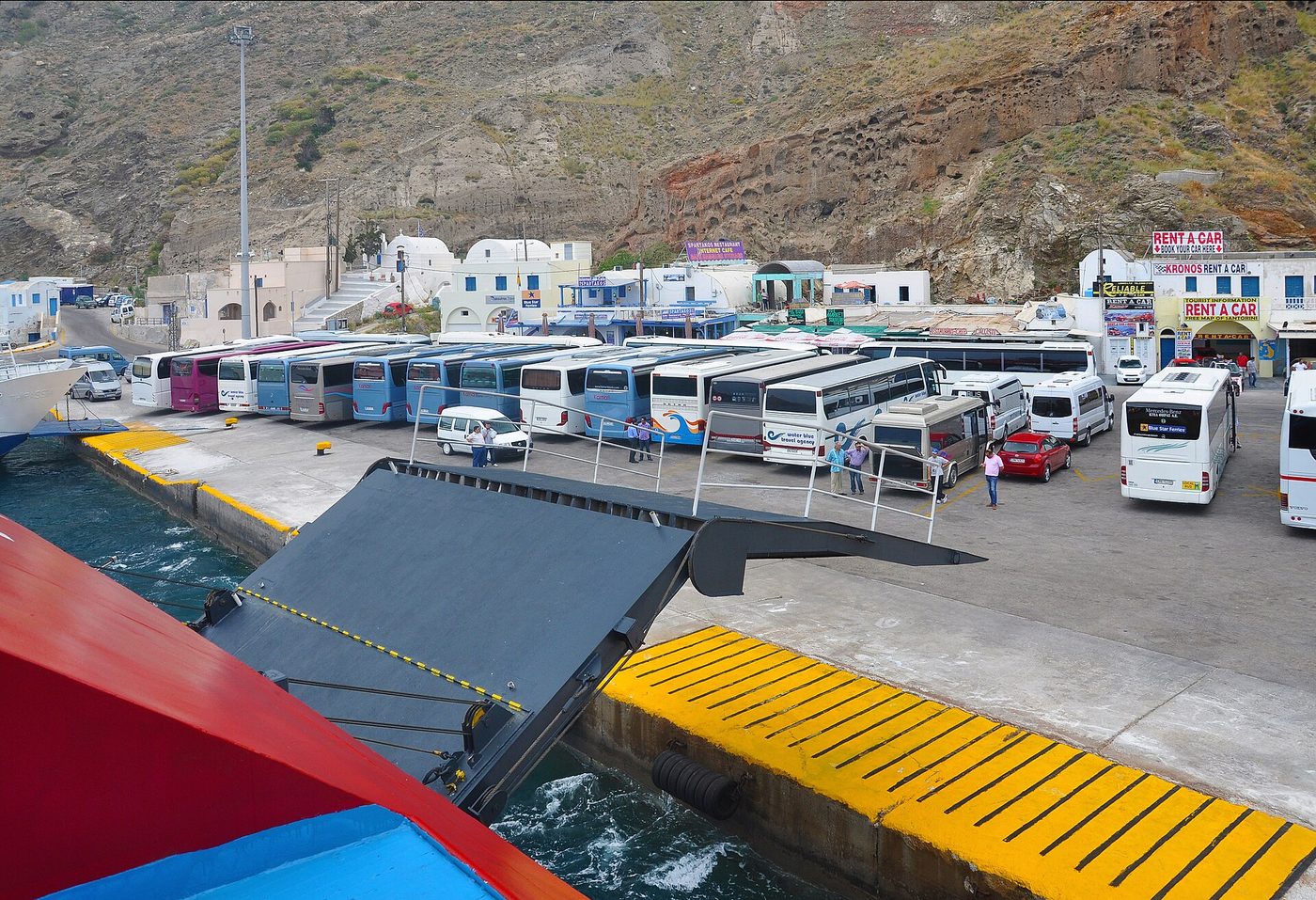
Day 7. Ferry to Santorini, 1 hour 5 minutes to 2 hours 45 minutes depending on the vessel, from around €31.50. You arrive at Athinios, which is a chaotic slot of concrete under a cliff and now has traffic controls under the 2026 measures. Arrange your hotel transfer in advance. Afternoon: settle in Imerovigli or Firostefani rather than Oia, because you get the same caldera and half the crowd. Sunset from wherever you are standing.
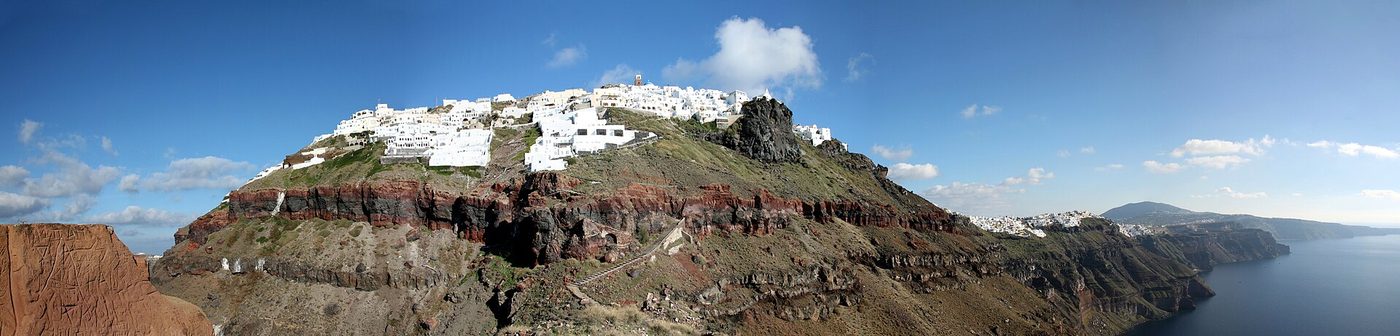
Day 8. The Fira to Oia hike, 10 km along the caldera rim, 2 to 3 hours of walking and realistically 3 to 5 with stops. Start at first light in summer; the last 4 km from Imerovigli is rocky, exposed and has no shade. Afternoon: recover. Evening in Oia, arriving early, because the sunset crowd there is a genuine crush.
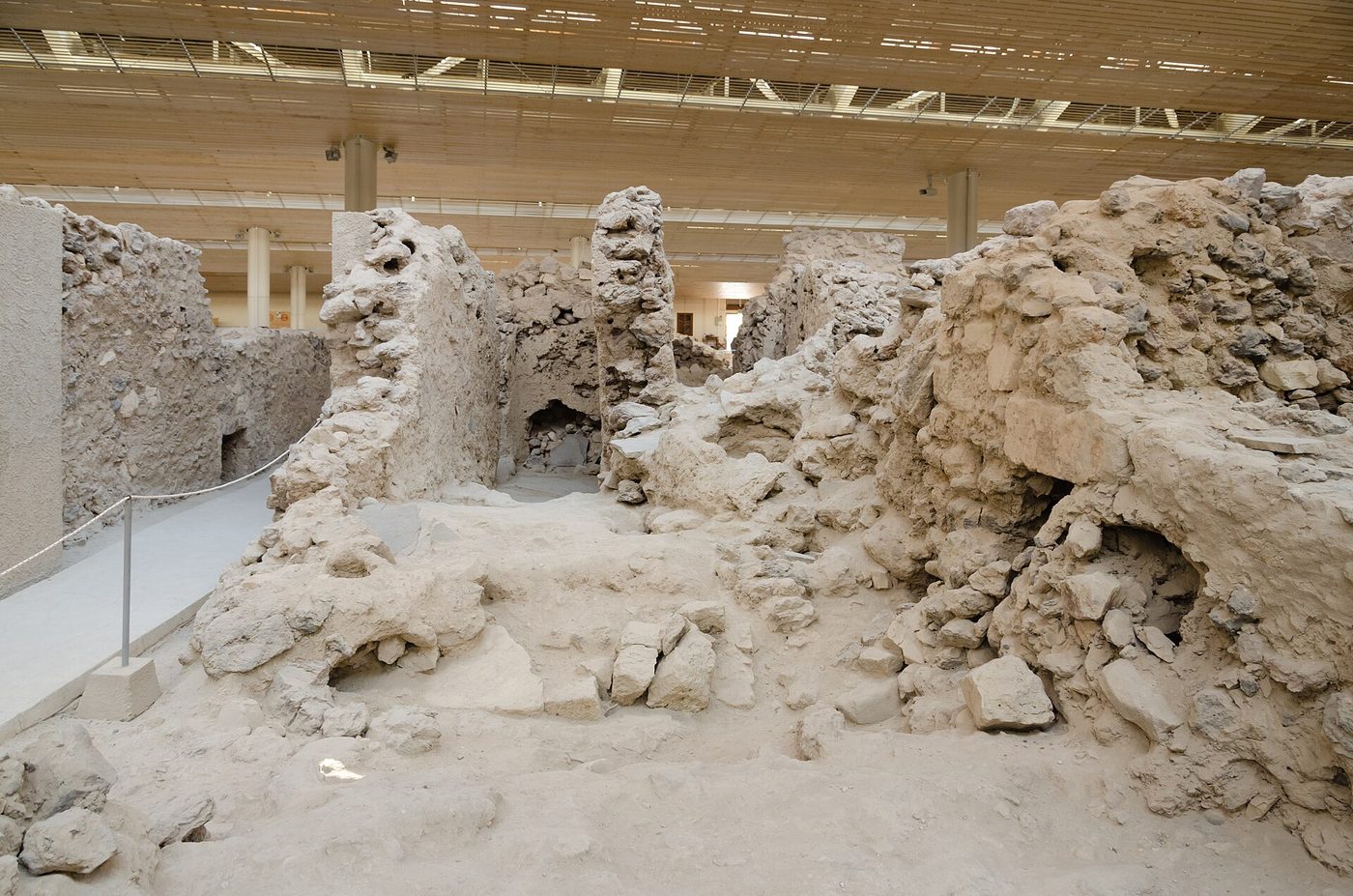
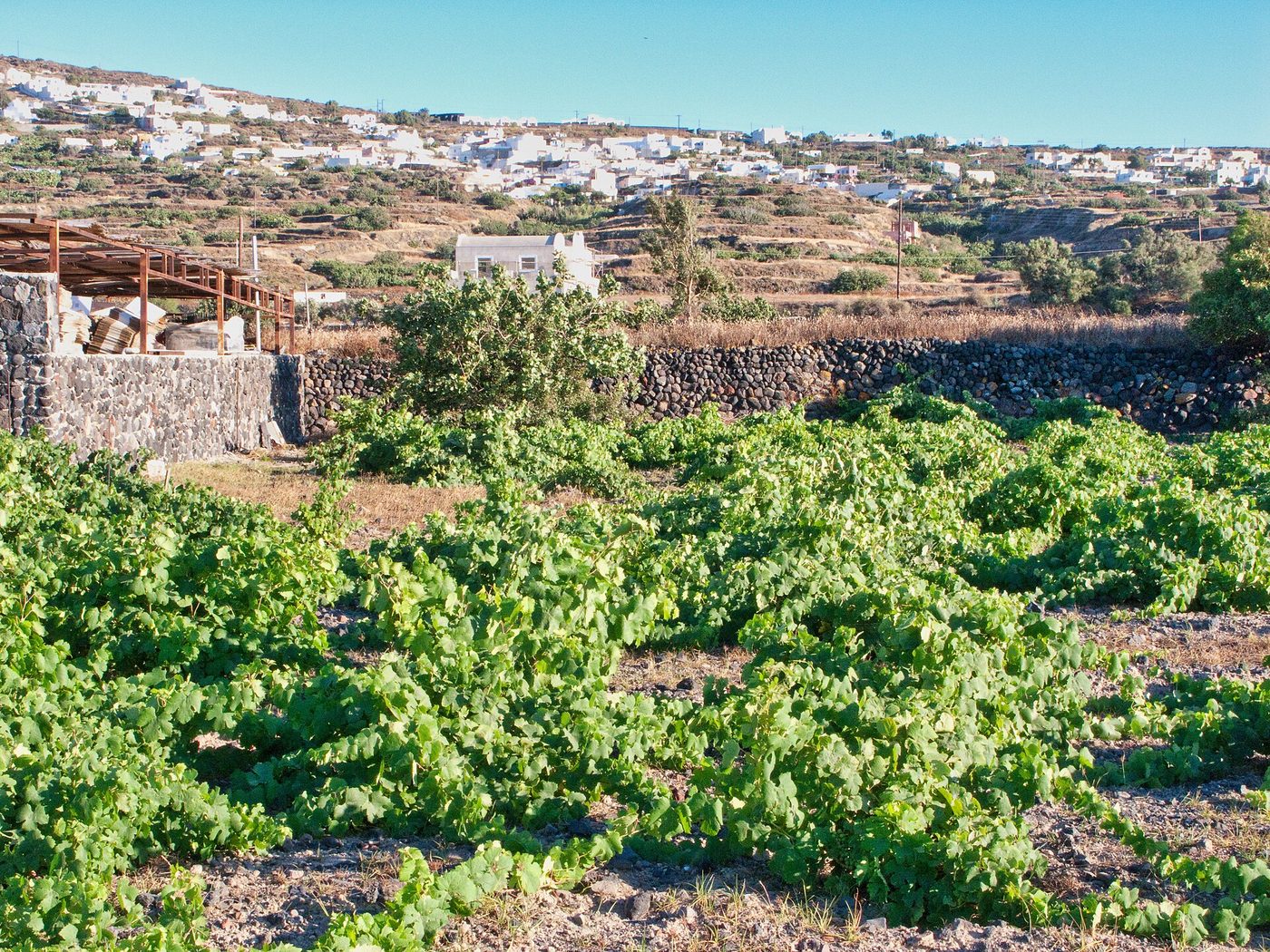
Day 9. Akrotiri in the morning, €20, a Bronze Age town buried by the eruption and roofed over, and the single most interesting thing on the island. Then the Museum of Prehistoric Thera in Fira for €10 to see what came out of it. Afternoon: a caldera boat trip to Nea Kameni and the hot springs, or a winery in the middle of the island where the vines are trained into baskets on the ground against the wind. The Santorini travel guide goes village by village.
Day 10. Fly home from Santorini. The airport has Athens connections plus seasonal direct flights to a number of European cities, which saves you the backtrack.
The one rule I will not bend: do not plan a same-day ferry into an international departure from Athens. If your flight leaves Athens, sleep in Athens the night before. Fast ferries cancel in the meltemi, the return leg from the Cyclades is the most exposed one, and there is no version of that story that ends well.
The 7-day Greece itinerary: two stops, no heroics
Seven days is six nights. Split it three and three, Athens then Santorini, and travel between them by ferry if you want the sea day or by plane if you want the time. The 45-minute flight costs more than the ferry but buys back most of a day.
- Nights 1 to 3, Athens. Day one Plaka and dinner. Day two Acropolis at opening, Acropolis Museum, Ancient Agora. Day three either the National Archaeological Museum and a swim at Vouliagmeni, or a day trip to Delphi.
- Nights 4 to 6, Santorini. Day four travel and settle. Day five the Fira to Oia hike and an Oia evening. Day six Akrotiri, a winery and a caldera boat.
- Day 7. Fly home from Santorini.
The better version, if you can face it. Swap Santorini for Naxos or Paros and the three island nights fall from perhaps €200 to nearer €110, which takes roughly a quarter off the cost of the whole week. You also get better beaches, no queues and a working town rather than a viewing platform. It slots neatly into a wider 7-day Europe itinerary if Greece is one leg of something bigger. What you lose is the caldera, and for a great many people the caldera is the reason they booked Greece at all. That is a perfectly good reason, and it earns its reputation.
The 14-day Greece itinerary: two ways to spend it
Fourteen days, three islands
Athens 3 nights, Paros 3, Naxos 3, Santorini 4. Thirteen nights, three ferries, and the longest single crossing is under six hours. Paros to Naxos is the shortest useful hop in the Cyclades at 25 to 30 minutes on a high-speed, which means you barely lose a morning. Paros gives you Naoussa and Parikia, a lively harbour scene and good windsurfing; Naxos gives you the mountains and the food; Santorini gives you the finish. Four nights on Santorini is one more than most people need, but it lets you do Akrotiri, the hike, a boat trip and a beach day without feeling like you are ticking things off.
Fourteen days, mainland and islands
Athens 3, Nafplio 2, Meteora 2, Naxos 3, Santorini 3. This is the itinerary I would choose for myself, and it maps closely onto how our 2 weeks in Europe itinerary handles a single country. You hire a car in Athens for the mainland loop, drive back from Meteora on day eight, drop the car, and take the ferry out of Piraeus the next morning. Budget that Meteora to Athens leg properly: it is around four and a half hours of driving and it is the one seam in this route.
- Nafplio is the prettiest small city in Greece, sits under two Venetian fortresses, and puts Mycenae and Epidaurus within a half-day each. The drive from Athens is about 139 km and just under two hours, taking the A8 to Corinth and then the A7, crossing the Isthmus on the way. Stop at the canal; ten minutes, well spent.
- Meteora is six working monasteries balanced on sandstone pillars, and it is the one place in Greece that reliably silences people. Between April and October each monastery closes one day a week and all six open on Saturday and Sunday. Admission is €5 per monastery, cash at the door. Two of the six in a day is plenty. It is one of the most beautiful places in Europe by any measure.
- Getting to Meteora is the catch. There is no through train. The Palaiofarsalos to Kalambaka section has been closed since the 2023 floods and is suspended for the foreseeable future, so the rail option is an intercity train from Athens Larissa Station, a change at Palaiofarsalos and a replacement bus via Karditsa and Trikala, roughly five to six hours each way with two transfers. Drive or take the direct KTEL coach instead.
The 10-day mainland Greece itinerary, for people who do not want boats
Athens 3, Delphi 1, Meteora 2, Nafplio 3. Nine nights, all of it drivable, and it works in months when the islands do not. In March, or November, when most island hotels and restaurants are shut and ferry schedules thin out, this is the itinerary that still functions.
Delphi is 153 km from Athens by road, around 2 hours 30 minutes to drive, or roughly 3 hours on the KTEL bus from Liossion station at about €15.10 one way. The site and museum together are €12. Going as an overnight rather than a day trip is the single best upgrade available on the mainland: the ancient Greeks placed the oracle where they did because of what the light does to that valley in the early morning, and day-trippers never see it.
Rick Steves has a good priority ladder for mainland Greece that runs roughly: two to three days for Athens, add Hydra at five days, Delphi at seven, Nafplio with Epidaurus and Mycenae at ten, Olympia and Monemvasia at twelve, and Kardamyli and the Mani at fourteen. If you have more than ten days on the mainland, follow it.
The 10-day Crete itinerary, if you would rather do one island properly
Athens 2 nights, Chania 4, Heraklion 3. Fly Athens to Chania in about 55 minutes, or take the overnight ferry to Souda in around 8 to 9.5 hours, mostly with ANEK Lines, departing around 20:00 to 21:00. Sleep on the boat and you save a hotel night. Chania to Heraklion is a 145 km drive along the north coast, a little over two hours, and you keep the same hire car.
Our full Crete travel guide covers the regions, costs and drive times. Crete is not an island in the Cycladic sense; it is a small country with its own dialect, a mountain range you can ski on in April and swim under in the afternoon, and food that is better than anywhere else in Greece. Elafonisi and Balos both make our list of the best beaches in Europe. Chania’s Venetian harbour is the base for the west: Balos, Elafonisi, the Samaria Gorge. Heraklion covers Knossos at €20, the archaeological museum, and the wine country south of the city. You need a car; rates at Chania average around €27 a day, with in-season quotes running from roughly €50 for a compact to close to €100 for an automatic SUV.

Greek ferries: the numbers your itinerary depends on
This is the part that decides whether a Greece itinerary works. Ferry routes in Greece are not a network so much as a set of spokes out of Athens with a few useful crossbars between islands, and the crossbars only exist where the traffic justifies them. Mykonos to Paros, Paros to Naxos, Naxos to Santorini, Paros to Santorini and Santorini to Crete are the reliable direct hops. Almost everything else routes back through Piraeus.
Athens has three ferry ports. Piraeus is the main one, has the widest choice and runs year-round. Rafina is closer to the airport and is quicker to Mykonos, Tinos, Andros and Naxos, which makes it the smart choice on an arrival day. Lavrio is small and mostly serves the western Cyclades.
| Route | Crossing time | Summer frequency | One-way fare from | Main operators |
|---|---|---|---|---|
| Piraeus → Santorini | 5 hr 00 min to 9 hr 10 min | Up to 8 daily | From approx. €46 | Blue Star, SeaJets, Fast Ferries |
| Piraeus → Mykonos | 2 hr 40 min to 5 hr 50 min | Up to 5 daily | From approx. €44 | Blue Star, SeaJets, Fast Ferries |
| Rafina → Mykonos | Varies by vessel | Up to 12 daily | From approx. €38 | Fast Ferries, Golden Star, SeaJets |
| Piraeus → Paros | 2 hr 40 min to 5 hr 00 min | Up to 7 daily | From approx. €41 | Blue Star, SeaJets |
| Piraeus → Naxos | 3 hr 15 min to 5 hr 20 min | Up to 7 daily | From approx. €43 | Blue Star, SeaJets |
| Rafina → Naxos | Varies by vessel | Up to 3 daily | From approx. €43 | Fast Ferries, Golden Star |
| Piraeus → Milos | 3 hr 00 min to 7 hr 00 min | Up to 6 daily | From approx. €42 | SeaJets and conventional operators |
| Piraeus → Syros | Varies by vessel | Up to 6 daily | From approx. €37 | Blue Star, Fast Ferries |
| Rafina → Tinos | Varies by vessel | Up to 12 daily | From approx. €30 | Fast Ferries, Golden Star |
| Rafina → Andros | Varies by vessel | Up to 11 daily | From approx. €25 | Fast Ferries, Golden Star |
| Piraeus → Heraklion, Crete | 7 hr 20 min to 13 hr 00 min | Up to 5 to 6 daily | From approx. €33 | Minoan, SeaJets, ANEK, Blue Star |
| Piraeus → Chania, Crete | Approx. 8 hr to 9 hr 30 min, overnight | 1 to 2 daily | Reported from approx. €37 to €52 | Mainly ANEK Lines |
| Piraeus → Rhodes | Varies by vessel | 1 to 2 daily | From approx. €46 | Blue Star |
| Paros → Naxos | 25 to 30 min on a high-speed | 8 to 12 daily in summer | Conventional from approx. €8, high-speed nearer €15 | SeaJets, Blue Star, Fast Ferries |
| Naxos → Santorini | 1 hr 05 min to 2 hr 45 min | Up to 8 daily in summer, year-round | From approx. €31.50 | SeaJets, Blue Star, Golden Star |
| Paros → Santorini | 1 hr 30 min to 5 hr 40 min | Up to 8 daily in summer, year-round | From approx. €13 | SeaJets, Blue Star |
| Mykonos → Santorini | 1 hr 55 min to 3 hr 15 min | Up to 8 daily, approx. March to November | From approx. €82.50 | SeaJets, Golden Star, Fast Ferries |
| Naxos → Milos | 2 hr 30 min to approx. 6 hr | Up to 7 weekly | Varies by vessel | SeaJets and conventional operators |
| Santorini → Heraklion, Crete | 1 hr 35 min to 3 hr 00 min | Up to 3 daily, year-round | Conventional from approx. €15, high-speed from approx. €92 | Minoan, SeaJets |
| Naxos → Small Cyclades | Varies by vessel | Most days in summer | €6 to €8 | Small Cyclades Lines |
| Domestic flight | Flight time | Airlines | Frequency and fares |
|---|---|---|---|
| Athens → Santorini | Approx. 45 min | Aegean, Sky Express, Ryanair, Volotea | Multiple flights daily in season across four airlines |
| Athens → Mykonos | Approx. 30 min | Aegean, Olympic Air, Sky Express, Volotea | From approx. €40 one way, sells out in summer |
| Athens → Heraklion, Crete | Not published as a single figure | Aegean, Olympic Air, Sky Express | Fares from approx. €50, typically €50 to €67 |
| Athens → Chania, Crete | Approx. 55 min | Aegean, Olympic Air, Sky Express | Fares not published as a band |
| Athens → Rhodes | Approx. 1 hr 05 min | Aegean, Olympic Air, Sky Express | Fares not published as a band |
| Athens → Corfu | Approx. 1 hr 05 min | Aegean, Olympic Air, Sky Express | Fares from approx. €50 to €60 |
Ferry or fly?
Fly when the sea crossing is over five hours and the flight is under an hour, which in practice means Crete and Rhodes. Take the ferry everywhere in the Cyclades, because once you have added airport transfers, bag drop and the two hours before departure, a 45-minute flight to Santorini is not much faster than the fast ferry, and it is considerably less pleasant. Our guide to getting around Europe makes the same case for trains elsewhere on the continent.
Two things worth knowing before you book. The first is that fares in the table are the cheapest available seat, and a high-speed catamaran on the same route will typically run to roughly double the conventional fare. The second is that a catamaran in a swell is a genuinely unpleasant experience and the big Blue Star ships are not. If anyone in your party gets seasick, book the slow boat and take a book.
When to book, and how
For June through August, book ferries two to three months ahead. Santorini and Mykonos routes fill first, and the July peak is the hardest window to leave to chance. Outside those months you can usually book a week or two out, though shoulder months have fewer sailings and less slack if one is cancelled.
Blue Star and Hellenic Seaways now issue boarding passes straight to your email or phone as a PDF or a Wallet pass, available from 48 hours before departure down to two hours before, and a phone screen is accepted at the gate. That is a real improvement on the old paper-collection routine. It is not yet universal, though: I could not confirm that every Greek operator has dropped paper collection, so check the confirmation email for your specific ferry rather than assuming. Whatever the format, you board with a ticket and photo ID, and without a ticket you do not board. Keep both on your phone and a screenshot in your photos, which is the sort of thing our Europe travel tips page exists to nag you about.
What everything costs to get into: Greek site and museum tickets in 2026
Greece restructured its archaeological site pricing on 1 April 2025 into a five-tier model based on visitor numbers and cultural significance. The Acropolis sits alone at the top at €30. Two consequences follow: the old Athens combined ticket was abolished in the same reform, and combination tickets survive at only four sites, Olympia, Delphi, Mycenae and Aegae. Resellers do still advertise their own multi-site passes, which is a different product from the state combo and priced accordingly.
| Site | 2026 admission | How to book | Notes |
|---|---|---|---|
| Acropolis of Athens | €30 full, €15 reduced | Timed hourly slot, book on hhticket.gr | Sells out 5 to 7 days ahead in peak summer |
| Acropolis Museum | Reported between €10 and €20 | Book through the museum’s own e-ticket site | Sources conflict; the likeliest structure is a summer and a winter rate, see note below |
| Ancient Agora of Athens | €10 April to October, €5 November to March | Buy at the gate | Ticket includes the Agora museum |
| National Archaeological Museum, Athens | €20 | Buy at the gate or online | New fee applying from 2026 |
| Delphi, site and museum | €12 | Combination ticket still available here | One of four sites that kept a combined ticket |
| Ancient Olympia, site and museum | €12 | Combination ticket still available here | Peloponnese, needs a car or a tour |
| Mycenae | €12 summer, reduced in winter | Buy at the gate | Half-day from Nafplio |
| Epidaurus theatre | €12 | Buy at the gate | Half-day from Nafplio |
| Knossos, Crete | €20 full, €10 reduced | Book ahead in summer | 20 minutes from Heraklion |
| Ancient Akrotiri, Santorini | €20 | Buy at the gate or online | Daily 08:00 to 20:00, Mondays and Thursdays 08:30 to 15:30 |
| Museum of Prehistoric Thera, Fira | €10 | Buy at the gate | Closed Tuesdays, otherwise 08:30 to 15:30 |
| Santorini three-site package | €15, valid 3 days | Buy at any of the three sites | Covers Akrotiri, Ancient Thera and the Prehistoric Thera museum |
| Meteora monasteries | €5 per monastery | Cash only, paid at the entrance | Each closes one day a week April to October |
Two honest caveats on that table. The Acropolis Museum’s own website is JavaScript-rendered and would not give me a price, and secondary sources report €20, €15 and €10 for the standard adult ticket. Buy through the museum’s e-ticket site and take the price it shows you. Separately, sources disagree on winter Acropolis pricing: one says the 50 per cent low-season discount was abolished in the same April 2025 reform, making €30 flat year-round, another says the €15 reduced rate applies to everyone from 1 November to 31 March. If you are travelling in winter, check hhticket.gr rather than trusting either.
One curiosity in the Santorini pricing that appears to be real: the €15 three-site package is cheaper than the €20 Akrotiri single ticket. If that still holds when you visit, buy the package even if Akrotiri is the only thing you want.
Booking the Acropolis, which is the one thing you cannot improvise
The daily cap is 20,000 visitors, allocated in hourly slots. Three thousand people go in between 08:00 and 09:00, two thousand between 09:00 and 10:00, and the quota keeps shifting through the day. You pick a one-hour entry window when you book, and you must be there in it.
Book on hhticket.gr, the official platform. In June, July and August the site sells out five to seven days ahead and the 08:00 slot fills weeks in advance, so treat it like a flight rather than a museum. Early-morning and late-evening slots covering roughly 07:00 to 09:00 and 20:00 to 22:00 were added to spread the load; take one if it is offered, because the difference between the rock at 08:00 and the rock at noon in August is the difference between an experience and an endurance test.
There is also, if you have €5,000 spare, a private Acropolis visit for up to five people outside opening hours, at 07:00 or 20:00 on Tuesdays, Fridays and Saturdays, run by the Ministry of Culture with up to four groups on the rock at once. It has been operating since 2024 and was still being offered in mid-2026. The site guards’ union opposes it. I mention it because people ask, not because I would spend the money.
Admission is free on 6 March, 18 April, 18 May, the last weekend in September for European Heritage Days, 28 October, and on the first and third Sundays from November through March. Free days are also the most crowded days by a wide margin. If timing around crowds matters to you, our guide to the least crowded time to visit Europe is worth a read before you fix dates.
Santorini in 2026: what is restricted, what is fine, and whether to go
If your Greece itinerary includes Santorini, and most do, this section is the one to read carefully. It is also the thing no page-one itinerary guide currently mentions.
What happened
Seismic activity surged northeast of Santorini from 31 January 2025. Around 28,000 tremors were recorded and a state of emergency was declared. The cause, per UNESCO, was a magmatic dike intrusion, magma moving sideways through the crust at depths beyond 10 km. No eruption occurred and the magma never reached the surface. As of March 2026, monitoring by GEOMAR’s underwater instruments at the Kolumbo crater recorded only negligible micro-seismic activity.
The island is open. Hotels operate, ferries run, and no government has issued an advisory against visiting. Tourism took a real hit in 2025, with airline seats down 26 per cent between January and June, and has been recovering since; January 2026 showed a 19 per cent rebound and caldera hotels have held their rates.

The restrictions actually in force
On 28 April 2026 the Civil Protection authorities announced a set of measures that run until 31 March 2027 and can be revised at any time after a fresh committee assessment. In plain terms:
- The Old Port of Fira and the upper areas around it are a restricted zone. Visitors are prohibited from entering.
- The cable car and the Fira to Old Port path are not restricted. The measures say so in as many words, which matters because the cable car is how most people get up from the port. That bullet and the one above it sit oddly together and both come from the same announcement; the reading that makes sense on the ground is that the restricted zone covers the unstable cliff slopes above the port rather than the transit route through it. Ask at your hotel when you arrive.
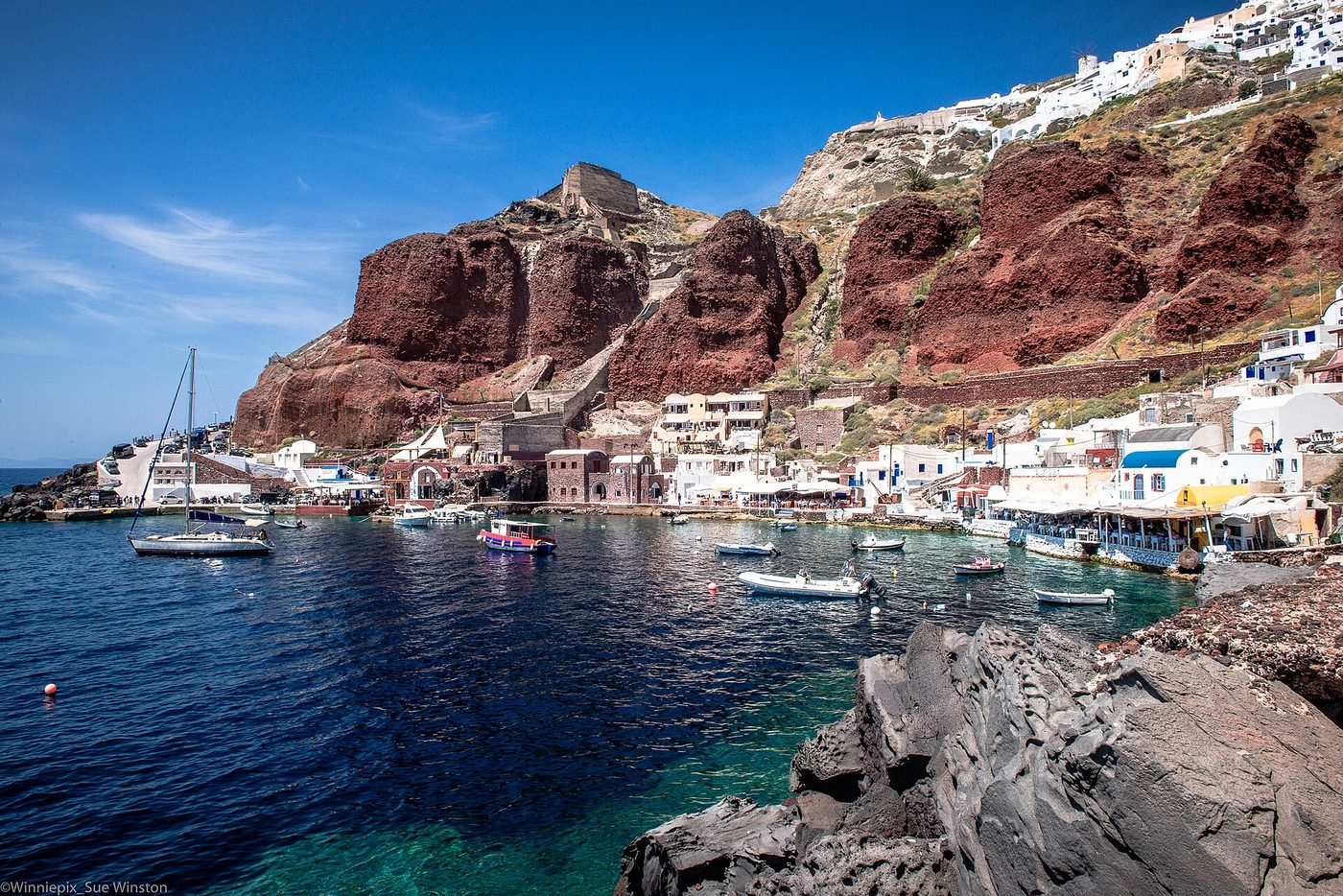
- The road to Ammoudi from the Oia ring-road junction is closed to vehicles, apart from a limited number of passenger vehicles run by the Municipality of Thira. You can still reach Ammoudi; you cannot drive yourself there.
- The Ammoudi to Agios Nikolaos hiking route is closed. Access is no longer permitted.
- Athinios Port has traffic controls on the port and its road network, to cut congestion and vehicle dwell time during arrivals and departures. Arrange a transfer in advance rather than turning up expecting a taxi.
- A prohibited-stay map has been issued, barring people from remaining in specified high-risk areas of the island during tremors.
Separately from the seismic measures, Red Beach is officially classed as unsafe because of rockfall and landslide risk. The cliff path has been closed repeatedly, with major rockfalls in 2018, 2023 and December 2025, and parts remain officially restricted. Hotels and operators are asked to discourage the cliff walk. You can reach the beach by boat from Akrotiri harbour instead, roughly €5 to €8 for a ten-minute trip.
So should you go?
Yes, with the caveat that I would read the Civil Protection notices before travelling rather than relying on this article, because the measures are explicitly revisable. What has changed for a visitor is narrower than the headlines suggest: you cannot walk the Ammoudi trail, you cannot enter the Old Port zone, you cannot drive to Ammoudi, and you should treat Red Beach as boat-access only. The caldera villages, the cable car, Akrotiri, the wineries, the Fira to Oia hike and the beaches on the east coast are all operating normally.
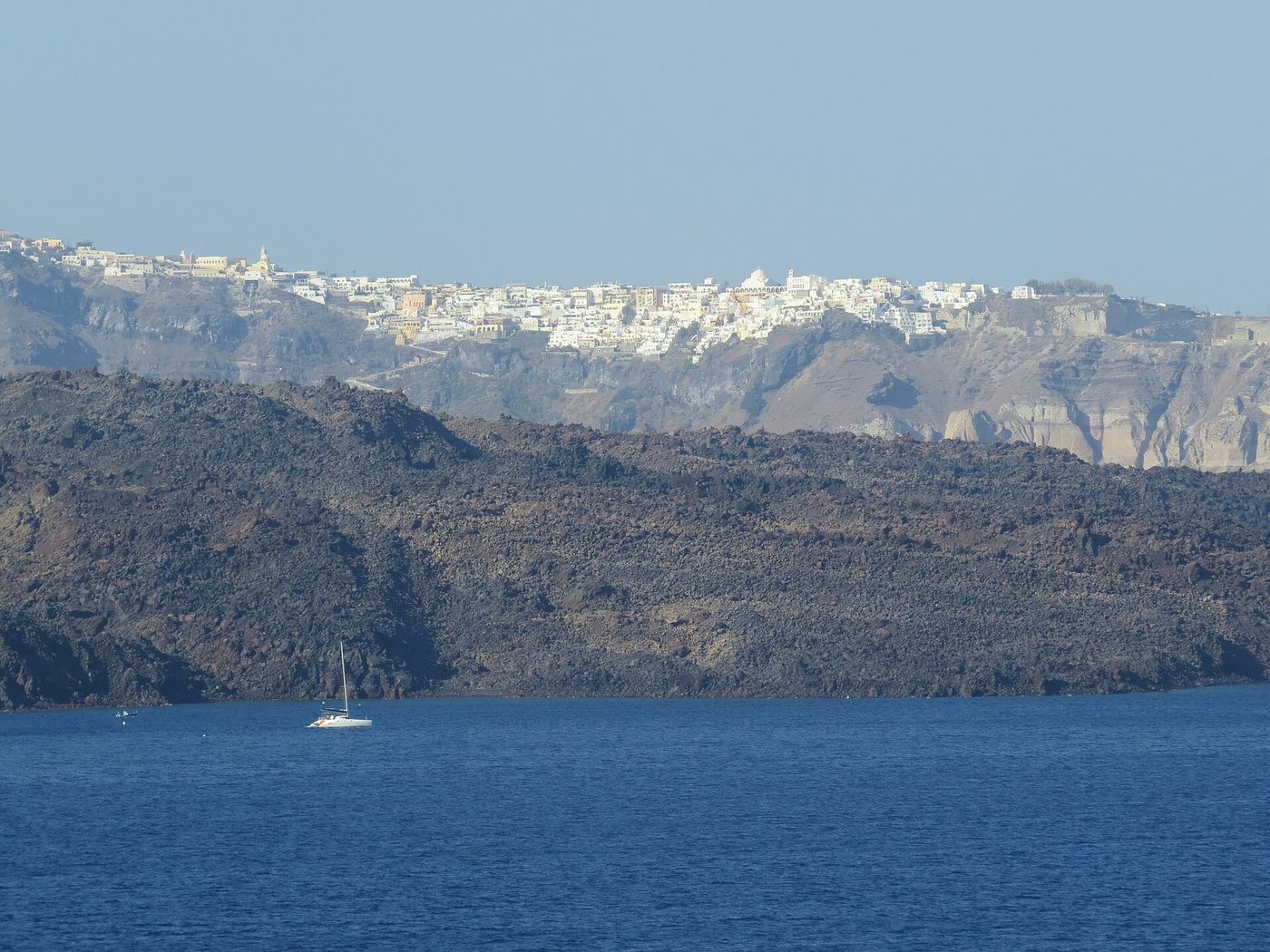
If you would rather sidestep the question entirely, Naxos, Paros and Milos are all excellent, all cheaper, and all reachable on the same ferry legs, and all covered in our guide to the Greek islands. Milos in particular gives you volcanic drama without the crowd.
Getting up and down the caldera
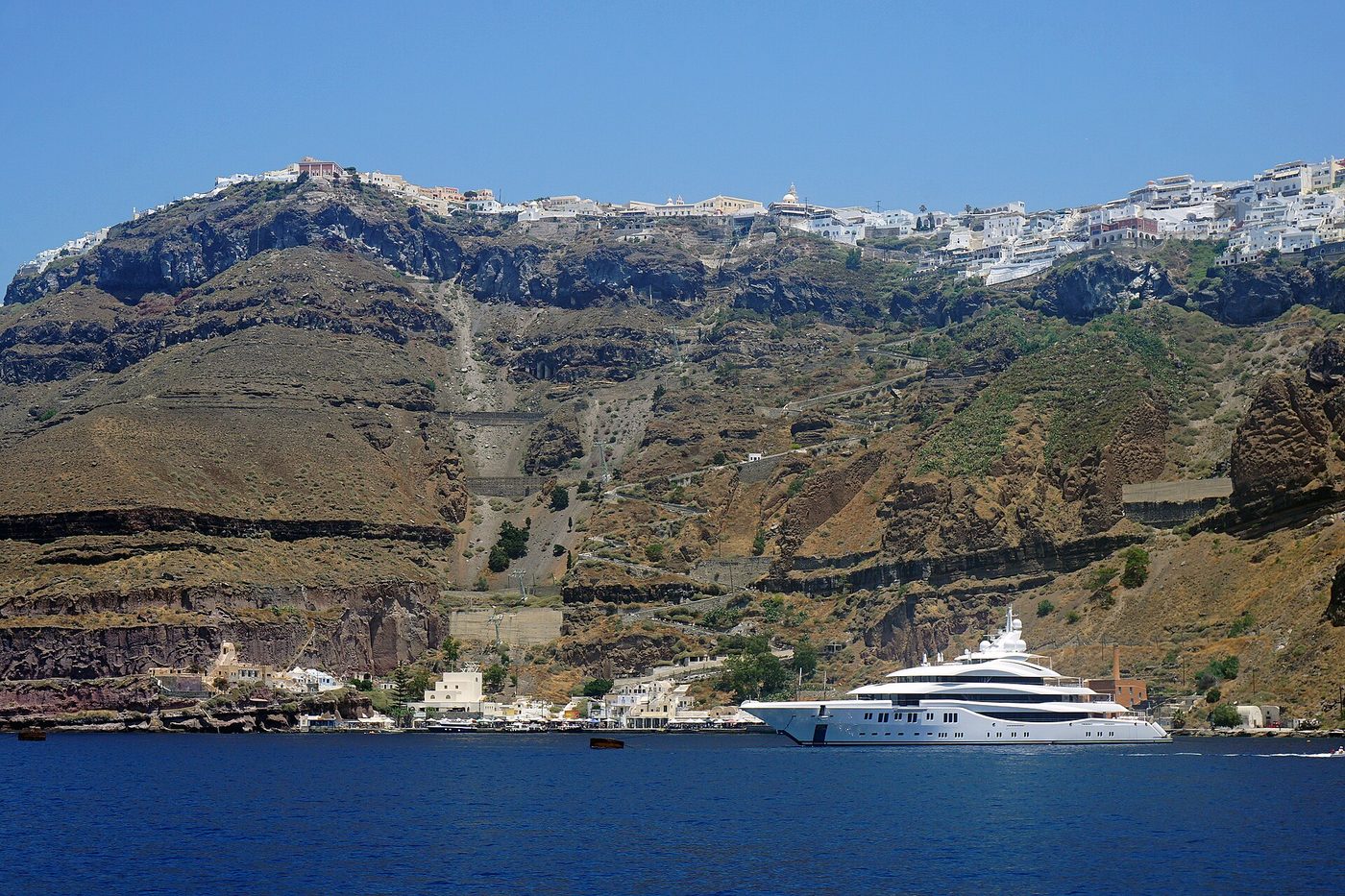
The cable car runs from the Old Port at Gialos up roughly 220 m to Fira. Tickets are €10 one way for adults, €5 for children aged 6 to 12, free under 6, and €5 per item of luggage. They are sold one way only, so buy twice if you are going down and back up. The alternative is the 588-step donkey path, about 20 to 30 minutes on foot, still in use and untouched by the 2026 restrictions. Mule rides cost around €10. I walk it down and take the cable car up, and I would gently suggest you consider the animals’ working day before choosing the ride.
When to go: the best months for a Greece itinerary
Late May, June and September. That is the whole answer, and everything below is the reasoning.
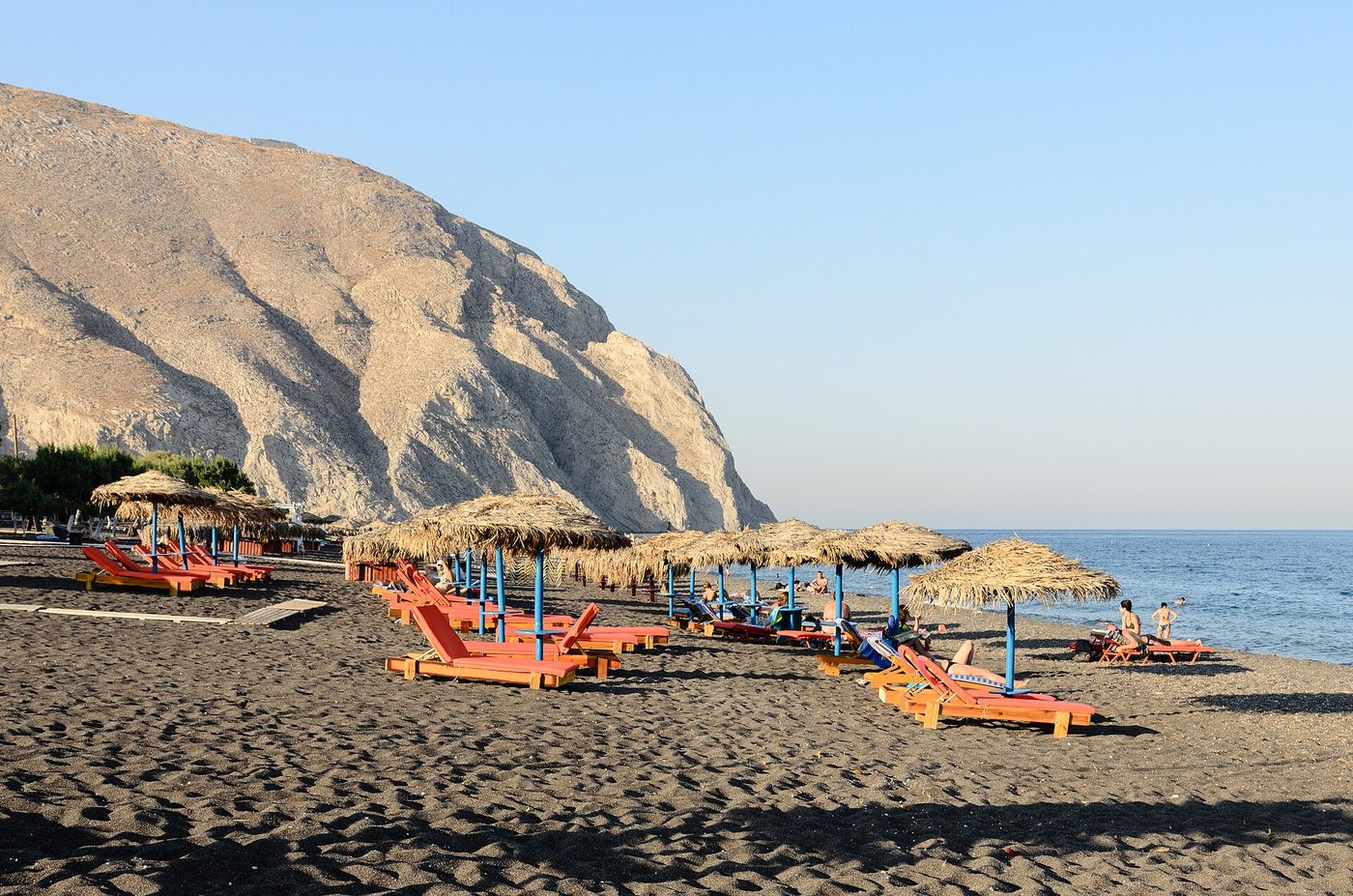
September is my pick if I get to choose. The sea is at its warmest of the year on Santorini at around 24°C, warmer than June, because water takes all summer to heat up and holds it. The air has dropped to a workable 26°C. The July and August crowds have gone home. Ferries are still running at full frequency. The meltemi is easing. There is no other month that gets all five of those right at once. The same logic drives our wider guides to the best time to visit Europe and to shoulder season in Europe.
| Month | Athens mean air / sea | Santorini daily high | Santorini sea | Verdict for an island itinerary | What to expect |
|---|---|---|---|---|---|
| January | Not published in my source set | Approx. 11°C average | 16°C | Mainland and Crete only | Most island hotels and ferries shut |
| February | Not published in my source set | Not published in my source set | Not published | Mainland and Crete only | As above, plus the wettest stretch |
| March | Not published in my source set | Not published in my source set | Not published | Mainland only | Sailings still thin, islands waking up |
| April | 16°C air, 16°C sea | 18°C high, 13°C low | 16°C | Good for ruins, cold for swimming | Islands reopen from early April |
| May | 20°C air, 18°C sea | 23°C high, 17°C low | 18.5°C | Excellent | Late May is one of the two best windows |
| June | 23°C air, 22°C sea | 27°C high, 21°C low | 22°C | Excellent | Meltemi season starts, crowds building |
| July | 26°C air, 24°C sea | 29°C high, peaks near 34.5°C | 23.5°C | Hot and full | Peak meltemi, peak prices, book 2 to 3 months out |
| August | 26°C air, 24°C sea | 29°C high, peaks near 33.5°C | 24.5°C | Hot and full | Athens can exceed 40°C |
| September | 22°C air, 23°C sea | 26°C high, 21°C low | 24°C | The best month overall | Warm sea, thinning crowds, wind easing |
| October | 20°C air, 22°C sea | 23°C high, 18°C low | 21.5°C | Very good to mid-month | Sailings reduce, hotels start closing |
| November | Not published in my source set | Not published in my source set | 19°C | Mainland and Crete | Most island businesses close for the winter |
| December | Not published in my source set | Not published in my source set | Not published | Mainland only | Athens, Meteora and Nafplio all work |
The meltemi, and why it belongs in your itinerary planning
The meltemi is a strong northerly that blows across the Aegean from June through September, strongest in July and August. The Cyclades sit almost directly in its path. Andros and Tinos catch it worst; Mykonos is nicknamed the island of the winds for a reason.
What it does to a Greece itinerary is cancel ferries. Smaller fast catamarans go first, with cancellations starting around 8 Beaufort, which is 62 to 74 km/h, and most operators standing down from 9 Beaufort. Big conventional ferries keep sailing in conditions that ground the fast boats, which is one more argument for booking Blue Star over a catamaran in high summer. Often the constraint is not the open sea but whether a vessel can dock safely at a small port.
The leg that matters is the return to Athens. Build a buffer night into the end of any July or August itinerary, or fly home from your last island. It costs you one hotel night and it removes the only failure mode on this trip that cannot be improvised around.
The off-season reality
From November to March the majority of island hotels and restaurants close, and many do not reopen until early April. Crete, Rhodes, Corfu and, to a lesser degree, Santorini and Mykonos keep some shops and tavernas trading year-round, but the choice narrows sharply. There is no dependable direct winter ferry between Santorini and Mykonos: November to March may run one or two sailings a week and some weeks have none, so flying via Athens becomes the only reliable island-to-island option.
None of which makes winter a write-off. It makes it a different trip. Athens, Delphi, Meteora, Nafplio and Crete all work in January, the sites are empty, and hotel rates fall through the floor. Just do not plan Cycladic island-hopping in February. When you are ready to route the boats, our Greek island hopping itinerary lays out nine ferry routes from five to fourteen days. For the full seasonal picture, including sourced monthly sea temperatures and the accommodation tax bands, see our guide to the best time to visit Greece. Our best time to visit southern Europe guide compares Greece with Italy, Spain and Portugal month by month, and Europe weather by month has the raw numbers.
What a Greece itinerary costs in 2026
Greece is not the bargain it was a decade ago, and Santorini and Mykonos in August have priced themselves into a different category from the rest of the country. Everywhere else remains reasonable by Western European standards. Good meals still come in under €15 and decent accommodation under €80 a night on the mainland and the smaller islands, which is why Greece still appears on our list of the cheapest places to travel in Europe.
| Style | Per person per day | Where you sleep | How you eat | How you move | What it unlocks |
|---|---|---|---|---|---|
| Budget | €50 to €70 | Hostels and guesthouses | Tavernas, bakeries, one sit-down meal a day | Conventional ferries, buses | Mainland, Naxos, Paros, Crete |
| Mid-range | €100 to €150 | 3-star hotels and good apartments | Meals out twice a day, most under €15 | Mix of fast ferries and one flight | Anywhere except Santorini caldera and Mykonos in August |
| Comfortable | €200 to €300 | 4-star and boutique, caldera view in shoulder season | Restaurants without checking prices | High-speed ferries, hire car, one internal flight | Santorini and Mykonos become realistic |
| Luxury | €250 upward, and past €400 on the caldera | Cave suites, private pools, top Oia properties | Whatever you like | Private transfers, helicopter or charter | Peak-season Santorini caldera at €400 to €700 a night |
A different methodology, aggregating what travellers actually spent rather than banding by style, puts an independent visitor at roughly €86 a day at the budget end, €216 mid-range and €535 at the luxury end, with accommodation counted in full rather than shared between two people. That is why those figures sit above the bands in the table. One widely quoted estimate for a 10-day trip lands between $1,480 and $3,850 per person including international flights, mid-range lodging, local dining and regional transport. That is a wide band, for a reason: the difference between Naxos and Santorini caldera is the single biggest variable in Greek travel budgeting.
The Santorini premium, in numbers. Mid-range hotels on Santorini and Mykonos regularly run €150 to €300 a night in summer. Cave-style cliffside suites with plunge pools start around €400 to €700, a four-star Imerovigli caldera-view hotel averages around €580 a night in peak summer, and the top Oia properties clear €1,000. Naxos, meanwhile, averages around $157 a night across all hotels, with budget rooms near $73 and the island’s luxury tier around $407. Those three figures are published in US dollars by the source, which is why they break the euro pattern here.
That comparison is the whole argument for the classic 10-day route in this guide. Three nights of Naxos and three of Santorini costs meaningfully less than six nights of Santorini, and it is a better holiday. Our where to stay in Europe guide takes the same approach to base-picking across the continent.
Two taxes that will not show up in your booking total
Greece charges a Climate Crisis Resilience Fee, introduced on 1 January 2024 under Law 5073/2023, replacing the older hotel stay tax. It runs from €0.50 to €15 per room, apartment or villa per night, depending on the accommodation type and the season. It is charged at the property, so it will not appear in your booking-site total. No changes were announced for 2026.
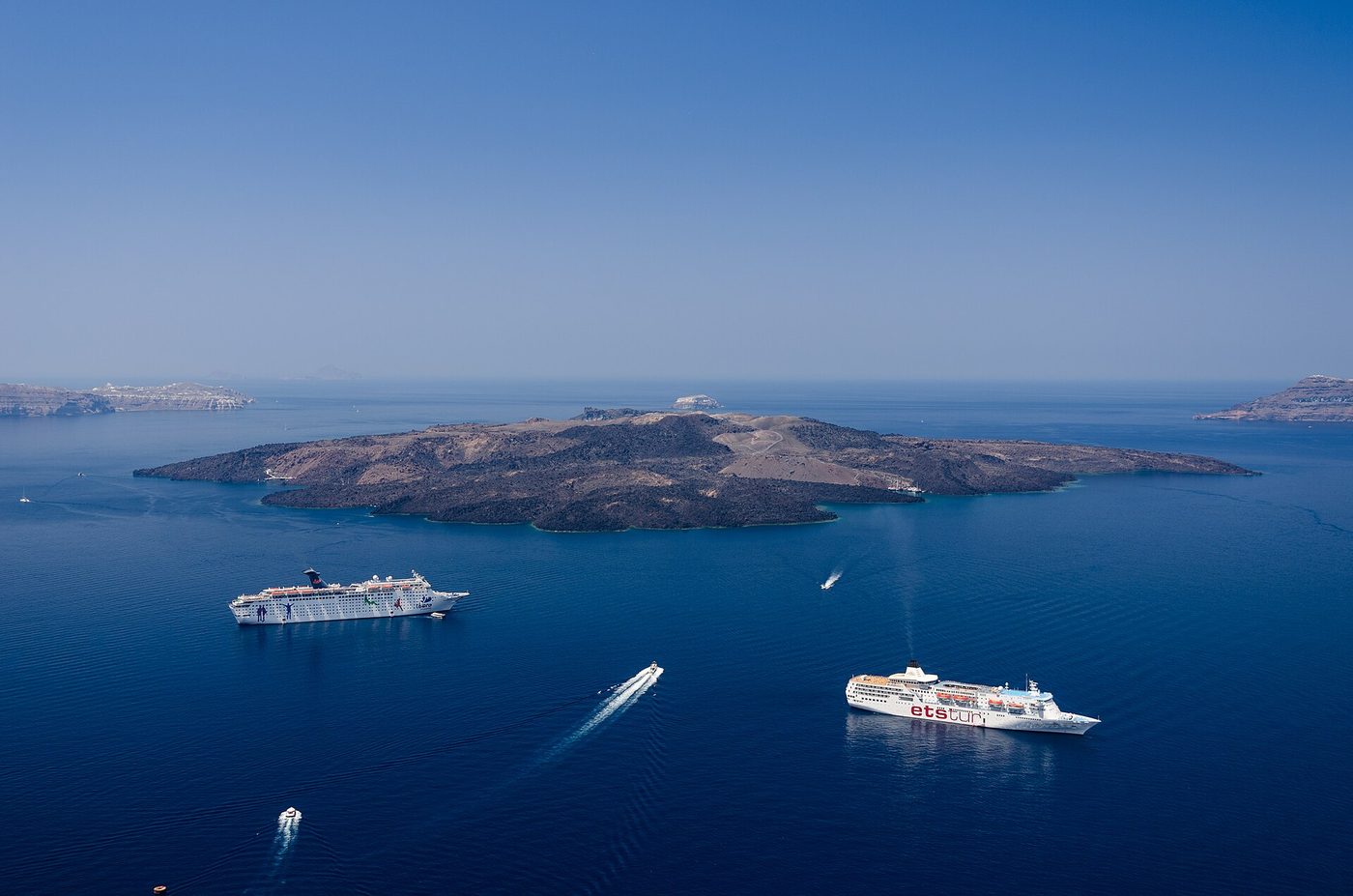
If you arrive by cruise ship there is a separate per-passenger levy, launched in July 2025, aimed squarely at Santorini and Mykonos. It applies to every disembarking passenger whether the call is a transit stop or a homeport, with exceptions only for medical emergencies and crew, and it goes on your onboard account. Santorini also now caps cruise arrivals at 8,000 passengers a day. If cruising is how you are travelling, our European river cruises guide covers the inland alternative.
| Charge | High season | Low season | Notes |
|---|---|---|---|
| Climate resilience fee, 1 and 2 star hotels and apartments | €2 per room per night | €0.50 per room per night | Paid at the property, not through your booking site |
| Climate resilience fee, short-term rentals | €8 per night | €2 per night | Applies to Airbnb-type lets |
| Climate resilience fee, furnished tourist villas | €15 per night | €4 per night | The top of the band |
| Climate resilience fee, 3 to 5 star hotels | Somewhere inside the €0.50 to €15 band | Somewhere inside the €0.50 to €15 band | I could not source the exact mid-tier rates, so I am not quoting them |
| Cruise passenger levy, Santorini and Mykonos | €20 per disembarking passenger, 21 July to 30 September | €4, 1 November to 31 March | €12 in the 1 to 31 October and 1 April to 31 May shoulders |
| Cruise passenger levy, all other Greek ports | €5, 21 July to 30 September | €1, 1 November to 31 March | €3 in the shoulder windows |
Eight swaps that fix a Greece itinerary that is not working
If a route is too expensive, too crowded, too wind-exposed or simply not to your taste, one of these usually solves it.
| Instead of | Consider | What you gain | What you give up |
|---|---|---|---|
| Santorini | Milos | Volcanic landscape, extraordinary coastline, a fraction of the cost, no sunset scrum | You give up the caldera view, which is genuinely singular |
| Mykonos | Paros | Naoussa has the harbour scene and the restaurants without the Mykonos bill | Less nightlife, fewer beach clubs |
| Mykonos | Naxos | Better beaches for families, a real mountain interior, far cheaper | Quiet after dinner |
| Athens | Nafplio | If you have seen Athens, Nafplio is the loveliest small city in the country | You give up the Acropolis and the museums |
| Crete | Rhodes | Medieval old town, easier to do without a car, strong shoulder-season weather | Smaller, less varied, less good food |
| Delphi as a day trip | Delphi overnight | The site at 08:00 with nobody in it, and the valley light | One more hotel night and one more drive |
| Cyclades in August | Ionian islands in August | Corfu, Kefalonia and Zakynthos sit outside the meltemi’s main path | Greener and wetter, a different Greece |
| Island hopping | One island, done properly | Fewer ferry days, more actual holiday, cheaper | You come home having seen one place |
Which Greece itinerary suits which traveller
First-timers. The classic 10 days. Athens, Naxos, Santorini. It exists because it works, and there is no prize for being contrarian on a first trip. Our first-time Europe itinerary applies the same principle continent-wide.
Couples and honeymooners. Athens two nights, Milos three, Santorini four. Milos is the most romantic island in the Cyclades, and the sea caves at Kleftiko are worth the boat day on their own. Book a caldera room in May or late September rather than August and you get better weather and a smaller bill. Our Europe honeymoon guide sets it against the alternatives.
Families with young children. Naxos or Paros for a week, plus two nights in Athens at the start. Naxos has shallow sandy beaches on the west coast, short drives, and food children will eat without negotiation. Skip Santorini: it is a cliff with a road along the top and a great deal of walking on uneven stone. There is more on this in our guide to Europe with kids.
Solo travellers. Athens, Paros, Naxos. Paros has the best hostel and social scene in the Cyclades, and the Athens to Paros to Naxos triangle has enough sailings that you can change your mind mid-trip. Our solo travel in Europe guide covers the practicalities.
History travellers. The mainland itinerary, extended. Athens, Delphi, Meteora, Nafplio for Mycenae and Epidaurus, then Olympia. Add Crete for Knossos if you have a fortnight. Greece sits near the top of our best countries to visit in Europe for exactly this reason.
Budget travellers. Athens, Naxos, Paros, all by conventional ferry, in May or October. Around €50 to €70 a day is realistic in guesthouses, eating where the boats come in. Shoulder season runs 25 to 40 per cent below peak. Europe on a budget covers the tactics.
Walkers. Crete. The Samaria Gorge, the E4 along the south coast, and the Lefka Ori. Nothing in the Cyclades comes close, though the Fira to Oia rim walk is a fine afternoon. Crete also anchors our hiking in Europe roundup.
Winter travellers. Athens, Delphi, Meteora, Nafplio, and nothing else. See where to go in Europe in winter if Greece turns out to be the wrong country for your dates.
Nine mistakes I see on Greece itineraries every single year
- Too many islands. Four islands in two weeks turns a holiday into a logistics exercise. Two or three, always. The same discipline shapes our 10-day Europe itinerary.
- A same-day ferry to an international flight. The meltemi does not care about your booking reference. Sleep in Athens the night before, or fly out from your last island.
- Assuming a combined Athens ticket exists. It was abolished on 1 April 2025 and you will buy each site separately.
- Turning up at the Acropolis without a slot. Timed entry, 20,000-a-day cap, sold out five to seven days ahead in summer.
- Booking a train to Meteora. There is no through service and none is expected for years.
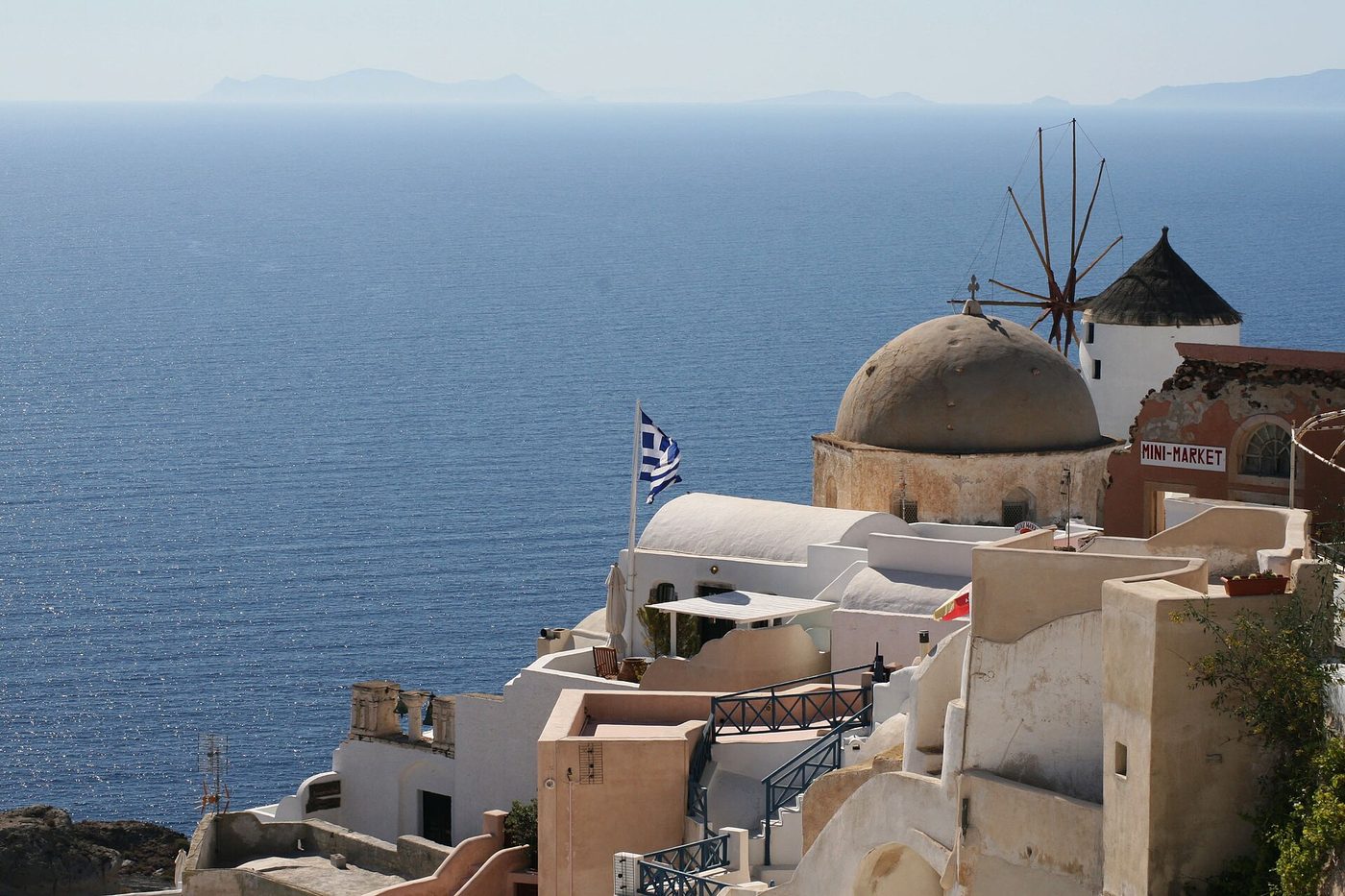
- Staying in Oia. Imerovigli and Firostefani have the same caldera, better value and far less foot traffic, and Oia is twenty minutes away when you want it.
- Underestimating Athens. Two days is not enough. Three is the minimum, and the National Archaeological Museum alone deserves a morning.
- Renting a car in Athens. Central Athens driving and parking is miserable and the metro is excellent, a point our guide to planning a trip to Europe makes about most European capitals. Pick the car up when you leave the city.
- Travelling without an IDP because the law does not require one. Correct on the law, wrong in practice. The rental desk still asks.
Six practical things that decide how the first day goes
Getting from the airport to Piraeus. This is the detail most itineraries skip and the one you need first if you are sailing on arrival. Take Line 3 to Monastiraki, change to Line 1 and stay on it to Piraeus, roughly an hour end to end on the €9 airport ticket. The X96 bus runs directly from the airport to Piraeus port and is the alternative if you land outside metro hours, though it is slower and traffic-dependent. Either way, leave far more time than the map suggests: Piraeus is a large port and your gate may be a fifteen-minute walk from where the bus drops you.
Where to stay in Athens. Koukaki for quiet streets and a ten-minute walk to the Acropolis Museum. Plaka for atmosphere and a tourist-price dinner. Monastiraki and Psyrri for nightlife and noise. Syntagma for metro connections in every direction, including the airport line, which matters on an early departure.
Two dates to plan around. Orthodox Easter moves each year and empties Athens while filling every island village, with ferries booked solid and many city businesses shut for several days. 15 August, the Feast of the Dormition, is the single busiest travel day in Greece: domestic ferries and flights sell out weeks ahead and prices peak. Both are wonderful if you plan for them and miserable if you do not.
Booking ferries. Compare on an aggregator, then buy from the operator where you can. Aggregators show you the whole day’s sailings across every company, which no single operator site does, and that comparison is the useful part.
Cash. Cards work almost everywhere, with two exceptions that catch people out: the Meteora monasteries take cash only at the door, and small island tavernas and beach kantinas often prefer it.
Sunday sailings and Monday closures. Ferry frequency drops on some routes at the shoulder ends of the season, and several archaeological sites and museums have reduced winter hours. Check the specific day rather than the season.
Entry requirements, driving and other practicalities
Entry. US, Canadian, UK and Australian nationals travel visa-free for up to 90 days in any rolling 180-day period. Those 90 days are pooled across all 29 Schengen countries, so a week in Greece plus a fortnight in Italy comes out of the same allowance, and leaving briefly does not reset the clock. Your passport must have been issued within the previous 10 years and stay valid at least three months beyond your planned departure.
EES. The EU Entry/Exit System became fully operational across the Schengen Area on 10 April 2026, after a phased rollout that started on 12 October 2025. Fingerprints and a facial scan replace the passport stamp. Expect the first registration to take a few extra minutes at Athens airport. The EU has reserved the right to partially suspend EES operation at exceptionally busy times.
ETIAS is not required, and as of late September 2026 it has no start date: the EU says it will announce the date several months in advance, and trade reports point to 2027. Our Schengen visa and ETIAS guide tracks the detail.
Driving. An International Driving Permit has not been legally required for US, UK, Canadian and Australian licences since a law change in November 2021. Carry one anyway, because the major rental brands and most island agencies still ask non-EU drivers for it and will refuse the keys without it. EU and EEA licences are fine as they are, provided they are in Latin characters. A car earns its keep on Crete outside the towns, in the Peloponnese and on Naxos, is useful on Paros, and is close to pointless in central Athens or on the Santorini caldera. Our Europe road trips guide covers the routes where a car genuinely transforms a trip.
Greece itinerary FAQ
How many days in Greece is enough?
Ten days is the first length that stops feeling compressed, because it gives you three stops with two or three nights each. Seven days works for two stops. Five days means one place. Fourteen days is where you can add the mainland or a second island group without rushing.
Is 10 days enough for Greece?
Enough for a very good first trip, yes. Not enough to see Greece, which nobody does. Ten days buys you Athens plus two islands, or Athens plus the mainland loop, or one island done thoroughly.
Is 7 days enough for Greece?
Yes, if you accept two stops. The mistake is treating a week as three stops, which leaves you with four usable days out of seven once travel time comes off.
How much does a 10-day trip to Greece cost?
Budget travellers manage on €50 to €70 a day, mid-range on €100 to €150, and luxury runs from around €250 upward, passing €400 a day quickly once caldera rooms are involved. One commonly quoted whole-trip estimate runs $1,480 to $3,850 per person for 10 days including international flights. Where you sleep on Santorini is the biggest single variable.
Should you fly or take ferries between the Greek islands?
Ferries within the Cyclades, flights to Crete and Rhodes. Once you count airport transfers and check-in, a 45-minute flight to Santorini saves less time than it looks, and the ferry is a pleasanter way to spend the morning.
How much are ferry tickets in Greece?
Roughly €10 to €150 one way depending on route, vessel and class. Short hops between neighbouring islands start around €6. Athens to Santorini starts around €46, and a high-speed catamaran on the same route typically runs to about double the conventional fare.
Is Naxos or Paros better for a first trip?
Naxos if you want mountains, food and beaches for a family. Paros if you want a harbour scene, more restaurants and an easier social atmosphere for solo travellers. They are 25 to 30 minutes apart on a fast ferry, so a two-week trip can have both.
Should you visit Mykonos on your first trip?
Only if the nightlife or the beach clubs are the point. Mykonos is beautiful and Chora’s lanes are lovely at 08:00, but you pay Santorini prices for a different thing, and the ferry from Mykonos to Santorini is the most expensive short hop in the Cyclades at around €82.50.
Can you visit Athens, Mykonos and Santorini in one week?
You can, and you will spend two of the seven days moving. If you are set on it, fly Athens to Mykonos in 30 minutes, ferry Mykonos to Santorini in around two hours, and fly home from Santorini. Do not attempt it in reverse with an Athens departure.
How many days do you need in Athens?
Three nights. Two if you must, and you will skip the National Archaeological Museum, which is a real loss. Our Athens guide has the detail.
Should Athens come first or last?
First, on almost every route. You land there, jet lag suits sightseeing better than beaches, and it leaves you free to fly home from your final island. The exception is a July or August trip where you want an Athens buffer night before an international departure.
What is the biggest Greece itinerary mistake?
Planning a ferry into a flight on the same day. Everything else is recoverable. Pack for the wind while you are at it; our Europe packing list has a Mediterranean summer section.
Can you fly home from Santorini?
Yes. Santorini has frequent Athens connections and seasonal direct flights to a number of European cities, which is exactly why it belongs at the end of the route rather than the middle.
Do you need a car in Greece?
On Crete and in the Peloponnese, effectively yes. On Naxos, very useful. On Paros, helpful. In Athens and on the Santorini caldera, no. Naxos rates run from around €24 a day in March to around €79 in August; Chania averages around €27 a day.
Is Santorini safe to visit after the earthquakes?
The island is open, hotels and ferries are operating, and no government has advised against travel. Specific restrictions are in force until 31 March 2027 covering the Old Port of Fira, the Ammoudi road and the Ammoudi to Agios Nikolaos trail. The cable car and the Fira to Old Port path are explicitly not restricted. Check the current Civil Protection notices before you travel, because the measures are revisable.
Final thoughts
For a shortlist to build that itinerary from, see where to go in Greece, which covers 45 places with 2026 prices. The best Greece itinerary is the one with the fewest moves on it that still gets you to the things you actually came for. Every extra island looks like a gain when you are planning at a kitchen table in February and feels like a cost when you are dragging a suitcase down a concrete ramp at Athinios in August.
Pick three stops for ten days. Give Athens three nights. Put a working island in the middle where you can eat well and swim without a queue. Finish on Santorini, because it deserves the ending even at the prices, and fly home from there. Book your Acropolis slot the week you book your flights, book high-season ferries two to three months out, and keep a night in hand at the end for the wind. Greece earns its place on our best places to visit in Europe list and on the Europe bucket list, and it rewards a slower route than most people give it.
One honest limit on this guide: it is built around Athens, the Cyclades, Crete and the classic mainland loop, because that is what the overwhelming majority of first and second trips to Greece look like and what I can source properly. There is no Ionian route here, nothing from the Dodecanese beyond a passing mention of Rhodes, and nothing on the Sporades or the northeast Aegean. That is a limit of scope, not a verdict on Symi or Skopelos. For the surrounding region, our best Mediterranean destinations guide and our Turkey travel guide cover what sits just across the Aegean.
If Greece turns out to be one leg of something larger, our Europe itinerary guide covers how it stitches together, and the Italy and Greece itinerary handles the most common pairing. If you are still choosing a shape, the best Europe travel routes and our guide to Europe in summer are the next two to read, and the best cities to visit in Europe will tell you whether Athens deserves a longer stay.
Hannah Brooks has spent fifteen years travelling, living and writing across Europe, from the Arctic tip of Norway to the south of Sicily. She has planned hundreds of European itineraries for readers and is Senior Europe Editor at EuropeanTourism.org.
Photo credits
All images are used under their stated licences. In order of appearance:
- Greece itinerary: the blue-domed churches and whitewashed houses of Oia above the Santorini caldera · Photo: Giles Laurent / CC BY-SA 4.0 via Wikimedia Commons
- The Monastiraki flea market district in central Athens · Photo: C messier / CC BY-SA 4.0 via Wikimedia Commons
- The Parthenon on the Acropolis rock above Athens · Photo: Jebulon (CC0) via Wikimedia Commons
- A cobbled street in the Plaka district beneath the Acropolis in Athens · Photo: JFKennedy at English Wikipedia (CC0) via Wikimedia Commons
- The Temple of Hephaestus in the Ancient Agora of Athens · Photo: Jebulon (CC0) via Wikimedia Commons
- The village of Imerovigli along the highest stretch of the Santorini caldera rim · Photo: Klearchos Kapoutsis / CC BY 2.0 via Wikimedia Commons
- The view over Athens from Mount Lycabettus with the Acropolis in the distance · Photo: George E. Koronaios (CC0) via Wikimedia Commons
- Pink-tinged sand and shallow turquoise lagoon at Elafonisi beach on Crete · Photo: trolvag / CC BY-SA 3.0 via Wikimedia Commons
- A ferry ramp and waiting buses at Athinios, the main commercial port of Santorini · Photo: Moonik / CC BY-SA 3.0 via Wikimedia Commons
- Fira strung along the top of the caldera cliff on Santorini, seen from the water · Photo: Luke Jones / CC BY 2.0 via Wikimedia Commons
- Whitewashed Cycladic-style houses in Anafiotika on the slopes of the Acropolis in Athens · Photo: Zde / CC BY-SA 4.0 via Wikimedia Commons
- The stone tiers of the Odeon of Herodes Atticus below the Acropolis in Athens · Photo: Julian Lupyan (CC0) via Wikimedia Commons
- A wide panorama across the flooded Santorini caldera from the cliff villages · Photo: Dimitri Raftopoulos / public domain via Wikimedia Commons
- Fishing boats and red cliffs at Ammoudi Bay below the stone houses of Oia, Santorini · Photo: Winniepix / CC BY 2.0 via Wikimedia Commons
- The caldera cliff below Fira with the cable car line running down to the Old Port, Santorini · Photo: Mario Roberto Duran Ortiz / CC BY-SA 4.0 via Wikimedia Commons
- Straw umbrellas and loungers on the black volcanic sand of Perissa beach, Santorini · Photo: Norbert Nagel / CC BY-SA 3.0 via Wikimedia Commons
- Cruise ships anchored in the Santorini caldera with the Nea Kameni volcano island beyond · Photo: Norbert Nagel / CC BY-SA 3.0 via Wikimedia Commons
- White and ochre houses stacked along the caldera edge in Oia, Santorini · Photo: bongo vongo / CC BY-SA 2.0 via Wikimedia Commons
- Bronze Age walls and lanes under the protective roof at the Akrotiri archaeological site, Santorini · Photo: Norbert Nagel / CC BY-SA 3.0 via Wikimedia Commons
- A platform on the Athens metro, the fastest way around the city · Photo: Rakoon (CC0) via Wikimedia Commons
- Old basket-trained vines on volcanic soil at Domaine Sigalas on Santorini · Photo: Treephoto / CC BY-SA 4.0 via Wikimedia Commons
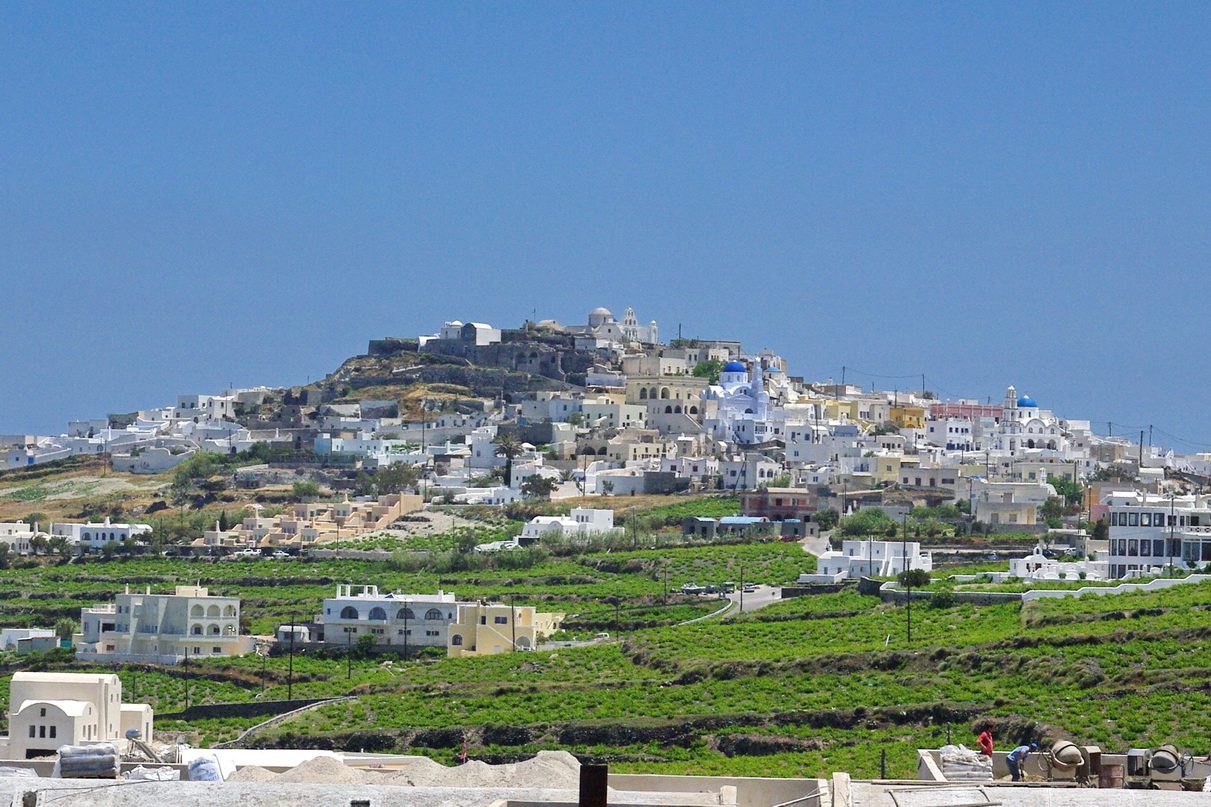
- The hilltop village of Pyrgos rising above vineyards in the middle of Santorini · Photo: Bgabel / CC BY-SA 3.0 via Wikimedia Commons