Santorini Travel Guide: Everything to Know Before You Go
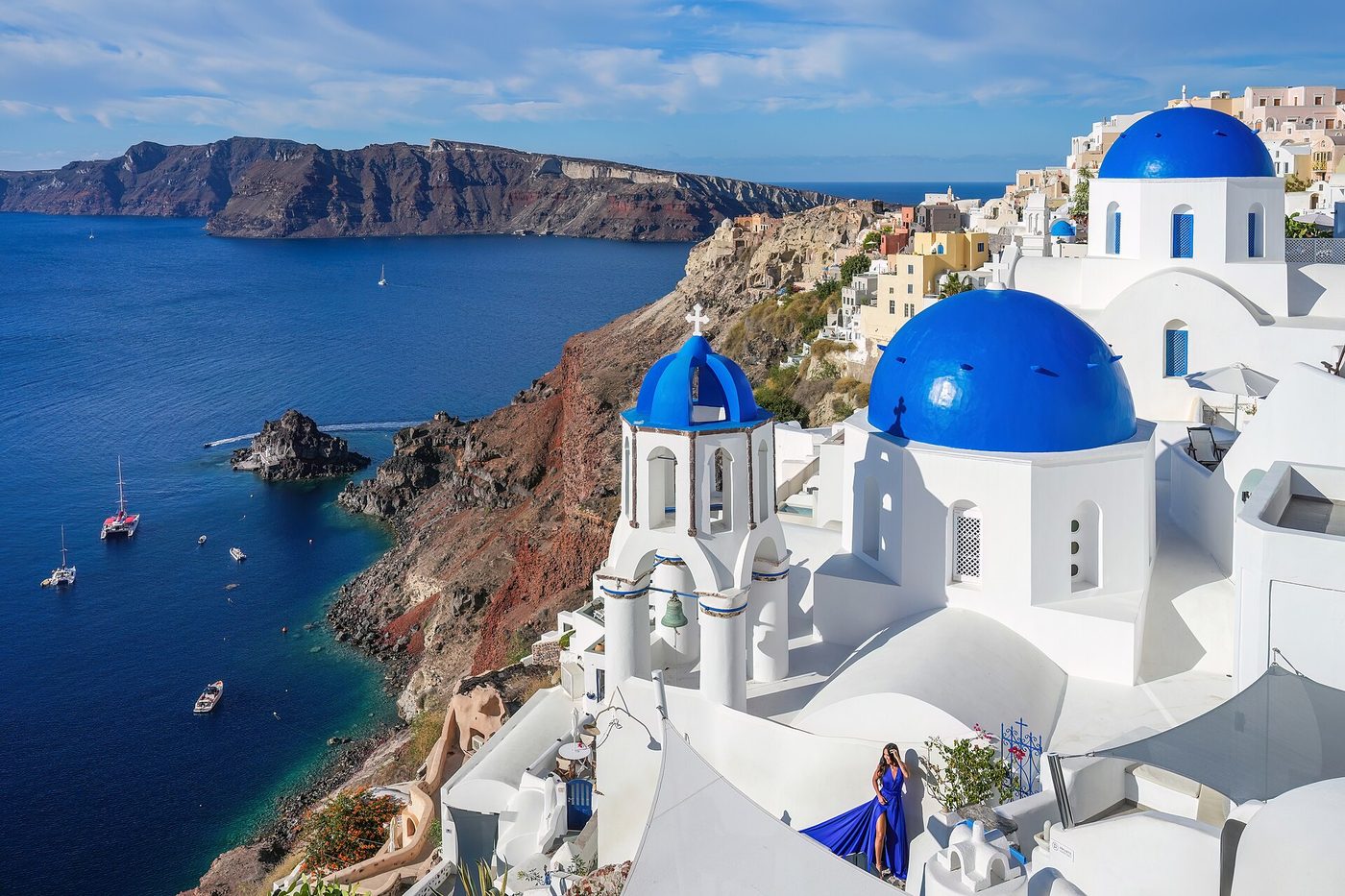
The first time I stood on the caldera rim at Imerovigli, I understood why people book Santorini before they have any idea what else is on the island. A drowned volcano fills the whole view, the far cliffs are striped like a cut cake, and the villages cling to the edge as if someone had spilled sugar along the top. The second thing I understood, about ninety minutes later in a queue outside Oia, is that the island has a management problem, and that your entire holiday depends on how well you plan around it.
This santorini travel guide is the version I wish someone had handed me on that first trip: the ferry maths, the bus fares, the ticket prices, the sunset times, the taxes that never appear on a booking page, and an honest read on whether the island deserves four days of your life or one. Every number here was checked against a source in 2026, and where I could not confirm one I say so.
Santorini is not a beach island, it is not a cheap island, and it is not a quiet one between June and mid-September. It is a geological spectacle with a very good wine region attached, roughly 76 square kilometres of volcanic rock holding about 13,900 permanent residents and something like 3.4 million visitors in a normal year. Get the timing and the base right and it is one of the great places in the Mediterranean. Get them wrong and you will spend a lot of money to shuffle through an alley behind a tour group.
Santorini at a glance
Here is the island in one screen. Every figure below is expanded, sourced and qualified further down.
| Question | Short answer |
|---|---|
| Where is it | The southern Cyclades, Greece, about 200 km southeast of Athens |
| Size | About 76 km²; roughly 16 km long and 1 to 5 km wide |
| Population | 13,868 in the Municipality of Thira at the 2021 census |
| Annual visitors | Around 3.4 million in a normal year, across air, ferry and cruise arrivals |
| Main airport | Thira National Airport (JTR), about 5 km from Fira |
| Main ferry port | Athinios, about 18 km from Fira by road |
| Flight from Athens | Roughly 50 to 55 minutes |
| Ferry from Piraeus | 5h00 to 6h10 by high-speed, 6h10 to 9h10 by conventional ferry |
| Currency | Euro; cards widely accepted, cash needed for buses and small tavernas |
| Accommodation tax | Climate Crisis Resilience Fee, €0.50 to €15 per room per night depending on category and season |
| Cruise passenger levy | €20 per disembarking passenger in peak season, €12 shoulder, €4 in winter |
| Daily cruise cap | 8,000 cruise passengers per day, in force for 2026 |
| Bus fare, Fira to Oia | €2.20, cash to the conductor |
| Cable car, Fira to Old Port | €10 one way for adults, €5 for children aged 6 to 12 |
| Akrotiri excavation | €20 full price |
| Best months | Late April to early June, and mid-September to late October |
| Worst months for crowds | July and August, especially between 10:00 and 12:00 in Fira and Oia |
| How long to stay | Four to five full days for a first visit; three if it is one stop on an island-hopping route |
| Emergency numbers | 112 general, 166 ambulance, 199 fire, 100 police |
The best things to do on Santorini
If you only read one list, read this one. Each of these is expanded further down with prices, hours and the practical catch.
- Walk the caldera path from Fira to Oia. About 10.5 km along the rim, free, and the best single day on the island.
- Go inside the Akrotiri excavation. A Bronze Age town preserved under ash and now under a roof. €20, and it works in any weather.
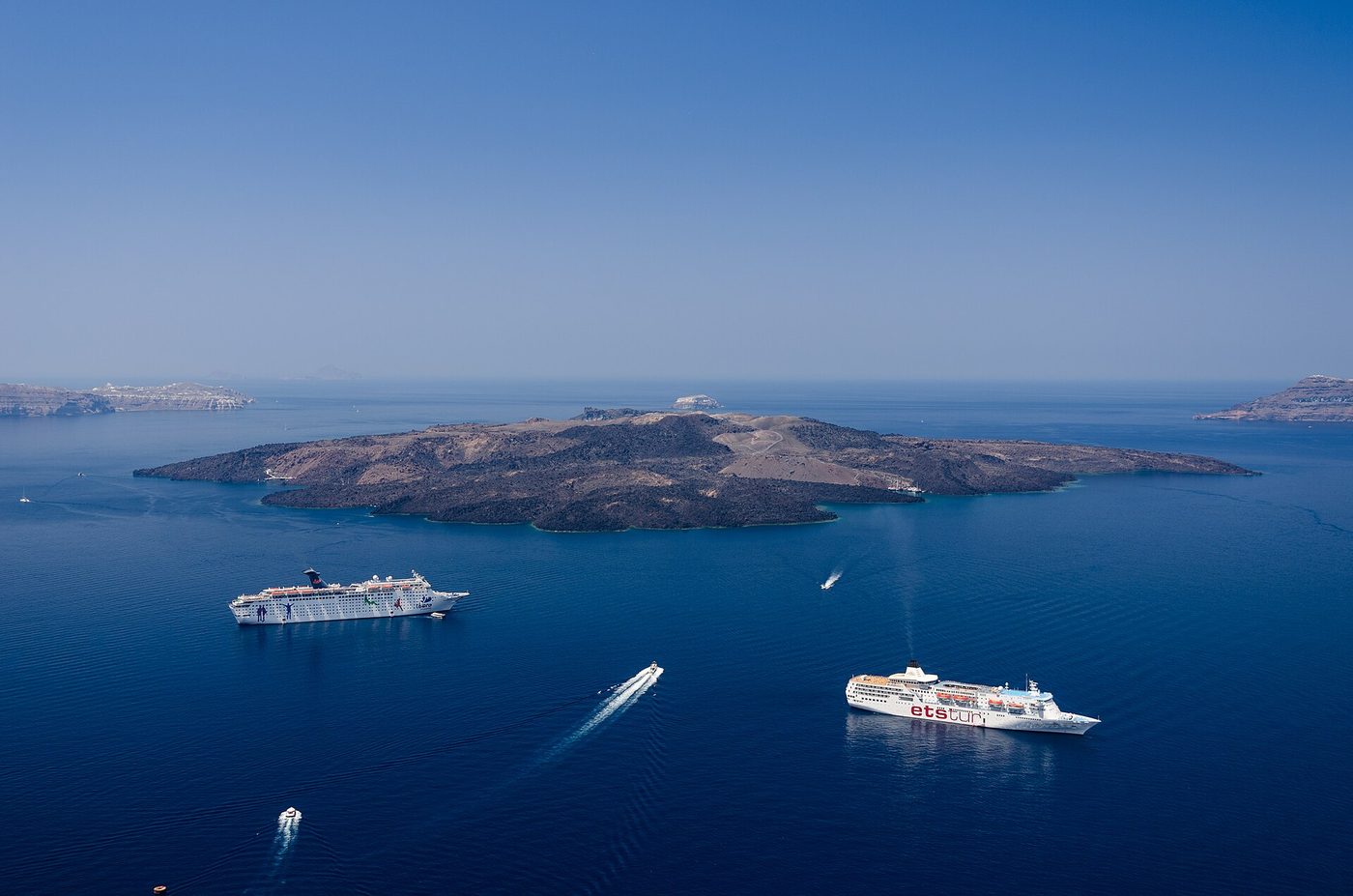
- Take a boat into the caldera. Nea Kameni’s crater, the Palea Kameni hot springs and the view back up at the villages, which inverts the entire postcard.
- Taste Assyrtiko where it grows. Basket-trained vines on volcanic ash, and one of the most distinctive white wines in Europe.
- Watch the sunset from somewhere that is not Oia castle. Imerovigli, Skaros Rock, Firostefani or Kasteli at Pyrgos.
- Climb to Ancient Thera. A Hellenistic city on the ridge high above Kamari, with barely anyone on it.
- See the Akrotiri frescoes at the Museum of Prehistoric Thira. The other half of the Akrotiri story, in Fira, for €10.
- Spend an afternoon inland. Pyrgos, Megalochori and Emporio are where the island still lives.
- Swim off the rocks at Ammoudi Bay. Below Oia, at the bottom of a long flight of steps, next to the fish tavernas.
- Cross to Thirassia. The inhabited island almost nobody stays on.
What actually changed on Santorini for 2026
Santorini has spent two years being reorganised. If you are working from a guide written before 2025, four things on it have changed, and one of them will decide what your day feels like.
1. The cruise cap is real, and 2026 tightened it
Greece introduced a daily ceiling of 8,000 cruise passengers at Santorini, and it is fully in force for the 2026 season. It works through berth allocation rather than by turning ships away at the dock: an oversubscribed day gets shifted to another date months in advance. For 2026 the authorities also raised the occupancy assumption used in the calculation from 80 per cent to 100 per cent, so a 3,000-berth ship now eats 3,000 of the 8,000 slots instead of 2,400. The effect shows in the schedule. One tracking site counts 595 cruise calls booked for 2026 against 728 in 2025, a drop of about 18 per cent.
For context on what the cap is holding back: before it existed, the busiest days brought 11,000 to 17,000 cruise passengers ashore onto an island of fewer than 14,000 residents.
2. The 70/30 rule, which is the big one
From 15 June 2026, the Municipal Port Fund of Thira requires that up to 70 per cent of each ship’s passengers come ashore at the Old Port below Fira, and no more than 30 per cent at Athinios. The previous allowance let 40 per cent land at Athinios. The stated justification is civil protection, a direct legacy of the 2025 seismic crisis.
What that means in practice is that a much larger share of cruise passengers now arrives at the bottom of the cliff below Fira and has to get up it, by cable car, on foot, or on a mule. The cable car moves 1,200 people an hour in total, 600 in each direction. Waits of up to two hours were already being reported at peak before the rule changed. Plan on worse. The rule was unpopular enough locally that the island’s tourist offices and bus operators struck on Monday 22 June 2026, and some calls were cancelled.
If you are staying on the island rather than visiting from a ship, the practical takeaway is simple: do not be in central Fira between about 10:00 and 12:00 on a big cruise day, and do not plan to use the cable car then either.
3. The Karavolades stairs closed, then reopened
On Wednesday 28 July 2026 the Municipal Port Fund closed the stepped path between the Old Port and Fira after a landslide and a wall collapse, banning pedestrian traffic and pushing cruise excursions back to Athinios. The Athinios cap was temporarily suspended to absorb the traffic. The Mayor of Thira reopened the path on 3 August 2026, so it is open as I write this. It is also a reminder that this is a crumbling volcanic cliff with weather on it, and that closures happen at short notice.
4. Two taxes that are not in older guides
Greece replaced the old stayover tax with the Climate Crisis Resilience Fee, charged per room per night and collected by your accommodation on departure with its own receipt. It is not per person. There is also a per-passenger cruise levy at Greek ports, and Santorini and Mykonos have their own, much higher band than everywhere else. Both tables are in the costs section below.
And one thing that did not change: the earthquakes
Between 25 January and 7 February 2025 the sea between Santorini and Amorgos produced over 1,200 earthquakes of magnitude 1.0 to 5.2, including 129 above magnitude 4.0. Schools closed for a month across Santorini, Anafi, Ios and Amorgos, and many residents temporarily left for Athens. Scientists later traced the swarm to pump-like intrusions of magma into newly opened dikes about 12 km below the seafloor, published in Science. There were no reports of injuries or significant property damage. Schools reopened on 4 March 2025, and the ports were fully operational again from 15 May 2025 after safety works at Fira Old Port and Ammoudi.
As of 2026 the swarm is over. Monthly monitoring summaries through 2026 report no meaningful activity, and the UK Foreign Office’s Greece advice, updated on 11 August 2026, carries no Santorini-specific warning at all, only the generic Greece-wide earthquake guidance it applies to the whole country. The standing advice is to turn on emergency alerts so Greek Civil Protection messages reach your phone, and to know where the assembly points are. That is it.
Is Santorini worth visiting? My honest answer
Yes, with conditions, and the conditions are the whole story.
Santorini is worth it if you come for the geology and the wine and the villages, and you give the island enough time to show you the four-fifths of itself that is not Oia. It is worth it if you can travel outside July and August, or if you can accept peak-season prices and crowds as the cost of a warm sea. It is worth it if you like walking, because the best hours here are on foot.
It is not worth it if you want a classic beach holiday, because the beaches are dark, hot underfoot and often windy. It is not worth it if you are chasing value, because you are paying a location premium on almost everything. And it is emphatically not worth it as a five-hour stop off a cruise ship in August, which is the version most of the disappointed people experienced. One analysis of a thousand public comments found that 82 per cent of visitors were glad they came, and that over 80 per cent of the unhappy minority were cruise passengers who only saw Oia and Fira. That split is the most useful piece of data about this island I have found.
My own view, after several trips: Santorini is one of the most extraordinary landscapes in the Mediterranean, and it is also the place where I most often see people having a worse time than they should because of decisions they made three months earlier. Where you sleep, which month you pick, and whether you rent wheels are worth more here than in almost any other destination in our Greece travel guide.

When to go: Santorini month by month
The season runs roughly from late March to early November. Peak is June to mid-September. The shoulders run from late March to early May and from late September into early November. Within those, the stretches I would book are late April to early June and mid-September to late October, when the sea is still usable.
The table below uses 1991 to 2020 climate normals, so it is the long-run average rather than a forecast for your week.
| Month | Avg high | Avg low | Rain | Sea temp | Sun/day | My read |
|---|---|---|---|---|---|---|
| January | 14.2°C | 10.2°C | 115 mm / 9 days | 16.3°C | 4 h | Half the island is shut. Atmospheric if you want empty streets |
| February | 14.4°C | 10.1°C | 80 mm / 7 days | 15.7°C | 5 h | Coldest sea of the year. Windiest month on average |
| March | 16.0°C | 11.4°C | 65 mm / 6 days | 15.7°C | 6.5 h | Season restarts late in the month. Green, cheap, unreliable |
| April | 18.8°C | 13.4°C | 30 mm / 3 days | 16.5°C | 8.5 h | Excellent for walking and wine, too cold for most swimmers |
| May | 23.0°C | 17.0°C | 15 mm / 2 days | 18.7°C | 9.5 h | My favourite month. Warm, long days, sea still bracing |
| June | 27.5°C | 21.1°C | 5 mm / 1 day | 21.8°C | 11 h | Latest sunsets of the year. Crowds arrive properly |
| July | 29.6°C | 23.5°C | 1 mm | 23.7°C | 12 h | Hot, packed, and the meltemi blows hardest |
| August | 29.6°C | 23.7°C | 1 mm | 24.6°C | 11.5 h | Warmest sea, worst prices, worst queues |
| September | 26.7°C | 21.0°C | 15 mm / 1 day | 23.8°C | 9.5 h | The soundest compromise. Sea still 23°C, crowds thinning after the 15th |
| October | 22.9°C | 17.7°C | 60 mm / 3 days | 22.0°C | 7.5 h | Lovely and quiet. Some places close from mid-month |
| November | 19.1°C | 14.5°C | 70 mm / 5 days | 19.6°C | 5.5 h | Season ends in the first week. Ferries thin out |
| December | 15.6°C | 11.7°C | 100 mm / 9 days | 17.5°C | 4 h | Earliest sunset of the year falls on 6 December |
Across the year that is about 555 mm of rain over roughly 46 rain days, and around 2,915 hours of sunshine, an average of eight hours a day. August is the warmest month at a 26.6°C mean, January the coldest at 12.2°C. The record extremes on file are 41°C in June 2017 and snow at sea level in February 2004 and February 2008, which tells you the winter is a real winter even if it is a mild one.
The meltemi, and why it matters more than the temperature
The meltemi is the dry northerly that blows across the Aegean from May onward, in spells of a few days, peaking in July and August. It is the reason a 30°C afternoon in Fira can feel pleasant and the reason your catamaran cruise gets cancelled. Average wind speeds on Santorini actually peak in winter, at about 23.8 kph in February, with summer averaging 19 to 22 kph, but the meltemi arrives in gusts well above that.
Two practical consequences. First, high-speed catamarans are far more likely to be cancelled or delayed in a blow than the big conventional ferries, so if you are connecting to a flight, take the slow boat. Second, the west-facing caldera side is sheltered compared with the exposed east and south coasts, which is why Perissa can be unswimmable on a day when Ammoudi is glassy.
Swimming season, honestly
On the sea temperature data, comfortable swimming is July to September, peaking at 24.6°C in August. That often gets stretched to late May through October, and if you are the kind of person who swims in the Atlantic in June you will be fine from May. If you are not, do not book May for the beach. For a broader view across the continent, our guide to the best beaches in Europe sets Santorini’s dark volcanic sand against what else is out there, and the best time to visit Europe breaks the same shoulder-season logic down country by country.
Wildfire and strike season
Wildfire risk across Greece runs high from April to October. Santorini has little to burn, but the mainland does, and it can affect flights. Strikes are a more likely disruption: Greece has them regularly, sometimes at short notice, and they hit buses, ferries and air travel. Build a buffer day before an international flight home. This is one of the few places where I would not connect a Santorini departure to a same-day long-haul.
Getting to Santorini: ferry or fly
Almost everyone arrives from Athens, and the choice is a genuine trade-off rather than a formality.
| Fly (ATH to JTR) | High-speed ferry | Conventional ferry | |
|---|---|---|---|
| Journey time | 50 to 55 minutes | 5h00 to 6h10 from Piraeus | 6h10 to 9h10 from Piraeus |
| Typical fare | €35 to €110 one way | From about €110 | From about €60; the lowest advertised fare on the route is €46.50 |
| Arrives at | Thira airport, 5 km from Fira | Athinios, 18 km from Fira | Athinios, 18 km from Fira |
| Weather risk | Low | High in a meltemi | Moderate |
| Luggage | Airline limits and fees | No practical limit | No practical limit |
| Best for | Short trips, tight schedules, families with a lot of luggage | Island hopping between Cyclades | Value, rough weather, overnight sailings |
Flights take about 53 minutes on average and there were around 350 a week on the route as of August 2026, flown by Aegean, Sky Express and Ryanair. September is typically the cheapest month to fly it. Book the earliest flight of the day if you can: JTR is a small airport with a big afternoon rush, and delays compound.
On the water, Blue Star Ferries runs the conventional service year round with up to thirteen sailings a week, while SeaJets, Golden Star Ferries, Hellenic Seaways and Cyclades Fast Ferries run the fast catamarans. Across all routes, Santorini sees something in the region of 46 sailings a day at the height of summer. Rafina, the smaller Athens port, is worth checking if you are routing via Mykonos or arriving straight from the airport.

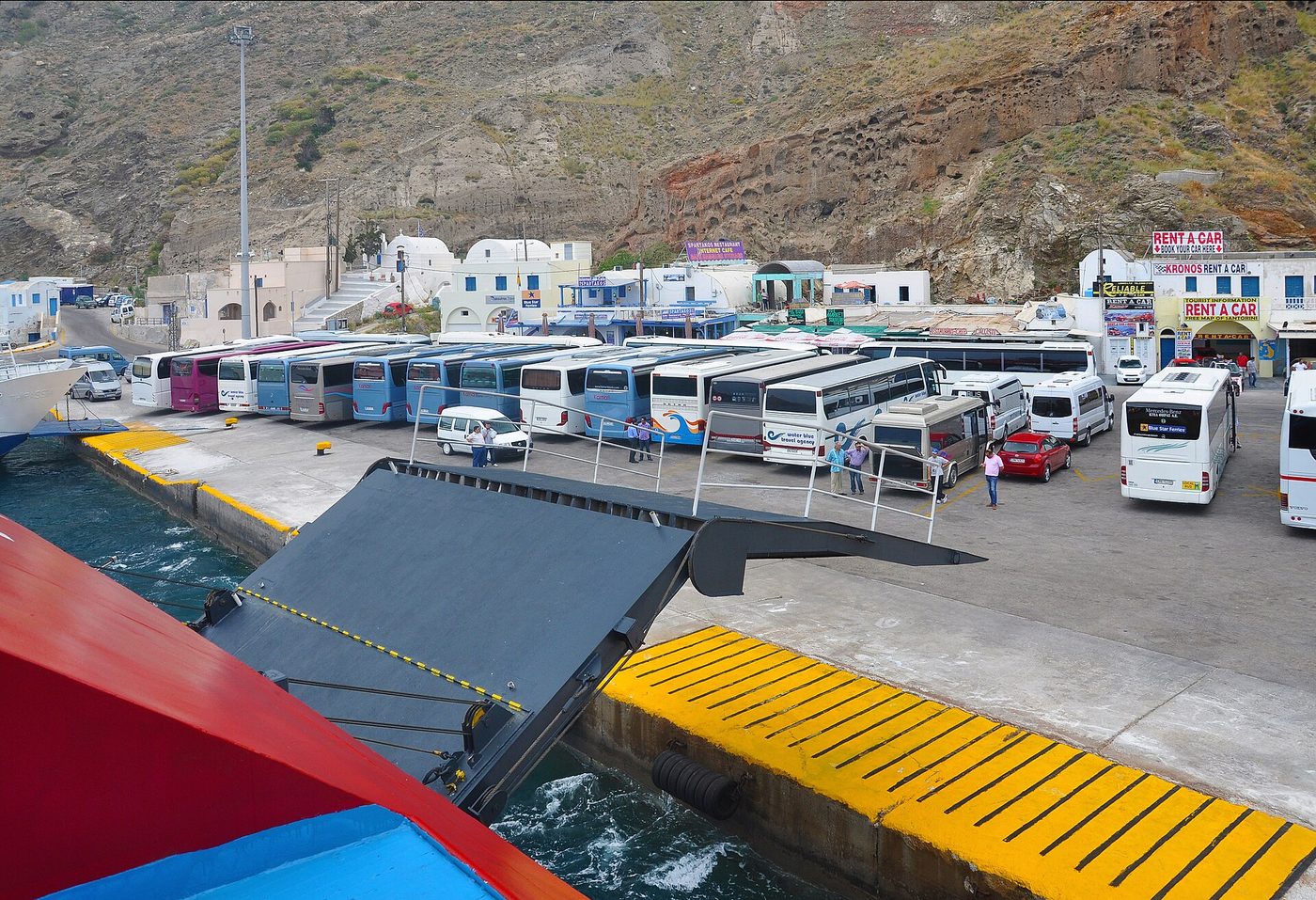
Three things worth knowing before you book a boat. Athinios is squeezed under the cliffs and it congests fast when several ships dock together, so arrange a transfer or know your bus. Catamarans are the first thing cancelled when the wind gets up. And if you are combining Santorini with other islands, the ferry is not just transport, it is the cheapest sightseeing on the trip. Our Greek island hopping itinerary maps the routes that actually connect, and getting around Europe covers the wider ferry, rail and budget-flight picture.
Coming from further afield, most people route through Athens and stitch on a day or two in the capital. That is a good idea: our guide to things to do in Athens makes the case for at least two nights, and the Greece itinerary shows how Santorini fits into ten days. If you are pairing Greece with Italy, the Italy and Greece itinerary handles the ferry and flight logistics of that combination.
Entry paperwork
Greece is in the Schengen area, so the EU Entry/Exit System now applies to non-EU visitors at the border on the same terms as anywhere else in the zone. ETIAS, the separate travel authorisation, is not yet in force and, as of late September 2026, has no start date. Our Schengen visa and ETIAS explainer covers where both stand. Carry your actual passport around the island rather than a photocopy: Greek police can ask to see it, and a copy may not be accepted.
Getting around Santorini
The island is 16 km long and about 45 minutes to drive end to end. That sounds trivial and is not, because the roads are narrow, the parking in Oia and Fira is close to hopeless in season, and every bus route goes through Fira.
The KTEL bus, which is better than its reputation
KTEL Santorini runs 23 buses and every route starts or ends at the central station in Fira. That is the one structural annoyance: a trip from Kamari to Oia means a change in Fira and a second fare. Fares are cash to the conductor, in euros, and you want small notes. Service runs roughly every 30 to 60 minutes depending on route and season. There is no luggage charge anywhere on the official price table.
| Route from Fira | Fare | Distance |
|---|---|---|
| Oia | €2.20 | 11.8 km |
| Firostefani and Imerovigli | €2.20 | Short hop |
| Kamari | €2.20 | 7.3 km |
| Airport (via Kamari and Monolithos) | €2.20 | About 5 km direct |
| Megalochori | €2.20 | 10.7 km |
| Pyrgos (via Vothonas) | €2.20 | About 8 km |
| Emporio | €2.20 | 14.2 km |
| Akrotiri village | €2.20 | 15.1 km |
| Akrotiri beach | €2.20 | 16.5 km |
| Athinios port | €2.70 | 18 km |
| Perissa and Perivolos | €2.70 | 20.4 km |
| Vlychada | €2.80 | 20.4 km |
| Kamari to Athinios (direct) | €2.60 | 19.9 km |
Two discounts and one surcharge. Students get 25 per cent off, so Fira to Oia is €1.70. Large-family and disability cardholders get 50 per cent off, making it €1.10. Between 00:30 and 05:00 there is a 25 per cent night surcharge, which takes Fira to Oia to €2.80, Fira to Perissa to €3.40 and Fira to Vlychada to €3.50. The official timetable does not publish journey times; from experience Fira to Oia takes roughly 25 to 30 minutes when the road is clear, longer when it is not.
Taxis and Uber
There are very few taxis on Santorini and they do not multiply in August. Expect €20 to €35 from the airport to Fira in the daytime, and roughly €35 to €45 to Oia, with an airport pick-up surcharge on top and more at night. Uber operates but draws on the same small pool of licensed local cars, so availability collapses exactly when you need it: after the Oia sunset, late at night, at the ferry port, and at flight arrival peaks. Book transfers in advance for arrival and departure, and treat spontaneous taxis as a bonus rather than a plan.
Renting a car, a quad or an ATV
A car is the single biggest quality-of-life upgrade on this island if you are staying more than three days and not sleeping in a caldera village. Rates start from very little through aggregators out of season and climb steeply in August.
Quads and ATVs are everywhere, and the rules around them are worth reading properly because people get this wrong and it costs them.
- A standard category B car licence is legally sufficient for a quad or ATV in Greece. You do not need a motorcycle licence.
- Most operators additionally require you to be 21 or over and to have held the licence for at least a year. Officials have proposed raising that to five years and requiring rental firms to provide helmets; as of mid-2026 this is a proposal, not law.
- Helmets are mandatory by Greek law for quad and moped riders and passengers. Riding without one can invalidate your insurance, and police issue fines and confiscate licences.
- Provisional licences are not valid in Greece for driving or hiring anything.
- A moped needs at least category A1. A UK category P entitlement for 50cc mopeds is not valid in Greece.
- Quad biking is classed as an extreme sport and is excluded from a lot of travel insurance. The hire company’s cover is usually third party only. Read your policy before you sign.
- Carry the original licence and your passport. Photocopies may be refused.
On the International Driving Permit question: since 5 November 2021, US and Canadian national licences have been legally recognised in Greece for both renting and driving, so no IDP is legally required. In practice, rental firms on Santorini, Mykonos, Crete and elsewhere in the Cyclades routinely demand one from non-EU drivers and may simply refuse the rental without it, and the US Embassy in Greece recommends carrying both. Get the IDP. It costs very little and removes an argument at a desk in a language you do not speak. EU licences need nothing extra.
Rough daily rates I have seen quoted for 2026: about €25 to €30 for a 125cc to 200cc quad, €35 to €65 for 200cc to 400cc, €70 to €95 for the big 550cc-plus machines, and €70 to €150 for a buggy. Roughly half of quad operators will not rent for a single day at all in peak season.
The cable car, the steps and the mules
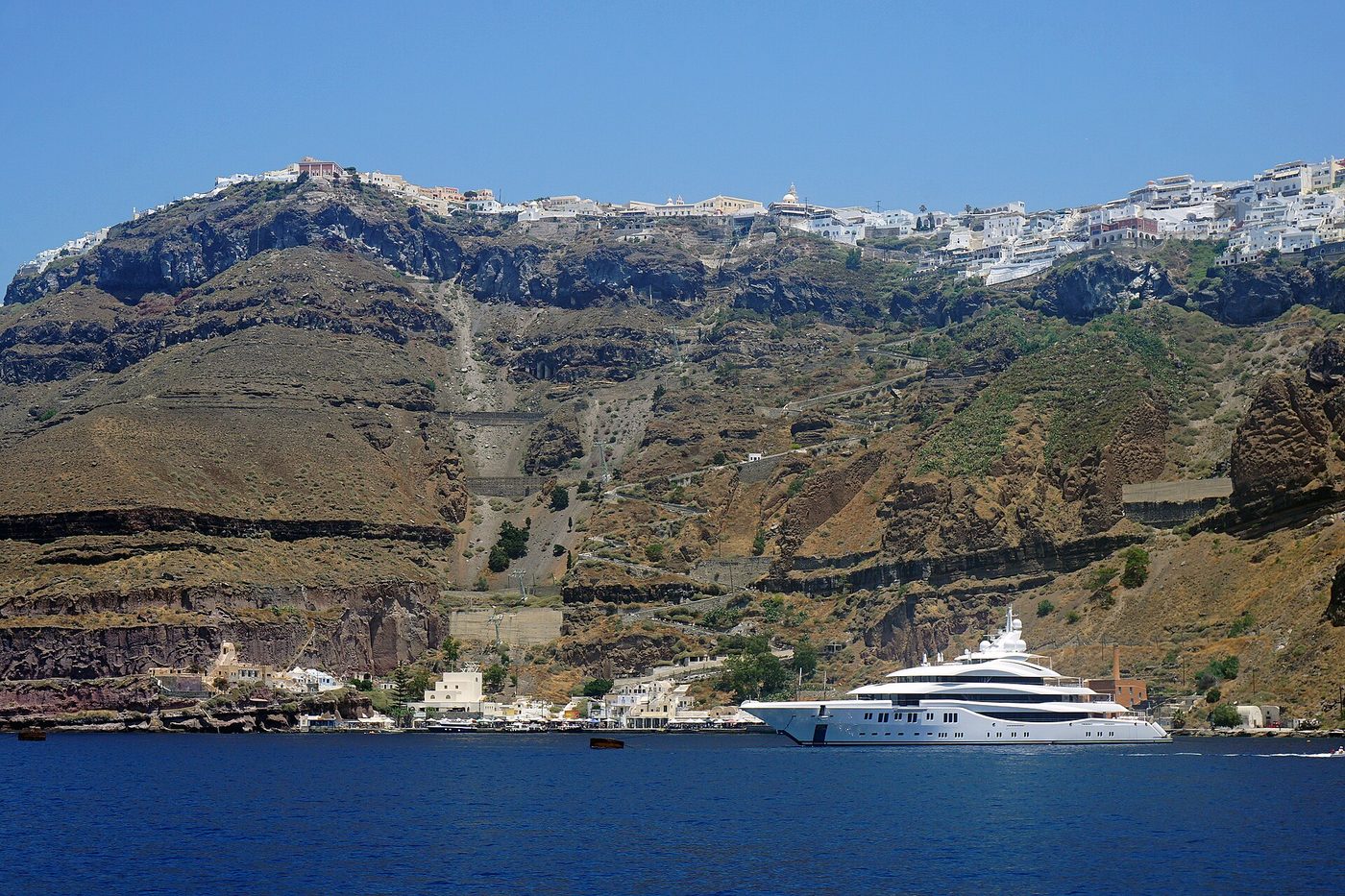
The cable car connects Fira with the Old Port at Gialos, a vertical rise of about 220 metres covered in three to five minutes. It was built by Doppelmayr from 1980, opened in 1982, and was funded by the Loula and Evangelos Nomikos Foundation. The Municipality of Thera runs it, and ticket revenue is shared among the island’s fourteen communities with a portion allocated to supporting the traditional mule drivers.
| Cable car | Detail |
|---|---|
| Adult fare, one way | €10 |
| Child fare, 6 to 12 | €5; under 6 free |
| Luggage | €5 per item |
| Capacity | 1,200 passengers per hour, 600 each way |
| Cabins | 6 cabins per train, 6 passengers per cabin |
| Summer hours | 06:30 to 23:00 June to August, last departure from the top at 22:40, roughly every 20 minutes |
| Shoulder-season hours | 06:30 to 22:00 in May, September and October, last departure from the top at 21:40 |
| Wheelchair limit | Maximum 58 cm wide and 120 cm long to fit the gondola |
Check the fare at the booth before you join the queue, and note that strollers and pets may not be suitable for the gondolas.
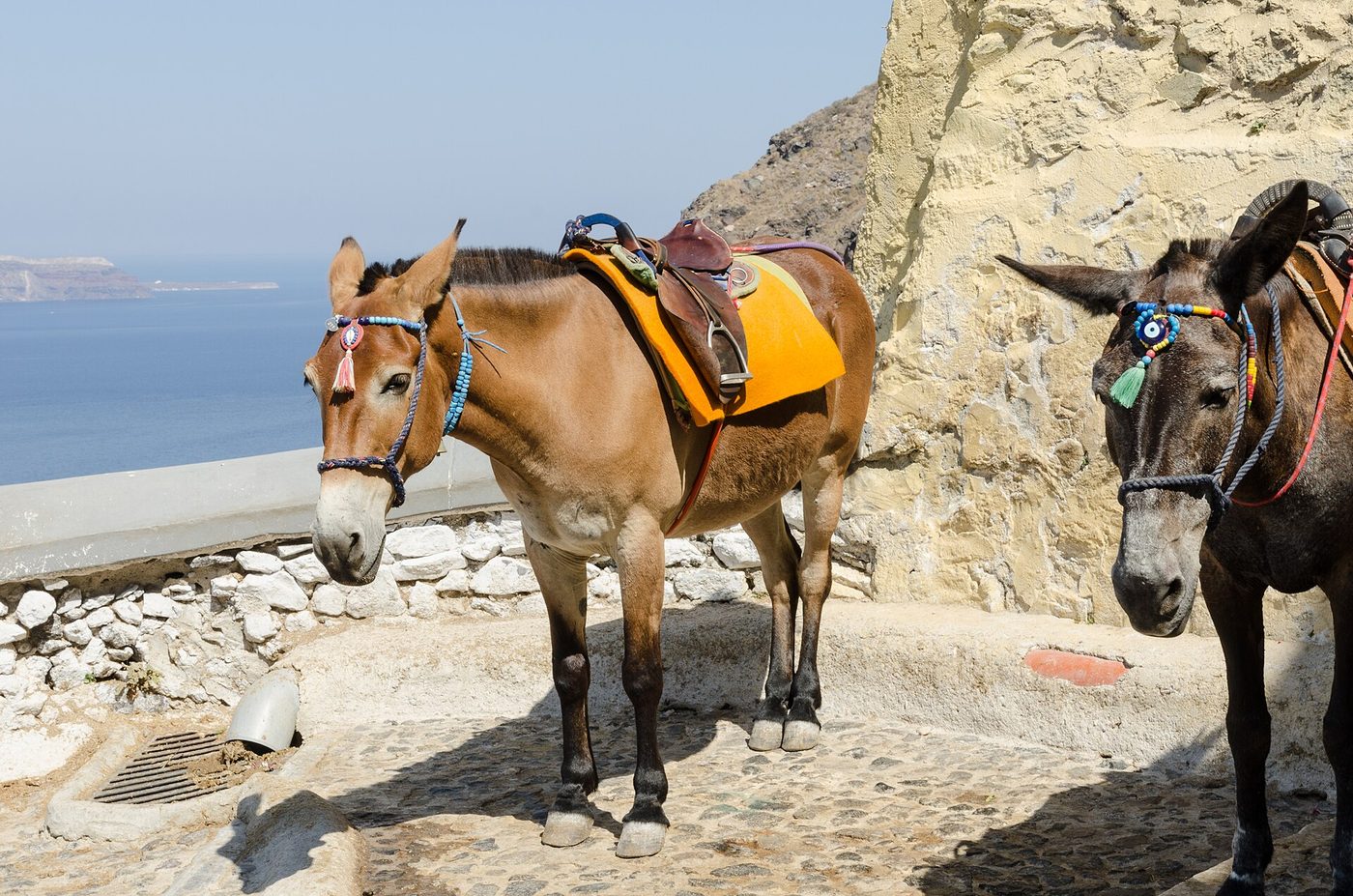
The alternative on foot is the Karavolades stairway, 588 zigzag steps rising about 231 metres, which takes most people an hour to an hour and a half going up. It is shadeless, it smells of mule, and the surface is polished stone. Going down is fine in decent shoes. Going up in August is a genuinely bad idea unless you are fit and early.
The mules are the third option, and I do not use them. Roughly a hundred animals work the steps in summer. Greek national regulation caps the weight each animal may carry and requires access to water and shelter from the weather, but welfare organisations report enforcement as patchy at high-volume sites like this one, and I could not find the current weight limit in kilograms published anywhere. There is no ban in 2026, and the cable car exists as the humane alternative, which is how the island itself frames it. Your call, but make it a considered one.
Where to stay in Santorini
This is the decision that determines your trip. Santorini’s price gradient is brutal: the same room quality can cost two to four times more with a caldera view than it does five minutes inland, and the caldera villages are the ones with the steps, the crowds and the pedestrian-only access.
| Base | Character | Typical nightly rate | Best for | The catch |
|---|---|---|---|---|
| Oia | The postcard. Cave suites, plunge pools, sunset crowds | €600 to €2,000+ at peak, more at the very top | Honeymoons, photography, one big splurge | Most expensive, most crowded, most steps |
| Imerovigli | Highest point on the rim, widest views, calmer | Caldera-view bands apply | Views without the Oia scrum | Steep, few shops, need wheels or the bus |
| Firostefani | Between Fira and Imerovigli, walkable to both | Caldera-view bands apply | First-timers who want views and convenience | Still expensive, still stepped |
| Fira | The capital. Buses, banks, restaurants, nightlife | Wide range, cheapest caldera-adjacent options | No car, short stays, island logistics | Cruise crowds 10:00 to 12:00, noisier |
| Pyrgos and Megalochori | Inland villages, real life, good food | €100 to €180 | Value, quiet, second visits | No caldera view from most rooms |
| Kamari | Beach town under Mesa Vouno, long promenade | From about €80 | Families, flat walking, beach days | Twenty minutes from the caldera villages |
| Perissa and Perivolos | Long black-sand strip, beach bars, water sports | Budget to mid | Beach and nightlife on a budget | Furthest from the caldera, windy when the meltemi blows |
| Akrotiri and the south | Quiet, near the excavation and the lighthouse | Mid | Drivers, archaeology, sunsets over open sea | You will need a car |
The numbers behind that table: a caldera-view hotel runs roughly €300 to €600 a night in shoulder season and €600 to €2,000 or more at peak. Inland hotels sit around €100 to €180, commonly 40 to 50 per cent below a comparable caldera-side room and far below a rim suite, often five minutes’ walk from a caldera view you can go and look at whenever you like. Peak season roughly doubles shoulder-season prices across the board.
Booking lead time is longer here than almost anywhere in Europe: six to nine months ahead for June through September, a little later for May, October and early November. If you want a specific cave suite in Oia in August, that is a January decision.
Two warnings that catch people out. Many caldera hotels are pedestrian-only and cannot be reached by car, so you and your suitcase are doing the last stretch on steps. And a lot of the boutique caldera properties are adults-only or carry minimum age rules, because of cliffside layouts and unfenced plunge pools. Check before you book with children. Our where to stay in Europe guide covers the same base-choosing logic for other destinations.
The villages, one by one
Santorini is not a town with suburbs, it is a string of distinct villages along a rim plus a scattering of inland ones. Knowing which is which is most of the battle.
Fira
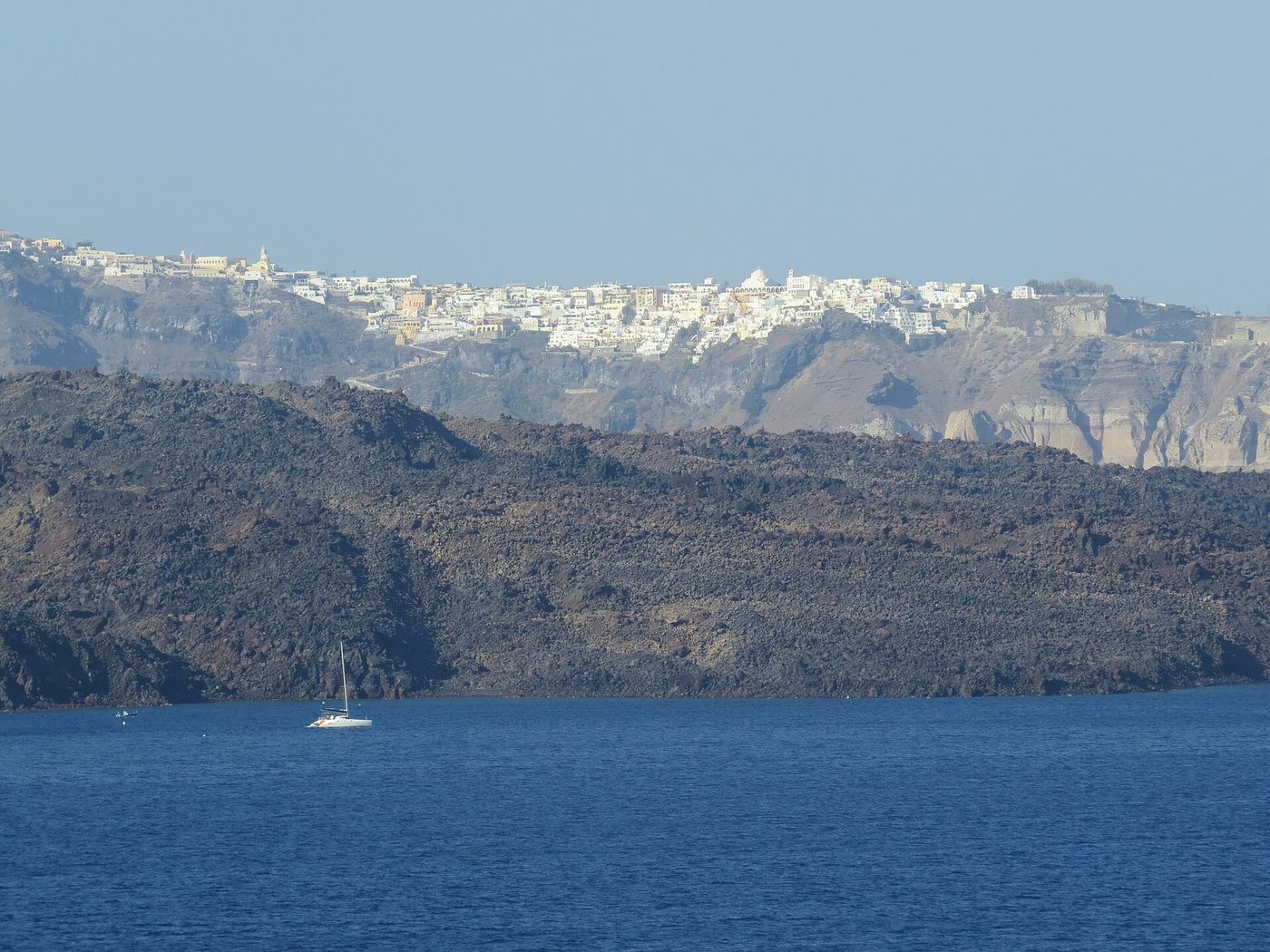
The capital, and the island’s engine room. Every bus route runs through it, the banks and pharmacies are here, and so is most of the nightlife. It also takes the full weight of the cruise arrivals, since the cable car and the steps land right in the middle of it. Come in the early morning or the evening and it is a handsome, vertiginous town with terraces stacked down the cliff. Come at 11:00 in August and it is a corridor of shoulders.
What to actually do here: walk the caldera path north, visit the Museum of Prehistoric Thira, eat somewhere off the rim where the prices are half what they are on it.
Firostefani
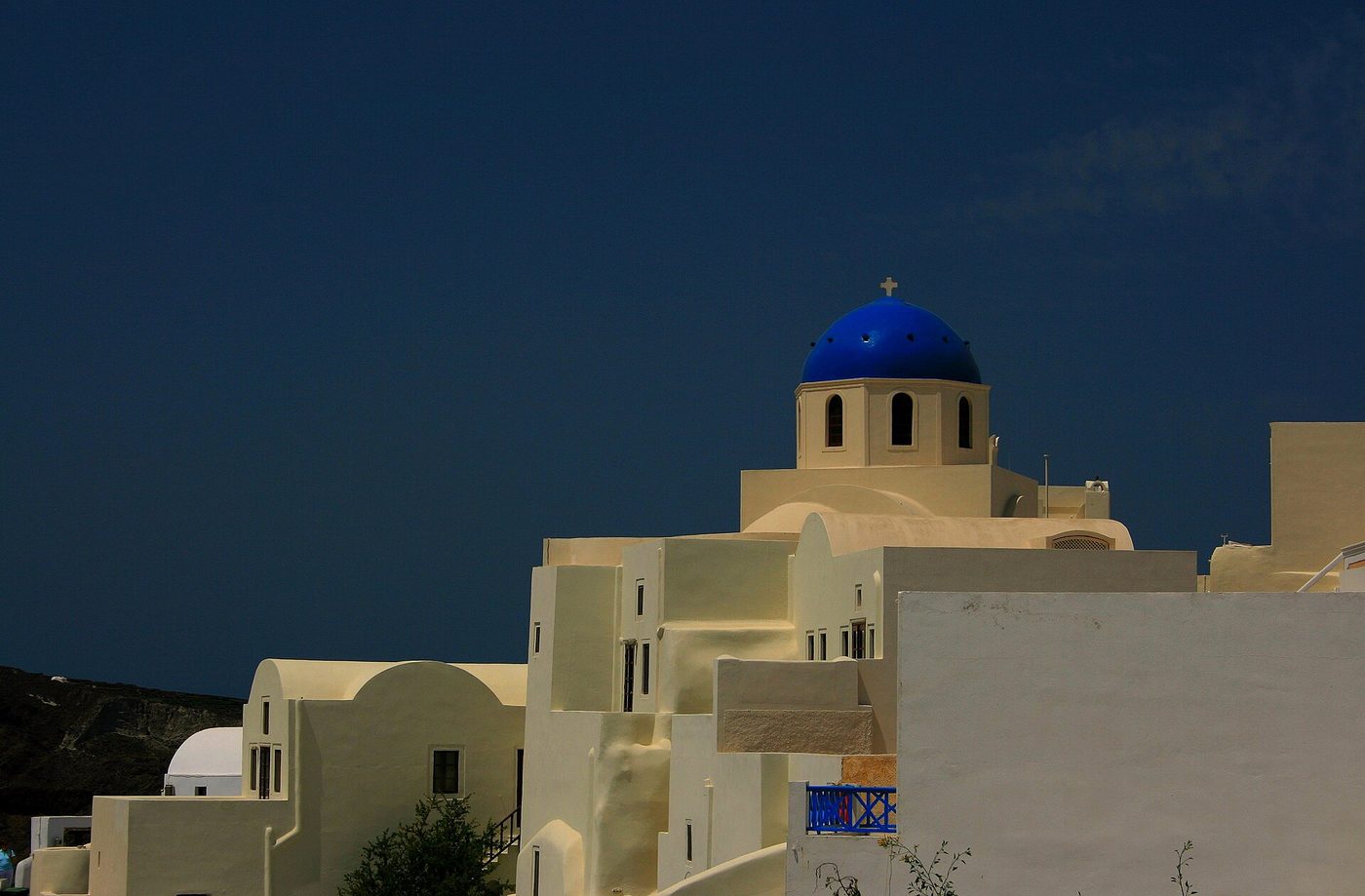
Ten minutes’ walk north of Fira along the rim path, and a noticeable drop in noise. The Church of Agioi Theodoroi and its blue dome above the caldera is one of the most photographed spots on the island and one of the easiest to reach. Good compromise base.
Imerovigli
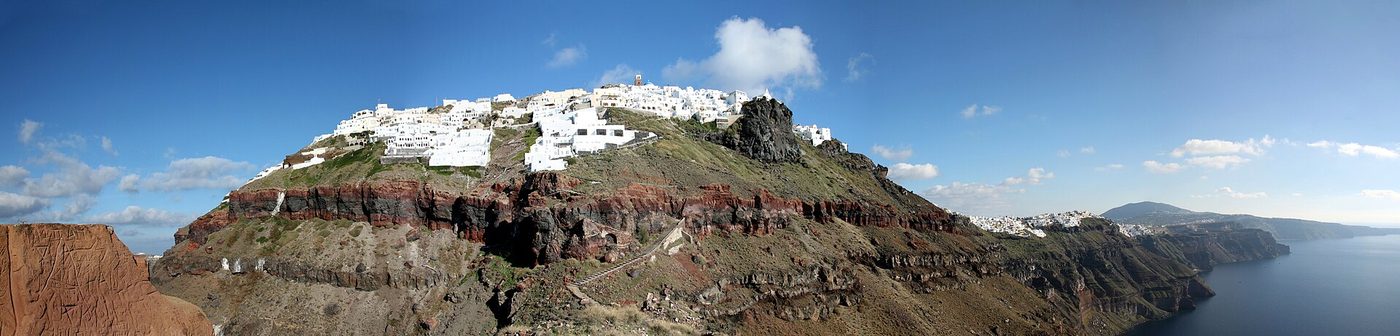
The highest village on the caldera rim, which gives it the widest and least obstructed views on the island. It is calmer and more spacious than either Fira or Oia, and it is where I would stay if the budget stretched to a rim room. Skaros Rock, the headland below it, makes the finest evening walk on the island.
Oia
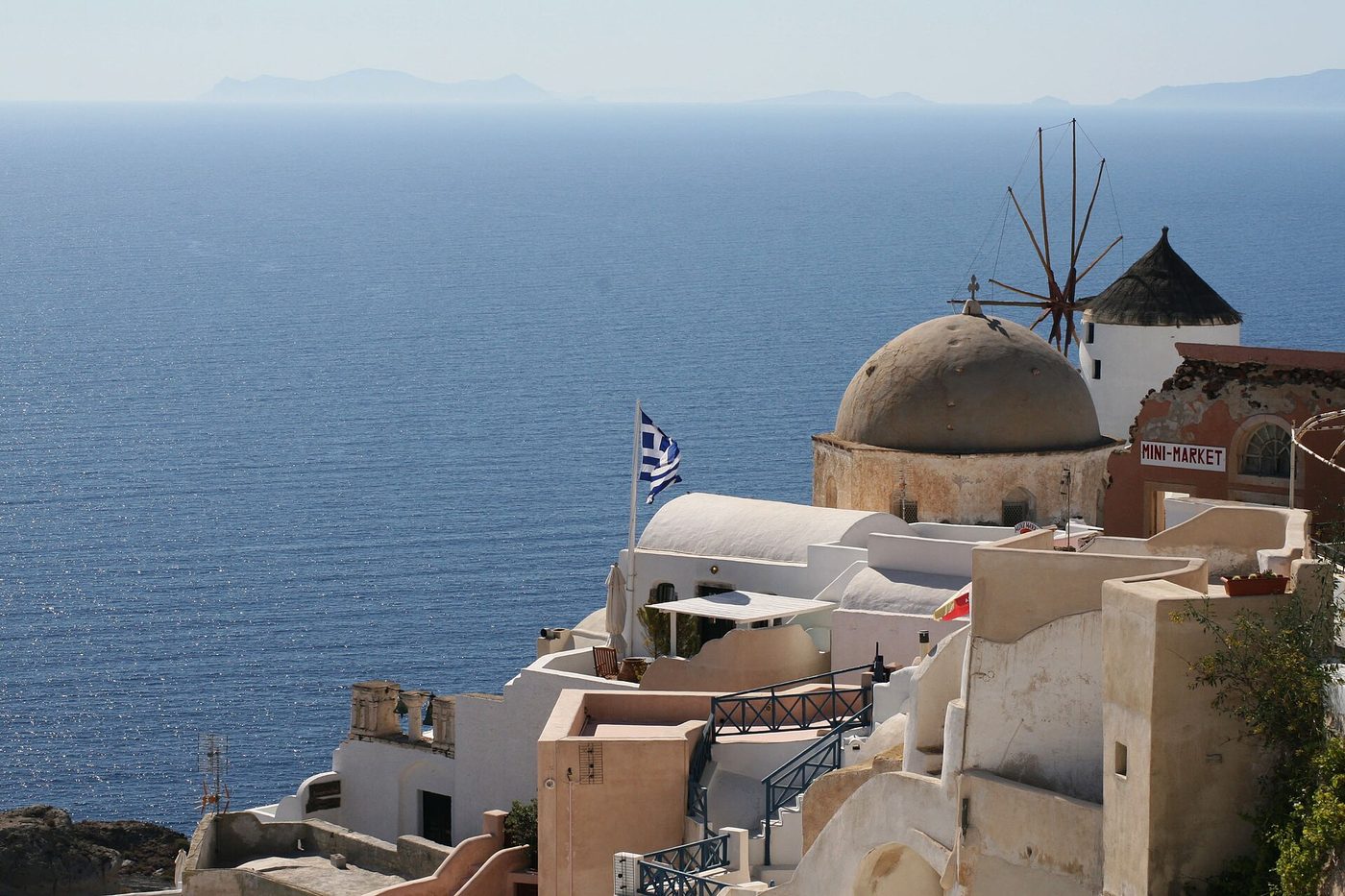
Yes, it deserves the fuss. The stacked white and ochre houses, the blue domes, the windmills at the tip, the way the whole village faces the sunset: it is the image of the Cyclades for good reason. It is also small, and in July and August it holds far more people than it was built for. Go early in the morning, or go for dinner and stay after the sunset crowd disperses. After the view itself, the walk down to Ammoudi Bay and back is what I would spend the time on.
Ammoudi Bay
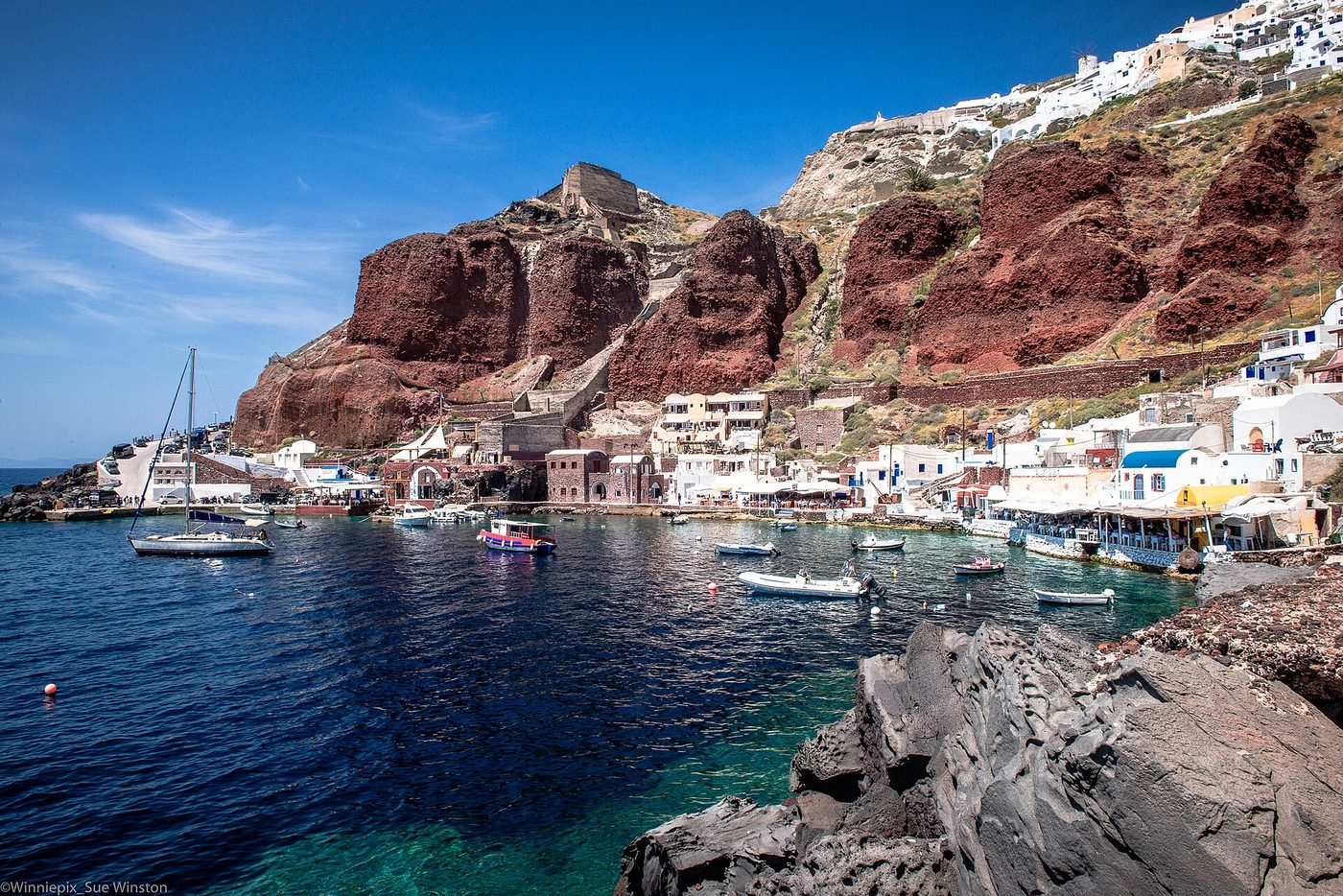
The little fishing harbour at the bottom of Oia’s cliff, reached by a long flight of steps. Red rock, blue water, fish tavernas at the waterline, and a swimming spot off the rocks by the chapel. Walking down is easy. Walking back up in the afternoon heat is not, and a taxi or a lift is a perfectly reasonable use of €10.
Pyrgos
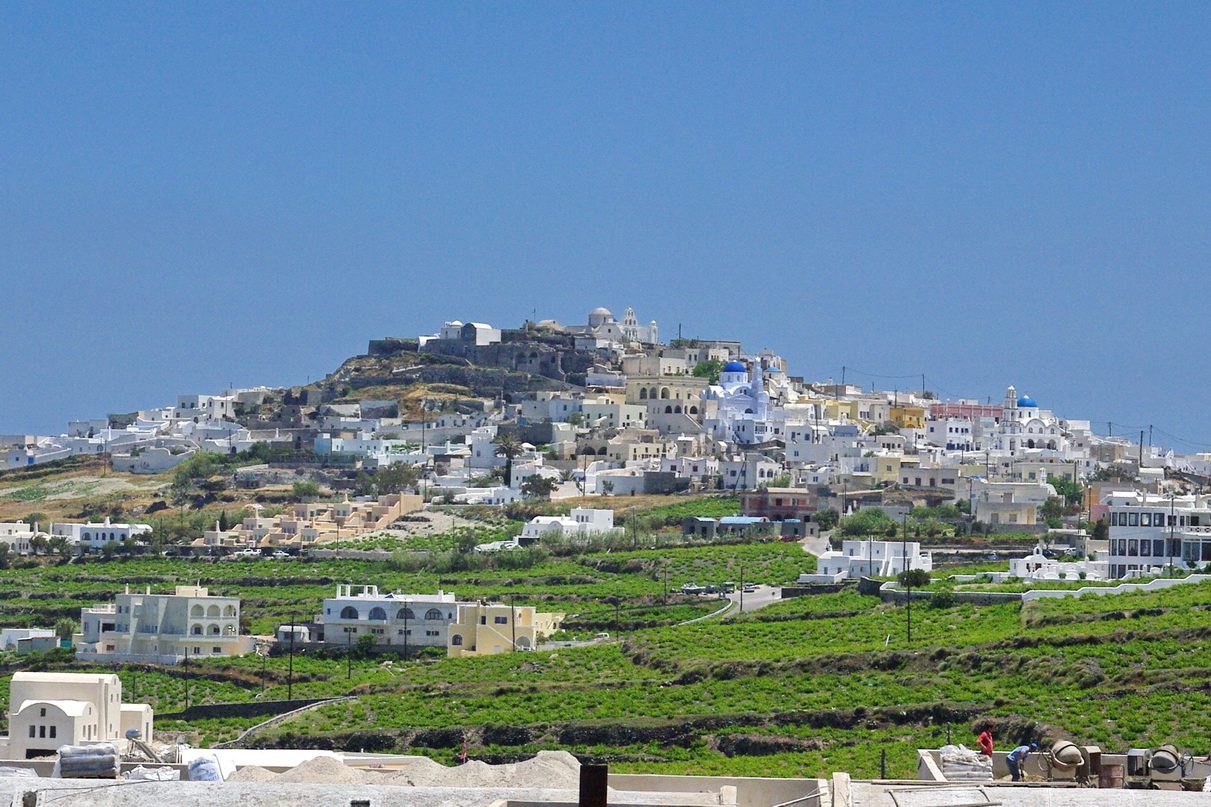
The pick of the inland villages, built up a hill around a Venetian castle in the middle of the island. Kasteli at the top gives you a whole-island panorama rather than a caldera-only one, which is a different and in some ways better view: you can see both coasts, the airport, Mesa Vouno and the caldera at once. Good tavernas, a fraction of the price of the rim, and reachable on a €2.20 bus.
Megalochori and Emporio
Two more inland villages worth an afternoon. Megalochori has a bell tower, wine caves and neoclassical houses built by nineteenth-century wine merchants. Emporio is the biggest village on the island and has a genuine medieval Kasteli, a fortified quarter of blind outer walls and covered lanes built against pirates. Neither is on a coach itinerary, and both are €2.20 from Fira.
Akrotiri and the southern tip
The southwestern corner holds the excavation, the lighthouse at the very tip, the red and white beaches and some of the best wineries. The lighthouse gives you a sunset over open sea instead of over the caldera, with no facilities and limited parking, which is exactly why it is quiet.
Thirassia, the island most people never set foot on
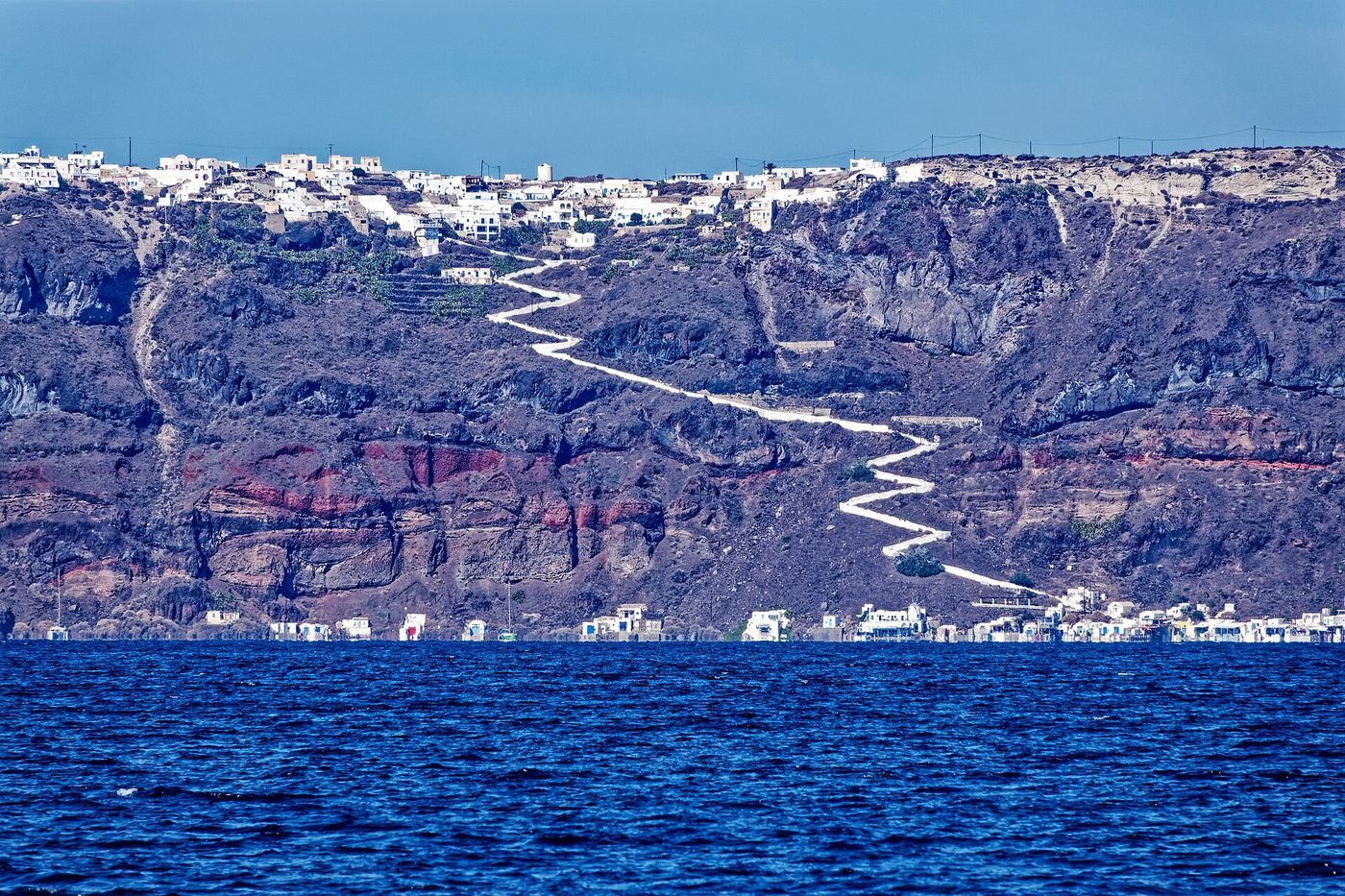
Santorini is a group of islands, and only two of them are inhabited: Thira itself and Thirassia across the water. Thirassia has a few hundred residents, a village called Manolas at the top of a long stair climb from the boat dock, and almost no tourism infrastructure. Boat tours stop there. Very few people stay. If you want to know what Santorini felt like before the cruise ships, this is the closest you will get in a day.
The Santorini sunset, and where to watch it without the scrum
The sunset is the island’s headline act and its worst-managed asset. Everyone goes to the same place at the same time, which is the Byzantine castle ruins at the tip of Oia, also called the Castle of Agios Nikolaos. In July, August and September people arrive hours early and fill every wall, stairway and viewpoint. It is a good sunset. It is not a good experience.
Start with the times, because vagueness is where the planning falls down. These are for Oia in 2026.
| Date or period | Sunset | Note |
|---|---|---|
| Latest sunset of 2026 | 20:41 on 29 June | The solstice on 21 June gives 14h 39m of daylight |
| Through July | After 20:30 | Dinner before the sunset means eating at 18:30 |
| Through August | Around 20:15 | Busiest month at the castle |
| 1 September 2026 | 19:49, dusk at 20:15 | 12h 58m of daylight |
| 30 September 2026 | 19:05 | 44 minutes earlier than 1 September |
| Through October | About 19:00 at the start of the month, about 17:15 by the 31st | Clocks go back on 25 October, which takes an hour off in one night |
| Earliest sunset of 2026 | 17:04 on 6 December | Winter solstice on 21 December has 9h 40m of daylight |
Clocks go forward on 29 March 2026 and back on 25 October 2026. If your restaurant booking is built around the sunset, check the date against that table rather than assuming “about eight”.
How early to arrive, and where else to go
If you are set on the Oia castle, budget a couple of hours before sunset in peak season and about sixty minutes in the shoulder. Then consider not doing that, because the alternatives are better.
- Imerovigli. Higher than both Fira and Oia, with a wider caldera view and room to breathe. My first choice.
- Skaros Rock. The path out toward Skaros and the trail down to the Chapel of Theoskepasti are the best spots, and you do not need to climb the rock itself. Bring a torch for the walk back, because the path is unlit.
- Firostefani. Ten minutes from Fira on the rim path, much quieter, and you can walk to dinner afterwards.
- Pyrgos, at Kasteli. A whole-island sunset rather than a caldera one, with the sun going down behind the rim in front of you.
- Akrotiri Lighthouse. Open-sea sunset at the southwestern tip. No facilities, limited parking, and the walk back to the car in the dark is on a rough track.
- A boat. Sunset catamaran cruises put you in the middle of the caldera looking up at the villages, which inverts the whole picture. Book ahead from June to September.
One more, and it is free: the caldera rim path between Fira and Imerovigli at any point. You are looking at the same sun over the same water as the people packed into the castle.
Walking from Fira to Oia
This is the one thing on the island I would refuse to skip, and it costs nothing.
| Detail | Figure |
|---|---|
| Distance | About 10.5 km (6.5 miles) |
| Elevation gain | 326 m |
| Profile | A net descent of roughly 140 m, with 326 m of climbing folded into it |
| Time | 3 to 5 hours with photo and water stops |
| Villages passed | Fira, Firostefani, Imerovigli, Skaros, then Oia |
| Surface | Paved lanes, steps and dirt path, with loose gravel in places |
| Shade | Almost none between Imerovigli and Oia |
Walk it Fira to Oia rather than the reverse. It is a net descent, the light is better heading north, and you finish in the most famous village on the island with a cold drink and a bus home for €2.20. Note the profile: 326 metres of climbing inside a net descent means a series of ups and downs rather than a downhill stroll.
Start early. In July and August a 09:00 start can already be too late in a heatwave, and there is nowhere to hide on the northern half. Proper shoes, not flip-flops. More water than you think. Sunscreen, sunglasses, a hat. If you enjoy this kind of thing, our guide to hiking in Europe has more coastal walks in this register.
Santorini’s beaches and what to expect from them
Manage your expectations first. Santorini’s beaches are volcanic and dramatic rather than soft and golden. The sand and pebbles get painful underfoot in July and August, so bring something you can walk in. The east and south coasts catch the meltemi, so a beach day here is more weather-dependent than on most Greek islands.
| Beach | What it is | Sunbeds | Getting there |
|---|---|---|---|
| Perissa | Long black sand under the Mesa Vouno cliff, tavernas and water sports | Free up to about €30 a set | Bus €2.70 from Fira |
| Perivolos | Continuation of Perissa, beach-club territory | Sold as packages with drinks and food, minimum spend common | Bus €2.70 from Fira |
| Kamari | Family-friendly dark sand, long promenade, most restaurants | €10 at the quiet ends, €30 to €40 for prime August spots | Bus €2.20 from Fira |
| Vlychada | Quiet, sculpted pale volcanic cliffs, marina alongside | Effectively none | Bus €2.80 from Fira |
| Red Beach | Red cliffs and red sand near Akrotiri. Access restricted, see below | None to rely on | Boat from Akrotiri harbour, €5 to €8, about 10 minutes |
| White Beach | Pale cliffs, small cove | None | Boat only |
| Kolumbo (Cape Columbo) | Remote black sand on the northeast coast, about 8.5 km from Fira | None. No lifeguards, showers or tavernas either | Dirt road with free parking; own wheels |
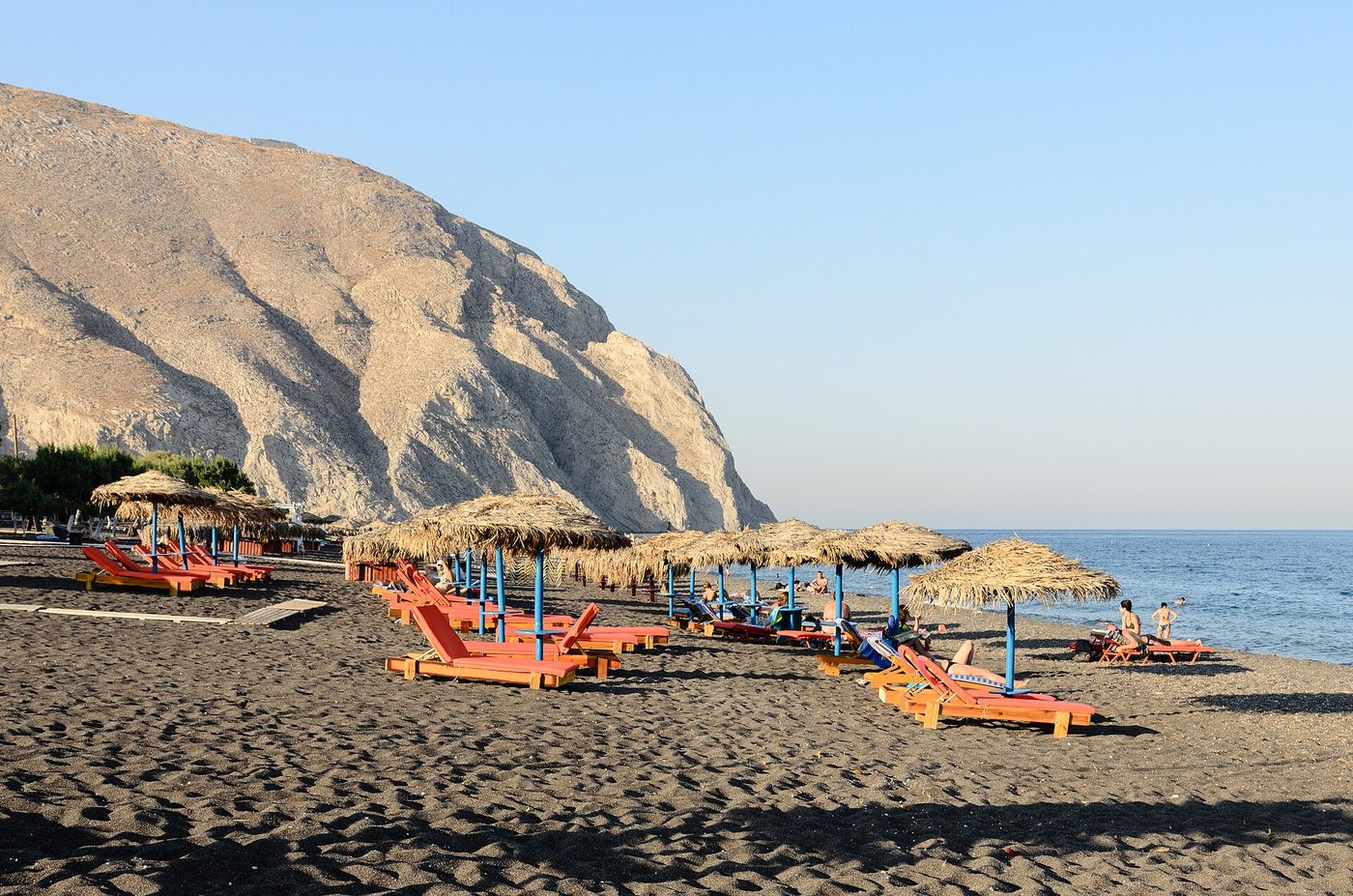
Kolumbo, at Cape Columbo on the northeast coast, is the outlier in that table and the one worth the effort if you have wheels. It is a wide sweep of black volcanic sand reached down a dirt road with free parking at the end, with no lifeguards, no showers, no sunbeds and no taverna. On a still day it is the emptiest good beach on Santorini. On a windy one it is unswimmable, so check the forecast before you drive out.
Where an organised beach flies a flag system, take it seriously: a red flag means stay out of the water. At the organised beach clubs, as opposed to the ordinary stretches in the table above, a set of two beds and an umbrella runs from about €30 to €150 depending on the club and the row. That is a wide enough band that you should ask the price before you sit down.
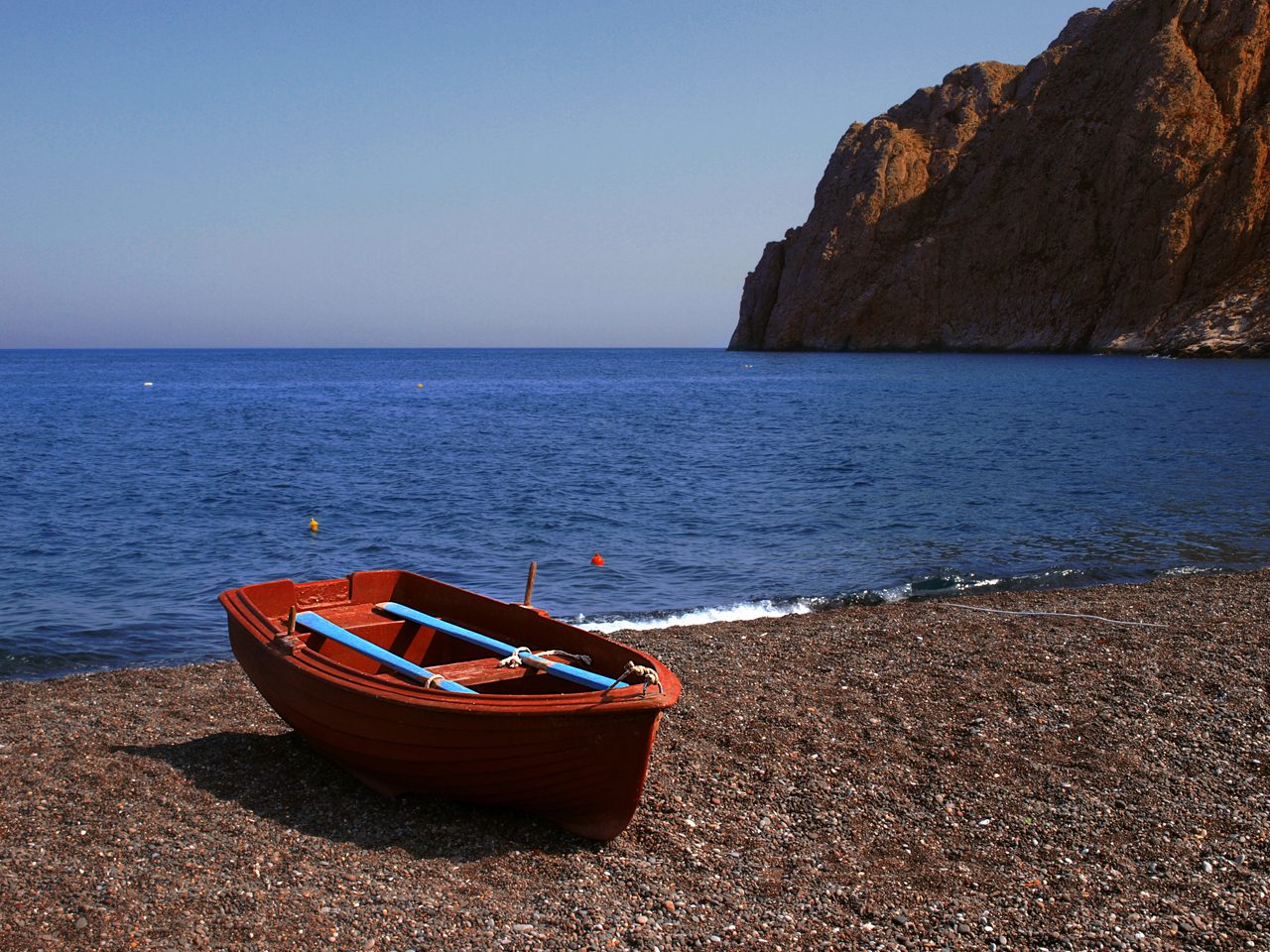
Red Beach: the honest position
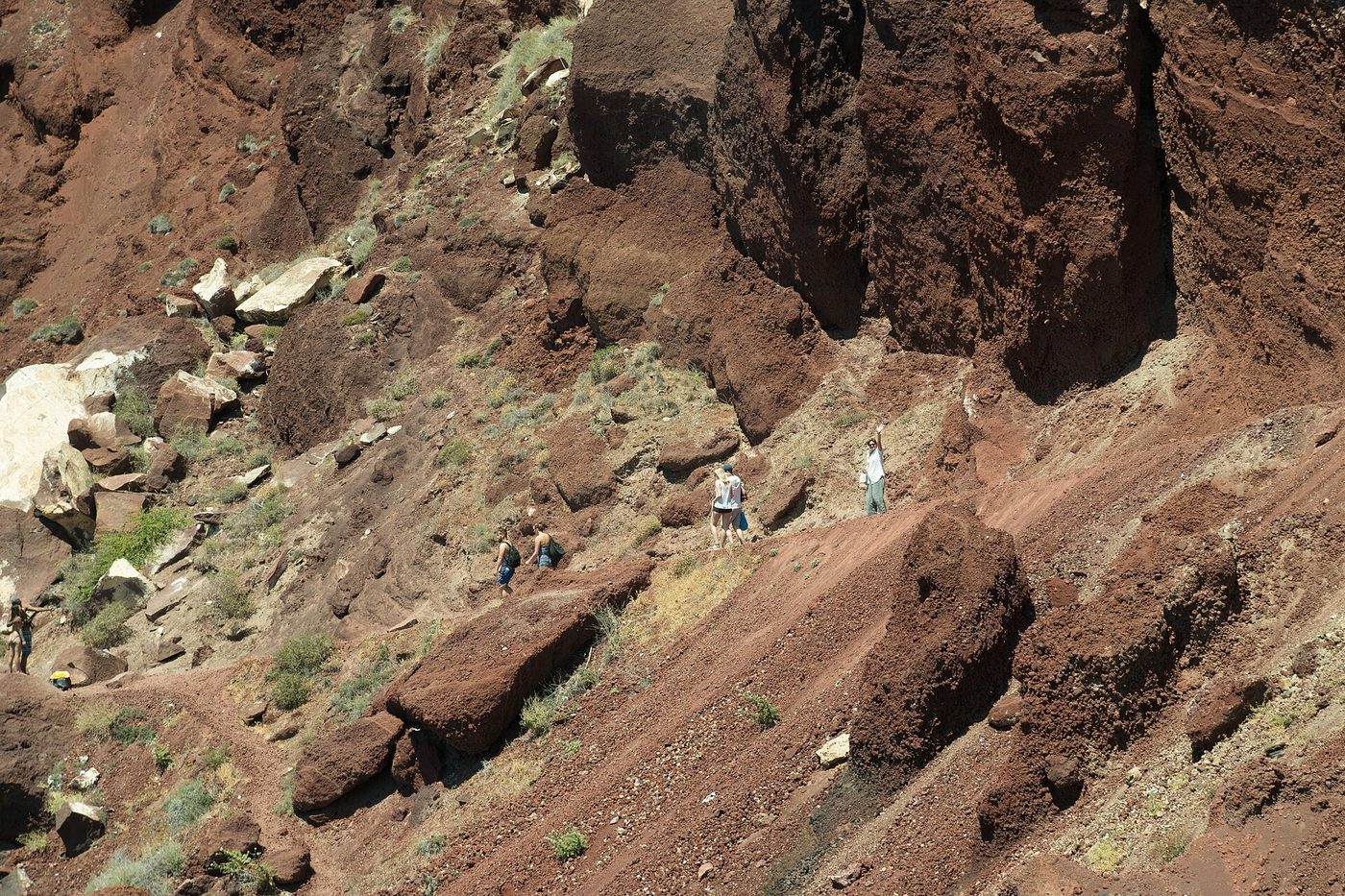
Red Beach closed in February 2025 after rockfalls during the seismic swarm, and the situation since has been murky. One 2026 source says the cliff-side footpath closes repeatedly for rockfall risk, that parts of the beach remain officially restricted, and that hotels and operators have been told to discourage people from using the path. Another, a Santorini booking platform, says access is unchanged by boat or by the small footpath and that the rockfalls predate the earthquakes entirely. I could not resolve that contradiction from a primary source.
What I would do: treat Red Beach as a viewpoint rather than a beach day. Look at it from the marked overlook, which is the best angle anyway, and if you want to swim there, go by boat from Akrotiri harbour for €5 to €8. Whatever you do, take posted rockfall warnings at face value. This is loose volcanic tuff above a narrow strip of sand, and it has come down before.
Akrotiri, Ancient Thera and the museums
Santorini’s archaeology is world-significant and comprehensively under-visited relative to the sunset. If you do one indoor thing here, make it Akrotiri.
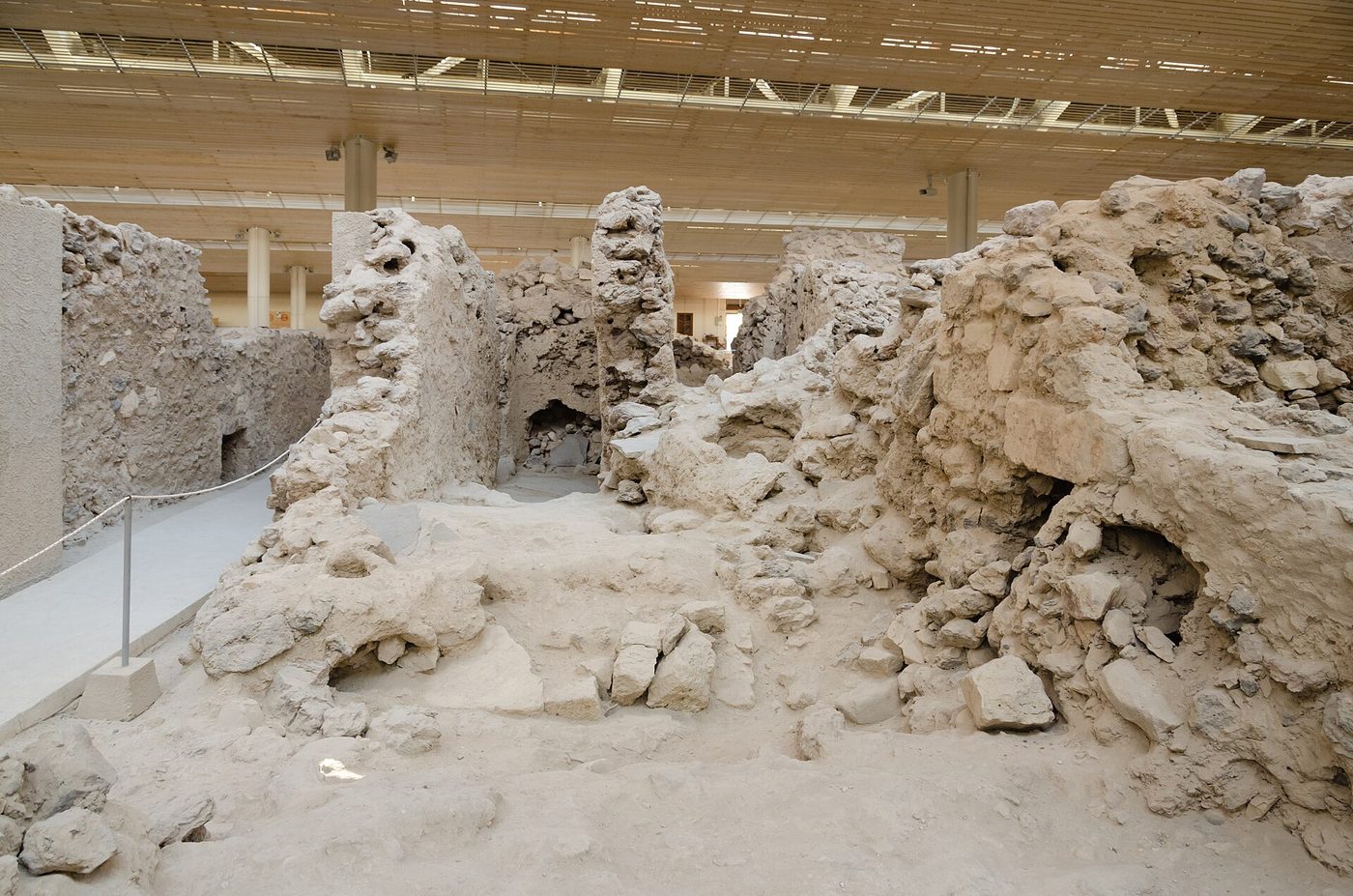
The Akrotiri excavation
A Bronze Age town buried by the eruption that reshaped the island, preserved in ash with its streets, drains, multi-storey houses and frescoes intact. It is fully roofed and toured on elevated walkways, which matters practically as well as archaeologically: it works on a 30°C afternoon, in a meltemi, and in the rain, which makes it the obvious wet-weather and heatwave option. Budget one to two hours.
It closed in early 2025 for seismic safety checks on the roof and reopened to the public on Friday 11 April 2025. It has been open and selling tickets ever since, including online.
| Site or museum | Ticket | Hours | Closed |
|---|---|---|---|
| Akrotiri excavation | €20 | 1 Apr to 31 Aug: Wed, Fri, Sat, Sun 08:00 to 20:00, tapering earlier from September (see below); Mon and Thu 08:30 to 15:30. 1 Nov to 31 Mar: daily 08:30 to 15:30 | No weekly closing day |
| Ancient Thera | €10 (€5 reduced) | 08:30 to 15:30 | Wednesdays |
| Museum of Prehistoric Thira, Fira | €10 | 08:30 to 15:30, year round | Tuesdays |
| Archaeological Museum of Thera, Fira | €10 | Standard state museum hours | Check locally |
| Agia Triada Collection, Pyrgos | €5 | Standard state museum hours | Check locally |
Akrotiri’s summer closing time tapers through the autumn: 19:30 from 1 to 15 September, 19:00 from the 16th to the 30th, 18:30 for the first half of October and 18:00 for the second. Last admission at the state museums is twenty minutes before closing.
A note on the combined ticket. A €15 three-day combined ticket covering Akrotiri, Ancient Thera and the Museum of Prehistoric Thira is widely quoted, but €15 is less than the €20 Akrotiri single, which is internally inconsistent and may predate the April 2025 repricing. I could not verify it against an official source. Ask at the Akrotiri ticket office before you assume it exists at that price.
Ancient Thera
The classical and Hellenistic city on the Mesa Vouno ridge between Kamari and Perissa, several hundred metres above the sea, with a theatre looking straight down the cliff. You can walk up from Perissa or drive the switchbacks from Kamari. Entry is €10, with a €5 reduced rate for EU citizens over 65 and non-EU visitors under 25. Closed Wednesdays. Go early: there is no shade on the ridge.
The Museum of Prehistoric Thira
In Fira, and the place where the Akrotiri frescoes and finds actually live. Doing the museum and the excavation on the same trip is what makes either of them make sense. Official price is €10, identical in summer and winter, open 08:30 to 15:30 and closed Tuesdays. Some secondary sources still quote €6; the Ministry-run museum directory says €10 and that is the number to plan around. The museum lists a ramp, a lift and an accessible WC among its services.
Free and reduced admission
- Free for EU citizens under 25 on production of ID, and for non-EU citizens under 18.
- Fifty per cent off for EU citizens aged 65 and over, from 1 October to 31 May.
- Free admission days at Greek state sites and museums: 6 March, 18 April, 18 May, the last weekend of September, 28 October, and the first Sunday of each month from 1 November to 31 March. A 2025 announcement adds every third Sunday from November to March, though that is not yet reflected in the official directory text.
- Closed days: 1 January, 25 March, Greek Orthodox Easter Sunday, 1 May, and 25 and 26 December.
- The old reduced winter entry fee for everyone was abolished in April 2025, so headline prices are the same year round. The over-65 EU concession above is a separate thing and still applies.
Santorini wine: Assyrtiko, kouloura and where to taste
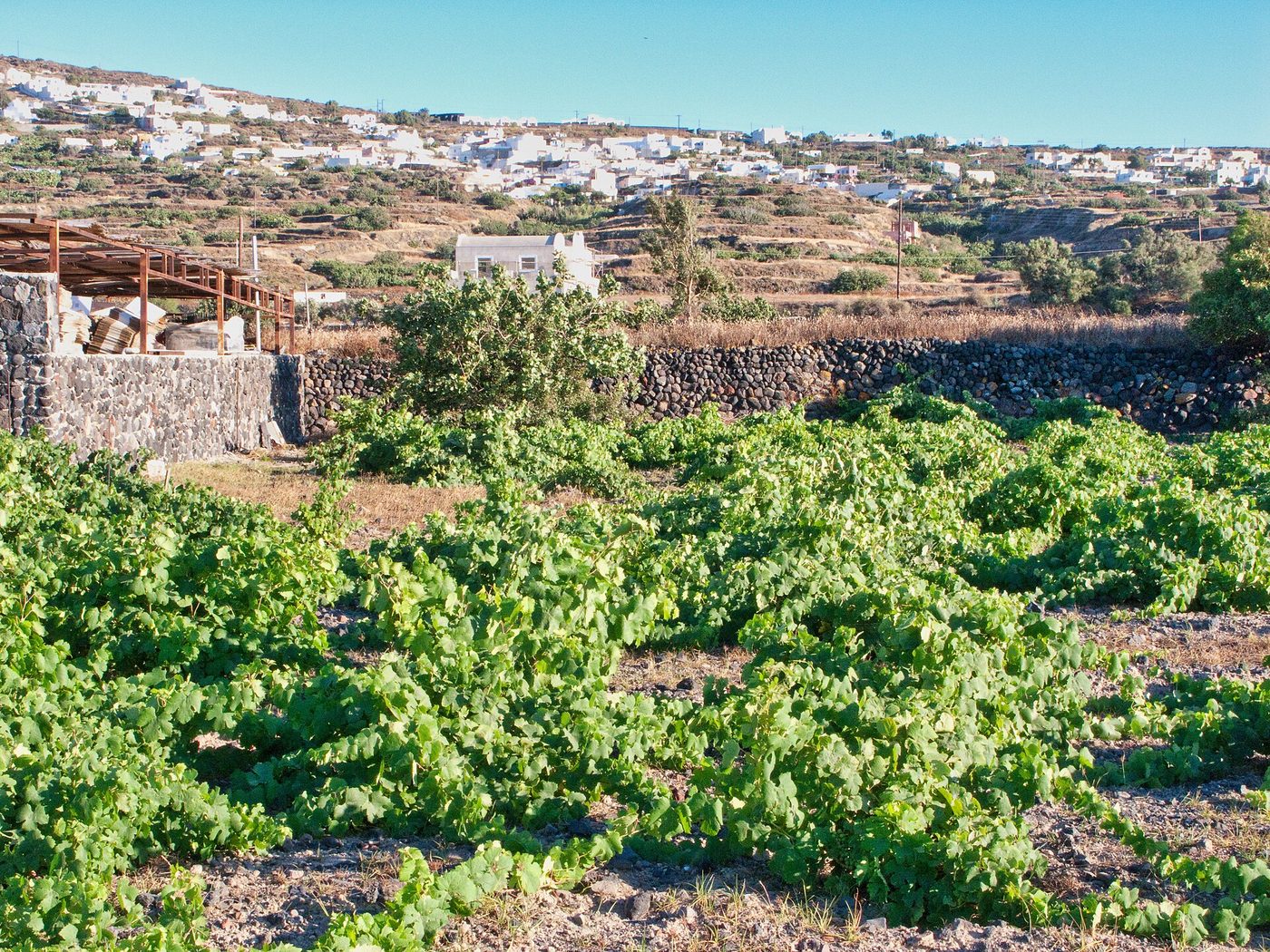
This is the part of Santorini I would fight for. The island grows white grapes on pumice and ash with almost no rainfall, and the vines survive on sea mist condensing overnight. To protect them from the meltemi and the sun, growers train each plant into a basket called a kouloura, a coiled nest of woody cane with the grapes growing inside it, sheltered from the wind. There is a second local system, kladeftiko, developed for the same reason. After many years of this pruning the sap has to travel several metres of coiled old wood to reach the fruit, which is part of why yields here are so low and prices so high.
The wine itself: PDO Santorini dry white must be at least 85 per cent Assyrtiko, with up to 15 per cent Athiri and Aidani. The sweet version needs at least 51 per cent Assyrtiko plus a list of local grapes including Aidani, Athiri, Gaidouria, Katsano and Monemvasia. Vinsanto, the amber dessert wine made from sun-dried Assyrtiko, is the island’s other calling card and is worth a glass even if sweet wine is not your thing.
| Winery | Tasting price | What it is good for |
|---|---|---|
| Santo Wines | Flights €18 to €55; short tour with two tastings €12 | The biggest terrace and the widest caldera view. Busy with coaches |
| Venetsanos | €12 to €28; wine and a light meal €55 per person | Smaller, more refined, fewer buses, better food pairings |
| Estate Argyros | Book ahead, prices vary by flight | Serious wine, old vines, less about the view |
| Domaine Sigalas | Book ahead, prices vary by flight | Same, up in the north near Oia |
| Gaia Wines | Book ahead, prices vary by flight | On the beach at Exo Gialos, which is a change of scene |
Late afternoon is the best slot, and sunset tastings need booking. If you want the view, Santo Wines is unbeatable and you will share it. If you want the wine, go to Argyros or Sigalas. There is no reason not to do both across a week. Our guide to European food puts Greek island cooking in context, and the best Mediterranean destinations covers where else in the region does this well.

The volcano, the hot springs and the caldera boat tours
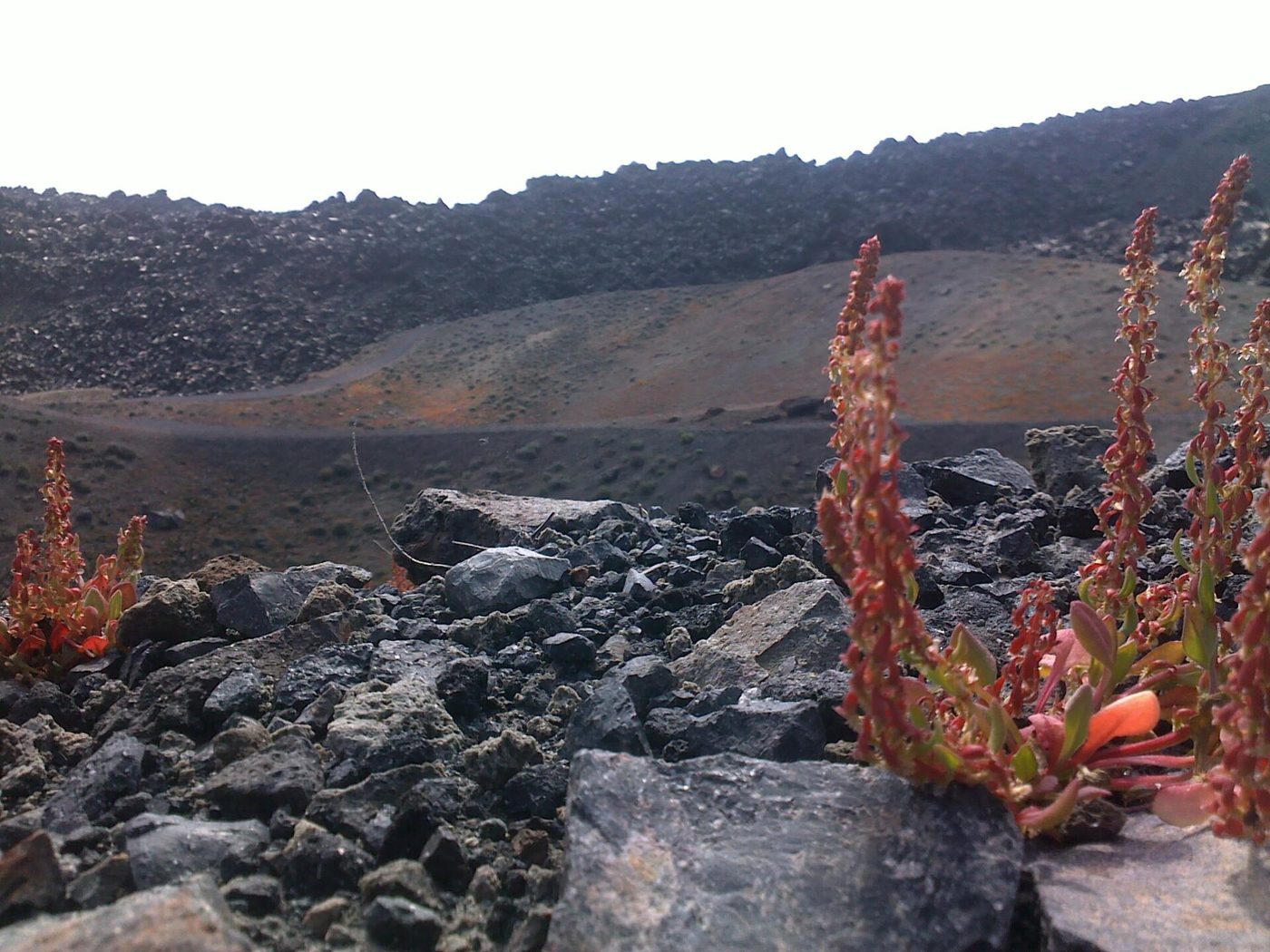
The caldera is the reason the island looks like this, and the only way to understand it is from the water. Nea Kameni, the black lava island in the middle, is a walk up a crumbling cinder path to a steaming crater, and it is the closest thing Santorini has to a proper hike with a payoff at the top.
The one thing to know before you book: the Nea Kameni site entry fee of about €5 per person is collected in cash at the trailhead and is almost never included in the boat ticket. Bring coins.
| Option | Typical price | Duration | Includes |
|---|---|---|---|
| Basic volcano boat tour | About €25 to €35 | Half day | Nea Kameni and usually the hot springs. Volcano fee extra |
| Caique sailboat cruise | From around US$65, roughly €60 | Half day | Caldera, swim stops, hot springs |
| Catamaran cruise | From around US$110, roughly €100 | 6 to 8 hours | Meal and some drinks, Red and White Beach views, swim stops. Volcano fee extra |
Tours leave from Fira Old Port, Athinios, Ammoudi below Oia, and Vlychada. The season starts up again in mid-March. Two practical notes: wear dark swimwear at the Palea Kameni hot springs, because the sulphur-rich water stains pale fabric permanently, and book ahead from June to September, especially for sunset catamarans, which sell out first.
What to eat and drink on Santorini
Santorini’s food is better than its restaurant scene suggests, because the good version of it is agricultural rather than architectural. The island’s volcanic soil and near-total absence of rain produce small, intensely concentrated crops, and the local specialities are built around them.
- Tomatokeftedes. Fritters made from the tiny, dense Santorini cherry tomato, mixed with onion, mint and flour and fried. The island’s signature dish and the thing to order first.
- Fava. A puree of yellow split peas, served warm with olive oil, lemon and raw onion. Santorini fava has protected status and is nothing like the broad-bean dish the name suggests elsewhere.
- White aubergine. A local variety, sweeter and less bitter than the purple kind, usually grilled or baked.
- Chloro cheese. A fresh, soft goat’s cheese made on the island, often served with the tomato fritters or in a salad instead of feta.
- Grilled fish and seafood. Best eaten at the waterline: Ammoudi below Oia, Vlychada, Perissa. Ask the price by the kilo before you order.
- Assyrtiko and Vinsanto. The dry white with the fish, the amber dessert wine after.
On where to eat rather than what: the price of a meal on this island tracks the view almost perfectly. The same plate of grilled fish with a salad and house wine runs €12 to €18 in a village taverna in Perissa or Pyrgos and €35 to €60 per person on a caldera terrace in Oia. Neither is a rip-off exactly, but you should know which one you are paying for. My habit is to have lunch with the view and dinner without it.
Greek restaurants are legally required to give you an itemised bill, so take the receipt. Tipping is 10 per cent for good service, 15 for exceptional, nothing extra where a service charge already appears.
If the weather turns
Rain is rare between May and September and reliable in winter, and the meltemi can make a beach day miserable in any month. The reliable indoor options are the Akrotiri excavation, which is fully roofed, the Museum of Prehistoric Thira in Fira, the Tomato Industrial Museum in an old cannery at Vlychada, and any of the wineries. Check current hours locally, because the smaller museums vary their opening by season and are not always listed accurately online.
What a trip to Santorini actually costs
Santorini is expensive, and saying so without numbers is useless. Here is the arithmetic.
The two taxes
The Climate Crisis Resilience Fee replaced the old stayover tax. It is charged per room, apartment, villa or rental per night, not per person, paid by whoever occupied the room, collected on departure with its own receipt. Architectural heritage buildings, youth hostels and campsites are exempt.
| Accommodation type | April to October | November to March |
|---|---|---|
| 1 to 2 star hotel | €2 per night | €0.50 |
| 3 star hotel | €5 | €1.50 |
| 4 star hotel | €10 | €3 |
| 5 star hotel | €15 | €4 |
| Furnished rooms and apartments | €2 | €0.50 |
| Short-term rental | €8 (€15 if a detached house over 80 m²) | €2 (€4 if over 80 m²) |
| Furnished tourist villa | €15 | €4 |
Note the statutory bands: April to October and November to March. You will see “March to October” quoted; that is wrong, and it matters if you are travelling in late March. Rates were reported as unchanged for 2026 with no adjustment announced.
The cruise levy is separate and applies only to passengers disembarking from a cruise ship. Santorini and Mykonos have their own band, several times the rate at every other Greek port.
| Season | Santorini and Mykonos | All other Greek ports |
|---|---|---|
| 1 June to 30 September | €20 per passenger | €5 |
| April, May and October | €12 | €3 |
| November to March | €4 | €1 |
It comes from Law 5162/2024, Article 27, has applied since 21 July 2025, is declared through Taxisnet and checked by the Hellenic Coast Guard. Every disembarking passenger pays regardless of age, with the only exceptions being medical emergencies and crew.
Food and drink
- Gyros from a back street in Fira: €3.50 to €5, closer to €5.50 in the tourist centre.
- Fast food and souvlaki stands: €6 to €12 for a quick meal.
- Local taverna in Perissa or Pyrgos, grilled fish or moussaka with salad and house wine: €12 to €18.
- Mid-range lunch without alcohol: €12 to €15 per person. Dinner with shared starters: €25 to €35.
- The same meal at a caldera-view restaurant in Oia: €35 to €60 per person.
- Average recorded food spend across visitors: about €48 a day, with an average meal around €19.
Tipping is 10 per cent as standard and 15 for something exceptional, small change at coffee shops, a euro at a bar, nothing extra where a service charge is already on the bill. On a catamaran cruise, €10 to €20 for two is normal. Tap water is widely advised against for drinking, so budget for bottled or bring a filter bottle.
Three daily budgets
No source publishes a credible all-in daily figure for Santorini, so this is built from the component costs above rather than quoted from anyone. Treat it as a planning frame, not a promise. Accommodation assumes two people sharing, per person.
| Per person per day | Careful | Comfortable | Caldera splurge |
|---|---|---|---|
| Bed (shoulder season, sharing) | €40 to €60 | €70 to €110 | €150 to €300 |
| Food and drink | €18 to €28 | €60 to €90 | €100+ |
| Transport | €5 (buses) | €20 to €35 (shared car or quad) | €50+ (taxis and transfers) |
| Sights and activities | €10 | €25 | €60+ |
| Resilience fee (per room, so halved) | €1 | €2.50 to €5 | €7.50 |
| Rough total | €74 to €104 | €177 to €265 | €367 to €517+ |
Peak season roughly doubles the accommodation line and adds maybe a fifth to everything else. For ways to cut this materially, our guide to Europe on a budget and the list of cheapest places to travel in Europe are both worth a read before you commit to a caldera room.
One small money tip that costs nothing: at card terminals and ATMs, always choose to be charged in euros rather than your home currency. Dynamic currency conversion quietly takes a few per cent every time.
Santorini itineraries: three, five and seven days
Four to five full days is the sweet spot for a first visit. Three works if Santorini is one stop on an island-hopping trip. Two is a rush, and one from a cruise ship is the version people regret.
Three days, no car
- Day 1. Arrive, settle, walk the rim path from Fira to Firostefani. Museum of Prehistoric Thira before it shuts at 15:30. Sunset from Firostefani, dinner off the rim.
- Day 2. Early bus to Akrotiri for the excavation, then the bus back through Megalochori. Afternoon at Perissa or Vlychada. Evening in Fira.
- Day 3. Fira to Oia on foot, starting at first light in summer. Ammoudi Bay for a late lunch and a swim off the rocks. Sunset from somewhere that is not the castle. Bus back for €2.20.
Five days, with wheels for two of them
- Day 1. Arrival, rim walk, Museum of Prehistoric Thira, sunset from Firostefani.
- Day 2. Fira to Oia hike. Ammoudi. Dinner in Oia after the crowd disperses.
- Day 3. Caldera boat trip: Nea Kameni, the hot springs, Thirassia. Bring €5 in cash and dark swimwear.
- Day 4. Car or quad. Akrotiri excavation, the lighthouse, Red Beach viewpoint, then a winery in the south. Sunset at Akrotiri Lighthouse.
- Day 5. Ancient Thera in the morning before the heat, Kamari beach below it in the afternoon, Pyrgos for dinner and the whole-island view from Kasteli.
Seven days, and what to add
With a week you can slow down properly. Add a full day on Thirassia rather than a boat-tour stop, a second winery afternoon in the north around Oia, a day doing nothing at Vlychada or Perivolos, and one deliberately unplanned day for the weather to ruin. If you would rather island-hop than stay put, our best Greek islands guide and the Mykonos travel guide cover the obvious next hops, while the best places to visit in Greece takes in the mainland too. For structuring a longer trip, the Europe itinerary and first time Europe itinerary guides both help with pacing.
Santorini for different travellers
Families
Santorini works with children if you base yourself flat. Both are level and walkable, with a promenade and shallow entries, and they put you twenty minutes from everything by bus. The caldera villages are the opposite: Fira, Firostefani, Imerovigli and Oia are all steps, uneven cobbles and narrow lanes with drops, and none of them are stroller-friendly. A lot of caldera boutique hotels also set a minimum age, for reasons the plunge pools and cliff terraces make obvious, so read the policy before you book rather than after. Akrotiri is a good rainy or scorching day out for older children, and the volcano walk is a hit with anyone over about eight. Our Europe with kids guide has more on this kind of trip.
Honeymooners
You are the island’s core market and it shows in the pricing. Santorini has been a destination-wedding island for decades, and one UK operator reported bookings up 17 per cent for the 2025 to 2026 period. What that means for you: book far ahead, expect to pay the premium, and consider Imerovigli over Oia for the same view with less foot traffic past your terrace. Our Europe honeymoon guide covers the alternatives if the price makes you flinch.
Travellers with limited mobility
Assessed honestly, Santorini is a difficult island for anyone with limited mobility, and the workarounds are specific.
- The cable car is designed to take wheelchairs, but the gondola sets a hard limit of 58 cm wide by 120 cm long. Coordinate with the operator in advance. Strollers and pets may not be suitable.
- Akrotiri is the most accessible major site: roofed, toured on elevated walkways and ramps, with a lift at the entrance and a route that avoids rough ground. It is partially accessible rather than fully, with some slopes, steps and level changes, and parts of the deep excavation viewed from above. A companion is recommended.
- The Museum of Prehistoric Thira officially lists a ramp, a lift and an accessible WC.
- The caldera villages are not realistically navigable on wheels, and many caldera hotels cannot be reached by car at all.
- The beach towns on the east and south coasts are flat, and are the sensible base.
Budget travellers
It is possible. Sleep inland or in Perissa, use the €2.20 bus, eat gyros at lunch and taverna at dinner, walk the Fira to Oia path instead of paying for a tour, take the free viewpoints instead of the castle, and drink Assyrtiko by the glass at a village taverna rather than by the flight on a terrace. That gets you to the €74 to €104 a day in the table above. What you cannot do is stay on the rim cheaply.
Cruise passengers with one day
Under the 70/30 rule most of you now land at the Old Port below Fira. Skip the cable car queue if it is long and consider the walk up only if you are fit and it is not August. Then leave Fira immediately. The single best use of a cruise day here is a bus to Akrotiri and the excavation, or the bus to Oia early before the coaches. The worst is to spend five hours in the two most crowded villages, which is what most of the island’s unhappy visitors did.
Solo travellers
Easy and safe, with the caveat that Santorini is priced for couples. Perissa and Fira have the most sociable accommodation and the easiest evenings. Buses mean you never need to split a car. Our solo travel in Europe guide has more.
What to pack for Santorini
Nothing exotic, but three things people get wrong.
- Shoes you can walk in. This is the big one. The villages are steps and polished cobbles, the beaches are hot pebbles and coarse volcanic sand, and the Fira to Oia path is loose gravel in places. Flip-flops will not do for any of it.
- Sun protection well beyond what you think you need. There is almost no shade anywhere on this island. Hat, sunglasses, high-factor sunscreen, and a refillable water bottle.
- A light layer for the evening. The meltemi drops the felt temperature sharply after sunset on the rim, even in August.
- Dark swimwear if you are doing a caldera boat trip, because the sulphur water at the hot springs stains pale fabric permanently.
- Cash. Buses, the €5 volcano fee, bakeries and kiosks all want euros in hand.
Our full Europe packing list covers the rest, and Europe travel tips has the general practicalities.
Mistakes I see people make on Santorini
- Booking two nights. You lose most of one to arrival and most of another to departure. Four full days is the target.
- Staying in Oia and never leaving it. The best day here is the one where you go inland or get on the water.
- Assuming a caldera view is the same as a caldera-view room. Read which side the room faces, not what the hotel is called.
- Turning up at the Oia castle thirty minutes before sunset in August. You will see the backs of heads.
- Not bringing cash. Buses, the volcano fee, small tavernas, bakeries and kiosks all want euros in hand.
- Booking a high-speed catamaran to make a same-day flight. The meltemi cancels catamarans first.
- Renting a quad without checking your insurance. Extreme sport exclusions are common and the hire cover is usually third party only.
- Planning a beach day at Red Beach. Access is restricted and contested. Make it a viewpoint.
- Walking Fira to Oia at midday in July. There is no shade on the northern half.
- Doing Akrotiri without the museum, or the museum without Akrotiri. The frescoes are in Fira; the town they came from is in the south. Each is half the story.
- Forgetting the resilience fee at checkout. Up to €15 a night on a five-star room is real money across a week.
- Not accounting for cruise timing. Check a cruise schedule for your dates and simply do something else between 10:00 and 12:00.
If Santorini is not quite right: four swaps
Sometimes the honest answer is that another island fits better. These are editorial judgements rather than sourced comparisons, but they are the ones I make most often.
| If Santorini’s problem is | Go instead to | Why |
|---|---|---|
| Price | Naxos | Bigger, greener, cheaper, with proper sandy beaches and a working agricultural economy behind the tourism |
| Crowds, but you want the volcanic drama | Milos | Same geological weirdness, a small share of the visitors, and the strangest coastline in the Cyclades |
| Beaches | Crete | Everything Santorini is not: long sandy beaches, mountains, gorges, and food worth flying for |
| You want the nightlife rather than the view | Mykonos | The Cyclades island that is actually built for it, with better beaches to recover on |

Full guides to each: Crete, Mykonos and Corfu if you want the Ionian instead. Beyond Greece, Croatia, Sicily and the Amalfi Coast scratch a similar itch, and underrated places in Europe collects the ones nobody is queueing for yet.

What I could not pin down
Three things resisted verification, and I would rather say so than invent a number.
- The €15 combined archaeological ticket. Widely quoted, cheaper than the €20 Akrotiri single, and unconfirmable against an official source. Ask at the gate.
- Red Beach access. Two credible 2026 sources contradict each other on whether the footpath and beach are restricted. Treat it as a viewpoint and obey posted signs.
- The weight limit for working mules. Greek regulation sets one; I could not find the current figure in kilograms published anywhere.
One scope note as well. This guide covers Thira, the main island, plus Thirassia. It does not cover the four uninhabited islets in the group, and it does not attempt to review individual hotels or restaurants, because those change faster than any guide can keep up with.
Santorini travel guide FAQ
How many days do you need in Santorini?
Four to five full days for a first visit. That gives you the caldera villages, the Fira to Oia walk, a boat day, the archaeology and a beach afternoon without rushing. Three works if Santorini is one stop on an island-hopping trip. Two is a rush and one is a taster.
Is Santorini worth visiting?
Yes, if you come for the landscape, the wine and the villages, and you travel outside July and August or accept what those months cost. No, if you want a value beach holiday. In one analysis of a thousand public comments, 82 per cent of visitors were glad they came, and over 80 per cent of the unhappy minority were cruise passengers who saw only Oia and Fira.
What is the best time of year to visit Santorini?
Late April to early June, and mid-September to late October. May and September are the two strongest months on the balance of weather, price and crowds: in September the sea is still 23.8°C on the long-run average and the crowds thin after mid-month.
Is Santorini expensive?
Yes, but the range is enormous. A careful traveller can do roughly €74 to €104 a day per person in shoulder season staying inland and using buses. A caldera-view room alone runs €300 to €600 a night in shoulder season and €600 to €2,000 or more at peak. Inland hotels at €100 to €180 are commonly 40 to 50 per cent cheaper than a comparable caldera-side room.
Ferry or flight from Athens?
Fly if your time is short or you have a lot of luggage: 50 to 55 minutes for roughly €35 to €110. Take the ferry if you are island hopping or want to save money: 5 to 6 hours by high-speed catamaran, 6 to 9 by conventional ferry, from about €46.50. In windy weather, take the big conventional boat, because catamarans get cancelled first.
Where should a first-timer stay?
Firostefani or Fira if you want caldera views with easy logistics. Imerovigli if the budget allows and you want the best view on the island. Pyrgos or Megalochori for value. Kamari or Perissa if you are travelling with children or want flat ground and a beach.
Where is the best place to watch the sunset?
Not the Oia castle, unless you are prepared to arrive a couple of hours early in summer. Imerovigli, the path toward Skaros Rock, Firostefani, Kasteli at Pyrgos and the Akrotiri Lighthouse are all better experiences, and a sunset catamaran gives you the whole caldera from the middle.
What is the best way to get around Santorini?
The KTEL bus for a short trip: €2.20 to most places from Fira, €2.70 to Perissa and the port, cash to the conductor. Every route goes through Fira, so village-to-village trips need a change and a second fare. Rent a car or quad if you are staying more than three days and not sleeping on the rim. Taxis are scarce and Uber draws on the same small pool.
Do I need an International Driving Permit in Greece?
Legally, no, if you hold a US or Canadian licence: those have been recognised in Greece since 5 November 2021. In practice, island rental firms often demand an IDP from non-EU drivers and may refuse the rental without one, and the US Embassy in Greece recommends carrying both. Get one. EU licences need nothing extra, and provisional licences are not valid at all.
How much is the Santorini cable car, and how many steps are there?
€10 one way for adults, €5 for children aged 6 to 12, free under 6, and €5 per item of luggage. It carries 1,200 people an hour in total and takes three to five minutes. The alternative on foot is the Karavolades stairway, 588 steps rising about 231 metres, which takes most people an hour to an hour and a half going up.
Is there a tourist tax in Santorini?
Yes. The Climate Crisis Resilience Fee is charged per room per night, not per person: €2 to €15 from April to October depending on category, and €0.50 to €4 from November to March. Short-term rentals pay €8 in summer, or €15 for a detached house over 80 m². It is collected at checkout with its own receipt. Cruise passengers separately pay a €20 levy per disembarking passenger from June to September.
Is Akrotiri open?
Yes. It closed in early 2025 for seismic safety checks on the roof and reopened on 11 April 2025. It is open and selling tickets in 2026 at €20.
Is Red Beach closed?
Partly, and sources disagree. It closed in February 2025 after rockfalls, and one 2026 source says the cliff path closes repeatedly and parts of the beach remain restricted, while another says access is unchanged. See it from the viewpoint, or reach it by boat from Akrotiri harbour for €5 to €8.
Is Santorini safe after the 2025 earthquakes?
The swarm ended in 2025 and monitoring through 2026 reports no meaningful activity. The UK Foreign Office’s Greece advice, updated 11 August 2026, carries no Santorini-specific warning, only generic Greece-wide earthquake guidance. Enable emergency alerts on your phone so Greek Civil Protection messages reach you, and know where your assembly point is.
Can you drink the tap water in Santorini?
It is widely advised not to. Most of the island’s supply is desalinated and the taste alone puts people off. Bottled water is cheap, and a filter bottle cuts the plastic.
Is Santorini good for families?
With the right base, yes. Kamari and Perissa are flat and easy. The caldera villages are steps and drops, and many caldera hotels are adults-only or have minimum-age rules. Akrotiri and the volcano walk both work well with older children.
What currency is used, and are cards accepted?
The euro. Cards are accepted at hotels, restaurants, shops, beach clubs and rental agencies. Carry cash for buses, bakeries, kiosks, small tavernas and the €5 volcano fee. At any terminal, choose to be charged in euros rather than your home currency.
Do I need a visa for Greece?
Greece is in the Schengen area, so the standard Schengen rules and the EU Entry/Exit System apply. ETIAS, the additional authorisation for visa-exempt non-EU visitors, is not yet in force. See our Schengen visa and ETIAS guide for current requirements.
What are the emergency numbers in Greece?
112 is the general European emergency number and works from any phone. Locally, 166 is the ambulance, 199 the fire service and 100 the police. Santorini General Hospital is in Fira. Turn on emergency alerts in your phone settings so Greek Civil Protection messages reach you.
When are museums free in Greece?
State sites and museums are free on 6 March, 18 April, 18 May, the last weekend of September, 28 October, and the first Sunday of each month from November to March. EU citizens under 25 are free year round with ID, as are non-EU citizens under 18.
Final thoughts
Santorini is a place that rewards effort and punishes drift. The people who leave delighted are almost always the ones who got up early, went inland, spent an afternoon on the water and ate dinner somewhere without a caldera view. The people who leave grumbling usually spent four hours in two villages during the two busiest hours of the day and paid €50 for the privilege of a mediocre meal with a good backdrop.
The island has been actively managing itself since 2025: a cruise cap, a redistribution of where passengers land, a levy, a resilience fee. Not all of it is comfortable and not all of it is popular locally, but it is working in the direction of a better visit. Come in May or late September, base yourself where you can walk to a view rather than pay for one, hire something with wheels for two of your days, and give the geology the attention the sunset usually gets. It is one of the strangest and most beautiful pieces of ground in Europe, and it is still there under all the traffic.
For more of Greece, start with our Greece travel guide and the best time to visit Greece. For the wider picture, our lists of the most beautiful places in Europe, the Europe bucket list and the best places to visit in Europe in summer are all good places to plan the rest of the trip, and how to plan a trip to Europe covers the practicalities end to end.
Hannah Brooks has spent fifteen years travelling, living and writing across Europe, from the Arctic tip of Norway to the south of Sicily. She has planned hundreds of European itineraries for readers and is Senior Europe Editor at EuropeanTourism.org.
Photo credits
All images are used under their stated licences. In order of appearance:
- Photo: Giles Laurent / CC BY-SA 4.0 via Wikimedia Commons
- Photo: Norbert Nagel / CC BY-SA 3.0 via Wikimedia Commons
- Photo: Dimitri Raftopoulos / public domain via Wikimedia Commons
- Photo: Moonik / CC BY-SA 3.0 via Wikimedia Commons
- Photo: Jean Housen / CC BY-SA 4.0 via Wikimedia Commons
- Photo: Jebulon (CC0) via Wikimedia Commons
- Photo: Mario Roberto Duran Ortiz / CC BY-SA 4.0 via Wikimedia Commons
- Photo: Norbert Nagel / CC BY-SA 3.0 via Wikimedia Commons
- Photo: Luke Jones / CC BY 2.0 via Wikimedia Commons
- Photo: Navin75 / CC BY-SA 2.0 via Wikimedia Commons
- Photo: Klearchos Kapoutsis / CC BY 2.0 via Wikimedia Commons
- Photo: bongo vongo / CC BY-SA 2.0 via Wikimedia Commons
- Photo: Winniepix / CC BY 2.0 via Wikimedia Commons
- Photo: Bgabel / CC BY-SA 3.0 via Wikimedia Commons
- Photo: Holger Uwe Schmitt / CC BY-SA 4.0 via Wikimedia Commons
- Photo: Norbert Nagel / CC BY-SA 3.0 via Wikimedia Commons
- Photo: Eric Hossinger / CC BY 2.0 via Wikimedia Commons
- Photo: Zde / CC BY-SA 4.0 via Wikimedia Commons
- Photo: Norbert Nagel / CC BY-SA 3.0 via Wikimedia Commons
- Photo: Treephoto / CC BY-SA 4.0 via Wikimedia Commons
- Photo: Benoît Prieur (CC0) via Wikimedia Commons
- Photo: Damigouath / public domain via Wikimedia Commons
- Photo: dronepicr / CC BY 2.0 via Wikimedia Commons
- Photo: moustakik (CC0) via Wikimedia Commons