Corfu Travel Guide: Beaches, Old Town and the Ionian

Corfu is the Greek island that does not behave like a Greek island. There are no whitewashed cubes stacked above a caldera here. There is an arcaded promenade modelled on the Rue de Rivoli, a cricket pitch, ginger beer sold in corner shops, four million olive trees, and a fortified old town that the Venetians spent four centuries making impossible to take. Then you drive twenty minutes west and there is a sand beach with a bar built into a cliff.
This Corfu travel guide covers the whole island and the Ionian group around it: which beaches are sand and which are pebble, what the museums charge in 2026 on the ministry’s current figures, how the two separate bus networks work, what the accommodation tax adds to your bill, and when to go. Prices checked September 2026.
Corfu at a glance
| Detail | Figure |
|---|---|
| Greek name | Kerkyra (Corfu is the anglicised Venetian form) |
| Area | 610.9 km² (235.9 sq mi), seventh largest Greek island |
| Population | 101,600 (2021 census) |
| Distance to Albania | 3 km at the narrowest point, 23 km at the widest |
| Airport | Ioannis Kapodistrias International (CFU), 3 km south of Corfu Town |
| Air arrivals 2025 | 2,080,517 international, the first year above two million |
| Cruise passengers 2025 | 894,179 passenger visits |
| UNESCO status | Old Town inscribed 2007, criterion (iv), 70 ha core zone |
| Highest point | Mount Pantokrator, 906 m |
| Warmest month | August, mean 25.4°C, sea averaging 25.6°C |
| Wettest month | November, 253 mm |
| Annual rainfall | 1,290 mm across 73 rain days. One of the wettest places in Greece |
| Currency | Euro. Standard VAT 24% |
| Accommodation tax 2026 | Climate Crisis Resilience Fee, €0.50 to €15 per room per night |
| Cruise levy 2026 | €5 peak, €3 shoulder, €1 off-season per disembarking passenger |
| Best months | Late May to mid June, and September |
How to use this Corfu travel guide
Corfu is 64 km long and takes about an hour to cross north to south on winding roads, so where you base yourself changes your holiday more than it would on a small island. I have organised this around that decision. Read the coasts section first, pick a base, then work backwards to flights and ferries.
Two things about my sourcing, because they matter here more than usual. Museum admission prices on this island have changed: the Greek Ministry of Culture now lists the Old Fortress and the Archaeological Museum at €10, where the widely quoted figure is €6. And the tax layer introduced since 2024 is significant on a villa holiday. Both are covered in full below, with the caveats where the official sources contradict themselves.
If you are still choosing an island, our guide to the best Greek islands compares Corfu against the Cyclades and the Dodecanese, and the Greece travel guide is the parent article for everything below.
Getting to Corfu
Flying
Corfu’s airport is called Ioannis Kapodistrias International, after the Corfiot who became the first governor of modern Greece, and it sits 3 km south of Corfu Town. That is a 10 to 15 minute drive, which is unusually convenient. It is run by Fraport Greece, which handled 4,343,748 passengers there in 2024 and expected to pass 4.6 million in 2025.
From the UK you have easyJet, Jet2, TUI, British Airways, Ryanair and Wizz Air, with easyJet and Jet2 running the heaviest schedules at roughly 50 flights a week each in season. London to Corfu is about three hours and fifteen minutes. The catch, and it is the one thing to get straight before you plan a shoulder-season trip: the direct UK routes are seasonal, running roughly April to October. October is the last month for most international flights. In winter you connect through Athens.
Getting from CFU into town: a taxi runs about €15 to €20. Blue Bus No. 15 links the airport to the Blue Bus terminal at San Rocco square, roughly hourly and reduced at weekends. Sources disagree on the fare (I have seen both €1.20 and €1.70 quoted), so carry small change.
The important bit: the green KTEL buses that serve the rest of the island do not stop at the airport. If you land and want to go straight to Paleokastritsa or Kassiopi, you either take Blue Bus 15 into town and buy a second ticket at the separate green bus terminal, or you walk about 20 minutes to the KTEL site, or you take a taxi. Two networks, two terminals, two tickets. Budget an extra hour.
Ferries
Corfu is one of the easiest Greek islands to reach without flying, because the mainland is right there.
| Route | Time | Typical fare | Frequency | Notes |
|---|---|---|---|---|
| Igoumenitsa to Corfu | 1 h 10 min fastest, about 1 h 23 min average | €7 to €10 foot passenger | Year-round, up to 25 crossings a day in high season | Kerkyra Lines and Kerkyra Seaways. The workhorse route. Cars carried |
| Corfu to Paxos | 45 min to 1 h 20 min, most around 55 min | From €15, typically €18 to €35 | Roughly 93 sailings a week in season | Kerkyra Lines and Joy Cruises. Kamelia Lines runs from Lefkimmi in the south |
| Corfu to Saranda, Albania | 30 to 35 min by hydrofoil, 50 to 70 min by conventional ferry | €10 to €40 each way | Daily in season | International border. Passport or national ID checked three times |
| Corfu to Kefalonia (Sami) | About 9 h 35 min, roughly 168 km | From around €73 | Southbound Mon, Wed, Fri | Lefkada Palace, calling at Paxos, Lefkada, Meganisi and Ithaca en route |
| Corfu to Zakynthos | Same Lefkada Palace service, continuing south | Varies by leg | Southbound Mon, Wed, Fri; northbound Tue, Thu, Sat | The only realistic single-ticket Ionian island-hop |
| Italy to Corfu | Overnight | Not published consistently | Seasonal | Sailings reported from Bari, Brindisi and Venice. Confirm with the operator, not an aggregator |
One thing to check rather than assume: I could not confirm a current direct Patras to Corfu service on any operator timetable. Kefalonia connects to Patras separately. If you are coming up from the Peloponnese, plan on Igoumenitsa or the Lefkada Palace route rather than assuming a direct sailing exists.
The Lefkada Palace service is the single most useful thing to know about the Ionian, because it turns a group of islands that are famously hard to link into one ticket. It is slow. Nine and a half hours to Kefalonia is a day of your holiday. But it exists, it runs three days a week in each direction, and it saves the Athens backtrack that ruins most Ionian itineraries. For the wider picture see our Greek island hopping itinerary.
If Corfu is one stop on a longer trip, our guide to getting around Europe covers the flight, ferry and rail options between countries, and train travel in Europe covers the overland route as far as Igoumenitsa.
Getting around Corfu
The two bus networks
Blue Buses cover Corfu Town and its suburbs. Green Buses (KTEL) cover the island. Different operators, different terminals, different tickets, and no through-ticketing between them. A blue bus fare in town is €1.70 on the sources I could find, and there is an unlimited day pass at €5 which is worth buying if you are staying near town.
| Green bus route | Fare |
|---|---|
| Short hops | From about €1.50 to €2.40, depending which source you believe |
| Corfu Town to Sidari | €3.70 |
| Corfu Town to Kassiopi | €3.90 |
| Corfu Town to Paleokastritsa | Not separately published. Ask at the terminal |
| Longest runs to the far corners of the island | Up to €5.80 |
Buy green bus tickets on board from the conductor, who carries change, or at kiosks. Timetables are published by KTEL Kerkyras at ktelkerkyras.gr. Service thins out badly at weekends and is close to non-existent to outlying areas outside the summer season. Even in August the frequency to the west coast beaches is not what you would call generous. Corfu is one of the few Greek islands where you can genuinely manage without a car, but only if you base yourself in or near Corfu Town.
Hiring a car
| Item | 2026 cost |
|---|---|
| Small car, July and August | Can exceed €60 a day |
| Small car, shoulder season | Around €25 to €50 a day |
| Small car, booked ahead on a multi-day hire | From around €20 a day |
| Scooter | From €16 a day |
| Quad or ATV | From €38 a day |
| Bicycle | From €10 a day |
| Petrol (Euro 95) | Around €2.03 a litre, August 2026 |
| Diesel | Around €2.04 a litre |
| Taxi | Around €3.60 base, just over €1 per km |
| Corfu Town paid parking | €3 to €5 for a few hours, €10 to €15 a full day |
| Parking fine | €40 to €80, payable at any post office or online |
Minimum driver age is 21. UK photocard licence holders do not need an International Driving Permit for Greece, but you must carry the physical card, because a photo on your phone will not be accepted at the desk. Licences issued outside the EU and EEA generally do require an IDP, and island rental desks ask for one routinely, so US, Canadian and Australian drivers should get one before travelling. The US Embassy advises carrying both.
Corfu Town blue-zone street parking has a three-hour maximum. I could not find a published per-hour blue-line rate anywhere, official or otherwise, so budget from the car park figures above rather than assuming kerbside is cheaper.
Corfu Town, its museums and the Achilleion
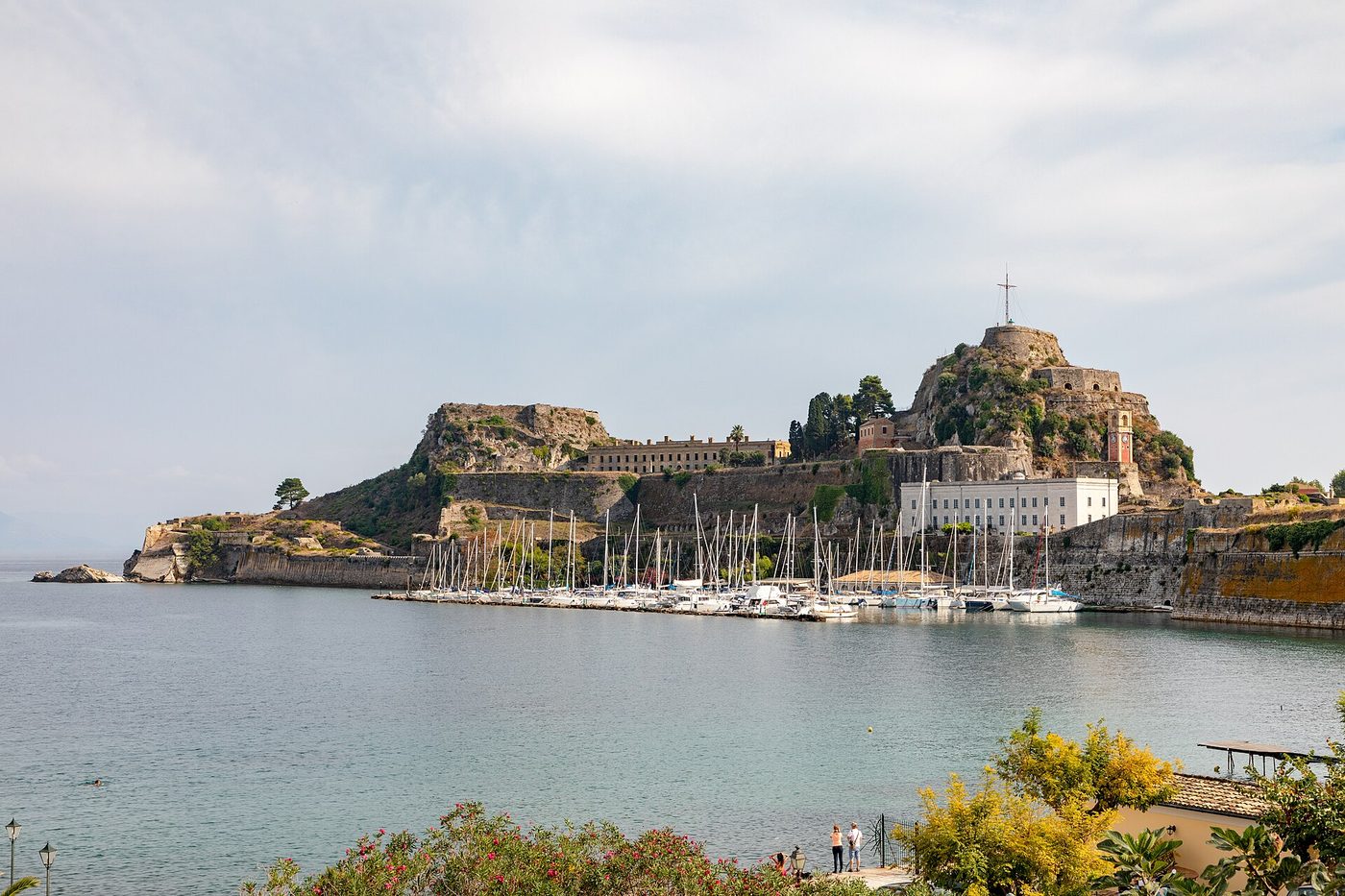
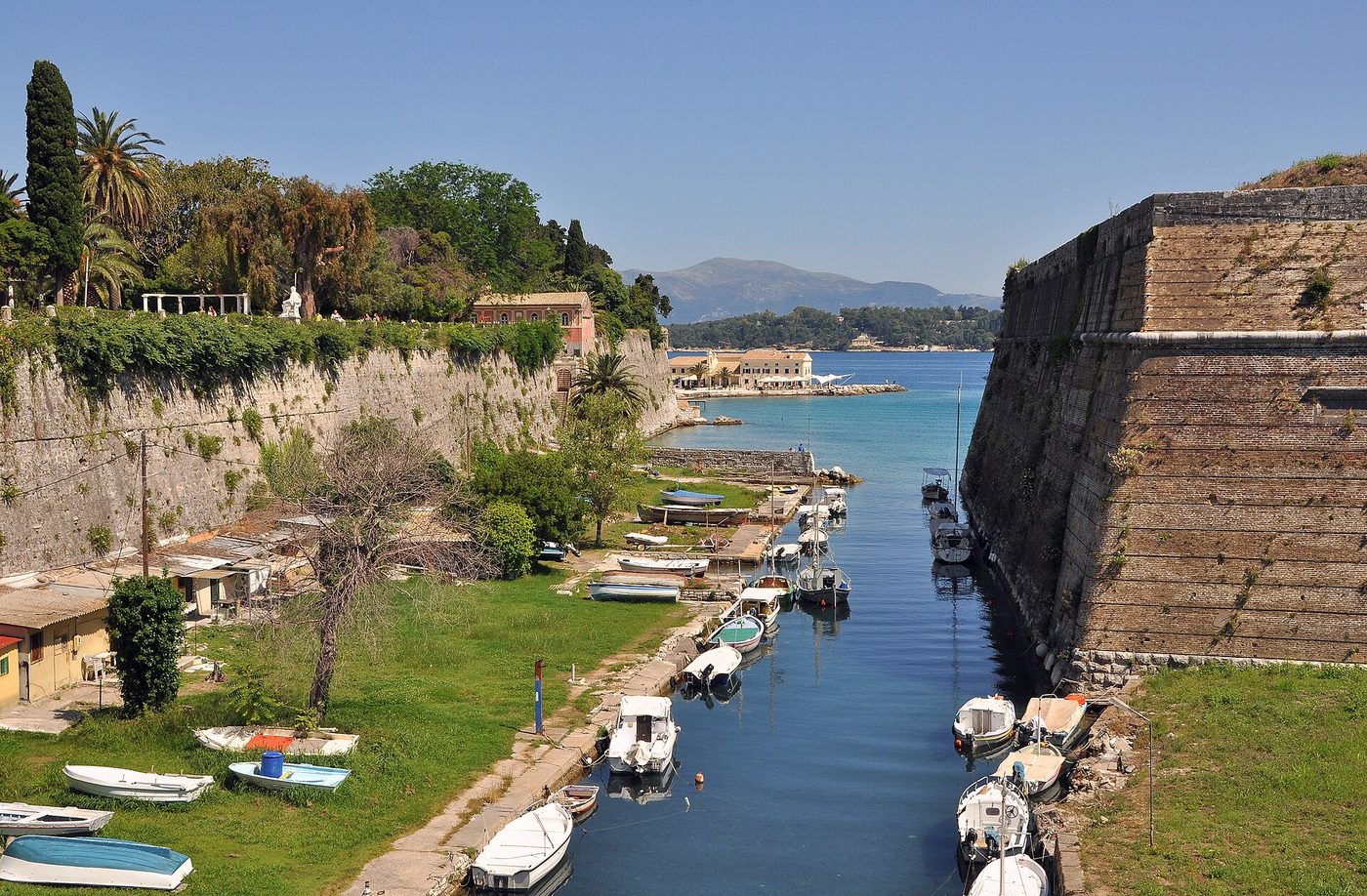
The Old Town of Corfu went onto the UNESCO World Heritage list in 2007 under criterion (iv), with a 70-hectare core property and a 162-hectare buffer zone. UNESCO’s reasoning is worth understanding before you walk it, because it explains the shape of the place: three Venetian-designed forts, engineered in part by Sanmicheli, defended Venice’s maritime trade against the Ottomans for four centuries, and the fortified port ensemble survives with unusual integrity. The housing behind the walls is mainly neoclassical.
Corfu was never taken by the Ottomans. That single fact accounts for most of what makes the town look wrong for Greece: the arcades, the six-storey tenements, the Italianate shutters, the Catholic church on the square. Venice held it from 1386 to 1797, France took it when Napoleon took Venice, the British arrived in 1815, and the Ionian Islands were ceded to Greece on 21 May 1864. The British left behind Greece’s first university, the Ionian Academy of 1824, a road network, a water supply, cricket, and ginger beer.
Walk the Campiello, the oldest quarter, in the early morning before the cruise ships disembark. The Liston, the arcaded terrace on the Spianada, was built by the French and modelled on the Rue de Rivoli. Sit there in the evening, pay too much for a coffee, and consider it rent for the view.
Museum and monument prices in 2026
Here is where I have to be careful, because the Ministry of Culture’s own portal contradicts itself in one place.
| Site | Full | Reduced | Hours | Confidence |
|---|---|---|---|---|
| Old Fortress | €10 | €5 | 1 Apr to 31 Oct daily 08:00 to 20:00; winter 08:30 to 15:30 | Ministry of Culture, current |
| Archaeological Museum | €10 | €5 | Check on the day | Ministry of Culture, current |
| Museum of Asian Art | €6 | €3 | Check on the day | Ministry of Culture, current |
| Antivouniotissa (Byzantine) Museum | €5 | €3 | Check on the day | Ministry of Culture, current |
| Achilleion Palace | €7 | €5 | 1 Apr to 31 Oct daily 08:00 to 20:00; 1 Nov to 31 Mar daily 08:00 to 16:00 | Official palace site, current |
| New Fortress | €4 to €5 | Not published | Around 09:00 to 19:00 summer, 09:00 to 15:30 winter | Sources conflict, no ministry page found |
| Angelokastro | Around €3 | Not published | Daily except Wednesdays, 10:00 to 18:00 | Sources conflict (€3 versus €10). Take cash, expect €3 |
| Mon Repos / Palaiopolis Museum | Not published | Not published | Check on the day | The ministry page lists address and phone but no price. Third-party figures range €4 to €10 |
| Vlacherna Monastery | Free | Free | Daylight | Reached on a pedestrian causeway |
| Mouse Island (Pontikonisi) boat | Around €3 | n/a | Around 5 minutes each way | Single source |
| Banknote Museum | Free | Free | Check on the day | Single source |
| Kaiser’s Throne, Pelekas | Free | Free | Always open | Viewpoint at Pelekas |
| Aqualand | €37 gate, €33 online | Not published | Daily 10:00 to 18:00 | Single source. A two-day ticket is quoted at €60. No outside food or drink |
The combined ticket. Two ministry pages state that the combined ticket covering the Old Fortress, Museum of Asian Art, Archaeological Museum, Antivouniotissa and Mon Repos is no longer available and that separate tickets are now required. A third ministry page still advertises the same package at €14 full, €7 reduced, valid three days. I cannot resolve that from outside Greece. Ask at the first ticket desk you reach. If it still exists, it pays for itself the moment you visit two of the €10 sites.
Reduced rates at the state sites are narrow: Greek and EU citizens over 65 qualify only between 1 October and 31 May, plus accompanying parents and teachers on school visits. At the Achilleion the reduced categories are wider (students 6 to 18, university students, large-family cardholders, military, registered unemployed, over-67s) but reduced tickets are issued only at the ticket office, never online. Entry is free at the Achilleion for under-6s, for disabled visitors plus one companion, and for licensed guides. State archaeological sites close on 25 and 26 December, 1 January and 25 March.
Corfu’s old town holds its own against anything on our list of the most beautiful towns in Europe, and the fortifications belong in the same conversation as the entries in the most beautiful places in Europe.
The Achilleion at Gastouri
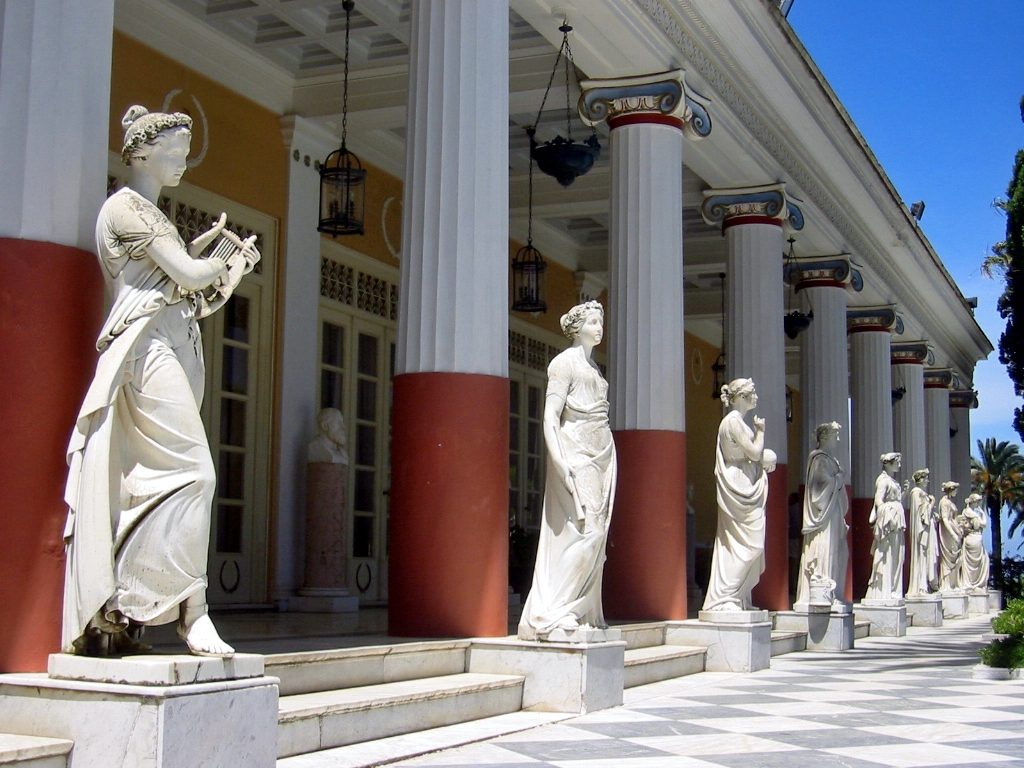
Empress Elisabeth of Austria built the Achilleion at Gastouri in 1890, in mourning for her son, and filled it with Achilles. It is 10 km from Corfu Town and 3 km from Benitses. Kaiser Wilhelm II bought it after her assassination and used to walk up to the viewpoint at Pelekas, which is why the viewpoint is called the Kaiser’s Throne. The palace is now run by the Hellenic Public Properties Company and sells e-tickets. Go early: it is on every cruise excursion itinerary.
The Gorgon in the Archaeological Museum
The Archaeological Museum’s single unmissable object is the Gorgon pediment from the temple of Artemis, carved around 590 BCE and the oldest stone pediment in Greece. She is enormous, snake-belted and completely unbothered by your opinion.
St Spyridon
St Spyridon’s church holds the relics of the island’s patron saint behind the tallest bell tower in the Ionian. Corfiots will tell you Spyridon has personally saved the island from Ottoman siege, plague and famine, and the four annual processions are not a tourist performance.
Kanoni, Vlacherna and Mouse Island
Two kilometres south of the town, the Kanoni peninsula gives you the view that ends up on every Corfu postcard: the little white chapel of Vlacherna at the end of a pedestrian causeway, with wooded Pontikonisi, Mouse Island, behind it. Vlacherna is free and stopped functioning as a monastery in 1980. A boat runs across to Mouse Island in about five minutes for around €3. Both appeared in the 1981 Bond film For Your Eyes Only. Go at the end of the day, and be aware that aircraft on final approach to CFU pass low overhead, which is either a nuisance or the reason you came.
Corfu at Easter
Corfu’s Easter is one of the biggest in Greece and it is worth planning a trip around if the dates work. The famous part is the botides, at 11:00 on Holy Saturday, when the First Resurrection is announced and thousands of large clay water jugs are thrown from the balconies around the Spianada and the Liston onto the street below. The custom is usually traced to a Venetian new year tradition that Corfu moved to Easter. There are philharmonic bands, processions of the relics of St Spyridon, and a town that fills to capacity. Dates move each year with the Orthodox calendar, and accommodation goes early. Carnival, in the week before Ash Wednesday, is the other date locals will tell you about.
Corfu’s beaches
The geography is simple once someone states it. The west and south coasts hold the golden sand. The green north-east coast, the strip the British press has called Kensington on Sea for forty years, is white pebble coves and deep clear water. The north around Sidari has the sandiest beaches on the island and the heaviest development. If your holiday depends on walking into soft sand, you want the west or Sidari, not the north-east.
Twenty beaches follow, with the access difficulty stated honestly, because a cove described as secluded is usually secluded for a reason, and that reason is normally a forty minute scramble in unsuitable shoes. The east coast resort beaches around Gouvia, Dassia, Kontokali and Ipsos are deliberately not in the table: they are sheltered, serviceable and convenient for the airport, and nobody chooses Corfu for them.
20 of the best Corfu beaches at a glance
| Beach | Coast | Surface | Access | Crowds | Best for |
|---|---|---|---|---|---|
| Paleokastritsa (Agios Spyridon) | North-west | Sand and shingle | Easy. Road, parking, and a green bus from Corfu Town | Busy | Snorkelling, boat trips, first-timers |
| Ampelaki, Paleokastritsa | North-west | Pebble | Hard. The least visited of the six coves | Quiet | Escaping the main bay on a busy day |
| Rovinia | North-west | White pebble | Hard. A path down, or a short boat ride from Paleokastritsa | Quiet | Deep blue water and no facilities |
| Porto Timoni | North-west | Twin pebble bays | Hard. 30 to 40 min hike from Afionas, rocky and stepped. Parking €10, water taxi €15 return | Moderate | Twin bays and a narrow isthmus. The photograph everyone comes for |
| Agios Georgios Pagon | North-west | Sand | Easy. Road and parking, lifeguard on duty | Moderate | Families. Deep on the left, shallow on the right |
| Loggas (Logas), Peroulades | North-west | Sand under red cliffs | Moderate. Steps down from the clifftop | Busy at sunset | Sunset. Shaded in the mornings |
| Arillas | North-west | Sand | Easy | Moderate | A quieter resort base than Sidari |
| Canal d’Amour, Sidari | North | Sandstone channels and sand | Easy. Green bus €3.70 | Very busy | The rock formations. Sidari has the sandiest beaches on Corfu |
| Kassiopi coves | North-east | Pebble | Easy. Green bus €3.90 | Moderate | A harbour village with a Byzantine castle above it |
| Barbati | North-east | Pebble | Easy. Road access | Moderate | Long swims and clear water |
| Nissaki | North-east | Pebble | Easy | Quiet | Doing very little, well |
| Agni Bay | North-east | White pebble | Moderate. Narrow road down, or arrive by boat | Quiet | Three waterside tavernas and a mooring |
| Kalami | North-east | Pebble | Easy | Moderate | The Durrell White House at the water’s edge |
| Erimitis | North-east | Sand and pebble coves | Hard. Mostly sea access | Very quiet | Undeveloped coastline |
| Glyfada | West | Golden sand | Easy. Road and parking | Busy | Beach bars. Sunbeds around €15 to €20 a day |
| Myrtiotissa | West | Sand, roughly 80 to 100 m long | Hard. Park at the top and walk about 1 km down a steep part-surfaced road | Moderate | Corfu’s long-established naturist beach. About half is naturist, nudity is not compulsory |
| Agios Gordios | West | Sand | Easy. Road, tavernas, accommodation | Busy | A full resort beach without the high-rise |
| Agios Georgios South | South-west | Sand | Easy | Moderate | Diving |
| Halikounas | South-west | Fine sand | Moderate | Quiet | The Korission lagoon behind it |
| Issos | South-west | Sand and dunes | Moderate | Quiet | Space. Wind when the west coast is blowing |
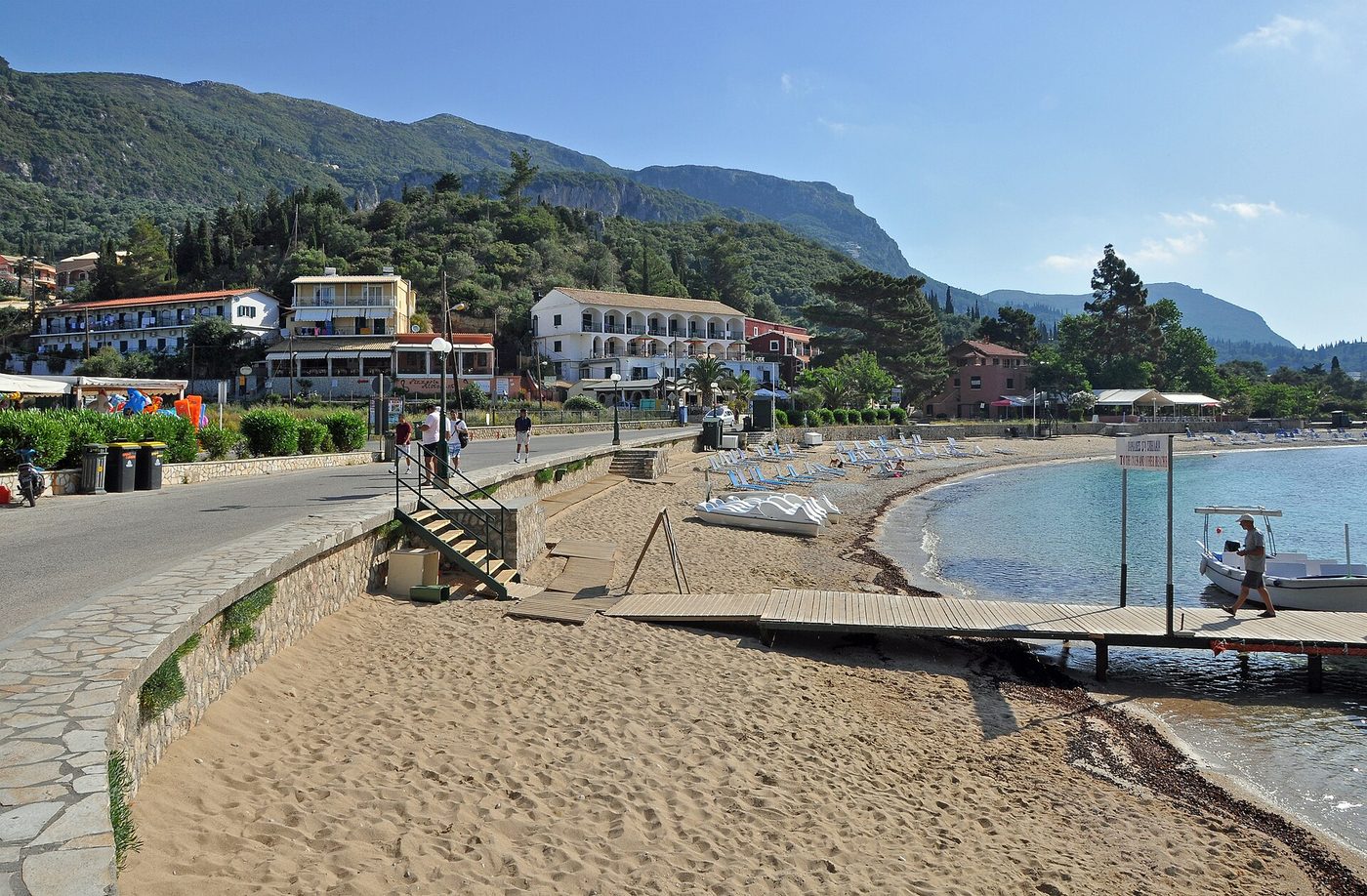
Paleokastritsa, and why it is worth the coach parties
Paleokastritsa is 23 km from Corfu Town and it is not one beach but a run of coves around a single bay. Agios Spyridon is the busy, fully serviced one. Ampelaki is the most isolated. Agios Petros sits between them and is the one most people walk past. The water is deep, calm and startlingly clear, which is why the snorkelling, water-skiing and parasailing operators set up here, and why the sea caves are worth the boat trip. Kastelli, Limni Beach Glyko and Stelari are reachable only by hired speedboat, and Rovinia takes either a boat or a path down from the road. Hiring a small boat for a couple of hours is money well spent.
La Grotta, a bar built into the cliffs on the way into the bay, rents sunbeds and lets you swim off the rocks. Go in the evening.
Porto Timoni, honestly
Two pebble bays back to back, separated by a narrow isthmus, with different water temperature and depth on each side. It is the picture everyone comes for. The walk from Afionas village is 30 to 40 minutes each way, rocky, steep and full of steps, and it is uphill on the way back when you are tired and salty. Parking near the trailhead is €10 for the day. If the walk sounds unpleasant, a water taxi runs about €15 per person return, and there are boat taxis from Agios Georgios beach.
Myrtiotissa
Roughly 80 to 100 metres of sand, 20 to 30 metres deep, backed by green cliffs, and about half of it is naturist. It has been Corfu’s best-known naturist beach for decades. Nobody will bother you if you keep your swimsuit on, and nobody will bother you if you do not. The access is the real filter: park at the hilltop about a kilometre from the shore and walk down a steep, only partly surfaced road. Wear proper shoes.
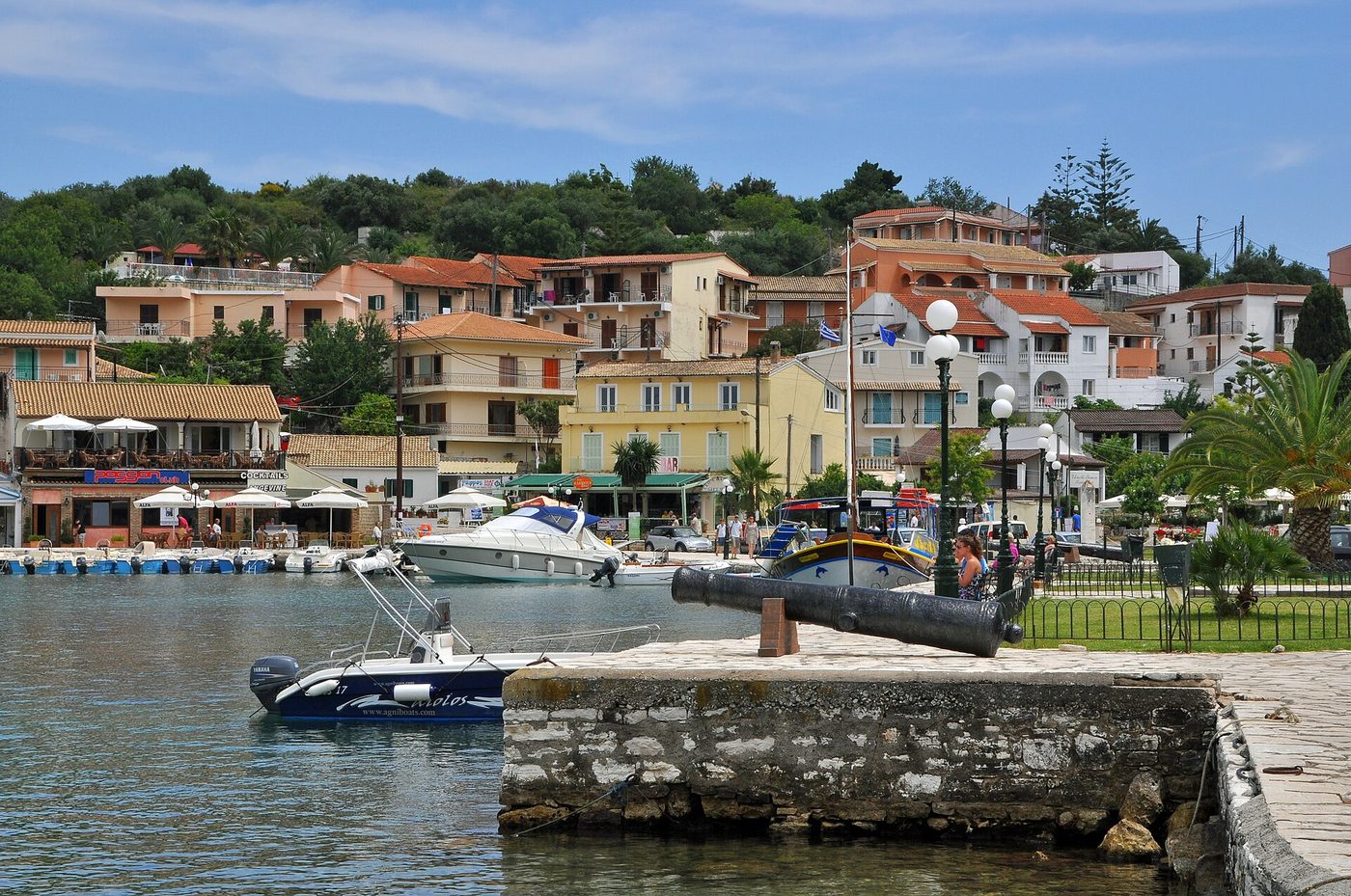
The north-east coast
Barbati, Nissaki, Agni and Kalami are the pebble coves under the flank of Pantokrator, with the Albanian mountains close enough across the strait to see the weather arriving on them. This is the expensive end of Corfu: villas with olive terraces, tavernas you moor a boat at, no nightlife to speak of. Kalami has the White House at the water’s edge, where Lawrence Durrell and his wife Nancy lived from 1935 to 1939 and where he wrote about the island in Prospero’s Cell. The ground floor is a taverna you can eat in. The upper floors are holiday apartments you can rent.
I could not find published nightly rates for the Kalami, Agni and Nissaki strip on any aggregator, which is itself informative: this is a villa market booked through agencies rather than a hotel market, and it prices accordingly. Book it a season ahead.
On sunbeds: the Greece-wide 2026 range runs from about €15 for two loungers and an umbrella on a quiet beach up to €120 for a front row at a luxury beach club. Corfu sits at the low end of that. Glyfada is the only Corfu beach with a published figure I could verify, at €15 to €20 a day. Free public space exists on every beach listed above by law, though at the busiest it can be a narrow strip at the back.
For how Corfu compares with the rest of the continent, see our roundup of the best beaches in Europe.
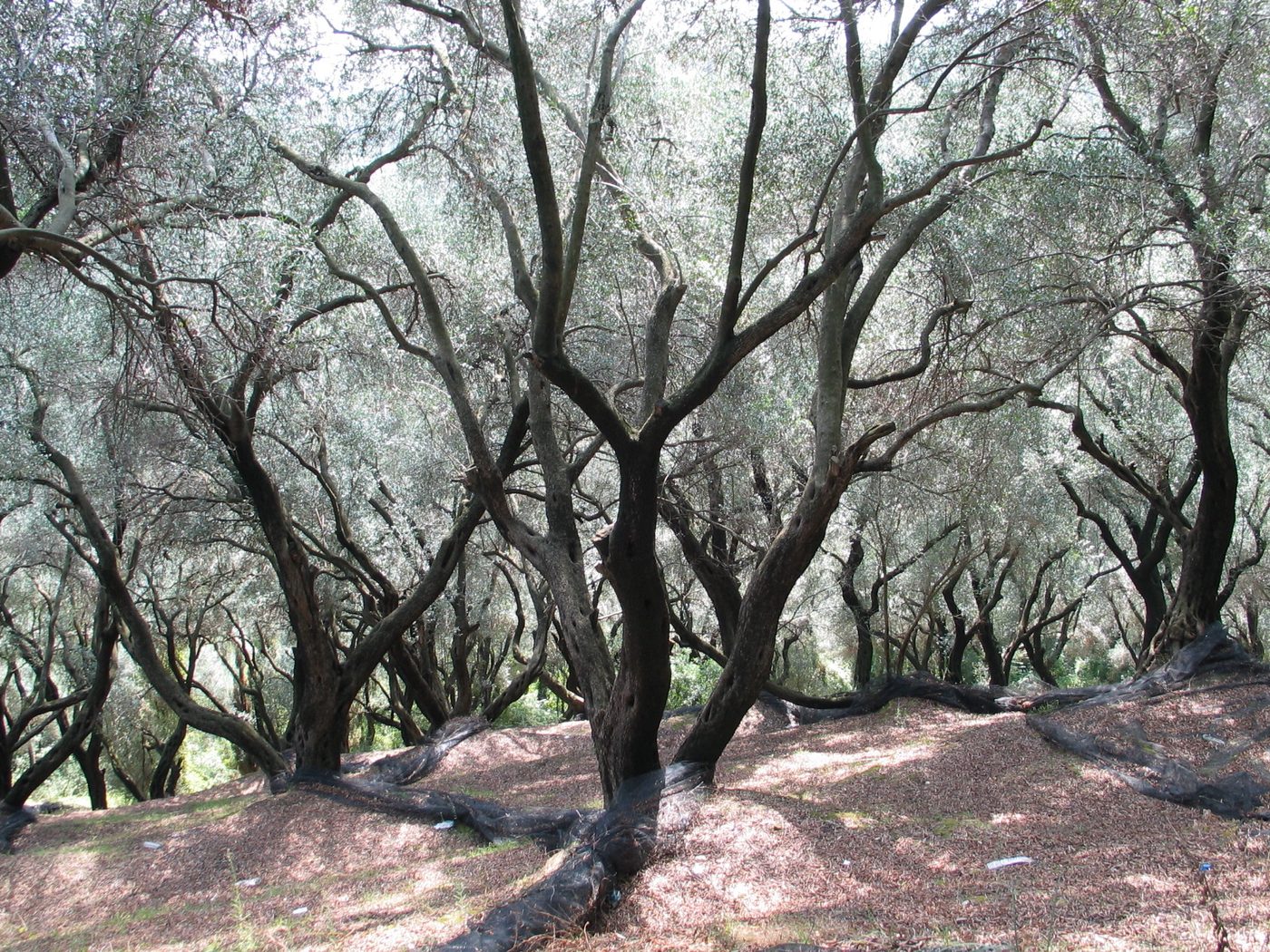
Corfu is called the emerald island because it is green, and it is green because it rains. Roughly four million olive trees cover about 60% of the arable land, some of them close to 500 years old, and the island still produces an average of around 15,000 tonnes of olive oil a year. Those groves come right down to the shore on the north-east coast, which is why the coves there feel enclosed in a way the west coast does not.
The mountains, the trail and the viewpoints
Mount Pantokrator
At 906 metres this is the highest point on the island, with a monastery on top whose main sanctuary dates from the 17th century (nothing survives of the original 14th-century buildings). Three ways up by road: from the south via Spartylas and Strinylas, which is the easiest and the one the buses serve as far as Strinylas; from the west via Lafki to Petalia and then 5 km east; and from the north through Loutses and Old Perithia, which becomes a steep 5 km track suitable for walkers or a 4WD only. On a clear morning you can see Italy.
The Corfu Trail
| Detail | Figure |
|---|---|
| Length | 220 km per the official guide. Rough Guides says 200 km, other sources 180 km |
| Route | Cape Asprokavos near Kavos in the south to Cape Agias Ekaterinis and Agios Spyridon beach in the far north |
| Sections | 10 |
| Duration | 10 days for strong walkers, 8 to 12 days for most |
| Opened | 2001, created by Hilary Whitton Paipeti |
| Waymarking | Yellow aluminium signs the whole way |
| Companion guide | Published as a companion guide to the route, distribution varies |
| Maintenance contribution | Walkers are asked for €3 |
| Passes through | Lefkimmi, the Korission lagoon, Agii Deka, Pelekas, Myrtiotissa, Paleokastritsa, Agios Georgios Pagon, Spartylas, Pantokrator |
The length discrepancy is real and I am not going to pretend otherwise: the official trail site says 220 km, Rough Guides says 200, and other sources say 180 or 193 with the Kalami coastal loop added. Plan your days off the sections, not the total. More long-distance options in our guide to hiking in Europe.
Kaiser’s Throne, Pelekas
Free, always open, and the single best half-hour on Corfu. A 360-degree viewpoint above Pelekas village taking in both coasts, the Ropa Valley and the Albanian mountains. About 25 minutes’ drive from Corfu Town, with a public car park just below the summit and a steep 10 to 15 minute walk up from the village square bus stop. The car park fills well before sunset in summer. Arrive an hour early, or walk up.
Angelokastro
A 13th-century Byzantine castle 305 metres above the sea on the north-west coast, run by the Kerkyra Ephorate of Antiquities, and never captured in its history. Open daily except Wednesdays, roughly 10:00 to 18:00. On the ticket price my sources split between €3 and €10, with no official page to settle it. Carry cash and expect around €3.
The Nymfes waterfalls
A 6.5 km loop of about two hours, with the tallest fall around 15 metres. The village is 33 km north of Corfu Town, just under an hour by car. Go in spring when there is water in them. In August there may not be.
The villages worth the drive
Corfu’s interior is where the island stops performing. These are the ones I would build a day around.
| Village | Where | Why go |
|---|---|---|
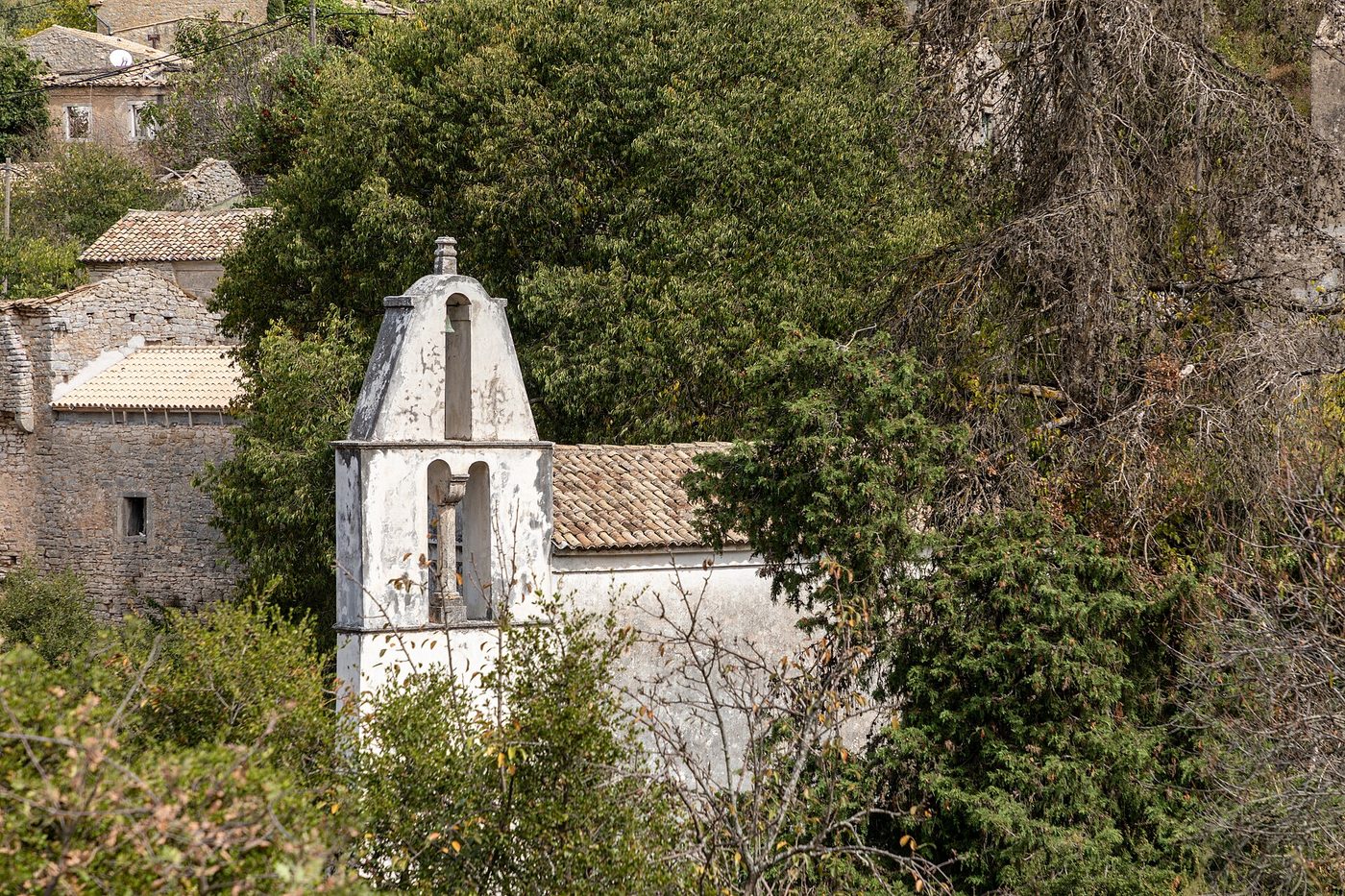
| Old Perithia | Northern flank of Pantokrator | Corfu’s oldest permanent settlement, built in the 14th century and heritage protected. Over 130 Venetian-style houses, many still abandoned, eight churches including Agios Iakovos Persis, and a handful of restored family tavernas that make the drive worth it on their own |
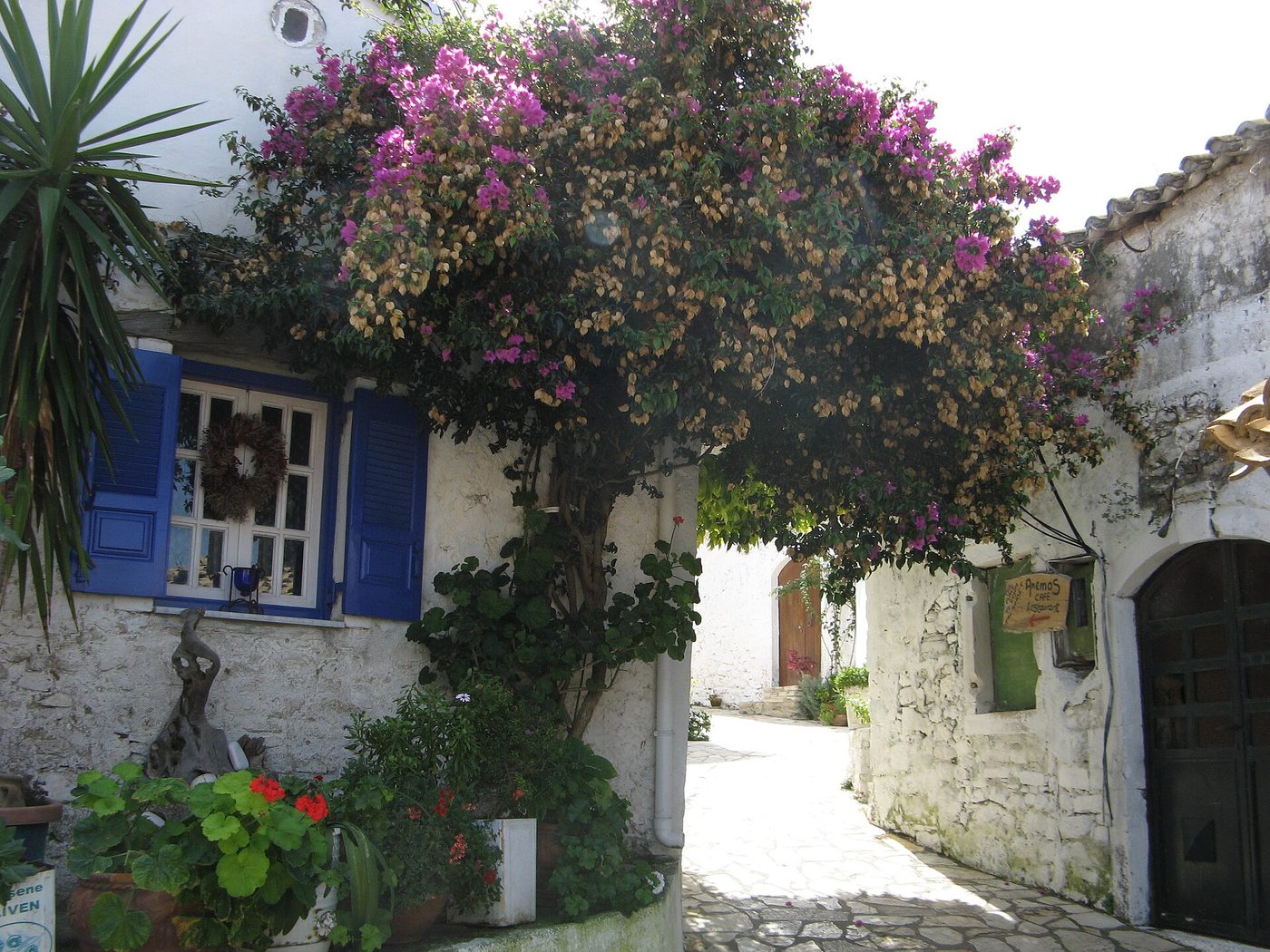
| Afionas | Narrow north-west peninsula | Whitewashed houses with blue shutters, and the trailhead for the Porto Timoni descent |
| Lakones | High above Paleokastritsa | The Bella Vista viewpoint looks straight down onto all six bays. Best light in the late afternoon |
| Doukades | Inland from Paleokastritsa | Three tavernas, a village shop and a square where people actually sit in the evening. Taverna Elizabeth is the long-running family place |
| Pelekas | West-coast hills | Sunsets and the Kaiser’s Throne |
| Sinarades | Inland, west coast | Venetian-style buildings and a folklore museum in a traditional house |
| Strinylas | Southern approach to Pantokrator | The walkers’ base, and reachable by bus from Corfu Town |
| Avliotes | North-west corner | A hill town making few concessions to tourism, and the gateway to Peroulades and Loggas beach |
| Gardiki | Southern Corfu | Gardiki Castle, a Byzantine fortress on the flat, unusually for Corfu |
| Danilia | Near Kontokali | A purpose-built village used as the main filming set for The Durrells |
What to eat, and what to drink
Corfiot cooking is the clearest evidence of the island’s history on a plate. Four centuries of Venice, then France, then Britain, produced something with Italian richness and Greek simplicity, and almost none of it appears on a standard Greek taverna menu elsewhere.
| Dish or drink | What it is |
|---|---|
| Pastitsada | The signature dish. Beef or rooster slow-cooked in a rich tomato sauce with cinnamon, cloves, red wine and sweet spices, traditionally served on Sundays and feast days |
| Sofrito | Thinly sliced veal slow-cooked in white wine, garlic and parsley |
| Bourdeto | Spicy fish. The red colour comes mainly from peppers, and the heat is real |
| Tsitsibira | Corfiot ginger beer, left behind by the British. A brewery was founded on the island in 1842 to supply the garrison, and people still drink it |
| Kumquat | Imported from Asia in 1846. Corfu and Sicily are the only two places in the Mediterranean where it still flourishes. Sold as a bright orange liqueur, as spoon sweets and as marmalade |
| Kakotrygis | Corfu’s leading white grape. The name refers to how awkward it is to harvest. Floral, herbal, citrus, good acidity |
| Skopelitiko and Petrokoritho | The local red and a second white. Ambelonas works with the indigenous varieties |
Theotoky Estate at Giannades is one of the oldest wineries on the island, about 120 hectares, family-owned for generations, doing tours, tastings and organic olive oil. A Theotoky white appears in the 1981 Bond film For Your Eyes Only, which was partly shot here, including at Vlacherna.
Corfiot food sits in the same tradition covered in our guide to the best Mediterranean destinations, with more Venetian influence than most of it.
What a meal costs in 2026
| Item | Price |
|---|---|
| Full taverna meal per person | €8 to €15 |
| Moussaka | €8 to €10 |
| Grilled fish | €10 to €15 |
| Lamb kleftiko | €9 to €12 |
| Greek salad | €4 to €6 |
| Souvlaki pita | €2.50 to €4 |
| Gyros lunch | €6 to €8 |
| Seaside restaurant dinner with drinks | €20 to €40 |
| Beer | €3 to €5, draught domestic around €4 |
| Glass of wine | Around €5 |
| Cappuccino | Around €3 |
| Bottled water | Around €1 |
| Weekly groceries | €45 to €50 |
| Olive oil tasting | From €27 for an hour, €55 for a three-hour tour |
| Couvert (cover charge) | €0.50 to €3 per person |
The couvert is worth understanding because it surprises people. It covers bread, the table setting, water and small accompaniments, it goes to the restaurant rather than the server, and it is not a tip. Tipping on top is customary at around 5 to 15% and is not compulsory. Nomadic Matt has a useful rule of thumb that I have found holds up: a €0.50 bread charge and a Greek salad under €7 means you are in a cheap place, a €1 cover and a €7 to €8.50 salad means average, above that means you are paying for the view.
Tap water is safe to drink. The emergency number is 112. More on eating across the continent in our guide to European food.
What Corfu costs in 2026, including the taxes that are easy to miss
Corfu is meaningfully cheaper than Santorini or Mykonos, and July prices run roughly double what you pay in May or September.
| Daily budget | Cost | What it buys |
|---|---|---|
| Backpacker | €65 a day | Hostel dorm, self-catering plus one taverna meal, buses. Add €10 to €15 if you drink |
| Midrange | €125 a day | Budget hotel or apartment, eating out twice, a hire car shared, a paid sight or two |
| Upscale | €215 a day | Four-star or villa share, seaside dinners, boat hire, guided trips |
| Accommodation type | Typical rate |
|---|---|
| Hostel dorm | €19 to €26, roughly doubling in summer |
| Hostel private room | €55 to €65, up to €110 in summer |
| Budget hotel | Around €35, doubling in summer |
| Airbnb private room | Around €40 |
| Whole apartment | Around €130 |
| Campsite pitch | €12 |
Aggregator averages for hotels are quoted in dollars rather than euros, so treat them as indicative: roughly $178 a night for three-star, $319 for four-star and $653 for five-star across the island, with entry-level deals from around $67 in Corfu Town, $57 in Paleokastritsa, $45 in Sidari and $34 in Kavos. The cheapest months to book are February, March and December. The dearest are June through August.
The Climate Crisis Resilience Fee
This one can add real money to a villa holiday, and it will not be in the price you were quoted. Greece replaced its old accommodation tax with the Climate Crisis Resilience Fee under Law 5073/2023, effective from 1 January 2024, and the 2026 rates are national. There is no separate Corfu tourist tax. The fee is charged per room, apartment or property per night, not per person, and it is usually collected locally at check-in or check-out with its own receipt. Package prices routinely exclude it.
| Accommodation type | April to October | November to March |
|---|---|---|
| 1 to 2 star hotels | €2 a night | €0.50 |
| 3 star hotels | €5 | €1.50 |
| 4 star hotels | €10 | €3 |
| 5 star hotels | €15 | €4 |
| Furnished rooms and apartments | €2 | €0.50 |
| Short-term rentals (Airbnb type) | €8 | €2 |
| Detached short-term rental house over 80 m² | €15 | €4 |
| Furnished tourist villas | €15 | €4 |
Two weeks in an August villa is €210 of tax that will not be in the price you booked. Two weeks in a family-run apartment in the same fortnight is €28. That difference is worth knowing before you choose.
Corfu is also a stop on plenty of sailings covered in our guide to European river cruises and their sea-going equivalents.
The cruise levy
Greece introduced a cruise passenger fee under Law 5162/2024, live from 1 July 2025 and collected at disembarkation. Santorini and Mykonos are charged at €20 in peak season, €12 in shoulder and €4 off-season. Corfu, along with every other Greek port, sits in the lower tier: €5 peak, €3 shoulder, €1 off-season. It applies to cruise passengers only. Arriving by air or ferry, you pay nothing.
There is an unintended consequence here that affects your holiday even if you never set foot on a cruise ship. The €20 Santorini and Mykonos charge is pushing cruise itineraries toward the €5 ports, and Corfu is one of them. Corfu took 894,179 cruise passenger visits in 2025. Early 2025 arrivals were up 79% year on year, and 111 calls were scheduled for October to December, bringing over 180,000 visitors into what used to be the quiet months. A single 3,500-passenger ship can put 2,000 to 3,000 people onto the Spianada at once. Plan the Old Town for early morning or evening, and check the cruise schedule for your dates if you can.
Corfu is a comparatively good-value island by Greek standards. For more on stretching a budget across the continent, see Europe on a budget and our list of the cheapest places to travel in Europe.
When to visit Corfu
Corfu has a Mediterranean climate, Köppen Csa, with a mean annual temperature of about 17°C. August is the warmest month at a mean of 25.4°C. January is the coldest at 10°C. The sea averages 14.7°C in February and 25.6°C in August. And it rains a great deal more than people expect, which is the price of the green.
| Month | Avg daily max | Avg temp | Sea | Rainfall | Rain days | Crowds | Verdict |
|---|---|---|---|---|---|---|---|
| January | 11.6°C | 10.0°C | 15.6°C | 151 mm | 9 | None | Corfu Town only. Most of the island is closed |
| February | 11.8°C | 10.2°C | 14.7°C | 143 mm | 8 | None | Cheapest month to book. Carnival falls in the week before Ash Wednesday |
| March | 13.8°C | 12.0°C | 14.8°C | 111 mm | 8 | None | Wildflowers, waterfalls running, no swimming |
| April | 16.4°C | 14.5°C | 16.2°C | 71 mm | 6 | Light | Season opens. Cheap, green, and a real rain risk. Easter is a major event here |
| May | 20.1°C | 18.3°C | 19.4°C | 36 mm | 4 | Building | Late May is one of the two best windows on the island |
| June | 24.1°C | 22.3°C | 22.8°C | 20 mm | 2 | Busy from mid-month | Mid-June runs 25 to 30°C on the warmest days with everything open. The other best window |
| July | 26.6°C | 24.8°C | 24.7°C | 9 mm | 1 | Peak | The driest month of the year. Hot, crowded, expensive. Prices roughly double May |
| August | 27.3°C | 25.4°C | 25.6°C | 16 mm | 2 | Peak | Warmest sea of the year. Daytime peaks often reach the mid-30s. Greek domestic holidays on top of everything else |
| September | 23.9°C | 22.2°C | 24.5°C | 105 mm | 5 | Easing after the first week | The best month overall. Warm sea, thinning crowds, everything still open |
| October | 20.5°C | 18.9°C | 22.4°C | 152 mm | 7 | Light | Cheap and lovely, but tavernas start closing mid-month and it is the last month for direct international flights |
| November | 16.8°C | 15.3°C | 20.0°C | 253 mm | 10 | None | The wettest month of the year. Resorts closed |
| December | 13.0°C | 11.6°C | 17.4°C | 223 mm | 11 | None | Corfu Town at Christmas is quietly charming. Everything coastal is shut |
Those temperature columns are 1991 to 2021 monthly normals, so the “avg daily max” is the average of every daily maximum in the month, not the number on the hottest afternoon. In practice July and August days routinely pass 30°C and reach the mid-30s in a heatwave. Treat the table as the shape of the year rather than a forecast.
The rainfall column is the part that surprises people. Corfu takes about 73 rain days and 1,290 mm a year on this dataset, with November alone at 253 mm. Other sources put the coastal annual figure nearer 1,000 mm and November nearer 222 mm, so treat the exact number loosely and the pattern seriously: this is among the wettest parts of Greece, July gets 9 mm and November gets more than twenty-five times that.
The consensus among people who know the island well, and my own view, is that late May to mid June and September are the two windows worth planning around. April, May and October are cheaper but carry real rain risk. July and August are hot, crowded and expensive, and if those are your only weeks, base yourself somewhere with shade and a car.
On the shutdown: most large seasonal hotels, beach bars and tourist businesses close from November to March, particularly in the north and west. Kavos in the south and Benitses on the east coast empty out the moment October begins. Corfu Town stays open all year because it is the administrative and commercial centre of the island, not a resort.
If you are choosing between islands and seasons at the same time, the best places to visit in Europe in summer and shoulder season Europe both put Corfu in context, and the least crowded time to visit Europe covers the cruise-call problem across the continent.
Which month for which experience
The sights on this island are not season-neutral, so here is the calendar broken down by what you actually came to do.
| What you want to do | Best month | Why |
|---|---|---|
| Swim in warm water | August and early September | The sea averages 25.6°C in August and holds its heat into September, well after the air has cooled |
| Walk the Corfu Trail | Late April to May, or October | Ten to twelve days on foot in July heat is unpleasant and in some sections unsafe |
| See the Nymfes waterfalls | March to May | They can be dry by August |
| Photograph Porto Timoni | May, June or September | The hike is exposed. Do it early in the day whatever the month |
| Have Paleokastritsa to yourself | May or October, before 10am | The cruise coaches arrive mid-morning |
| Old Town without crowds | Any month, before 09:00 or after 18:00 | Cruise calls now run October to December too, so the off-season dodge no longer works reliably |
| Boat to Paxos and Antipaxos | June and September | Calmer seas than the shoulder months, fewer boats than July and August |
| Sunset at the Kaiser’s Throne | June and July | Latest sunsets. Arrive an hour early for parking |
| Cheapest possible trip | February, March or December | Cheapest hotel months of the year, but you are flying via Athens and most of the island is closed |
| Greek Easter | April, dates move each year | Corfu’s Easter is one of the biggest in Greece, with the pot-throwing on Holy Saturday |
| Naturist beaches | June to September | Myrtiotissa is bleak and unstaffed outside the season |
| Villa holiday at the lowest tax | November to March | The resilience fee drops from €15 to €4 a night. Everything else is shut, so this is theoretical |
For the continent-wide picture, see the best time to visit Europe and, for Greece specifically, the best time to visit Greece.
Where to stay on Corfu
This is the decision that shapes the trip. Corfu’s resorts have distinct characters and the gap between them is wide: Kavos and Nissaki are on the same island and share almost nothing.
| Area | Where | Character | Suits | Entry-level rates |
|---|---|---|---|---|
| Corfu Town | East coast, mid-island | The UNESCO old town. Restaurants, museums, both bus terminals, open all year | First-timers, culture, anyone without a car | Deals from around $67 a night |
| Gouvia, Dassia, Kontokali, Ipsos | East coast, just north of town | The main resort strip. Convenient rather than beautiful, and easy for the airport | Families, package holidays, short stays | Mid-market |
| Benitses and Perama | East coast, south of town | Older resorts, quieter, close to the Achilleion | Value seekers | Mid-market. Empties from October |
| Kalami, Agni, Nissaki, Barbati | North-east coast | The villa coast under Pantokrator. Pebble coves, waterside tavernas, no nightlife | Couples, families with a car, repeat visitors | Villa agency market. No reliable public rates |
| Kassiopi | North-east tip | A working harbour village with a castle, tavernas and some nightlife | People who want a village rather than a resort | Mid-market |
| Acharavi and Roda | North coast | Long flat beaches, family-oriented, lots of self-catering | Families wanting sand and a level walk | Mid-market |
| Sidari | North coast | Busy, developed, the sandiest beaches on the island, the Canal d’Amour | Budget beach holidays, young families | 3 star averaging around $76, deals from around $45 |
| Paleokastritsa | North-west coast | Six coves, clear deep water, dramatic cliffs, day-tripper traffic | Swimmers, snorkellers, boat hire | Deals from around $57, beach hotels around $81 |
| Agios Gordios, Glyfada, Ermones, Pelekas | West coast | Sand, sunsets, studios and small hotels. Winding roads in | Beach days and sunsets, drivers | Mid-market |
| Kavos | Far south | Young, loud, seasonal, and completely shut by mid-October | Under-25s on a party holiday, and nobody else | Deals from around $34 |
My default recommendation for a first visit is four nights in Corfu Town and the rest on the coast, because the town rewards evenings rather than the two hours a coach tour gives it, and because you can get to almost everything from there on the bus if you decide not to hire a car. If it is a second visit, go straight to the north-east and hire a boat. For the wider continental picture see where to stay in Europe.
The other Ionian Islands
The Ionians are called the Eptanisa in Greek, literally “the seven islands”, and they cover 2,306.94 km² with a combined population of 207,855 at the 2011 census. Their shared character comes from the same history as Corfu’s: they faced Italy rather than the Ottoman world, so you get Venetian architecture, dense greenery and water the colour of bottle glass. They are one of the most visited parts of Greece, behind the Cyclades.
| Island | Population (2011) | Character | Go for |
|---|---|---|---|
| Corfu (Kerkyra) | 104,371 | The northernmost and most layered. Venetian town, best museums, easiest to manage without a car | History with beaches attached |
| Zakynthos | 40,759 | Busiest in peak season and built up in parts. Shipwreck Beach and the National Marine Park | Loggerhead turtles, blue caves, big-name scenery |
| Kefalonia | 35,801 | The largest and most rugged. Spread out, quieter, needs a car | Myrtos beach, mountain driving, space |
| Lefkada | 23,693 | Connected to the mainland by a causeway, so reachable by road | Vasiliki and Myli, among the best wind and kitesurfing in the Mediterranean |
| Ithaca | 3,231 | Small, green, quiet, mythologically loaded | Doing nothing in a harbour |
| Paxos and Antipaxos | Not in my census source | An hour from Corfu. Gaios harbour, olive groves, the Blue Caves | The clearest water in the group |
| Kythira | Not in my census source | Geographically detached, off the tip of the Peloponnese | Genuine isolation, but not combinable with Corfu |
Corfu, Zakynthos, Kefalonia and Lefkada are the lively ones. Ithaca, Paxos, Kythira and Meganisi are the quiet ones. The best window for the group as a whole is mid-to-late spring or early autumn: May to mid-June, or mid-September to mid-October.
For how the Ionians compare with the rest of the Greek archipelago, see the best Greek islands and, for the practical mechanics of moving between them, the Greek island hopping itinerary.
Day trips from Corfu
Paxos, Antipaxos and the Blue Caves
The standard organised cruise leaves Corfu port around 09:00, sails along the Paxos coast past the Blue Caves, stops to swim off Antipaxos, and gives you an hour and a half to two hours ashore in Gaios. Total length runs seven to twelve hours depending on the operator. Expect €50 to €60 per adult.
If you would rather do it yourself, the scheduled ferry to Paxos takes 45 minutes to an hour and twenty, costs from €15 one way with typical fares of €18 to €35, and there are around 93 sailings a week in season between Kerkyra Lines and Joy Cruises. Kamelia Lines runs from Lefkimmi in the south of Corfu, which is a shorter crossing if you are staying down that end. Going independently costs less, gives you a full day on Paxos and skips the Antipaxos swim stop, which is the bit most people remember.
Albania in a day
Saranda is 30 to 35 minutes away by hydrofoil, or 50 to 70 minutes on the conventional car ferry, at €10 to €40 each way. Fares of around €10 turn up on morning and afternoon departures.
Be clear that this is an international border crossing, not an island hop. You need a passport or national ID card, and it is checked at the Corfu terminal, at boarding, and by Albanian immigration on arrival. UK, EU, EEA, Swiss, Canadian, Australian, New Zealand, Japanese and Korean passport holders do not need a visa for stays up to 90 days in any 180. US passport holders get a longer allowance still. Leave time at both ends: the queue at Saranda on a summer afternoon is not short. Most people go for the day and continue to Butrint, the Roman and Venetian ruins south of the town.
The Diapontia Islands
Mathraki, Othoni and Ereikoussa, north-west of Corfu’s tip. Empty beaches and fishing harbours, reached from Agios Stefanos. This is the trip for people who think Paxos sounds crowded.
Butrint is one of the reasons Albania keeps appearing in our underrated places in Europe and Eastern Europe travel guide. Check the Schengen visa and ETIAS rules if you are counting days, because Albania sits outside the zone.
Corfu itineraries
Three days, no car
- Day 1. Corfu Town on foot. Campiello in the morning, the Old Fortress (€10), lunch in the back streets rather than on the Liston, the Archaeological Museum (€10) for the Gorgon pediment, and the Liston in the evening for a drink you are overpaying for on purpose.
- Day 2. Blue bus to Kanoni for Vlacherna and Mouse Island, then the Achilleion (€7). Afternoon at a beach reachable on the day pass.
- Day 3. Green bus to Paleokastritsa (check the fare and the return time before you leave). Swim, boat trip to the caves, La Grotta in the late afternoon.
Five days, with a car
- Days 1 and 2. As above, using the car for the Achilleion and one west-coast beach.
- Day 3. North-west. Paleokastritsa, up to Lakones for the Bella Vista view, Angelokastro, then Afionas and the walk down to Porto Timoni if you have the legs for it. Sunset at Loggas.
- Day 4. North-east. Barbati, Nissaki, Agni for a long lunch you arrive at by boat if you can, Kalami and the White House. Old Perithia on the way back over the shoulder of Pantokrator.
- Day 5. Mount Pantokrator early, then the Kaiser’s Throne at Pelekas for sunset, with Doukades or Sinarades for dinner.
Seven days, Corfu plus the Ionian
- Days 1 to 4. The five-day plan, compressed slightly.
- Day 5. Paxos and Antipaxos, either on the cruise or independently.
- Day 6. Saranda and Butrint, or the south of the island, Korission lagoon, Halikounas and Issos.
- Day 7. Corfu Town again, for the museums you missed and the shopping you postponed.
If you want to keep going south, the Lefkada Palace runs Corfu to Lefkada, Ithaca, Kefalonia and Zakynthos on Mondays, Wednesdays and Fridays. See our Greece itinerary for how to fit that around Athens, and the best places to visit in Greece for the mainland alternatives.
Corfu by traveller type
| Traveller | Base | Verdict |
|---|---|---|
| First time in Greece | Corfu Town, then the west coast | Very good. More to look at than a Cycladic island, and easier to reach from the UK |
| Families with young children | Acharavi, Roda, Agios Georgios Pagon or Sidari | Very good. Sand, shallow water, lifeguards at Agios Georgios Pagon, and Aqualand as the rainy-day insurance |
| Couples | North-east coast or Paleokastritsa | Excellent, if you hire a car or a boat |
| Walkers | Strinylas, or move along the Corfu Trail | Excellent in April, May and October. Poor in July and August |
| Solo travellers | Corfu Town | Good. Hostels exist, buses work, and the town is walkable and safe at night. See our solo travel in Europe guide |
| Backpackers | Corfu Town | Good at €65 a day. Cheaper than the Cyclades and connected to the mainland by a €7 ferry |
| Luxury travellers | Kalami, Agni, Nissaki | Excellent. The villa coast is as good as anything in the Mediterranean, and it is where the resilience fee bites hardest at €15 a night |
| Cruise passengers | One day ashore | Tight. Old Town plus the Achilleion is a full day. Skip Paleokastritsa unless your call is over eight hours |
| Winter visitors | Corfu Town only | Limited. Flights go via Athens and most of the island is closed, but the town is open and cheap |
Two things to check before you book
Water
Corfu was declared in a state of emergency over water shortage for three months in March 2026, in a decision signed by the Environment and Energy Minister. The causes are ageing infrastructure, poor maintenance, heavy losses in the network and peak-season demand on top of low rainfall, which is a maintenance problem rather than a rainfall problem on an island that takes 1,290 mm a year. Several Greek islands declared water emergencies during 2026.
I could not confirm whether the declaration has been extended past its three-month term or what, if anything, it currently requires of visitors, so I am not going to tell you there are restrictions in force. Check with your accommodation when you book. Villas with pools in the south and west are the ones most likely to be affected if restrictions return.
Accessibility
There is very little published information on step-free access to Corfu’s sites, and I could not source anything reliable enough to publish. What I can tell you from the geography: the Old Fortress, the New Fortress and Angelokastro all involve significant climbs on uneven historic surfaces; the Achilleion has terraces and steps throughout; the Old Town is cobbled and steeply pitched in the Campiello; and the beaches with easy level access are Sidari, Acharavi, Roda, Agios Georgios Pagon, Glyfada and Agios Gordios, while Myrtiotissa, Porto Timoni, Rovinia and Loggas all require a descent that is difficult or impossible with limited mobility. Contact sites directly. This is a genuine gap in the coverage of this island, mine included.
Packing for a wet-and-warm island is its own problem. Our Europe packing list covers it, and Europe travel tips has the general ground rules.
Mistakes people make on Corfu
- Landing and expecting a green bus at the airport. They do not serve it. Blue Bus 15 into town, then a second ticket at a different terminal.
- The north-east coast does not work without a car. Kalami, Agni and Nissaki are lovely and the bus service to them is not a plan.
- Budgeting from a package price. The Climate Crisis Resilience Fee is charged locally and is usually excluded. A fortnight in an August villa is €210 on top.
- Trusting a museum price you read online. The Old Fortress and Archaeological Museum are €10 each on the ministry’s own pages. Budget for that and enjoy being wrong.
- Porto Timoni is a hike, not a stroll. Rock and steps in both directions, and the return leg is uphill.
- Going in October and assuming everything is open. Tavernas start closing mid-month, Kavos and Benitses empty the first week, and the direct flights stop at the end of it.
- Doing the Old Town at midday. That is exactly when a 3,500-passenger ship has put a couple of thousand people on the Spianada. Go at 08:00 or after 18:00.
- Assuming the Ionians link up easily. They mostly do not. The Lefkada Palace is the one through service, it runs three days a week southbound, and Corfu to Kefalonia takes nine and a half hours.
- A phone photo of your driving licence will not do. The rental desk wants the physical card, and non-EU licences generally need an International Driving Permit alongside.
- The Albania trip is a border crossing, not an island hop. Passport, immigration queues, and time at both ends.
What I could not pin down
These are the questions I went looking for answers to and did not find. Better to say so than to fill the gaps with plausible numbers.
- The combined museum ticket. Two ministry pages say it is withdrawn, a third still sells it at €14 for three days. Ask at the first desk.
- The New Fortress, Angelokastro and Mon Repos ticket prices. Sources conflict (€4 versus €5, €3 versus €10) or publish nothing at all. Carry cash.
- The Bus 15 airport fare. Quoted at both €1.20 and €1.70.
- Corfu Town’s blue-zone hourly parking rate. Not published anywhere I could find, official or otherwise.
- Nightly rates for the Kalami, Agni and Nissaki strip. It is a villa-agency market and does not appear on the aggregators.
- Sunbed prices beyond Glyfada. Only one Corfu beach publishes a figure.
- A direct Patras to Corfu ferry. I found no operator timetable confirming a current service.
- Whether the March 2026 water emergency is still in force. Ask your accommodation.
There is also a scope limit worth naming. This guide covers Corfu in depth and the rest of the Ionian in outline. Kefalonia, Zakynthos and Lefkada each deserve their own treatment, and the comparison table above is a starting point rather than a substitute.
Corfu travel guide FAQ
How many days do you need in Corfu?
Five is the number that works. Three gets you the town and one coast. Five gets you the town, the north-west and the north-east with a day left over. Seven lets you add Paxos or Albania. Anything under three and you are choosing between the UNESCO town and the beaches, which is a shame given they are twenty minutes apart.
Is Corfu worth visiting?
Yes, and particularly if you have been to the Cyclades and found them samey. Corfu has a walled Venetian town on the UNESCO list, serious museums, a mountain you can drive up, a 220 km waymarked long-distance trail, and beaches on four different coasts with genuinely different characters. It is also greener and wetter than the Greece of the brochures, which is either the appeal or the drawback depending on you.
What is Corfu famous for?
Its Venetian old town, four centuries of never falling to the Ottomans, four million olive trees, the Durrell family, the Achilleion, kumquat liqueur and ginger beer. It was one of the first Greek islands to attract mass tourism, in the 1960s, and it has been managing the consequences ever since.
Do you need a car in Corfu?
Not if you stay in or near Corfu Town, where the €5 blue bus day pass and the green bus network cover most of what you want. Yes if you stay on the north-east or west coasts, or if you want to be at Paleokastritsa before the coaches or at the Kaiser’s Throne for sunset. Shoulder-season hire runs about €25 to €50 a day and peak can exceed €60.
Is Corfu expensive?
It is one of the better-value big Greek islands, clearly cheaper than Santorini or Mykonos. Budget €65 a day backpacking, €125 midrange, €215 upscale, and remember the accommodation tax on top at €0.50 to €15 per room per night depending on the property and the season. July prices are roughly double May.
What is the best area to stay in Corfu?
Corfu Town for a first visit and for anyone without a car. The north-east coast between Barbati and Kassiopi for couples and villa holidays. Acharavi, Roda or Sidari for families who want sand and level ground. Paleokastritsa for swimmers. Kavos only if you are under 25 and know exactly what you are booking.
What is the best time of year to visit Corfu?
Late May to mid-June, or September. Those two windows give you warm water, open businesses and prices well below July and August. April, May and October are cheaper still but carry a real chance of rain, and the direct flight season is over by the end of it.
Which is better, Corfu or Kefalonia?
Corfu if you want a town, museums, history and the option of not hiring a car. Kefalonia if you want space, mountain driving and Myrtos beach, and you are happy to drive everywhere. Corfu has roughly three times Kefalonia’s population and correspondingly more infrastructure, which cuts both ways.
What is the prettiest part of Corfu?
The north-east coast between Barbati and Kassiopi, with Pantokrator behind and Albania across the strait. Second place goes to Paleokastritsa seen from Lakones, and third to the Campiello at eight in the morning.
Can you do a day trip from Corfu to Albania?
Yes. Saranda is 30 to 35 minutes by hydrofoil, €10 to €40 each way. It is a real border crossing, so bring your passport and allow queue time. Most visitors continue to the ruins at Butrint.
Is Corfu good for families?
Very. Agios Georgios Pagon has a lifeguard, shallow water on one side and deep on the other. Sidari, Acharavi and Roda are flat and sandy. Aqualand covers the day the weather turns. Our Europe with kids guide has more on travelling the continent with children, and the best beaches in Europe covers the family-friendly options elsewhere.
How do you get from Corfu Airport to Corfu Town?
Taxi for €15 to €20 and a 10 to 15 minute drive, or Blue Bus No. 15 to San Rocco square, roughly hourly and reduced at weekends. The green island buses do not serve the airport at all.
Do I need an International Driving Permit?
UK photocard holders do not, but must carry the physical card. Licence holders from outside the EU and EEA generally do, and rental desks on the island ask for one routinely, so US, Canadian and Australian drivers should sort it before they fly.
Final thoughts
Corfu has been receiving visitors since the 1960s and it shows, in both directions. There are stretches of the east coast built without much thought and a south end given over entirely to a particular kind of holiday. There is also a fortified Venetian town that Greece has nothing else like, an interior of olive terraces and half-abandoned stone villages, a 906 metre mountain you can drive up before breakfast, and a coastline that changes completely every twenty minutes of driving.
What I would tell a friend: go in September, stay four nights in the town and four on the north-east coast, hire a car for at least three of those days, and hire a small boat for one of them. Take €10 notes for the museums. Book the villa a season ahead if you want the good coast. And do not let the reputation of the resort strips decide it for you, because the island behind them is a different place.
Next in this silo: our Crete travel guide, the Santorini travel guide and things to do in Athens. If you are still assembling the wider trip, start with the Europe itinerary or how to plan a trip to Europe.
About the author
Hannah Brooks has spent fifteen years travelling, living and writing across Europe, from the Arctic tip of Norway to the south of Sicily. She has planned hundreds of European itineraries for readers and is Senior Europe Editor at EuropeanTourism.org.
Photo credits
- Corfu travel guide: the Venetian old town and fortress of Corfu · Dietmar Rabich / CC BY-SA 4.0 via Wikimedia Commons
- The Venetian Old Fortress and the marina seen across the bay from Corfu Town · Dietmar Rabich · CC BY-SA 4.0 · via Wikimedia Commons
- The Contrafossa canal between the walls of the Old Fortress in Corfu Town · Marc Ryckaert (MJJR) · CC BY 3.0 · via Wikimedia Commons
- Statues of the Muses along the terrace colonnade of the Achilleion palace at Gastouri, Corfu · Thomas Schoch · CC BY-SA 3.0 · via Wikimedia Commons
- An old iron lantern on a vaulted ochre wall inside the Old Fortress at Corfu Town · Dietmar Rabich · CC BY-SA 4.0 · via Wikimedia Commons
- The sand beach, hotels and wooded headlands of Paleokastritsa on the north-west coast of Corfu · Marc Ryckaert (MJJR) · CC BY 3.0 · via Wikimedia Commons
- The harbour at Kassiopi on the north-east coast of Corfu, with waterfront tavernas and moored boats · Marc Ryckaert (MJJR) · CC BY 3.0 · via Wikimedia Commons
- Ancient olive trees with harvest nets spread beneath them on Corfu · Gareth Williams from Redhill, England · CC BY 2.0 · via Wikimedia Commons
- The church of Agios Spyridon among stone houses in Old Perithia, the oldest permanent settlement on Corfu · Dietmar Rabich · CC BY-SA 4.0 · via Wikimedia Commons
- A whitewashed lane with bougainvillea in the village of Afionas on the north-west coast of Corfu · Vlado Alin · CC BY 4.0 · via Wikimedia Commons