Mykonos Travel Guide: Beaches, Delos, Costs and When to Go
The first time I got off the ferry at Tourlos I did what almost everyone does. I dragged a suitcase up the coast road toward town, in August, at two in the afternoon, with the meltemi throwing grit into my eyes and a line of quad bikes hooting past my elbow. It took twenty-five sweaty minutes and taught me more about Mykonos than any of the reading I had done beforehand. This is an island that rewards a small amount of planning out of all proportion to the effort, and punishes none at all.
This Mykonos travel guide is the version of that reading I wish had existed: which beach to choose on a windy day, what a sunbed actually costs, what the ferry from Rafina really costs against the one from Piraeus, what the island charges you in taxes you never see advertised, and when to go if you would rather not queue for your own holiday.
I have been coming here for more than a decade, in high summer and in the dead of February, on a budget and on somebody else’s expense account. Mykonos gets written about as either a hedonistic playground or an overpriced trap, and it is neither of those things exclusively. It is a small, dry, beautiful Cycladic island with an unusually good bus network, one of the most important archaeological sites in the Mediterranean sitting three and a half kilometres offshore, and a tourism economy that has grown far faster than its infrastructure. If this is your first Greek island, our guide to how to plan a trip to Europe covers the groundwork this one assumes. All of those facts matter to your trip.
Mykonos at a glance
Every number here is sourced, and the rest of the guide explains where it comes from and when it stops being true.
| Question | The short answer |
|---|---|
| Where is it | The Cyclades, central Aegean. 86 nautical miles from Piraeus, 71 from Rafina |
| Permanent population | 10,704 at the 2021 Greek census |
| Summer population | Rises to an average of around 50,000 on the municipality’s own figures |
| How long to stay | 3 to 4 nights first time; 4 to 5 if Mykonos is the main event rather than one island-hopping stop |
| Best month | September, then June. July and August are the peak of everything, including the wind |
| Airport | Mykonos “Manto Mavrogenous” Airport, IATA code JMK, 4 km from town |
| Ferry port | All passenger ferries dock at the New Port at Tourlos, 2.5 km north of Chora |
| Cheapest way from Athens | Rafina, from around €35.50 one way, from about 1 hr 50 min on the fastest sailings |
| Bus fare | Roughly €1.80 to €2.80 a ride, about €3.00 for airport and port runs |
| Do you need a car | No. Buses, walking and the water taxi cover the south coast. One hire day opens the north and east |
| Accommodation tax | The climate resilience levy: €2 to €15 per room per night from April to October, by property class |
| Cruise levy | €20 per passenger in peak season, one of only two Greek ports charging the top rate |
| Currency | Euro. Cards are widely accepted; carry cash for buses, kiosks and small tavernas |
| Language | Greek. English is spoken almost everywhere a visitor goes |
| The day trip | Delos, a UNESCO World Heritage Site inscribed in 1990. €20 entry, roughly €25 for the boat |
Is Mykonos worth visiting, honestly?
Yes, with a condition attached: you have to decide what you want from it before you book, because Mykonos will happily sell you a version of itself you did not want.
There are effectively three islands sharing one name. There is party Mykonos, which lives on a two-kilometre stretch of the south coast between Paradise and Paraga and in a handful of clubs in town. There is luxury Mykonos, which lives at Psarou and Ornos and in a set of beach clubs where a lunch for two can cost more than your flight. And there is the old island, which is Ano Mera on a Tuesday morning, the fishermen’s boats at the Old Port, the empty north coast, and the marble ruins of Delos in the heat.
All three are real. The mistake is booking for one and landing in another. If your image of a Greek island is a taverna with six tables and a cat, Mykonos can give you that, but only if you point yourself at it deliberately. If you want the version from the drinks adverts, it is here in quantity, and it is expensive.
What Mykonos is not is a cheap island. It is the most expensive of the Cyclades along with Santorini, and if your budget is tight, Naxos or Paros will give you more for the money. What it is, more than any of its neighbours, is easy: a small island with a bus network that works, an airport with direct flights from most of Europe in summer, and enough range that a family, a honeymooning couple and a group of twenty-five-year-olds can all have a good week on it without ever seeing each other.
When to visit: the month-by-month numbers
The whole argument about when to visit turns on three numbers: air temperature, sea temperature and wind. Here are all three, from the 1991 to 2020 climate normals.
| Month | Avg high °C | Avg low °C | Sea °C | Rainfall mm | What it feels like |
|---|---|---|---|---|---|
| January | 12.6 | 9.2 | 16 | 100 | The island is closed. Wettest month, 3.5 hours of sun a day |
| February | 13.0 | 9.5 | 15.5 | 70 | Coldest sea of the year. Snow has fallen here, rarely |
| March | 15.0 | 11.1 | 15.5 | 60 | Delos is shut until 1 April. Very quiet |
| April | 18.0 | 13.2 | 16 | 25 | Things reopen. Walkable, swimmable only if you are brave |
| May | 22.3 | 16.7 | 18.5 | 15 | Lovely. Meltemi starts around mid-month |
| June | 26.7 | 20.8 | 21.5 | 4 | The best month before the crowd arrives |
| July | 28.5 | 22.9 | 23.5 | 2 | Peak everything. Wind averaging 28.2 kph |
| August | 28.4 | 23.2 | 24 | 2 | Warmest sea, biggest crowds, and the windiest month at 29.0 kph |
| September | 25.7 | 20.7 | 23.5 | 10 | My pick. Sea still at August warmth, everything open |
| October | 21.9 | 17.6 | 21.5 | 45 | Swimmable at the start, shutting down by the end |
| November | 17.8 | 14.2 | 19 | 65 | Delos closes 1 December. Most businesses already shut |
| December | 14.0 | 10.7 | 17 | 100 | Wet, dark, and genuinely local |
Two things fall out of that table.
The first is that September is warmer in the water than June by two full degrees, and the water is what most people actually came for. September gets you an August sea with a June crowd, everything still open, and the wind beginning to ease. If you can only take one week of the year off, take it in the first half of September. I have never regretted it.
The second is that Mykonos has 2,900 hours of sunshine a year and effectively no rain between June and September: 2 mm in July, 2 mm in August, zero rain days in either. You do not need to plan for weather here. You need to plan for wind, which is a different problem entirely, and one I have given its own section below.
The shoulder question comes up constantly. April and early May are pleasant for walking and for Chora, but the sea sits at 16 to 18 degrees and half the beach clubs have not opened. From November to April the island is very quiet indeed, seasonal businesses close, and the ferry and flight timetables thin out. Some people love that version. If you are one of them, go, but go knowing that Delos is shut from 1 December to 31 March and can be visited only by written request. For a wider view of how this fits the region, our guide to the best time to visit Europe and the month-by-month Europe weather guide put Mykonos in context, and the shoulder season guide makes the case for going either side of the peak.
Mykonos in high summer also sits on most shortlists of the best places to visit in Europe in summer, which is precisely the problem with July.
The meltemi rule, which decides your beach day
The meltemi is a dry north wind that blows down the Aegean through the summer. It starts around the middle of May, runs all season, and is strongest and most stubborn in July and August, when the island’s average wind speed climbs to 28 to 29 kph against 21 to 23 kph the rest of the year. Gusts can exceed 70 kph. On the Beaufort scale it commonly sits at Force 5 to 7 and exposed spots can catch Force 8. It strengthens through the day and often keeps blowing into the evening.
Most guides mention the meltemi as atmosphere. It is not atmosphere, it is a decision rule, and it is the single most useful thing in this guide:
When the wind is up, go south. When it is calm, the north coast is yours.
The island’s hills shelter the south- and west-facing beaches, which is why Psarou, Platys Gialos, Ornos, Agios Ioannis, Paraga, Paradise, Super Paradise, Agrari, Elia, Kalo Livadi and Lia stay swimmable on days when the north coast is a washing machine. The four exposed beaches are Agios Sostis, Panormos, Ftelia and Fokos, which face straight into it, and Kalafatis on the east coast catches enough wind inside its bay to keep the sailors happy. Ftelia is so reliably windy that it hosts Greek windsurfing and kitesurfing championships and can see waves of up to four metres. That is wonderful if you brought a board and miserable if you brought a paperback.
Check the forecast the night before, not the week before. On a still morning in July, drive north; you will have Fokos more or less to yourself. On a Force 6 afternoon, do not fight it, take the bus to Platys Gialos and be glad of the breeze.
One consolation prize: the meltemi is also why Mykonos in August is more bearable than mainland Greece. It normally holds the maximum below 30 degrees. Thirty-eight to forty is possible here but very rare.
Getting to Mykonos: flights and ferries compared
You arrive by air or by sea, and the choice is usually decided by where you are coming from rather than by cost.
Flying into JMK
Greece is in the Schengen area, and since 10 April 2026 the EU’s Entry/Exit System has been fully operational, so non-EU passport holders now have fingerprints and a facial image registered at the external border instead of a passport stamp. Budget extra time on your first crossing of the year. Our explainer on Schengen rules, EES and ETIAS has the detail.
Mykonos Airport, formally Mykonos “Manto Mavrogenous” Airport after the heroine of the Greek War of Independence, opened in 1971 and has been run by Fraport Greece since April 2017 under a forty-year concession. It sits 4 km from Mykonos Town, or about 3.5 km and ten minutes by road according to the airport’s own guidance, and 3.5 km from Ornos, Psarou and Platys Gialos.
It is a single-runway airport, 1,903 metres by 30, which is why you will only ever see narrow-body jets. Traffic figures published in the airport’s own reporting put throughput at 1,688,037 passengers and 19,421 aircraft movements, and the 2024 breakdown by country shows how European this island’s market is: Greece 543,755, Italy 317,209, the UK 205,988, France 157,628, Switzerland 75,883, Germany 70,106. Aegean is the largest operator with around 53 weekly departures, joined in summer by easyJet, Ryanair, Neos, flydubai, Kuwait Airways and ITA Airways.
The critical thing about JMK is seasonality. The nonstop network is dense from June to September and thins sharply outside it. Several European routes run for a matter of weeks: Eurowings from Düsseldorf in August to October, Transavia from Lyon and Air France from Paris in August and September. Off-peak the airport has limited connections and reduced operating hours. If you are travelling in May or October, check that your route exists before you book the hotel, and expect to connect through Athens if it does not.
From the airport, a KTEL bus runs to the Fabrika station in Mykonos Town, summer season only. A taxi to Chora runs roughly €17 to €25 including a €2.85 airport pickup surcharge; the airport’s own older guidance cited €20.
Ferries from Athens
There are two mainland ports and they are not interchangeable. Piraeus is 15 km south of central Athens and 45 km from Athens airport. Rafina is 33 km east of the city but only 26 km from the airport, which makes it the obvious choice if you are connecting straight off a flight. Cyclades sailings from Piraeus leave from gates E6 and E7.
| Piraeus to Mykonos | Rafina to Mykonos | |
|---|---|---|
| Distance | 86 nautical miles | 71 nautical miles |
| Crossing time | 2 hr 40 min to 5 hr 50 min | 1 hr 50 min to 4 hr 40 min |
| Fastest sailing | 2 hr 40 min (Seajets) | From 1 hr 50 min on the quickest scheduled sailings |
| Cheapest advertised fare | From €43 | From €35.50 outbound, €38 returning |
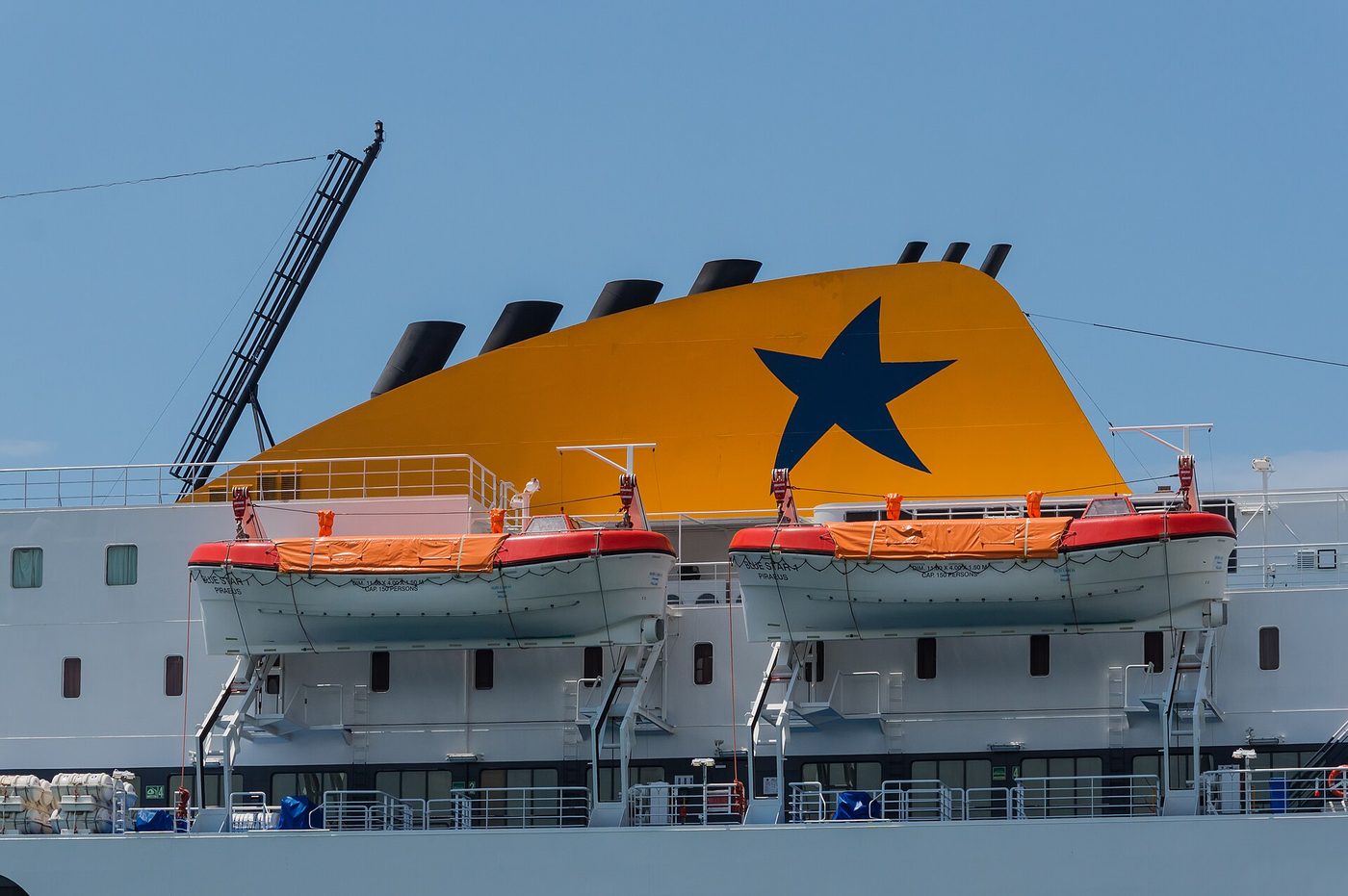
| Conventional ferry | Blue Star, from €53 peak / €44 shoulder, 4 hr 40 min | Fast Ferries and Golden Star, around €38 deck |
| High-speed | Seajets from €87.70 summer, €65.70 November | Seajets €50.00 to €66.50 by month |
| Frequency | Daily, all year | Up to 10 crossings a day in summer |
| First and last | Varies by operator | First around 07:05, last around 23:00 |
| Distance from Athens airport | 45 km, 45 min by car | 26 km |
On Piraeus sailings, fare class matters more than people expect: deck lounge from €53, an economy seat from €58, business or VIP from €74. On a four-and-a-half-hour conventional crossing in August, the twenty-euro upgrade to a reserved seat in air conditioning is one of the better small purchases available on this trip. Taking a car across costs roughly €90 on a high-speed vessel and €123 to €178 on a conventional one, with motorcycles around €30 to €60. Infants and children up to 4 travel free, ages 5 to 10 pay half, and ISIC and Greek student cards get 50 percent. Luggage is not checked in; Blue Star, Golden Star and Seajets allow around 50 kg per passenger.
Every passenger ferry docks at the New Port at Tourlos, 2.5 km from Chora and 4 km from the airport. Do not walk it, whatever your instinct says when you see the distance. The road is busy and lacks proper pavement for much of the route. Take the bus, a taxi, or the SeaBus.
Island hopping from Mykonos
Mykonos sits on the busiest ferry corridor in the Aegean, so it works as a start point, a middle stop or a finish. For the full set of routes, see our guide to planning a Greek island hopping itinerary.
| Route | Duration | Typical one-way fare | Notes |
|---|---|---|---|
| Mykonos to Santorini | 2 hr 10 min to 3 hr 35 min | About €75.50 to €89.70 standard seat | Roughly March to November, up to 8 daily in summer |
| Mykonos to Naxos | 35 min to 1 hr 25 min | About €30 to €57.70 | First around 08:45, last around 21:00 |
| Mykonos to Paros | 35 min to 2 hr 30 min | From €36.00 to €78.40 | 7 to 10 crossings daily in high season |
Mykonos also has direct sailings to Tinos, Syros, Heraklion, Thessaloniki, Milos, Sifnos and Ios, plus Bodrum and Çeşme in Turkey, which is a useful and underused way to bolt a completely different country onto a Greek island trip. Our Turkey travel guide covers what to do with that idea, and the 10-day Greece itinerary shows how the Cyclades hops fit together.
Note the price gap between Naxos and Santorini. Naxos is 35 minutes and starts around thirty euros. Santorini is two hours and rarely under seventy-five. If you are building a two-island trip on a budget, that difference is worth more than most people’s hotel savings.
Getting around Mykonos: buses, boats and the taxi problem
Mykonos has, for a small island, an unusually functional public bus network, run by KTEL Mykonos. Understanding it saves you a hire car, a parking headache and a substantial amount of money.
There are two bus stations in town and they are not the same place. Fabrika, the south station, serves the airport, the New Port, Ornos, Agios Ioannis, Platys Gialos, Paraga, Paradise and Super Paradise. The Old Port station, at the north end, serves Ano Mera, Elia, Kalo Livadi, Kalafatis and Agios Stefanos. They are a fifteen to twenty minute walk apart through the lanes, which is fine unless you have worked that out while standing at the wrong one with a ferry to catch.
| How you move | What it costs | Where it goes | Worth it? |
|---|---|---|---|
| KTEL bus | Around €1.80 to €2.80 a ride; about €3.00 for airport and port | Both stations cover the south coast, Ano Mera and the east | Yes. The default for most visitors |
| Night bus | Same fares | Busy beach routes run every 30 min in peak season past midnight; last from Paradise around 02:30, Platys Gialos to roughly 03:00 | Yes, and it removes the strongest argument for hiring anything |
| Beach water taxi | A €20 all-day pass on the current service | Ornos and Platys Gialos to Paraga, Paradise, Super Paradise, Agrari and Elia | Yes if you plan to beach-hop the south coast |
| SeaBus | €2 one way, some listings say €2.50 | New Port at Tourlos to the Old Port, 8 to 10 minutes, roughly every 15 to 30 min until about 23:00 | Yes. The best two euros on the island on arrival day |
| Taxi | Metered: around €0.90/km daytime, €1.25/km between 00:00 and 05:00, plus minimum and pickup charges. Airport to Chora €17 to €25 | Ranks at Fabrika Square, Manto Mavrogenous Square, Tourlos and airport arrivals | Only when nothing else works |
| Hire car | Around €34/day island-wide average, about €41/day for a mini at the airport, from around €13/day at the low end; peak July and August 20 to 30 percent higher | Everywhere, including the north | For one or two days, not the whole trip |
| ATV or quad | Varies by operator and engine size | Everywhere | Read the licence and safety notes below first |
The taxi situation deserves a warning of its own. There are roughly thirty to thirty-five licensed taxis for the entire island. On a July night, when the clubs empty and the ferries land at once, that number is not a queue, it is a lottery. I could not confirm a dedicated Mykonos taxi app on any source; Uber operates here as a request layer over the same tiny fleet rather than as extra supply. Book ahead by phone if you have a flight, and otherwise plan around the buses.
About those quad bikes
Renting an ATV is the default tourist move here and it deserves more caution than it gets. A full category B car licence is generally accepted for smaller road-legal quads, but larger machines may require a motorcycle entitlement, and the exact requirement depends on engine size and how the rental company classifies the vehicle. Non-EU licence holders must carry an International Driving Permit alongside the home licence, and that applies to cars, motorbikes and ATVs alike. EU licences are valid as issued. Minimum ages vary: commonly 22 for smaller machines around 170cc, 25 for larger ones around 450cc, and some companies insist on 26.
The roads are narrow, summer traffic is heavy and lighting is poor in places. Tourist ATV accidents are a real and recurring problem on this island. If you do rent one, rent it sober, wear the helmet, and do not treat the ring road at midnight as part of the entertainment.
Parking, or the reason not to bother
The centre of Chora is pedestrian-only, and the lanes are barely wide enough for two people to pass. You park outside and walk in. The main options are the Old Port car park on the northern edge of town and the free unsurfaced lot at the Fabrika bus station, which fills by 10:00 in high season. A hire car parked all week is a hire car you spend twenty minutes a day finding a home for. Our guide to getting around Europe makes the same argument about most Mediterranean old towns.
All 16 Mykonos beaches worth knowing, compared
Every beach worth your time, with its coast, its wind exposure, whether it is organised, whether a bus goes there, and what a sunbed costs where a 2026 figure exists. Where no figure exists I have said so rather than inventing one.
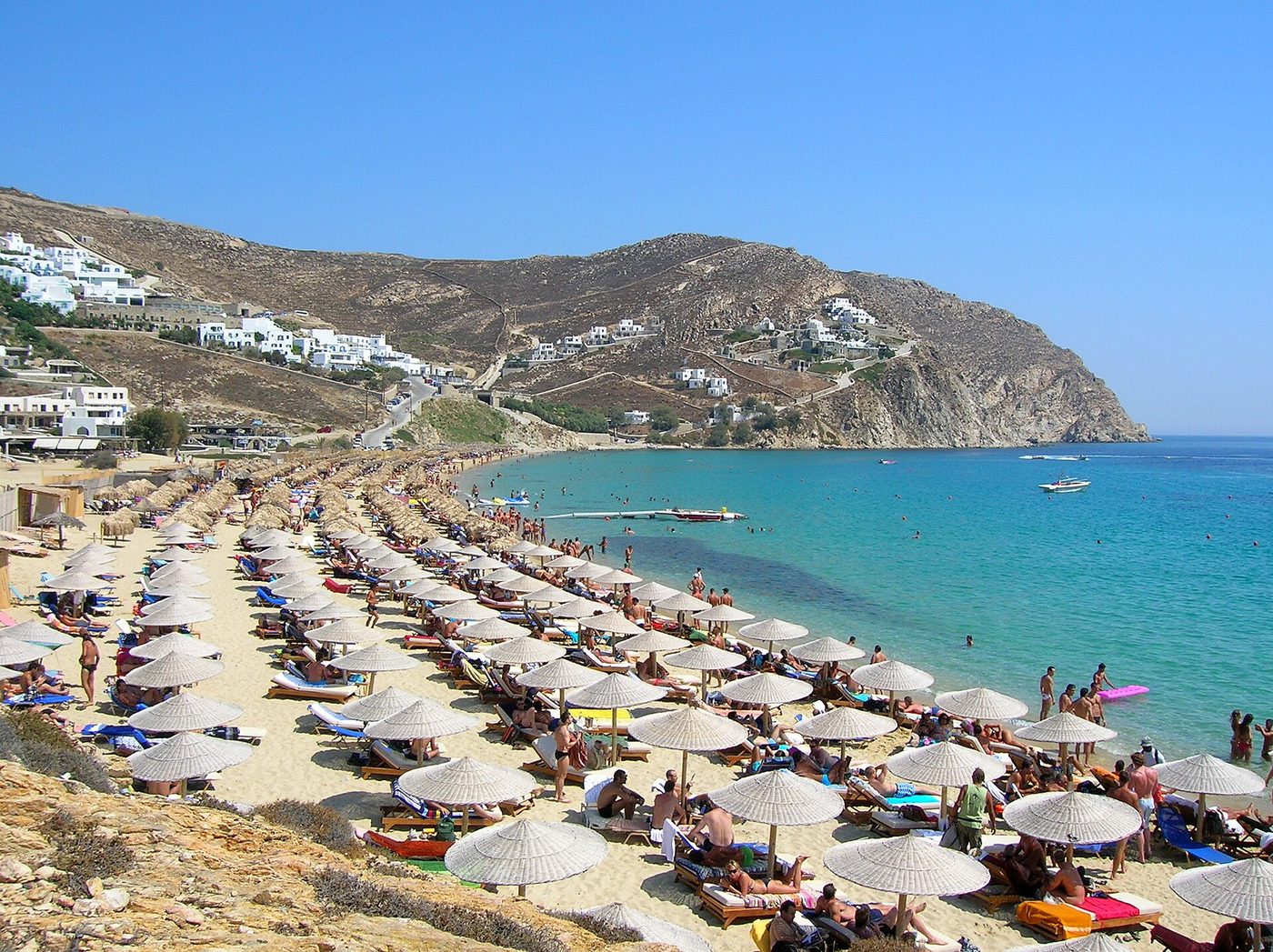
| Beach | Coast | Meltemi | Set-up | Getting there | Sunbeds 2026 | Character |
|---|---|---|---|---|---|---|
| Psarou | South | Sheltered | Organised | Bus to Platys Gialos, then walk | From about €25 at Cavo Psarou restaurant to €250+ at Nammos | Money, superyachts and the island’s most photographed lunch |
| Platys Gialos | South | Sheltered | Organised | Frequent bus from Fabrika | Yialo Yialo from €20 a set; Branco €60 to €80 | The practical hub: hotels, tavernas and the water-taxi pier |
| Ornos | South | Sheltered | Organised | Bus from Fabrika | €50 to €60 for an umbrella and two beds in the back rows; around €70 front row at Kostantis | Calm shallow water. The strongest family beach on the island |
| Agios Ioannis | West | Sheltered | Organised | Bus from Fabrika | No 2026 figure I could source | Small, quiet, west-facing, with Delos on the sunset horizon |
| Paraga | South | Sheltered | Organised | Bus from Fabrika | Beach-club pricing: Scorpios and SantAnna, see the club table below | Quiet in the morning, a different proposition by four in the afternoon |
| Paradise | South | Sheltered | Organised | Bus from Fabrika | Paradise Beach Club sets from €20 | The party beach. Cavo Paradiso sits on the cliff above it |
| Super Paradise | South | Sheltered | Organised | Bus from Fabrika | €40 to €70 a sunbed by row; back row from around €25 | High energy, and a long-standing LGBTQ+ following |
| Agrari | South | Sheltered | Organised | No public bus; water taxi from Platys Gialos | No 2026 figure I could source | Sunbeds and watersports without the Paradise volume |
| Elia | South | Sheltered | Organised | Bus from the Old Port station | From around €40; Elia Beach Club €30 to €50 a set | The longest sandy beach on Mykonos, with quiet stretches at either end |
| Kalo Livadi | Southeast | Sheltered | Organised | Bus from the Old Port station | No 2026 figure I could source | Long, sandy, family-friendly, with Solymar on the sand |
| Lia | Southeast | Sheltered | Organised | No bus, car needed | No 2026 figure I could source | Loungers, clear water and the best easy snorkelling |
| Kalafatis | East | Exposed enough to sail | Organised | Bus from the Old Port station | No 2026 figure I could source | The watersports hub: windsurf centre May to end September, plus diving |
| Ftelia | North | Exposed | Unorganised | No bus, car needed | Not applicable | Windsurf and kitesurf championships. Waves to four metres in a blow |
| Panormos | North | Exposed | Partly organised | No bus since 2020, car needed | Principote from €100 to €150 a sunbed | Quieter and windier, with a beach-club scene of its own |
| Agios Sostis | North | Exposed | Unorganised | No bus service confirmed; car or taxi | Not applicable: no sunbed operation | No sunbeds, no beach bar, no facilities. Kiki’s Tavern sits above it |
| Fokos | North | Exposed | Unorganised | Dirt road, car needed | Not applicable | Fine sand, deep water, steep rocks and almost nobody |
Before you use it, one legal point that saves people a lot of money. Greek beaches are public. You are entitled to swim and to sit on the sand at an organised beach without buying a lounger, and current law requires at least half of any beach to be free of umbrellas and sunbeds. Nobody is going to hand you a towel and a welcome, but nobody can lawfully move you on either.
The sheltered south, where most people should start
Platys Gialos is the one I recommend to first-timers who are not hiring a car. It has the most frequent bus, a row of hotels and tavernas directly behind the sand, and it is the hub for the beach water taxi, so you can arrive by bus and then hop east along the coast by boat. Sunbed sets run from around €20 at Yialo Yialo to €60 or €80 at Branco, which is a spread wide enough to suit almost anyone. Psarou is a fifteen-minute walk over the headland and is a different world: Nammos, superyachts at anchor, and front-row sets that start at €250. The Cavo Psarou restaurant end of the same beach, meanwhile, has offered sets from about €25. Same water, same view, a tenth of the price.
Ornos is the family answer. It is a proper sheltered bay with shallow calm water, restaurants immediately behind the sand, a bus from Fabrika and the starting point of the water taxi. Expect around €50 to €60 for an umbrella and two beds in the back rows and about €70 for the front at Kostantis. If you are travelling with small children this is where I would put you, and our Europe with kids guide explains why sheltered water matters more than facilities at that age.
Agios Ioannis is the sunset beach, small and west-facing with Delos on the horizon, and it is the one I send couples to on their last evening. Elia is the longest sandy beach on the island, and it effectively splits in two: it has a busy organised middle and properly quiet ends, plus the resorts above it, and it has long been popular with couples and with LGBTQ+ travellers. It runs from the Old Port bus station, not Fabrika, which catches people out.
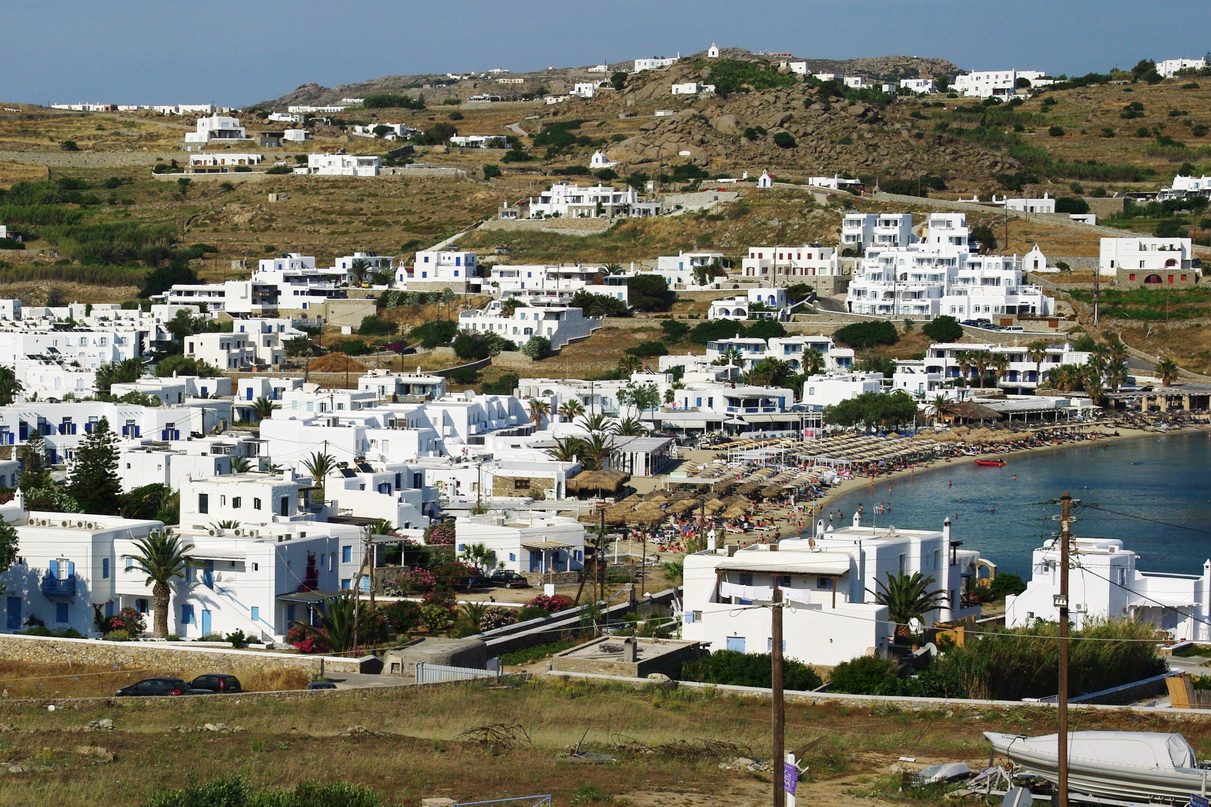
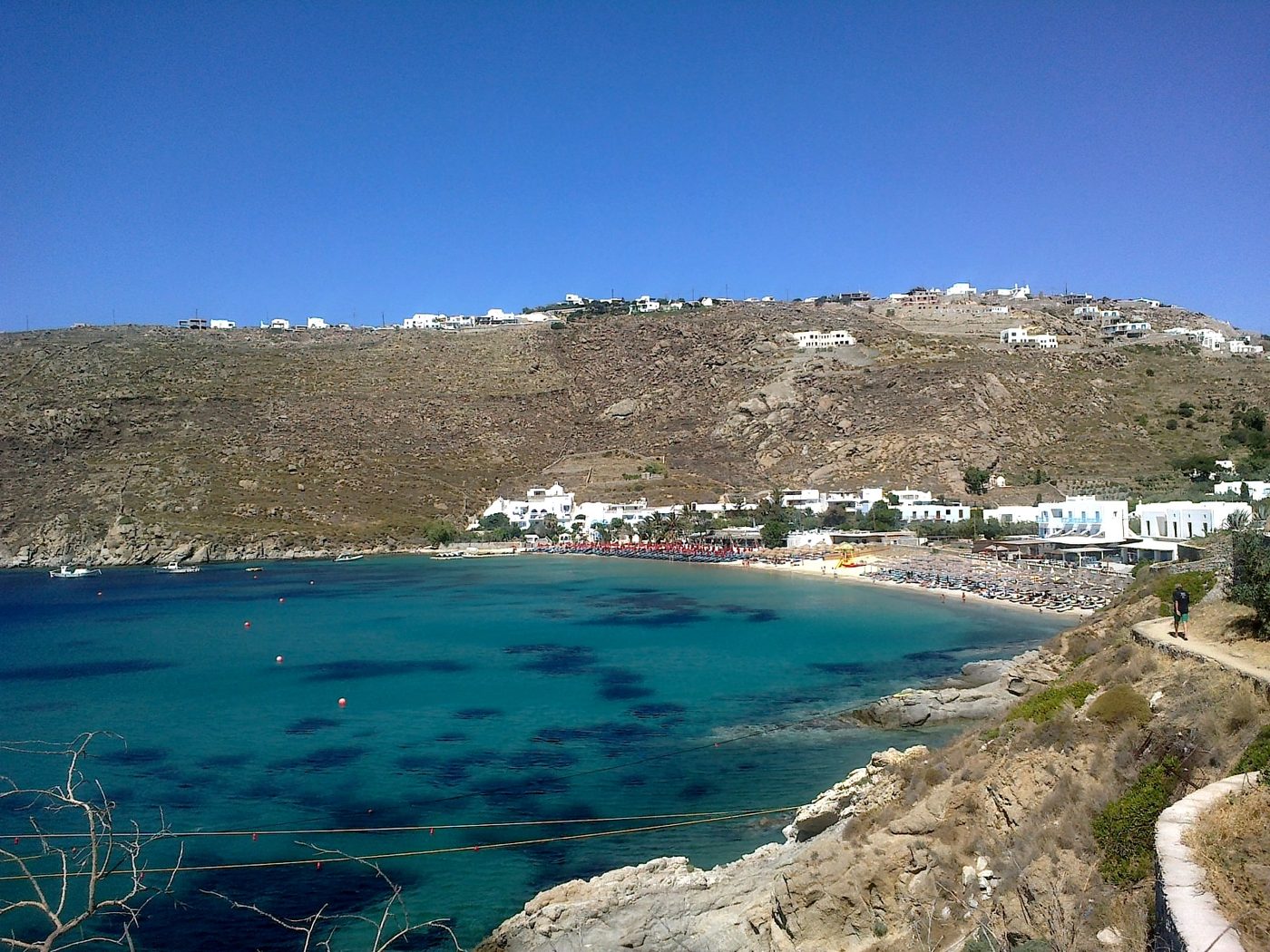
The party stretch, and how to use it without committing to it
Paradise, Super Paradise and Paraga sit in a two-kilometre run along the south coast and they are the reason Mykonos has the reputation it has. Paradise Beach Club sets start from about €20, among the lowest sunbed prices I could source on any of the island’s famous beaches; Cavo Paradiso is the club on the cliff above. Super Paradise runs €40 to €70 by row with back rows from around €25, and JackieO’ sets the tone.
The thing to know is that these beaches keep normal-beach hours in the morning. Paraga at ten in the morning is a quiet cove with clear water. Paraga at five in the afternoon has Scorpios in full flow with per-person minimum spends of €80 to €150. If you want to see the beaches without buying into the scene, go early and leave at two.
The exposed north, for the day the wind drops
Agios Sostis is the one I would take a first-time visitor to on a calm day. It is undeveloped: no sunbeds, no beach bar, no facilities of any kind, with Kiki’s Tavern on the hill above it. There is no bus service I could confirm, so you need a car or a taxi. Fokos is reached down a dirt road and has fine sand, deep water and steep rocks; it swims beautifully in a southerly and turns to surf in the meltemi. Ftelia is where the windsurfers and kitesurfers go, hosts Greek championships and can throw up four-metre waves. Panormos lost its bus service in 2020, which is why it feels quieter than its beach-club scene would suggest, and why you need wheels.
The east, if you want to do something
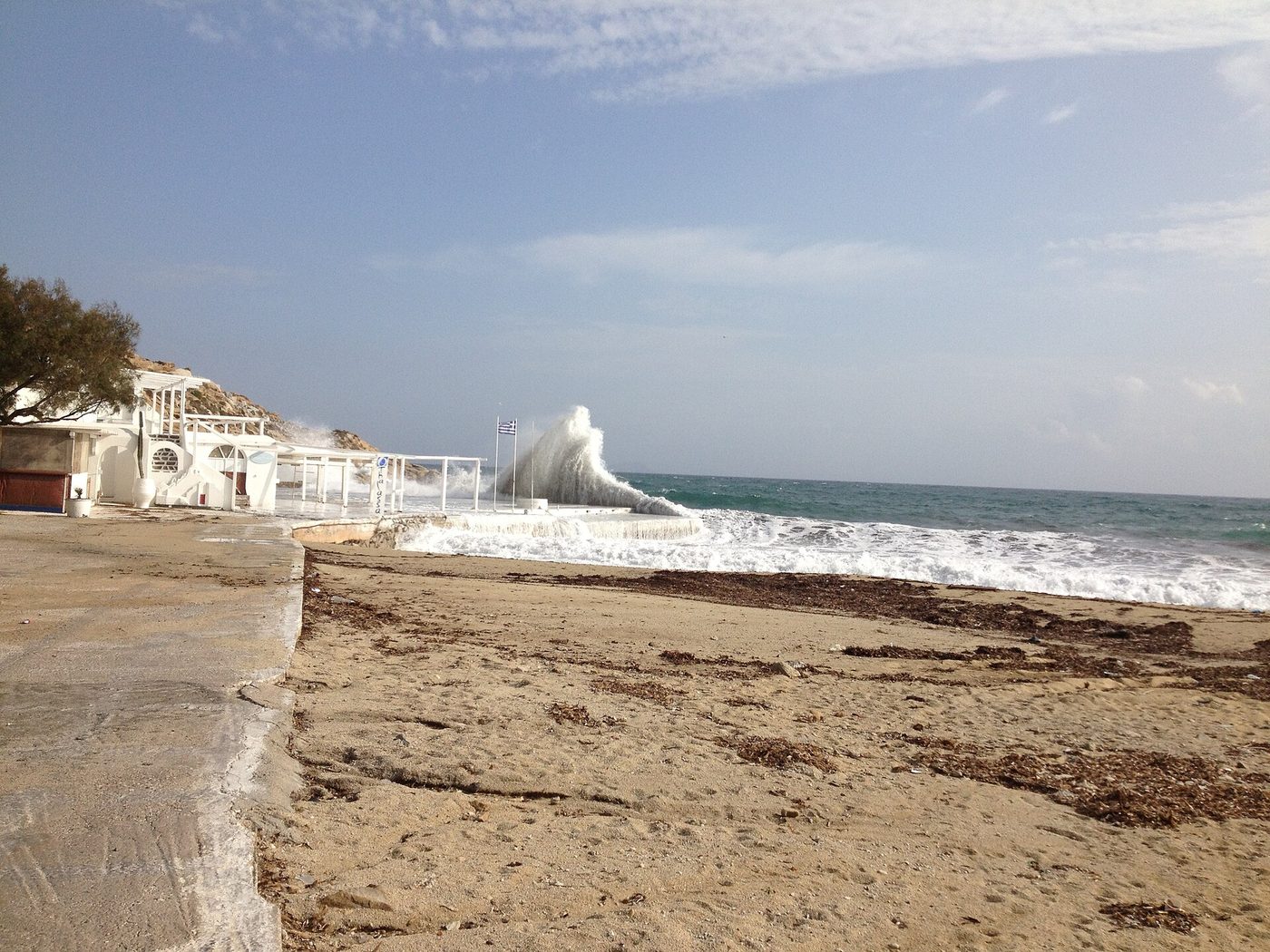
Kalafatis is the island’s watersports centre. The bay is around 600 metres wide, the windsurf centre runs from May to the end of September, and there is jet ski, waterski, wakeboard, tube riding and a dive centre. Inside the bay the meltemi can hit 6 on the Beaufort scale in July and August, which is exactly what the sailors want. Kalo Livadi is the long, easy family beach with frequent buses and Solymar on the sand, and Lia, a little further round, has the clearest easy snorkelling on the island but no bus at all. If beaches are the whole point of your trip, our round-up of the best beaches in Europe puts these in continental company.
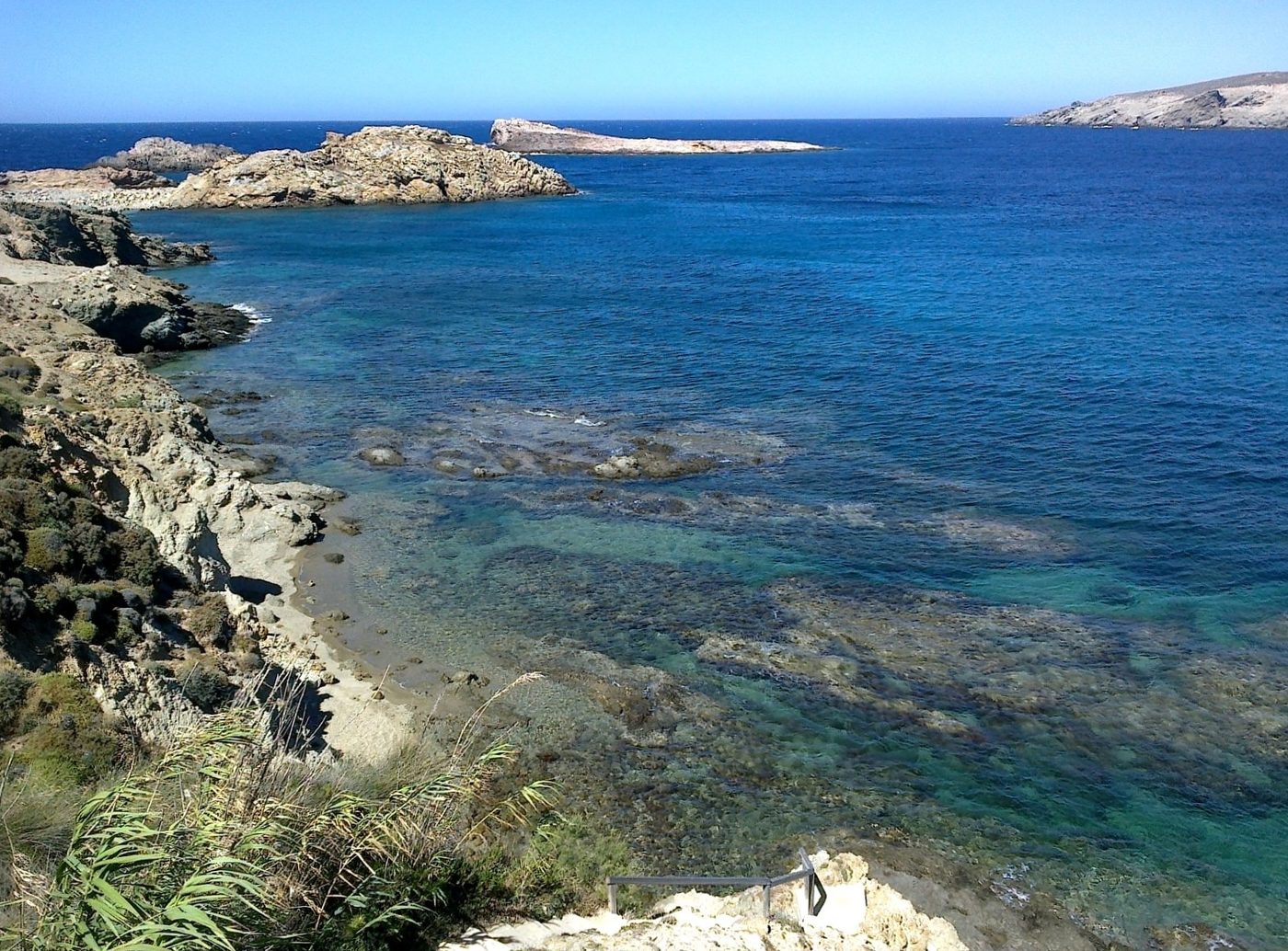
Mykonos Town: what is worth your time in Chora
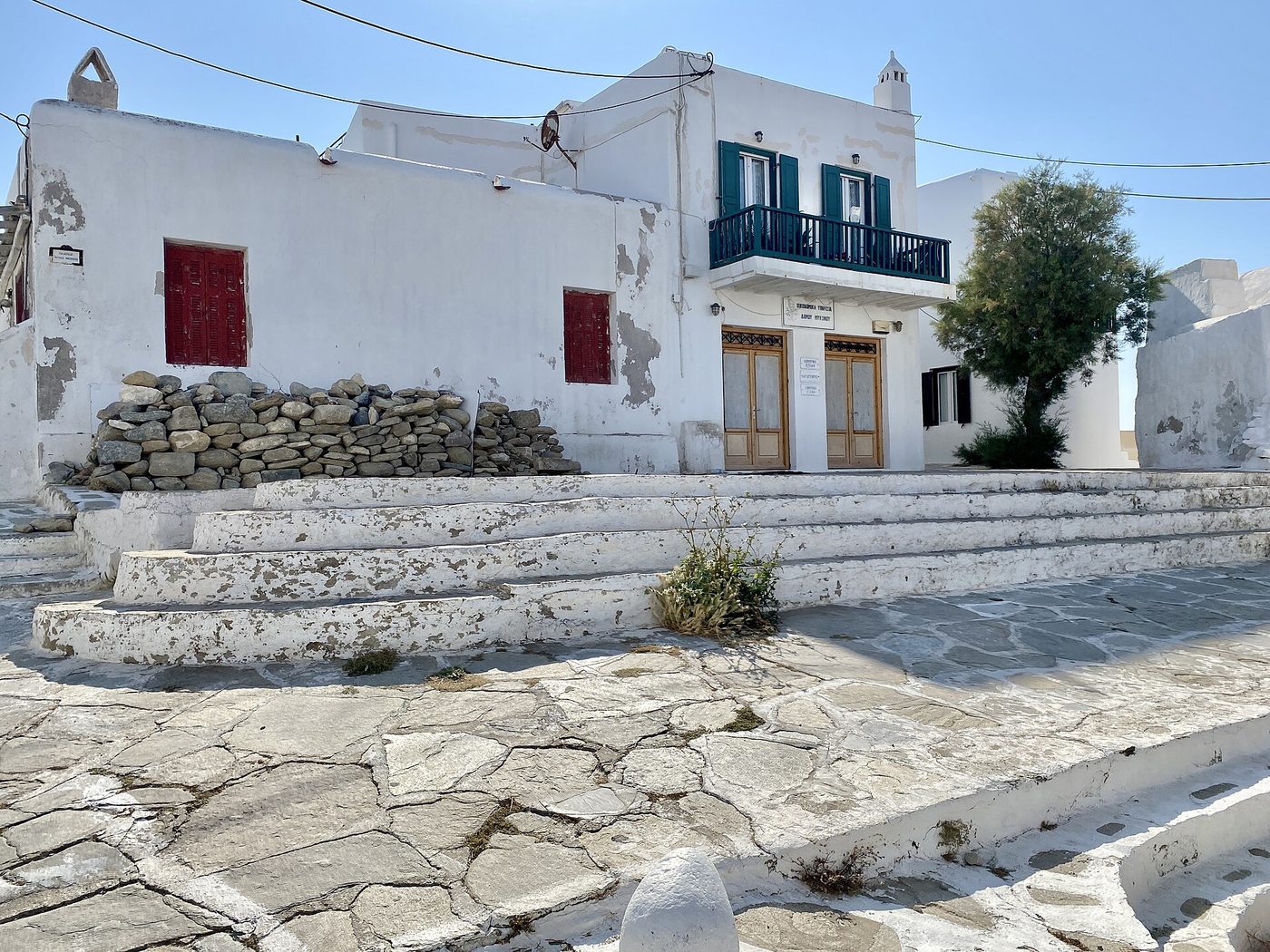
Chora is the reason people fall for this island despite themselves. It is a whitewashed maze of lanes that was, by tradition, laid out deliberately to disorient raiders, and it still works: you will get lost, on purpose and otherwise, and that is the correct way to use it.
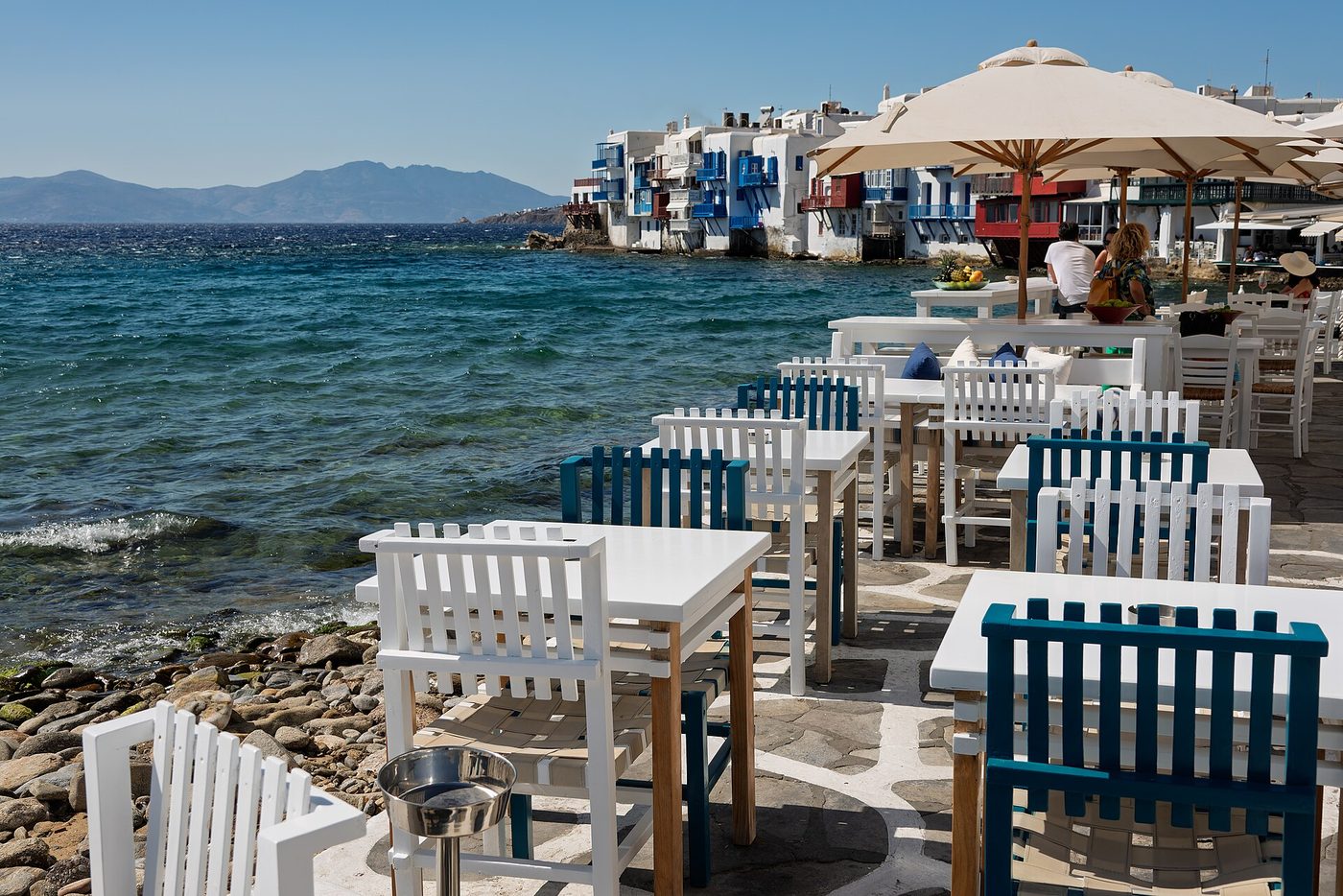
Little Venice is the row of houses at Alefkandra whose balconies hang directly over the water. It faces due west, which is the entire point, and the bars along it including Kastro’s exist to sell you that hour. It is unapologetically a tourist ritual. It is also lovely, and you should do it once, ideally on a night when the meltemi is up and the spray is coming over the tables.
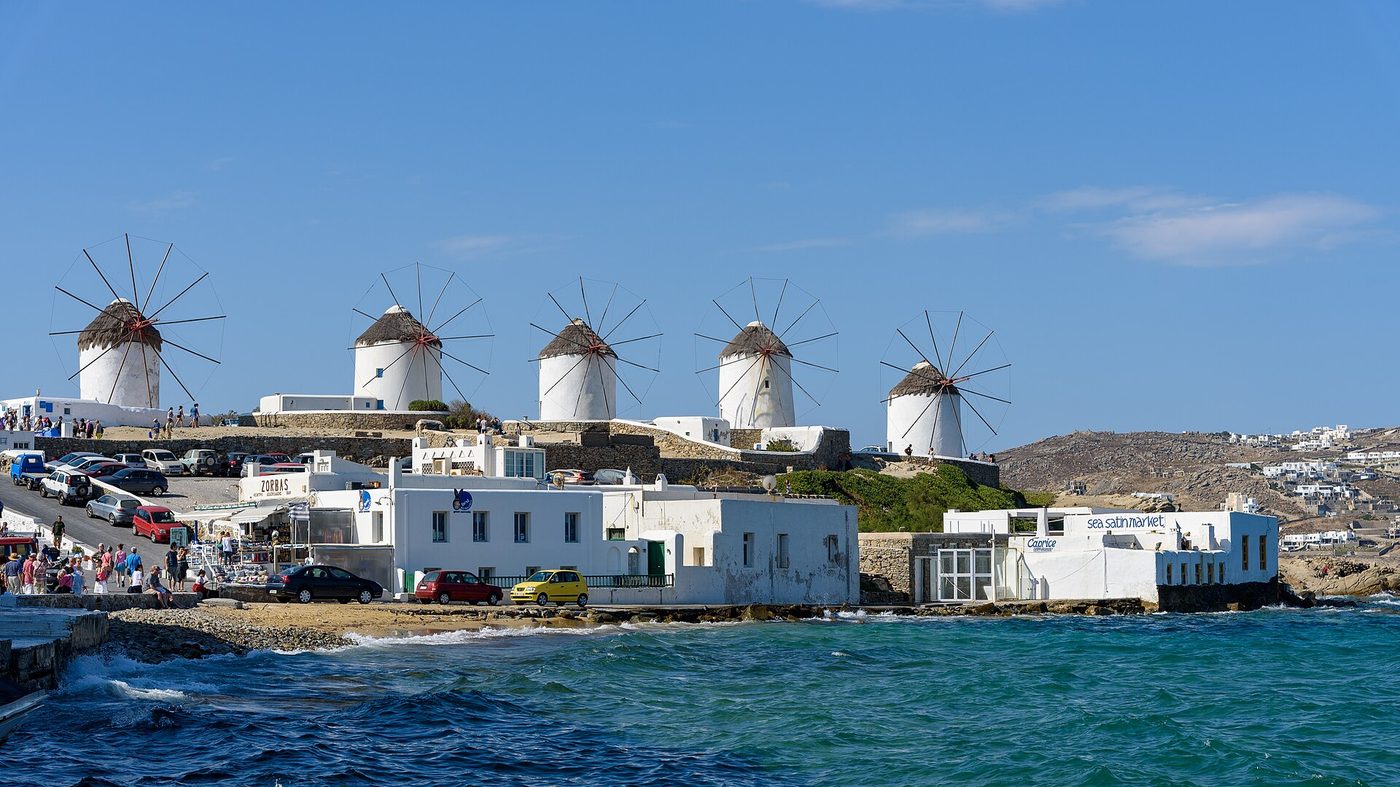
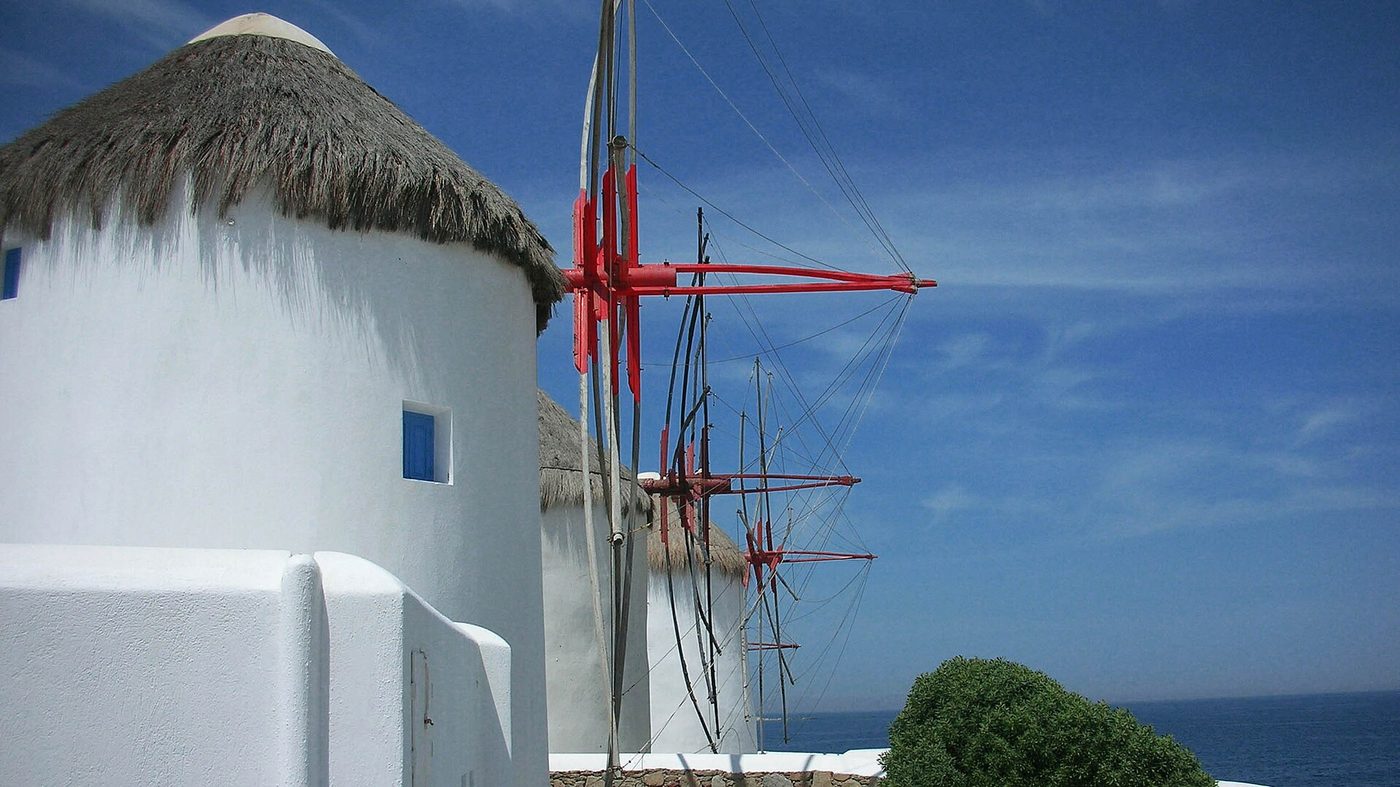
The windmills are the island’s postcard. Here I have to be careful, because the sources genuinely disagree. Sixteen windmills are said to survive across Mykonos. The famous row above Chora, Kato Mili, is given as seven by most sources and as five by others; historically the complex numbered ten or eleven in its working period between the seventeenth and nineteenth centuries. I am not going to give you a confident number that I cannot source. Walk up from Alefkandra, count them yourself, and enjoy the view back over the town either way.
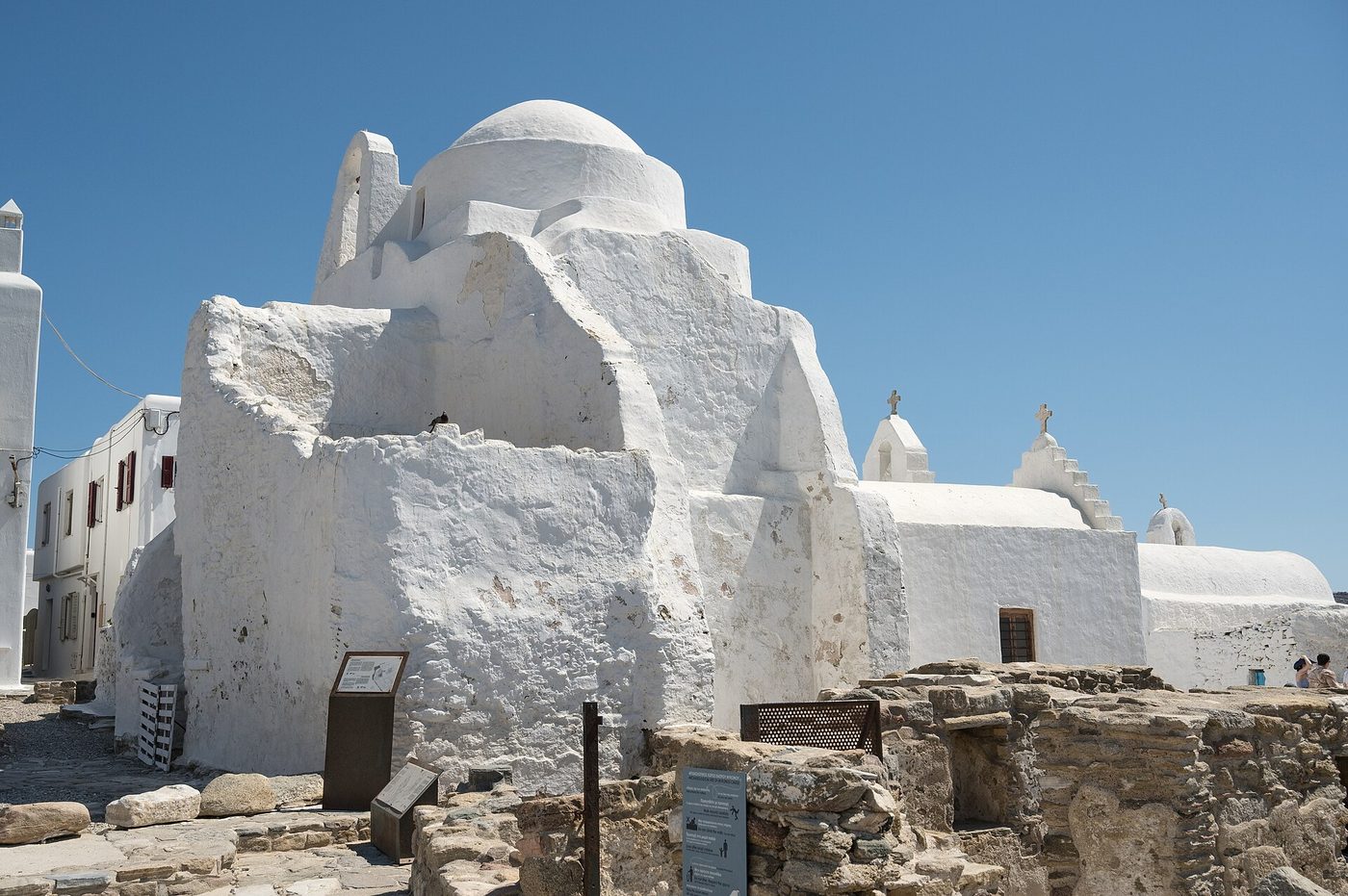
Panagia Paraportiani is the most photographed church in the Cyclades and the most misdescribed. It is not one church, it is five, built as a two-storey complex principally between the sixteenth and seventeenth centuries: four at ground level, with Agios Efstathios at the centre surrounded by Agios Anargyros, Agios Sozon and Agia Anastasia, and the church of the Virgin Mary sitting on top of them to form the dome. Once you know that, the strange melted shape of it makes sense, and it stops being a white blob you photograph and becomes a building you read.
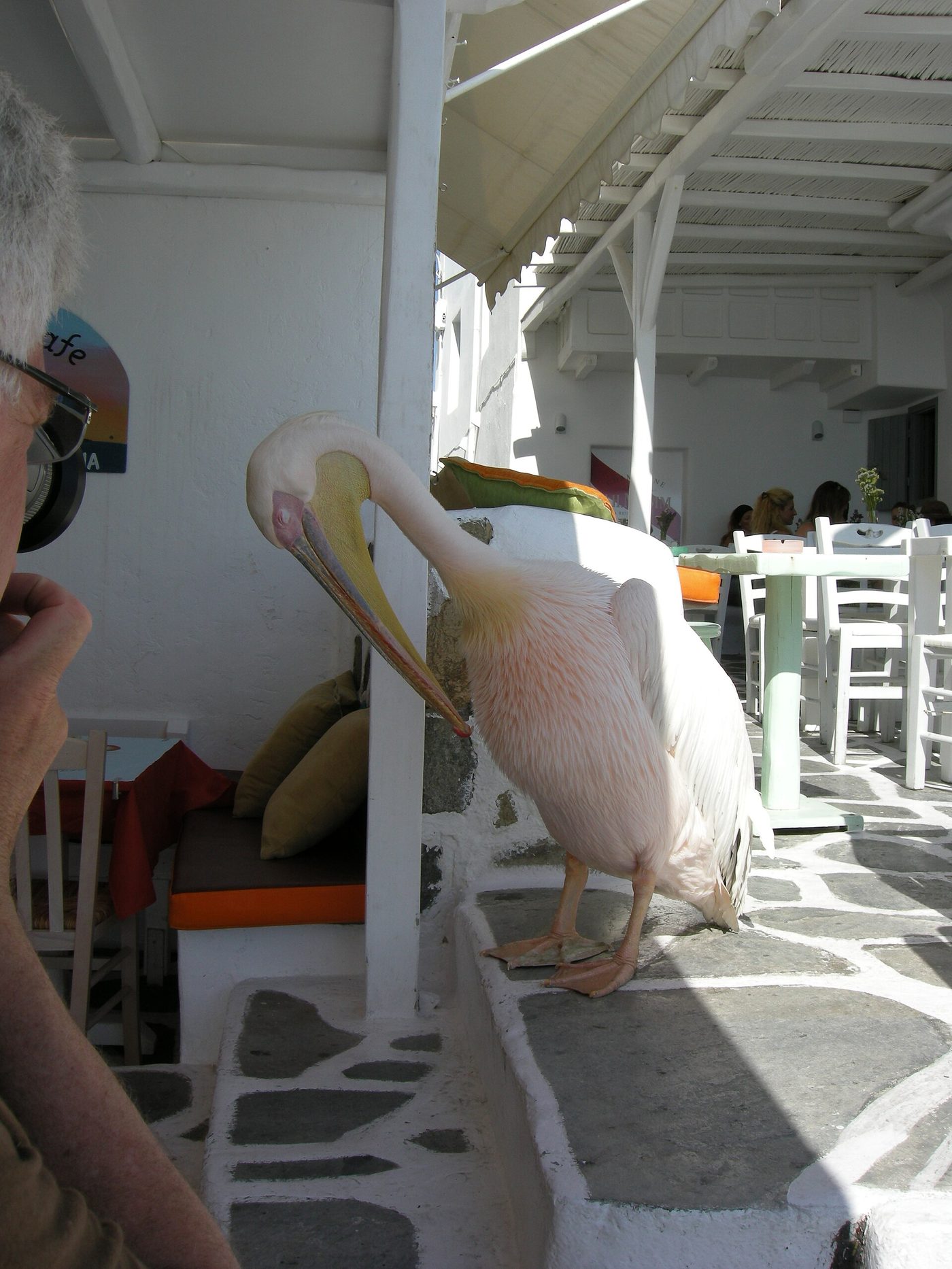
The pelicans are not a gimmick, or at least they did not start as one. In 1958 a Mykonian fisherman rescued an injured white pelican; pelicans are not native to the Aegean, and the island adopted him as Petros. He later flew to Tinos, whose residents tried to keep him, and Mykonos sued and won the custody case. Petros was killed by a car in December 1985, after which Jacqueline Kennedy Onassis donated a pelican named Irene. Three pelicans roam the island today and one of them always carries the name Petros. It is the single best story on Mykonos, and worth knowing before you join the crowd photographing them.
The two museums are quick and worthwhile. The Archaeological Museum of Mykonos is closed on Mondays year round and runs 08:30 to 15:30 in winter with extended summer hours; I could not pin down a current entry fee, because sources give €1, €2 and €4 and none of them is authoritative, so treat it as a few euros and check at the door. The Aegean Maritime Museum in the Tria Pigadia quarter charges €4, opens from 1 April to 1 November, and is commonly listed as daily 10:30 to 13:00 and 18:30 to 21:00. Greek state museums also have free days: 6 March, 18 April, 18 May, the last weekend of September, 28 October, and the first Sunday of each month from 1 November to 31 March.
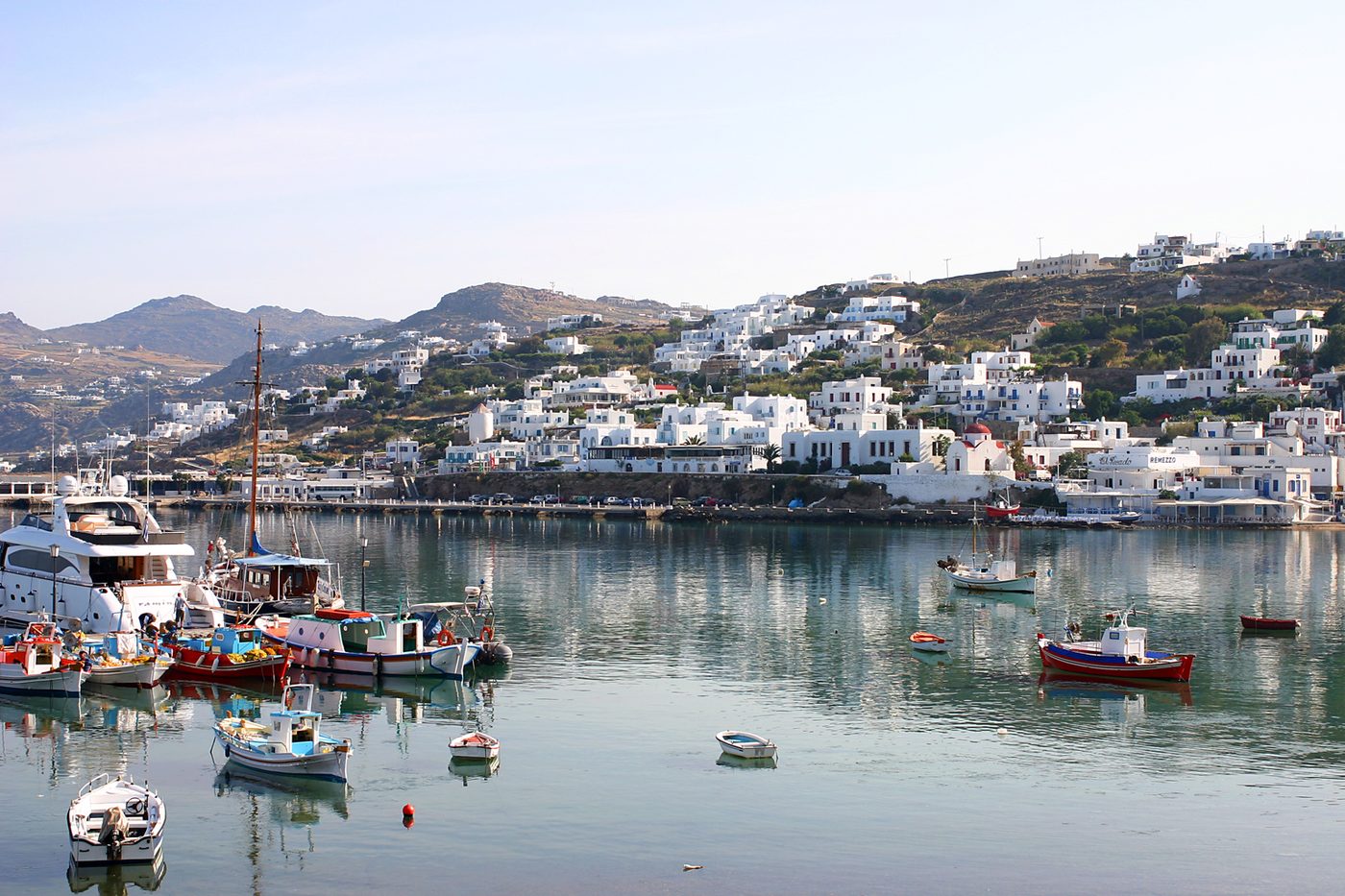
Finally, the Old Port. It is a five-minute walk north of the centre and it is where the fishing boats still tie up and the Delos boats leave from. In a town that can feel like an outdoor shopping centre in August, it is the bit that still smells like a working island.
Delos: the day trip that justifies the whole trip
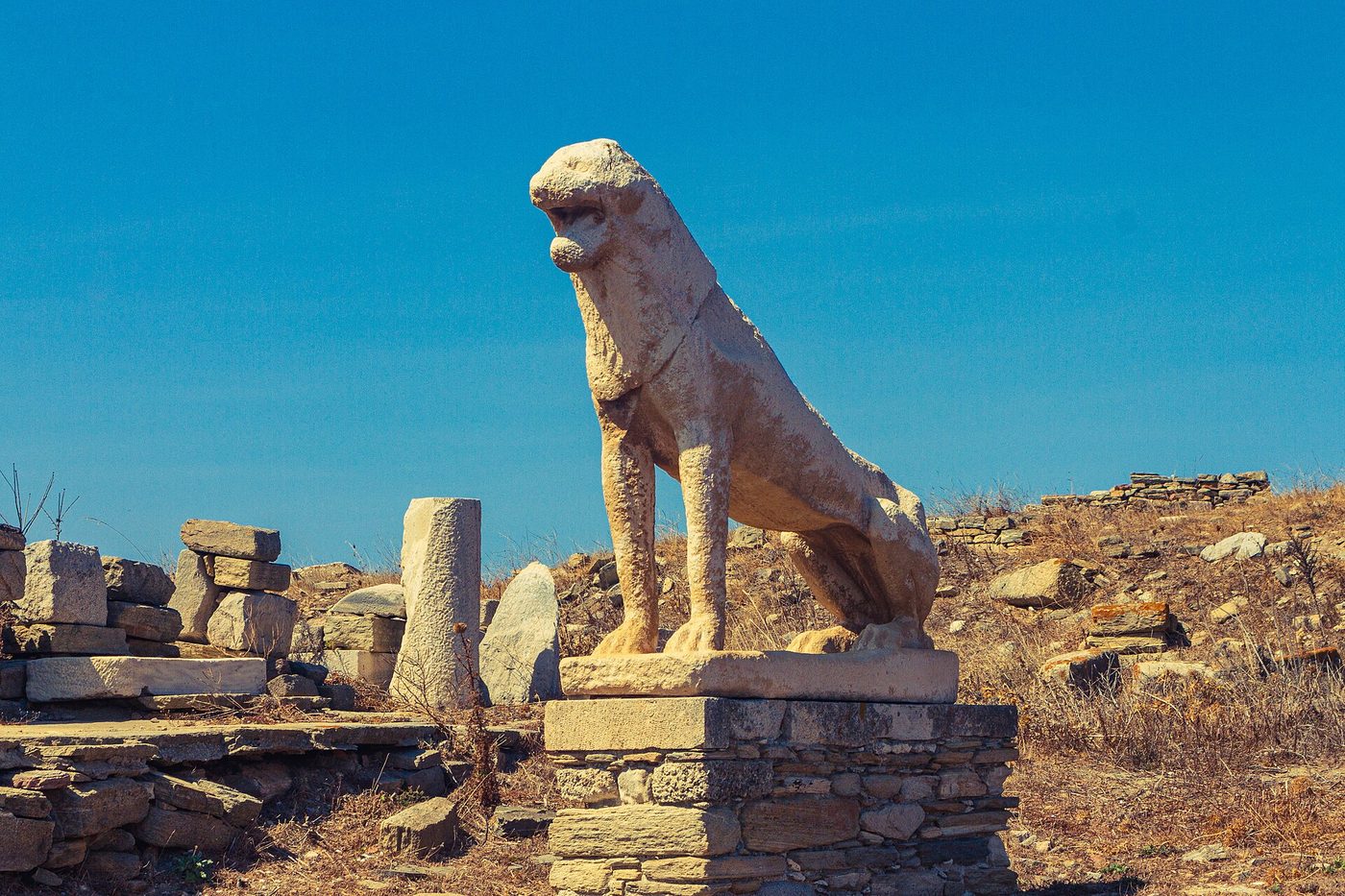
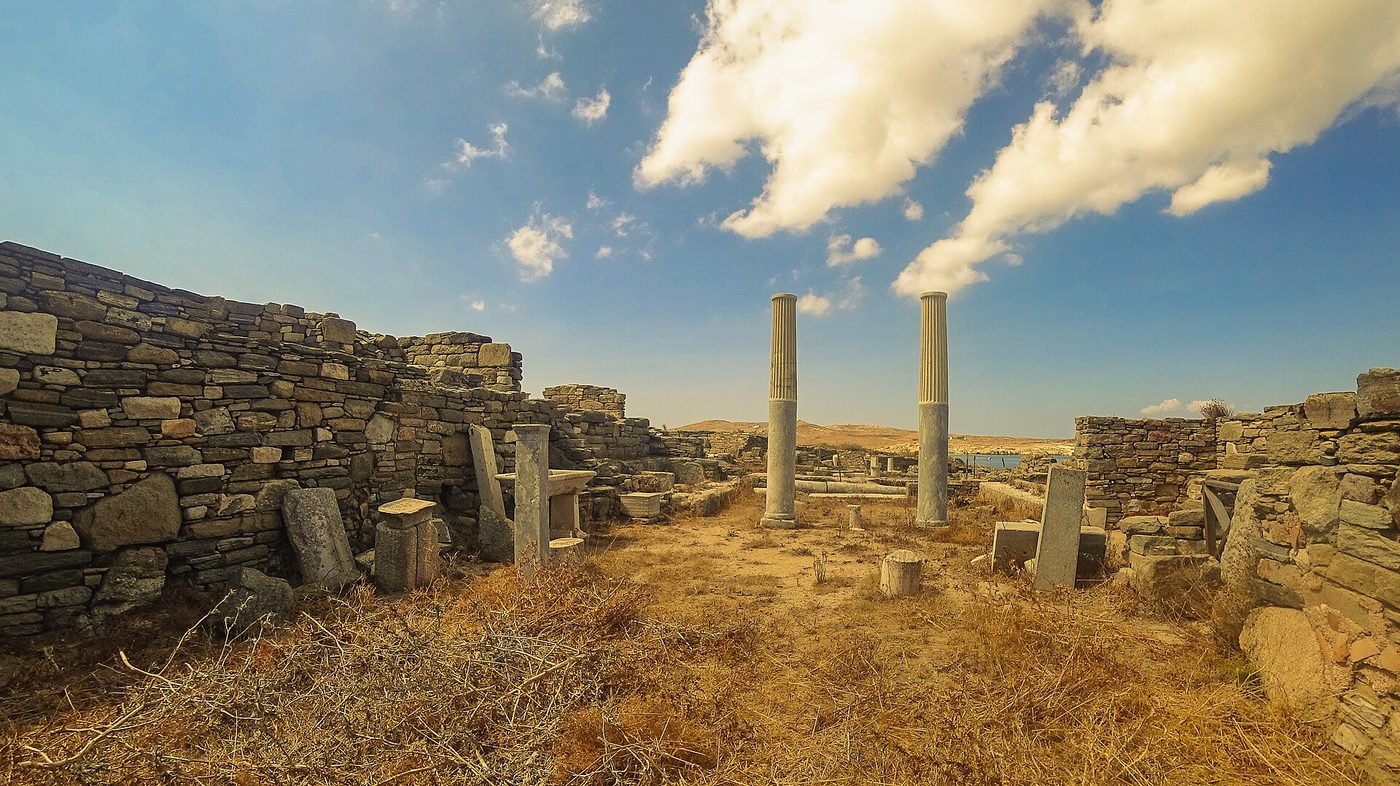
If you do one thing on Mykonos that is not a beach, do this. Delos is a UNESCO World Heritage Site, inscribed in 1990, and it is the single most concentrated ancient city you can walk through in the Aegean. Nobody lives there. Nobody has been allowed to for a very long time: the entire island is an archaeological site, overnight stays are prohibited, camping is prohibited, and the only people there after the last boat are caretakers and archaeologists. That is why it feels the way it does.
| Delos practicalities | 2026 detail |
|---|---|
| Site and museum entry | €20 full, €10 reduced. The ticket explicitly does not include the boat |
| Boat fare | Around €25 return, bought at the pier kiosk or through agents |
| Departure point | The Old Port of Mykonos Town, not Platys Gialos |
| Crossing | Roughly 20 to 40 minutes, typically about 30, over a 3.5 km channel |
| Season and schedule | Roughly May to October; morning departures around 09:00, 10:00 and 11:30, returns around 12:00, 13:30 and 15:00, with a reduced Monday service |
| Operator | The Joint Venture of Passenger Vessels of Mykonos-Delos. One ticket is valid on any of its boats |
| Winter | Closed 1 December to 31 March; visits only by written request |
| Opening hours | 1 April to 30 October 08:00 to 20:00; 1 to 30 November 08:00 to 16:00 |
| Free admission days | 18 April, 18 May, the last weekend of September and 28 October |
| Shade | Almost none. Hat, water and closed shoes are not optional |
One caveat. The official listing gives no weekly closing day, only the standard national closures on 1 January, 25 March, 1 May, Easter Sunday and 25 to 26 December. Guides variously assert Monday or Tuesday. The reliable check is the boat operator’s schedule the day before you want to go, because if the boats are not running the opening hours are academic.
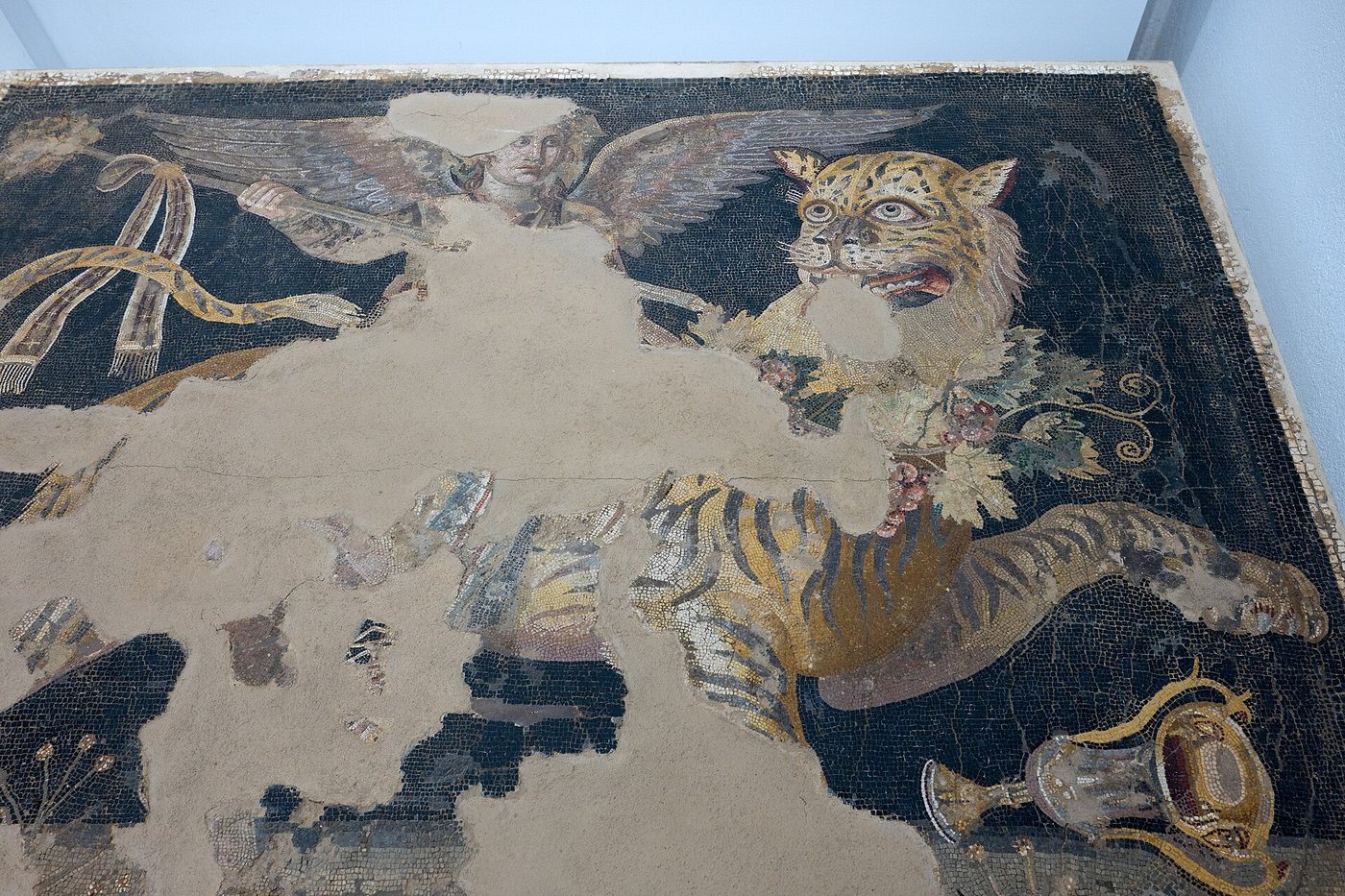
Go on the first boat. The site is unshaded, the marble throws heat back at you by eleven, and the light is better early. Budget three hours on the island, which sounds like a lot until you are standing in the House of Dionysus looking at a mosaic that has been there since before Rome mattered.
Ano Mera and the island nobody photographs
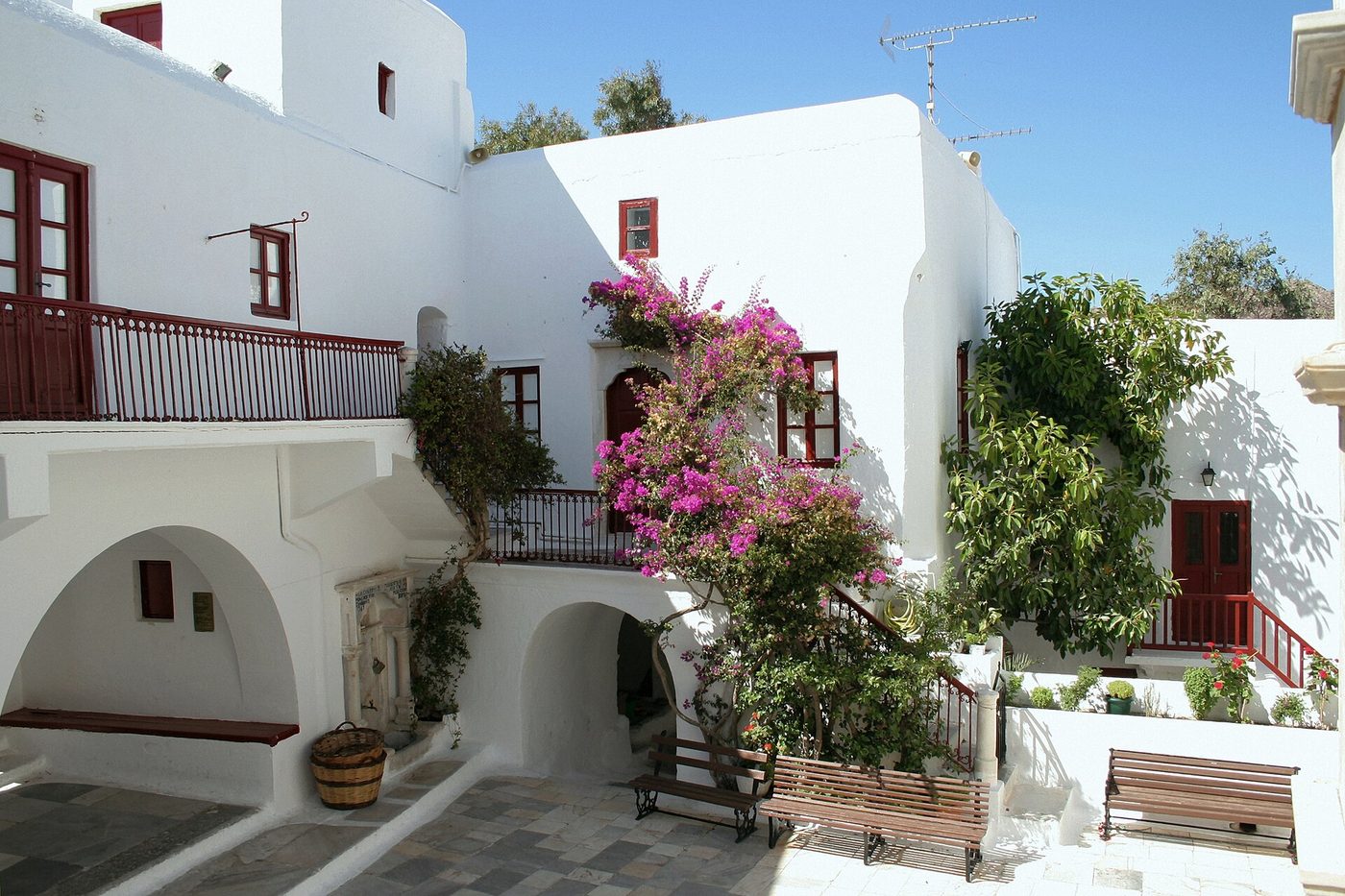
Ano Mera is the only real inland village on Mykonos, about 8 km east of Chora, and it is the antidote to a week on the south coast. The Panagia Tourliani monastery, which dates to 1542, sits on the main square with tavernas around it, and the square itself does the thing that Chora stopped doing years ago: it operates at the speed of the people who live there. Buses go from the Old Port station. Go for lunch, sit for two hours, and let the island be ordinary for an afternoon.
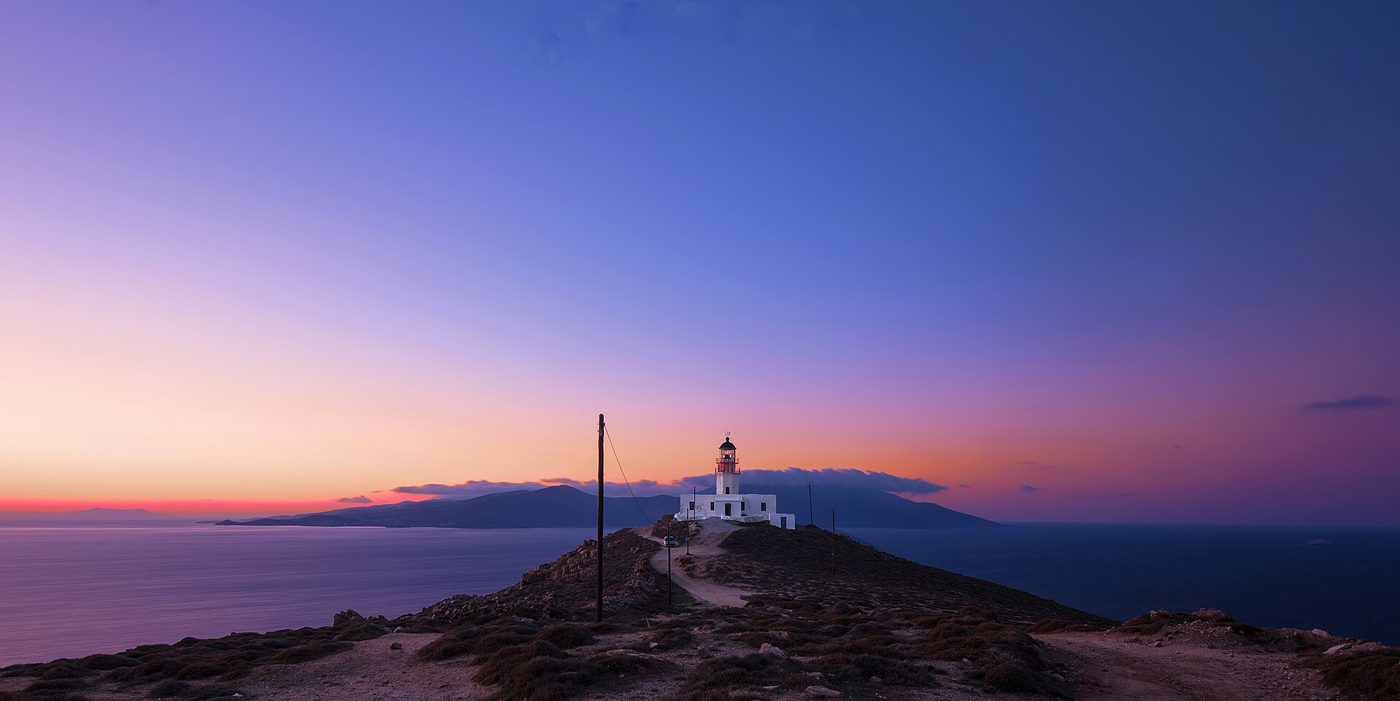
Further out, the Armenistis lighthouse on the northwest tip is the best free sunset on Mykonos and requires a car, which is most of why it stays quiet. The interior in general is stone walls, dry hills and chapels, and it looks more like the Cyclades of forty years ago than anything you will see near the water.
What Mykonos actually costs in 2026
The honest answer is that Mykonos costs whatever you let it, across a range wider than almost anywhere else in Greece. A gyros is four or five euros. Lunch at Nammos for two has been reported at €300 to €600. Both of those are Mykonos.
| Item | Typical 2026 price |
|---|---|
| Gyros at a souvlaki counter | €4 to €5, some sources quote €7; a pork gyros and a beer around €9 |
| Beer | €4 to €5 at an ordinary bar; around €8 for a domestic beer at a taverna in town |
| Cocktail | €10 to €20 at popular venues, higher at beach clubs and sunset bars |
| Restaurant main course | €18 to €25 |
| Dinner out, per person | €40 to €60 at most sit-down restaurants |
| Sunbed set, ordinary organised beach | €20 to €80 depending on beach and row |
| Sunbed set, name beach club | €120 to €400, plus minimum spends |
| Bus ride | €1.80 to €2.80; about €3.00 airport and port |
| Water taxi day pass | €20 |
| SeaBus, port to port | €2, some listings €2.50 |
| Delos, all in | About €45 per person for boat and entry |
| Hire car | Around €34 a day island-wide average; 20 to 30 percent more in July and August |
| Mid-range room, peak season | Budget at least €150 to €200 a night |
| Beachfront in Platys Gialos, July | Around €500 to €800 a night |
| Luxury standard room | €300 to €700; private-pool suites €1,000 and up |
Booking platforms report the same shape from another angle, with July consistently the most expensive month of the year across every hotel category. Greek VAT is 24 percent standard, with a reduced 13 percent rate covering most food and non-alcoholic drinks, restaurant and catering services, and hotel accommodation. Those are included in menu and room prices, not added at the till.
Three sample days, all realistic, none of them padded:
| Style | A day looks like | Rough daily spend per person |
|---|---|---|
| Lean | Buses, a free stretch of Platys Gialos with your own towel, gyros lunch, taverna dinner with a beer, one cocktail at sunset | Around €45 to €60 plus your room |
| Comfortable | Back-row sunbeds at an organised beach, a sit-down lunch, a proper dinner, two drinks, a water-taxi pass | Around €150 to €200 plus your room |
| Beach club | One club day with a sunbed set and a minimum spend, dinner in town, drinks after | €300 upward, per person, easily |
The single biggest saving available to you is not a discount code, it is the calendar. Shifting from the first week of August to the second week of September changes almost every number in that table. Our guides to Europe on a budget and the cheapest places to travel in Europe make the same case across the continent.
The taxes nobody puts on the booking page
This one is real money and it is rarely on the booking page. Greece charges a per-night Climate Crisis Resilience Fee on accommodation, introduced in 2024 to replace the old stayover tax, with revenue funding a natural-disaster emergency fund. Rates increased on 1 January 2025 and those are the rates in force now. It is charged per room, apartment, villa or rental per night, not per person, and it is collected on departure, which is why it surprises people.
| Accommodation type | April to October | November to March |
|---|---|---|
| 1 to 2 star hotel | €2 per night | €0.50 |
| 3 star hotel | €5 | €1.50 |
| 4 star hotel | €10 | €3 |
| 5 star hotel | €15 | €4 |
| Rooms and apartments to rent | €2 | €0.50 |
| Short-term rental, standard | €8 | €2 |
| Short-term rental, detached house over 80 m² | €15 | €4 |
| Furnished tourist villa | €15 | €4 |
| Furnished holiday home under 80 m² | €8 | €2 |
| Furnished holiday home 80 m² and over | €15 | €4 |
Architectural heritage buildings, youth hostels and campsites are exempt. On a seven-night stay in a five-star hotel in July that levy is €105 on top of the room, which is not nothing, and it is not shown on most booking platforms until checkout.
If you are arriving by cruise ship there is a second charge. Under Law 5162/2024, in force since 1 July 2025, Greece levies a cruise passenger fee per person per port at disembarkation. Mykonos and Santorini pay the top rate: €20 in peak season from 1 June to 30 September, €12 in the shoulder periods of 1 April to 31 May and the month of October, and €4 from 1 November to 31 March. Every other Greek port pays €5, €3 and €1 respectively. The fee is not subject to VAT and the revenue splits in thirds between the host municipality, the Maritime Ministry and the Tourism Ministry.
That charge is a policy statement as much as a tax. Mykonos took 1.29 million cruise passengers on 768 ship calls in 2024, up 8.4 percent year on year, which made it Greece’s third-busiest cruise port behind Piraeus and Santorini and second by number of ship arrivals. Set that against 10,704 permanent residents and a summer population that the municipality itself puts at an average of around 50,000, and the arithmetic explains itself.
One correction worth making, because it circulates constantly: Mykonos does not have a daily cruise passenger cap. The 8,000-a-day cap belongs to Santorini and is run by the Municipal Port Fund of Thira. Mykonos manages arrivals through the levy and a berth-allocation system instead.
Where to stay: the areas compared
Where you sleep on Mykonos determines your holiday more than on almost any island I know, because the bus network radiates from town and the beach clubs do not.
| Area | Best for | Watch out for |
|---|---|---|
| Chora (Mykonos Town) | First-timers, no car, dinner and nightlife on foot, both bus stations | Noise, and dragging luggage through pedestrian lanes |
| Ornos | Families, calm swimming, restaurants on the sand, quick bus to town | Small bay, gets busy, limited beach for its popularity |
| Platys Gialos | Beach-first trips without a car; water-taxi hub | Very much a resort strip rather than a village |
| Psarou | Luxury, the see-and-be-seen version of the island | Prices, and a beach dominated by one club |
| Paradise and Paraga | Party trips, younger groups, camping and hostels | Music until late, and it is not a quiet base at any hour |
| Agios Ioannis | Couples and sunsets, quieter, still on the bus | Very little to walk to |
| Elia and the southeast | Space, long beaches, resort hotels | Old Port bus station, further from town, car helps |
| Ano Mera | Value, quiet, the real island | Inland, so no beach on your doorstep |
| Kalo Livadi and Kalafatis | Watersports, families wanting room to spread out | You will want a car for at least some of the week |
My default advice for a first visit without a car is Chora for two nights and Platys Gialos or Ornos for two, which gets you the town and the sea without a taxi bill. If you are coming for one long lazy week with a hire car, the southeast around Elia and Kalo Livadi gives you more space for the money. Our broader guide to where to stay in Europe follows the same logic of splitting a short trip between two bases.
Beach clubs: what the money buys
Here is the thing that makes beach clubs hard to write about honestly: they do not publish fixed price lists. Pricing is dynamic by date, by row and by booking channel, and it is often revealed only inside the online booking flow. Anyone quoting you a single official rate is guessing. What follows are reported ranges, and they should be treated as ranges.
| Club | Beach | Reported 2026 pricing |
|---|---|---|
| Nammos | Psarou | Sunbeds from €70+ per person in back rows, €110+ front row; front-row sets reported from €250 upward with an August minimum spend of €400 to €600 before drinks; lunch for two often €300 to €600 |
| Scorpios | Paraga | Per-person minimum spend €80 to €150; sunbed setups typically €120 to €200; sunset tables require a bottle, wine from around €70, spirits €160 to €300 |
| SantAnna | Paraga | €60 to €200 and up |
| Principote | Panormos | €150 a sunbed or €300 for two on the left side; €100 or €200 for two on the right; pairs quoted €200 to €300 by section |
| Paradise Beach Club | Paradise | Sets from €20 |
| Branco | Platys Gialos | €60 to €80 |
| Yialo Yialo | Platys Gialos | From €20 a set |
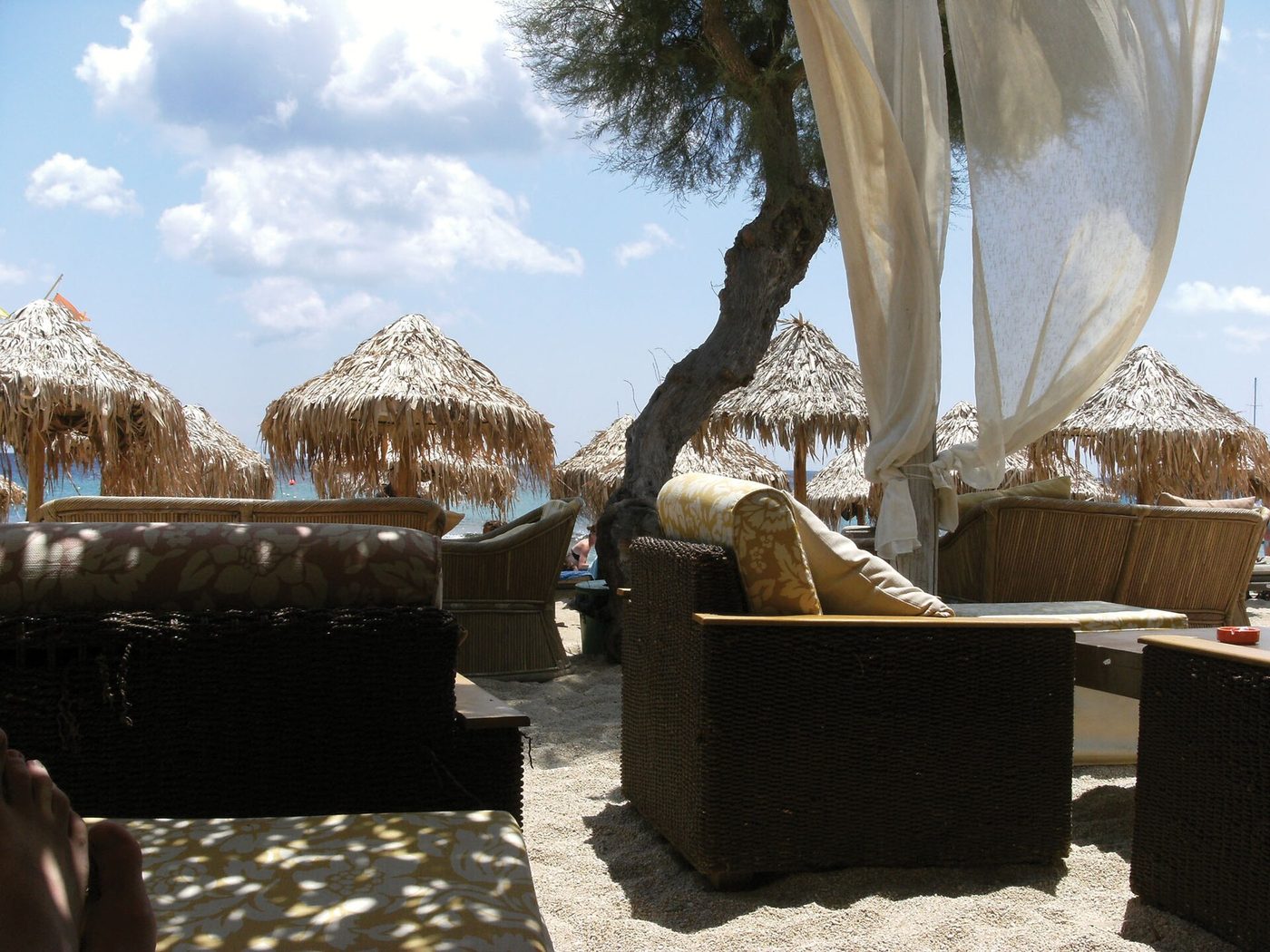
My view, for what it is worth after a lot of these: one beach club day is worth doing if the scene is part of why you came, and two is usually one too many. The food at the top end is good rather than remarkable, the service is excellent, and what you are buying is the room, not the lunch. Book directly and in advance, because walk-up rates on an August Saturday are a punishment. And note that the difference between the front row and the back row at the same club is frequently a hundred euros for eight metres of sand.
Eating and drinking
The food story on Mykonos is better than its reputation, mostly because the reputation was set by the beach clubs. Look for louza, the island’s cured pork, kopanisti, the sharp peppery cheese that appears on every meze plate, and the local mostra, barley rusk with kopanisti and tomato. Ano Mera and the Old Port are where I eat; the streets immediately behind Little Venice are where I do not, unless somebody has recommended a specific table.
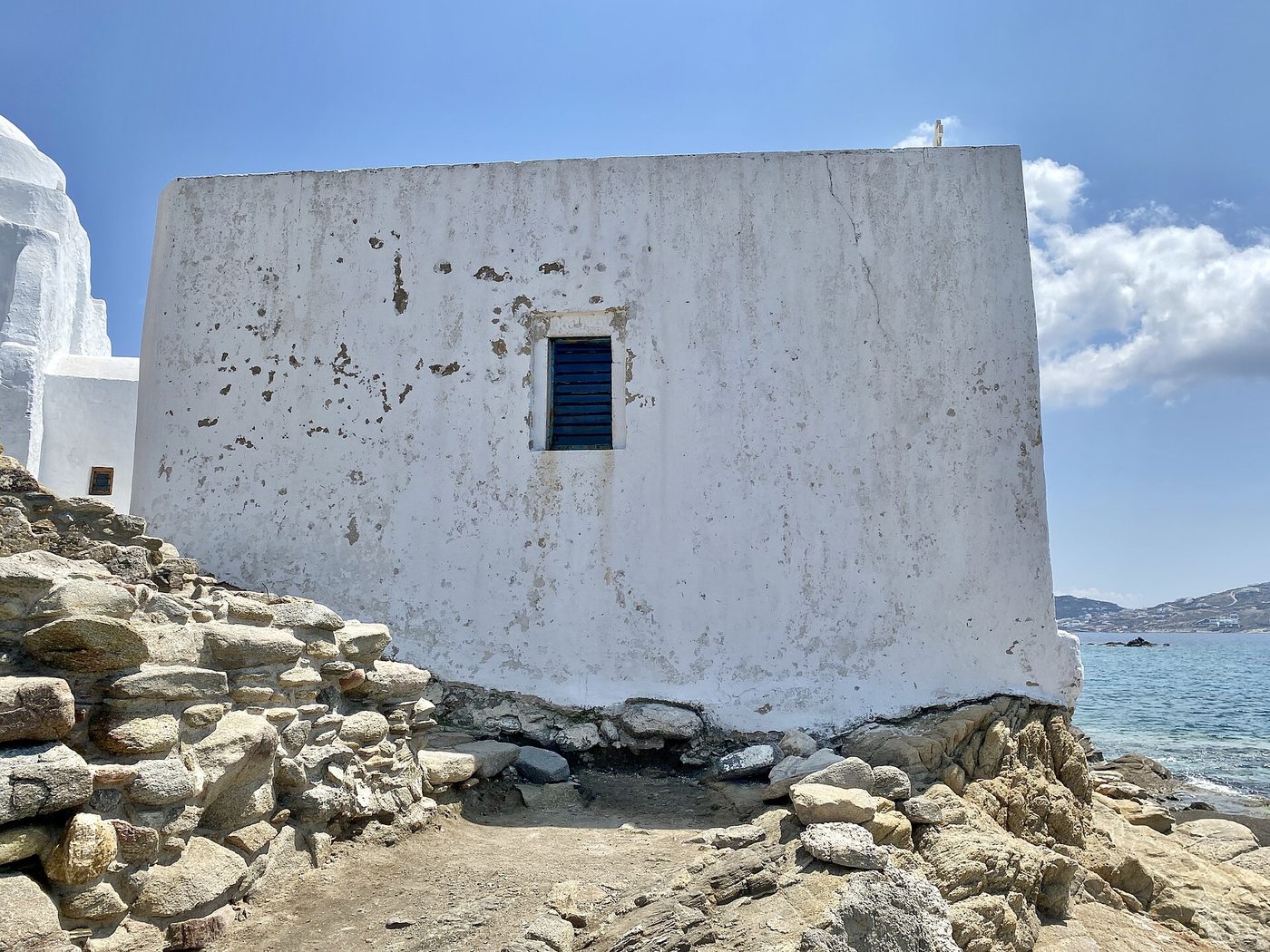
Practical notes. Do not drink the tap water. Mykonos has no natural freshwater supply capable of serving its summer population and runs largely on desalinated seawater and imported supply, and the tap water is not recommended for drinking; buy bottled, and use it for brushing your teeth too. Greeks eat late, and a nine o’clock booking in August is an early one. Indoor smoking is banned in all public indoor spaces and outdoor café areas must have at least two open sides, with e-cigarettes and vapes covered by the same rules. Carry cash for the small places. Always choose to be charged in euros when a card terminal offers you your home currency, because the exchange rate it offers you will not be a good one. For more on what to order across the region, see our guide to European food.
Nightlife, and how to avoid it if you want to
Mykonos nightlife runs in three tiers. The beach clubs start in the afternoon and wind down around sunset. The bars of Chora and Little Venice take over from there. Then the late clubs, Cavo Paradiso above Paradise beach being the famous one, run until the light comes back. Cocktails are €10 to €20 at popular venues and more at the sunset bars, and the last buses from Paradise around 02:30 and Platys Gialos to roughly 03:00 mean you can do all of it without a car.
If nightlife is not why you came, the island is easier to avoid it on than its reputation suggests. Stay in Ano Mera, Agios Ioannis or the southeast, eat at nine, and you will barely encounter it. The scene is geographically concentrated, which is the most useful thing about it in both directions.
What has changed for 2026: rules worth knowing before you go
Mykonos is in the middle of a regulatory tightening, and some of it will affect your trip directly.
The beach law. No more than 50 percent of a Greek beach may be leased for commercial use, dropping to 30 percent inside Natura 2000 zones, and at least half of any beach must stay free of umbrellas and loungers. Each concession is limited to 500 m², of which a maximum of 60 percent may carry equipment, 30 percent in Natura zones. Sunbeds must sit at least 4 metres back from the shoreline, with a 6-metre gap between concession zones. Sunbeds are banned outright on a schedule of protected beaches, with more than 250 such beaches reported for the 2025 season. Fines for obstructing public access to the sea run from €2,000 to €60,000.
MyCoast. There is a free government app for reporting beach violations, live since April 2024, and more than 11,500 complaints had been filed through it by summer 2025. If a concession has crowded you off a public stretch of sand, that is the mechanism, and it is used.
Construction limits. The Special Spatial Framework for Tourism published in May 2026 classifies Mykonos as a saturated destination. New tourist accommodation is capped at 100 beds, the minimum hotel plot size is 1.6 hectares, a carrying-capacity assessment is required, out-of-plan construction is banned entirely and the required spacing between tourist facilities has tripled from 10 to 30 acres. Protected areas cover roughly two-thirds of the island.
Short-term rentals. A freeze on new short-term rental registrations has been introduced in key areas of the island. In practice that means less new supply, and it is one reason to book accommodation earlier than you would elsewhere in the Cyclades.
Drones. Do not assume you can fly one. Greece requires flight notification through the DAGR system five working days in advance, which most short-stay visitors cannot satisfy, and flying over any archaeological site needs written Ministry of Culture permission. Penalties can be very large. Leave it in the bag, or at minimum research your specific plan properly before you travel.
Nudity. Public nudity is lawful in Greece only on officially designated nudist beaches or in licensed naturist resorts, and elsewhere it can be treated as public indecency, with fines reported up to €1,500. No Mykonos beach is officially designated for naturists. In practice the island’s norms are liberal, topless sunbathing is unremarkable, and Agios Sostis, Elia and Super Paradise are the beaches most associated with nudity. Read the beach you are on rather than the reputation of the island.
Residents, for their part, are pushing back on traffic congestion, water shortages, rising housing costs and infrastructure strain. Travelling here in September rather than August, taking the bus, and spending money in Ano Mera rather than only on the south coast are small things, but they are the ones that actually help.
Mykonos itineraries: 3, 4 and 5 days
Three to four nights is right for a first visit. Four to five if Mykonos is the main beach destination rather than one stop on an island-hopping route.
| Day | 3-day trip | 4-day trip | 5-day trip |
|---|---|---|---|
| 1 | Arrive, settle, Chora on foot, sunset at Little Venice, dinner in town | Same | Same |
| 2 | First boat to Delos, back by early afternoon, swim at Platys Gialos | Same | Same |
| 3 | South-coast beach day by water taxi, dinner at the Old Port, fly or sail out | South-coast beach day by water taxi, one beach club afternoon | South-coast beach day by water taxi, one beach club afternoon |
| 4 | Hire car: Ano Mera for lunch, Fokos or Agios Sostis if the wind is down, Armenistis for sunset | Same | |
| 5 | Kalafatis for watersports or Lia for snorkelling, last night back in Chora |
Pack for wind and sun rather than for weather; our Europe packing list has the version I use for the Cyclades, and the wider Europe travel tips cover the small stuff.
The logic behind that shape is simple. Delos goes on day two because the first boat is the best boat and you want a clear morning for it. The car goes on day four because by then you know what the wind is doing and can point it at the north coast on the right day. And the beach club, if you are having one, goes in the afternoon of a day that started somewhere cheaper.
If you are stitching Mykonos into something larger, our Greece itinerary and combined Italy and Greece itinerary handle the joins, and the broader Europe itinerary planner is the place to start if this is one leg of a longer trip.
Mykonos or somewhere else? An honest comparison
| Island | Choose it if | Getting there from Mykonos |
|---|---|---|
| Mykonos | You want beaches, nightlife and Delos, with the best transport of the four and the highest prices | |
| Santorini | The caldera view is the point, and you accept crowds and a cruise cap of 8,000 a day | 2 hr 10 min to 3 hr 35 min, about €75.50 to €89.70 |
| Naxos | You want better value, bigger beaches, mountains and villages, and less scene | 35 min to 1 hr 25 min, about €30 to €57.70 |
| Paros | You want a middle path: pretty towns, good food, and markedly lower prices than Mykonos | 35 min to 2 hr 30 min, from €36.00 |
The Mykonos and Santorini question is the one I get most. They are not rivals, they are different holidays. Santorini is a view you look at; Mykonos is a beach you swim off. If you have five days, do one properly rather than two badly, and if you have ten, do Mykonos and Naxos rather than Mykonos and Santorini, because the crossing is 35 minutes and half the price. Our Santorini travel guide makes the opposite case fairly, and the best Greek islands guide covers the rest of the field. For the mainland end of a trip, see things to do in Athens.
Mykonos by traveller type
| You are | Base yourself | Do this | Skip this |
|---|---|---|---|
| A first-timer with four nights | Two nights Chora, two at Platys Gialos or Ornos | Delos on the first boat; the water taxi; one evening in Little Venice | Hiring a car for the whole stay |
| A family with young children | Ornos | Sheltered swimming, Kalo Livadi, the pelicans, an Ano Mera lunch | Paradise and Paraga after midday |
| A couple on a honeymoon | Agios Ioannis or the southeast | Sunset at Armenistis; a quiet Elia stretch; one considered beach club day | August |
| A group in their twenties | Paradise or Paraga | The beach-club circuit; the night buses; Cavo Paradiso once | Taxis, which barely exist here |
| A solo traveller | Chora | Walking the lanes; Delos; the Old Port at dusk; hostel or camping bases at Paradise | Isolated villas without a car |
| Someone who hates crowds | Ano Mera | September or June; the north coast on a calm day; Fokos | The first fortnight of August, and cruise-ship mornings in Chora |
| A watersports traveller | Kalafatis | The windsurf centre, May to end September; Ftelia in a meltemi | Booking a north-coast base in a still week |
| On a real budget | Ano Mera or Paradise camping | Buses, free beach stretches, gyros, Naxos as your second island | Beach clubs, hire cars, and the front row of anything |
Two of those need a note. Solo travel here is straightforward and safe; our solo travel in Europe guide covers the practicalities. And honeymooners should read the Europe honeymoon guide before assuming Santorini is the automatic choice, because Mykonos does the quiet version better than its reputation allows.
Mistakes I see people make on Mykonos
Walking from the New Port. It is 2.5 km along a busy road that lacks proper pavement for much of the route. Take the SeaBus for two euros, or the bus.
The bus station trap. There are two, they are fifteen to twenty minutes apart on foot, and they serve different halves of the island. Fabrika covers the airport, the port and the southwest; the Old Port station covers Ano Mera and everything east. Check which one your beach leaves from before you set out.
North-coast plans made a week out. Wind decides that side of the island, and the forecast is only useful the night before.
Assuming there will be a taxi. There are roughly thirty to thirty-five licensed taxis for the entire island. Plan around buses, or book by phone well in advance.
The front row. At most clubs the same beach, the same sea and the same service cost a hundred euros less eight metres back.
Forgetting the levy. A week in a five-star room in July carries €105 of climate resilience fee, payable on departure.
Flying in May or October without checking the route. The nonstop network at JMK thins sharply outside June to September and several European routes run for only a few weeks.
Going to Delos in the afternoon. No shade, marble radiating heat, and you will have less time on the site than you think. First boat, always.
Quad paperwork. Non-EU licence holders need an International Driving Permit alongside the home licence, and the licence category required depends on the machine’s engine size.
What I could not verify, and why I am telling you
A few things in the usual Mykonos coverage do not stand up to sourcing, so rather than repeat them confidently I am flagging them. The official Delos listing gives no weekly closing day, while guides variously assert Monday or Tuesday, so I have pointed you at the boat schedule instead. I could not find an authoritative current entry fee for the Archaeological Museum of Mykonos; the figures in circulation are €1, €2 and €4. I could not source 2026 sunbed prices for Agios Ioannis, Kalafatis, Agrari, Kalo Livadi or Lia. I could not confirm a dedicated Mykonos taxi app. And the Kato Mili windmill count is contested between five and seven, which is why I have not given you a number.
None of those gaps will spoil a trip. All of them would be worse as invented numbers.
Mykonos travel guide FAQ
How many days should I spend in Mykonos?
Three to four nights on a first visit, four to five if Mykonos is your main beach destination rather than one hop on an island-hopping route. Three is enough for Chora, Delos and two beach days.
Is Mykonos expensive?
Yes, at the top end, and it is among the most expensive Greek islands along with Santorini. But the range is enormous: a gyros is €4 to €5 and a bus ride is a couple of euros, while a front-row set at Nammos can be €250 to €400 with a €400 to €600 August minimum spend. You control which island you are on.
When is the best time to visit Mykonos?
September, then June. September gives you a sea at 23.5°C, air highs of 25.7°C, everything still open and lighter crowds than August. July and August bring the peak crowds, the peak prices and the strongest meltemi.
Is Mykonos a party island?
Partly, and geographically so. The scene concentrates on the Paradise to Paraga stretch of the south coast and in a handful of clubs in Chora. Stay in Ano Mera, Agios Ioannis or the southeast and you can have a very quiet week.
How do I get to Mykonos?
Fly to JMK, which has direct European flights concentrated between June and September, or take a ferry from Piraeus, from €43 and 2 hr 40 min at the fastest, or from Rafina, from €35.50 and closer to Athens airport. All ferries dock at the New Port at Tourlos.
Do I need a car in Mykonos?
No, for most visitors. Buses, walking and the €20 water-taxi day pass cover the south coast and town. Hire a car for one day if you want the north coast, Fokos, Ftelia, Panormos or the Armenistis lighthouse.
What is the best day trip from Mykonos?
Delos, without competition. It is a UNESCO World Heritage Site inscribed in 1990, about 30 minutes by boat from the Old Port, roughly €25 return plus €20 site entry. Nobody stays overnight; the whole island is an archaeological site.
What is the best area to stay in Mykonos?
Chora if you want to walk to dinner and use both bus stations, Ornos if you have small children, Platys Gialos for a beach-first trip without a car, Paradise or Paraga if nightlife is the point, Ano Mera for value and quiet.
Which Mykonos beaches are best on a windy day?
The south and west coasts. Psarou, Platys Gialos, Ornos, Agios Ioannis, Paraga, Paradise, Super Paradise, Agrari, Elia, Kalo Livadi and Lia all sit in the lee of the island’s hills. Avoid Agios Sostis, Panormos, Ftelia and Fokos, which face straight into the meltemi.
Is Mykonos or Santorini better?
Different trips. Santorini is a view and a caldera; Mykonos is beaches, a walkable town and Delos. Mykonos has better public transport and better swimming; Santorini has the scenery. If you have ten days, pair Mykonos with Naxos rather than Santorini, since the crossing is 35 minutes and roughly half the fare.
Can I visit Mykonos without partying?
Easily. The nightlife is concentrated in two small areas. Base yourself away from them, eat late in Ano Mera or at the Old Port, and the island you experience is a quiet Cycladic one.
Is Mykonos good for families?
Yes, if you pick your base. Ornos and Kalo Livadi have calm shallow water and food behind the sand, the bus network makes days out easy, and the pelicans and Delos both work for children. Avoid the Paradise and Paraga stretch after midday.
How much is the tourist tax in Mykonos?
Greece’s climate resilience levy runs €2 to €15 per room per night from April to October depending on the class of accommodation, and €0.50 to €4 from November to March. It is charged per room rather than per person and collected on departure. Cruise passengers pay a separate €20 per-person levy in peak season.
Can you drink the tap water in Mykonos?
No. The island runs largely on desalinated seawater and imported supply, and the tap water is not recommended for drinking. Bottled water is universally available and cheap outside the beach clubs.
Where do ferries arrive in Mykonos?
All passenger ferries dock at the New Port at Tourlos, 2.5 km from Chora and 4 km from the airport. Do not walk it; use the SeaBus, the bus or a taxi.
Final thoughts
What surprises people about Mykonos is how small it is. You can cross it in half an hour. The party beaches are a two-kilometre run of coast, the nightlife is two neighbourhoods, and the rest of the island is dry hills, stone walls, a monastery courtyard and an empty north coast that most visitors never reach because the bus does not go there.
The island has a reputation problem in both directions. Critics call it a vulgar theme park; the drinks adverts sell an effortless paradise. Neither description survives a week here. It is a working Cycladic island of ten thousand people that carries around fifty thousand on an average summer day, and it is at its best when you go slightly against that grain: in September instead of August, on the early Delos boat instead of the late one, in the back row instead of the front, and on the north coast on the one morning the wind drops.
Do that and Mykonos is one of the great islands of the Mediterranean. Do the other thing and it is an expensive day out. The difference costs nothing but a bit of planning, which is what this guide was for.
If you want the version of the Cyclades that has not been overrun, our round-up of underrated places in Europe is the better starting point, and Mykonos still earns its spot among the most beautiful places in Europe despite everything said about it.
For more on planning a trip around this one, start with our complete Greece travel guide, then the best time to visit Greece and best Mediterranean destinations.
Hannah Brooks has spent fifteen years travelling, living and writing across Europe, from the Arctic tip of Norway to the south of Sicily. She has planned hundreds of European itineraries for readers and is Senior Europe Editor at EuropeanTourism.org.
Photo credits
All photographs are used under the licences shown. Thank you to the photographers.
- Photo: Joe deSousa (CC0) via Wikimedia Commons · source
- Photo: Dinkum (CC0) via Wikimedia Commons · source
- Photo: Warren LeMay from Chicago, IL, United States / CC BY-SA 2.0 via Wikimedia Commons · source
- Photo: Jebulon (CC0) via Wikimedia Commons · source
- Photo: Squirmy2000 at English Wikipedia (CC0) via Wikimedia Commons · source
- Photo: Bgabel / CC BY-SA 3.0 via Wikimedia Commons · source
- Photo: rene boulay / CC BY-SA 3.0 via Wikimedia Commons · source
- Photo: Χρήστης: ΔΗΜΑΔΗΣ / ΔΗΜΑΔΗΣ at Greek Wikipedia (CC0) via Wikimedia Commons · source
- Photo: rene boulay / CC BY-SA 3.0 via Wikimedia Commons · source
- Photo: Warren LeMay from Chicago, IL, United States / CC BY-SA 2.0 via Wikimedia Commons · source
- Photo: Mustang Joe (CC0) via Wikimedia Commons · source
- Photo: Zde / CC BY-SA 4.0 via Wikimedia Commons · source
- Photo: sailko / CC BY 2.5 via Wikimedia Commons · source
- Photo: Jeremy Avnet (brainsik) (CC0) via Wikimedia Commons · source
- Photo: ftrc / CC BY-SA 2.0 via Wikimedia Commons · source
- Photo: Zde / CC BY-SA 4.0 via Wikimedia Commons · source
- Photo: ftrc / CC BY-SA 2.0 via Wikimedia Commons · source
- Photo: Zde / CC BY-SA 4.0 via Wikimedia Commons · source
- Photo: Mateus Pabst / CC BY 2.0 via Wikimedia Commons · source
- Photo: Lance Cpl. Vanessa M. American H (CC0) via Wikimedia Commons · source
- Photo: Warren LeMay from Chicago, IL, United States / CC BY-SA 2.0 via Wikimedia Commons · source
- Photo: Dim Leventis / CC BY-SA 2.0 via Wikimedia Commons · source