Greek Island Hopping Itinerary: 9 Routes, 5 to 14 Days

The first time I planned a Greek trip I opened a map, saw islands a thumb-width apart, and assumed I could string six together in ten days. The Aegean ferry network is not a grid. It is a set of spokes out of Athens, with good local links and gaps you cannot see on a map.
A greek island hopping itinerary works when you pick one island group, keep your hops short, and build the route around ferries that sail daily rather than the ones that look shortest on paper. Below are nine routes I would send friends on, from five days to a fortnight, with the crossing times, fares, ports and booking rules behind each one. Two of the islands on my first attempt had no boat between them at all.
I have spent fifteen years travelling around Europe and a good chunk of that on Greek ferries, in the good seats and on the outside deck in a gale. What follows is built on the 2026 timetables, the current fare bands, and the rules that changed this year, including the accommodation tax and the Santorini cruise cap. Where I could not source a number, I say so. For the wider picture of when to travel anywhere on the continent, see our guide to the best time to visit Europe.
How to use this guide
Read it in three passes. First, the island groups table below: pick one group, because trying to combine two in under two weeks is where most trips fall apart. Second, the nine routes: find the one that matches your trip length and choose it more or less as written. Third, the practical sections. The Piraeus gate map, the ferry cancellation ladders, the platform booking fees, the 2026 tax bands. Those are the parts you will actually use in the week before you fly.
If you are still choosing a country rather than an island, start with our Greece travel guide, which sets out the mainland alongside the islands. If you have already settled on Greece and want the wider trip shape, the Greece itinerary covers Athens, the Peloponnese and the islands together, and the best Greek islands ranks the islands themselves if you are still deciding which ones to route.
The five island groups, and how to choose one
Greece has around 6,000 islands and islets, of which a couple of hundred are inhabited. For island hopping purposes, though, you are choosing between five clusters. The choice matters more than which islands you pick inside it, because ferries run within groups and rarely between them.
| Group | Where | Gets you | Main gateway | Ferry density | Season |
|---|---|---|---|---|---|
| Cyclades | Central Aegean, south-east of Athens | The white cubic villages, bare hills, the famous ones | Piraeus and Rafina; airports on Santorini, Mykonos, Paros, Naxos, Milos, Syros | Highest in Greece; SeaJets alone runs up to 229 sailings a day here | Late April to late October |
| Dodecanese | South-east Aegean, hugging the Turkish coast | Crusader castles, Italian architecture, Byzantine monasteries | Rhodes and Kos airports | Good along the Rhodes to Patmos spine, thin off it | May to October |
| Ionian | West coast, facing Italy | Green hills, olive groves, Venetian towns, calmer sea | Corfu, Kefalonia and Zakynthos airports; Patras and Kyllini by road | Sparse between the big islands; you often route via the mainland. See Corfu and the Ionian islands | June to August, dropping fast by October |
| Saronic | The gulf on Athens’s doorstep | An island night without committing a whole trip to it | Piraeus, an hour or so away | Year-round, several a day, all on one line | Year-round |
| Sporades | North-west Aegean, off Volos | Pine forest to the waterline, a marine park, very short hops | Skiathos airport, or Volos by road | Excellent within the group, poor to anywhere else | Late May to September |
If this is your first Greek trip, take the Cyclades. Not because they rank higher, but because the ferry density gives you room to be wrong. If a boat cancels in the Cyclades in July there is usually another one within a few hours. In the Ionian there may not be another one that week.
How many days do you need for a Greek island hopping itinerary?
Ten days is the honest minimum for a trip that feels like island hopping rather than a transfer marathon, and fourteen is where it stops feeling rushed. The arithmetic is simple once you accept two rules. Every island change costs you the best part of a day even when the crossing is only ninety minutes, because you check out, get to the port early, sail, then arrive and find your room. And no island is worth fewer than two nights, because the first evening and the last morning are half days.
So the working guide is roughly this. Five to seven days gets you two islands. Eight to ten days gets you two or three. Ten to fourteen gets you three or four. Six islands in ten days is six ferry terminals, not six islands. If you want the wider trip shape first, our Europe itinerary and how to plan a trip to Europe cover the sequencing.

Two more constraints shape every route below. The first is that there is no ferry from Athens to the Ionian islands, at all, in any season. You reach the Ionian by flying, or by crossing the mainland to Patras, Kyllini, Astakos or Igoumenitsa. The second is that there are no direct ferries between the Cyclades and the Saronic islands, so combining Hydra with Naxos means going back through Piraeus. Both of these catch people out every summer. Our guide to getting around Europe covers the ferry, rail and budget-airline picture more broadly.
Nine Greek island hopping routes at a glance
Here are the nine routes in full, sorted by length. I have given each one a ferry difficulty score out of five, which is my own shorthand for how much the timetable will boss you around. A 1 means daily year-round sailings on short hops and a missed boat is an inconvenience. A 4 or 5 means you are building the entire trip around two or three sailings a week and a cancellation costs you a day.
| Route | Length | Island group | Islands | Ferry difficulty | Car needed? | Best for |
|---|---|---|---|---|---|---|
| 1. The Saronic Sampler | 5 days | Saronic Gulf | Athens, Aegina, Hydra | ●○○○○ 1/5 | No | First-timers, short trips, anyone flying in and out of Athens |
| 2. The Classic Cyclades | 7 days | Cyclades | Athens, Paros, Naxos, Santorini | ●●○○○ 2/5 | Yes, on Naxos | A first Greek island trip that still ends on the caldera |
| 3. The Postcard Run | 7 days | Cyclades | Mykonos, Paros, Santorini | ●●○○○ 2/5 | No | Honeymoons, photographers, people who want the famous two |
| 4. The Western Cyclades Quiet Line | 10 days | Cyclades (western) | Athens, Milos, Folegandros, Santorini | ●●●○○ 3/5 | Yes, on Milos | Second-time visitors, walkers, anyone allergic to crowds |
| 5. Cyclades to Crete, Open-Jaw | 10 days | Cyclades and Crete | Athens, Naxos, Santorini, Crete | ●●○○○ 2/5 | Yes, on Naxos and Crete | Travellers who want ruins, mountains and beaches in one trip |
| 6. The Dodecanese Loop | 12 days | Dodecanese | Rhodes, Symi, Kos, Patmos | ●●●○○ 3/5 | Yes, on Rhodes | History travellers and anyone who wants to skip the Cyclades entirely |
| 7. The Ionian Green Route | 10 days | Ionian | Corfu, Paxos, Kefalonia, Zakynthos | ●●●●○ 4/5 | Yes, except Paxos | Beach trips, families, sailors, anyone who finds the Cyclades too bare |
| 8. The Sporades Slow Route | 8 days | Sporades | Skiathos, Skopelos, Alonissos | ●●○○○ 2/5 | Yes, on Skopelos | Green islands, short hops, families, low-key food trips |
| 9. The Grand Cyclades Fortnight | 14 days | Cyclades | Athens, Milos, Sifnos, Paros, Naxos, Santorini | ●●●○○ 3/5 | Yes, on Milos and Naxos | A once-in-a-decade trip with time to actually stop moving |
Notice what the difficulty column is telling you. The Ionian scores worst not because the islands are hard work but because the inter-island connections are thin and seasonal, and one of them, Corfu to Lefkada, I could not confirm runs reliably in 2026. The Saronic scores best because every island on the route sits on the same line out of Piraeus, several times a day, all year.
1. The Saronic Sampler: 5 days from Athens
Athens 2 nights, Aegina 1 night, Hydra 2 nights. Ferry difficulty 1/5.
This is the route I recommend to people who have five days, a flight into Athens, and a nagging worry that they cannot fit islands in. You can. The Saronic islands sit between forty minutes and just over two hours from Piraeus, they are all on the same ferry line, and boats run several times a day all year, which is not true of anywhere else in this guide.
Give Athens two nights at the start, because you will want the Acropolis and one long dinner in Plaka before you leave, and because arriving on an island jetlagged wastes the island. Our guide to things to do in Athens covers the two days properly.
Then Aegina, forty minutes by high-speed catamaran or an hour and twenty-five on the conventional boat, for about EUR 10.50 to EUR 19.50 depending which you take. Aegina is a working island with pistachio orchards, a fifth-century BC temple of Aphaia on a pine ridge, and a fish market on the harbour that has nothing to do with tourism. One night is enough.

Finish on Hydra, an hour and five minutes from Piraeus on the fast Flyingcat, longer on the slower sailings, for roughly EUR 40 to EUR 50. Hydra has no cars. Not “few cars”, none: goods move by mule and water taxi, and the silence in the town after the last day-trip boat leaves is the most surprising thing on this route. Boutique rooms run around EUR 120 to EUR 350 a night, so it is not the cheap option, but two nights here will do more for you than four somewhere busier.
Skip this route if you have come for long sandy beaches or nightlife. The Saronic islands are rocky, small-scale and quiet, which is the point.
2. The Classic Cyclades: 7 days, Athens to Santorini
Athens 1 night, Paros 2 nights, Naxos 2 nights, Santorini 2 nights. Ferry difficulty 2/5.
If you asked me for one route to give a first-time visitor with a week, this is it. Every hop is short, every hop runs multiple times a day in summer, and the trip builds instead of peaking early.
Fly into Athens, overnight near the centre or in Piraeus, and take a morning ferry to Paros: two hours forty on a SeaJets catamaran, four and a half to five hours on the Blue Star, from around EUR 35. Paros is the most useful island in the Aegean network, because almost every inter-island route in the Cyclades passes through or near it. That means if a later boat cancels, you have options. Stay in Naoussa rather than Parikia if you can: the old fishing harbour with the half-sunken Venetian fort is one of the loveliest evening spots in Greece.
Then Naxos, twenty-five minutes to under two hours away depending on the boat, and cheap: fares run from EUR 5.50 on the slow crossings up to EUR 82.40 in the top classes. Naxos is the island I would move to. It is big enough to have mountains, a real farming economy, unfinished marble kouroi lying in olive groves, and the best beaches in the group along the west coast. This is the one island on this route where you should rent a car, at roughly EUR 35 to EUR 55 a day in high season.
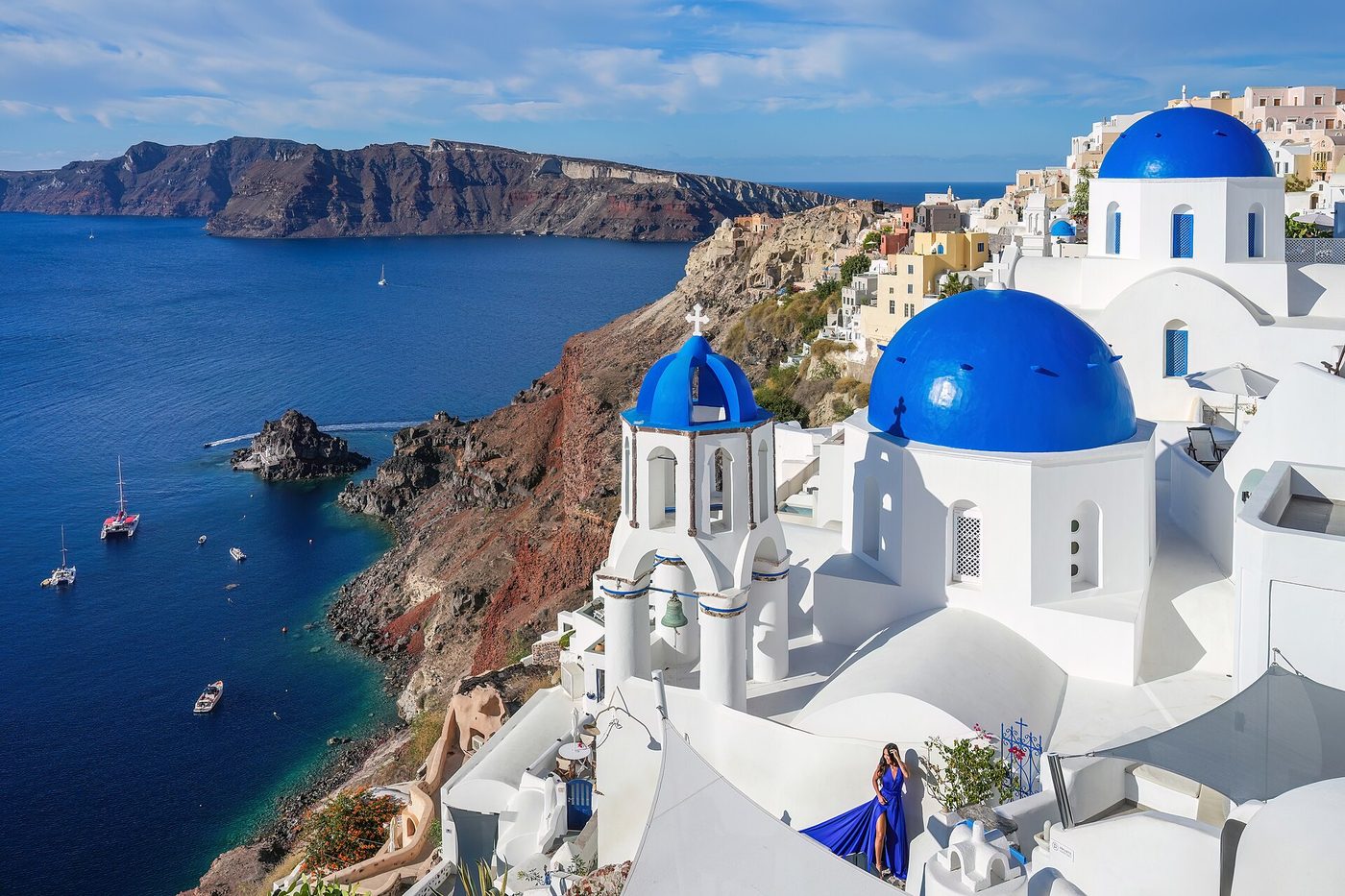
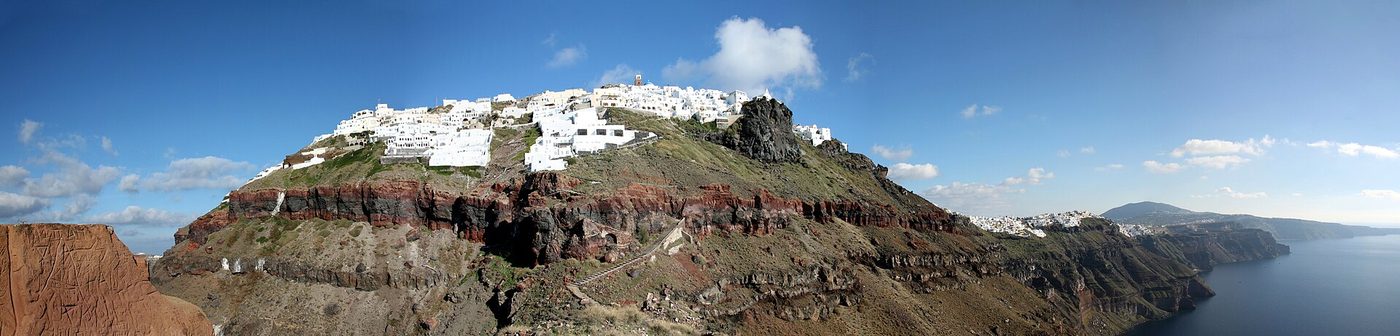
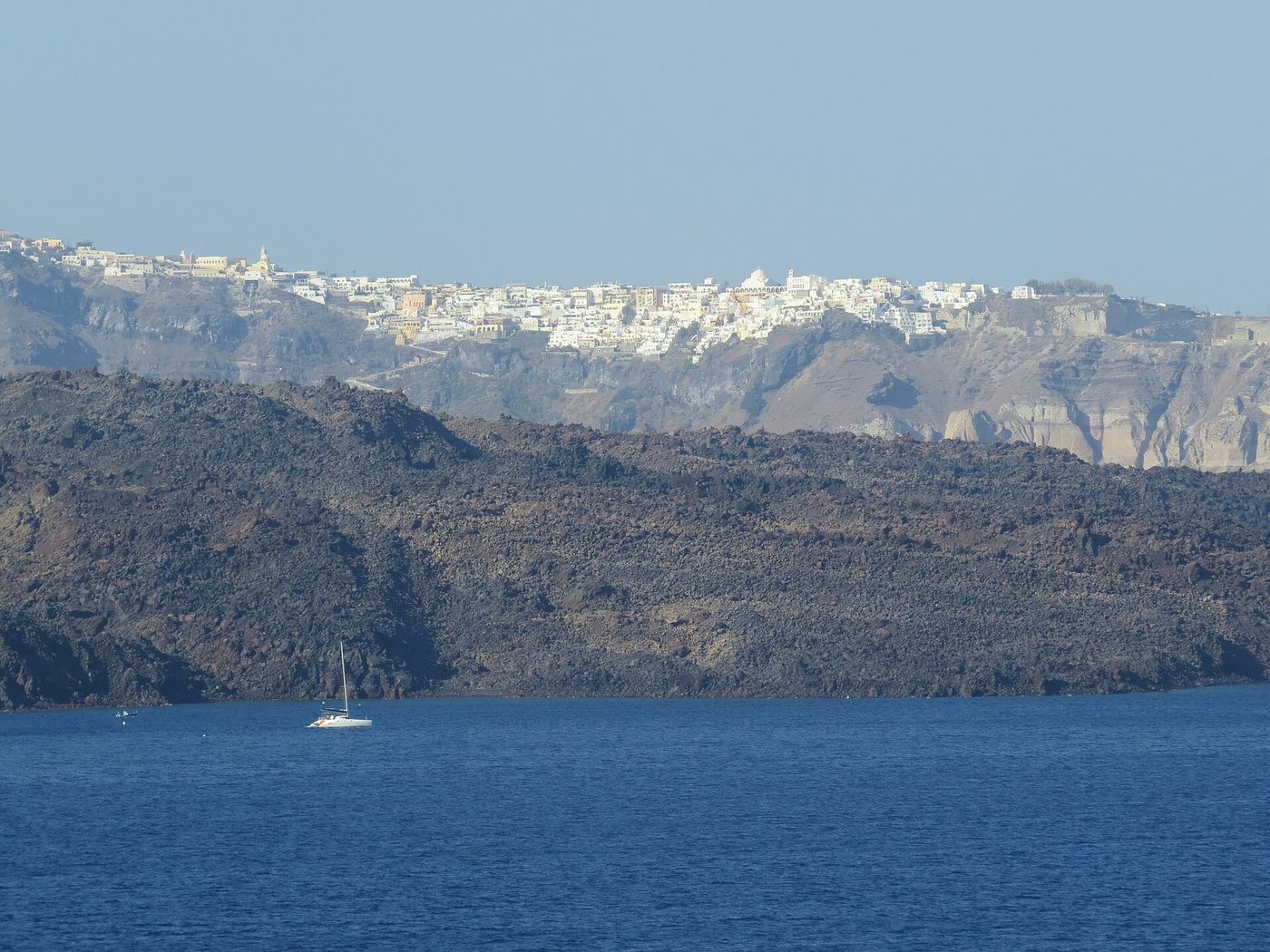
Finish on Santorini, an hour and five minutes to three hours from Naxos, from about EUR 31.50, with up to eight crossings a day and service all year. Santorini earns its reputation and also deserves the complaints: the caldera at dusk is one of the great sights in Europe, and Oia at that same hour is a scrum. Stay in Imerovigli or Pyrgos instead of Oia, walk the Fira to Oia caldera path early, and you will get the good version. Our Santorini travel guide has the detail, and where to stay in Europe covers the neighbourhood question more widely.
Skip this route if you have fewer than six full days on the ground. At five you will be checking in and out constantly.
3. The Postcard Run: 7 days, Mykonos to Santorini
Mykonos 3 nights, Paros 1 night, Santorini 3 nights. Ferry difficulty 2/5.
The version most people want, and there is no shame in it. Both islands take direct international flights in summer, so you can fly into Mykonos and out of Santorini and never see Athens, which saves you two travel days. Open-jaw flights are the biggest efficiency gain available on any Greek trip.
Mykonos first, because the nightlife is better tackled while you still have energy. Beyond the beach clubs, the island has the whitewashed lanes of Chora, the pelicans on the waterfront, and the windmills above the town. Our Mykonos travel guide goes deeper. More importantly it has Delos, twenty minutes offshore, which is one of the most important archaeological sites in the Mediterranean and one of the very few reliable day trips in the Cyclades. Go early, take a hat, and allow three hours.

The direct Mykonos to Santorini catamaran takes about two hours ten on the fastest SeaJets Supercat and starts around EUR 50. Here is my argument for breaking it: that crossing runs through the most exposed water in the central Cyclades and is one of the first to go when the meltemi blows. Stopping one night on Paros costs you almost nothing, splits the journey into two short legs and gives you a fallback if the weather turns. If you would rather run it direct, book the earliest sailing of the day, which is the least likely to be cancelled.
Then three nights on Santorini. Use one of them for a caldera sailing boat to the volcanic islets of Nea Kameni and the hot springs, and one afternoon for the Bronze Age excavation at Akrotiri, which is the better site and the emptier one.
Skip this route if your budget is tight. Mykonos and Santorini are the two most expensive islands in Greece, with high-season rooms commonly EUR 150 to EUR 250 a night at the budget end and EUR 300 upwards at the top. Swap in Paros and Naxos and you will pay roughly forty to sixty per cent less for comparable quality. See the cheapest places to travel in Europe if budget is the deciding factor.
4. The Western Cyclades Quiet Line: 10 days
Athens 1 night, Milos 4 nights, Folegandros 2 nights, Santorini 3 nights. Ferry difficulty 3/5.
This is my favourite route in the guide and the one I would take myself. It uses the western Cyclades line, which is quieter than the Paros and Naxos corridor and links up to Santorini at the end, so you still get the famous finish without spending the whole trip in the crowd.
Milos is two hours thirty-five from Piraeus on the fastest SeaJets catamaran, three to five hours on a conventional ferry, from about EUR 33. It is a volcanic island with more than seventy beaches and a coastline that does not look Greek at all: Sarakiniko is a white pumice moonscape you can walk out over, and Kleftiko on the south-west coast is only reachable by boat. Rent a car here. Four nights sounds generous until you see how spread out it is.

Folegandros is one to two hours forty from Milos, and the lead-in fare is startlingly low, from about EUR 7. It is a cliff-edged island with one small Chora perched 200 metres above the sea and almost nothing else, which is the appeal. Take the walk up to the Panagia church at sunset. Bring cash: small islands like this can have a single ATM and it does run out.
Then Santorini, fifty minutes to three hours away depending on the operator, from about EUR 7 on the cheapest sailings, with up to two departures a day year-round.
Skip this route if you are travelling in the shoulder season and need certainty. The western line thins out fast either side of summer, and the very cheap Milos to Folegandros and Folegandros to Santorini fares reflect a small number of sailings, not a bargain.
5. Cyclades to Crete, Open-Jaw: 10 days
Athens 1 night, Naxos 3 nights, Santorini 3 nights, Crete 3 nights. Ferry difficulty 2/5.
The best-value route here if you want variety, because it ends on an island the size of a small country. Fly into Athens, ferry down the Cyclades chain, then take the short crossing from Santorini to Heraklion and fly home from Crete.
The Santorini to Heraklion leg is the hinge. It is easier than people expect: an hour and thirty-five on the high-speed, about three hours on the Blue Star, up to three crossings a day, all year. The fare gap is dramatic. Conventional sailings start around EUR 15 while the high-speed starts around EUR 92, with business and VIP classes up to about EUR 130. The high-speed saves roughly an hour and a half on the direct crossing. Take the slow boat and put the difference toward a rental car.
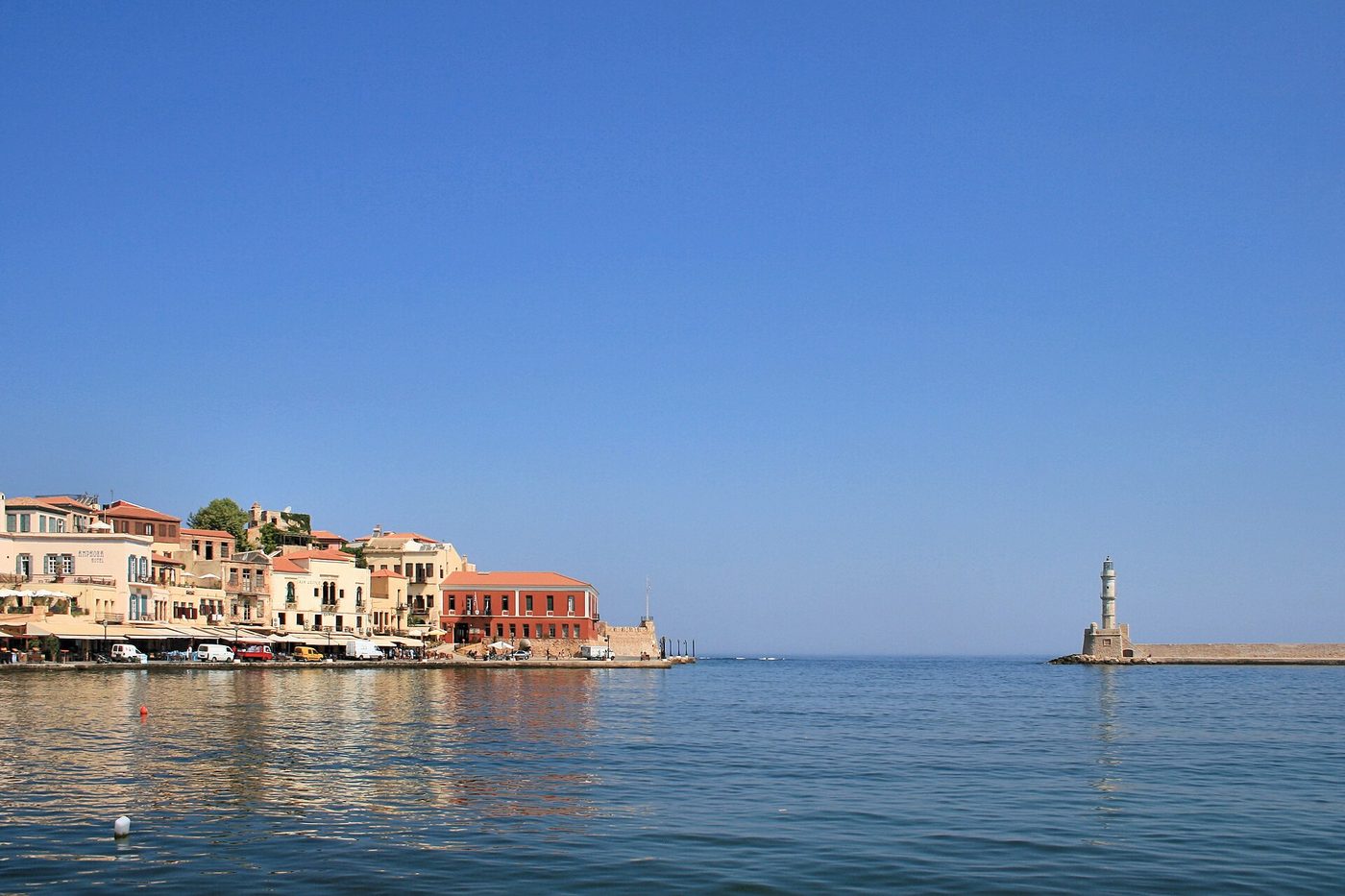
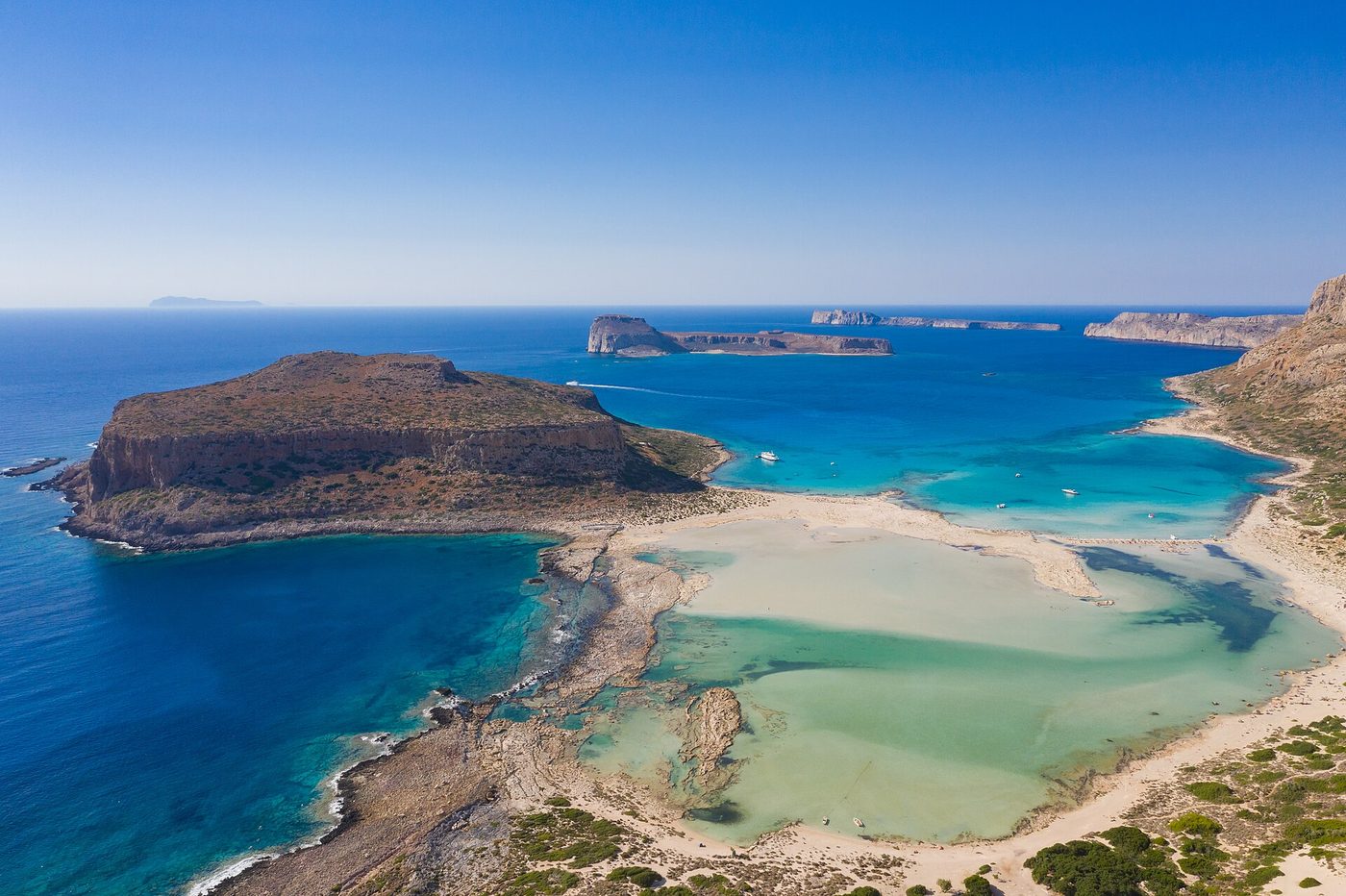
On Crete, three nights means choosing one end. I would go west to Chania, for the Venetian harbour, the Samaria Gorge and the Balos and Elafonissi lagoons, and fly home from Chania rather than backtracking to Heraklion. If ruins matter more to you, stay east for Knossos and the Heraklion Archaeological Museum. Trying to do both in three nights means five hours of driving you did not budget for. Our Crete travel guide splits the island properly, and the best beaches in Europe covers Balos and Elafonissi alongside their rivals.
Skip this route if you dislike driving. Crete without a car is a fraction of Crete.
6. The Dodecanese Loop: 12 days
Rhodes 5 nights, Symi 2 nights, Kos 3 nights, Patmos 2 nights. Ferry difficulty 3/5.
The Dodecanese is where I would send someone who has done the Cyclades and found them beautiful but a bit bare. These islands were under Italian rule from 1912, formally ceded to Greece in 1947, and Knights Hospitaller before that, and it shows in the architecture in a way nothing in the Cyclades does. If ancient sites are the draw, our Europe bucket list sets them in context.
Rhodes has one of the best-preserved medieval walled towns in Europe, UNESCO-listed since 1988 and one you can sleep inside, plus the ancient acropolis at Lindos an hour down the coast. Five nights, with a car for two of them.

Symi is forty to fifty minutes away on the Dodekanisos Seaways catamaran, longer on slower boats, with deck tickets from around EUR 7 to EUR 11 in the low season. The harbour at Gialos is a bowl of neoclassical mansions in ochre and ice-cream colours stacked up the hillsides, built on sponge-diving money, and arriving by sea into it is one of the great entrances in Greece. Two nights, because the day-trippers leave at four and the town changes completely.
Back through Rhodes to Kos, two hours five to two hours forty, from about EUR 15, with roughly fifteen sailings a week. Kos is flatter, greener and more package-holiday than the others, but it has the Asklepieion, the Roman ruins in the town centre, and excellent cycling.
Finish on Patmos, an hour and a half to just over two hours on Dodekanisos Seaways, around four hours twenty on the Blue Star. Patmos is where the Book of Revelation was written, and the Monastery of Saint John and the Cave of the Apocalypse are UNESCO-listed. It is also, unexpectedly, one of the most elegant small islands in Greece. Patmos has no airport, so plan the exit: ferry back to Kos or Rhodes for the flight home, and give that leg a spare day.
Skip this route if you only have a week. The Dodecanese connections are good but not dense, and compressing this to seven days means two islands, not four.
7. The Ionian Green Route: 10 days
Corfu 3 nights, Paxos 2 nights, Kefalonia 3 nights, Zakynthos 2 nights. Ferry difficulty 4/5.
The Ionian is the other Greece: green, wooded, rainier in winter, Venetian rather than Ottoman in its history, and facing Italy rather than Turkey. The sea is calmer here because the meltemi does not reach it, which makes it the best group for anyone who gets seasick or is travelling with small children. The Croatia travel guide covers the other big Mediterranean island-hopping country if you are comparing.
The catch is the connections, and I want to be straight about it. There is no ferry from Athens. Between the big Ionian islands the sailings are seasonal and sparse, and you will often route via the mainland ports of Kyllini, Patras or Igoumenitsa. On the Corfu to Lefkada leg specifically, sources actively contradict each other: some list a sailing of around five hours forty running three times a week, others say no ferry currently operates. I could not confirm it either way, so I have left Lefkada out of this route. Check with the operator directly if you want it.

Corfu first, and specifically Corfu Town, which is a UNESCO-listed Venetian old town with two fortresses, arcaded streets and a cricket ground on the esplanade left over from the British protectorate. Mid-range rooms in town run roughly EUR 50 to EUR 120, rising sharply on the beach strips in August.
Paxos is fifty-five minutes to an hour forty-five away, from about EUR 15, with up to thirteen crossings a day in high season, the first around 06:45 and the last around 18:35. That density is the exception in this group, not the rule. Paxos is tiny, olive-covered and has three harbour villages and the sea caves of Antipaxos offshore.

Then south to Kefalonia and Zakynthos, which connect to each other and to the mainland in one to two and a half hours for roughly EUR 12 to EUR 20. Kefalonia has Myrtos beach and the underground lake at Melissani. Zakynthos has Navagio, the shipwreck cove that appears on every Greece poster ever printed, and here the 2026 detail matters: the port authority has closed the beach itself to boat landings and swimming until 31 October 2026 over landslide risk. Boats still hold offshore and the clifftop viewpoint above Anafonitria stays open, so you can see it, you just cannot stand on the sand. Our most beautiful places in Europe guide includes it.

Skip this route if you are travelling outside June to September. The Ionian sweet spot is short, ferry frequency drops noticeably by October, and Ionian timetables are often published only weeks before the season starts.
8. The Sporades Slow Route: 8 days
Skiathos 2 nights, Skopelos 3 nights, Alonissos 3 nights. Ferry difficulty 2/5.
The most underrated route here. The Sporades sit off Volos in the north-west Aegean, they are covered in pine forest right down to the water, and the hops between them are absurdly short.
Fly into Skiathos, which takes direct European flights in summer, or come by road to Volos and cross in an hour and a quarter to two and a half hours for about EUR 27 upwards. Skiathos has more than sixty beaches on an island you can drive across in half an hour, including Koukounaries, which is consistently rated among the best in Greece.
Skopelos is twenty-five minutes to an hour away, from about EUR 15. It is the greenest of the three, has almost no mass tourism, and it is where Mamma Mia! was filmed, which has aged into a mild local joke rather than an industry. The clifftop chapel of Agios Ioannis Kastri is the one from the wedding scene.
Alonissos is five to thirty minutes from Skopelos on a standard ticket of about EUR 12 to EUR 17, the shortest hop in this guide. It sits inside the National Marine Park of Alonissos and the Northern Sporades, the largest marine protected area in Europe, set up for the Mediterranean monk seal. Boat trips into the park are the reason to come. Plan your flight home from Skiathos, not Alonissos, which has no airport: the hop back takes fifty minutes to two hours, so build in a night on Skiathos at the end. For more of this sort of thing, see underrated places in Europe.
Skip this route if you want the white-and-blue Cycladic look. The Sporades are stone, terracotta and pine, and they look like a different country.
9. The Grand Cyclades Fortnight: 14 days
Athens 2 nights, Milos 3 nights, Sifnos 2 nights, Paros 2 nights, Naxos 3 nights, Santorini 2 nights. Ferry difficulty 3/5.
Two weeks, six stops, five moves, and still only a bit over two nights per island on average, which shows you how much time the hops eat. This is the one route that stretches my own three-or-four-island rule, and it works only because a fortnight gives you the slack to absorb a cancelled boat. This route crosses from the western Cyclades line to the central one, which is the move that makes it interesting and also the one that needs the most attention when you book.
Athens for two nights, then Milos for the volcanic coastline, Sifnos for the food, which is the reason people who know the Cyclades keep going back to it and which has a real claim on modern Greek cooking through the chef Nikolaos Tselementes, and then across to Paros, the network hub, where you rejoin the busy line. Naxos gets the longest single stay because it rewards it: the Tragaea valley villages, Mount Zas, the marble quarries and the beaches.

I have deliberately put Santorini last and given it only two nights. On a fourteen-day trip you will have had a fortnight of quiet coastline, and Santorini in full season is loud, expensive and crowded. Two nights, one caldera sunset, one boat trip, then fly home from the island rather than ferrying back to Athens.
Skip this route if what you want is to relax. Five moves in fourteen days is a lot of packing. If that is the trip you want, take route 4 and add nights to Milos.
Note the gaps across all nine routes, because they are real. There is no Ios here, no Amorgos, no Small Cyclades, no Serifos, no Andros or Tinos, and nothing from the north-east Aegean at all. That is a limit of what I can route reliably with published 2026 sailings, not a verdict on those islands. Amorgos and the Small Cyclades in particular are wonderful and I have left them out only because the connections need more slack than a fixed itinerary can promise.
The ferry legs: crossing times, fares and who runs them
The legs used in the nine routes above, plus the ones you are most likely to substitute in. Times run from the fastest catamaran to the slowest multi-stop conventional sailing, which is why some ranges look absurd: the Piraeus to Santorini spread of four hours fifty to eleven hours thirty is real. It is the difference between a direct SeaJets high-speed and a Blue Star that calls at four islands on the way.
| From | To | Crossing time | Typical lead-in fare, one way | Main operators |
|---|---|---|---|---|
| Piraeus | Mykonos | 2h40m to 5h55m | from about EUR 38 | SeaJets, Fast Ferries, Golden Star, Blue Star |
| Rafina | Mykonos | 2h05m to 4h40m | from about EUR 38 | Fast Ferries, Golden Star, SeaJets |
| Piraeus | Paros | 2h40m to 5h10m | from about EUR 35 | SeaJets, Blue Star, Fast Ferries |
| Piraeus | Naxos | 3h15m to 5h30m | from about EUR 43 | SeaJets, Blue Star, Fast Ferries |
| Piraeus | Santorini | 4h50m to 11h30m | from about EUR 46 | SeaJets, Blue Star, Golden Star |
| Piraeus | Milos | 2h35m to 7h10m | from about EUR 33 | SeaJets, Aegean Sea Lines, Minoan, Fast Ferries |
| Mykonos | Paros | 35m to 2h30m | from about EUR 36 | SeaJets, Blue Star, Fast Ferries, Golden Star |
| Paros | Naxos | 25m to 1h50m | EUR 5.50 to EUR 82.40 | Blue Star, Fast Ferries, Golden Star, SeaJets |
| Naxos | Santorini | 1h05m to 3h | from about EUR 31.50 | Blue Star, SeaJets, Golden Star |
| Ios | Santorini | 35m to 1h10m | EUR 6.50 to EUR 64.70 | Blue Star, Fast Ferries, Golden Star, SeaJets |
| Milos | Folegandros | 1h to 2h40m | from about EUR 7 | SeaJets, Fast Ferries, Hellenic Seaways |
| Folegandros | Santorini | 50m to 3h | from about EUR 7 | SeaJets, Fast Ferries, Maistros Santorini |
| Mykonos | Santorini | 2h10m upwards | from about EUR 50 | SeaJets, Blue Star, Golden Star |
| Santorini | Heraklion (Crete) | 1h30m to 4h30m | conventional from about EUR 15 | Blue Star, SeaJets |
| Piraeus | Heraklion (Crete) | about 9h30m overnight | cabin fares vary | Minoan Lines, Superfast |
| Piraeus | Chania (Crete) | 8h to 9h overnight | cabin fares vary | ANEK / Superfast |
| Rhodes | Symi | 40m to 1h20m | deck from about EUR 7 | Dodekanisos Seaways and local operators |
| Rhodes | Kos | 2h05m to 2h40m | from about EUR 15 | Dodekanisos Seaways, Blue Star |
| Kos | Patmos | 1h30m to 4h20m | varies widely by date | Dodekanisos Seaways, Blue Star |
| Corfu | Paxos | 55m to 1h45m | from about EUR 15 | Ionian Blue Wave, Kamelia Lines, Kerkyra Lines |
| Piraeus | Aegina | 40m to 1h25m | EUR 10.50 to about EUR 19.50 | Aegean Flying Dolphins, Hellenic Seaways, Saronic Ferries |
| Piraeus | Poros | 1h to 2h30m | from about EUR 17 | Hellenic Seaways, Saronic Ferries |
| Piraeus | Hydra | 1h05m to 2h20m | about EUR 40 to EUR 50 | Hellenic Seaways (Flyingcat), Aero Highspeed |
| Milos | Sifnos | 40m to 1h20m | from about EUR 15 | SeaJets, Aegean Sea Lines, Fast Ferries |
| Sifnos | Paros | 55m to 3h05m | from about EUR 15 | SeaJets, Aegean Sea Lines, Fast Ferries |
| Kefalonia | Zakynthos | 1h to 2h30m | about EUR 12 to EUR 20 | Levante Ferries and local operators |
| Kefalonia | Ithaca | 20m to 50m | about EUR 2 to EUR 5 | Levante Ferries |
| Skiathos | Alonissos | 50m to 2h | from about EUR 15 | Aegean Flying Dolphins, SeaJets |
| Volos | Skiathos | 1h15m to 2h25m | from about EUR 27 | Aegean Flying Dolphins, SeaJets |
| Skiathos | Skopelos | 25m to 1h | from about EUR 15 | Aegean Flying Dolphins, SeaJets |
| Skopelos | Alonissos | 5m to 30m | EUR 11.90 to EUR 17.40 | Aegean Flying Dolphins, SeaJets |
Two things to take from it. First, conventional ferries are dramatically cheaper than catamarans on the same route, and the gap is widest on the longest legs: Santorini to Heraklion is about EUR 15 on the Blue Star and about EUR 92 on the high-speed for a difference of roughly ninety minutes. Second, the very low lead-in fares, the EUR 5.50 Paros to Naxos and the EUR 6.50 Ios to Santorini, are deck or economy tickets on specific sailings, not the price you will pay on a Saturday in August.
On vessel choice: large conventional ro-pax ferries are slower, cheaper, more stable in rough water and far less likely to be cancelled. High-speed catamarans are faster, dearer, and the first thing the port authority stops when the wind picks up. If you are prone to seasickness or the forecast looks unsettled, the slow boat is the right answer twice over.
Athens ports and the Piraeus gate problem
Athens has three ferry ports, and getting to the wrong one is the most expensive mistake available to you on the morning of a crossing.
Piraeus is the big one, the largest port in Greece, and serves the Cyclades, the Dodecanese, the Saronic, the north Aegean and Crete. Rafina is smaller, sits closer to Athens airport, is reachable only by road, and serves Mykonos, Andros, Tinos, Naxos and Syros among others. Lavrio is the quiet third option for Kea, Kythnos and Syros. Your ticket says which one. Read it the night before.
Piraeus is also enormous, and the gates are spread around a working commercial harbour rather than clustered in one terminal. Walking from E1 to E9 takes real time. This is the gate map, from Blue Star’s own port plan:
| Gate | Where it sails | Typical vessels |
|---|---|---|
| E1 | Dodecanese, plus the Santorini to Anafi, Heraklion, Sitia, Kasos, Karpathos, Chalki and Rhodes line | Blue Star Chios, Blue Star 2, Blue Star Patmos, Lefka Ori |
| E2 | Chios, Mytilene (Lesvos), Psara, Oinousses | Nissos Samos, Ariadne |
| E3 | Serifos and Heraklion; Milos and Chania | Asterion II, Nissos Rodos, Elyros, Kissamos |
| E6 | Main Cyclades gate, foot passengers only | Blue Star 1, Blue Star Naxos, Blue Star Delos, Blue Star Paros |
| E7 | Main Cyclades gate, passengers and vehicles; also Syros, Mykonos, Ikaria, Fourni, Samos | Blue Star Myconos and the vehicle-carrying Cyclades sailings |
| E8 | Argo-Saronic islands | Conventional Saronic ferries |
| E9 | Aegina, Agistri, Poros, Hydra, Ermioni, Spetses, Porto Heli, plus extra Cyclades departures | Aero Highspeed 1 to 5 |
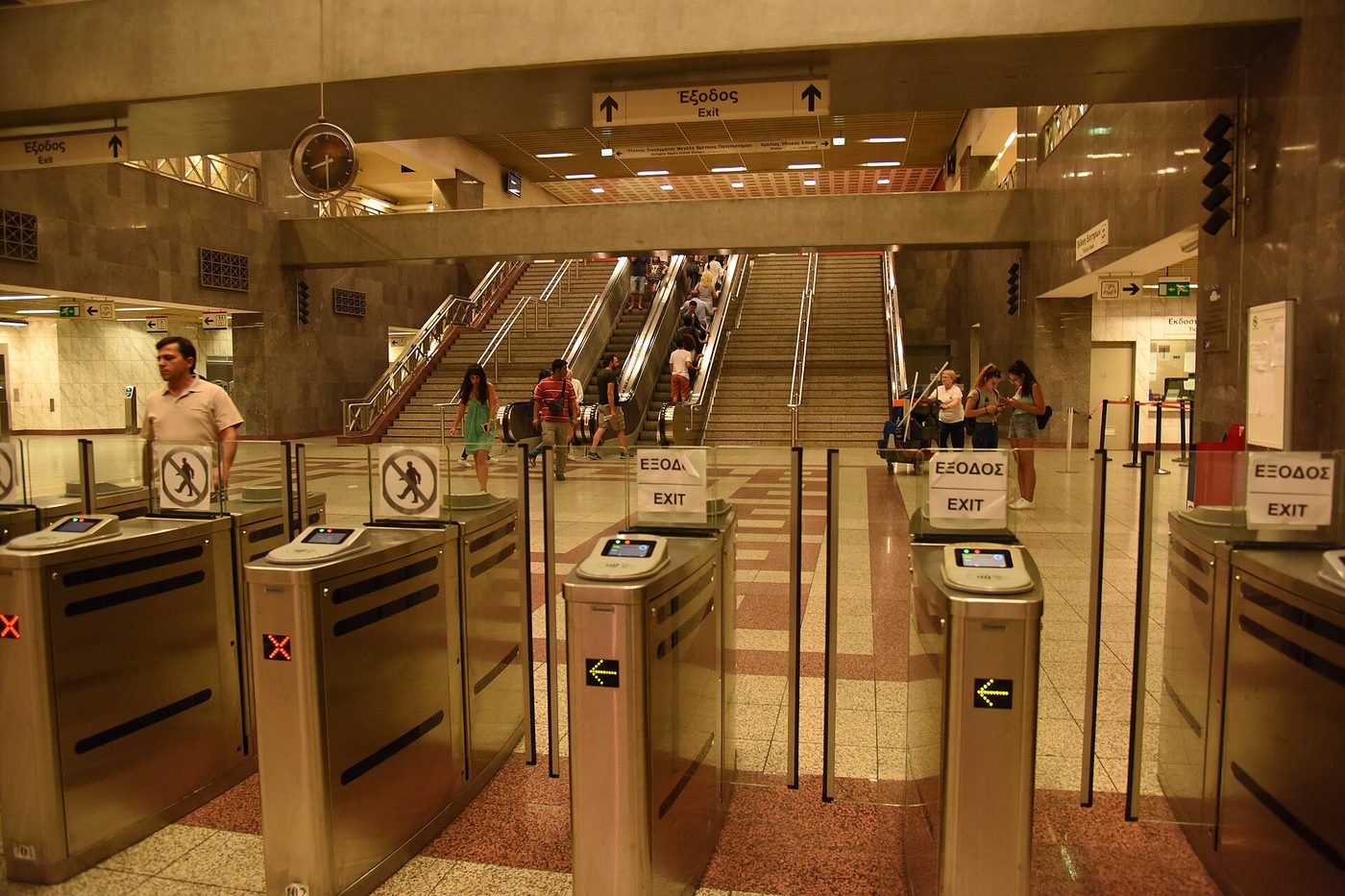
Free shuttle buses run around the port ring, and there is a stop near the metro station. Our Athens guide covers the city end of the journey. My rule is to be at Piraeus forty-five to sixty minutes before a sailing and thirty minutes at island ports, which matches what the operators advise. If you are taking a vehicle, make it ninety minutes, because vehicle loading closes thirty to forty-five minutes before departure.
Athens airport to the ports
| Route | How | Cost | Time | Notes |
|---|---|---|---|---|
| Airport to Piraeus | Metro Line 3 (blue), direct | EUR 9 one way | 60 to 70 minutes | Runs to Piraeus station, a short walk or shuttle from most gates |
| Airport to Piraeus | X96 express bus | EUR 5.50 (EUR 2.70 reduced) | About 90 minutes | Runs 24 hours, every 15 to 30 minutes; the only option on an early sailing |
| Airport to Rafina | KTEL Attikis bus | Commonly cited around EUR 4, sources quote EUR 3 to EUR 5.50 | 30 to 40 minutes | Roughly 04:30 to 22:30, every 30 to 60 minutes; boards near Exits 2 and 3 |
| Central Athens to Piraeus | Metro or taxi | Varies | 20 to 25 minutes | Useful if you overnight in the city before an early boat |
If you land after about 20:00 and have a morning ferry, sleep in Piraeus rather than central Athens. It is no beauty spot, but it removes the one variable that can wreck the whole trip.
Arriving at the island ports: the bit nobody photographs
Three things about island ports that will save you an afternoon.
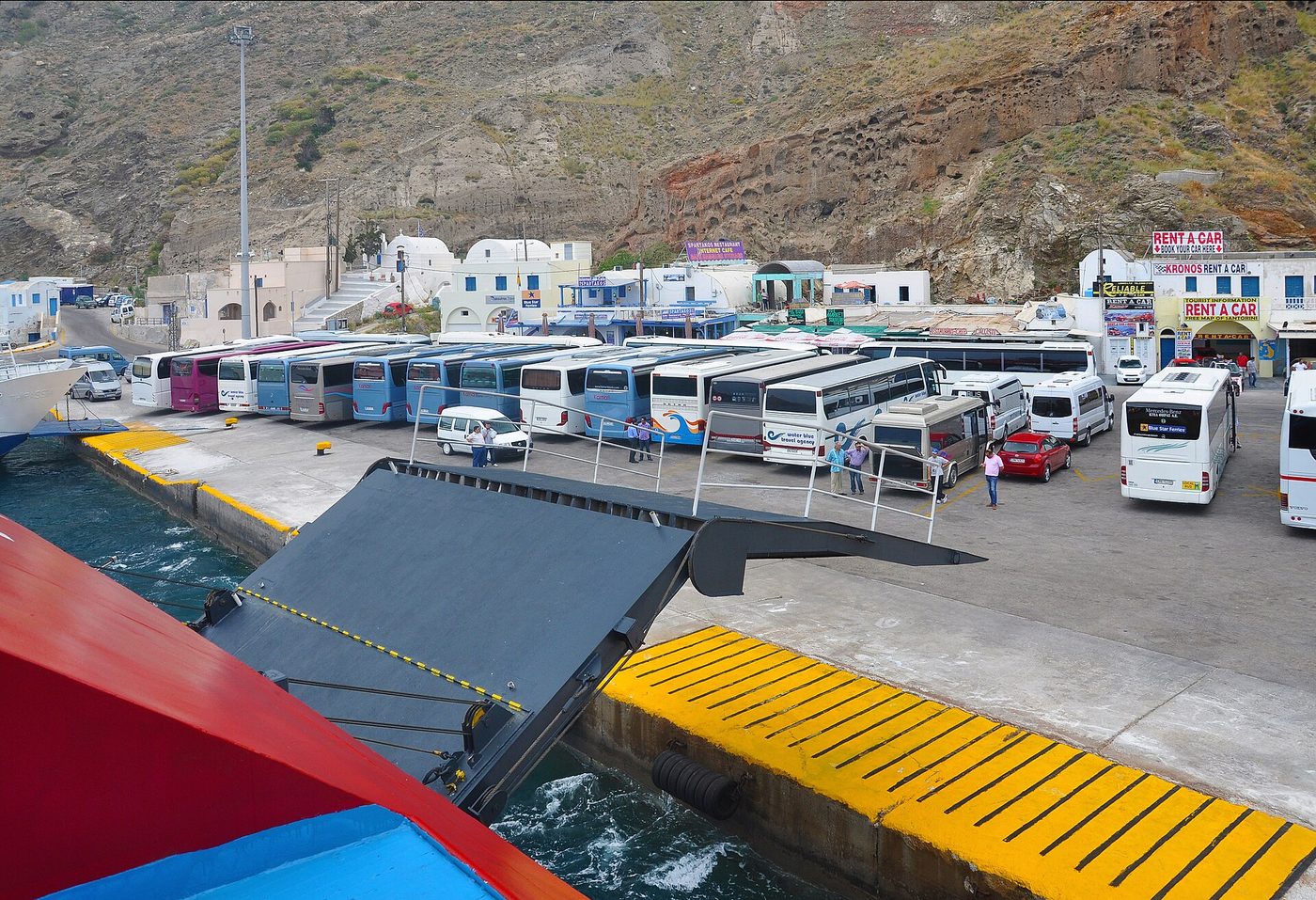
Santorini docks at Athinios, not below Oia. Athinios is a commercial ramp at the bottom of the caldera cliff with a switchback road above it, and it is chaos on arrival: coaches, hotel transfers and taxis all fighting for the same strip. Arrange a transfer in advance if you can, take the KTEL bus to Fira if you cannot, and do not expect a taxi rank. The cable car between Fira and the old port is for the caldera cruise boats, not the ferries, so it is no help getting off the Blue Star.
Mykonos has two ports and they are not walkable from each other. Almost all conventional and most high-speed ferries use the New Port at Tourlos, a couple of kilometres north of Chora. Some smaller boats and the Delos excursions use the Old Port in town. Check which one your ticket says before you book a taxi, and check it again for the return.
Plan your luggage around steps and cobbles. Cycladic towns are stairs, marble lanes and no lifts, vehicles are often banned inside them, and on Hydra there is no vehicle at all beyond a mule. A hard case with four wheels is the wrong bag for this trip. Larger ports and most island bus stations have paid left-luggage if you have a late boat and an early checkout.
Know what class you have bought. Deck or economy is a seat in a lounge or on the outside deck, and is what the lead-in fares in the table above refer to. Air seat or numbered seat is a reserved place, usually worth the small premium on a crossing over four hours. Business and VIP buy you a quieter lounge. Cabins exist only on the overnight sailings to Crete and the north Aegean, and they are the first thing to sell out.
Booking Greek ferries: schedules, lead times and refund rules
When the timetables come out
Operators publish official summer schedules between February and March. Some routes appear six to eight months ahead, others only a couple of months before travel, and Ionian timetables are notoriously late, sometimes weeks before the season starts. If you are planning a July trip in November, you can shape the route but you cannot lock the boats yet. Sketch the itinerary, book flights and the first and last night of accommodation, then come back in March.
How far ahead to book
For June to September, book at least one to two months ahead, and sooner for high-speed sailings. What sells out first, in order: high-speed catamarans, cabins on overnight crossings, and vehicle spaces. Large conventional ferries have far more capacity and are the last to fill. The specific sailings that vanish fastest are the Friday and Saturday Piraeus departures to Santorini and Mykonos, which can fill within weeks of the schedules opening.
Outside high season, buying at least twenty-four hours ahead is enough on most routes, but allow ten days around Easter, Christmas and New Year, when Greeks are travelling to their home islands and tourists are not the constraint.
Refunds and changes, which is where the money hides
These rules are the difference between a cancelled ferry costing you nothing and costing you the fare. Blue Star Ferries, whose conditions are the clearest published in Greek shipping, works on this ladder in high season:
| When you cancel | What you get back |
|---|---|
| 14 or more days before departure | Full refund, or convert to an open ticket |
| Fewer than 14 days, down to 7 days before | 75% refund, or convert to an open ticket |
| Fewer than 7 days, down to 12 hours before | 50% refund, or convert to an open ticket |
| Inside 12 hours, up to departure | 50% refund, no conversion |
| After departure | Nothing |
Two mechanics matter alongside that. Only the agency that issued your ticket can invalidate it, and it cannot be done by phone, so if you booked through a platform you cancel through that platform. And Blue Star open tickets are valid for two years from issue, with the fare difference payable if you travel on a dearer date, which makes conversion a genuinely useful option rather than a fob-off.
SeaJets does not publish an equivalent ladder in a form I could confirm on its own site, so I am not going to invent one. Read the conditions at the point of purchase for any SeaJets sailing, because it is the operator you are most likely to be booked on for the fast crossings and the one whose catamarans cancel most often.
What the booking platforms charge
| Platform | Booking fee | Cancellation fee | Change fee |
|---|---|---|---|
| Ferryhopper | None on ticket bookings | EUR 6 per booking, waived with FlexiCancel or Support Plus | EUR 6 per booking for support-handled changes, waived with the add-ons |
| Direct Ferries | Charged, calculated on booking value, shown only at the final step | GBP 10 / EUR 12 online, GBP 20 / EUR 25 offline | Fare difference plus GBP 10 / EUR 12, waived within 24 hours of booking |
| Ferryscanner | No fixed fee published; advertises the same price as booking direct | Free cancellation on most routes, shown per route at booking | Per route, shown at booking |
My practical advice: use an aggregator to find the sailing, because comparing five operators’ own sites is miserable, then decide where to buy based on how likely you are to change. If your dates are firm, buy wherever is cheapest. Our Europe travel tips collects the equivalent booking rules for trains, buses and flights. If there is any chance of a change, Ferryhopper’s flat EUR 6 is the cleanest of the three, and the free-cancellation routes on Ferryscanner are worth checking.
Download your e-tickets before you leave for the port. Most major Greek operators support them, but boarding procedure varies by operator and port wifi is not something to rely on.
What a Greek island hopping itinerary costs in 2026
Two taxes changed the arithmetic recently, so start here.
The Climate Crisis Resilience Fee
This replaced the old stayover tax and it is charged per room per night, not per person, and collected when you check out. Rates depend on the type of accommodation and the season, and they have been in force since 1 January 2025 with no announced change for 2026.
| Accommodation type | April to October | November to March |
|---|---|---|
| 1 to 2 star hotel | EUR 2 per night | EUR 0.50 per night |
| 3 star hotel | EUR 5 per night | EUR 1.50 per night |
| 4 star hotel | EUR 10 per night | EUR 3 per night |
| 5 star hotel | EUR 15 per night | EUR 4 per night |
| Furnished rooms and apartments | EUR 2 per night | EUR 0.50 per night |
| Short-term rentals (Airbnb type) | EUR 8 per night, or EUR 15 if a detached house over 80 sqm | EUR 2 per night, or EUR 4 if detached and over 80 sqm |
| Furnished tourist villas | EUR 15 per night | EUR 4 per night |
On a ten-day trip in a four-star hotel that is EUR 100 you had not budgeted for, and on a short-term rental it is EUR 80. It is small money in the scheme of a Greek holiday, but it is cash on departure and it surprises people.
The cruise passenger levy, and why it affects you even if you are not on a cruise
A cruise levy came into force on 21 July 2025 and continues through 2026, payable by every cruise passenger disembarking at a Greek port. From 1 June to 30 September it is EUR 20 per person at Mykonos and Santorini and EUR 5 elsewhere. In April, May and October it is EUR 12 at those two islands and EUR 3 elsewhere. From 1 November to 31 March it is EUR 4 and EUR 1.
The reason this matters to an independent traveller is what it sits alongside. Santorini has a hard cap of 8,000 cruise passengers a day, and for 2026 the occupancy assumption used to count a ship against that cap rose from 80 per cent to 100 per cent, so a 3,000-berth ship now consumes 3,000 of the 8,000 slots rather than 2,400. Scheduled cruise arrivals for 2026 are down 18.27 per cent on 2025, at 595 ships against 728. In plain terms, Santorini in 2026 has meaningfully fewer cruise-day crowds than it did, and the caldera path in the late morning is less of a scrum than it was two years ago.
Mykonos has the levy but no daily cap, and cruise calls there have grown by roughly sixteen to seventeen per cent despite it. So the crowd relief is a Santorini story, not a Cyclades one.
Daily budgets and what rooms actually cost
| Item | High season | Notes |
|---|---|---|
| Budget traveller, all in | EUR 65 to EUR 90 per day | Hostels or basic rooms, tavernas, conventional ferries |
| Mid-range traveller, all in | EUR 100 to EUR 200 per day | Accommodation, food and transport combined |
| Santorini and Mykonos rooms | EUR 150 to EUR 250 budget; EUR 200+ mid-range; EUR 300 to EUR 1,000+ luxury | The two most expensive islands in Greece |
| Paros and Naxos rooms | EUR 70 to EUR 120 mid-range | Roughly 40 to 60 per cent below Mykonos for comparable quality |
| Corfu rooms | EUR 50 to EUR 120 in town; EUR 120 to EUR 180 mid-range; EUR 250 to EUR 600+ beachfront | August is the dearest month |
| Hydra rooms | EUR 120 to EUR 350 | Boutique-heavy, no budget tier to speak of |
| Folegandros rooms | Commonly EUR 70 to EUR 200 | Small island, limited stock, and rates climb steeply in August |
| Mid-tier island rooms generally | EUR 40 to EUR 70 per room in peak season | Achievable on Naxos, Milos, Sifnos, Skopelos |
| Economy car rental | EUR 35 to EUR 55 per day | 7+ day rentals typically unlock 10 to 20 per cent off |
| ATV or quad | EUR 25 to EUR 50 per day | See the licence warning below |
| Scooter | EUR 15 to EUR 35 per day | Paros 50 to 125cc around EUR 35 a day, falling to about EUR 23 on a week |
| Ferry tickets | Under EUR 10 to around EUR 100 per person | Depends on distance, operator and vessel type |
The largest single lever on your budget is which islands you choose, not how you travel between them. Swapping Santorini and Mykonos for Naxos and Milos on a ten-day trip saves more than every ferry ticket you will buy. If cost is the main constraint, our Europe on a budget guide has the wider picture, and the Europe packing list will stop you buying things you already own.
The ATV and quad licence trap
Quad and ATV rental is everywhere in the Cyclades and the rules are genuinely murky. For the common 200 to 350cc tourist quads a full category B car licence is generally sufficient, because they are registered as light quadricycles rather than motorcycles. Quads under 125cc technically require an A1 motorcycle licence, which runs against every instinct you have. The requirement depends on engine size, power category and how the individual vehicle is registered, so it is not uniform across islands or operators.
What is uniform: a provisional licence is never accepted, for any engine size, on any island, with any operator. Non-EU visitors should carry an International Driving Permit alongside their national licence. The legal minimum age is 18 but most reputable operators want 23 or over with a year of licence held, especially on Santorini and Mykonos. Police checks do happen, notably on the Parikia to Naoussa road on Paros in August, and if you are driving outside your entitlement your rental insurance is void.
The meltemi, and what to do when your ferry is cancelled
The meltemi is a dry northerly wind that blows across the Aegean between June and September, strongest in July and August. It is the reason Greek island trips go wrong. It is also the reason the Cyclades are as clear and as bearable as they are in high summer, so it is not purely an enemy. See Europe weather by month for how the Aegean compares with the rest of the continent.
The Cyclades take the worst of it. Mykonos is literally the island of the winds, and Andros and Tinos are just as exposed, with Naxos and southern Crete also catching it. The Ionian barely feels it at all, which is one of the strongest arguments for that group if a cancelled boat would ruin your trip.
What gets cancelled follows a predictable order. Small high-speed vessels may stop from around Beaufort 7, a near gale of roughly 50 to 61 km per hour. Cancellations become common at Beaufort 8 and above, and most operators cancel from Beaufort 9. Large conventional ferries usually keep running when the catamarans do not, and SeaJets cancels more often than the others simply because its fleet is mostly catamarans. The most exposed leg on the popular routes is Santorini to Mykonos, which crosses the open central Cyclades and is delayed or cancelled at wind strengths well below those that stop the other sailings.
Six things that reduce the damage:
- Book the earliest sailing of the day. Wind typically builds through the afternoon, and an early boat that gets cancelled still leaves you later options.
- Prefer conventional ferries on any leg you cannot afford to lose. Particularly your last hop before a flight.
- Never take a ferry back to Athens on the day of an international flight. This is the rule I would tattoo on people. Overnight in Athens, or fly out from your last island.
- Build a slack day into any trip of ten days or more. Put it on the island you would least mind an extra night on.
- Route via Paros when you need optionality. More lines pass through it than anywhere else in the Aegean, so it has more escape routes.
- Watch September and October. Winds pick up considerably in the shoulder season, which is otherwise the best time to go. Do not book tight connections then. Our shoulder season Europe guide covers the trade-off.
If a sailing is cancelled by the operator you are entitled to a refund or a rebooking, but the practical outcome is that everyone on that boat is now competing for the same seats on the next one. Get on the phone or the app immediately rather than joining the queue at the port office.
Ferry or fly between the islands?
Flying looks tempting on paper and is usually the worse call. Direct flights between islands are limited and many of them route through Athens, which turns a two-hour ferry into a five-hour day. Within an island group the ferry is almost always the better answer.
Where flying earns its keep is at the ends of the trip. Fly into one end of your route and home from the other. Mykonos, Santorini, Heraklion, Chania, Rhodes, Corfu, Kos, Zakynthos, Skiathos and Kefalonia all take direct European flights in summer, roughly late April to late October, which makes open-jaw routing easy. Athens to Naxos is a useful exception at forty to forty-five minutes and roughly 147 weekly flights as of September 2026, flown by Aegean, Olympic Air and SKY express.
| Island | Airport | Direct international flights in summer? |
|---|---|---|
| Santorini | JTR | Yes |
| Mykonos | JMK | Yes |
| Crete (Heraklion / Chania) | HER / CHQ | Yes |
| Rhodes | RHO | Yes |
| Kos | KGS | Yes |
| Corfu | CFU | Yes |
| Zakynthos | ZTH | Yes |
| Kefalonia | EFL | Yes |
| Skiathos | JSI | Yes |
| Paros | PAS | No, domestic from Athens only |
| Naxos | JNX | No, domestic only, year-round from Athens |
| Milos | MLO | No, domestic only |
| Syros | JSY | No, domestic only |
| Astypalaia, Ikaria, Karpathos, Leros, Kalymnos, Chios | Various | No, domestic only from Athens or Thessaloniki |
One timing note if you are flying out. Allow around thirty-five to forty minutes from central Athens to the airport plus at least an hour for check-in, more in summer. Piraeus to central Athens is another twenty to twenty-five minutes on top. If trains rather than boats are your thing elsewhere in Europe, see train travel in Europe.
Do you need a car on each island?
Renting on every island is expensive and mostly unnecessary. Rental companies also vary on whether you may take their car on a ferry, and some prohibit it outright or require advance permission, so renting separately on each island is usually simpler than moving one car around.
| Island | Car worth it? | Why |
|---|---|---|
| Naxos | Yes | Big, mountainous, the best of it is inland |
| Milos | Yes | Beaches scattered around a wide coastline |
| Crete | Yes, essential | The size of a small country |
| Rhodes | Yes | Lindos and the west coast are a long way from the old town |
| Kos | Optional | Flat and excellent for cycling instead |
| Paxos | No | Three villages and one road; a scooter is plenty |
| Corfu, Kefalonia, Zakynthos | Yes | Ionian public transport is thin |
| Skopelos | Yes | Beaches and villages spread along one long road |
| Paros | Optional | Good bus network between the main towns |
| Santorini | No | Buses, taxis and tours cover it; parking in Oia is a nightmare |
| Mykonos | No | Buses and taxis to the beaches work fine |
| Folegandros | No | Small enough to walk and bus |
| Hydra | Impossible | No private cars exist on the island |
Swaps: if you like the famous one, try this instead
Every route above can be rebuilt cheaper or quieter with one substitution. These are the swaps I actually make.
| Instead of | Try | What you gain | What you give up |
|---|---|---|---|
| Mykonos | Paros | Similar Cycladic town in Naoussa, far better ferry connections, roughly 40 to 60 per cent less per room | The nightlife, and Delos on the doorstep |
| Santorini | Folegandros | The same cliff-edge drama with a fraction of the people, and very cheap ferry links | The caldera itself, and the restaurant scene |
| Santorini | Milos | Volcanic landscape, 70-plus beaches, better value | The sunset view everyone came for |
| Ios | Naxos | Better food, mountains, family-friendly, more to do beyond the beach | The party scene |
| Corfu | Paxos | Tiny, olive-covered, and connected up to thirteen times a day in summer | An airport, and Corfu Town’s Venetian core |
| Rhodes | Symi | The most beautiful harbour arrival in the Dodecanese | Beaches, and enough to fill four days |
| The Cyclades entirely | The Sporades | Pine forest, a marine park, five-minute hops, almost no crowds | The white-and-blue look |
| Any island trip in August | The same trip in June or late September | Full ferry schedules, warm sea, noticeably fewer people, lower rates | Guaranteed heat, and some late-season sailings |
Which route suits which traveller
- First time in Greece, one week: Route 2, the Classic Cyclades. Short hops, dense ferries, a good build.
- Honeymoon: Route 3, the Postcard Run, or Route 4 if you would rather be alone than photographed. Our Europe honeymoon guide has more.
- Families with young children: Route 7, the Ionian, or Route 8, the Sporades. Calmer water, shorter crossings, greener islands, and more shade. See Europe with kids.
- Solo travellers: Route 2 or Route 9. The Cyclades have the hostel infrastructure and the social scene; the western line does not. See solo travel in Europe.
- On a budget: Route 9 without Santorini, or Route 8. Conventional ferries, mid-tier islands, rooms at EUR 40 to EUR 70. Also read backpacking Europe and the best places to visit in Europe in summer.
- History and ruins: Route 6, the Dodecanese, or Route 5 for Knossos and Akrotiri in one trip.
- Walkers: Route 4. Milos and Folegandros both have real coastal paths, and the Fira to Oia caldera walk finishes the trip. See hiking in Europe.
- Five days or fewer: Route 1, the Saronic Sampler. It is the only one that works at that length.
- Second or third Greek trip: Route 4 or Route 8. Both are what people move on to once the Cyclades headline islands are done.
Nine mistakes that wreck Greek island trips
- Too many islands. The most common error by a distance. Each change costs most of a day. Three islands in ten days is a good trip; six is a logistics exercise.
- Ferrying to Athens on the day of your flight home. One cancellation and you have missed an intercontinental flight. Fly from your last island, or sleep in Athens the night before.
- Assuming a map distance means a ferry route. The Cyclades and the Saronic islands have no direct connections. Neither does Athens and the Ionian. The network is spokes, not a web.
- Going to the wrong Athens port. Piraeus, Rafina and Lavrio are an hour apart in traffic. Check the ticket the night before.
- Arriving at Piraeus twenty minutes before sailing. The gates are spread around a working commercial port. Give yourself forty-five to sixty minutes, or ninety with a vehicle.
- Booking the fastest catamaran on every leg. You pay several times the fare for an hour saved and take on far more cancellation risk.
- Planning island day trips. Greek ferry timetables are built for transport, not sightseeing, and the return sailing usually lands too late or not at all. There are three dependable exceptions and you will find them in the FAQ below.
- Turning up on a small island with no cash. Folegandros, Lipsi and Kasos may have a single ATM, and it can run out. Taxis often want cash anyway.
- Booking a July trip in November and expecting locked schedules. The timetables are not out yet. Shape the route, book the flights, return in March for the boats.
Entry rules for 2026
Two changes at the Schengen border affect non-EU travellers. The EU Entry/Exit System began a progressive rollout on 12 October 2025 and became fully operational on 10 April 2026. It registers your name, travel document, fingerprints, facial image and entry and exit at the external borders of 29 European countries, which in practice means a slower first crossing and faster subsequent ones. Member states may partially suspend it in exceptional circumstances at peak travel times later in 2026.
ETIAS, the pre-travel authorisation, is not yet live and, as of late September 2026, has no start date. It was pencilled in for the last quarter of 2026, but the EU’s official ETIAS pages now say only that the date will be announced several months before launch, and trade reports point to 2027. It is an authorisation, not a visa. Our Schengen visa and ETIAS guide tracks both, and the first-time Europe itinerary covers the rest of the paperwork.
I found no new-for-2026 Greek ferry regulation or port fee.
Greek island hopping itinerary FAQ
What is the best time for island hopping in Greece?
May to October, with June and September the two best months. You get warm water, full ferry schedules and noticeably fewer people than in August, which has the biggest crowds, the highest prices and the strongest meltemi. Sea temperatures peak at about 23 to 24 C in July and up to around 24.5 C in August, and stay comfortable into early October, which is what makes late September the value pick. See the best time to visit Greece for the month-by-month detail.
How many days do I need for a good island-hopping trip?
Ten days is the minimum for a trip that feels like hopping rather than commuting. Fourteen is the sweet spot at three to four nights per island. Five to seven days gets you two islands, eight to ten gets you two or three.
Which island group is best for first-timers?
The Cyclades, because the ferry density gives you room to recover from a cancellation. The Saronic islands are the best choice if you have fewer than five days.
Should I book ferries in advance or buy tickets at the port?
Book in advance for June to September, at least one to two months out for high-speed sailings, cabins and vehicle spaces. Outside high season, twenty-four hours is usually enough, but allow ten days around Easter, Christmas and New Year.
When do Greek ferry schedules come out?
Operators publish official summer schedules between February and March. Some routes appear six to eight months ahead; Ionian timetables often only weeks before the season.
Is it better to fly between Greek islands or take the ferry?
Ferry, within a group. Inter-island flights are limited and many require an Athens connection, which costs more time than it saves. Use flights at the two ends of your trip to avoid backtracking.
Should I start in Athens or fly directly to an island?
Fly direct to an island if your route ends somewhere with its own international airport, because that saves two travel days. Start in Athens if you want the Acropolis, if you are heading for the western Cyclades or the Saronic, or if your flights are cheaper that way.
How much do Greek ferry tickets cost?
Anything from under EUR 10 on a short conventional hop to around EUR 100 on a long high-speed crossing. As a rough guide: Piraeus to Paros from about EUR 35, Piraeus to Santorini from about EUR 46, Naxos to Santorini from about EUR 31.50, and Paros to Naxos from EUR 5.50 in the cheapest class.
Are high-speed ferries worth the extra cost?
Sometimes. On Santorini to Heraklion you pay roughly EUR 92 instead of about EUR 15 to save around ninety minutes, which is poor value. On Piraeus to Santorini, where the spread is four hours fifty against eleven hours thirty, it can be worth it. Weigh the saving against the higher cancellation risk in windy weather.
What happens if my ferry is cancelled because of wind?
You are entitled to a refund or rebooking, but so is everyone else on that sailing, so act immediately through the app or the operator rather than queuing at the port. Small high-speed vessels stop from around Beaufort 7 and most operators cancel from Beaufort 9. Large conventional ferries usually keep running.
Do I need a rental car on every island?
No. Naxos, Milos, Crete, Rhodes, Skopelos and the larger Ionian islands reward one. Santorini, Mykonos, Paros, Paxos and Folegandros work fine without, and Kos is better on a bike than in a car. Hydra has no cars at all.
Can I take a rental car on the ferry?
Sometimes, but rental company rules vary and some prohibit it or require advance permission. Renting separately on each island is usually easier and often cheaper than paying vehicle fares. Piraeus to Crete vehicle fares start around EUR 85 for a car and about EUR 28 for a motorcycle, which gives you a sense of the cost.
Can I island hop with young children?
Yes, and the Ionian and the Sporades are the groups to pick. Calmer water, shorter crossings and greener islands with shade. Avoid the exposed central Cyclades catamaran legs in July and August.
Which Greek island is best for families?
Naxos in the Cyclades, for the shallow west-coast beaches and the size of the island. Kefalonia in the Ionian and Skopelos in the Sporades are the equivalents in their groups.
Which is prettier, Naxos or Paros?
Paros has the prettier town, in Naoussa. Naxos has the better island: mountains, farmland, ancient marble and the strongest beaches. If you have two nights, take Paros. If you have four, take Naxos.
Is Mykonos or Santorini better?
Different trips. Santorini is a landscape you look at, with the caldera, the Akrotiri excavation and the volcanic islets. Mykonos is a place you go out in, with better beaches, a livelier town and Delos twenty minutes offshore. If you can only take one and you are not there for nightlife, take Santorini.
Which Greek island is the least touristy?
Of the islands in this guide, Alonissos and Folegandros. Both are small, both have a single main settlement, and neither has an airport. Alonissos also sits inside the largest marine protected area in Europe.
Which Greek island do you not need a car on?
Hydra is the extreme case, since private cars do not exist there and goods move by mule and water taxi. Santorini, Mykonos, Folegandros, Paxos and Paros all have workable buses, taxis or short enough distances to walk.
What is the cheapest way to island hop around Greece?
Conventional ferries rather than catamarans, mid-tier islands rather than Santorini and Mykonos, rooms in the EUR 40 to EUR 70 band, and June or late September rather than August. That combination brings a budget trip in at roughly EUR 65 to EUR 90 a day all in.
Can I visit several islands as day trips from one base?
Mostly no. Greek ferry timetables are built for transport, not sightseeing, and the return sailing rarely works. The reliable exceptions are Delos from Mykonos, Antiparos from Paros, and Hydra or Aegina from Athens.
What is the biggest mistake first-time visitors make?
Booking too many islands, then booking a ferry back to Athens on the day of the flight home. The first ruins the pace of the trip and the second can cost you the flight.
How much money should I save for two weeks in Greece?
On a mid-range budget of EUR 100 to EUR 200 a day, a fortnight runs roughly EUR 1,400 to EUR 2,800 per person on the ground, before flights. A budget trip at EUR 65 to EUR 90 a day comes in around EUR 910 to EUR 1,260. Add the accommodation tax at EUR 2 to EUR 15 per room per night, and ferry tickets on top if you are using high-speed crossings.

Final thoughts
The best Greek island hopping itinerary is almost always shorter than the one you first sketch. Pick one group. Take three islands if you have ten days, four if you have fourteen. Put the famous island last, not first, so the trip builds. Book the early boat, prefer the slow one on the legs that matter, and leave a day of slack somewhere you would not mind being stuck.
If you would rather widen the net beyond the islands first, our roundup of the top places to visit in Greece covers the mainland sites too. Do that and the ferries stop being the stressful part of the trip and become the good part: standing on the back deck with a coffee at seven in the morning, watching a bare brown island get slowly bigger, with the whole day ahead of you. That is the thing people come back for, and no timetable can schedule it.
If Greece is one leg of a longer trip, our Italy and Greece itinerary joins the two, and the best Mediterranean destinations guide sets Greece against its neighbours. For a wider shortlist, try the best places to visit in Europe and the best countries to visit in Europe.
Hannah Brooks has spent fifteen years travelling, living and writing across Europe, from the Arctic tip of Norway to the south of Sicily. She has planned hundreds of European itineraries for readers and is Senior Europe Editor at EuropeanTourism.org.
Photo credits
All photographs are used under the licences shown. Thank you to the photographers.
- Photo: Jean Housen / CC BY-SA 4.0 via Wikimedia Commons · source
- Photo: moustakik (CC0) via Wikimedia Commons · source
- Photo: Jebulon (CC0) via Wikimedia Commons · source
- Photo: Giles Laurent / CC BY-SA 4.0 via Wikimedia Commons · source
- Photo: Warren LeMay from Chicago, IL, United States / CC BY-SA 2.0 via Wikimedia Commons · source
- Photo: dronepicr / CC BY 2.0 via Wikimedia Commons · source
- Photo: Lapplaender / Wikimedia Commons (CC BY-SA 3.0 de) · source
- Photo: Nikolay Gromin from Moscow, Russia / CC BY 2.0 via Wikimedia Commons · source
- Photo: Dietmar Rabich / CC BY-SA 4.0 via Wikimedia Commons · source
- Photo: Dan Taylor from London, UK / CC BY 2.0 via Wikimedia Commons · source
- Photo: kallerna / CC BY-SA 4.0 via Wikimedia Commons · source
- Photo: Benoît Prieur (CC0) via Wikimedia Commons · source
- Photo: Rakoon (CC0) via Wikimedia Commons · source
- Photo: Moonik / CC BY-SA 3.0 via Wikimedia Commons · source
- Photo: Klearchos Kapoutsis / CC BY 2.0 via Wikimedia Commons · source
- Photo: Luke Jones / CC BY 2.0 via Wikimedia Commons · source
- Photo: dronepicr / Wikimedia Commons (CC BY 2.0) · source
- Photo: trolvag / CC BY-SA 3.0 via Wikimedia Commons · source