Things to Do in Florence
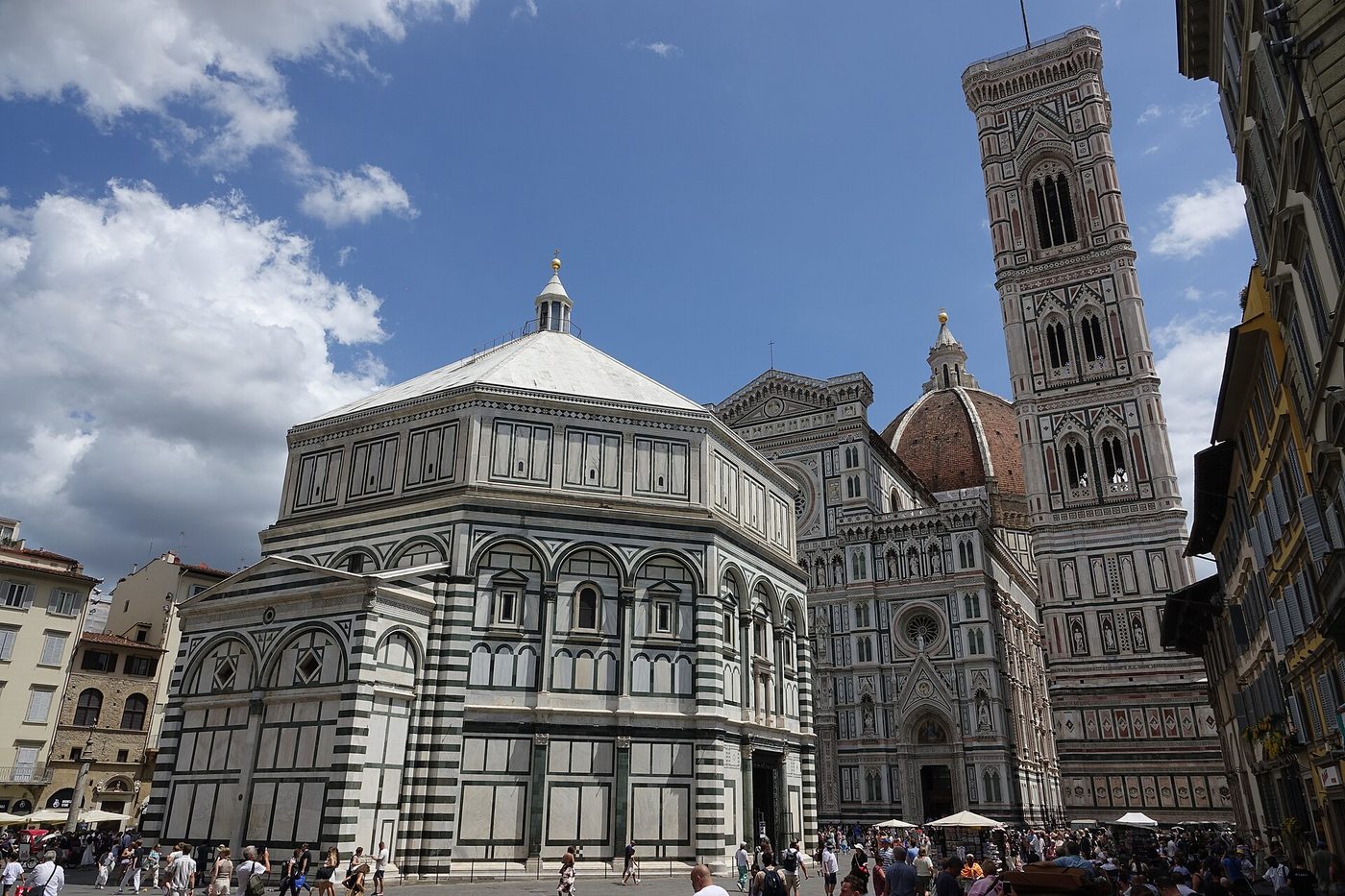
The first time I climbed out of the stairwell onto the lantern of Brunelleschi’s Dome, I was too out of breath to say anything sensible, so I just laughed. Florence is small, and the best things to do in Florence are packed into a centre you can cross on foot. From up there you can see the whole of it, terracotta roof after terracotta roof, hemmed in by green hills, the Arno sliding through the middle of it like a lazy afterthought. You can walk from one side of the historic centre to the other in twenty-five minutes. And into that tiny space the fifteenth century poured more art than most countries manage in a millennium.
That list runs from Brunelleschi’s Dome and the Uffizi to a five euro lampredotto sandwich eaten standing up at a cart, and the city rewards a plan far more than it rewards wandering. Book the Dome and the Uffizi weeks ahead, know which museums close on which day, and Florence unfolds. Turn up without a plan in July and you will spend your holiday in a queue.
I have been coming here for fifteen years, first as a student on a shoestring, later with a notebook and a press pass, most recently with two friends who had never been and wanted to see everything in three days. That last trip is the one that taught me the most, because it forced me to be honest about what actually earns its place. What follows is that list, checked against the operators’ own 2026 ticket pages in August 2026, because a shocking number of Florence guides are still quoting prices from 2023 and telling you the cathedral is open on Sundays. It is not.
A quick note on scope. This covers Florence itself, plus the day trips that genuinely work by public transport. If you want the wider region, our Tuscany travel guide handles the hill towns and the wine country, and the Italy travel guide puts Florence in the context of a longer trip.
All 44 of the best things to do in Florence at a glance
Every entry below is covered in full further down. Prices are the 2026 adult rates taken from the operators themselves, and I have said plainly where a figure could not be pinned down. Times are how long the visit realistically takes, not the optimistic figure on the ticket page.
| # | What | Where | Adult cost | Time | Booking | When to go |
|---|---|---|---|---|---|---|
| 1 | Step inside Florence Cathedral | Duomo | Free | 30 min | No booking | Mon-Sat, first hour |
| 2 | Climb Brunelleschi’s Dome | Duomo | Brunelleschi Pass, EUR 30 | 45 min | Timed slot, weeks ahead | First slot of the day |
| 3 | Climb Giotto’s Bell Tower | Duomo | Brunelleschi or Giotto Pass | 45 min | Slot only on Giotto Pass | Late afternoon |
| 4 | The Baptistery of San Giovanni | Duomo | Any Duomo pass | 30 min | Included | Early morning |
| 5 | Museo dell’Opera del Duomo | Duomo | Any Duomo pass | 90 min | Included | Rainy afternoon |
| 6 | The Uffizi Gallery | Piazza della Signoria | EUR 25 same-day, EUR 29 advance | 3 hr | Yes, essential | 8:15 a.m. or after 4 p.m. |
| 7 | The Accademia Gallery and Michelangelo’s David | San Marco | EUR 16 plus EUR 4 booking | 1 hr | Yes, essential | 8:15 a.m. |
| 8 | Museo di San Marco | San Marco | EUR 11 | 1 hr | No | Morning only, shuts 1:50 p.m. |
| 9 | Palazzo Pitti | Oltrarno | EUR 16 same-day, EUR 19 advance | 2 hr | Recommended | Weekday morning |
| 10 | The Bargello National Museum | Santa Croce | EUR 12 | 90 min | Rarely needed | Any morning |
| 11 | Palazzo Vecchio museum | Piazza della Signoria | EUR 18 | 90 min | Yes, online | Late afternoon |
| 12 | Climb the Arnolfo Tower | Piazza della Signoria | EUR 20 | 45 min | Yes, online | Late morning, never in rain |
| 13 | Museo Galileo | Riverfront | EUR 14 | 90 min | No | A Monday, when others shut |
| 14 | Basilica di Santa Croce | Santa Croce | EUR 10 | 1 hr | No | Weekday morning |
| 15 | Santa Maria Novella | Station district | From EUR 8 | 1 hr | No | On arrival day |
| 16 | Basilica di San Lorenzo | San Lorenzo | EUR 10 | 1 hr | No | Mon-Sat morning |
| 17 | The Medici Chapels | San Lorenzo | Check on the day | 1 hr | No | Mid-morning |
| 18 | Biblioteca Medicea Laurenziana | San Lorenzo | EUR 9 | 30 min | No | Wed-Fri afternoon |
| 19 | The Brancacci Chapel | Oltrarno | From EUR 11 | 45 min | Yes, compulsory | Any slot you can get |
| 20 | San Miniato al Monte | Above the Arno | Free | 1 hr | No | 6:30 p.m. for vespers |
| 21 | Piazza della Signoria and the Loggia dei Lanzi | Piazza della Signoria | Free | 45 min | No | After 9 p.m. |
| 22 | Orsanmichele | City centre | EUR 10 | 45 min | No | Tue-Sat, any time |
| 23 | Ponte Vecchio | Riverfront | Free | 20 min | No | Sunrise |
| 24 | The Vasari Corridor | Riverfront | EUR 43 with the Uffizi | 1 hr | Yes | Friday evening |
| 25 | Piazza della Repubblica and its carousel | City centre | Free, EUR 2 a ride | 20 min | No | After dark |
| 26 | Palazzo Medici Riccardi | San Lorenzo | EUR 15 | 1 hr | Groups of 8+ only | Any weekday |
| 27 | Museo di Palazzo Davanzati | City centre | EUR 8 | 1 hr | Advisable, tiny cap | Opening time |
| 28 | Boboli Gardens | Oltrarno | EUR 10 same-day, EUR 13 advance | 2 hr | No | Early or late, not noon |
| 29 | Bardini Garden | Oltrarno | EUR 10, or EUR 15 with Boboli | 1 hr | No | Late April for wisteria |
| 30 | Piazzale Michelangelo | Above the Arno | Free | 1 hr | No | 45 min before sunset |
| 31 | Giardino delle Rose | Above the Arno | Free | 45 min | No | May and June |
| 32 | Fiesole | Hills, 20 min by bus | Bus EUR 2.00 | 3-4 hr | No | Late afternoon |
| 33 | Bistecca alla fiorentina | Citywide | About EUR 50 a kilo | 2 hr | Yes, at good places | Dinner, shared |
| 34 | A lampredotto panino | Citywide | EUR 5-6 | 15 min | No | Lunchtime |
| 35 | A proper gelato crawl | Citywide | EUR 2.50-4.50 a cup | 1 hr | No | After dinner |
| 36 | Mercato Centrale | San Lorenzo | Free to browse | 1 hr | No | Before 10 a.m. |
| 37 | Mercato di Sant’Ambrogio | Sant’Ambrogio | Free to browse | 1 hr | No | Weekday morning |
| 38 | A glass of Chianti in a vinaio | Citywide | EUR 5-8 a glass | 1 hr | No | 6 p.m. onwards |
| 39 | Piazza Santo Spirito | Oltrarno | Free | 1 hr | No | Evening |
| 40 | The artisan workshops of the Oltrarno | Oltrarno | Free to look | 2 hr | No | Tue-Fri, working hours |
| 41 | Officina Profumo-Farmaceutica di Santa Maria Novella | Station district | Free to enter | 30 min | No | Any day |
| 42 | Museo Novecento | Station district | From EUR 8 | 1 hr | No | Not Thursday |
| 43 | A Florentine cooking class or market tour | Varies | EUR 60-120 | 4 hr | Yes | Morning start |
| 44 | The Arno at dawn | Riverfront | Free | 1 hr | No | Before 7 a.m. |
How long do you need in Florence?
Two full days is the minimum that does not feel like a smash and grab. Three is the sweet spot. Four lets you add Siena or Lucca without resenting it.
The arithmetic goes like this. The Uffizi takes three hours if you are moving briskly and six if you are the kind of person who reads the wall text. The Accademia takes one. The Duomo complex, if you climb both the Dome and the Bell Tower and do the museum properly, eats the better part of a day. That is already two days gone and you have not sat down in a piazza yet, which is the single best thing about Florence and free.
My honest recommendation: three nights, four days on the ground, with one of those days spent outside the city. Florence is intense. The centre is roughly five square kilometres and something like 95% of the city’s tourism is squeezed into it, so by the third afternoon you will want a hill, a garden, or a train.
The best time to visit Florence, month by month
Florence sits inland in a river valley with hills on three sides, which is lovely in April and brutal in August. The city is regularly among the hottest in Italy. Every summer brings days of 36 to 38°C and occasionally 40°C, and the record, set in July 1983, is 42.5°C. There is very little shade in the centre and a great deal of stone, which holds the heat until midnight.
| Month | Avg high | Rainfall | Crowds | My verdict |
|---|---|---|---|---|
| January | 11.2°C | 60 mm | Lowest | Cold and grey, but you will have the Bargello to yourself |
| February | 12.7°C | 65 mm | Low | Underrated. Cheap hotels, short museum queues |
| March | 16.3°C | 65 mm | Building | Good. Wisteria not out yet, gardens still bare |
| April | 20.0°C | 85 mm | Very high | Beautiful and busy. April was one of the two peak months in 2025 |
| May | 24.5°C | 70 mm | Very high | The best light of the year, and the biggest crowds |
| June | 29.1°C | 55 mm | High | Hot by mid-month. Start at 8 a.m. and stop at 1 p.m. |
| July | 32.3°C | 35 mm | High | Punishing. Driest month, and the only month that dipped in 2025 |
| August | 32.6°C | 55 mm | High | Hottest month. Many artisan workshops shut for ferragosto |
| September | 27.1°C | 80 mm | High | My favourite. Warm evenings, softening light, harvest in the hills |
| October | 21.6°C | 105 mm | Moderate | Lovely, but pack a jacket and expect nine wet days |
| November | 15.7°C | 115 mm | Low | Wettest month and only three hours of sun a day |
| December | 11.5°C | 80 mm | Low, spikes at Christmas | Atmospheric, and the museums are blissfully quiet |
Climate figures are the 1991 to 2020 normals. If summer is your only window, our guide to the best places to visit in Europe in summer has cooler alternatives, and the winter list covers the other end of the year. If you want one answer: go in the second half of September. The heat has broken, the school groups have gone, and the evening light on the Arno is the reason people paint this city. Mid-April to mid-June is the other window, though you are sharing it with everyone else, since Florence recorded 9.7 million overnight stays in the first ten months of 2025, with arrivals up 7.1% and stays up 8.5%, and April and May were the peak.
For how Florence fits into a wider seasonal plan, see our guide to the best time to visit Europe.
The Duomo complex: five monuments, one ticket
Start here, because the Duomo complex is the one part of Florence that punishes improvisation hardest. It is run by the Opera di Santa Maria del Fiore, a private foundation, not the state, which has three consequences: it is not covered by the Firenze Card, it does not take part in the free-entry Sundays that the state museums do, and it has its own ticketing system that confuses almost everyone on their first visit.
There are three passes. All are valid for three calendar days from midnight on the date you select, and each monument can be entered once.
| Pass | Adult | Age 7-14 | Dome | Bell Tower | Museum | Baptistery | Santa Reparata |
|---|---|---|---|---|---|---|---|
| Brunelleschi Pass | EUR 30 | EUR 12 | Yes | Yes | Yes | Yes | Yes |
| Giotto Pass | EUR 20 | EUR 7 | No | Yes | Yes | Yes | Yes |
| Ghiberti Pass | EUR 15 | EUR 5 | No | No | Yes | Yes | Yes |
Under-sevens go free on all three. There is also an on-site-only Ghiberti variant at the same EUR 15 that covers just the museum and Baptistery, sold at the ticket office and not online, and students of any level, Italian or foreign, can buy a Ghiberti Pass for EUR 5 at the ticket office. That last one is quietly the best deal in Florence, so bring a student card if you have one.
Two rules catch people out every single day. Ticket holders must leave suitcases, backpacks, parcels and medium or large bags at the free luggage storage at Piazza Duomo 38/r before entering any monument, and there is a dress code: no flip-flops, no bare shoulders, nothing above the knee. The Baptistery additionally bars sandals and hats.
1. Step inside Florence Cathedral
Entry to the cathedral nave is free. No ticket, no reservation, nothing to book. What there is instead is a very specific window: Monday to Saturday, 10:15 a.m. to 3:45 p.m., and closed on Sundays and religious celebrations for worship. I have watched dozens of people arrive on a Sunday morning expecting to walk in, and it costs them the whole morning.
The interior is deliberately austere after the polychrome marble outside, which is the point. Look up into the dome for Vasari’s Last Judgement, look down for the marble floor, and find Paolo Uccello’s fresco of the English mercenary Sir John Hawkwood, painted to look like an equestrian statue because the city had promised him one and then thought better of the expense. That is Florence in a single anecdote.
Go in the first fifteen minutes after opening. By eleven the nave is a slow-moving river of people.
2. Climb Brunelleschi’s Dome

Four hundred and sixty-three steps, no lift, and a stretch near the top where you walk between the inner and outer shells of the dome on a staircase that curves with the masonry and forces taller people to duck. The count of 463 is confirmed on the Opera’s own page. The visit takes about forty-five minutes and enters through the Porta della Mandorla on the north side of the cathedral, not the main west door.
The rules are strict and worth memorising. The Dome time slot is compulsory, it must fall on the first day of your pass, and once issued it cannot be changed or cancelled. You get five minutes’ grace on the start time and that is all. Since 1 March 2025 you must show an identity document alongside the ticket. It is not advised for anyone with a heart condition, vertigo, claustrophobia, or who is pregnant, and under-eighteens must climb with an adult.
Slots sell out weeks and sometimes months ahead. Book two to three weeks out as an absolute minimum, and further for summer. Opening is Monday to Friday 8:15 a.m. to 6:45 p.m. for the last slot, Saturday to 4:30 p.m., and Sundays and public holidays 12:45 p.m. to 4:30 p.m. only. Note the maintenance closure: the Dome is closed 16 to 20 November 2026.
Take the first slot of the day if you can get it. The stairwell is narrow, there is no way past a slow group, and it gets very hot by mid-morning.
3. Climb Giotto’s Bell Tower
414 steps, also no lift, and here is the argument I make to everyone: if you only climb one thing, climb the Bell Tower rather than the Dome. From the Dome you get a magnificent view that does not contain the Dome. From the campanile you get the Dome itself, filling half the frame, which is the photograph you actually came for. Do both if you have the legs.
A useful quirk: Brunelleschi Pass holders need no time slot for the Bell Tower and can walk up whenever they like within the three days. Giotto Pass holders must use their booked slot. The tower opens daily, 8:15 a.m. to 6:45 p.m. for the last entry. A major restoration is under way and the top terrace stays open, though views may be partly reduced by works. It closes 9 to 13 November 2026.
4. The Baptistery of San Giovanni
The oldest building on the square and, for my money, the most moving. Thirteenth-century mosaics cover the vault, including a Christ in Judgement with a hell scene that will lodge in your head for days. One caveat you need before you go: the vault mosaics are currently not visible because of restoration. If the mosaics are your reason for going, check the Opera’s notices page before booking a pass.
The doors are outside and free to look at. What you see on the east side facing the cathedral are copies of Ghiberti’s Gates of Paradise; the originals are inside the Museo dell’Opera, restored and displayed in a controlled atmosphere. Open daily 8:30 a.m. to 7:30 p.m., closing at 1:30 p.m. on the first Sunday of the month.
5. Museo dell’Opera del Duomo
The most underrated museum in Florence, included in all three passes, so most people who have paid for it never go. Twenty-eight rooms over three floors, about ninety minutes, and it holds Ghiberti’s original Gates of Paradise, Donatello’s harrowing wooden Mary Magdalene, and Michelangelo’s unfinished Bandini Pieta, the one he attacked with a hammer in his seventies. There is also a full-scale reconstruction of the cathedral’s original medieval facade, which was dismantled in 1587 and survives nowhere else.
The trap: it is closed every first Tuesday of the month. Otherwise daily, 8:30 a.m. to 7:00 p.m. There is no standalone adult ticket, so access is only through one of the three passes. If it rains, this is where you go.
The great museums of Florence
6. The Uffizi Gallery
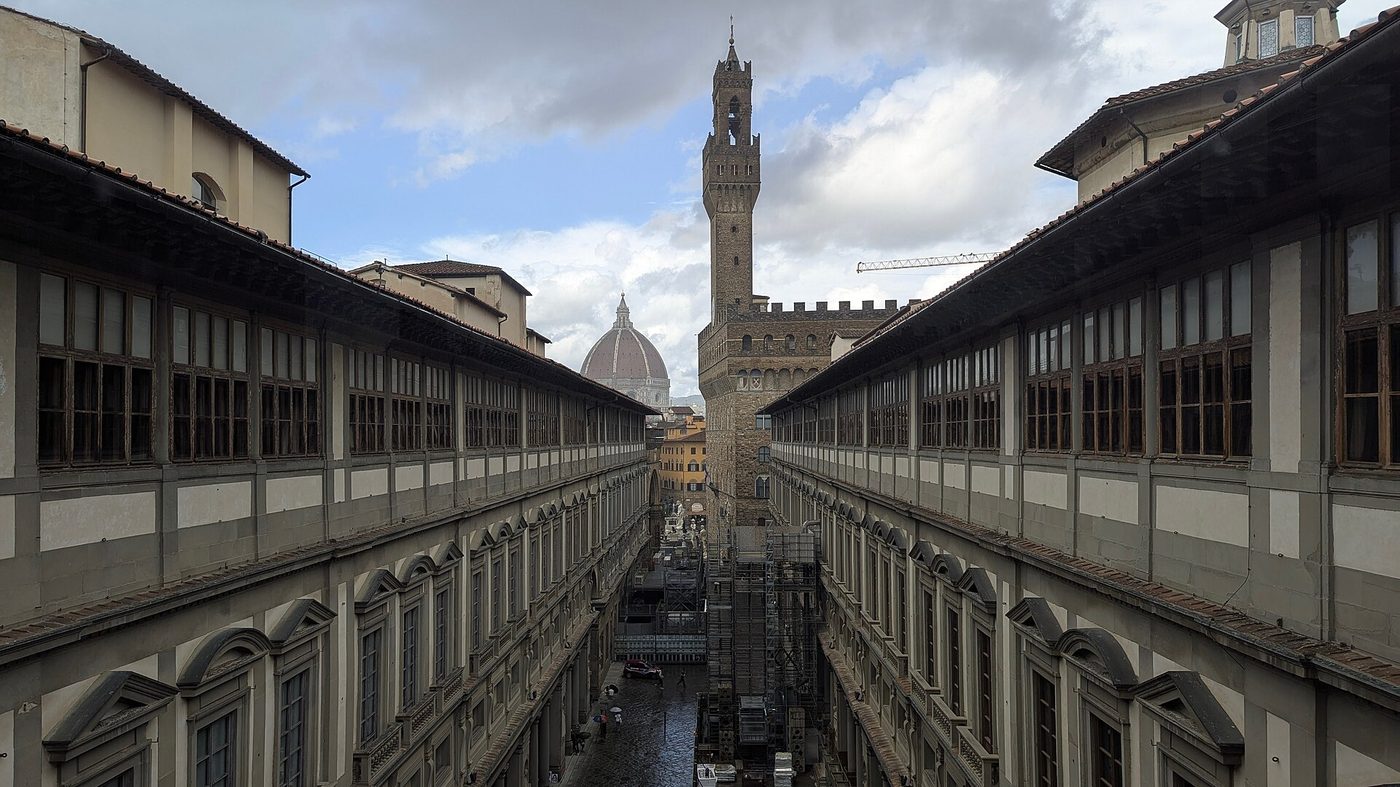
Vasari built it as offices for the Medici administration, which is what uffizi means, and it now sits second only to the Colosseum among Italy’s most-visited attractions: the Gallerie degli Uffizi, a group that also counts Palazzo Pitti and the Boboli Gardens, drew 5.3 million visitors in 2024. Botticelli’s Birth of Venus and Primavera are here, along with Leonardo’s Annunciation, Michelangelo’s Doni Tondo, Caravaggio’s Medusa and Titian’s Venus of Urbino. Room after room of the actual canon.
The 2026 pricing has changed and almost nothing online reflects it. There is no high season and low season adult rate any more. The split is by when you buy:
- EUR 25 if you buy on the day of entry
- EUR 29 if you buy in advance of the entry date
- EUR 16 for entry from 4:00 p.m. onwards, new from 1 January 2026
- EUR 2 reduced for EU citizens aged 18 to 25
That afternoon fare is the single most useful thing in this article for anyone travelling on a budget. Sixteen euros, and the gallery closes at 6:30 p.m. with the ticket office shutting at 5:30 p.m., so you get roughly two and a half hours. That is enough for the Botticelli rooms, the Leonardos and the Caravaggios if you skip the long corridor of Roman statuary. It is also the emptiest the Uffizi ever gets during opening hours.
Hours are Tuesday to Sunday, 8:15 a.m. to 6:30 p.m., closed Mondays, 1 January and 25 December. An audioguide is EUR 6. Groups of eleven or more pay a EUR 70 surcharge, groups cap at sixteen people, and whisper headsets are compulsory from six people up.
Two combination tickets are worth knowing. The PassePartout 5 Days at EUR 40 covers the Uffizi, Palazzo Pitti and the Boboli Gardens across five consecutive days, and stretches to a sixth day if those five include a Monday, 25 December or 1 January. You book your Uffizi slot at purchase because it must be the first museum you visit. With the Vasari Corridor added it is EUR 58. If you are seeing all three, it saves real money against buying separately.
If you are here on the first Sunday of the month, the Domenica al Museo scheme still runs in 2026 and gives free admission to all state museums. That covers the Uffizi, the Accademia, Pitti and Boboli, the Bargello, the Medici Chapels, Palazzo Davanzati, San Marco, the Opificio delle Pietre Dure and Casa Martelli. There is no reservation and no priority access on those days except for visitors with disabilities, their companions and pregnant women, so it is free but you queue. How that trade lands depends on what your morning is worth to you. On a July first Sunday, mine is worth EUR 25.
7. The Accademia Gallery and Michelangelo’s David
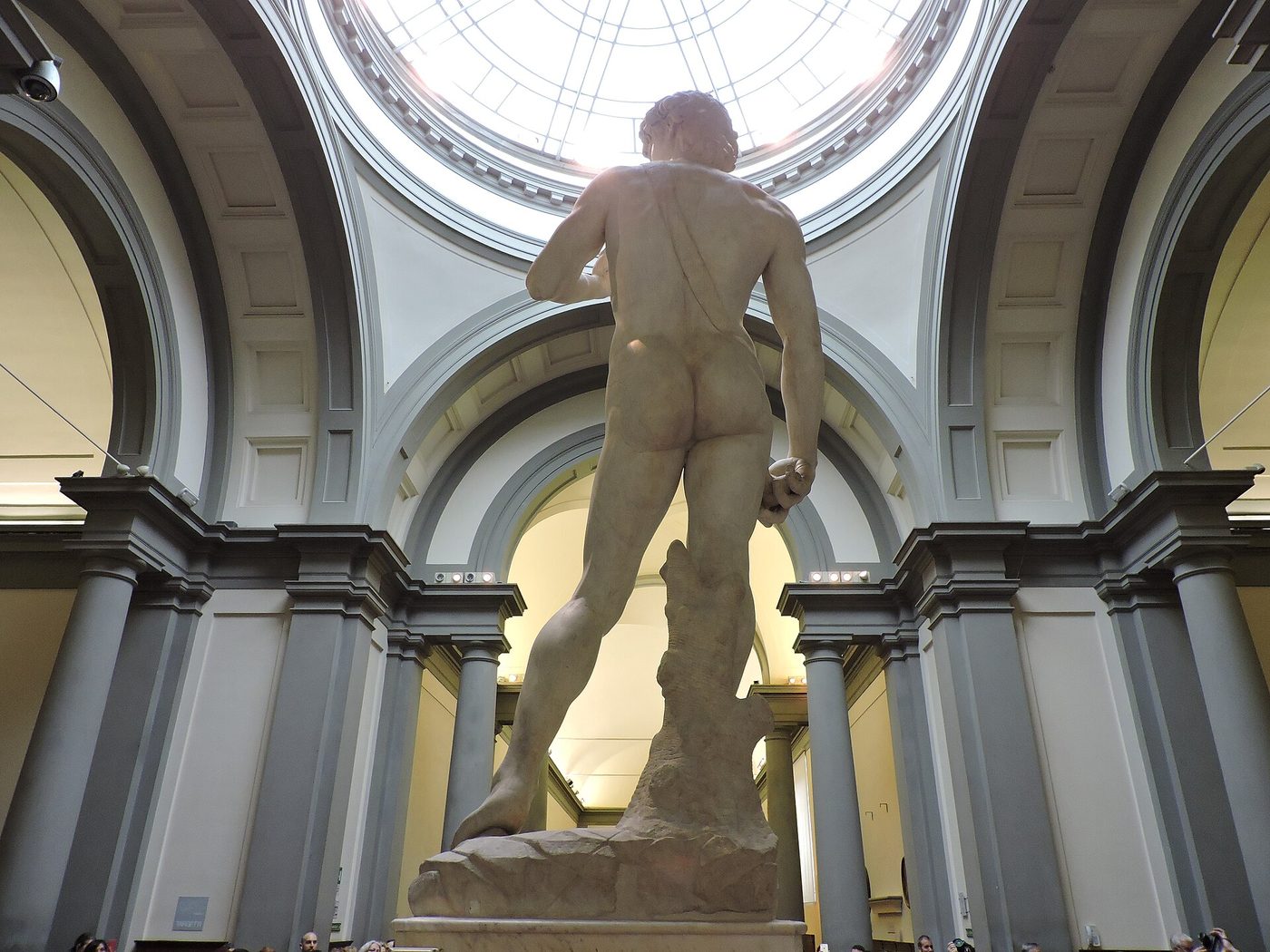
People are sniffy about the Accademia because it is one famous statue and a fairly modest collection around it. They are wrong, and I say that as someone who was sniffy about it for years. The approach matters: you walk up a corridor lined with Michelangelo’s unfinished Prisoners, figures still half-buried in their blocks, and then David is at the end under a purpose-built skylight, five metres of him, and the scale simply does something to you that reproductions cannot.
Tickets are EUR 16, in force since 1 January 2024, plus a EUR 4 booking fee. EU citizens aged 18 to 25 pay EUR 2. Open 8:15 a.m. to 6:50 p.m. with last admission at 6:20 p.m., closed Mondays, 1 January and 25 December. The ground-floor musical instruments rooms and the first floor start closing from 6:40 p.m., so do not leave those to the end.
The gallery’s own wording is that reservations are highly recommended and that without one the wait for access may be long. In practice, reported waits run from twenty minutes to two hours, commonly one to two hours between April and October, and worst late morning. The 8:15 to 9:00 a.m. slots reportedly sell out ten to fourteen days ahead in summer. Book, and book the first slot.
There is no cloakroom, so large bags, backpacks and helmets are refused entry outright. Water bottles up to half a litre are fine. Groups cap at twenty including the guide.
New for 2026: since 15 March 2026 the Accademia and the Bargello group have merged into a single institution, the Galleria dell’Accademia di Firenze e Musei del Bargello, with new combined tickets. A EUR 26 ticket covers the Accademia and Bargello for 48 hours, and a EUR 38 pass covers the Accademia, Bargello, Medici Chapels, Palazzo Davanzati, Orsanmichele and Casa Martelli for 72 hours. The Uffizi is not included in either. These are new enough that I would confirm them at the point of purchase, but if they hold, the EUR 38 pass undercuts the Firenze Card for a lot of itineraries.
8. Museo di San Marco
The Dominican convent where Fra Angelico frescoed a devotional scene into every single monk’s cell on the upper floor, so that a friar climbing the stairs met the Annunciation at the top: a pale, wordless, perfectly balanced painting that people travel a very long way to stand in front of. Savonarola was prior here, and his cell and possessions are preserved.
EUR 11 full. Open Tuesday to Sunday 8:30 a.m. to 1:50 p.m. with last entry at 12:45 p.m., closed Mondays, the fifth Sunday of the month, 1 January and 25 December. Those hours are the trap: it shuts just before two, so it has to be a morning, and it cannot be squeezed in after the Accademia if you dawdle. Go here first and the Accademia second, since they are four minutes apart on the same square.
9. Palazzo Pitti
The Medici bought this vast, deliberately intimidating palace across the river in 1550 and spent the next three centuries filling it. It is really four or five museums stacked together: the Palatine Gallery, hung floor to ceiling in the seventeenth-century manner with a Raphael collection that would headline anywhere else, the Royal Apartments, the Treasury of the Grand Dukes, the Museum of Costume and Fashion, and the Gallery of Modern Art.
EUR 16 same-day, EUR 19 in advance, EUR 3 reduced for EU 18 to 25, and EUR 22 or EUR 25 combined with Boboli. It follows the Uffizi calendar, so closed Mondays. At the time of writing the Room of the Iliad and the Treasury of the Grand Dukes are temporarily closed, which is worth checking on the notices page before you go, because the Treasury is one of the highlights.
It is one of the most beautiful interiors in Europe. Give it two hours. Fewer people come here than to the Uffizi and you can stand in front of a Raphael on your own on a Tuesday morning, which is not something Florence offers often.
10. The Bargello National Museum
If a Florentine friend takes you to one museum, it will be this one. A thirteenth-century fortress turned prison turned museum, and the greatest collection of Renaissance sculpture anywhere: Donatello’s bronze David, the first freestanding male nude since antiquity and a far stranger, more unsettling thing than Michelangelo’s; the two competition panels by Brunelleschi and Ghiberti for the Baptistery doors, displayed side by side so you can judge the contest yourself; Michelangelo’s Bacchus, drunk and swaying.
The ticket rose to EUR 12 on 1 February 2026 from EUR 10. Hours are Tuesday to Sunday, 8:15 a.m. to 6:50 p.m., and it closes every Monday plus the second and fourth Sunday of the month, 1 January and 25 December. Write the Sunday pattern down, because it catches people who assume Monday is the only risk.
11. Palazzo Vecchio museum
Still the city hall, which is the charm and also the risk. The Salone dei Cinquecento is enormous, hung with Vasari’s battle frescoes, and beneath one of them art historians have spent decades arguing about whether Leonardo’s lost Battle of Anghiari survives. Upstairs are the private Medici apartments and Eleonora di Toledo’s tiny, jewel-like chapel by Bronzino.
The price rose on 1 February 2026 to EUR 18 full and EUR 12 reduced, with under-18s free. Hours are Friday to Wednesday 9:00 a.m. to 7:00 p.m., and Thursday 9:00 a.m. to 2:00 p.m., with last entry an hour before closing. Online booking is required, and the museum and tower are separate tickets. Because the building is the seat of the city council, rooms or the whole museum can close without notice for ceremonies, so allow for that if it is the last thing on your list.
12. Climb the Arnolfo Tower
The third of Florence’s climbs and the least crowded, up the tower of Palazzo Vecchio for a view straight down the throat of Piazza della Signoria with the Duomo behind. EUR 20 full, EUR 13 reduced, also from 1 February 2026. Open 9:00 a.m. to 5:00 p.m. most days, Thursday to 2:00 p.m.
Two things to know. It closes to the public in rain, though the medieval walkway inside stays accessible, and under-sixes are not admitted at all. Check the sky before you commit.
13. Museo Galileo
Right on the river, two minutes from the Uffizi, and almost empty. Two floors of Medici scientific instruments: astrolabes, armillary spheres, early telescopes, and the two surviving telescopes Galileo built himself, along with, in a reliquary that says everything about how Italy treats its geniuses, his middle finger.
EUR 14 adult, EUR 7 for ages 6 to 18, EUR 32 family, under-sixes free. Open Monday and Wednesday to Sunday 9:30 a.m. to 6:00 p.m., and Tuesday only 9:30 a.m. to 1:00 p.m. Ticket sales stop half an hour before closing. It closes only on 1 January and 25 December, which makes it one of the very few Florence museums open every single Monday. Remember that when you realise you have arrived on a Monday and the Uffizi, Accademia, Pitti and Bargello are all shut.
Churches and chapels beyond the Duomo
14. Basilica di Santa Croce
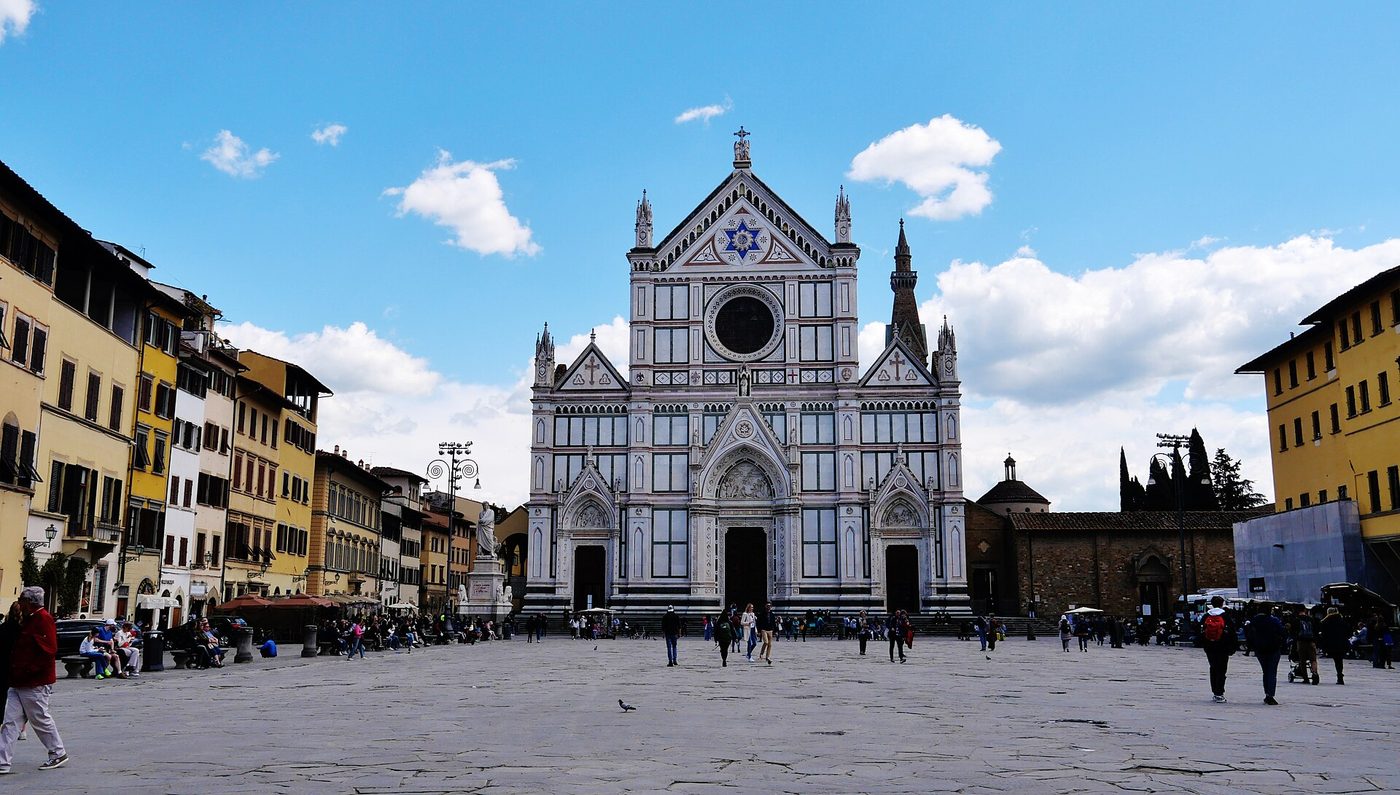
The Franciscan basilica at the east end of the centre is where Florence buries its own. Michelangelo is here, and Galileo, and Machiavelli, and Rossini, and there is a monument to Dante who is not, because Ravenna has refused to give him back since 1321. Giotto frescoed two of the chapels and Brunelleschi built the Pazzi Chapel in the first cloister, a room so calm and so exactly proportioned that it functions as an antidote to everything else in this city.
EUR 10 at the ticket office, EUR 6 reduced for ages 12 to 17, university students and groups of fifteen or more, with a EUR 1 online booking fee. Under-elevens and Florence residents go free. Open Monday to Saturday 9:30 a.m. to 5:30 p.m. with last admission at 5:00 p.m., and Sundays and religious holidays 2:00 p.m. to 5:30 p.m. The ticket covers the basilica, cloisters, chapels and the Opera museum in the refectory.
The piazza outside is one of the few large open spaces in the centre, and in June it hosts calcio storico, a sixteenth-century game somewhere between football and a brawl, played on sand by four teams representing the historic quarters. Bring a strong stomach.
15. Santa Maria Novella
Most people walk straight past it because it faces the station, which is a shame, because Alberti’s green and white marble facade is one of the founding documents of Renaissance architecture and Masaccio’s Trinity inside is where linear perspective arrives in painting, fully formed, around 1427. Stand in front of it and the wall appears to open into a barrel-vaulted chapel that is not there. Painters came from all over Italy to look at it.
Museum tickets start at EUR 8 through the Musei Civici Fiorentini, with the ticket office at Piazza Stazione 5. It is the ideal first stop if you arrive by train, because you can do it with your bag before check-in, then walk ten minutes to the Duomo.
16. Basilica di San Lorenzo
The Medici parish church, designed by Brunelleschi, and deliberately left unfinished on the outside: that rough brown stone facade was never clad because Michelangelo’s design for it was abandoned. Inside is one of the most harmonious spaces in the city, with Brunelleschi’s Old Sacristy off the left transept and two late Donatello pulpits.
The complete visit is EUR 10 and covers the basilica, the Old Sacristy, the Treasury Museum, the cloisters and the monumental crypts. Open Monday to Saturday 10:00 a.m. to 5:30 p.m., last admission 4:30 p.m.
One point worth stating plainly: the Medici Chapels and the Laurentian Library are in the same complex but are separate admissions, not included in this ticket. Three tickets, three entrances, one church. Plan accordingly.
17. The Medici Chapels
Behind San Lorenzo, entered from Piazza Madonna degli Aldobrandini. The Chapel of the Princes is a riot of inlaid semi-precious stone, gaudy in a way that tells you exactly what the family thought of itself. The New Sacristy is the reason to come: Michelangelo designed the room and carved the tombs of two minor Medici, with the allegorical figures of Night, Day, Dawn and Dusk sprawled across the sarcophagi. Night is one of the four or five greatest things in Florence.
Hours are Tuesday to Sunday 8:15 a.m. to 6:50 p.m. Closures follow an awkward pattern: the first, third and fifth Monday, the second and fourth Sunday of each month, plus 1 January, 1 May and 25 December.
On price I have to be straight with you: I could not find an official 2026 face value for a standalone adult ticket. Resellers advertise from around EUR 14 with their own booking fees folded into that number. Buy at the door or through the state museum system, and if you are doing several of these sites, the EUR 38 72-hour pass mentioned above includes it.
18. Biblioteca Medicea Laurenziana
A thirty-minute visit that art history students make pilgrimages for. Michelangelo designed the vestibule and its staircase, and the staircase does something structurally outrageous: it pours down into the room like liquid, columns are recessed into the walls rather than standing proud, and the whole thing breaks the classical rules it appears to be obeying. Mannerism starts here.
EUR 9 adult, EUR 2 for ages 18 to 25, free under 18. The hours are the fiddliest in Florence: Saturday, the second and fourth Sunday, and Monday 8:15 a.m. to 1:50 p.m.; Wednesday to Friday 1:15 p.m. to 6:50 p.m.; closed Tuesdays and the other Sundays. Write it down.
19. The Brancacci Chapel
Across the river in Santa Maria del Carmine, and worth the effort of booking. Masaccio’s Expulsion from the Garden of Eden is here, and Adam and Eve’s faces in it are the first time anyone in European painting really looks like they are suffering. Michelangelo came here to copy the frescoes as a teenager and had his nose broken in the chapel by a fellow student who got tired of his commentary.
Tickets from EUR 11. Timed reservation is compulsory, a maximum of thirty visitors are inside at once, and visits are capped at thirty minutes. Take whichever slot you can get.
20. San Miniato al Monte
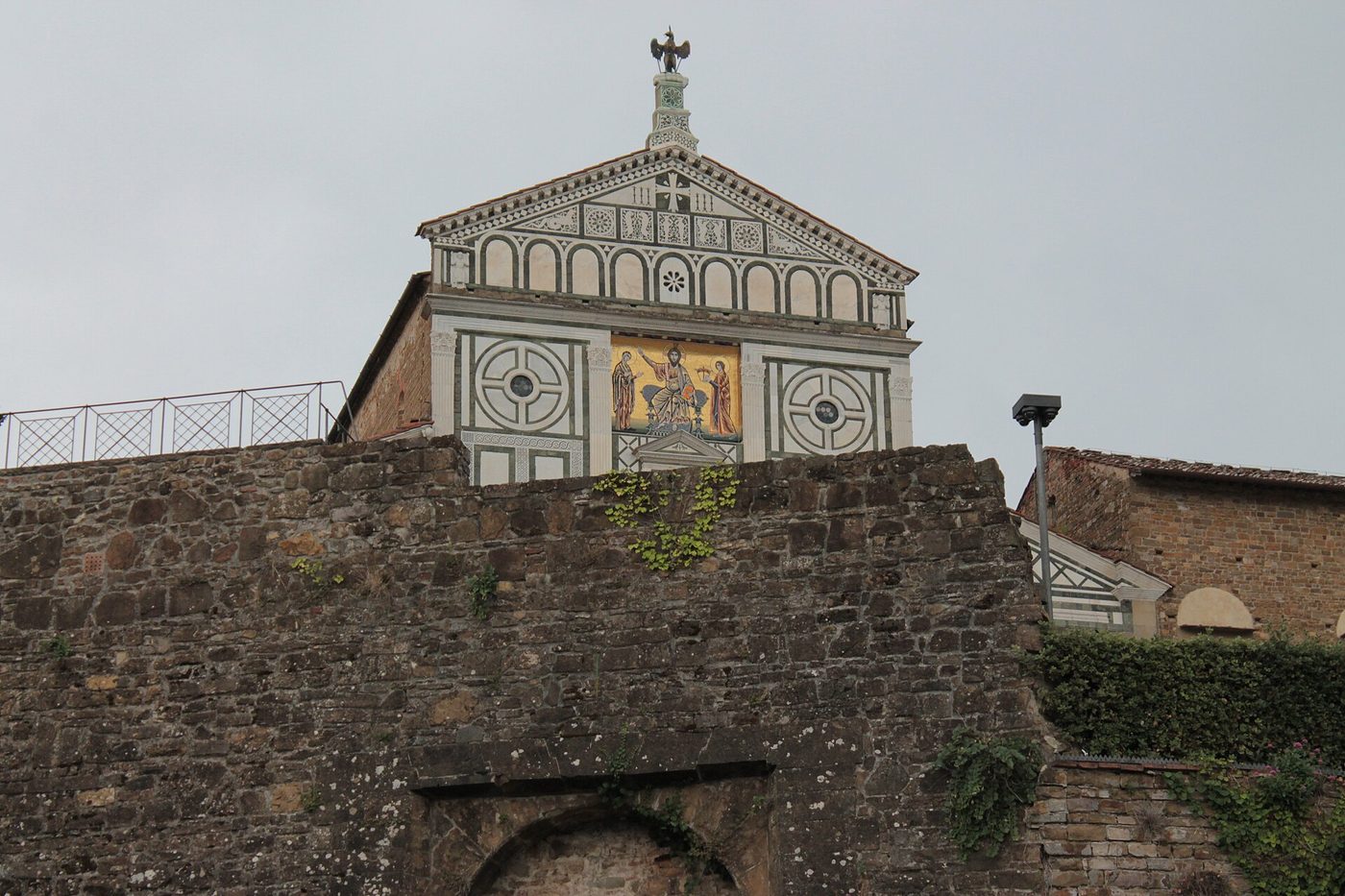
The most beautiful church in Florence, and free. An eleventh-century Romanesque basilica on the hill above Piazzale Michelangelo, with a geometric green and white marble facade, a zodiac inlaid in the floor and a crypt where Benedictine monks still sing.
Open Monday to Saturday 9:30 a.m. to 1:00 p.m. and 3:00 p.m. to 7:00 p.m., Sundays and holidays 8:15 a.m. to 1:00 p.m. and 3:00 p.m. to 7:00 p.m. Time your afternoon around this: on weekdays and Saturdays there is Mass at 6:00 p.m. in Latin Gregorian chant, with vespers at 6:30 p.m. On Sundays and holidays there are Masses at 8:30, 10:00 and 11:30 a.m. and at 5:30 p.m., the last of these in Latin Gregorian.
You can sit at the back for vespers. Twenty minutes of plainchant in a thousand-year-old church, then you walk out onto the terrace and the whole city is below you going gold. Buses 12 and 13 stop directly in front of the stairs, five to ten minutes uphill from Piazzale Michelangelo.
Squares, bridges and palaces
21. Piazza della Signoria and the Loggia dei Lanzi
Florence’s political heart for seven hundred years, and an open-air sculpture gallery that costs nothing. Under the Loggia dei Lanzi stand Cellini’s bronze Perseus holding up the head of Medusa, and Giambologna’s Rape of the Sabine Women, a marble spiral you can walk all the way around because there is no rope and no glass. Outside are a copy of David where the original stood until 1873, Ammannati’s Neptune fountain, which Florentines have mocked for four centuries, and a small bronze disc in the paving marking where Savonarola was hanged and burned in 1498, a year after he had persuaded the city to burn its own art on the same spot.
Come back after nine at night. The tour groups have gone, the marble is lit, and for once the square feels like it belongs to the city rather than to us.
22. Orsanmichele
A grain market converted into a church, with the guilds of Florence each commissioning a statue for a niche on the outside. Donatello, Ghiberti, Verrocchio and Nanni di Banco all contributed, which means there is a ring of major Renaissance sculpture at street level that you can walk round for nothing. What you see outside now are copies; the originals are upstairs in the museum, in a spectacular vaulted hall that was the guilds’ grain store.
Admission went to EUR 10 on 1 February 2026, up from EUR 8. Open Tuesday to Sunday 8:30 a.m. to 6:30 p.m., though on Sundays the church closes at noon and the museum at 1:30 p.m. Closed Mondays. It is also one of the five sites on the EUR 38 72-hour pass. Almost everyone walks past the exterior on the way from the Duomo to Piazza della Signoria without looking up.
23. Ponte Vecchio
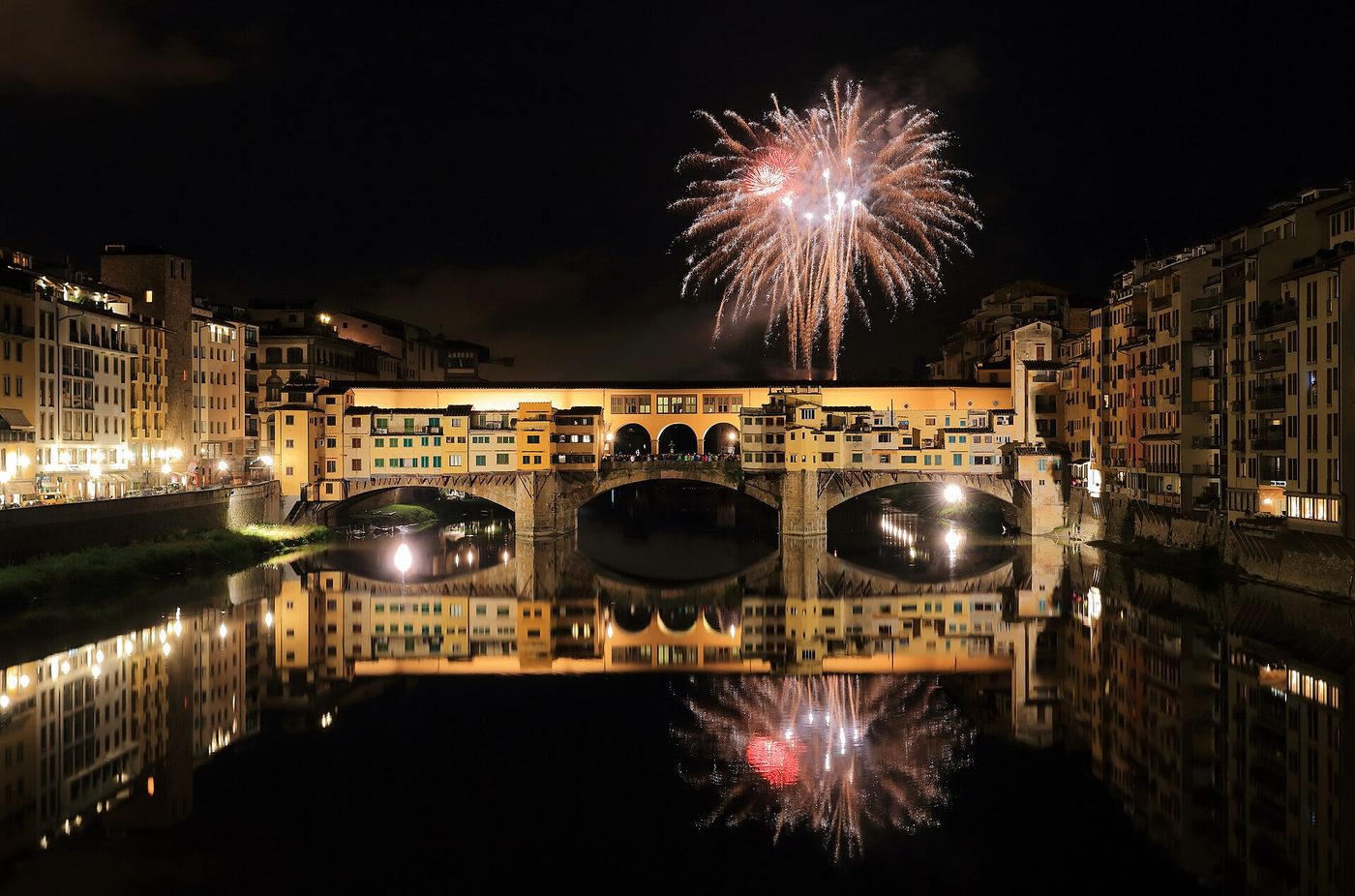
The only bridge in Florence the retreating Germans did not blow up in 1944. Butchers occupied the shops until 1593, when Ferdinando I evicted them for the smell and installed goldsmiths, who are still there. It is jammed shoulder to shoulder from ten in the morning until late.
So go at sunrise. Genuinely, set an alarm. Between about six and seven the bridge is empty, the light comes down the river from the east, and you can stand in the middle arch and look at the Arno without another person in the frame. It is a completely different structure at that hour and it takes twenty minutes.
For the photograph of the bridge rather than from it, walk one bridge downstream to Ponte Santa Trinita and shoot back east.
24. The Vasari Corridor
The kilometre-long enclosed passage Vasari threw up in five months in 1565 so the Medici could walk from Palazzo Vecchio to Palazzo Pitti without mixing with anyone. It runs along the top of the Uffizi, over the Ponte Vecchio, past a private window into Santa Felicita so the Grand Duke could hear Mass without attending it, and out into the Boboli.
It is EUR 43 same-day or EUR 47 in advance combined with the Uffizi, or EUR 58 with the PassePartout 5 Days. There are also special Friday-evening openings between 7 p.m. and 11 p.m. at EUR 20 same-day and EUR 24 in advance. Firenze Card holders are not covered but can add a Vasari supplement at a reduced EUR 20 with free booking. The Friday-evening ticket is the value option and the atmosphere at that hour is better anyway.
25. Piazza della Repubblica and its carousel
The least Florentine square in Florence, built in the 1880s on the site of the Roman forum and later the Jewish ghetto, both of which were demolished for it. The triumphal arch is faintly embarrassing. But there is a beautiful early twentieth-century carousel on it, about EUR 2 a ride, and if you are travelling with children this square will buy you an hour of goodwill. The historic cafes on it, Gilli and Paszkowski, charge accordingly for a table.
26. Palazzo Medici Riccardi
Michelozzo’s palace on Via Cavour, the prototype for every Renaissance palazzo that followed, and inside it the Magi Chapel: Benozzo Gozzoli’s fresco of the Procession of the Magi winding through a Tuscan landscape, packed with recognisable Medici faces in fifteenth-century dress. It is small, it is intensely coloured, and it is one of the most purely enjoyable rooms in the city.
Tickets are EUR 15. Booking is optional for individuals and groups up to seven, compulsory for groups of eight or more, with a group cap of sixteen. Because access to the chapel is limited to a small number at a time, you may wait a few minutes at the door. Worth it.
27. Museo di Palazzo Davanzati
A fourteenth-century merchant’s house, preserved with its painted rooms, its private well running up through every floor, and its latrines. This is the one that tells you how people lived here before the Renaissance made everything about art. EUR 8 full, free for under-18s, and included in the EUR 38 72-hour pass. The visitor cap is nine people at a time, which tells you how intimate it is, and means you should turn up at opening time rather than hope.
Gardens, hills and the best views in Florence
28. Boboli Gardens
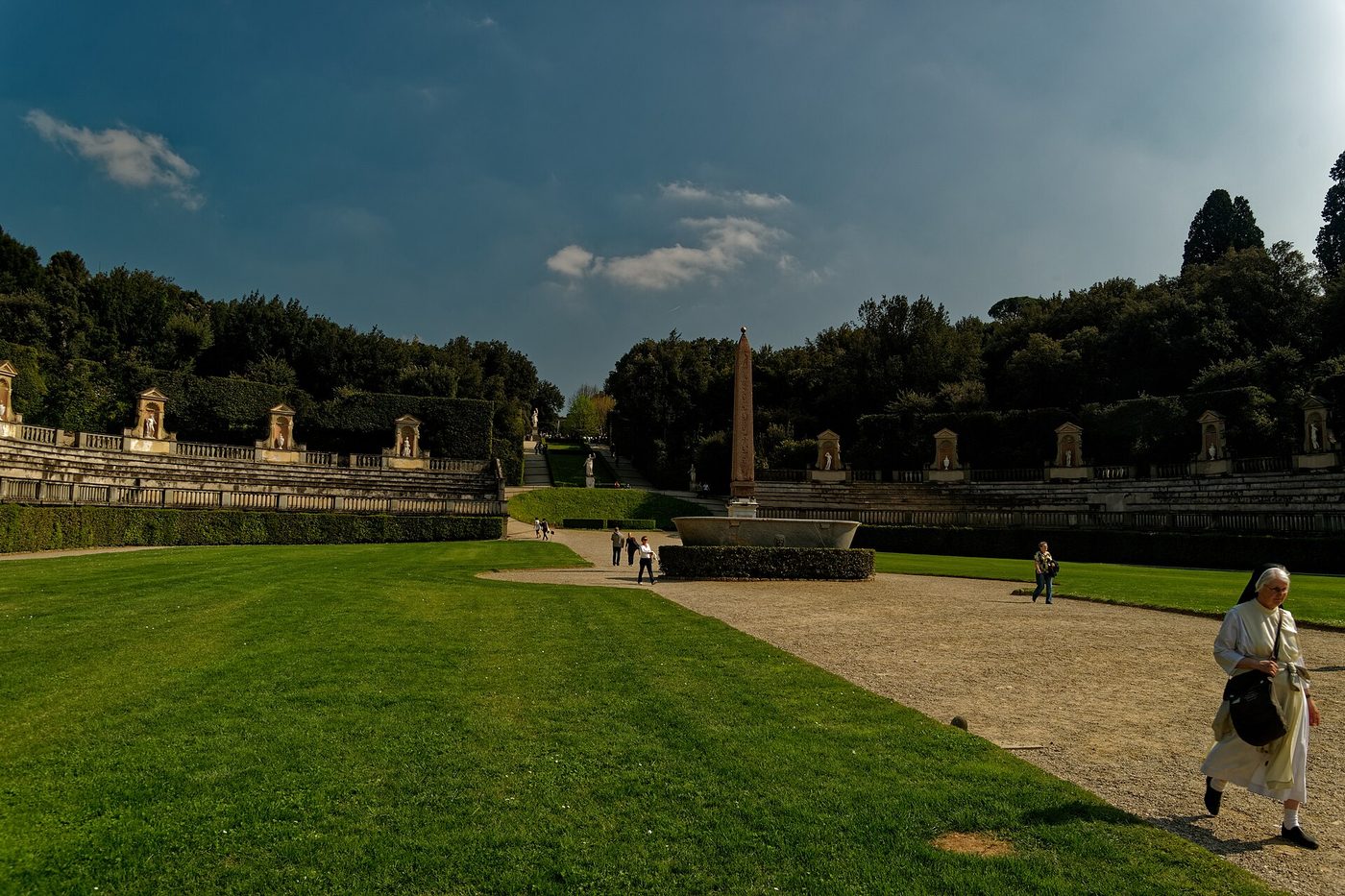
Forty-five thousand square metres of Medici garden climbing the hill behind Palazzo Pitti: a Roman amphitheatre with a genuine Egyptian obelisk in the middle of it, the Buontalenti Grotto with its dripping artificial stalactites and copies of Michelangelo’s Prisoners, avenues of cypress, and at the top a view over the roofs that most visitors never see because they run out of energy at the Pitti.
EUR 10 same-day, EUR 13 in advance, EUR 3 reduced for EU 18 to 25, and closed Mondays with the rest of the Uffizi Galleries. From 3 March 2026 there is a EUR 15 combined Boboli and Bardini ticket, sold at the ticket offices on the day only, not online.
Do not come at midday in summer. There is very little shade on the upper terraces, and this is a hill. Early morning or the last two hours before closing.
29. Bardini Garden
EUR 10 for the garden on its own. Smaller, steeper, quieter and, I think, better than the Boboli for a view. It is terraced straight down the hillside toward the river, so the city arranges itself in front of you the whole way down. For about three weeks in late April a wisteria tunnel over one of the staircases comes into flower and the entire thing turns violet. If your trip falls in that window, go.
30. Piazzale Michelangelo
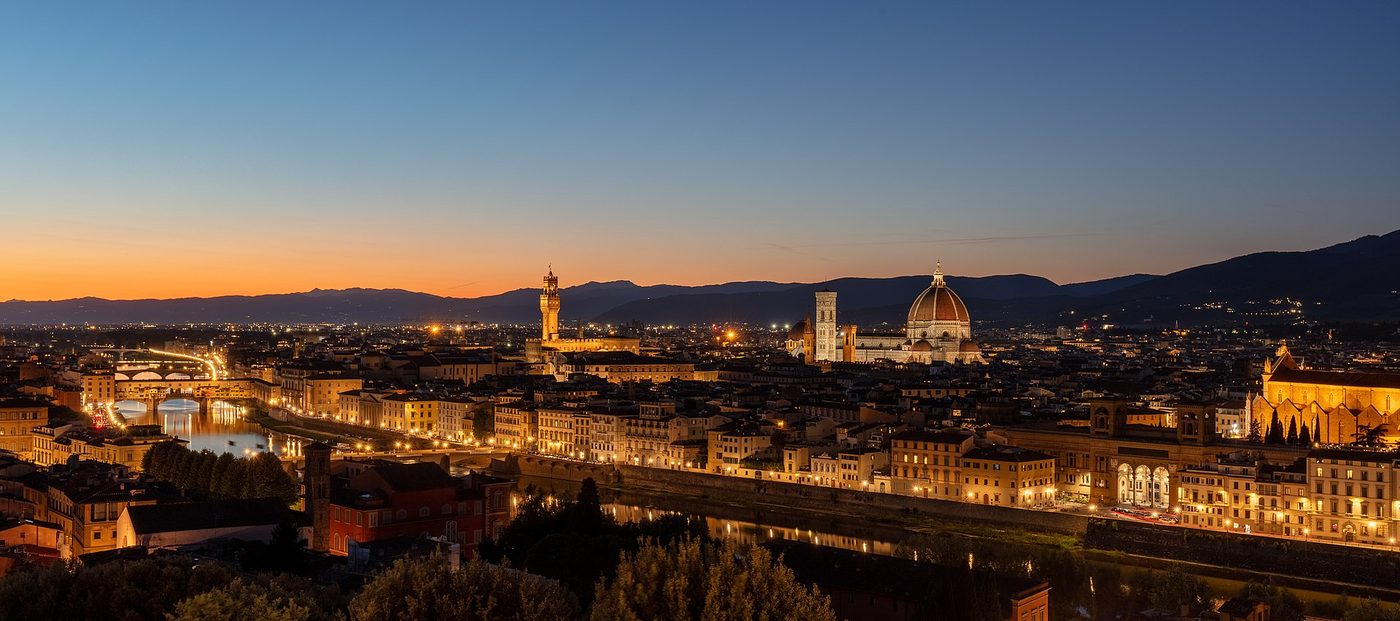
The view of Florence. Free, always open, and busy at sunset, though the terrace is big enough that this matters less than you fear.
Walking up takes twenty to twenty-five minutes from Ponte Vecchio: cross to the south bank, follow the Arno east to Piazza Poggi, then take either the ornamental Rampe del Poggi with its fountains at each landing or the direct staircase alongside, about fifteen minutes of climbing. Buses 12 and 13 from Santa Maria Novella station both stop at the square, running opposite loops, 12 climbing via Ponte alla Carraia and 13 the reverse.
My advice, learned the hard way in August: ride the bus up and walk down. The descent takes under fifteen minutes back to Ponte Vecchio and you arrive at dinner rather than at a shower.
Arrive forty-five minutes before sunset. The light on the Duomo goes through about four distinct stages and the last one, after most people have left, is the best.
31. Giardino delle Rose
On the slope just below Piazzale Michelangelo, free, and shockingly under-visited given that it is on the direct walking route. A terraced rose garden with more than a thousand plants, a Japanese garden section, a scattering of Jean-Michel Folon’s melancholy bronze figures among the beds, and the same view as the Piazzale with a tenth of the people. May and June are the peak. It is the best free half-hour on the walk up.
32. Fiesole
The Etruscan town on the ridge above Florence, founded centuries before the city below it, and the standard Florentine escape when the heat becomes unreasonable. There is a Roman theatre still used for summer concerts, an archaeological area, a Duomo, and a terrace with the entire Arno valley laid out beneath.
Bus line 7 gets you there in about seventeen to twenty-five minutes, running every twenty minutes daily to the terminus at Piazza Mino, on a standard EUR 2.00 urban ticket. It is a half day at most and it will reset you completely. Go in the late afternoon and eat dinner up there.
Eating and drinking your way through Florence
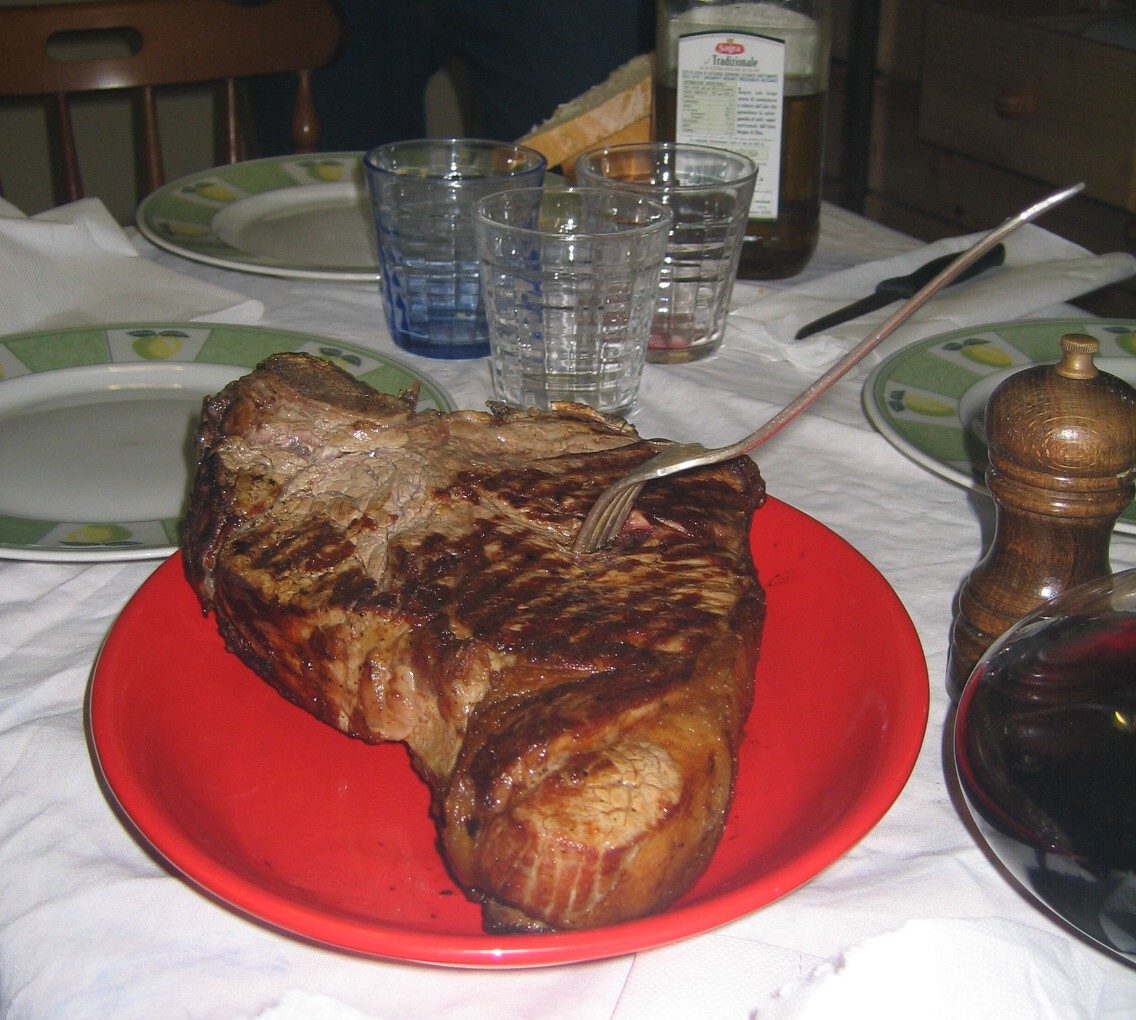
Tuscan cooking earns its place in any list of the great European food traditions, and it does it without a single luxury ingredient. Tuscan food is peasant food that got famous: bread, beans, oil, offal, and one very expensive steak. It rewards eating badly-lit and standing up more than it rewards a tablecloth.
33. Bistecca alla fiorentina
A T-bone from a Chianina or Maremmana calf, cut at least three fingers thick, salted, and grilled over embers for a few minutes a side so the inside stays properly rare. If a restaurant asks how you want it cooked, that is not a good sign. If they refuse to cook it past rare, you are in the right place.
It is sold al chilo, by the kilo, and weighed raw before cooking. Menu surveys in 2026 put the average at about EUR 50 a kilo, with a normal range of EUR 40 to 60. Certified Chianina runs nearer EUR 60 to 65, and EUR 80 a kilo is not unusual in the historic centre. A real fiorentina is rarely under 1.2 kg and is designed to be shared by two. Budget EUR 100 to 150 for two with sides and wine.
That is a lot of money, and I want to be straightforward about it: this is a once-per-trip meal, not a nightly one. If it is not in the budget, the same kitchens usually do peposo, a black-pepper beef stew from the kiln workers of Impruneta, for a quarter of the price and with more flavour.
34. A lampredotto panino
The fourth stomach of a cow, simmered with tomato and herbs, chopped, piled into a bread roll whose top half has been dunked in the cooking broth, and finished with salsa verde and chilli. EUR 5 to 6 from a cart. It is the single best thing you will eat in Florence and it costs less than a seated coffee on Piazza della Repubblica.
The carts, trippai, cluster around the markets and work from mid-morning to mid-afternoon. Say bagnato if you want the bread dipped, which you do. Eat it standing at the cart with a plastic cup of red.
35. A proper gelato crawl
Rules for not eating bad gelato: skip anywhere with mounded, brightly-coloured tubs, because real gelato slumps and banana should be grey. Look for metal-lidded pozzetti containers rather than open display. Ignore anywhere directly on a major sight’s square.
Reckon on EUR 2.50 to 4.50 for a small cup or cone of one or two scoops at a decent gelateria, with about EUR 3 a scoop reported in 2026. Order two flavours, not four, and get the cup if you are walking in July.
36. Mercato Centrale
The nineteenth-century iron-and-glass market hall at San Lorenzo. The ground floor is the real thing, butchers and cheesemongers and a couple of tripe counters, and it works best before ten in the morning. The upper floor is a modern food hall, open late, useful for a group that cannot agree on anything.
37. Mercato di Sant’Ambrogio
Twenty minutes east, and a different scene entirely: a smaller neighbourhood market with produce outside, meat and cheese inside, and a handful of no-frills lunch counters where the queue is mostly locals. If you want to see what Florentines put in their baskets, come here on a weekday morning.
38. A glass of Chianti in a vinaio
The vinaio is a Florentine institution: a hole-in-the-wall wine window or counter serving a glass and a plate of crostini standing up. Expect EUR 5 to 8 a glass of Chianti in a wine bar, with house wine typically from EUR 6 to 7 and premium producers running EUR 9 to 15 and up.
Look out for buchette del vino, the small arched wine windows set into palace walls, originally used by noble families to sell their estate wine directly to the street. Several reopened after 2020 and now hand out glasses and cones of gelato through the hatch. There are more than a hundred of them around the centre and spotting them is a decent game to play while walking.
What Florence actually costs in 2026
| Item | Typical price | Note |
|---|---|---|
| Espresso standing at the bar | EUR 1.30-1.50 | National average was EUR 1.25 in August 2025 and is climbing |
| Coffee seated at a table | EUR 3.00-4.50 | Two to three times the counter price, up to EUR 4-5 on the main squares |
| Coperto or service charge | EUR 1.00-2.00 a head | Charged on top, and legal, as long as it is on the menu |
| Glass of Chianti | EUR 5-8 | House wine from EUR 6-7 |
| Lampredotto panino | EUR 5-6 | From a street cart |
| Gelato, small cup or cone | EUR 2.50-4.50 | About EUR 3 a scoop |
| Bistecca alla fiorentina | About EUR 50 a kilo | Range EUR 40-60; EUR 80 in the centre is not unusual |
| Dinner for two with bistecca | EUR 100-150 | With sides and wine |
| Bus or tram single ticket | EUR 2.00 | Valid 90 minutes; rose from EUR 1.70 on 1 August 2026 |
| Tourist tax, 3-star hotel | EUR 6.00 per person per night | Capped at 7 consecutive nights |
| Uffizi, afternoon entry | EUR 16 | From 4 p.m., new for 2026 |
| Brunelleschi Pass | EUR 30 | All five Duomo monuments, 3 days |
The pattern is that sitting down is what costs money here, not eating. A coffee that is EUR 1.40 at the bar can be EUR 4 or 5 at a table on a main square metres away, and both prices are legal and posted. Drink standing, eat standing, and spend the difference on the Uffizi. For more on stretching a budget across the continent, see Europe on a budget and our list of the cheapest places to travel in Europe, which Florence is emphatically not.
The Oltrarno and craft Florence
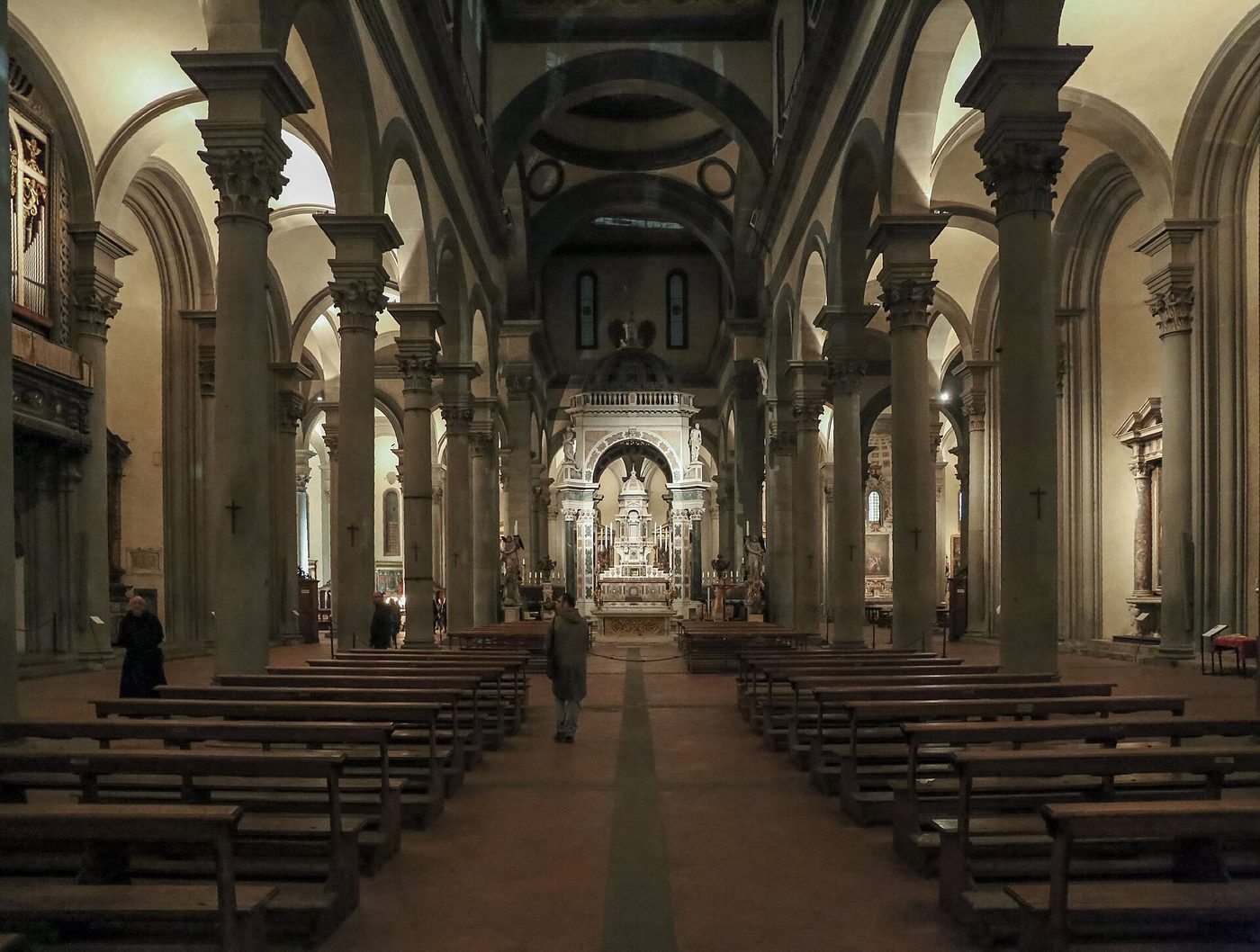
Cross the river and Florence loosens its collar. The Oltrarno, “beyond the Arno”, is where the workshops are, where the rents were cheaper for four centuries, and where you will find people eating dinner at nine rather than at seven.
39. Piazza Santo Spirito
Brunelleschi’s last church, its facade a blank cream wall that was never finished, faces a square with trees, a morning market and a lot of steps that people sit on in the evening with a beer. The interior is the purest piece of Brunelleschi in the city, a forest of grey stone columns in perfect rhythm, and there is a small wooden crucifix in the sacristy attributed to Michelangelo at seventeen, carved as thanks to the friars who let him dissect corpses in their hospital.
Come at seven in the evening and just stay a while. This is the square where Florence stops performing.
40. The artisan workshops of the Oltrarno
Along Via Maggio, Via de’ Serragli, Borgo San Frediano and the lanes between them, there are still gilders, bookbinders, marblers of paper, shoemakers, restorers and mosaicists working in ground-floor shops with the doors open. You can stand in the doorway and watch. Most of them are happy for you to, and several sell direct.
Go Tuesday to Friday during working hours. Many close through August, so if you are here for ferragosto you will find shutters down.
41. Officina Profumo-Farmaceutica di Santa Maria Novella
Back on the north bank, and technically a shop, but it is one of the oldest pharmacies in the world, founded by Dominican friars in 1221 and selling to the public since 1612. The frescoed former chapel that serves as the sales hall is free to walk into, smells of iris and rose water, and is worth thirty minutes whether or not you buy the EUR 40 soap. The story the shop tells is that Catherine de’ Medici took its orange-blossom water to France with her in 1533.
42. Museo Novecento
Florence’s twentieth-century art museum, on Piazza Santa Maria Novella, tickets from EUR 8, open 11:00 a.m. to 8:00 p.m. and closed Thursdays.
An important 2026 caveat: the permanent collection is currently on display off-site at the CAMBIO Cultural Center in Castelfiorentino through 20 September 2026. Temporary exhibitions continue in Florence. If you are coming specifically for the permanent collection before that date, you will be disappointed, so check what is hanging before you buy.
Slower Florence, for when the queues have beaten you
43. A Florentine cooking class or market tour
Half a day, typically EUR 60 to 120, usually starting with a walk through Sant’Ambrogio or Mercato Centrale and ending with you eating what you made. The good ones teach fresh pasta, a ragu and a tiramisu; the very good ones teach you to make pappa al pomodoro and ribollita, which are what Tuscans actually eat, and which sit alongside the rest of the country in our guide to regional Italian cooking and which are essentially bread, tomato and stale-bread-with-beans respectively. Book a small-group class, ask how many people, and walk away if the answer is more than eight.
44. The Arno at dawn
Free, and the thing I would keep if I could only keep one. Walk the north bank from Ponte alle Grazie west to Ponte Vespucci before seven in the morning. Mist comes off the water in autumn, the weirs make a low noise, the buildings on the far bank turn from grey to ochre over about twenty minutes, and there is nobody there except runners and a few people opening bars. Florence spends the rest of the day being a museum. At that hour it is a river town in Tuscany, which is what it has always been.
Which Florence pass is worth it, and which is not
This is the question I get asked most, and the honest answer is that Florence has four overlapping ticket systems run by four different bodies, and none of them covers everything. Here is what each one covers.
| Pass | Price | Valid | Covers | Does not cover | Worth it when |
|---|---|---|---|---|---|
| Firenze Card | EUR 85 | 72 hours from first museum entry | Over 60 museums, gardens and monuments, including exhibition supplements and booking | The whole Duomo complex, the Vasari Corridor, city transport, airport transport | You will hit four or five major museums in three days and want free skip-the-line bookings |
| Uffizi PassePartout 5 Days | EUR 40 | 5 consecutive days | Uffizi, Palazzo Pitti, Boboli Gardens | Everything else | You are doing all three, which otherwise costs EUR 51 same-day or EUR 61 in advance |
| Brunelleschi Pass | EUR 30 | 3 calendar days | Dome, Bell Tower, Opera Museum, Baptistery, Santa Reparata | Everything outside the Duomo complex | Always, if you intend to climb the Dome at all |
| 72-hour Accademia group pass | EUR 38 | 72 hours | Accademia, Bargello, Medici Chapels, Palazzo Davanzati, Orsanmichele, Casa Martelli | Uffizi, Pitti, Duomo | You care about sculpture more than painting |
On the Firenze Card specifically. It is EUR 85, one rate, online or at an official ticket office, and it runs for 72 hours from the moment you enter your first museum rather than from purchase. Under-eighteens in your family are added free, though they still need their own free reservations. Reservations remain compulsory even with the card for the Uffizi, the Accademia, the Palazzo Vecchio museum, the Brancacci Chapel, the Arnolfo Tower and Palazzo Medici Riccardi; they are free but cannot be changed. There is a new Firenzecard Restart at EUR 28 from 1 March 2026 that adds 48 hours to an expired card, turning three days into five, available on the app and online only, and only if the original card was bought within the last twelve months. Online vouchers are valid six months from purchase.
My view: at EUR 85 the card breaks even at roughly four or five major museums in three days, and most people do not manage that pace without hating themselves. The real value is not the headline saving, it is that the bookings are free and included, which removes the EUR 4 booking fees and the faff. If you are a completist with three full days and strong legs, buy it. If you are here for two days and want the Duomo, the Uffizi and the Accademia, do not: buy those three separately, because the Duomo is not covered and that is a third of your plan gone.
The 2026 rules in Florence that changed recently
Florence has spent the last two years legislating against the effects of its own success, and several of these will affect your trip directly.
The tourist tax went up on 1 February 2025. The current rates come from council deliberation number 535 of 10 December 2024. Short lets, holiday flats, B&Bs and rooms are charged at EUR 6.00 per person per night, raised from EUR 5.50. For hotels the rates run by star rating: 1-star EUR 3.50, 2-star EUR 4.50, 3-star EUR 6.00, 4-star EUR 7.00, 5-star EUR 8.00, per person per night. It is capped at seven consecutive nights, children are exempt up to their twelfth birthday, and there are further exemptions for carers of hospital patients, day-hospital patients, University of Florence students, on-duty emergency services personnel, and people with a severe certified disability plus one companion. School groups on educational visits and under-16 sports groups in council-linked tournaments pay half. A council session on 29 June 2026 tabled an update to the regulation, so this may move again.
Key boxes are banned. Self-check-in key safes had to come off the walls of the historic centre by 25 February 2025, with fines up to EUR 400 for owners who did not comply. If your rental host is still promising you a code and a box on the wall, ask what the actual arrival process is before you land at 11 p.m.
New short lets in the historic centre are banned. Since 30 July 2024 it has been forbidden to use as a short tourist let any dwelling in the UNESCO historic core that was not already registered on the tourist-tax portal. The short-term-let regulation took effect on 31 May 2025, a Florence court upheld the restrictions in May 2026, and from 26 June 2026 a Tuscan regional law requires operators to file electronically with the SUAP before any tourist-tax step. Florence is also proposing to extend the ban well beyond the UNESCO centre, into San Jacopino, Statuto and parts of the Oltrarno, which would take the covered housing stock from around 35,500 homes to over 100,000, with existing operators protected by a moratorium until 31 May 2028. The practical effect for visitors is that legal short-let supply in the centre is capped and slowly shrinking, so book earlier than you would have five years ago. Our guide to accommodation across Europe explains how to weigh a central hotel against a cheaper flat further out.
Tour groups are capped and loudspeakers are out. From summer 2026 organised tours may not exceed forty people, and guides must use wireless earpieces rather than loudspeakers, with the coloured umbrella replaced by a discreet paddle. If you are booking a guided tour, ask the group size.
Outdoor dining is banned on sixty streets. From early 2026, tables are off sixty streets in the UNESCO centre including the Ponte Vecchio, Piazzale degli Uffizi, Via Roma and Via Maggio, with a further seventy-three streets facing stricter rules on tarps, advertising and lighting. Some restaurants you may have booked for a terrace no longer have one.
What Florence has not done, despite persistent rumours, is introduce a Venice-style day-visitor entry fee or a citywide cap. The caps that exist are per-site: 40 people on a tour, 30 in the Brancacci Chapel, 28 in the Boboli, 21 at the Bargello and Medici Chapels, 20 at the Accademia, 16 at the Uffizi and Palazzo Medici Riccardi, 15 at the Museo Galileo, 10 at Casa Martelli and 9 at Palazzo Davanzati.
Getting to Florence and getting around
From Florence Airport (FLR)
The T2 tramline runs from Peretola Aeroporto directly into the city and it has made the old airport bus irrelevant. It takes about twenty minutes to the Alamanni stop beside Santa Maria Novella station, and twenty-two minutes to Unita near the cathedral. A single is EUR 2.00 on a biglietto a tempo, valid ninety minutes with unlimited tram and bus transfers within Florence. Note that this went up from EUR 1.70 on 1 August 2026, so older guides and even some signage will quote the old fare. A carnet of ten is EUR 18.20. Trams run 05:00 to 00:30 daily, to 02:00 on Friday and Saturday nights, every four to six minutes in the day and eight to ten off-peak. Buy at the machines on the platform, which take cards and cash, at the tobacconist in arrivals, or on the Autolinee Toscane app.
On taxis I am going to disappoint you deliberately. Four different flat fares are quoted online for the airport run, from EUR 22 to EUR 32, and none is confirmed on a Comune di Firenze tariff page, so the spread is wide enough that quoting one figure would mislead you. Agree the fare with the driver at the rank before you get in. A luggage surcharge of EUR 1.00 per bag in the boot is standard.
Many visitors fly into Pisa or Bologna instead and take the train, which is often cheaper. Pisa Centrale to Florence is about an hour on a fixed EUR 8.50 regional fare.
Trains from Firenze Santa Maria Novella
| To | Journey time | Typical fare | Notes |
|---|---|---|---|
| Rome Termini | About 1h30 | EUR 19.90-55 | Frecciarossa; book early for the low fares |
| Venice | About 2h | EUR 20-70 | From EUR 19.90 standard, EUR 29.90 business |
| Milan Centrale | 1h55-2h | Varies by booking date | Frecciarossa |
| Pisa Centrale | About 1h | EUR 8.50 fixed | Regional, every 15-30 minutes, no advance discount |
| Lucca | 1h19-1h45 | EUR 8.40 | One to two regional trains an hour |
| Siena | 1h28 | EUR 10.20 | Hourly regional; the station is below the old town |
The rule that saves people money: regional fares are fixed with unlimited availability, so for Pisa, Lucca and Siena you simply turn up, buy, and board the next train. High-speed fares to Rome, Venice and Milan behave like airline seats and rise steeply as the date approaches, so book those weeks out. Our guide to train travel in Europe covers the booking windows in detail, and our transport guide compares rail against the alternatives.
Do not drive into Florence
The historic centre is a ZTL, a zona a traffico limitato, enforced by automatic cameras at every entry gate. In practice only residents and permit holders may drive in. Visitors can enter only if their hotel registers the number plate in advance or they hold a temporary permit. Enforcement runs Monday to Friday 07:30 to 20:00 and Saturday 07:30 to 16:00 from September to June.
Fines are around EUR 83 per camera crossed, with quoted figures ranging from EUR 80 to EUR 335, and every gate you cross is a separate fine. They arrive by post weeks or months later, often after you are home, and hire companies add their own admin fee on top. I have met people who collected four in one wrong turn.
Park outside and walk in, or better, do not bring a car to Florence at all. If a Tuscan road trip is the plan, pick the car up on the day you leave the city. See our Europe road trips guide for how to structure that.
Getting around inside the city
Walk. Florence is one of the most rewarding European city breaks precisely because you never need transport. The centre is about five square kilometres and almost everything in this article is within a fifteen-minute walk of the Duomo. The exceptions are Piazzale Michelangelo and San Miniato, where buses 12 and 13 help, and Fiesole on bus 7. A single ticket is EUR 2.00 and covers ninety minutes of unlimited bus and tram transfers. The Firenze Card does not include city transport, which surprises people.
The single most important piece of kit is footwear. Florentine paving is uneven stone laid over centuries and it destroys thin soles. Our Europe packing list has the details, and if you are travelling from outside the EU, check the entry requirements in our Schengen visa and ETIAS guide before you book.
The best day trips from Florence by public transport
| Destination | How | Time each way | Fare each way | Best for |
|---|---|---|---|---|
| Siena | Bus from Firenze Autostazione, or regional train | 1h15 by bus, 1h28 by train | EUR 10.20 by train | The Campo, the striped Duomo, and a whole different medieval city |
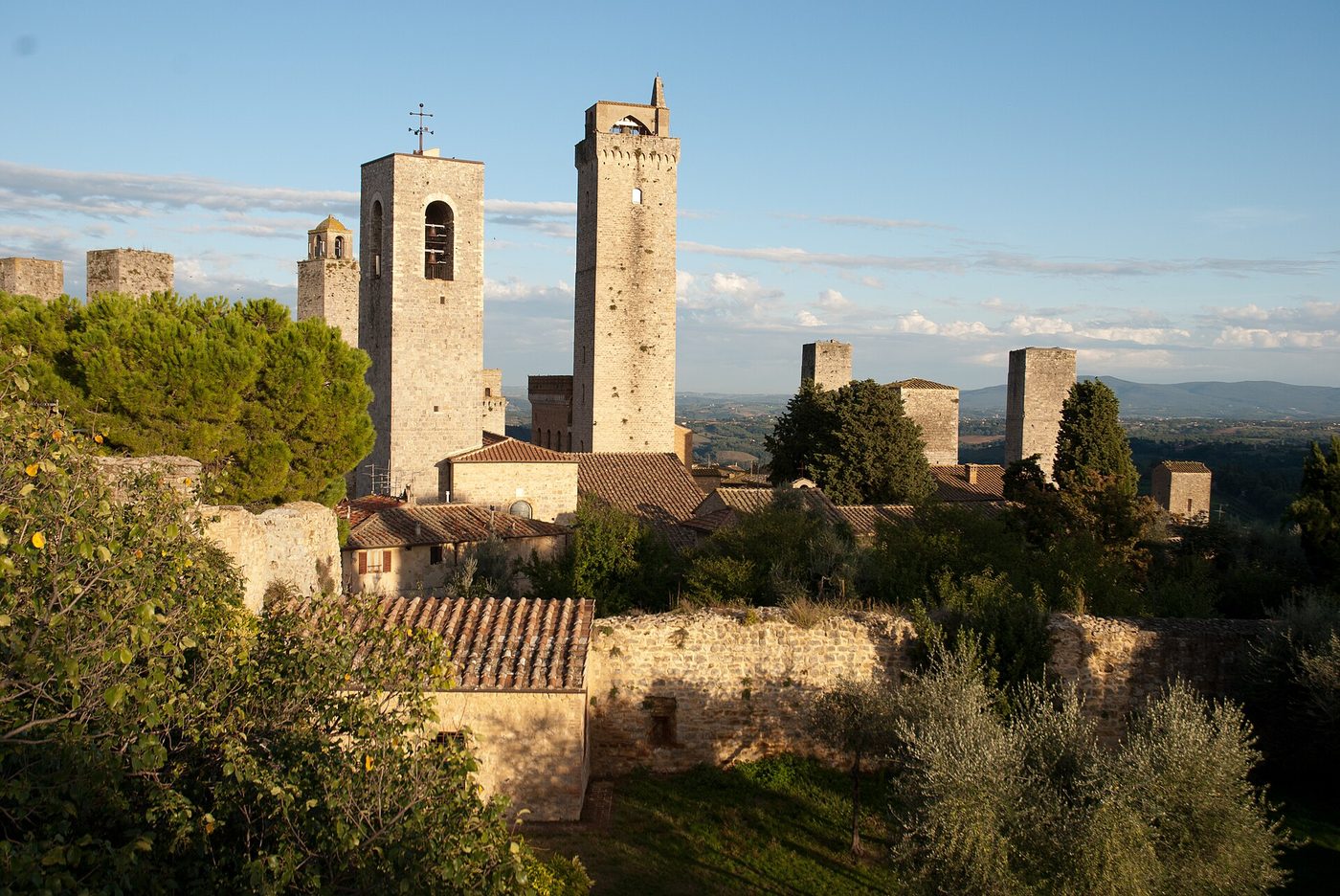
| San Gimignano | Autolinee Toscane bus, usually changing at Poggibonsi | About 1h42 including the transfer | Cheaper in advance than on board | The tower skyline, best in the two hours after the coaches leave |
| Pisa | Regional train | About 1h | EUR 8.50 fixed | Half a day; the Camposanto is better than the tower |
| Lucca | Regional train | 1h19-1h45 | EUR 8.40 | Cycling the intact Renaissance walls; the most liveable of the four |
| Fiesole | Bus 7 | 17-25 minutes | EUR 2.00 | An evening escape, not a full day |
Two practical notes. Buy San Gimignano bus tickets at the ticket office or on the Autolinee Toscane app rather than from the driver, because the onboard fare is several euros higher each way. And Pisa to Lucca is only about twenty-five minutes, so you can pair them in a single day if you start early: Pisa first thing, Lucca for lunch and the walls, back to Florence in the evening.
On Chianti I have to be honest. I could not source a workable scheduled public-transport route and fare into the Chianti wine villages that I would be willing to send you off on, and that is a genuine limitation of the region rather than an oversight. Chianti is realistically a hire car or an organised tour. If wine country is the whole point of your trip, build it around a car from a pick-up outside the ZTL, or read our Tuscany travel guide for how to base yourself in the hills instead of commuting from the city.
If you want quieter alternatives to the famous Tuscan names, our round-up of underrated places in Europe is a good place to look. The same caveat applies to my coverage generally: there is no Volterra here, no Arezzo, no Montepulciano. Those are all worth a day and none of them is a straightforward public-transport hop from Florence, so they belong in a Tuscany itinerary rather than a Florence one.
Free things to do in Florence
Florence has a reputation as an expensive city and it earns it, but a very good day here can cost nothing but your feet.
- Florence Cathedral interior, free, Monday to Saturday 10:15 a.m. to 3:45 p.m.
- The Loggia dei Lanzi, an open-air room of masterpieces in Piazza della Signoria, always open
- San Miniato al Monte, free, and the 6:30 p.m. Gregorian vespers on weekdays and Saturdays
- Piazzale Michelangelo at sunset, free, always open
- Giardino delle Rose, free, on the walk up to the Piazzale
- The Officina di Santa Maria Novella sales hall, free to walk into
- Ponte Vecchio at dawn, and the walk along the Arno
- Piazza Santo Spirito in the evening, and the morning market on it
- Mercato Centrale ground floor and Sant’Ambrogio, free to browse
- The Baptistery doors from outside, and the whole exterior of the Duomo, which is the real show anyway
- Orsanmichele’s exterior niches, a ring of statues by Donatello, Ghiberti and Verrocchio at street level, no ticket needed
- State museums on the first Sunday of the month, free under the Domenica al Museo scheme, though you will queue
Add a EUR 5 lampredotto and a EUR 1.40 espresso at the bar and that is a full day in one of the great cities of the world for under ten euros.
Florence itineraries: one, two and three days
One day in Florence
Brutal, but doable if you book two things in advance and accept that you are seeing the greatest hits.
- 8:15 a.m. Accademia, first slot, booked. One hour.
- 9:30 a.m. Walk to the Duomo. Cathedral interior at 10:15 when it opens, then the Baptistery.
- 11:30 a.m. Bell Tower, 414 steps, for the Duomo view.
- 1:00 p.m. Lampredotto or a market lunch at Mercato Centrale.
- 2:00 p.m. Piazza della Signoria and the Loggia dei Lanzi, free, past Orsanmichele, then Ponte Vecchio.
- 4:00 p.m. Uffizi on the EUR 16 afternoon ticket. Two and a half hours.
- 7:00 p.m. Bus 12 up to Piazzale Michelangelo for sunset, walk down.
- 9:00 p.m. Dinner in the Oltrarno.
Note what this skips: the Dome, because the slot would eat the morning; the Pitti; the Bargello. If you can only pick one climb, the Bell Tower gives you the better photograph.
Two days in Florence
Day one as above but slower: Accademia at 8:15, Duomo complex including the Dome on your booked slot and the Opera Museum in the afternoon, sunset from the Piazzale, dinner in Santo Spirito.
Day two: Uffizi first thing at 8:15. Lunch at Sant’Ambrogio. Cross the river for the Pitti or the Brancacci Chapel, then the Boboli or Bardini in the late afternoon when the sun is off the terraces. Aperitivo in a vinaio. Bistecca for dinner, shared.
Three days in Florence
Days one and two as above, then on day three either go out to Siena or Lucca on the train, or stay and do the city Florentines would show you: San Marco at opening and the Bargello after it, San Lorenzo and the Medici Chapels, lunch, the Oltrarno workshops in the afternoon, and San Miniato for the 6:30 p.m. vespers. That third day is the one people write to me about afterwards.
If Florence is one stop on a longer trip, our Europe itinerary guide and the 10-day Italy itinerary will help you slot it in. Florence pairs naturally with Rome, an hour and a half south, and Venice, two hours north.
If it is sold out, closed or heaving: swaps that work
| If this is not available | Do this instead | Why it works |
|---|---|---|
| Brunelleschi’s Dome is sold out | Giotto’s Bell Tower on a Giotto Pass, EUR 20 | Ten euros cheaper, 414 steps instead of 463, and the view includes the Dome itself |
| Uffizi morning slots gone | The EUR 16 entry from 4 p.m. | Thirteen euros cheaper than the advance price, and the quietest hours of the day |
| Accademia fully booked | Bargello, for Donatello’s David | Better sculpture collection, a fraction of the queue, EUR 12 |
| It is Monday and the state museums are shut | Museo Galileo, the Duomo complex, Santa Croce, San Lorenzo | None of them follow the state museum Monday closure |
| Piazzale Michelangelo is a wall of people | Giardino delle Rose, just below it | Same view, free, a tenth of the crowd |
| Boboli is too hot and too exposed | Bardini Garden | Smaller, shadier, better framed view, and the wisteria in late April |
| Bistecca is out of budget | Peposo, or a lampredotto panino | Same tradition, a quarter of the price, arguably more flavour |
| The Vasari Corridor combined ticket is too much | The Friday-evening ticket, EUR 20 same-day | Half the price and better atmosphere at that hour |
| Museo Novecento’s permanent collection | Palazzo Strozzi’s temporary shows, or the Pitti’s Gallery of Modern Art | The Novecento permanent collection is off-site until 20 September 2026 |
| The city is too much entirely | Bus 7 to Fiesole | Twenty minutes, EUR 2.00, and a different climate |
The best things to do in Florence by traveller type
If you are at the earliest stage of planning, start with how to plan a trip to Europe and our general Europe travel tips, then come back to this.
First time in Florence. Duomo complex on a Brunelleschi Pass, Uffizi, Accademia, Ponte Vecchio at dawn, Piazzale Michelangelo at sunset, one bistecca. Three days. Do not try to add the Pitti; you will not enjoy it. Our guide to the best places in Europe for first-time visitors puts Florence alongside the alternatives.
Second or third visit. San Marco for the Fra Angelicos, then the Bargello, Medici Chapels, Brancacci, Palazzo Davanzati, the Laurentian Library, the Oltrarno workshops, San Miniato for vespers, and a full day in Lucca. This is the better trip.
With children. Museo Galileo is the winner, hands down, and it opens on Mondays. Add the Piazza della Repubblica carousel, the Boboli’s grottoes and amphitheatre, the Perseus in the Loggia, which children find gruesome in the best way, and a gelato-making class. Skip the Uffizi unless they have asked for it. See Europe with kids for more.
Travelling solo. Florence is one of the easiest solo cities in Europe: compact, well-lit, and full of counters where eating alone standing up is the norm rather than a statement. Vinai and lampredotto carts solve dinner. A cooking class solves company. Our solo travel in Europe guide has the wider picture.
On a honeymoon or a romantic trip. Bardini Garden in late April, the Vasari Corridor on a Friday evening, San Miniato at vespers, dinner in the Oltrarno, and a night in a hotel with a roof terrace. See Europe honeymoon destinations.
On a tight budget. The free list above, plus the EUR 16 afternoon Uffizi, the EUR 5 student Ghiberti Pass if you qualify, the first-Sunday free museums, and a bed outside the ZTL where the tourist tax is lower. Backpacking Europe covers the hostel side.
With limited mobility. Be realistic about the climbs: the Dome, the Bell Tower and the Arnolfo Tower are all step-only with no lifts, and the Dome’s upper section is narrow, sloped and unavoidably physical. The Uffizi, Accademia, Pitti, Bargello and Museo Galileo are all accessible by lift, and the Accademia gives priority access on free Sundays to visitors with disabilities and their companions. Piazzale Michelangelo is reachable by bus 12 or 13, avoiding the stairs entirely.
Mistakes people make in Florence
Turning up at the cathedral on a Sunday. It is closed for worship. This costs more visitors a morning than anything else on the list.
Assuming the Firenze Card covers the Duomo. It does not, and neither does the free-entry Sunday scheme, because the complex is run by a private foundation rather than the state.
Arriving on a Monday. The Uffizi, Accademia, Pitti, Boboli, Bargello, San Marco and Orsanmichele all close. Plan a Monday around the Duomo complex, Museo Galileo, Santa Croce and San Lorenzo.
Booking the Dome for the wrong day. The Dome slot must be on the first day of your three-day pass, and cannot be changed or cancelled once issued. Build the rest of the pass around it, not the other way round.
A backpack at the Duomo. You will be turned away and sent to the free storage at Piazza Duomo 38/r, which is a fifteen-minute round trip you did not budget for.
Shorts and a vest top in any church. Shoulders and knees covered, no flip-flops. Carry a scarf in summer.
Driving into the centre. Around EUR 83 per camera, and every gate is a separate fine.
Coffee at a table, without checking the price first. The two-tier pricing is legal and posted, and the difference can be four euros a cup.
Bistecca for one. It is priced by the kilo, weighed raw, and rarely under 1.2 kg. It is a dish for two.
Leaving a phone in a back pocket around the station and the markets. Santa Maria Novella station, Mercato Centrale and the crowd on the Ponte Vecchio are the three places pickpockets work hardest. Front pocket, bag across the body, and do not put anything on a cafe table.
Doing three museums in a day. Renaissance fatigue is real and it arrives around hour four. Two major sites a day, plus a garden or a hill, is the sustainable rhythm.
Never crossing the river. The Oltrarno is where the city still lives, and it is five minutes’ walk away.
Skipping the Opera del Duomo Museum. You have already paid for it in the pass, and it holds the original Gates of Paradise.
Frequently asked questions about things to do in Florence
How many days do you need in Florence?
Two full days covers the essentials, three is the right answer for most people, and four lets you add a day trip without cutting anything. One day is possible if you book the Accademia and the Uffizi in advance and accept that you will not climb the Dome.
Is Florence worth visiting?
Yes, with a caveat. If you care about art, architecture or food, it is close to unmatched anywhere in Europe, and the concentration of it in a walkable centre is unique. If you want space, quiet and spontaneity, Florence in July will make you miserable, and you would be happier in a smaller Italian town. Go in September, book ahead, and it is one of the great trips.
What is Florence best known for?
Being the birthplace of the Renaissance. Brunelleschi’s dome, Michelangelo’s David, Botticelli’s Venus, the Medici family, and a food culture built on beef, bread and beans.
What should I not miss in Florence?
If you do only four things: the Duomo complex, the Uffizi, the Accademia, and sunset from Piazzale Michelangelo or the Rose Garden below it. Add the Bargello or San Marco if you have a fifth slot, and San Miniato at 6:30 p.m. if you want the moment you will remember.
What can you do in Florence in two days?
Day one: Accademia at opening, the Duomo complex including a climb, sunset from the Piazzale. Day two: Uffizi at opening, lunch at a market, the Oltrarno and a garden in the afternoon, bistecca in the evening. That is a complete first visit.
What are the best free things to do in Florence?
The cathedral interior, the Loggia dei Lanzi sculptures, San Miniato al Monte, Piazzale Michelangelo, the Giardino delle Rose, the Officina di Santa Maria Novella, the Arno at dawn, Piazza Santo Spirito in the evening, and the state museums on the first Sunday of the month.
Do you need to book the Uffizi in advance?
Not strictly, and in 2026 there is a financial reason not to: buying on the day of entry costs EUR 25 against EUR 29 in advance. But same-day availability in peak season is not guaranteed and the queue is real. The compromise most people should take is the EUR 16 ticket for entry after 4 p.m., which is both the cheapest and the quietest option.
How far in advance should you book the Duomo dome climb?
Two to three weeks minimum, and further for summer, because slots sell out weeks and sometimes months ahead. Remember the slot must fall on the first day of your three-day pass and cannot be changed or cancelled once issued.
How many steps to the top of the Duomo?
463, confirmed by the Opera del Duomo, with no lift. Giotto’s Bell Tower is 414 steps, also with no lift.
Is the Firenze Card worth it?
Only if you will visit four or five major museums within your 72 hours. At EUR 85 it excludes the entire Duomo complex, the Vasari Corridor and all city transport, which are three of the things most visitors assume are included. Its real advantage is that reservations are free and built in.
Is Florence Cathedral free to enter?
Yes. The nave is free with no ticket and no reservation. It is open Monday to Saturday 10:15 a.m. to 3:45 p.m. and closed on Sundays and religious celebrations. The Dome, Bell Tower, Baptistery, museum and crypt are all ticketed.
What is the best time to visit Florence?
The second half of September, then mid-April to mid-June. Avoid July and August if you can: average highs sit at 32°C and the city regularly hits 36 to 38°C with almost no shade in the centre.
Can you drive in Florence city centre?
Effectively no. The centre is a camera-enforced limited traffic zone and fines run to around EUR 83 per gate crossed. Park outside and walk in.
How do you get from Florence airport to the city centre?
The T2 tram, twenty minutes to Santa Maria Novella and twenty-two to Unita near the cathedral, EUR 2.00 on a ninety-minute ticket. Trams run from 05:00 to 00:30, later on Friday and Saturday nights.
What are the best day trips from Florence?
Siena, San Gimignano, Pisa, Lucca and Fiesole, all reachable on scheduled public transport. Pisa and Lucca can be combined in one day since they are twenty-five minutes apart. Chianti realistically needs a car or a tour.
Where is the best view of Florence?
Giotto’s Bell Tower for the view that includes the Dome, Piazzale Michelangelo for the classic panorama, the Giardino delle Rose just below it for the same view without the crowd, and San Miniato al Monte’s terrace, which is my own favourite, at six in the evening.
Do museums in Florence close on Mondays?
Most of the state ones do: the Uffizi, Accademia, Palazzo Pitti, Boboli, Bargello, San Marco and Orsanmichele. The Duomo complex, Museo Galileo, Santa Croce and San Lorenzo stay open, which is what a Florence Monday should be built around.
Final thoughts
Florence asks more preparation than almost any city in Europe, and gives back more than almost any city in Europe. The preparation is not glamorous: book the Dome three weeks out, note that the cathedral shuts on Sundays and the state museums on Mondays, take the four o’clock Uffizi ticket, and put your shoes on the list before your camera.
What you get for it is a city where you can stand on a bridge at six in the morning with nobody else on it, climb 414 steps before lunch, look at the Gates of Paradise in the afternoon, and hear monks sing plainchant at half past six while the light goes off the roofs below. That sequence is possible in one day, on foot, for well under a hundred euros. There is nowhere else quite like it.
Go in September if you can. Stay three nights. Cross the river.
Florence also makes a natural pair with the coast. The Cinque Terre is a couple of hours west by train, and the Amalfi Coast works as the southern half of a longer Italian trip. For more of Italy, our Italy travel guide is the place to start, and if you are still choosing between cities, see the best cities to visit in Europe and our Europe bucket list.
Hannah Brooks has spent fifteen years travelling, living and writing across Europe, from the Arctic tip of Norway to the south of Sicily. She has planned hundreds of European itineraries for readers and is Senior Europe Editor at EuropeanTourism.org.
Photo credits
All images are used under their stated Creative Commons or public domain licences.
- Duomo · Photo: Gzen92 / CC BY-SA 4.0 via Wikimedia Commons
- Uffizi · Photo: Verum3414 / CC BY 4.0 via Wikimedia Commons
- David · Photo: Dimitris Kamaras from Athens, Greece / CC BY 2.0 via Wikimedia Commons
- Santa Croce · Photo: Zairon / CC BY 4.0 via Wikimedia Commons
- San Miniato · Photo: John Samuel / CC BY-SA 4.0 via Wikimedia Commons
- Ponte Vecchio · Photo: Martin Falbisoner / CC BY-SA 3.0 via Wikimedia Commons
- Boboli · Photo: Txllxt TxllxT / CC BY-SA 4.0 via Wikimedia Commons
- Piazzale Michelangelo · Photo: Diego Delso / CC BY-SA 4.0 via Wikimedia Commons
- Bistecca · Photo: Lucarelli / CC BY-SA 3.0 via Wikimedia Commons
- Oltrarno · Photo: Giovanni Battista Caccini / CC BY 3.0 via Wikimedia Commons
- Tuscany Day Trip · Photo: Thomas Quine / CC BY 2.0 via Wikimedia Commons
- Dome View · Photo: Max_Ryazanov / CC BY-SA 3.0 via Wikimedia Commons
2 comments