Normandy Travel Guide: 29 Sights, 2026 Prices and Real Timings

The first thing to understand, before any Normandy travel guide gets into abbeys and beaches, is that Normandy is not one place. It is a war memorial and a cider farm and a Gothic cathedral and a beach resort with striped parasols, all inside a two-hour drive of each other, and the trip you have in your head is probably only one of those things. People arrive planning three days on the D-Day beaches and leave wishing they had given a morning to Honfleur. People come for Monet’s garden and find themselves standing in a war cemetery they had not planned to visit, unable to move.
This guide covers the whole region: the five departments, the two very different coasts, what everything costs in 2026, how long each place needs, and the two big changes this year that most trip plans have not caught up with. Normandy suits three to five days by car, with Bayeux or Caen as a base, and it is at its best in May, June, September and early October.
I have been coming here for fifteen years, first as a student on a ferry with a rucksack, later with a car and a notebook and a much better sense of when to stop driving and eat something. What follows is the version of Normandy I would give a friend: honest about the crowds, specific about the money, and clear about the couple of things that will genuinely change your itinerary this autumn.
Two things that change your 2026 plan
The D-Day beaches are now a UNESCO World Heritage Site
On 26 July 2026, at the World Heritage Committee meeting in Busan, UNESCO inscribed the Normandy landing beaches on the World Heritage List. The inscription covers all five beaches, Utah, Omaha, Gold, Juno and Sword, along with Pointe du Hoc, and UNESCO described them as an exceptional cultural landscape shaped both by the events of 1944 and by their enduring remembrance. It took nearly two decades of campaigning, led by Herve Morin, president of the Normandy Region, who first pushed the nomination around 2008.
ICOMOS attached a formal caution to the decision, flagging coastal erosion, rising visitor pressure and planned offshore wind development. Which is the polite way of saying: the beaches are about to get busier. If you have been meaning to come, the next two seasons are the quiet ones.
The Bayeux Tapestry has left Bayeux
The Bayeux Tapestry Museum closed to the public on 1 September 2025 for a full renovation and is scheduled to reopen in October 2027, timed to the millennium of William the Conqueror’s birth. The scheme is a €38 million conversion of a 17th-century seminary by the architects Rogers Stirk Harbour + Partners, with a new wing.
The 68-metre embroidery itself is on loan to the British Museum in London from September 2026 to July 2027. So for the whole of this autumn and the winter that follows, the Tapestry is closer to London than it is to Normandy. If seeing it is the point of your trip, book London instead and come to Normandy for everything else, which is most of it. Our UK travel guide covers the London end if you want to do both.
Bayeux is still absolutely worth two nights. The cathedral is enormous and mostly empty. The Museum of Art and History Baron Gerard and the Memorial Museum of the Battle of Normandy are both open, at €8.50 each or €14 for the Bayeux Museum Pass covering both, valid a year. One practical catch: those tickets are sold only on site, in person, with no online or advance purchase, so arrive with a card or cash and do not waste twenty minutes hunting for a booking page.
Bayeux War Cemetery, ten minutes’ walk from the museums, holds 4,144 Commonwealth Second World War graves, 338 of them unidentified, plus more than 500 graves of other nationalities, mostly German. It is the largest Commonwealth war cemetery in France. It is also free, always open, and the quietest place in the town.
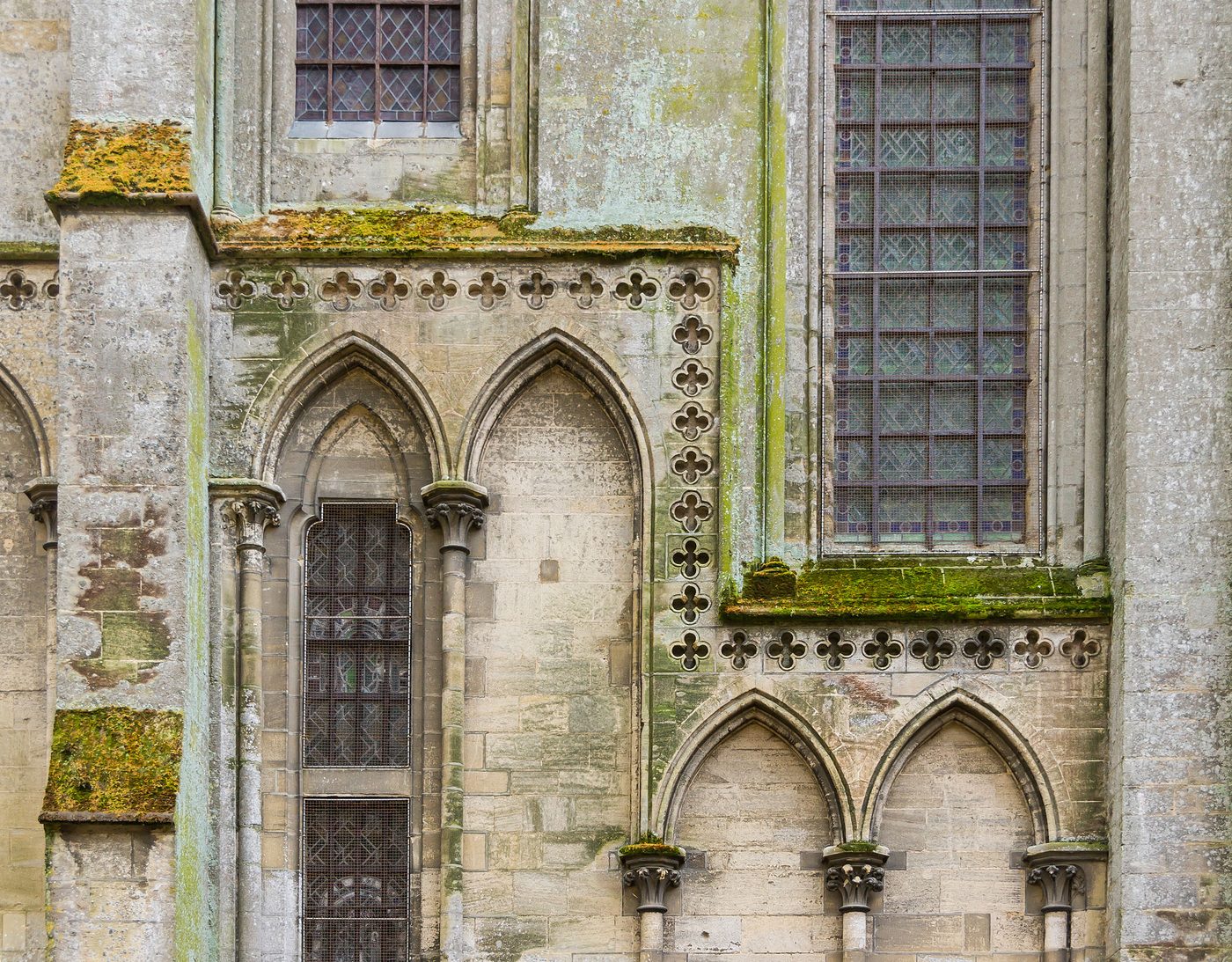
Where Normandy actually is, and how it splits up
Normandy is the northwest corner of France, between Paris and Brittany, made up of five departments: Seine-Maritime and Eure in the east (the old Haute-Normandie), and Calvados, Orne and Manche in the west (Basse-Normandie). They merged into one region in 2016, but people still talk about the two halves, and for planning purposes the split is useful.
The practical geography looks like this:
- The Alabaster Coast (Cote d’Albatre), from Le Treport down to Le Havre: white chalk cliffs, Etretat, Fecamp, Dieppe. Wild, windy, dramatic.
- The Seine valley: Rouen, Jumieges, Chateau Gaillard, and Giverny at the Paris end. Cathedrals, abbeys, Impressionists.
- The Flowered Coast (Cote Fleurie), Honfleur to Cabourg: pretty harbours, belle-epoque resorts, boardwalks, casinos.
- The landing beaches, Ouistreham west to the Cotentin: Sword, Juno, Gold, Omaha, Utah, and the museums and cemeteries between them.
- The Cotentin peninsula and the bay: Cherbourg, the western beaches, and Mont-Saint-Michel at the far southwest corner, technically the last few metres of Normandy before Brittany begins.
- Inland: the Pays d’Auge with its cider farms and half-timbered villages, Suisse Normande for walking, and the Orne, which almost nobody visits.
Mont-Saint-Michel is the corner case worth naming. It sits in Manche, so it is in Normandy, but the bay is shared with Brittany and the argument over whose it is has been running for centuries. From most of Normandy it is a long drive: Bayeux to the Mont is a good two hours each way.
The 29 headline sights in this Normandy travel guide, with 2026 prices
Every price below is the 2026 adult rate, taken from each site’s own ticket page and checked in August 2026, with a handful of ranges where a site publishes bands rather than a single figure. Twelve of the twenty-nine cost nothing at all, which is worth knowing before you build a budget around museum entry.
| Place | Where | What it is | 2026 adult admission | Time needed | Best window |
|---|---|---|---|---|---|
| Mont-Saint-Michel Abbey | Bay | Benedictine abbey on a tidal rock, UNESCO listed 1979 | €16 Apr–Sep, €13 Oct–Mar | Half a day with the walk in | Any month; go first or last entry |
| Bayeux Museum Pass | Bayeux | MAHB art museum plus the Battle of Normandy museum, one ticket | €14 (€8.50 each separately) | 2–3 hours | Closed 5–18 Jan 2026 |
| Bayeux War Cemetery | Bayeux | 4,144 Commonwealth graves, the largest in France | Free | 30–45 minutes | Any month |
| Bayeux Tapestry Museum | Bayeux | Closed for renovation until October 2027 | Closed | n/a | Reopens Oct 2027 |
| Normandy American Cemetery | D-Day coast | Nearly 10,000 graves on the bluff above Omaha | Free, parking free | 1.5–2 hours | Any month, 09:00–17:00 |
| Omaha Beach | D-Day coast | The long open sand below Colleville, UNESCO listed July 2026 | Free | 1 hour | Low tide, any month |
| Pointe du Hoc | D-Day coast | Cratered clifftop the US Rangers scaled, UNESCO listed July 2026 | Free, parking free | 1 hour | Apr–Sep 09:00–18:00 |
| Musée du Débarquement, Arromanches | D-Day coast | New 2023 museum on the Mulberry harbour | €12.90 | 1.5 hours | Closed all January |
| Arromanches 360 | D-Day coast | Nine-screen circular cinema on the cliff | €7 | 30 minutes | Feb–Dec |
| Longues-sur-Mer battery | D-Day coast | German casemates with guns still in place | Free; guided tour about €5 | 45 minutes | Tours Apr–Oct |
| Utah Beach Museum | Cotentin | Landing museum built into the dunes | €10 | 1.5 hours | Any month |
| Airborne Museum, Sainte-Mère-Église | Cotentin | US paratroopers, gliders, the church with the parachute | €11.50 | 1.5 hours | Any month |
| Juno Beach Centre | D-Day coast | The Canadian museum at Courseulles-sur-Mer | €9, or €13.50 with the bunker tour | 1.5 hours | Any month |
| Mémorial Pegasus | D-Day coast | Pegasus Bridge and the British airborne story | €9.50 | 1 hour | Any month |
| Musée Mémorial d’Omaha Beach | D-Day coast | Small, dense museum right behind the beach | €7.90 | 1 hour | Any month |
| Overlord Museum | D-Day coast | Vehicles and armour, next to the American Cemetery | €9.90 (€7.50 reduced) | 1 hour | Feb–Dec |
| Mémorial de Caen | Caen | The big-picture war museum, 1918 to the Cold War | €20.80 | 3 hours | Closed early January |
| Rouen Cathedral | Rouen | The facade Monet painted more than thirty times | Free | 45 minutes | Any month |
| Musée des Beaux-Arts, Rouen | Rouen | Major Impressionist holding, one of twelve free museums | Free | 1.5 hours | Any month |
| Historial Jeanne d’Arc | Rouen | Joan of Arc’s trial and rehabilitation, in the archbishop’s palace | €12 (€9 reduced) | 1 hour | Tue–Sun 10:00–19:00 |
| Gros-Horloge | Rouen | Astronomical clock with a 1389 movement, over the street | €7.70 (€3.90 reduced) | 30 minutes | Any month |
| Monet’s House and Gardens, Giverny | Seine valley | The Clos Normand, the water garden and the lily pond | €13 adult, €7 child 7–17 | 1.5–2 hours | 1 Apr–1 Nov only; June for lilies |
| Les Jardins d’Étretat | Alabaster Coast | Clipped topiary gardens on the cliff above the arch | €14 in Jul–Aug, €12.90 Apr–Jun and Sep–Oct, €11 Mar and Nov | 1 hour | Mar–Nov |
| Étretat cliffs | Alabaster Coast | The Aiguille, the Porte d’Aval, the GR21 clifftop path | Free | 2–3 hours on foot | Any month; best at low sun |
| Palais Bénédictine, Fécamp | Alabaster Coast | Neo-Gothic distillery and museum of Bénédictine liqueur | From €19 adult, €8 age 12–17 | 1.5 hours | Any month |
| Honfleur Vieux Bassin | Flowered Coast | The old harbour and Église Sainte-Catherine, France’s largest timber church | Free | Half a day | Any month; weekdays |
| Deauville and Les Planches | Flowered Coast | Boardwalk, parasols, casino, racecourse | Free to walk | Half a day | Jun–Sep, or Sep for the film festival |
| Le Havre city centre | Alabaster Coast | Auguste Perret’s rebuilt centre, UNESCO listed 15 July 2005 | Free to walk; MuMa and the show flat charge | Half a day | Any month |
| Route du Cidre | Pays d’Auge | 40 km signed loop through Beuvron-en-Auge and Cambremer | Free; tastings free, buy a bottle around €4 | Half to a full day | May–Oct |
A few notes on reading that table. Prices at French museums move by a euro or two each January, so treat these as accurate for 2026 and check the site page if you are travelling deep into 2027. Reduced rates for students, under-18s, EU citizens aged 18 to 25 and visitors with disabilities exist almost everywhere and are often substantial: at Mont-Saint-Michel the abbey is free for everyone under 18, for EU citizens aged 18 to 25, for visitors with disabilities plus one companion, and for jobseekers, and free for all on the first Sunday of the month from November to March.
The other thing the table makes obvious is that the D-Day coast is cheap. The cemeteries, the beaches, Pointe du Hoc and the Longues battery are all free. You could do a serious, moving, well-informed day on the landing beaches and spend nothing but fuel. The museums are optional depth, not the price of entry.
Mont-Saint-Michel: what it costs, how long it takes, and the tide question
Mont-Saint-Michel took 2.794 million visitors across the site in 2025, up 3.1 per cent on the year before, with just over 1.6 million of those going into the abbey itself, against 1.48 million in 2024. Those numbers are the whole planning problem in one line. It is the most visited thing in Normandy by a distance, and one of the most beautiful places in Europe by most measures and it is a village of narrow medieval streets with a single main staircase.
The mechanics. You park on the mainland, in a car park of roughly 4,000 spaces, 2.5 to 2.7 km from the rock. The 2025 tariff for six to twenty-four hours was €16 from November to February, €23 in March to June and September to October, and €27 in July and August, and in 2026 you should budget somewhere around €22 to €28 in high season. Parking is free from 18:30 in low and mid season, which is a useful thing to know if you are staying nearby and want to walk in for the evening.
The parking fee includes the shuttle bus, called Le Passeur, which runs from about 07:30 until midnight roughly every twelve minutes. It also covers the Tourist Information Centre facilities. From the car park it is about thirty minutes on foot to the dam and shuttle stop, then another twenty to thirty minutes to the Mont if you walk the causeway rather than ride, so call it fifty minutes to an hour end to end on your own legs.
The abbey costs €16 from 1 April to 30 September and €13 from 1 October to 31 March. Summer hours are 09:00 to 19:00 from 1 May to 31 August and 09:30 to 18:00 from 1 September to 30 April, with last admission an hour before closing and annual closures on 1 January, 1 May and 25 December.
How the tides work here
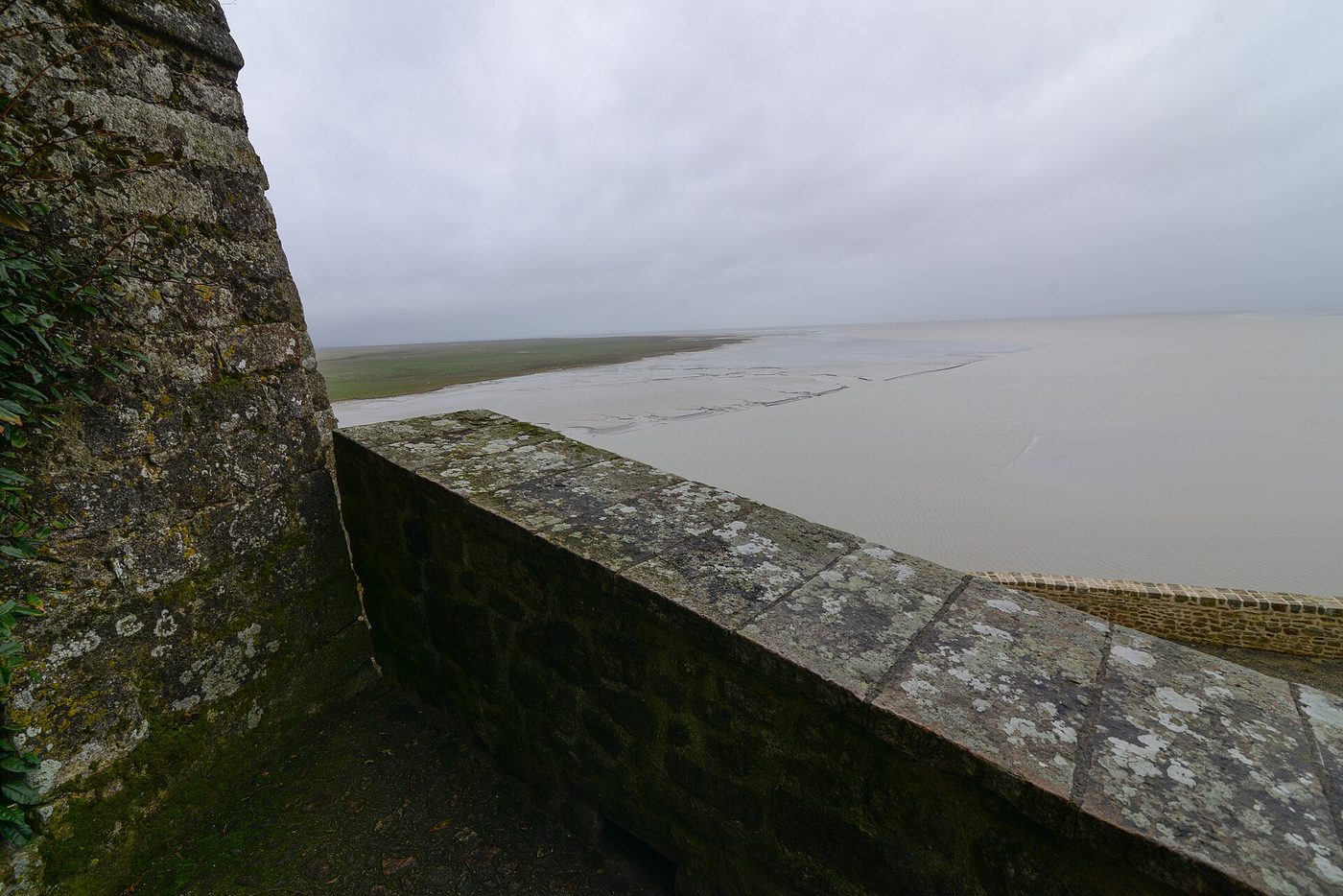
People are told to check the tides without ever being told what to check for. The mechanism is this: French tides are graded by a coefficient, and above coefficient 110 the water rises high enough to surround the ramparts, cutting off access to the village for several hours. The highest coefficients cluster around the equinoxes, around 20 to 21 March and 22 to 23 September. Summer tides are usually in the 80 to 90 range, which is to say the Mont does not become an island.
2026 is a useful illustration of how modest the numbers usually are. The strongest tides of the year were 20 to 21 March at coefficient 104 and 18 April at coefficient 105, neither of them anywhere near 110. Even so, the prefecture flagged two evenings when the sea would wash across the esplanade and cut access to the rock for over an hour: Friday 14 August at 21:28 and Saturday 12 September at 21:02. Both have now passed. The lesson is that the esplanade floods at a lower threshold than the ramparts, and that the good ones happen after dark, which most visitors do not expect.
The 2027 coefficient calendar was not published at the time of writing, so for next spring check the prefecture’s own tide notices at montsaintmichel.gouv.fr.
Walking the bay
You cannot cross the sands on your own. A prefecture-certified guide is required, and the warnings about quicksand and the speed of the incoming tide are not decoration. Guided formats run from a bay walk of an hour and a half to two hours, a trip out to the Tombelaine islet at three to three and a half hours, and the full thirteen-kilometre crossing from Bec d’Andaine at Genets or the Grouin du Sud at Vains. Prices are set by individual guides rather than centrally, so book direct and ask when you do.
Accessibility at the Mont
Be realistic. There are 139 steps from the top of the main street to the abbey, and there are no ramps or lifts in the village or in the abbey itself. What exists: car park P2 is reserved for reduced-mobility visitors and sits closest to the shuttle station, the shuttles carry removable access ramps on request, the Tourist Information Centre lends wheelchairs and seat canes, and a joelette, the single-wheeled chair carried by helpers, or a stair chair can be booked in advance. Abbey admission is free for disabled visitors and their companions on proof.
The D-Day coast: five beaches, and how to do them properly
Now UNESCO listed, the landing sites run from Utah Beach in the west to Sword Beach in the east, spread over roughly 120 km of coast. That distance is the single most common planning mistake. You cannot see them all properly in a day, and trying turns a pilgrimage into a driving exercise.
The five beaches, west to east: Utah (US, on the Cotentin), Omaha (US, the hardest fighting), Gold (British, with Arromanches at its centre), Juno (Canadian, Courseulles-sur-Mer) and Sword (British, running to Ouistreham and Pegasus Bridge).
Omaha and the American Cemetery
The Normandy American Cemetery at Colleville-sur-Mer is free, parking included, open daily 09:00 to 17:00 and closed on 25 December and 1 January, with admission closing fifteen minutes before the gates. Nearly 10,000 graves sit on the bluff. One practical note that surprises people: entering the Visitor Center means passing airport-style security screening, but if you are only walking to the graves and the memorial park you do not go through the checks. If you are short on time or travelling with someone who finds queues hard, go straight to the cemetery.
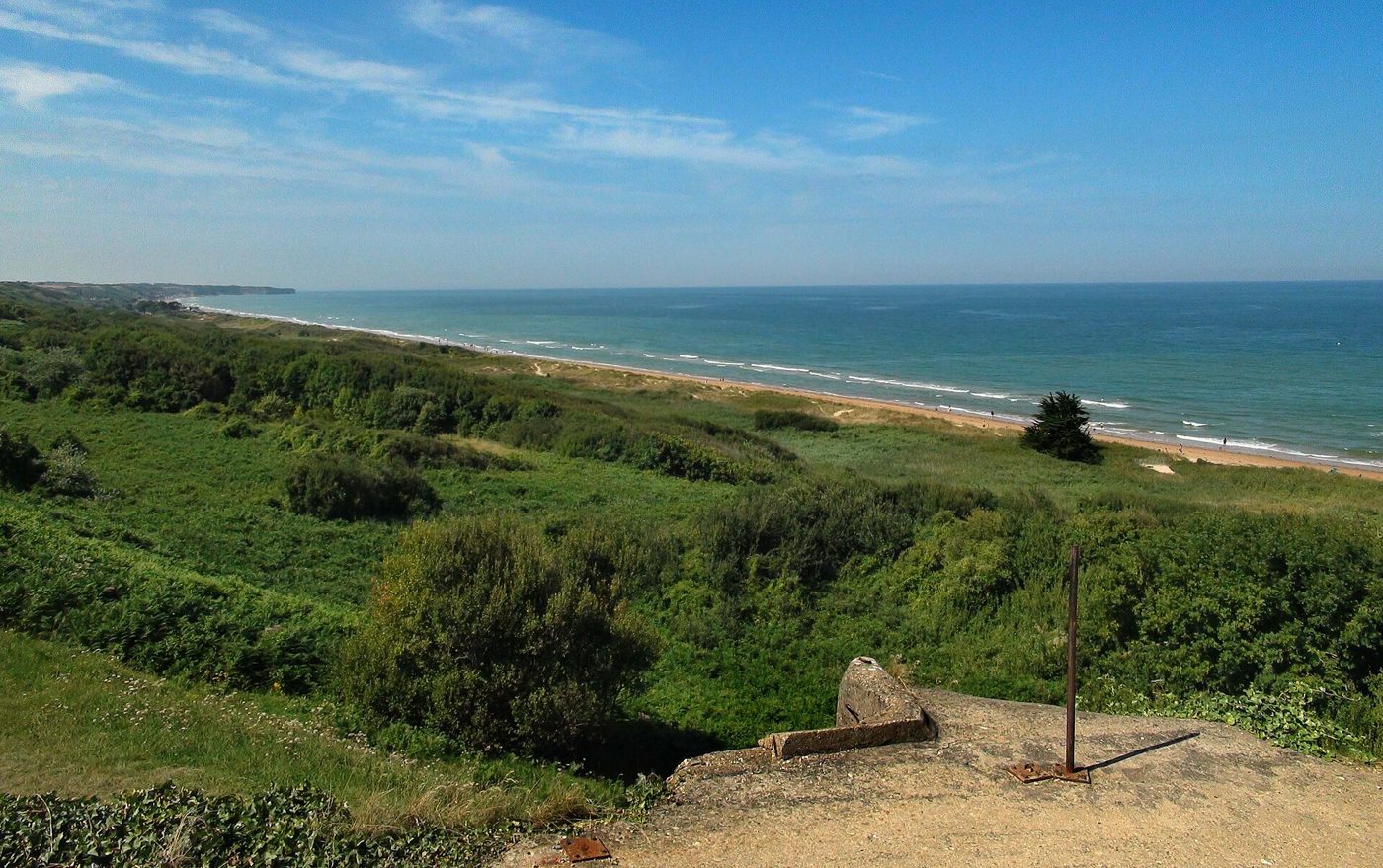
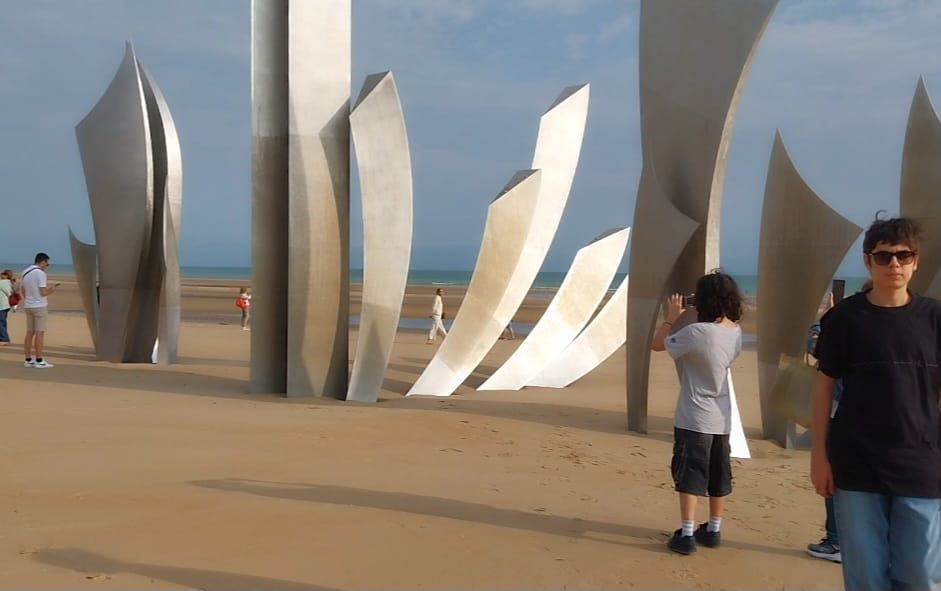
Down on the sand, Omaha is simply a very long, very flat beach, and at low tide the distance between the waterline and the shingle is the part that stops conversation. The Les Braves sculpture stands out on the sand at Saint-Laurent-sur-Mer, stainless steel blades that catch the light. It is free and it is always there.
Two small museums bracket the beach. The Musee Memorial d’Omaha Beach is €7.90 for adults, €5.90 for students aged 16 to 25 with ID and €4.60 for children 7 to 15. The Overlord Museum, right by the cemetery roundabout, is €9.90 for adults from 16 and €7.50 for children 7 to 15 and for students, teachers, military and disabled visitors, and leans towards vehicles and armour, which makes it the better choice if you are travelling with a teenager who has run out of patience for wall text.
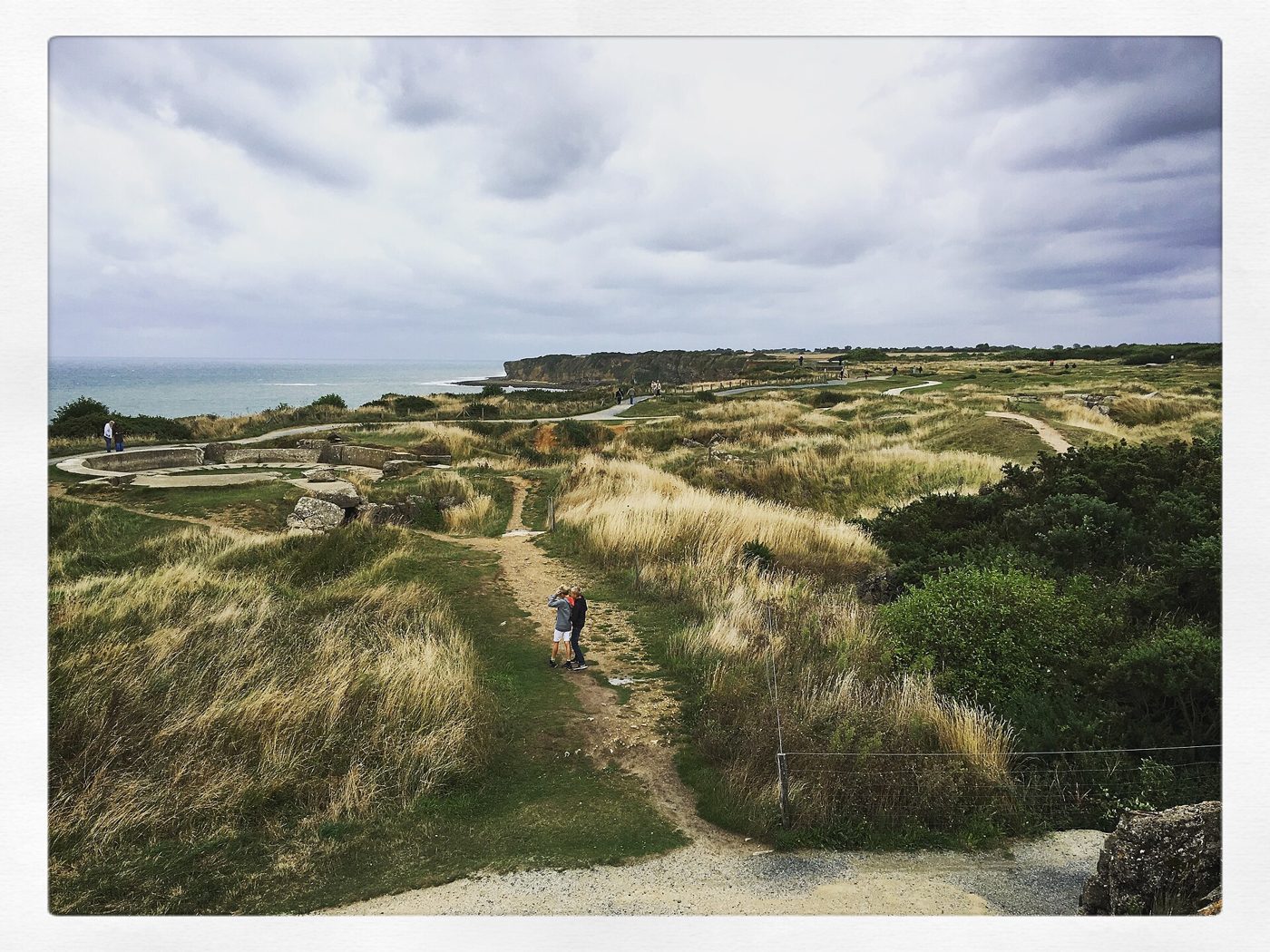
Pointe du Hoc
Free, with free parking, and open 09:00 to 18:00 from 1 April to 30 September and 09:00 to 17:00 the rest of the year. The clifftop has been left cratered, and walking it is the closest the coast gets to showing you what happened rather than telling you. Give it an hour. Wear something with grip; the paths are uneven and the wind off the Channel is serious even in July.
Arromanches and the Mulberry harbour
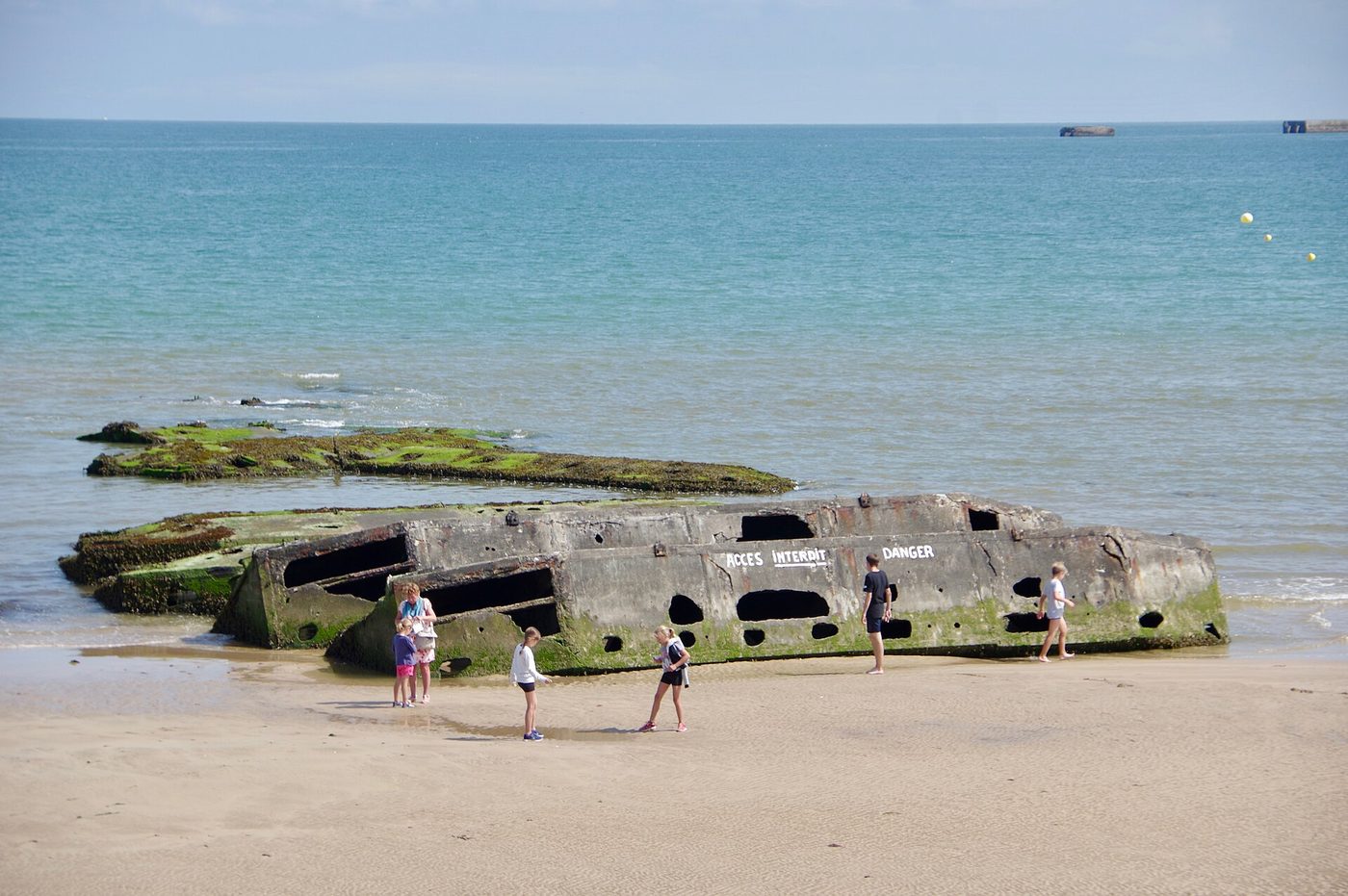
Arromanches is where the engineering story lives. The concrete caissons of the artificial Mulberry harbour are still sitting in the bay, visible from the seafront and walkable at low tide. The Musee du Debarquement moved into a new building in April 2023 and charges €12.90 for adults, €8.30 for children and students aged 6 to 18, €9.70 for veterans and serving military, and €37 for a family of two adults and two children, with extra children at €4 and free entry for disabled visitors. The audioguide is included, the average visit runs an hour and a half, and tickets are sold only at the museum’s own ticket office, which shuts 45 minutes before the museum does.
Hours shift by month: 10:00 to 17:00 in November, December and February; 09:30 to 17:30 in March and October; 09:00 to 18:00 in April and September; and 09:00 to 19:00 from May to August. Sundays open at 10:00 except in June, July and August. It is closed on 24, 25 and 31 December, and closed for the whole of January, which catches out winter visitors every year.
Up on the cliff, Arromanches 360 runs a twenty-minute film on the Battle of Normandy across nine screens in a circular cinema. Full rate is €7 for ages 19 to 65, €6 for 10 to 18, students, over-65s, teachers, military and carers, and there is a €17 Family Pass. Under-10s, disabled visitors, veterans and jobseekers go free. A combined ticket with the Caen Memorial is €24.
Longues-sur-Mer
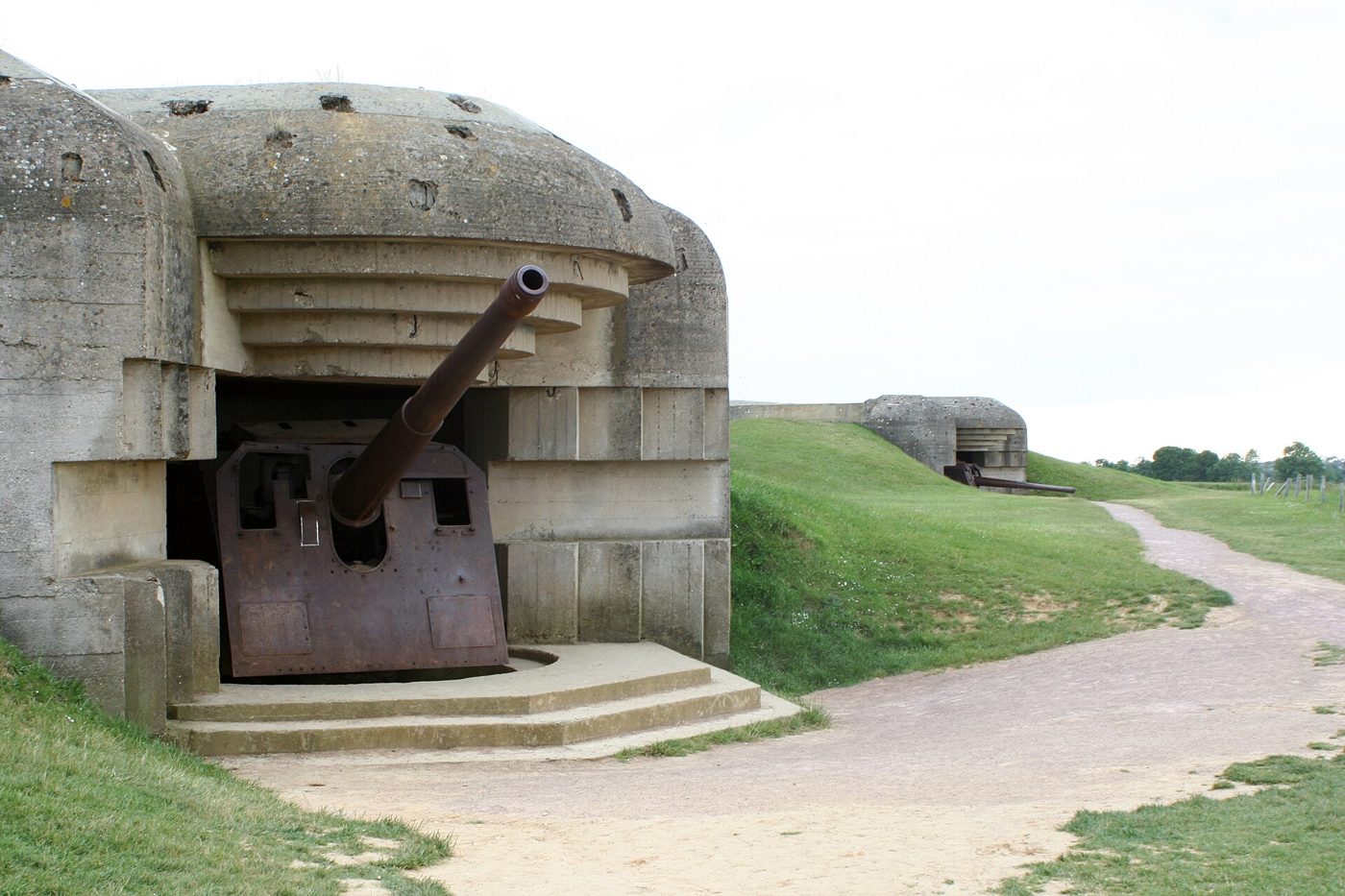
The best free stop on the coast, and the one that gets skipped. The German battery at Longues-sur-Mer still has its naval guns sitting inside their casemates, which is rare: most Atlantic Wall sites are empty concrete. The site is open all year and free to walk. Guided tours run April to October, an hour long, at roughly €5 for adults and €3 for children, in English at 10:15 and 14:15 and in French at 11:30, 15:30 and 16:45.
Utah Beach and Sainte-Mere-Eglise
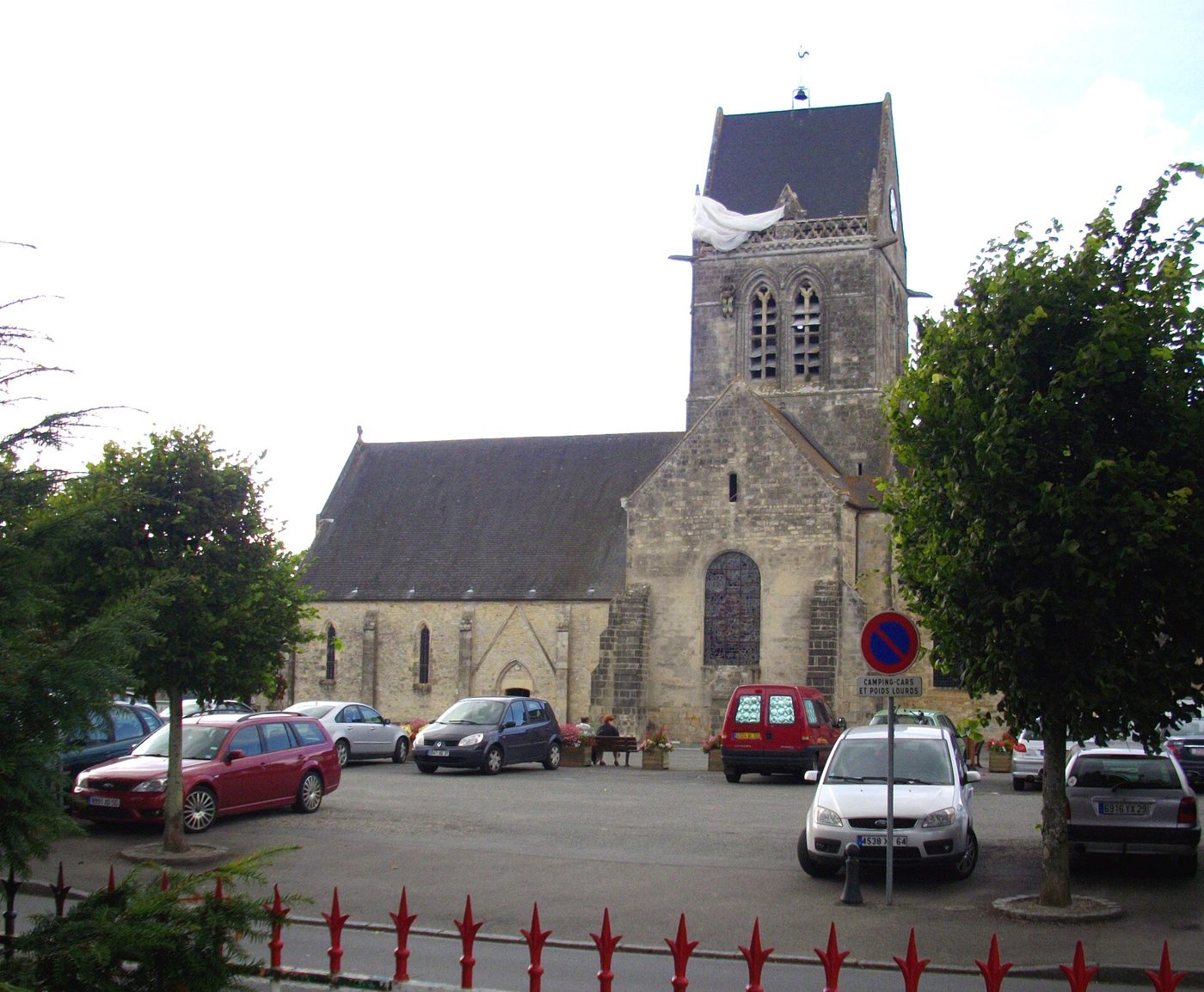
These two sit on the Cotentin, well west of the Bayeux cluster, and they need their own half day. The Utah Beach Museum is built into the dunes where the landing happened and costs €10 for adults. Twenty minutes inland, Sainte-Mere-Eglise was the first town liberated, and the dummy paratrooper still hangs from the church tower where John Steele’s parachute caught. The Airborne Museum there is around €11.50 for adults and €7.50 for children, free under 6, with a family rate of about €33 for two adults and two children. Confirm on airborne-museum.org before you go; the museum does not publish a single consolidated tariff page.
Juno, Pegasus and the eastern end
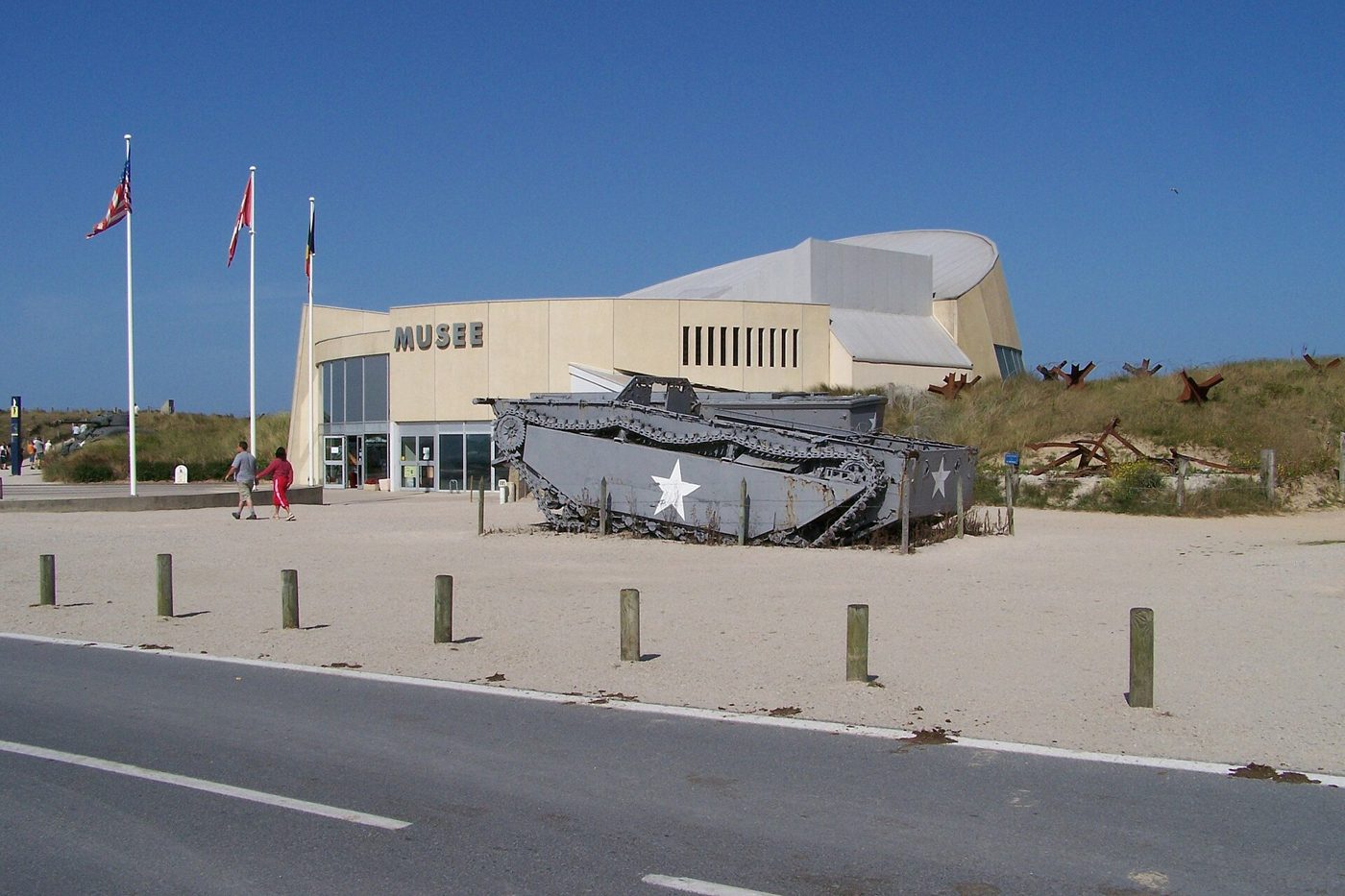
The Juno Beach Centre at Courseulles-sur-Mer is the Canadian museum and the only one on the coast that tells the story from a Canadian angle, which is a gap most visitors do not realise they have. General admission is €9, reduced €7, and there is a €6 “low carbon” rate for visitors who arrive without a car. Add the bunker tour and it is €13.50, €11.50 reduced, €10 low carbon.
Memorial Pegasus, near Benouville, covers the glider landing at Pegasus Bridge in the first minutes of 6 June. Adults €9.50, children 8 to 18 and students €6, free under 8.
Is the Caen Memorial worth €20.80?
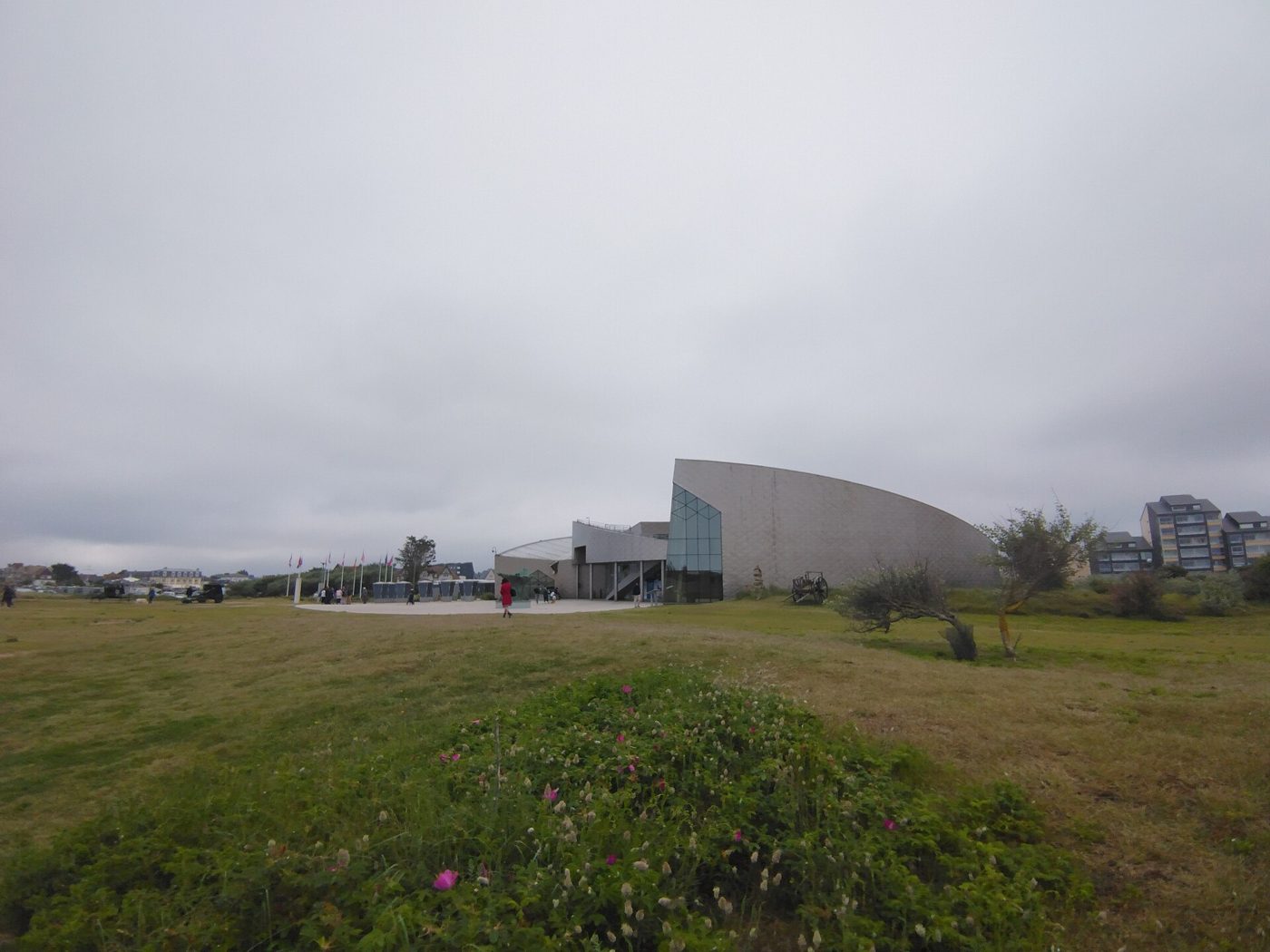
It is the most expensive single-site admission in this guide at €20.80 for an adult, and it is the one I would still buy. The Memorial de Caen is not a D-Day museum; it runs from the failure of the peace in 1918 through the Second World War to the Cold War, and it gives the beaches a shape that the small coastal museums cannot. Three hours, minimum. Opening hours vary through the year, broadly 09:00 to 19:00 from 1 April to 30 September and 09:30 to 18:00 in the winter shoulders, with on-site ticket sales closing an hour and a quarter before the doors. It closes for most of January, reopening around the 27th.
If you are doing both, the Arromanches 360 combined ticket at €24 is the obvious saving. There is also the Explore Normandy Pass, which gives discounts across more than sixty D-Day and Battle of Normandy sites plus exclusive audio content, and a smaller cross-promotion where an adult ticket to the Airborne Museum or Memorial Pegasus knocks €1 off adult admission at Arromanches, and the other way round.
Guided tours: what they cost and when they are worth it
A small-group full-day tour of the American sector from Bayeux ran at roughly €155 per person in early 2026, with private full-day tours from about €92 per person based on a group of six. Half-days sit at roughly €85 to €90 per person. That is real money for a family of four, and the sites themselves are mostly free, so the honest answer is: a guide is worth it if you want the narrative and the sequencing, and skippable if you have read anything at all and are happy with a car and the museum audioguides. If you have one day and no car, take the tour. If you have three days and a car, do it yourself and spend the difference on the Caen Memorial.
The 6 June anniversary
If your dates land on 5 or 6 June, know what you are walking into. The RN13, the D514 coastal road and the D517 close to normal traffic on 6 June, with heavy jams and town-centre restrictions on both days around Omaha Beach, Utah Beach and Bayeux. Accommodation and restaurants need booking a long way ahead, and catering on the beaches themselves is limited and overwhelmed during ceremonies. The ceremonies are extraordinary. The logistics are not. Decide which you came for.
And a plain winter warning: many D-Day museums close in January. If January is your only window, build the trip around the free sites, the Caen Memorial once it reopens around 27 January, and Rouen, which keeps going year round.
Rouen and the Seine valley
Rouen is the one I would defend hardest against people who think Normandy means beaches. It is an hour and a half from Paris Saint-Lazare, it is a UNESCO City of Gastronomy, and its museums are free. On the strength of the last of those alone it deserves a place among the best cities to visit in Europe.
Free, with no ticket at all. The Musee des Beaux-Arts, which holds what is described as the second-largest Impressionist collection in France, charges nothing for its permanent collections, because it is one of twelve free museums in the Reunion des Musees Metropolitains network. So is the Musee Le Secq des Tournelles, an ironwork museum in a deconsecrated church that is far stranger and better than that description suggests.
Two closures to plan around, and they are not small ones. The Musee des Antiquites and the Museum d’Histoire Naturelle are closed until 2028 for renovation, and the Musee de la Ceramique is closed until further notice for technical reasons. If any of those three were on your list, take them off.
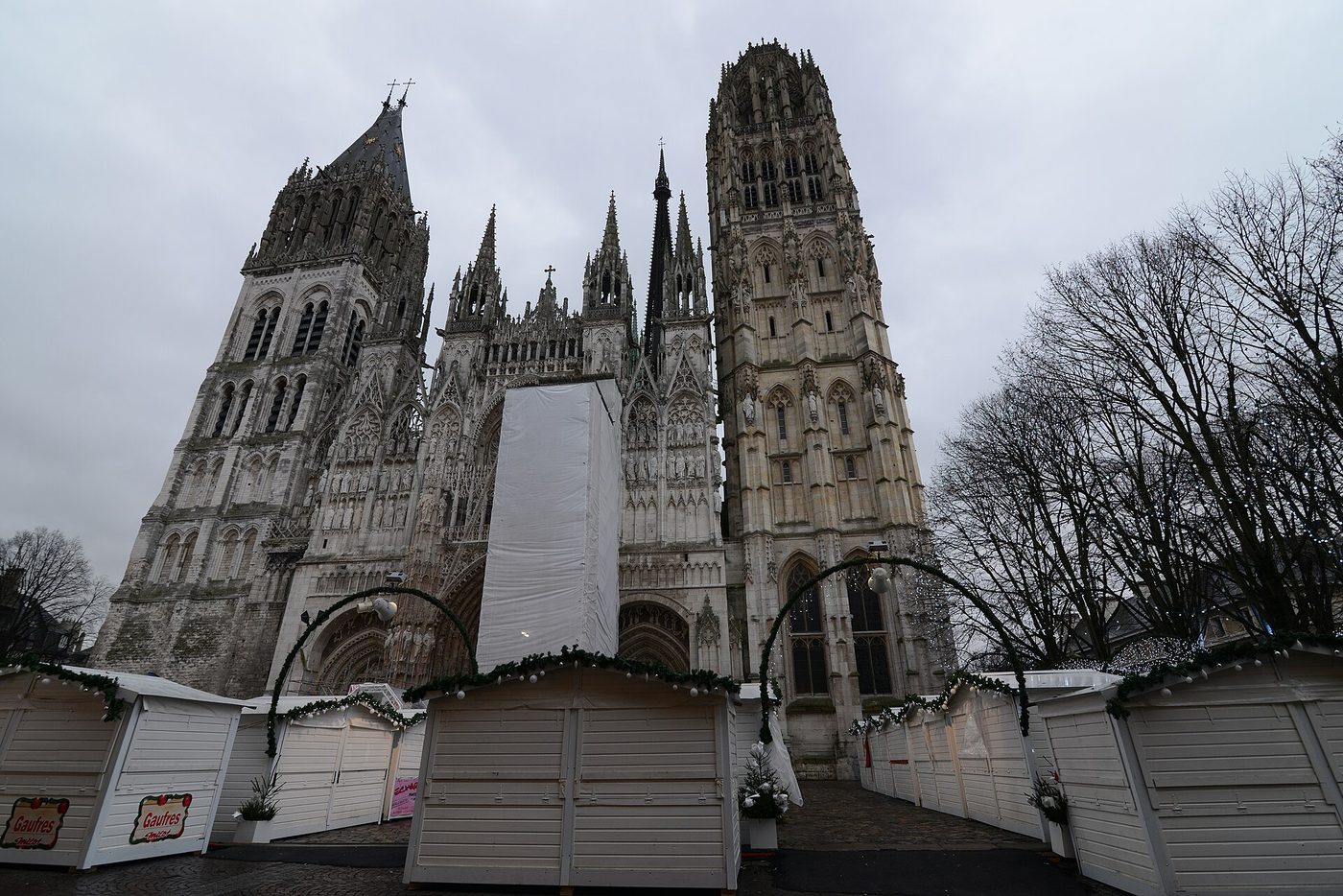
The cathedral is free to enter, with charges only for some special exhibitions and guided tours. This is the facade Monet painted more than thirty times in different light, and standing in front of it at four in the afternoon in October you understand exactly why. In summer the city projects “Cathedrale de Lumiere” onto the west front after dark, which is free and which I would rearrange an evening for.
Elsewhere in the centre: the Gros-Horloge, a great gilded astronomical clock spanning the street with a movement made in 1389 and thought to be among the oldest in France, costs around €8 to climb. The Historial Jeanne d’Arc, in the old archbishop’s palace where the trial and the rehabilitation both happened, is €12 full and €9 reduced, open Tuesday to Sunday 10:00 to 19:00. Joan was burned in the Place du Vieux-Marche in 1431; the modern Eglise Sainte-Jeanne-d’Arc on that square, with its swooping roof, divides opinion sharply and is worth ten minutes of yours.
Eat the duck. Canard a la rouennaise is the city’s dish and it is a strange one: the duck is part-roasted, the breast and legs removed, and the carcass then pressed in a duck press to extract blood and marrow for the sauce. It is not for everyone. It is also not something you will find done properly anywhere else.
Giverny: Monet’s garden, and the season that catches people out
Giverny is at the Paris end of the Seine valley, closer to Paris than to Bayeux, and it works far better as a day out from Rouen or Paris than as a Normandy stop. The critical detail is the season. Monet’s House and Gardens are open every day from 1 April to 1 November 2026 and closed the rest of the year. Every autumn someone arrives in mid-November and finds a locked gate.
Hours are 10:00 to 18:00 with last admission at 17:30. Admission is €13 for adults, €7 for children aged 7 to 17 and for students, €6 for visitors with a disability, and free under 7 except for school groups. The ticket covers the house, the Clos Normand flower garden and the water garden with the lily pond and the Japanese bridge. Private guided tours are €230 per party on top of admission. Allow an hour and a half to two hours unguided.
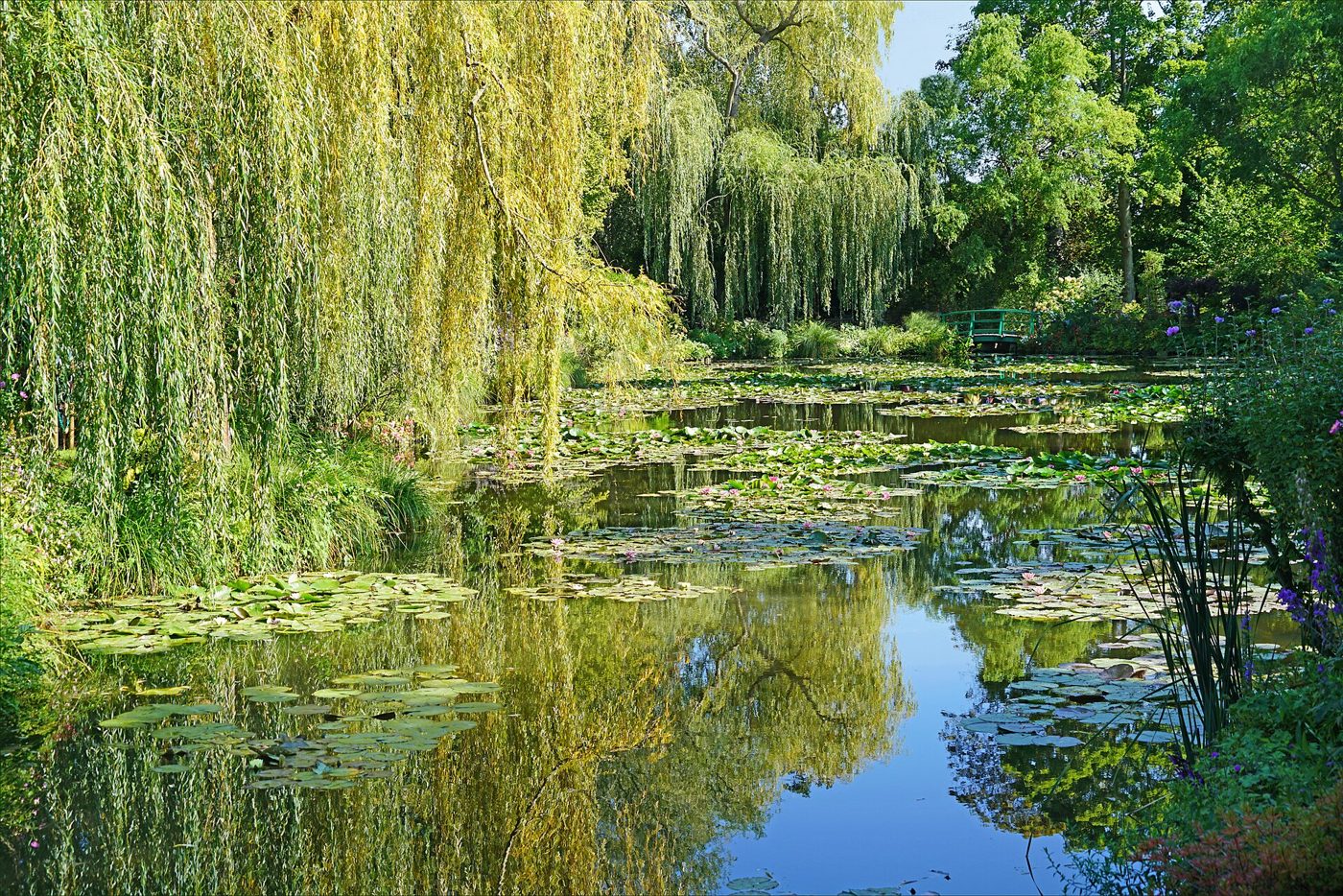
For the water lilies specifically: they start flowering in late May and peak through June. July is still good but past its best, September thins out, and October gives you the last blooms. If the lily pond is the reason you are going, aim for June.
The Musee des Impressionnismes is next door and runs a first-Sunday-of-the-month free admission. Its adult admission is quoted inconsistently across ticket resellers, so check mdig.fr directly before you go.
The Alabaster Coast: chalk cliffs and Perret concrete
North and east of the Seine estuary the coast turns into white chalk, and the mood changes completely. This is the Cote d’Albatre, and it is windier, emptier and more dramatic than the resort coast to the south.
Start with Etretat: the Falaise d’Amont and Falaise d’Aval, the natural arch and the free-standing Aiguille, or Needle. Walking it is free. The GR21 path links Yport and Etretat in about three hours, and the shorter Porte d’Amont loop takes roughly an hour. Above the arch, Les Jardins d’Etretat charge €12.90 in April, May, June, September and October and €11 in March and November, rising to €14 in peak season, 8 July to 30 August, when entry is by timed slot and worth booking online. Teenagers 15 to 17 pay €10, children 8 to 14 pay €8, disabled visitors €9, and under-8s nothing. A €20 Flex ticket lets you turn up whenever you like in peak season. The gardens are a Marmite proposition: clipped topiary that some people find brilliant and others find a distraction from one of the best coastal views in France.
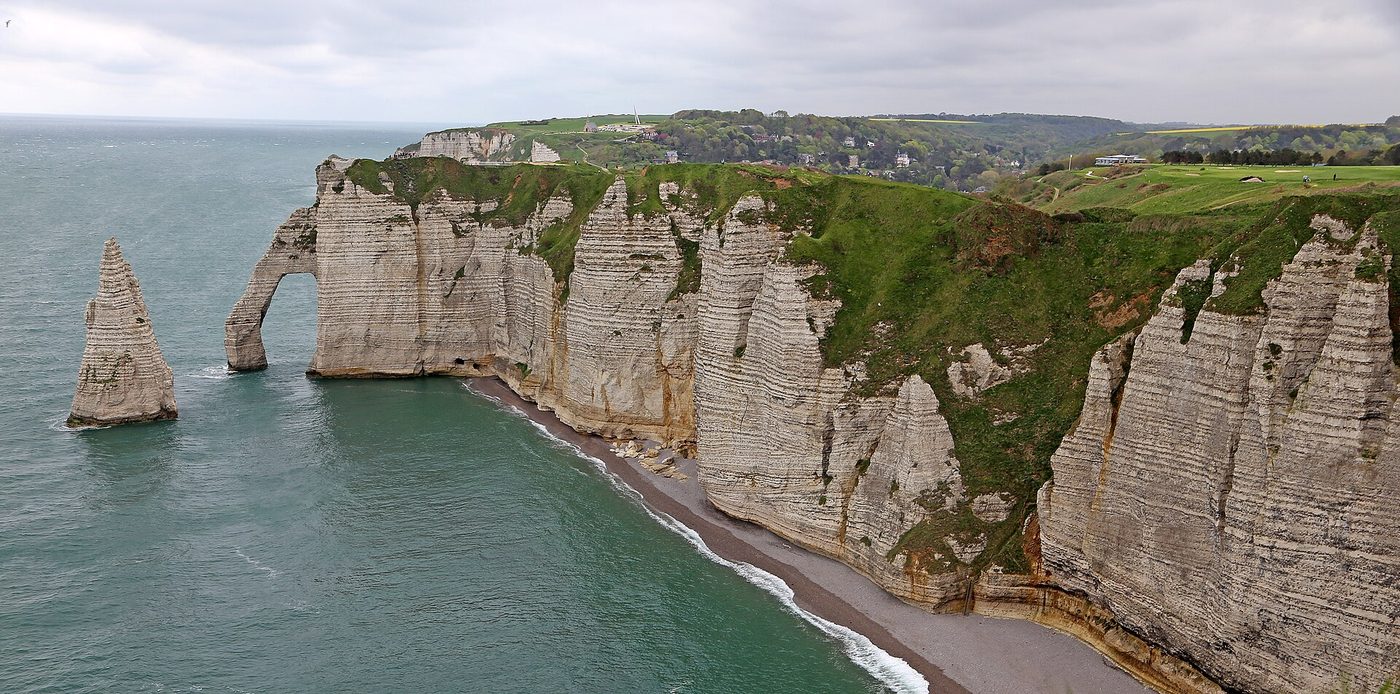
Fecamp has the Palais Benedictine, a wildly over-the-top neo-Gothic building that is both distillery and museum for Benedictine liqueur, from €19 for adults, €8 for ages 12 to 17 and free for under-12s, with a longer connoisseur tasting at €25. There is also the Abbatiale de la Trinite, the Musee des Pecheries and the cliffs and wartime bunkers at Cap Fagnet.
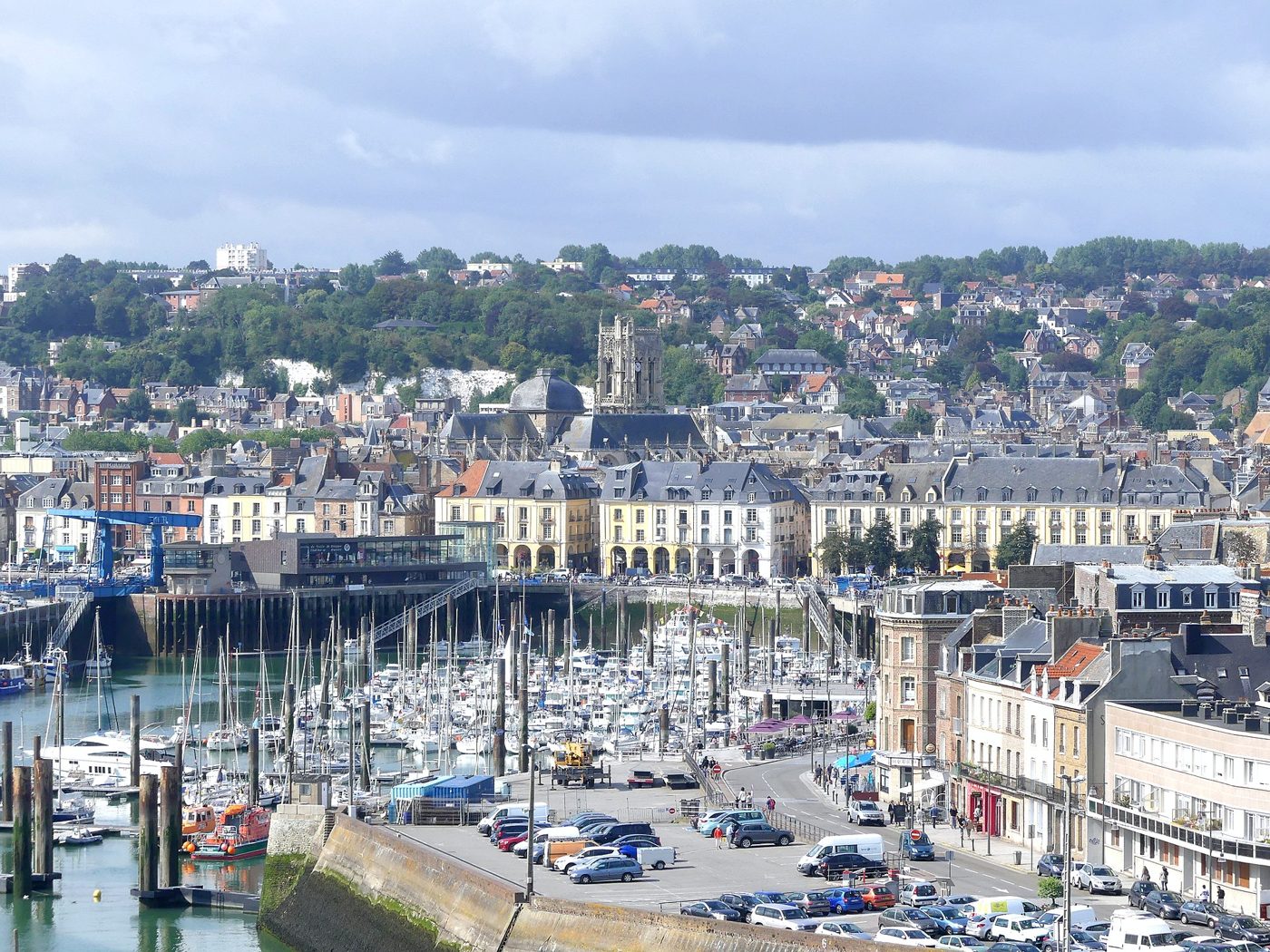
Dieppe claims to be the oldest seaside resort in France, has a castle museum on the cliff above the town, and is the Channel port for Newhaven. It is a working town rather than a pretty one, which is exactly why I like it. It also carries a second, harder war story: the disastrous Anglo-Canadian raid of 19 August 1942, which cost the Canadian regiments dearly and fed directly into the planning for 1944. If you are visiting Juno Beach for the Canadian side of D-Day, Dieppe is the other half of that sentence.
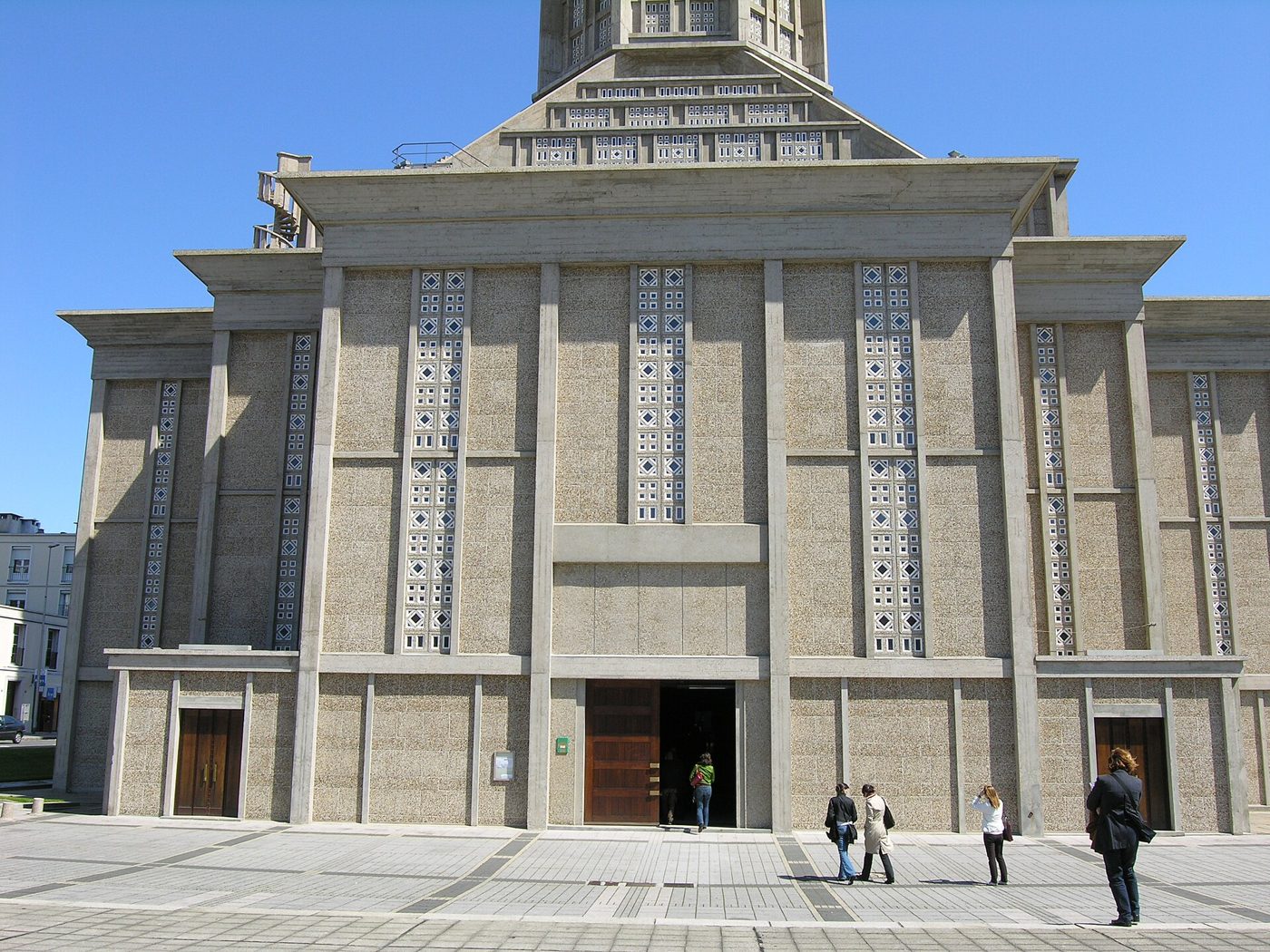
Then there is Le Havre, which nobody expects to like. Bombed almost flat in 1944, its centre was rebuilt by Auguste Perret across 133 hectares from 1945 until his death in 1954, with work continuing to 1964, and the result was inscribed on the UNESCO World Heritage List on 15 July 2005. Reinforced concrete, laid out on a grid, and far more beautiful in person than that sentence sounds. The Perret show apartment, restored as a 1950s interior, is visited from the Maison du Patrimoine at 181 rue de Paris and needs booking ahead. MuMa, the Musee d’art moderne Andre Malraux, holds a major Impressionist collection right on the seafront.
And Veules-les-Roses, between Dieppe and Fecamp, is a genuine oddity: one of France’s most beautiful villages, and a fair rival to anything in our most beautiful towns in Europe round-up, built along the Veules, said to be the shortest river in France at about 1.2 km. The riverside loop runs roughly 3 km and takes an easy hour.
The Flowered Coast: Honfleur, Deauville, Trouville, Cabourg
South of the Seine estuary the coast softens into the Cote Fleurie, and this is the Normandy of striped parasols and long weekends from Paris.
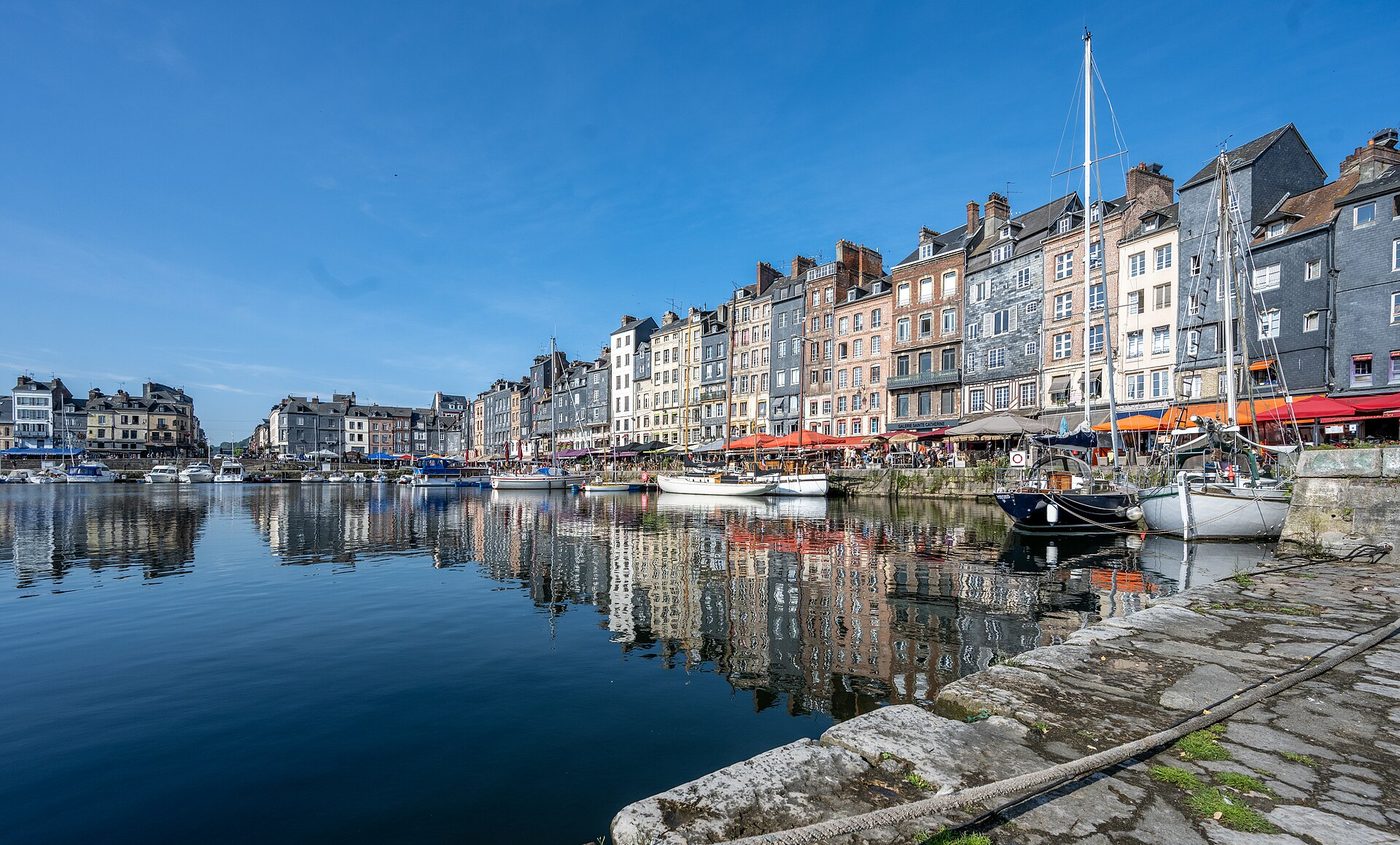
Everybody photographs Honfleur, and deservedly. The Vieux Bassin is ringed with impossibly tall, narrow slate-fronted houses, and Eglise Sainte-Catherine, just behind it, is France’s largest and oldest church built entirely of timber, put up by shipbuilders in the 15th century, with a ceiling like two upturned hulls. It is free to enter. Honfleur is also Impressionist ground zero: Eugene Boudin was born here and taught Monet to paint outdoors, and the Musee Eugene Boudin is the town’s main art museum.
Honfleur’s problem is its success. Go on a weekday, go early, and if you can only manage a summer Saturday, go at eight in the morning and have breakfast on the quay before the coaches land.
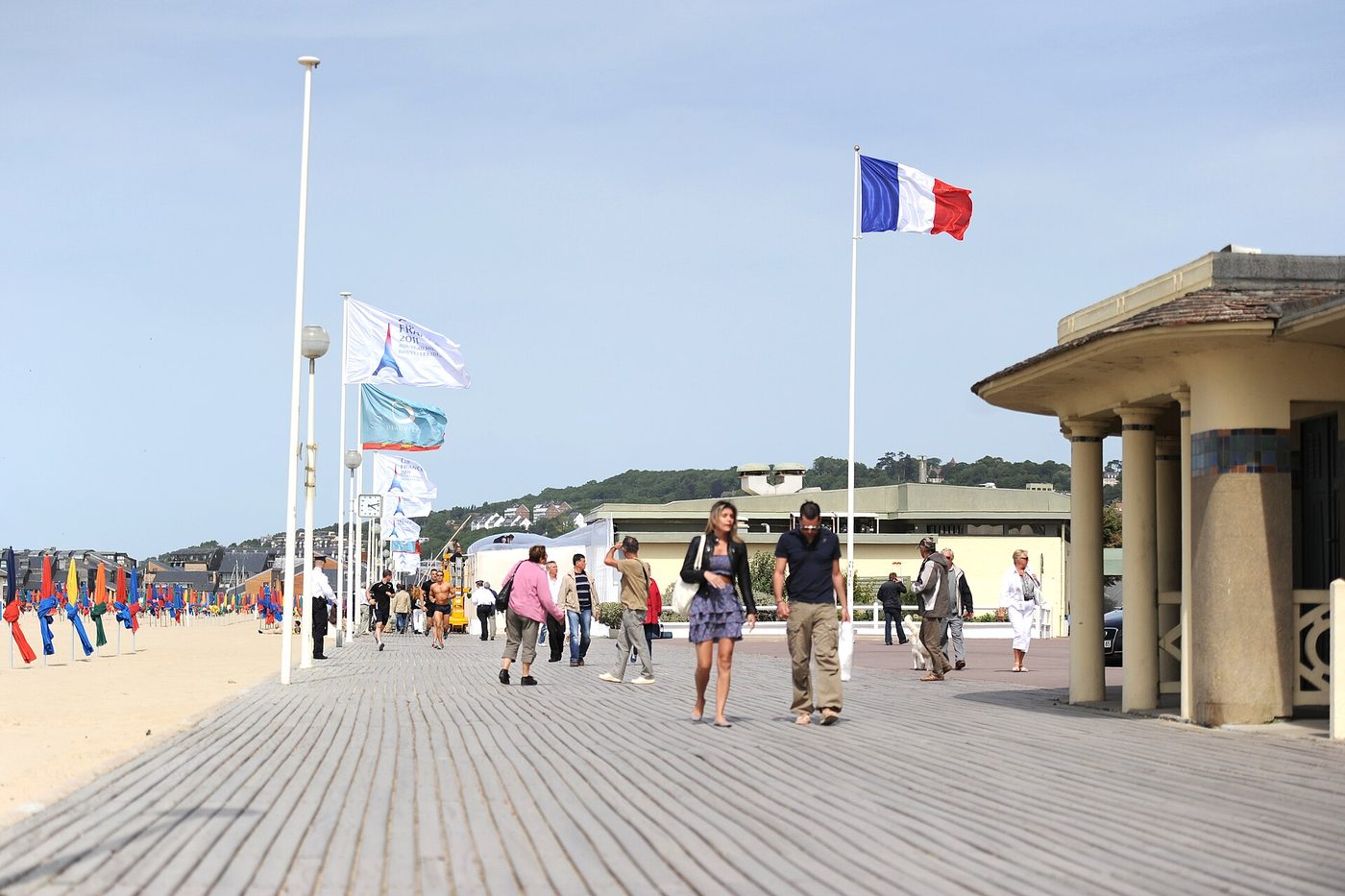
Deauville supplies the glamour: Les Planches boardwalk with its coloured parasols and cabins named after film stars, a casino, two racecourses, golf and polo, and the American Film Festival, whose 52nd edition runs 4 to 13 September 2026 with around a hundred American films over ten days. Walking the boardwalk is free and takes an afternoon.
Trouville, across the Touques, is the working fishing port and the better place to eat, with a seafront associated with Proust and Marguerite Duras. Cabourg is Proust proper: the Grand Hotel where he wrote parts of A la recherche du temps perdu still stands on the front.
Caen: the unglamorous, sensible base
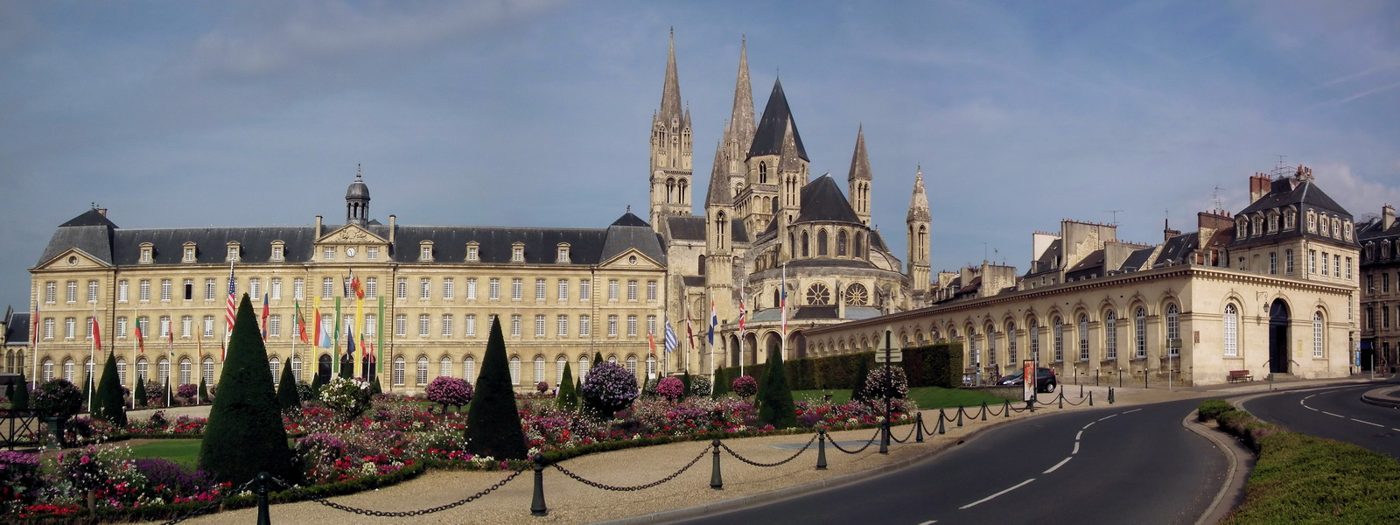
Caen took a terrible beating in 1944 and rebuilt itself in pale Caen stone. William the Conqueror founded the Abbaye aux Hommes and his wife Matilda the Abbaye aux Dames, and both survived the bombing. The city has the Memorial, the best rail links in Lower Normandy, the ferry port at Ouistreham twenty minutes away, and prices well below Bayeux or Honfleur.
It is not the prettiest town in this guide. It is the most practical one, and if you are doing the landing beaches on a budget, that matters more.
Cider, calvados and the four cheeses
Normandy runs on cream, Camembert, cider and calvados, which is how the region describes its own four Cs. The cooking is butter and apples and dairy rather than olive oil and tomatoes, and if you have come from the south of France it will feel like a different country.
The region has four AOP cheeses: Camembert de Normandie, made exclusively from raw milk; Livarot, wrapped in five bands of reed, which is why it is nicknamed the colonel; Pont-l’Eveque, a Pays d’Auge cow’s-milk cheese developed by Cistercian monks in the 12th century; and Neufchatel, one of the oldest of the lot, with written records from the 11th century and AOC status since 1969.
The Route du Cidre is a signposted 40 km loop through the Pays d’Auge linking Beuvron-en-Auge, Cambremer, Bonnebosq and Beaufour-Druval, with more than twenty cider farms along it and participating producers carrying the “Cru de Cambremer” label. It sits at the heart of the AOP Cidre Pays d’Auge zone. Tastings of cider, pommeau and calvados are free, with the understanding that you buy at least a bottle of cider, around €4. It is one of the best-value days out in France, and it is also the reason to nominate a driver.
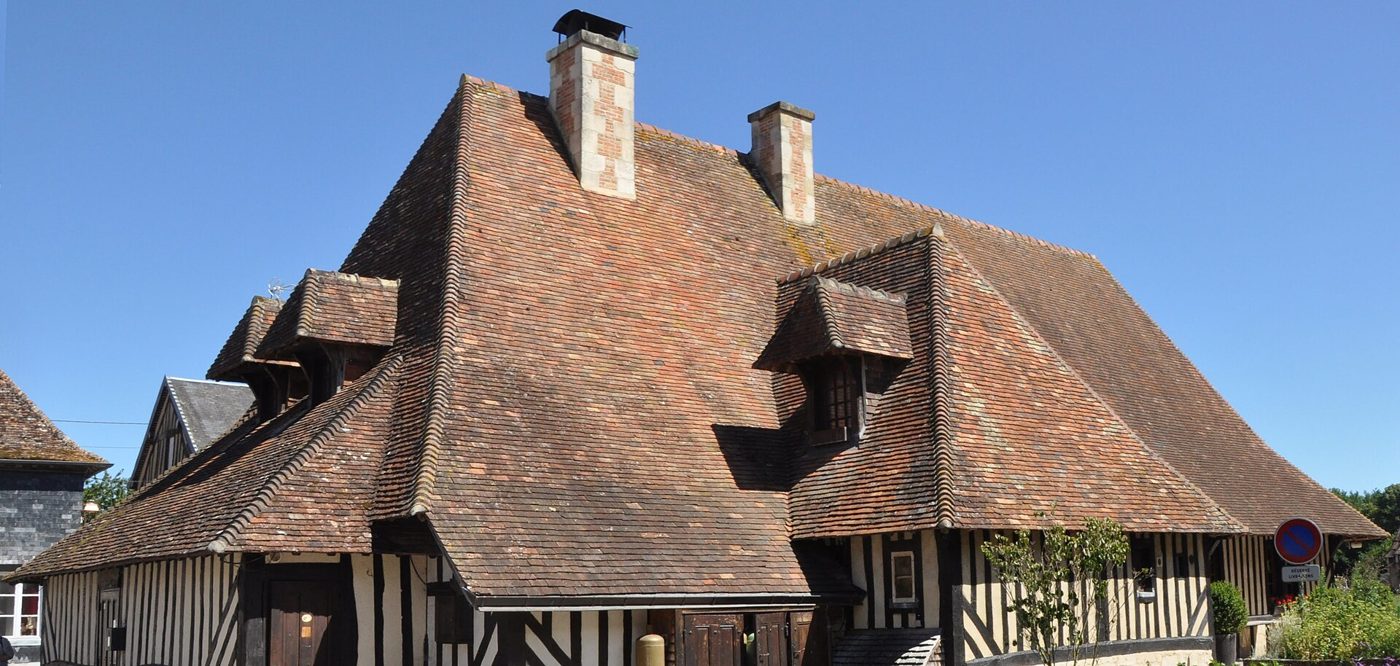
What to look for once you are in it: pommeau, apple juice blended with calvados and aged in oak; calvados itself, which takes its name from the Calvados department but whose AOC zone is far wider, taking in Manche and Orne and reaching into Eure, Seine-Maritime, Mayenne, Sarthe and Oise; there are three appellations, plain Calvados, Calvados Pays d’Auge and Calvados Domfrontais, and the Pays d’Auge one is the one to look for; the trou normand, a shot of calvados taken mid-meal to reset the palate, which is not a tourist gimmick but a real habit; teurgoule, rice slow-baked in milk with sugar and cinnamon until the top goes dark; and andouille de Vire, a chitterling sausage made from pig intestines and Guerande sea salt, which is a genuine acquired taste and which I would order anyway.
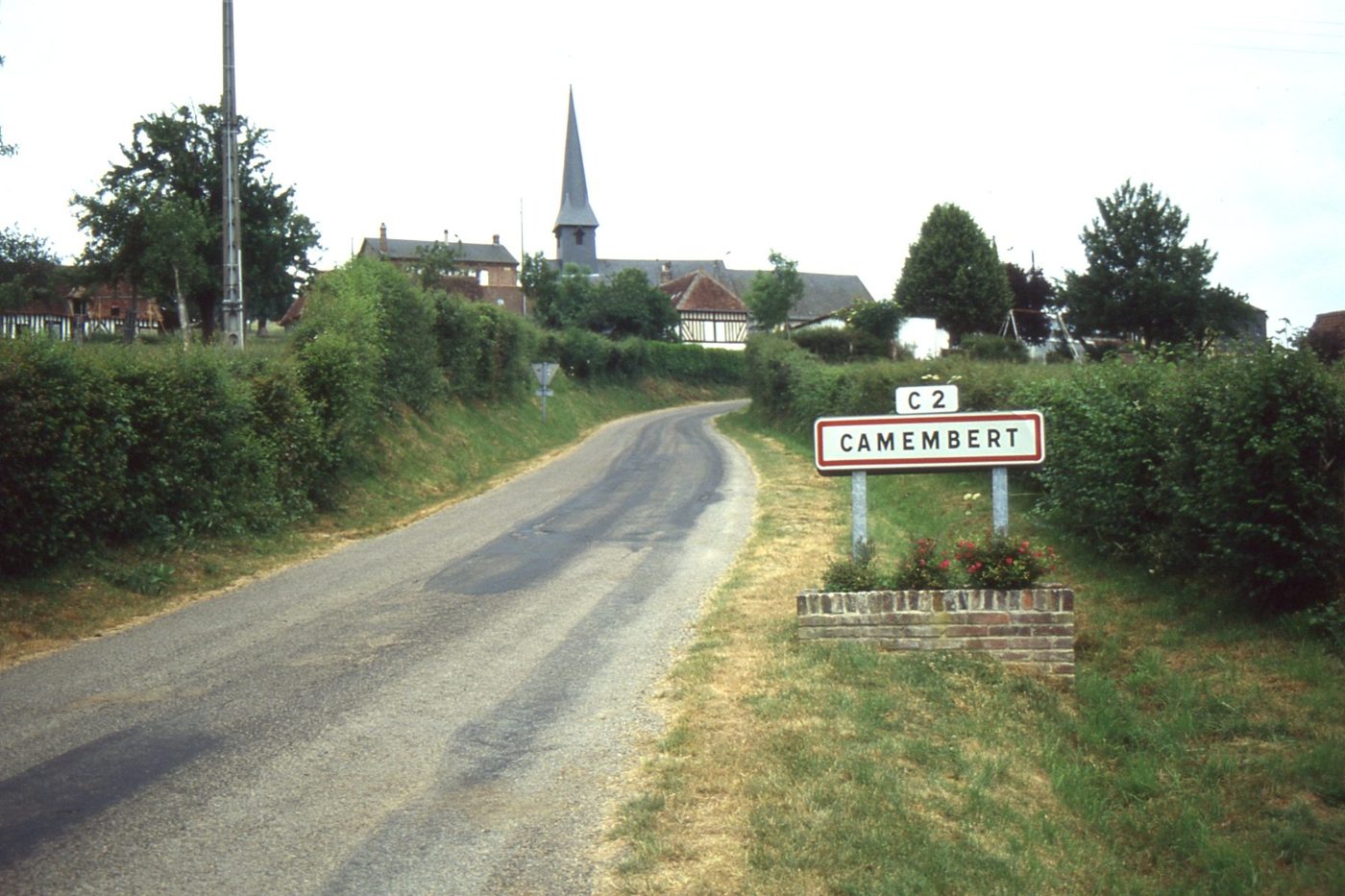
Around 800 apple varieties are grown in the region. The village of Camembert itself is a real place in the Orne, small and unassuming, and driving into it past the road sign is a mildly ridiculous pleasure.
Getting to Normandy, and moving around once you are there
Almost all the trains from Paris leave from Gare Saint-Lazare, not Montparnasse, with the important exception of Mont-Saint-Michel.
| Route | Typical time | Fastest | Frequency | Rough fare |
|---|---|---|---|---|
| Paris Saint-Lazare to Rouen | About 1h28 | About 1h13 | Roughly 33 a day | From roughly €11 |
| Paris Saint-Lazare to Caen | About 2h36 | About 1h55 | About 20 a day | From roughly €19 |
| Paris Saint-Lazare to Bayeux | About 3h25 | About 2h12 | 13 to 15 a day | From about €11 on TER |
| Paris Montparnasse to Mont-Saint-Michel via Rennes | About 3h total | TGV 1h30 plus bus 1h10 | Three buses a day each way, Apr–Sep | Varies |
| Paris Montparnasse to Mont-Saint-Michel via Villedieu or Pontorson | 4h to 4h30 | Train 2h50 plus bus 45 min | Once daily, year round | One through ticket |
Note the departure station. The Villedieu and Pontorson route has one feature worth knowing: it is a single through ticket covering train and bus, and the bus waits for a late train. There is also a direct summer service to Pontorson. The Rennes route is faster but the bus only runs April to September.
By sea from England, four routes land you in Normandy. Portsmouth to Caen, arriving at Ouistreham, is six to seven hours by day and 6h45 to 7h30 overnight, sailing every day of the year. Portsmouth to Le Havre averages about 5h30, Portsmouth to Cherbourg about three hours, and Newhaven to Dieppe about four hours with multiple daily sailings year round. Bringing a car on a ferry costs more than the train but solves the whole transport problem in one move. Our guide to getting around Europe and the European train travel guide go deeper on both.
Do you need a car? Mostly yes
Rail and bus links between the big towns are good. Public transport to the smaller places, and specifically to the landing beaches and the cider villages, is fragmented to the point of being impractical. If your trip is Rouen plus Caen plus Bayeux, trains are fine. If it includes Pointe du Hoc, Longues-sur-Mer or the Route du Cidre, hire a car or book a tour. If you would rather build the whole trip around driving, see our Europe road trips guide.
Hire costs vary sharply by pick-up point. In Caen, small cars start from around €28 a day, SUVs from €45 and people carriers from €59. In Bayeux the same categories start around €49, €56 and €79. Picking up in Caen and dropping in Caen is meaningfully cheaper than doing the same in Bayeux, and the two are twenty minutes apart by train.
On the roads: the A13 and A14 from Paris to Normandy are now barrier-free. There are no toll booths. Cameras read your plate and you pay online within 72 hours, which is fine if you know about it and an expensive surprise if you do not, especially in a hire car. French motorway tolls average about €9.50 per 100 km, and payment can also be made at a partner tabac if you would rather not do it online. Fuel prices in France in mid-2026 were reported inconsistently across sources, so I am not going to quote a per-litre number I cannot stand behind. What is reliable: motorway service stations typically run 15 to 20 cents a litre above the national average, so fill up at a supermarket before you join the autoroute. Two other driving habits worth adopting here. Small-town kitchens generally stop serving lunch around 14:00 and do not reopen until 19:00, so eat when Normandy eats or go hungry. And plan Sundays around the fact that most shops, including many supermarkets, close for the day.
What Normandy costs in 2026
The money side, itemised.
| Cost | 2026 figure | Notes |
|---|---|---|
| Taxe de séjour | National bracket €0.20 to €15.93 per person per night | €0.20–€4.90 municipal, rising to the €15.93 ceiling only once departmental and regional surcharges apply. Minors are exempt and are not counted |
| Île-de-France surcharge | 200% regional surcharge since 2025 | Does not apply in Normandy. That surcharge is a Paris problem |
| Hotels | Deals from roughly €55 a night; March is the cheapest month at roughly €125 average | Averages are dragged up by business travel in the cities, so rural rates run lower |
| Chambre d’hôtes | About €90 for two, €120 for three to five, breakfast included | The best-value option outside the towns |
| Restaurant menu du jour | €16–€28 for three courses; €14–€22 rurally | Lunch is far better value than dinner almost everywhere |
| Cider tasting | Free | Buy a bottle, about €4 |
| Car hire, Caen | Small from €28/day, SUV from €45, MPV from €59 | Cheaper than Bayeux across every category |
| Car hire, Bayeux | Small from €49/day, SUV from €56, MPV from €79 | Dearer than Caen in every category; the two are 20 minutes apart by train |
| Motorway tolls | About €9.50 per 100 km on average | A13/A14 to Normandy is free-flow: pay online within 72 hours |
| Mont-Saint-Michel parking | About €22–€28 a day in high season | 2025 tariff was €16 Nov–Feb, €23 Mar–Jun and Sep–Oct, €27 Jul–Aug. Free from 18:30 in low and mid season |
| D-Day tour, full day | Roughly €155 pp small group; private from about €92 pp based on six | Half-day roughly €85–90 pp |
Two border rules that changed while you were not looking
If you hold a non-EU passport, two things are different from your last trip.
EES is live. The EU Entry/Exit System began rolling out on 12 October 2025 and became fully operational on 10 April 2026. Physical passport stamping is gone, replaced by biometric registration: facial image and fingerprints taken at the border for non-EU nationals on short stays. In practice this means your first crossing after the switch takes longer than you expect. Build in time at Saint-Pancras, at the ferry terminal and at Charles de Gaulle. Our guide to planning a Europe trip has the full pre-departure sequence.
ETIAS is not live yet, and it has no start date. As of late September 2026 it has not started, and the EU says it will announce the date several months before launch; press reports point to 2027. It will cost €20, and once it begins, holding one is optional for at least six months before a six-month grace period. If you are travelling in 2027 or later, check the status before you book, because a trip that needs nothing today may need a €20 authorisation by the time you fly. Our guide to the Schengen visa and ETIAS tracks the detail.
When to go, and what the weather does
May, June, September and October are the sweet spot: comfortable temperatures, long enough days, lighter crowds. June to August is peak, and July and August on the Cote Fleurie mean French holiday traffic on top of international visitors.
The numbers, for Caen, which is representative of the coast:
| Measure | Figure |
|---|---|
| Annual rainfall | About 811 mm |
| Wettest month | December, about 82 mm |
| Driest month | March, about 61 mm |
| July average high | About 24°C |
| January average | About 9°C, that is the average daily high, not the mean |
| June average | 15.8°C mean, 11.2°C min, 20.5°C max |
| June daylight | About 16 hours 10 minutes |
| June sunshine | About 215 hours in the month, 7.2 hours a day |
| December sunshine | About 60 hours in the month |
| Sea temperature | 7°C in February rising to 18°C in August |
Read that sea temperature line twice before you pack swimming things. Eighteen degrees in August is the warmest it gets. Normandy beaches are for walking, and for the ten minutes of bravado you will regret. For actual swimming, see the best beaches in Europe.
The rainfall spread is gentler than the reputation suggests: 811 mm a year, with December, the wettest month at about 82 mm, only 21 mm ahead of March at about 61 mm. That is a region with no dry season rather than a region that is constantly soaked. Changeable is the right word, and changeable light is exactly why the Impressionists came. Our best time to visit Europe guide sets it against the rest of the continent.
Dates worth planning around
| Event | When | Why it matters |
|---|---|---|
| Normandy Impressionist Festival, 6th edition | 29 May to 27 September 2026 | Marks the centenary of Monet’s death; the first fully contemporary programme |
| Deauville American Film Festival, 52nd edition | 4 to 13 September 2026 | Around a hundred American films over ten days; book Deauville beds early |
| Armada de Rouen | 17 to 27 June 2027 | Free site access and free daytime boat visits; the city fills completely |
| D-Day anniversary | 5 to 6 June, annually | Major road closures on the RN13, D514 and D517 |
| Highest tides at Mont-Saint-Michel | Around the equinoxes, 20–21 March and 22–23 September | Sea covers the esplanade only above coefficient 110 |
The Impressionist Festival is the one to build a 2026 trip around if you have any interest in the painting. It runs the length of the summer, it covers Rouen, Le Havre, Giverny and Honfleur, and it is the centenary year.
Where to base yourself
Normandy is too spread out for one base to serve everything, but two bases will cover almost any trip, and our where to stay in Europe guide covers the general principle. Here is how the candidates compare.
| Base | Best for | Weak for | Car needed? | Verdict |
|---|---|---|---|---|
| Bayeux | The D-Day beaches, the Bessin, walkable and small | Rouen, the Alabaster Coast, Giverny; dearer car hire | Strongly recommended | The default for a war-focused trip |
| Caen | The Mémorial, rail links, the Ouistreham ferry, cheaper hire cars and beds | Charm; it is a rebuilt working city | Helpful but not essential | The value pick |
| Rouen | Cathedrals, free museums, food, easy Paris access, Giverny | Two hours from the landing beaches | Not for the city itself | Best for a first, short trip |
| Honfleur | Atmosphere, the Flowered Coast, Le Havre and Étretat | Prices, summer crowds, distance to the beaches | Yes | Romantic, not practical |
| Deauville or Trouville | Beach days, restaurants, the September festival | Everything historic is a drive away | Yes | For a holiday, not a tour |
| Near Mont-Saint-Michel | Beating the day-trip crowds; evening and dawn on the rock | Two hours from Bayeux, three from Rouen | Yes | Worth one night, not three |
I have deliberately not named hotels here, because the good small places in Normandy change hands often and a two-year-old recommendation is worse than none. What holds is the geography. My standing recommendation for five days: two nights in Rouen, two in Bayeux or Caen, one near Mont-Saint-Michel. That gets you the cathedral, the beaches and the abbey without ever driving more than two hours in a stretch.
Itineraries that fit the driving distances
Two days: the D-Day coast only
Day one, the American sector: Pointe du Hoc first thing, Longues-sur-Mer, then the Normandy American Cemetery in the late morning when the light is on the bluff, lunch in Colleville or Arromanches, and the Musee du Debarquement in the afternoon. Day two: the Caen Memorial in the morning for the shape of the whole thing, then Pegasus and Juno, or Utah and Sainte-Mere-Eglise if you want the Cotentin instead. Base in Bayeux or Caen. For a wider loop, see the western Europe itinerary.
Three days: the headline trio
Add Mont-Saint-Michel as a full day from Bayeux, leaving before eight and accepting two hours of driving each way, or better, sleeping near the Mont on night two and doing the abbey at first entry the next morning.
Five days: the honest version
Rouen (2), the D-Day coast (2), Mont-Saint-Michel (1). Or swap the Mont for Honfleur, Etretat and the Route du Cidre if you would rather have cider and cliffs than a queue and an abbey. Those are two different holidays and both of them are good. Either slots neatly into a longer 10-day Europe itinerary.
Seven days and up
Now you can add Giverny at the Paris end, the Cotentin properly, including Cherbourg and its Cite de la Mer in the old transatlantic terminal, a day walking the Alabaster Coast, an hour at Falaise where William the Conqueror was born, and an afternoon on the Route du Cidre with a designated driver. Seven days is where Normandy stops being a checklist. If you want to build it into something longer, our France itinerary guide and the wider Europe itinerary planner handle the joins.
Swaps: if the obvious choice is packed, do this instead
| If this is heaving | Go here instead | Why it works |
|---|---|---|
| Mont-Saint-Michel at midday in August | Mont-Saint-Michel at first entry or after 18:30 | Parking is free from 18:30 in low and mid season and the day-trip coaches have gone |
| Honfleur on a summer Saturday | Trouville, or Honfleur before 09:00 | Trouville is the working port with the better fish and a fraction of the coaches |
| The Bayeux Tapestry | Bayeux Cathedral and the War Cemetery | The Tapestry is in London until July 2027; the cathedral and the cemetery are both free |
| Étretat clifftop on a bank holiday | Veules-les-Roses or Cap Fagnet at Fécamp | Same chalk coast, almost no one on it |
| Giverny in November | Musée des Beaux-Arts in Rouen | Giverny is closed 2 November to 31 March; Rouen’s Impressionist collection is free and open |
| Deauville in August | Cabourg | Proust’s Grand Hôtel, the same long sand, a slower pace |
| The 6 June anniversary | Late May or mid-June | Same sites, no road closures on the RN13, D514 and D517 |
| A paid D-Day museum in January | Pointe du Hoc, the cemeteries, Longues-sur-Mer | Many D-Day museums close in January; the free outdoor sites do not |
Normandy by traveller type
First-timers with three days. Bayeux, the American sector, the Caen Memorial, Mont-Saint-Michel. Skip Rouen this time and come back for it. If this is your first trip to the continent, start with our first-timer’s guide to Europe.
Families. The Overlord Museum for the vehicles, Arromanches 360 for the twenty-minute film that holds attention, the beaches at Deauville and Cabourg, and the cider farms, where children get juice. Minors are exempt from the tourist tax, which quietly saves a family of four a real amount over a week. Budget carefully for the Caen Memorial, though: a ten-year-old is €18.50 there, barely below the adult rate, and a family pass runs €53. Our Europe with kids guide has more on the pacing.
History-first travellers. Caen Memorial, then three days working west from Sword to Utah, with the Explore Normandy Pass if you are hitting more than about five paying sites. Read something before you come; the sites reward it enormously. Normandy earns its place on any Europe bucket list.
Art and garden people. Rouen, Giverny in June, Le Havre’s MuMa, Honfleur and the Boudin, and the Normandy Impressionist Festival through the summer of 2026. The Loire Valley and Provence pair well on a longer French trip.
Walkers. The GR21 along the Alabaster Coast, the Etretat loops, Suisse Normande inland, and a licensed guided crossing of the bay at Mont-Saint-Michel. See our hiking in Europe guide for how it compares.
Couples. Honfleur or a chambre d’hotes in the Pays d’Auge at about €90 a night for two with breakfast, the cider route, and Etretat at sunset.
Budget travellers. Base in Caen, use the free sites, eat the menu du jour at lunch rather than dinner, and note that Rouen’s twelve free museums make it one of the cheapest cultural cities in France. More in our Europe on a budget guide.
Mistakes I have made, and watched other people make
Treating the landing beaches as one stop. Utah to Sword is around 120 km. Pick a sector.
Assuming the UNESCO listing changes nothing. It will. Inscription on 26 July 2026 came with an ICOMOS caution about visitor pressure, and every previous French inscription has been followed by a step change in numbers. The next two seasons are the last quiet ones.
Turning up at Bayeux for the Tapestry in 2026. Covered above, and worth repeating because it is the single most expensive assumption you can make this year.
Booking Mont-Saint-Michel as a day trip from Paris and expecting it to be short. Three hours each way on the fast route via Rennes, and only April to September for the bus. Four to four and a half hours via Villedieu or Pontorson, year round. That is a very long day for ninety minutes on a rock.
Arriving at a Bayeux museum expecting to have prebooked. Tickets are sold on site only.
Driving the A13 in a hire car and ignoring the free-flow tolls. No barriers means no reminder. Pay within 72 hours online or the hire company will bill you a handling fee on top.
Going to Giverny outside 1 April to 1 November. The gates are locked for four months of the year and there is no winter workaround.
Assuming January is a quiet time to do the museums. Many D-Day museums shut, Arromanches for the whole month, and the Bayeux museums for two weeks. The cemeteries and the beaches stay open, so a January trip should be built around those.
Packing for a beach holiday. The sea reaches 18°C in August. Bring a windproof layer in July. Our Europe packing list covers the rest.
Underestimating the emotional weight. This one is not logistical. People arrive at the American Cemetery with a plan for the afternoon and then do not want an afternoon. Leave slack in the day after a cemetery visit. It is the most common thing I hear from readers afterwards.
Normandy travel guide FAQ
How many days do you need in Normandy?
Two days minimum for the D-Day beaches alone, three for the headline sights, and five or more if you want to add Rouen and the Alabaster Coast. Seven days is where the region stops feeling like a list.
Is Normandy worth visiting?
Yes, and for more reasons than most people arrive with. It carries the D-Day sites, a UNESCO abbey, a UNESCO city centre at Le Havre, and since July 2026 a UNESCO listing for the landing beaches themselves, Monet’s garden, one of France’s great cathedrals, four AOP cheeses and a cider route, inside an area you can drive across in three hours. Very few French regions stack that much variety that close together. See our round-up of the best places to visit in France for how it ranks.
What is the best time to visit Normandy?
May, June, September and October. June gives the longest days at about 16 hours 10 minutes of daylight and the water lilies at Giverny; September gives warmer sea and the Deauville film festival. Avoid 5 and 6 June unless the anniversary is the point of the trip. For the summer picture across the continent, see where to go in Europe in summer.
Can you visit Normandy as a day trip from Paris?
Rouen, yes, comfortably: 1h13 at the fastest and around 33 trains a day. Giverny, yes, between 1 April and 1 November. The D-Day beaches, only on an organised coach tour and it will be a very long day. Mont-Saint-Michel, technically yes at about three hours each way via Rennes, but you will spend more time travelling than looking.
How do you get to Normandy from Paris?
Trains for Rouen, Caen and Bayeux leave from Gare Saint-Lazare. Trains towards Mont-Saint-Michel leave from Montparnasse, either TGV to Rennes plus a bus, or the NOMAD service to Villedieu-les-Poeles or Pontorson plus a connecting bus on a single through ticket. By car, the A13 and A14 are barrier-free and billed online.
Do you need a car in Normandy?
For Rouen, Caen and Bayeux as towns, no. For the landing beaches, the cider route and the smaller coastal villages, effectively yes. Public transport between the big cities is good; to everywhere else it is fragmented. Hire is cheaper in Caen than in Bayeux across every vehicle category.
Where should I base myself in Normandy?
Bayeux for the D-Day beaches, Caen for value and rail links, Rouen for a short first trip, Honfleur for atmosphere. Two bases beat one for any trip longer than three days.
What is Normandy famous for?
The D-Day landings and the Battle of Normandy, Mont-Saint-Michel, the Bayeux Tapestry, William the Conqueror, Impressionism and Monet’s garden at Giverny, and the four Cs of cream, Camembert, cider and calvados.
How do you get to Mont-Saint-Michel?
Drive and park on the mainland, roughly 2.5 to 2.7 km out, in a car park of about 4,000 spaces costing around €22 to €28 a day in high season, with the free Passeur shuttle included and running about every twelve minutes from 07:30 to midnight. By train from Paris Montparnasse, either TGV to Rennes then a bus, about three hours total, or the year-round NOMAD route via Villedieu-les-Poeles or Pontorson, four to four and a half hours, on one ticket where the bus waits for a late train.
What are the five D-Day beaches?
West to east: Utah and Omaha, the American sectors; Gold, British; Juno, Canadian; and Sword, British. They spread across about 120 km of coast, and all five, together with Pointe du Hoc, were inscribed on the UNESCO World Heritage List on 26 July 2026.
Is Mont-Saint-Michel worth visiting?
Yes, with a caveat. Nearly 2.8 million people visited the site in 2025 and 1.6 million went into the abbey, and in July and August the main street is genuinely uncomfortable. Go at first entry, or after the day trippers leave, or from October, when the abbey drops to €13 and the first Sunday of the month is free.
What food is Normandy known for?
Four AOP cheeses, Camembert de Normandie, Livarot, Pont-l’Eveque and Neufchatel; cider and calvados from the Pays d’Auge; pommeau; teurgoule; andouille de Vire; canard a la rouennaise; and cream in more or less everything. Around 800 apple varieties grow here. Our guide to European food puts it in context.
Is the Bayeux Tapestry open in 2026?
No. The museum closed on 1 September 2025 for renovation and reopens in October 2027. The Tapestry itself is on loan to the British Museum in London from September 2026 to July 2027.
Final thoughts
Normandy asks you to choose. It has a war coast and a holiday coast, a cathedral city and a cider valley, and the region is big enough that trying to have all of it in three days gives you none of it properly. The trips that work pick a theme and let the rest be a bonus. If Normandy is one leg of something bigger, our Europe travel tips and underrated places in Europe guides are the natural next reads.
What I would tell a first-time visitor in 2026 specifically: come before the UNESCO listing does its work on visitor numbers, check the Tapestry situation before you build a Bayeux day around it, book Giverny inside its 1 April to 1 November window, sort your EES expectations before you reach the border, and give yourself an hour more than you think you need at the American Cemetery. Everything else you can improvise, which is rather the point of a region with a cider route in it.
For the wider picture, our France travel guide is the hub this article sits under, and the best time to visit France guide covers how Normandy’s seasons compare with the rest of the country.
Hannah Brooks has spent fifteen years travelling, living and writing across Europe, from the Arctic tip of Norway to the south of Sicily. She has planned hundreds of European itineraries for readers and is Senior Europe Editor at EuropeanTourism.org.
Photo credits
All photographs are freely licensed. Full attribution below.
- Photo: Jorge Láscar from Melbourne, Australia / CC BY 2.0 via Wikimedia Commons · source
- Photo: Jebulon (CC0) via Wikimedia Commons · source
- Photo: Jorge Láscar from Melbourne, Australia / CC BY 2.0 via Wikimedia Commons · source
- Photo: Mario Hains / Wikimedia Commons, CC BY-SA 3.0 · source
- Photo: Francesco Falconetti / Wikimedia Commons, CC BY 4.0 · source
- Photo: Stefanhell / Wikimedia Commons, CC BY-SA 4.0 · source
- Photo: David Merrett from Daventry, England / CC BY 2.0 via Wikimedia Commons · source
- Photo: Original uploader was Sorin Lingureanu at en.wikipedia; http://www.cs.tut.fi/~lsorin / Wikimedia Commons, Public domain · source
- Photo: Jarosław Baranowski / Wikimedia Commons, CC BY-SA 3.0 · source
- Photo: Ttzavaras / Wikimedia Commons, CC BY-SA 3.0 gr · source
- Photo: remiforall / Wikimedia Commons, CC BY-SA 4.0 · source
- Photo: Mattana / Wikimedia Commons, CC BY 2.0 · source
- Photo: Jorge Láscar from Melbourne, Australia / CC BY 2.0 via Wikimedia Commons · source
- Photo: Monster4711 / CC BY-SA 4.0 via Wikimedia Commons · source
- Photo: W. Bulach / CC BY-SA 4.0 via Wikimedia Commons · source
- Photo: Jean-Pierre Dalbéra from Paris, France / Wikimedia Commons, CC BY 2.0 · source
- Photo: Guillaume Paumier / CC BY 3.0 via Wikimedia Commons · source
- Photo: Francesco Bandarin / Wikimedia Commons, CC BY-SA 3.0 igo · source
- Photo: Florian Pépellin / Wikimedia Commons, CC BY-SA 4.0 · source
- Photo: Palamède / Wikimedia Commons, CC BY-SA 4.0 · source
- Photo: Iain Gillespie / Wikimedia Commons, CC BY 2.0 · source