Cinque Terre Travel Guide
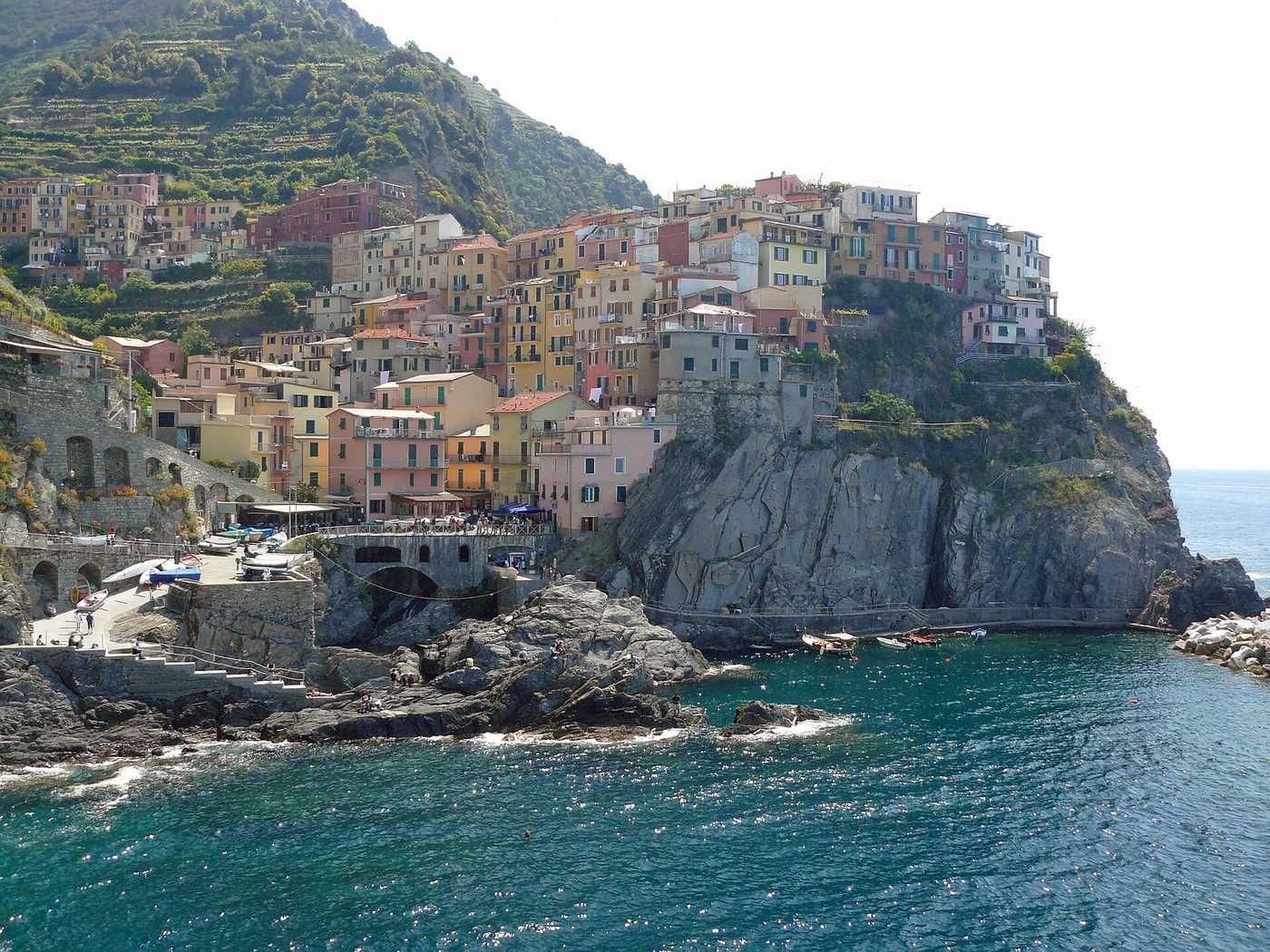
The first time I walked out of Corniglia station I laughed out loud. Thirty-three switchback flights of brick zigzagging up a cliff, and at the top a village of 150 people selling honey gelato. I climbed it with a rucksack in July and only found out later that a free shuttle bus does the same trip every twenty minutes. That is the Cinque Terre in miniature: gorgeous, demanding, and full of small logistical facts that change your day.
This Cinque Terre travel guide covers the five villages of Monterosso, Vernazza, Corniglia, Manarola and Riomaggiore on Italy’s Ligurian coast: which coastal trails are actually open in 2026, what the Cinque Terre Card costs now, how the trains and ferries work, when to go, and how to see the place without spending your day in a queue.
One thing belongs at the very top, because it reshapes most itineraries. The Corniglia to Manarola coastal path is closed. It has been closed by landslide for years. The old Via dell’Amore section between Manarola and Riomaggiore reopened in 2024 and now runs one way with a timed ticket. Vernazza to Corniglia is open in both directions. If you have been reading elsewhere that you “can only walk from Corniglia towards Monterosso”, that advice is out of date. The full 2026 picture is in the trail table below.
Cinque Terre travel guide: the five villages at a glance
Every village here rewards an unhurried hour or two, and only Monterosso really justifies a full day. None of them needs one. The differences that actually matter when you are planning are size, whether there is somewhere to swim, and how hard it is to get from the station into the village.
| Village | Feel | Swimming | Station to centre | Best for |
|---|---|---|---|---|
| Monterosso al Mare | The biggest and the flattest. Old town plus a modern beach resort half, split by a tunnel. | Real sandy beach, free and paid sections | Flat, 2 min to Fegina beach, 10 min through the tunnel to the old town | Families, beach days, arriving by car, anyone who wants a choice of restaurants |
| Vernazza | The postcard. A natural harbour, a ruined Doria castle, and the tightest crowds of the five. | Small sandy beach in the harbour plus sunning rocks | Flat, about 2 min, the station opens onto the main street | The classic photograph, harbourside aperitivo, first-timers with one day |
| Corniglia | The quiet one. A farming village on a promontory 100 m above the sea, no harbour. | None. No sea access at all | Roughly 380 steps in 33 flights, or a shuttle bus that is free with the card | Escaping the crowds, views along the whole coast, walkers |
| Manarola | Vertical, photogenic, built into a ravine above a tiny harbour. The famous sunset viewpoint. | No beach, but the best deep-water swimming of the five, with a ladder and a shower | Short walk through a tunnel, mild slope | Sunset, swimming off rocks, wine country walks up to Volastra |
| Riomaggiore | The southern gateway. One steep main street down to a photogenic slipway harbour. | Boulder beach east of the village, clear water | Tunnel from the station, then a walk up Via Colombo | Arriving from La Spezia, the Via dell’Amore entrance, evening light on the harbour |
If someone forced me to rank them, I would put Vernazza first on looks and Monterosso first on practicality, and I would tell you that Corniglia is the one you will remember, precisely because it makes you work.
What the Cinque Terre actually is, and what the name covers
“Cinque Terre” means five lands, and it refers to five villages strung along about 15 km of coast between Levanto and La Spezia, in the region of Liguria. It sits on the main Genoa to Pisa railway line, which is the reason a place that was almost unreachable except by boat until the 1870s now receives millions of visitors a year.
Three separate designations overlap here, and they are easy to run together:
- The UNESCO World Heritage site, inscribed in 1997, is not called the Cinque Terre. Its official name is “Portovenere, Cinque Terre, and the Islands (Palmaria, Tino and Tinetto)”. It covers 4,689 hectares with a buffer zone of 15,695 hectares, and it is listed as a cultural landscape under criteria (ii), (iv) and (v), not a natural one. What is protected is the human work: the drystone terraces, some running up to 2 km in length, climbing from the shoreline to around 400 m, the highest altitude where cultivation is possible here. Most were built from the 12th century onwards. A minor boundary modification went through in 2021.
- The Parco Nazionale delle Cinque Terre was created in 1999 by presidential decree, upgrading a regional park established in 1995. It covers 3,860 hectares and about 4,000 residents, taking in the municipalities of Riomaggiore, Vernazza and Monterosso al Mare in full plus unpopulated slices of La Spezia and Levanto.
- The Marine Protected Area was established by ministerial decree in December 1997. It is zoned: integral reserve A-zones and general reserve B-zones at Punta Mesco and Capo Montenero, plus a wider C-zone. Swimming is free in B and C zones. Spearfishing is banned throughout.
Two consequences for you as a visitor. First, the park has no gates and no opening hours; you can walk into the villages at any hour of any day of the year. Second, and this catches people out, the thing you pay for is not entry. You pay for access to three specific trail sections, which is a very different proposition.
One more piece of context I find weirdly cheering. The famously multicoloured houses are not the ancient part. Some facades were painted earlier, but the practice was expanded from the 1970s onwards, partly with visitors in mind. The terraces are the genuinely old thing. If you are still choosing between destinations, our roundups of the best places to visit in Europe and the most beautiful places in Europe put this coast in context.
Trail status in 2026: what is open and what is not
This is where guides go stale fastest, so treat everything below as correct at the time of writing in August 2026 and check the park’s own notices before you set out. Landslides here are frequent and closures can appear overnight.
The coastal path is the Sentiero Verde Azzurro, trail 592, usually translated as the Blue Trail. The park quotes 12 km end to end; the published section distances add up to a little under 11 km. Only three of the four are currently walkable, and only three sections in the whole park require a ticket.
| Section | Trail no. | 2026 status | Distance | Time | Difficulty | Card needed? |
|---|---|---|---|---|---|---|
| Monterosso to Vernazza | 592-4 | Open. One-way Monterosso to Vernazza, 09:00 to 14:00, on nine designated dates | 3.5 km | 2 h | Average, the hardest of the coastal sections | Yes |
| Vernazza to Corniglia | 592-3 | Open, both directions | 4 km | 1 h 30 | Average, max altitude 250 m | Yes |
| Corniglia to Manarola | 592-2 | Closed, landslide | 2.2 km when open | 1 h 15 when open | Easy when open | n/a |
| Manarola to Riomaggiore (Via dell’Amore) | 592-1 | Open, one way only, Riomaggiore to Manarola, timed entry | About 1 km | 30 min | Easy and paved | Yes, plus a booked slot |
So the honest version of the classic “walk all five villages in a day” plan is this: you can walk Monterosso to Vernazza to Corniglia on the coast, take a train or bus around the closed section, and then walk Riomaggiore to Manarola on the Via dell’Amore. That is about 8 km of walking plus one short hop, and it makes for a very good day.
The park maintains more than 120 km of trails across 48 numbered paths, and almost all of them are free. The paid sections are the exception, not the rule, which is the fact that reframes the whole “is the card worth it” question later on.
The Via dell’Amore, and how the ticket works
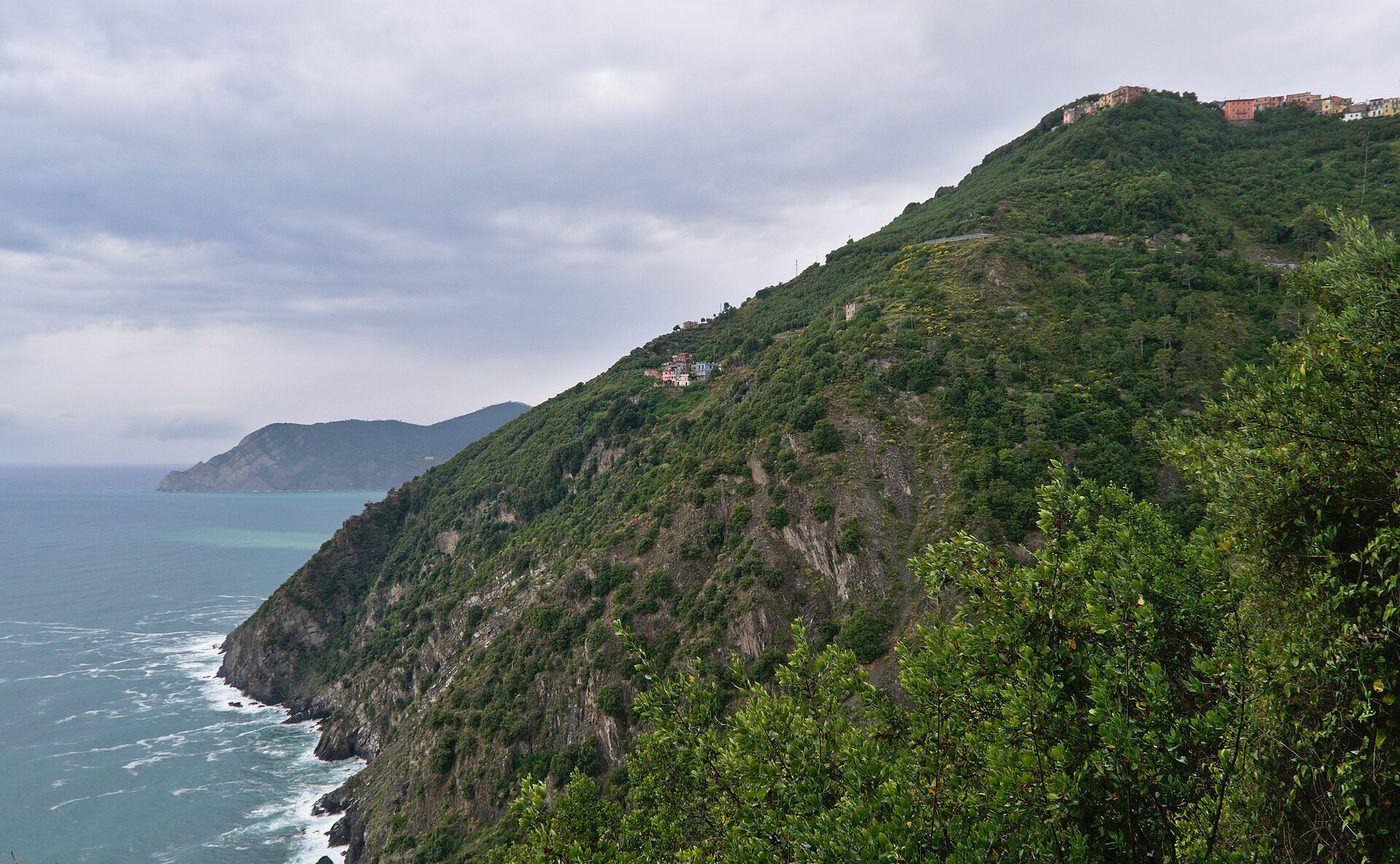
The cliff-cut path between Riomaggiore and Manarola was built in connection with the railway tunnel works of 1926 to 1928. It closed after a rockfall and stayed closed for twelve years before reopening in 2024, and it now operates on a different model to the rest of the park: limited access, timed reservation, one direction only. You enter in Riomaggiore and walk to Manarola. Five art installations by Gino Covili sit along the route.
Hours run 09:00 to 21:00 from 29 March to 24 October 2026, with last admission at 20:30. Outside that window it closes earlier, at 18:00 or 19:00 depending on the season, so check before an evening plan. Entry is free for disabled visitors on presentation of certification and for children under four.
Here is the part that saves people money and confusion. You do not buy a separate Via dell’Amore ticket. Access is now bundled into both Cinque Terre Card products, and the cheapest way in is a one-day Trekking Card from €10, which also throws in Riomaggiore Castle. Book the time slot online rather than turning up, because the gate queue in high season is genuinely miserable.
Two caveats. Sources disagree on the exact length, 900 m on the official ticketing site and 1 km elsewhere, so call it about a kilometre. And the closure window is reported inconsistently: some sources say 2012 to 2024, others say late 2019 to February 2025. I have used the twelve-year figure the official site publishes, but I would not stake anything on the precise dates.
The high routes, which is where the good walking actually is
If you only walk the coastal path you will spend two hours in a queue of people in the same three-metre-wide gully. Go one contour line up and the crowds vanish. These are all free, none requires a card, and the views are better because you can see the villages rather than standing in them.
| Route | Paths | Distance | Time | Difficulty | Notes |
|---|---|---|---|---|---|
| Manarola to Volastra to Corniglia | 587 + 586 + 506 | 5 to 5.4 km | 2 h 30 | Difficult | The workaround for the closed coastal section. Climbs to 400 m through the vineyard terraces. A bus runs Manarola to Volastra if you want to skip the climb |
| Monterosso to Vernazza, high route | 508 + 582 + 591 + 509 | 7.5 km | 3 h 30 | Average | Via the Reggio and Soviore sanctuaries, max altitude 550 m. Twice the distance of the coastal path and a fraction of the foot traffic |
| Manarola to Riomaggiore via Beccara | Via Beccara | 1.5 to 1.8 km | 1 h | Difficult | The free alternative to the Via dell’Amore. Steep in both directions, very good fitness needed |
| Levanto to Monterosso | 590 + 591 | 7 to 8 km | 3 h | Average | Over Punta Mesco. The best approach walk into the park if you are based in Levanto |
| Riomaggiore to Portovenere | 593 + 598 | 12.5 to 13 km | 5 to 6 h | Difficult | 550 m of altitude difference. A morning bus up to Telegrafo skips the 45-minute opening climb. Boat back around 17:00 |
| Riomaggiore to Santuario di Montenero | 593 + 593V | 3.5 km | 1 h 30 | Difficult | Short, steep, and the best single viewpoint over Riomaggiore |
| Levanto to Bonassola to Framura, tunnel path | Old railway | 5.5 km | 1 h walking, 30 min by bike | Easy, flat | Converted rail tunnels, level the whole way, and the flattest long walk in the area by a distance |
| Levanto to Framura, Scernio high route | Various | 7.5 km | 3 h | Average | The hilly version of the same journey |
Above all of these sits the Sentiero Rosso, or Alta Via delle Cinque Terre, the ridge route from Portovenere to Levanto. Descriptions put it at 35 to 40 km, though the five published stages sum to about 29 km, so the longer figures presumably fold in approach and connector paths. Total height difference is around 1,300 m, maximum altitude 800 m, graded E and waymarked white and red. Stage times add up to about eleven hours, which realistically means two days with a night on the ridge. The stages are 598-1 Portovenere to Telegrafo (about 4.7 km), 598-2 Telegrafo to Cigoletta (6.9 km), 598-3 Cigoletta to Il Termine (7.1 km), then 591 in two stages to Sant’Antonio del Mesco (7.2 km) and down to Levanto (3.3 km). Numbered connectors drop from the ridge into the villages: 501 from Sella La Croce to Riomaggiore, 506 to Manarola, 587 to Corniglia, 508 to Vernazza and 509 to Monterosso.
The five sanctuary trails are the other thing worth knowing about. Each village has a Marian sanctuary in the hills above it: Soviore above Monterosso, Reggio above Vernazza, San Bernardino above Corniglia, Volastra above Manarola and Montenero above Riomaggiore. Walking up to one of them and taking a bus back down is my standard recommendation for anyone who wants a proper walk without committing to a full day.
One planning note. The park and its partners publish maximum altitude and altitude difference, not cumulative ascent, so a precise metres-of-climbing figure for any coastal section comes from somebody’s GPS trace rather than an official source. More on walking the continent in our guide to hiking in Europe.

Weather closures
On orange and red civil protection alerts the park suspends Cinque Terre Card sales and staffs the trail entrances at Corniglia to Vernazza and Vernazza to Monterosso to turn people back. This is not excessive caution. On 25 October 2011 torrential rain caused floods and mudslides that severely damaged Vernazza and Monterosso and killed several people. Riomaggiore, Manarola and Corniglia were largely spared. Researchers have since argued the damage was worsened by decades of terrace abandonment and reduced maintenance of the drystone walls, and partly offset by the vegetation that had regrown on those same abandoned terraces. If the park says do not walk, do not walk.
The Cinque Terre Card in 2026: prices, and whether you need one
There are two products, both issued by the national park, and both now include Via dell’Amore access:
- PN5T Trekking Card (Carta Parco): trail access plus park services, no trains.
- PN5T Train Card (Carta Treno): everything the Trekking Card covers, plus unlimited second-class regional and fast-regional trains on the Levanto to La Spezia section. Intercity and Frecciabianca services are excluded.
Pricing works on tariff bands rather than a flat rate, which is the detail that trips people up. The Trekking Card has a base rate and a higher “peak days” rate. The Train Card has three bands: A green for low turnout, B yellow for average, C red for high. The park publishes the band calendar as a PDF, so check your dates before assuming a price.
Trekking Card 2026
| Ticket | 1 day base / peak | 2 days base / peak | 3 days base / peak |
|---|---|---|---|
| Adult | €10.00 / €15.00 | €17.00 / €26.70 | €23.50 / €37.50 |
| Child | €7.00 / €10.00 | €9.70 / €14.50 | €12.00 / €18.30 |
| Over 70 | €8.50 / €12.50 | €12.50 / €19.20 | €16.00 / €25.00 |
| Family (2 adults plus one or more children) | €27.10 / €40.20 | €39.00 / €60.00 | €49.50 / €77.50 |
| Group day trip, up to 15 people | €127.50 / €187.50 | n/a | n/a |
Child rates apply to ages 4 to 12 on the Trekking Card and 4 to 11 on the Train Card. Peak days in 2026 fall on 3 to 6 April, 25 to 26 April, 1 to 3 May, 9 to 10 May, 14 to 17 May, 23 to 24 May, 30 to 31 May, 1 to 2 June, 6 to 7 June, 13 to 14 June, and the weekends of 12 to 13, 19 to 20 and 26 to 27 September. Note what that list tells you: the park considers spring bank holidays and September weekends its busiest moments, not August.
Train Card 2026
| Ticket | 1 day A / B / C | 2 days A / B / C | 3 days A / B / C |
|---|---|---|---|
| Adult | €22.00 / €29.50 / €35.00 | €36.50 / €51.00 / €61.00 | €49.00 / €68.00 / €81.00 |
| Child | €15.00 / €20.00 / €23.50 | €24.50 / €33.50 / €40.50 | €33.00 / €44.50 / €53.50 |
| Over 70 | €18.50 / €25.00 / €29.50 | €30.50 / €42.50 / €51.00 | €41.00 / €56.00 / €67.50 |
| Family (2 adults plus 2 children) | €56.50 / €77.00 / €91.50 | €94.00 / €132.00 / €159.00 | €125.50 / €175.00 / €210.50 |
What the card actually includes
More than most people realise, and several of these are worth real money:
- Access to the ticketed park trails, including Via dell’Amore with a booked slot
- ATC shuttle buses within the five villages, including the Corniglia station shuttle
- Free use of the paid public toilets in Riomaggiore, Vernazza and Monterosso, otherwise €1 a visit
- Guided tours on the published schedule, and the Eugenio Montale Literary Park poetic paths
- Wi-Fi at park hotspots
- Reduced admission to the La Spezia civic museums, including the Amedeo Lia, Castello San Giorgio and CAMeC
- Workshops at the Park Environmental Education Centre
- Trains on the Levanto to La Spezia stretch, Train Card only
Practical rules: cards are nominative, so write your name and surname on the back and carry photo ID. Validate in a Trenitalia machine before your first train journey. Validity runs to 24:00 on the selected day, and you can change the date once, up to 24 hours ahead, within the same tariff band. Under-fours go free when accompanied by an adult cardholder. Buy online at the park’s card site, or in person at the welcome centres in the stations at all five villages plus La Spezia, Levanto and Riomaggiore Lavaccio. If your accommodation carries the park’s Environmental Quality Label, ask for their discount code before you buy.
So, is the card worth it?
Run the arithmetic on your own day rather than taking anyone’s word for it, including mine. Single train tickets between villages cost €5, €8 or €10 depending on the day’s category, and the matching one-day Train Card costs €22, €29.50 or €35. So it breaks even at about four journeys on a busy-day tariff and five on a cheap one, which most people make without trying.
| Your plan | What to buy | Why |
|---|---|---|
| One day, trains between all five villages, no trails | Train Card | Four hops at €8 already exceeds a Band B card, before the toilets |
| Walking the coastal path, staying in one of the villages | Trekking Card | You need trail access and the shuttle; you are walking rather than riding |
| Just the Via dell’Amore and a nice lunch | 1-day Trekking Card from €10 | It is the cheapest legal way onto the path and includes Riomaggiore Castle |
| Only the free high routes, walking between villages | Nothing | All the high routes are free. Buy single train tickets if you need them |
| Visiting between 2 November and 12 March | Probably nothing | All trails except Via dell’Amore are free off-season, and single fares drop to around €3 |
| Day trip from La Spezia with two children | Family Train Card | Under-fours free, children pay about two thirds of the adult rate, and it removes ticket queues from your day |
Budget travellers should note the off-season loophole above, and our Europe on a budget guide has more of the same thinking. The card was introduced in 2001 to manage trail use and fund maintenance, and given that the terraced walls it pays for were in serious disrepair when UNESCO inscribed the site, buying one is not the worst way to spend €10.
Getting to the Cinque Terre
Come by train. This is the rare Italian destination where the train is not merely the greener option but the obviously superior one, because the villages are car-free and the line runs through the middle of all five.
La Spezia Centrale is the hub. It sits on the Pisa to Genoa main line, every long-distance service stops there, and it is nine minutes from Riomaggiore. Levanto does the same job from the north. Monterosso is the only one of the five villages served directly by Intercity trains, so if you see a direct long-distance service to a Cinque Terre village, that is the one.
| From | Journey time | Rough fare | Route |
|---|---|---|---|
| Pisa | 1 h 15 | €9 to €18 | Hourly Pisa Centrale to La Spezia Centrale, some direct Intercity to Monterosso |
| Genoa | 1 to 1.5 h | €7 to €15 | Intercity or fast regional from Brignole or Piazza Principe to Levanto or Monterosso |
| Lucca | 1.5 h | €9 to €20 | Via La Spezia |
| Milan | 2.5 to 3 h | Around €25 | Intercity from Milano Centrale direct to Levanto, Monterosso or La Spezia |
| Florence | About 3 h | €15 to €25 | Hourly regional and Intercity from Firenze SMN, change at La Spezia |
| Turin | 3.5 h | €16 to €27 | Via Genoa |
| Rome | 3.5 to 4.5 h | €40 to €50 | Frecciabianca from Termini to La Spezia, then the Cinque Terre Express |
| Venice | 5 to 6.5 h | €40 to €50 | Usually via Milan or Florence |
The nearest airports are Pisa, which is the closest, then Genoa, then Milan Malpensa. From Pisa airport the chain is the PisaMover shuttle to Pisa Centrale, which is compulsory and costs a few euros, then a regional train to La Spezia, then the Cinque Terre Express. Budget two to two and a half hours and roughly €20 to €25 a head, more if the connections go against you.
If you are stitching this into a longer trip, our Italy travel guide sets out how the regions connect, and train travel in Europe covers reservations, passes and the difference between regional and high-speed tickets. If you are flying in from outside the bloc, check the entry rules in our Schengen visa and ETIAS explainer, and see how to plan a trip to Europe for the order to book things in.
Getting around: trains, ferries and buses
The Cinque Terre Express
A shuttle train running every twenty minutes between Levanto, Monterosso, Vernazza, Corniglia, Manarola, Riomaggiore and La Spezia, from 14 March to 1 November 2026. In winter it drops to once or twice an hour. Journeys between villages take four to six minutes and much of it is in tunnel, so do not expect a scenic ride; the views are the point of the walking, not the train.
| Leg | Time |
|---|---|
| La Spezia Centrale to Riomaggiore | Under 10 min |
| Riomaggiore to Manarola | 6 min |
| Manarola to Corniglia | 5 min |
| Corniglia to Vernazza | 4 min |
| Vernazza to Monterosso | 4 min |
| Monterosso to Levanto | 5 min |
| Monterosso to Bonassola | About 10 min |
| Monterosso to Deiva Marina | 16 min |
| Monterosso to Sestri Levante | 20 min Intercity, 30 min regional |
| Monterosso to Santa Margherita Ligure (for Portofino) | 40 min Intercity, 50 min regional |
Single tickets are a flat rate regardless of distance: €5 on category A days, €8 on B, €10 on C, halved for children aged 4 to 11. A discounted €5 evening fare applies to late journeys, which is a nice quiet subsidy for anyone eating dinner in a different village from the one they sleep in; check the conditions when you buy, because it does not cover every departure. Off-season singles are cheaper again. Validate paper regional tickets in the green machines before boarding; digital tickets validate themselves at departure. Bikes travel free on Ligurian regional trains. Our guide to transport across Europe covers the same logic applied across the continent.
Ferries
The boats are run by the Consorzio Marittimo Turistico Cinque Terre Golfo dei Poeti, trading as Navigazione Golfo dei Poeti, on Line 02. This is the best way to see the villages, because from the water you finally understand what everyone is photographing: the whole vertical arrangement of houses, harbour and terraces in one frame.
Line 02 calls at La Spezia, Lerici, Portovenere, Riomaggiore, Manarola, Vernazza, Monterosso, Levanto, Deiva Marina and Moneglia. Corniglia is not served, and cannot be: it is a hilltop village with no harbour. The core Cinque Terre service runs 28 March to 1 November 2026, with a longer Line 02 season of 1 March to 8 December for the shoulder sailings.
| Ticket | Adult | Child |
|---|---|---|
| One-day hop-on hop-off, Levanto to Portovenere to La Spezia | €42 | €15 (6 to 11), under-6s free |
| Afternoon roundtrip, from 14:00 | €28 | €15 |
| One-way with intermediate stops | €30 | €15 |
| Monterosso to Vernazza, or Manarola to Riomaggiore | €10 | €5 |
| Levanto to Monterosso or Vernazza | €12 | €5 |
| Monterosso or Vernazza to Manarola or Riomaggiore | €15 | €5 |
| Manarola or Riomaggiore to Portovenere | €18 | €10 |
| Northern villages to Portovenere | €22 | €10 |
| La Spezia or Lerici to Levanto, Monterosso or Vernazza | €30 | €15 |
| Portovenere to La Spezia or Lerici | €8 | €6 |
| Three Islands panoramic tour from Portovenere, 45 min | €15 | €8 |
| Three Islands tour from La Spezia or Lerici, includes Portovenere | €25 | €12 |
Add the Three Islands loop to a Cinque Terre day ticket for €5. Advance booking is not required; tickets are sold at the docks, though online presale opens on 1 February. Wi-Fi on board is free and unlimited, and day-ticket holders get an audio guide app. Dogs travel free with a leash and muzzle. The obvious risk is weather: sailings are cancelled at short notice when the sea gets up, so do not build a tight connection around one.
Two seasonal extras worth knowing. Versilia services from Viareggio and Marina di Carrara run from 3 July to 30 August 2026, every day except Wednesdays. Deiva Marina and Moneglia are served on Tuesdays, Thursdays and Saturdays from 30 June to 29 August.
The ATC shuttle buses
Easy to overlook, and worth ten minutes of your planning. The buses are included with both card types, and they connect each village with the hilltop hamlets and sanctuaries above it: Corniglia, Volastra, Groppo, San Bernardino, Soviore, Monesteroli. Named 2026 routes include Manarola to Volastra, Corniglia station to the village and on to Vernazza, Monterosso to Colle di Soviore and Vettora, and Riomaggiore to Litoranea and Monesteroli. Timetables changed on 3 April 2026.
What they do not do is link the five villages along the coast, so they are not an alternative to the train. And your Cinque Terre Card is not valid on La Spezia or Portovenere town buses; those need separate tickets.
The single most useful of them is the Corniglia station shuttle, which turns the Lardarina staircase from an obstacle into an option. Without a card, a one-way ticket costs under €3.
The five villages, one by one
Monterosso al Mare
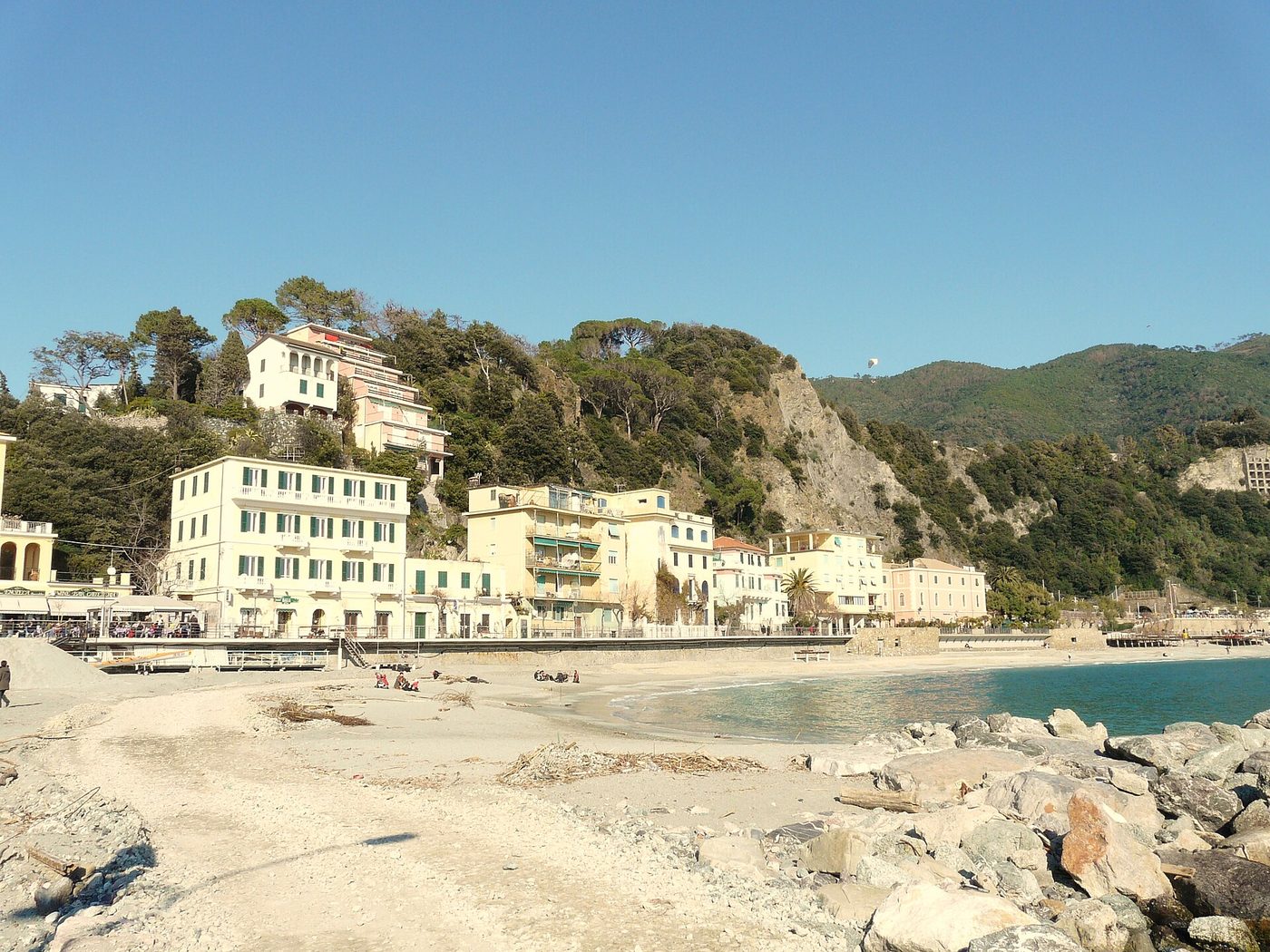
The largest, the flattest and the only one with a proper sandy beach, Monterosso is really two places joined by a pedestrian tunnel. Fegina, the newer half, is a beach resort with the train station on the promenade and 300 parking spaces behind it. The old town on the other side of the tunnel is medieval, tighter and where you want to eat.
The parish church of San Giovanni Battista was built between 1282 and 1307 and has the striped black and white facade that shows up all over Liguria. Above the old town sits the Convent of the Capuchin Friars. On Fegina beach stands the Statua del Gigante, a 46-foot Neptune of concrete and iron built in 1910 and battered ever since by war and weather; he has lost his trident and most of his dignity, and he is my favourite thing in the village. If you are building a longer Italian route, our Venice guide pairs well with a northern loop.
Monterosso is anchovy country. Acciughe di Monterosso carry EU Protected Designation of Origin status, and the village holds festivals in their honour. Order them salted, fried, marinated or stuffed, and order them here rather than anywhere else on the coast.
This is the village to base yourself in if you have children, a car, a mobility issue, or a strong preference for having more than four restaurants to choose from.
Vernazza
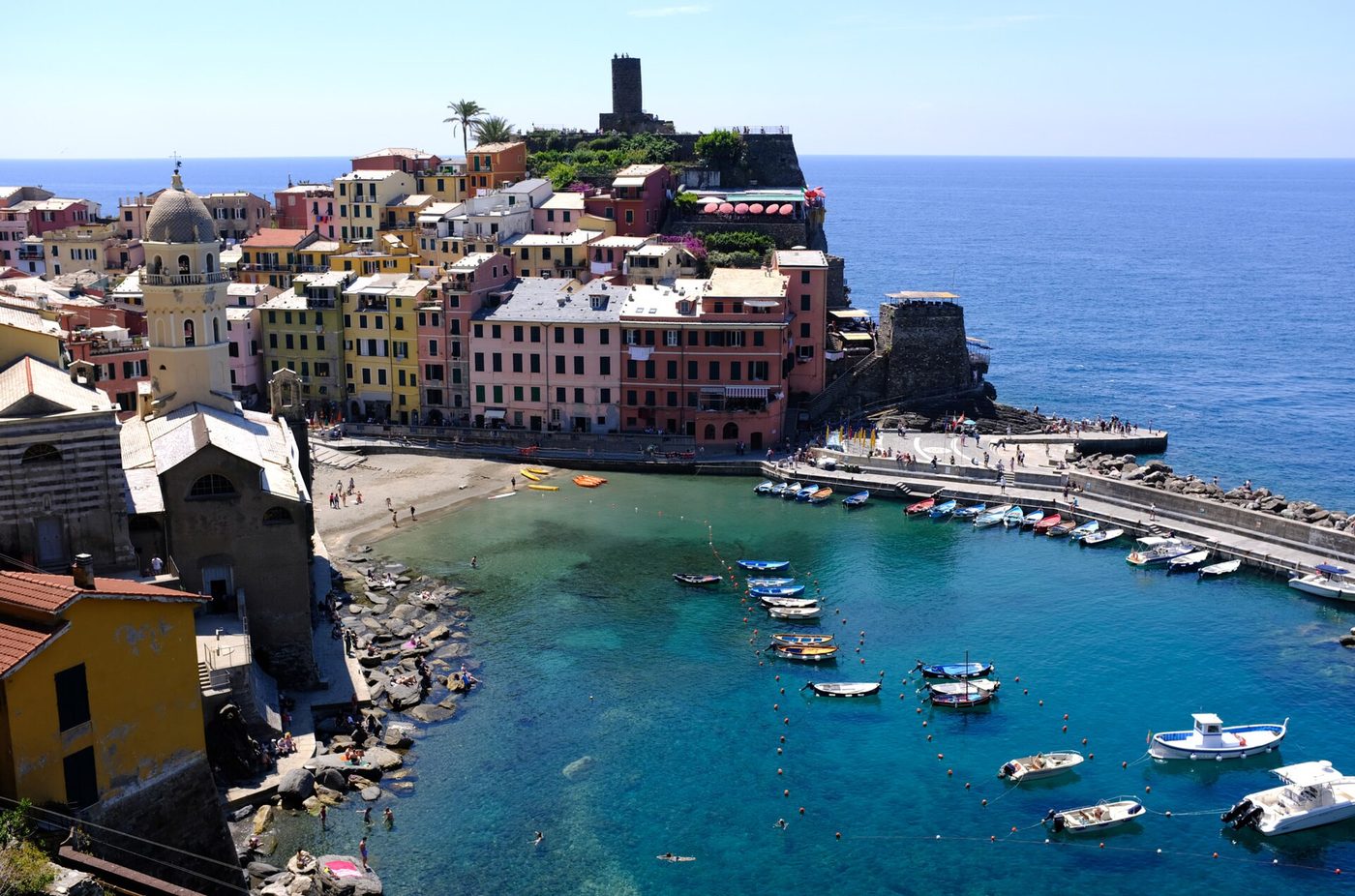
Vernazza is the one on the front of the guidebook, and one of the officially designated Borghi più belli d’Italia. A natural harbour, a small piazza that runs straight onto the water, the 14th-century waterfront church of Santa Margherita with its octagonal tower, and the ruins of the 11th-century Doria Castle on the headland above. Rick Steves has been giving it his top rating for decades and he is not wrong. It earns its place on any Europe bucket list.
The cost of that is crowding. Vernazza has a single main street, and on an August afternoon it moves at the speed of the slowest person on it. The station opens directly onto that street, which is convenient and also means every train empties into the bottleneck. The trick is simple: be here before 10:30 or after 16:00, and ideally sleep here so you get the evening.
Climb to the castle. Entry is a couple of euros, cash only, the climb takes about ten minutes, and it puts you above the crowd with the best view in the Cinque Terre looking back over the harbour.
Corniglia
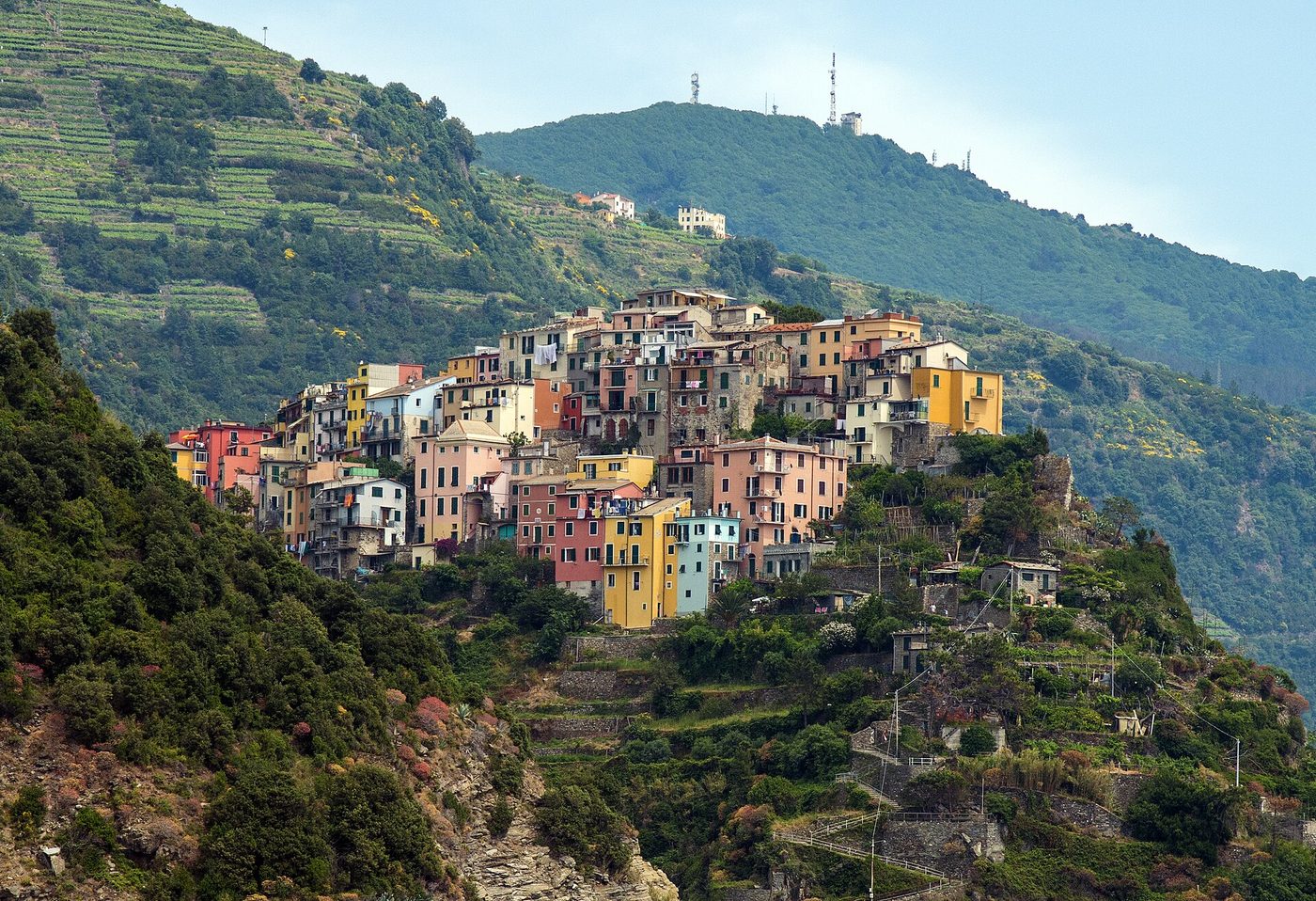
The odd one out, and the reason this guide keeps circling back to logistics. Corniglia is not on the water. It sits on a promontory about 100 m up, it is administratively a frazione of Vernazza rather than a comune of its own, and roughly 150 people live there. The name comes from Gens Cornelia, the Roman family that once owned the land, and Boccaccio name-checks its wine in the Decameron.
Between the station and the village lies the Lardarina: a brick staircase of 33 flights and roughly 380 steps. Sources differ on whether it is 382 or 383; either way you will lose count. The staircase is entirely optional. A road runs up from the station and the shuttle bus uses it, free with the card. If you have luggage, a stroller, a bad knee or a hot afternoon, take the bus and save your legs for the terraces.
At the top: the church of San Pietro, begun in 1334, with a white Carrara marble rose window dated 1351 and a 12th-century baptismal font. A terrace at the end of the village looks along the entire coastline. And gelato flavoured with local honey, miele di Corniglia, which is genuinely worth the climb even if you took the bus.
Corniglia stays the least trafficked of the five, and it is the one I send people to when the others feel oversubscribed. Pixar’s Luca was set in a fictional Ligurian town assembled from this coast, and watching it beforehand is a surprisingly good way to prime children for the trip.
Manarola
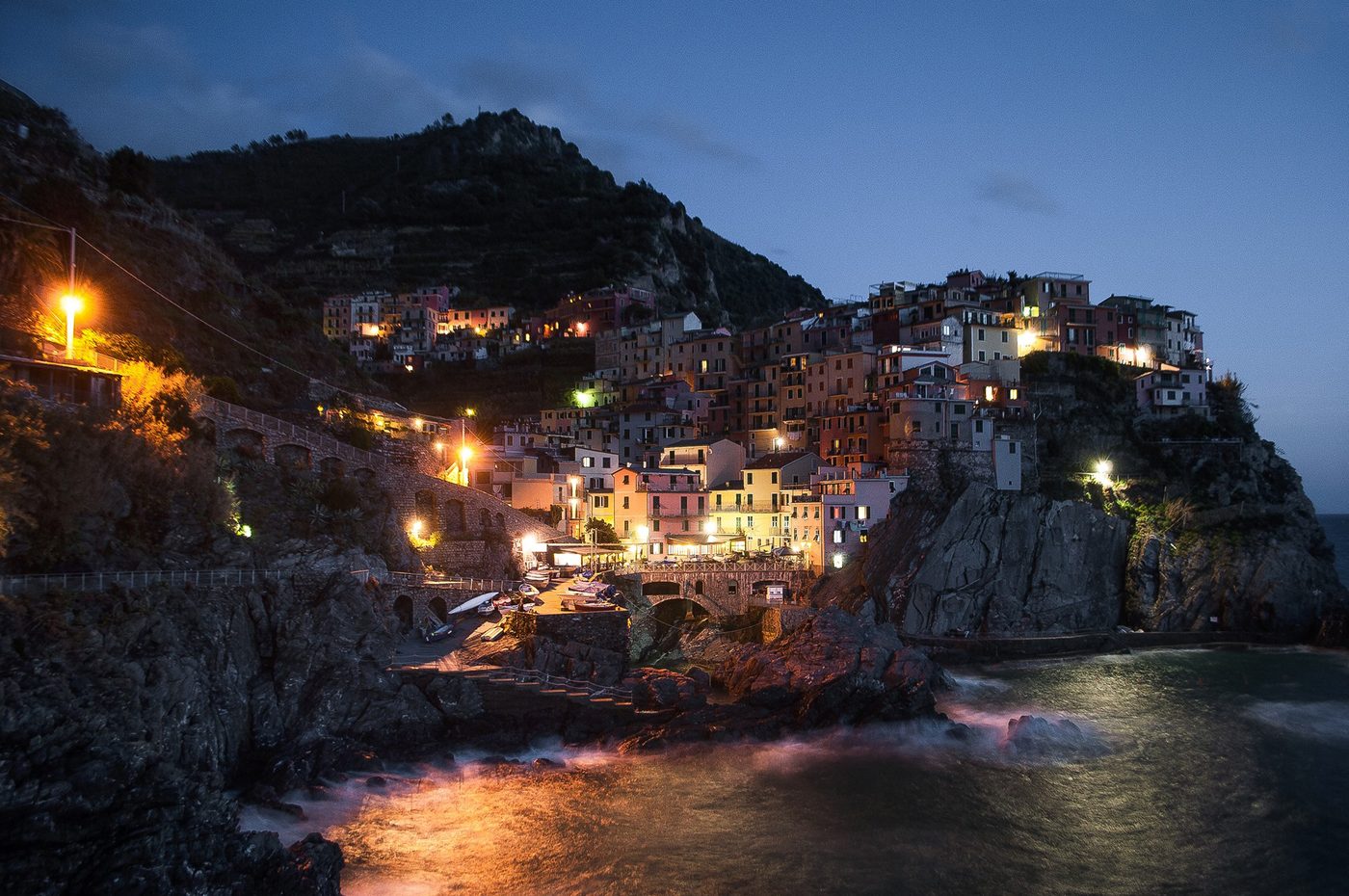
Manarola is the sunset village. The cluster of houses stacked above the tiny harbour, seen from the walkway on the Punta Bonfiglio side, is the single most photographed composition on this coast, and the light does the work between about an hour before sunset and dusk.
The church of San Lorenzo, 14th-century Gothic with Baroque additions and a good rose window, sits at the top of the village. Below, the harbour is not a beach but it is the best swimming in the Cinque Terre: deep, clear water with a ladder up the rocks and a freshwater shower. Three minutes from the station.
The famous aperitivo spot is Nessun Dorma, on the cliff by the overlook. It is the most-recommended single experience across every guide to this region, which means the queue is substantial. Go early, put your name down, and be relaxed about the outcome.
This is also a good spot for a Europe honeymoon stop, if that is the trip you are planning. Manarola is also the gateway to the wine country. The Cooperativa Agricoltura di Cinque Terre sits between here and Volastra, and the walk up through the terraces on paths 587 and 586 is the best hour of vineyard walking in the park.
Riomaggiore
The southernmost village, nine minutes from La Spezia, and for most people the arrival point. From the station a tunnel leads through to Via Colombo, the single steep street that runs down to a slipway harbour where boats are hauled up between the houses. In the evening, with the light coming in from the west, it is as good as anywhere on the coast.
The Castello di Riomaggiore, built in 1260, sits above the village, and entry is bundled into the Via dell’Amore and Trekking Card products, so you have probably already paid for it. Path 593 climbs from here to the Santuario di Montenero, an hour and a half of hard work for a view down the whole coastline.
Swimming is off a boulder beach east of the village: through the tunnel to the marina, then stairs past the ferry dock. The water is clear and the rocks are unforgiving on bare feet.
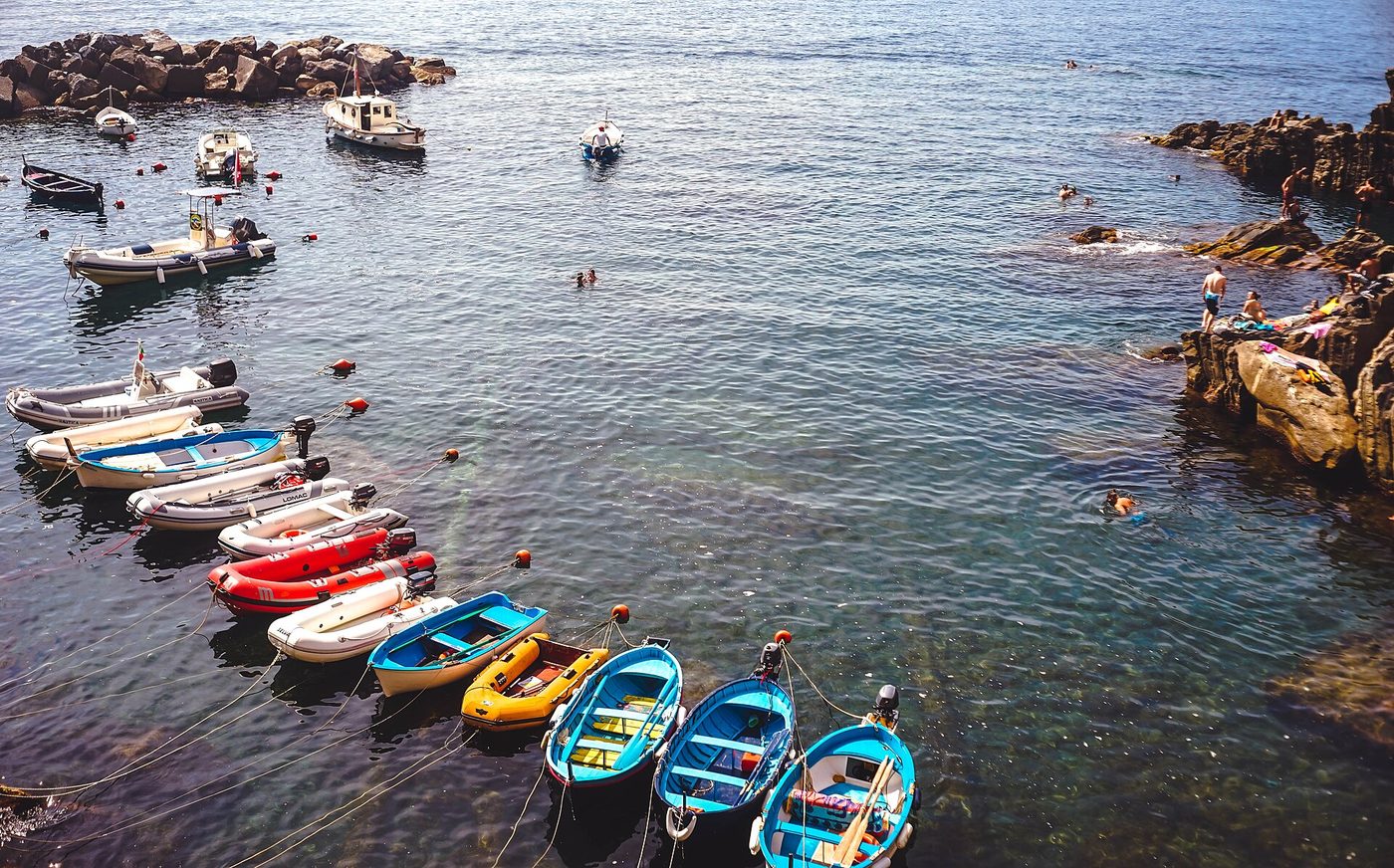
Riomaggiore is also the gate for the Via dell’Amore, so if you have booked a slot, work out where the entrance is before your time comes round.
Beaches and swimming
The swimming season here runs roughly May to October, and the sea is warmest in August at around 25°C. Expectations need calibrating: this is a rocky coast with one real beach and a lot of very good rock swimming.
| Where | Type | Free or paid | Notes |
|---|---|---|---|
| Monterosso, Fegina beach | Long sandy beach | Both. Paid umbrella-and-lounger sections plus free stretches | Directly in front of the station. The only true sandy beach in the Cinque Terre |
| Monterosso, old town beach | Sandy | Both, split public and private | By the boat rental area, 10 min from the station through the tunnel. The Vernazza trail starts here |
| Monterosso, Il Gigante and Portiglione | Sandy, smaller | Mixed | Quieter alternatives when Fegina is full |
| Vernazza harbour beach | Small sandy cove plus flat sunning rocks | Free | Two minutes from the station, calm water, tiny and popular |
| Manarola harbour | Deep-water rock swimming | Free | Ladder and shower. The best swimming of the five if you are confident in deep water |
| Riomaggiore | Boulder beach | Free | East of the village, through the tunnel to the marina then stairs past the ferry dock |
| Corniglia | None | n/a | No sea access. The village is 100 m above the water |
| Levanto | Long sandy beach | Both. Private sections with bars, a pool, loungers and showers | Canoe, pedalo, motorboat and surfboard rental. Far more space than Monterosso |
| Bonassola | Sand and small pebbles | Both. Three private zones plus two large free areas | Two minutes from the station and one of the most extensive beaches in Liguria |
Two honest notes. Sunbed and umbrella prices at Fegina change every season and are not published centrally, so ask at the beach kiosk before you sit down and assume August is expensive. And Guvano, the old nudist beach below Corniglia that appears in a lot of older writing, is not a realistic plan any more: the railway tunnel access was gated shut and the path down from the Blue Trail is in poor condition.
If beaches are the point of your trip rather than a bonus, our guide to the best beaches in Europe and the wider best Mediterranean destinations will serve you better than the Cinque Terre will, and Europe in summer covers the seasonal picture.
What to eat and drink
Ligurian food is not Tuscan food and it is not Roman food. It is a coastal cuisine built on herbs, olive oil, chickpea flour and small fish, and it is much lighter than most people expect from Italy.
- Pesto alla Genovese, on trofie or trenette. Basil, pine nuts, Parmigiano Reggiano, pecorino, garlic, olive oil, salt, and nothing else. Ligurians are unbending about this.
- Acciughe di Monterosso, the PDO anchovies, salted, fried, marinated or stuffed.
- Focaccia, plain or topped with onion, cheese or olives, bought from a bakery and eaten walking.
- Farinata, a chickpea-flour flatbread baked with water and olive oil in a wood-fired oven, crisp outside and soft within. The best two-euro snack in Italy.
- Pansotti with walnut sauce, stuffed pasta with ricotta and herbs.
- Fritto misto, the fried catch of the day in a paper cone. Tutti Fritti in Riomaggiore charges about €9 for one.
- Miele di Corniglia gelato, in the obvious place.
On wine: the Cinque Terre DOC white is made from Bosco, Albarola and Vermentino grapes and tastes fresh, floral and mineral, which is exactly what you want with anchovies. The prestige bottle is Sciacchetrà, a rare sweet passito made from the same grapes dried before pressing, served with aged cheese or dessert. Gabriele d’Annunzio wrote about “quel fiero Sciacchetrà che si pigia nelle cinque pampinose terre”, which is a lot of enthusiasm for a half-bottle. The main producer is the Cooperativa Agricoltura di Cinque Terre between Manarola and Volastra; smaller names to look for include Forlini-Capellini, Walter de Batté, Buranco and Arrigoni. Afterwards, grappa or limoncino, chilled.
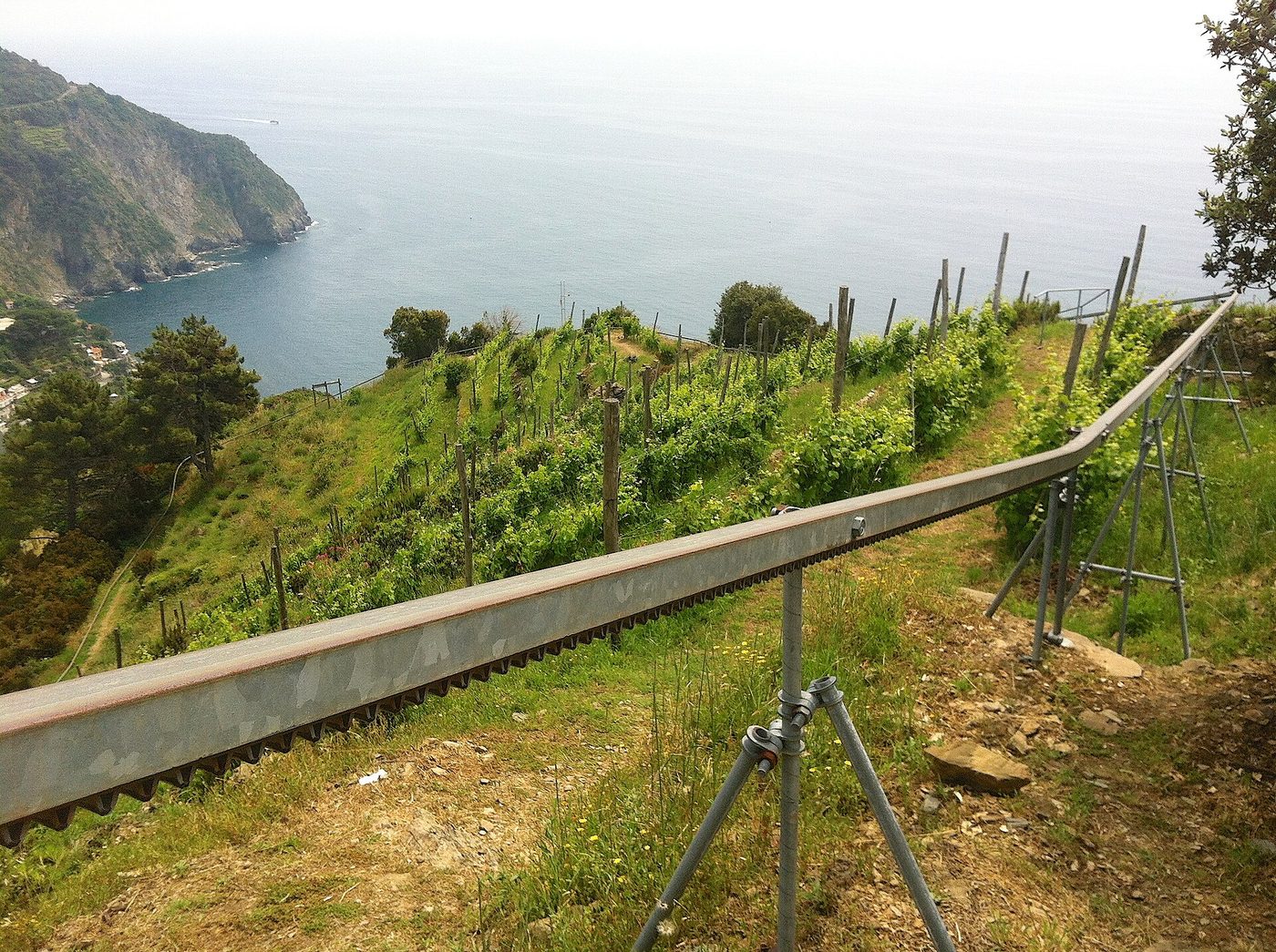
Remember what you are looking at while you drink it. Much of the vineyard work on these terraces is still done by hand, because no machine can operate on a strip of land two metres wide with a drystone wall on either side. That is what the DOC costs to produce, and it is why the wine is not cheap. More on the regional picture in our guide to European food.
On budget, some honest guidance rather than invented numbers. Village restaurants with a sea view sit at the expensive end of Italian normal; La Spezia and Levanto are noticeably cheaper for the same cooking; and a focaccia-and-fritto lunch eaten on a wall costs a small fraction of a sit-down one. Menus are posted outside, which is standard practice here, and a coperto cover charge per person is normal in Liguria and printed at the bottom. Carry cash, because several small places, and Vernazza’s castle, do not take cards.
When to visit: month by month
The consensus answer is late spring or early autumn, and for once the consensus is right. April to June and September to October give you warm days, walkable trails and a sea that is at least approachable. July and August give you the warmest water and the largest crowds. October and November are the wettest months of the year.
| Month | Avg max °C | Avg min °C | Rainfall mm | Rainy days | Sea °C | Verdict |
|---|---|---|---|---|---|---|
| January | 10 | 4 | 120 | 9 | 11 | Very quiet, trails free, many businesses shut |
| February | 11 | 4 | 85 | 7 | 13 | Same, with slightly better light |
| March | 14 | 6 | 95 | 7 | 14 | Season starts mid-month with the Express and the card |
| April | 17 | 10 | 115 | 8 | 15 | Green terraces, good walking, Easter crowds and peak card rates |
| May | 22 | 13 | 85 | 6 | 17 | Arguably the best month, though busy on the bank holiday weekends |
| June | 25 | 17 | 60 | 5 | 20 | Long days, swimmable sea, crowds building fast |
| July | 28 | 19 | 37 | 3 | 24 | Driest month, hot for hiking, very busy |
| August | 29 | 20 | 52 | 5 | 25 | Warmest sea, peak Italian holidays, hardest walking conditions |
| September | 24 | 16 | 95 | 7 | 22 | My pick. Warm sea, easier trails, though September weekends are peak-rate |
| October | 20 | 13 | 150 | 10 | 19 | Beautiful and quieter, but the rain arrives and landslide risk rises |
| November | 15 | 8 | 180 | 11 | 16 | The wettest month. Trails go free from 2 November for a reason |
| December | 11 | 5 | 115 | 10 | 12 | Quiet, damp, atmospheric if you want the villages to yourself |
A caveat on this table: these are long-run averages from a single regional climate source, so treat them as indicative rather than as a forecast. For a broader view, see our guide to the best time to visit Europe.
The practical version: go in September. The sea is still 22°C, the light is better than in August, the trails are walkable without suffering, and the summer peak has broken. Avoid the September weekends if you can, because the park charges peak card rates on three of them.
Where to stay
Reliable per-village nightly rates are not published anywhere I could verify, and aggregator “from” prices are not the same thing, so I have left them out. The strategic question is more useful than the price question anyway. Where you sleep determines what your evenings look like, and evenings are when the Cinque Terre is at its best: the day visitors are largely gone by 18:00.
| Base | Good for | Trade-off |
|---|---|---|
| Monterosso | Families, beach access, the widest choice of hotels and restaurants, arriving by car | Feels the most like a resort and the least like a fishing village |
| Vernazza | The best evenings of the five, and the classic setting | Small, expensive, and busy all day |
| Corniglia | Quiet nights, walkers, anyone who wants to feel they are living there | The staircase, and no beach |
| Manarola | Sunset on your doorstep, rock swimming, wine walks | Steep, and the sunset crowd is right outside |
| Riomaggiore | Easiest arrival, Via dell’Amore access, good evening light | One long uphill street, so pack light |
| Levanto | Easier parking and availability, a proper beach, 5 min by train to Monterosso, covered by the Train Card | You commute in, and the villages are the point |
| La Spezia | Cheapest food and beds, a real Italian city, 9 min from Riomaggiore, all long-distance trains | No charm to speak of, and you miss the empty evenings |
One universal warning: getting to most Cinque Terre accommodation involves at least some uphill walking, often with steps and no lift. Pack light, and if you cannot, base yourself in Monterosso or Levanto. Our wider guide to where to stay in Europe covers the apartment versus hotel question in more depth, and the cheapest places to travel in Europe is worth a look if the Ligurian coast blows your budget.
Crowds: the real numbers, and how to dodge them
A study commissioned by the park put the figure at four million visitors in 2023, almost all of them concentrated in roughly one square kilometre, which is about 3% of the park’s area. The park as a whole has around 4,000 residents. Add the cruise traffic through La Spezia, which handled 656,975 passengers across 178 calls in 2024 between the cruise terminal and Marina di Carrara, with the operator projecting more than 700,000 for 2025, and the arithmetic becomes uncomfortable.
Now the question everyone actually asks. Is there a cap on entry, or do you need to reserve? No. The park’s own FAQ is unambiguous: there is no reservation to access the park area, and no limited number of accesses. The boundaries are not fenced and the territory can be visited freely at any time on any day. The only thing you must book is a Via dell’Amore slot.
What the park does instead is manage flow on the worst days. In 2026 a one-way system operates on the Monterosso to Vernazza trail on nine designated dates: 4, 5 and 6 April, 1 and 2 May, 14 May, 30 and 31 May, and 1 June. On those days the trail runs Monterosso to Vernazza only until 14:00, then reopens both ways. The direction was chosen because more than 70% of walkers were already going that way. Information points are staffed in Monterosso at the former railway checkpoint and at Corone, and in Vernazza on Via Roma in the Lama area.
My working rules for avoiding the worst of it:
- Sleep in the villages. Everything changes after 18:00 and before 09:00. This is the whole game.
- Move against the flow. Most day trippers start in Riomaggiore from La Spezia or in Monterosso from the north and work inward. Start at the opposite end.
- Treat the middle of the day as the dead zone for village wandering. Walk a high route instead, or swim, or have a long lunch somewhere with a view.
- Check the cruise schedule for La Spezia before fixing your day. Multiple ships can call at once, and a two-ship day feels very different from a no-ship day.
- Use the free trails. The Volastra route and the Soviore high route carry a small share of the coastal path’s traffic and give better views.
Itineraries: one, two and three days
Two nights is the minimum I would recommend and three is the sweet spot. A day trip is possible and thousands of people do it, but you will see the villages only during their worst hours.
One day, arriving by train
Start early from La Spezia or Levanto. Ride to the far end from wherever you are staying and work back. Walk Monterosso to Vernazza (2 h) before 10:00, then Vernazza to Corniglia (1 h 30) before lunch. Eat in Corniglia, take the shuttle down, train to Riomaggiore, and walk the Via dell’Amore to Manarola on a late-afternoon slot. Finish with sunset at Manarola. That is three villages walked between, two more visited, and about 8 km on foot.
Two days
Day one as above, but slower, with a swim off the rocks at Manarola instead of rushing.
Day two: the ferry. Buy the €42 hop-on hop-off, ride to Portovenere in the morning, add the 45-minute Three Islands loop for €5, and come back through the villages by sea in the afternoon light. You will finally see what the place looks like from the angle every photograph is taken from.
Three days
Day three is where the trip becomes memorable. Options, in order of how much I would push them on you:
- Manarola to Volastra to Corniglia on paths 587, 586 and 506. Two and a half hours, difficult, 400 m up through the terraces, and almost nobody on it. Take the bus up to Volastra if the climb does not appeal.
- Monterosso to Vernazza by the high route, 7.5 km via the Reggio and Soviore sanctuaries. Three and a half hours for the same two villages the coastal path connects in two, and a completely different day.
- Riomaggiore to Portovenere, 12.5 km and five to six hours, with the morning bus to Telegrafo to skip the opening climb and the boat back around 17:00. The best long day walk in the region.
- Levanto to Bonassola to Framura through the old railway tunnels, flat and 5.5 km, on foot or by bike. The rest day that still counts as a walk.
If you have a week in the region, spend the extra days in Portovenere, Lerici and Sestri Levante rather than doing the same five villages again. There is more on route-building in our Europe itinerary guide and in Europe travel tips.
Quieter alternatives nearby
If your dates fall in August, or you have seen the crowd numbers above and gone cold, these are all within easy reach and none of them will be as busy.
| Place | How to get there | Why go |
|---|---|---|
| Portovenere | Ferry Line 02, €18 from Manarola or Riomaggiore, €8 from La Spezia. Or walk 12.5 km from Riomaggiore | Part of the same UNESCO inscription. Houses stacked along the waterfront under the Doria Castle, a Roman-era port, and its own regional park |
| Palmaria, Tino and Tinetto | Three Islands boat tour, 45 min from Portovenere, €15 | The islands in the UNESCO listing, with early monastic remains and the Portoro marble quarries on the ridge opposite |
| Lerici | Ferry Line 02, €8 from Portovenere | A castle town on the other side of the Gulf of Poets, with far fewer visitors and better swimming |
| Tellaro | Ferry Line 02, tickets issued on board | A tiny pink and ochre village on the rocks that looks like the Cinque Terre without the queue |
| Levanto | 5 min by train from Monterosso, covered by the Train Card | A long free beach, easy parking, surfing, and the Punta Mesco walk into the park |
| Bonassola | About 10 min by train from Monterosso, or the flat tunnel path from Levanto | One of the most extensive beaches in Liguria, with two large free sections |
| Framura | 5.5 km flat tunnel path from Levanto, 1 h walking or 30 min by bike | Scattered hamlets above the sea, and the least visited stop on this stretch of line |
| Deiva Marina | 16 min by train from Monterosso, plus summer ferries on Tue, Thu and Sat | A quiet family beach town with none of the queueing |
| Sestri Levante | 20 min by Intercity, 30 min by regional | Two bays, one of them the Baia del Silenzio, and a town that functions normally in August |
| Portofino and Camogli | 40 to 50 min by train to Santa Margherita Ligure, then bus or boat | The glossier end of the Riviera, plus boats to the Abbey of San Fruttuoso |
For more in this vein, our underrated places in Europe and most beautiful towns in Europe guides cover the same instinct applied across the continent, and European city breaks is the urban equivalent.
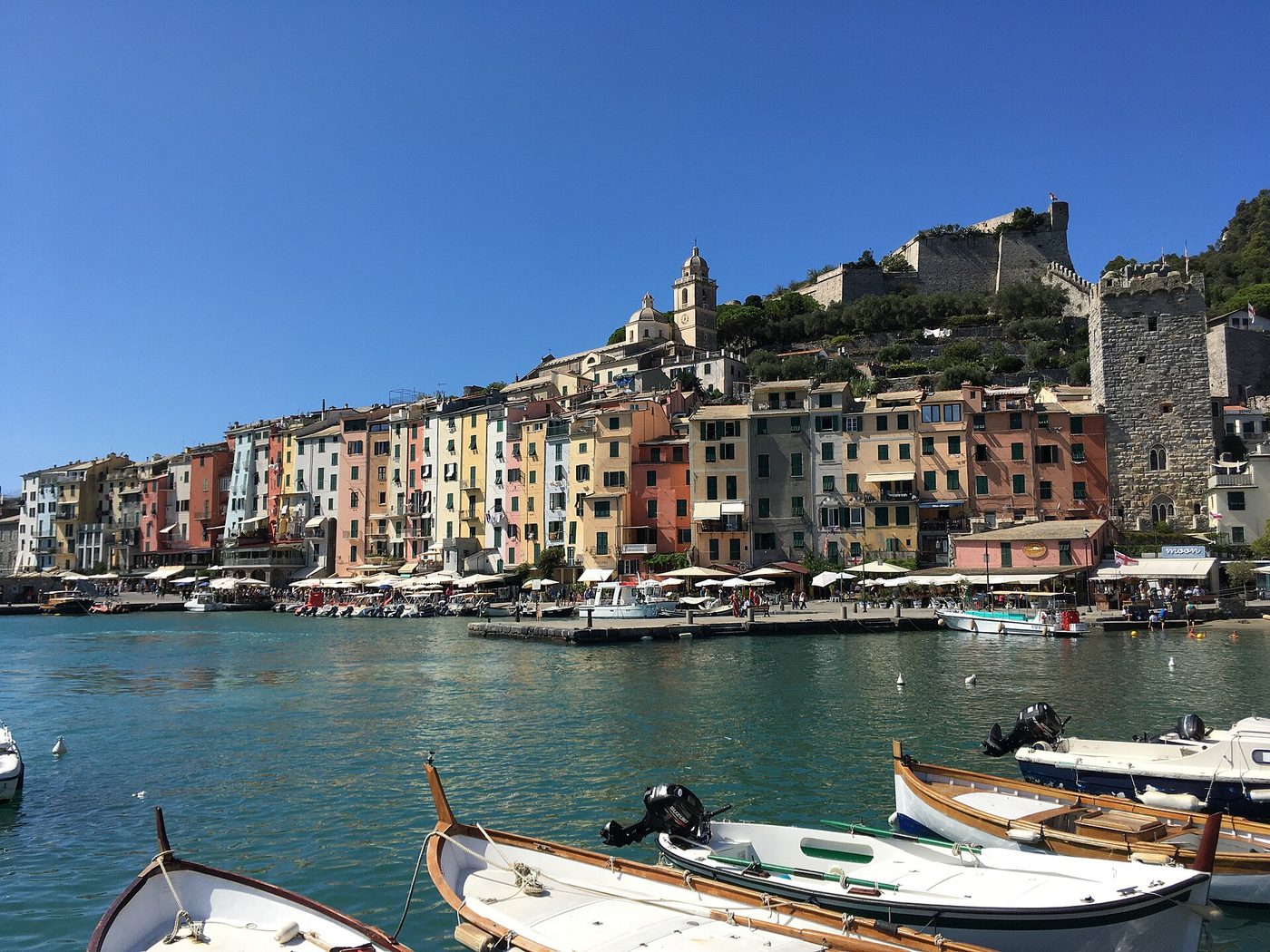
Driving, parking and the ZTL
The park’s own position is that you can come by car but should not, because of the terrain and the parking. I would put it more bluntly: unless you are staying in Monterosso or Levanto with a booked space, a car here is a liability.
The villages are car-free. Blue lines mean paid parking, white lines mean free. Never use a space marked parcheggio residenti. And be extremely careful in Vernazza: drive past the car parks and you enter a residents-only ZTL, where the camera issues a separate fine every time you pass it, so circling to look for a space multiplies the penalty. These fines are pursued across borders.
| Village | Parking | Cost | Notes |
|---|---|---|---|
| Monterosso | Fegina, 300 spaces; Loreto, 100 spaces | Paid | Open 24/7 year round. The only village with car parks in the centre. Fegina is 5 min from the station, Loreto 15 min from the station and 5 min from the boat dock |
| Vernazza | Vernassoa on the SP51, about 35 secure spaces; Vernazza Parking, 49 spaces | €2.50/h or €20/day | Both about 1 km before the village with a shuttle included. Vernassoa requires a reservation and has EV charging |
| Corniglia | One car park, about 60 spaces, 500 m from the village | €2.50/h, €20/24 h, €50/3 days, €120/week | The most straightforward of the five |
| Manarola | At the village entrance before the automatic barriers | €2.50/h, €20/day, €120/week | Non-residents cannot drive further. 10 min walk into the centre |
| Riomaggiore | Rio Park, 60 spaces, max height 1.95 m, no reservations; Zorza on the Manarola road | Rio Park €3.50/h or €35/day; Zorza €1/h, €2.50/h for campers | Zorza has a free shuttle to Riomaggiore or Manarola. No camping permitted there |
| La Spezia | Free spaces at Piazza d’Armi, plus a station garage | Free to paid | Piazza d’Armi is about 10 min walk from the station. The cheapest way to park and ride |
| Levanto | Behind the station and near the waterfront | Paid | Easier than any of the five villages |
Motorway access: for Riomaggiore and Manarola take the A12 (or the A15 from Parma) to the La Spezia exit, then the SP370. For Corniglia and Vernazza, exit at Brugnato and come via Borghetto Vara and Pignone, about 30 km and 50 minutes. For Monterosso, exit at Levanto Carrodano from the north (25 km, 40 min) or Brugnato from the south (28 km, 40 min). The nearest fuel is in La Spezia, Brugnato or Levanto, so fill up before you drop down to the coast. Our Europe road trips guide has more on Italian ZTLs generally, and what to pack for Europe covers the shoes question below.
Accessibility and travelling with limited mobility
The Cinque Terre is a hard place to visit with a wheelchair, a stroller or a bad knee, and it would be dishonest to pretend otherwise. But it is not impossible, and the provision that exists is easy to miss.
- The Corniglia shuttle removes the biggest single obstacle in the park. The staircase is not compulsory. A road runs from the station and the bus is free with the card.
- Ferries take wheelchairs, but only from and to La Spezia, Portovenere, Lerici, Levanto and Monterosso. Not the other villages.
- Via dell’Amore is paved and level, free for disabled visitors with certification, and the operator publishes an accessibility statement. It is the most realistic “trail” experience for anyone who cannot manage the coastal path.
- Monterosso is the flattest village by a distance, with the beach and the station on the same level.
- The Levanto to Framura tunnel path is 5.5 km, flat and asphalted through converted railway tunnels, and comfortably the best wheeled outing in the area.
Against that: the villages themselves are steep, many buildings are reachable only by stairs, and station platforms are not uniformly step-free. If you are travelling with a stroller, Corniglia is the village to skip. Our Europe with kids guide covers the practicalities of family travel in this kind of terrain, and solo travel in Europe has more if you are going alone.
Rules, fines and things that will get you in trouble
The flip-flop fine is real. Phased in from the 2019 season, the park introduced penalties for hiking in flip-flops, ballet flats or heeled shoes, with fines under park law running from €50 to €2,500. The park director at the time, Patrizio Scarpellini, made the point plainly: these are difficult paths, in some cases similar to mountain paths. The rule exists because helicopter rescues for footwear-related injuries were climbing. Officers check at Sentiero Azzurro access points, and in practice the first response is to turn you back rather than fine you. Bring trainers at minimum, proper walking shoes ideally.
Drones are not free to fly. Any overflight of the park, including by drone, needs authorisation requested from the park’s Protocol Office using their forms, on top of national ENAC rules. No fine figure specific to the park appears to be published, which I would not read as reassuring.
Wild camping is banned. The park states plainly that free camping is not possible and there are no equipped areas. Sleeping in the Zorza car park at Riomaggiore is explicitly not permitted.
Also worth knowing: dogs must be leashed at all times on the trails; collecting or damaging wild flora is forbidden and mushroom picking has its own rules; feeding wildlife is not allowed; spearfishing is banned across the whole Marine Protected Area; and boat speed limits apply, 5 knots in Zone B and within 300 m of the coast in Zone C, 10 knots beyond. The emergency number is 112, or 1530 for emergencies at sea.
Mistakes I see people make
- Planning around a trail that is closed. The Corniglia to Manarola section has been shut for years, and a lot of published itineraries still route people along it. Check the park’s notices before you go.
- The five-hour day trip. Off a cruise ship or a Florence train you arrive at 11:00 and leave at 16:00, which is precisely the window when the villages are least pleasant.
- Turning up at Via dell’Amore without a slot. It has timed entry now. Book it when you buy the card.
- The unnecessary Train Card. If your day is high routes and free trails, you may need nothing at all.
- Climbing the Lardarina with luggage. The shuttle is free with the card and runs on a road.
- Beach expectations. One village has real sand. If sand is the priority, Levanto or Bonassola will serve you far better.
- Driving in. Especially into Vernazza, where a wrong turn past the car parks means a ZTL fine, and another one on each pass.
- Too much luggage. Almost all accommodation involves stairs and a hill, and lifts are rare.
- Wearing sandals on the trails. A genuine fine, and a genuinely dangerous idea.
- Trying to do all five properly in a day. Three villages done well beats five done badly. Nobody has ever regretted skipping one.
Frequently asked questions
Is the Cinque Terre worth visiting?
Yes, with a caveat. The landscape is extraordinary, and the terraced hillsides are nine hundred years of human work stacked up a cliff. But four million people a year visit an area of roughly one square kilometre, so whether you enjoy it depends almost entirely on when you come and how you move. Stay overnight, walk the high routes, and you will love it. Arrive at midday in August on a day trip and you will wonder what the fuss was.
How many days do you need in the Cinque Terre?
Two nights minimum, three ideal. That gives you one day of coastal walking, one day on the ferry, and one day on a high route or a trip to Portovenere, plus two evenings with the villages half empty.
Which Cinque Terre village is best?
Vernazza is the most beautiful and the most crowded. Monterosso is the most practical. Corniglia is the quietest and the most rewarding to reach. Manarola has the best sunset and the best swimming. Riomaggiore is the easiest to arrive in. For a single village on a short visit, Vernazza. To stay, Monterosso or Vernazza depending on whether you want convenience or atmosphere.
Where should I stay in the Cinque Terre?
Monterosso for families, beaches and cars; Vernazza for the classic experience; Levanto or La Spezia if you want lower prices, easier parking and better availability, at the cost of the evenings.
Which village has the best beach?
Monterosso, and it is not close. Fegina is the only true sandy beach among the five. Levanto and Bonassola, both a short train ride away, have bigger and quieter ones.
How do you get from one village to another?
Train, ferry or on foot. The Cinque Terre Express runs every twenty minutes and takes four to six minutes between villages. Ferries serve four of the five, but not Corniglia. On foot, three of the four coastal sections are open in 2026.
Can you visit the Cinque Terre with a car?
You can drive to the edge of the villages, but they are car-free inside and parking is limited and expensive. Monterosso is the only village with central car parks. Base in Monterosso or Levanto if you must drive, and take the train from there.
What is the Cinque Terre Card, and where do you buy it?
A park pass in two versions, Trekking and Train, both of which now include Via dell’Amore. Buy it online at the park’s card site, or at the welcome centres in all five village stations plus La Spezia, Levanto and Riomaggiore Lavaccio. Write your name on the back and carry ID.
Do you need a ticket for the Blue Trail?
For three sections, yes: Monterosso to Vernazza, Vernazza to Corniglia, and Via dell’Amore. Every other trail in the park is free, and from 2 November to 12 March all trails except Via dell’Amore are free too.
Is the Blue Trail difficult?
Monterosso to Vernazza is the hardest coastal section, rated average, with plenty of steps and about two hours of climbing and descending. Vernazza to Corniglia is easier and shorter. Via dell’Amore is paved and flat. None of it is technical, but all of it needs proper shoes and a reasonable level of fitness in the heat.
Is there a limit on the number of visitors, or do I need to reserve?
No. The park’s own FAQ states there is no reservation for entry and no limit on the number of accesses. The only booking required is a timed slot for Via dell’Amore.
When does the one-way system operate in 2026?
On nine designated dates: 4, 5 and 6 April, 1 and 2 May, 14 May, 30 and 31 May, and 1 June. On those days the Monterosso to Vernazza trail runs in that direction only until 14:00, then reopens both ways.
What is the alternative to the closed Corniglia to Manarola trail?
The high route via Volastra, paths 587, 586 and 506: 5 km, two and a half hours, difficult, climbing to 400 m. Or take the train, which does it in five minutes.
What is the best place to watch the sunset?
Manarola, from the Punta Bonfiglio walkway or the cliffside bar above the harbour. Vernazza’s castle is the runner-up.
How many steps are there at Corniglia?
Roughly 380, in 33 flights, on the brick staircase called the Lardarina. Sources give both 382 and 383. You can avoid all of them by taking the shuttle bus from the station, free with the Cinque Terre Card.
Where can I leave my luggage?
Left-luggage services operate at La Spezia Centrale and at small offices and shops near the stations in Monterosso, Vernazza and Riomaggiore. Expect a single-figure euro sum per bag per day, sometimes with an hourly rate for short stops. Hours and prices change season to season, so confirm on the day rather than relying on a figure you read in advance, including mine.
Is there drinking water on the trails?
There are public taps in every village for refilling bottles, and the Cinque Terre Card gives free use of the paid toilets in Riomaggiore, Vernazza and Monterosso. Between villages, assume nothing and carry at least a litre in summer.
What is the nearest airport?
Pisa is closest, at around 1 h 15 by train to La Spezia. Genoa is the next nearest, then Milan Malpensa.
Can you visit with a stroller?
With difficulty. Monterosso is manageable, Via dell’Amore and the Levanto to Framura tunnel path are both flat, and the Corniglia shuttle avoids the staircase. The village lanes themselves are steep and stepped, and Corniglia is the one to skip.
What is the best time of day to visit?
Early morning and late afternoon. The middle of the day belongs to day trippers and cruise passengers, and the villages empty out noticeably after 18:00.
Final thoughts
The Cinque Terre has a reputation problem that it does not entirely deserve. Yes, the visitor numbers are enormous. Yes, Vernazza’s main street in August is an experience nobody enjoys. But the crowd is astonishingly concentrated, in five villages, on one trail, between about 10:30 and 16:00. Step outside that box in any direction and the place is quiet.
Walk up to Volastra through the vineyards. Take the ferry at five in the afternoon. Sleep in Corniglia and watch the last train leave. Eat anchovies in Monterosso in September when the sea is still warm and the crowds have thinned. The terraces have been worked for nine hundred years and they were built by people who had no interest in being photographed. That is still the best reason to come.
If you are planning the wider trip, start with our Italy travel guide, then look at how to spend 10 days in Italy and Tuscany and the Amalfi Coast for the obvious pairings, or Florence and Rome for the cities either side. First trip to the continent? Start with the best places to visit in Europe for first-timers and our list of the best countries to visit in Europe.
Hannah Brooks has spent fifteen years travelling, living and writing across Europe, from the Arctic tip of Norway to the south of Sicily. She has planned hundreds of European itineraries for readers and is Senior Europe Editor at EuropeanTourism.org.
Photo credits
All photographs are freely licensed. Full attribution below.
- Photo: Davcio / CC BY-SA 3.0 via Wikimedia Commons
- Photo: СССР / CC BY-SA 2.5 ca via Wikimedia Commons
- Photo: WikiLucas00 / CC BY-SA 4.0 via Wikimedia Commons
- Photo: Quinn Comendant / CC BY-SA 2.0 via Wikimedia Commons
- Photo: Davide Taviani / CC BY 3.0 via Wikimedia Commons
- Photo: chensiyuan / CC BY-SA 4.0 via Wikimedia Commons
- Photo: Angelo nastri nacchio / CC BY-SA 4.0 via Wikimedia Commons
- Photo: Federica Cidale / CC BY-SA 4.0 via Wikimedia Commons
- Photo: Davide Papalini / CC BY-SA 3.0 via Wikimedia Commons
- Photo: Daniela M. / CC BY-SA 4.0 via Wikimedia Commons
2 comments