Mallorca Travel Guide
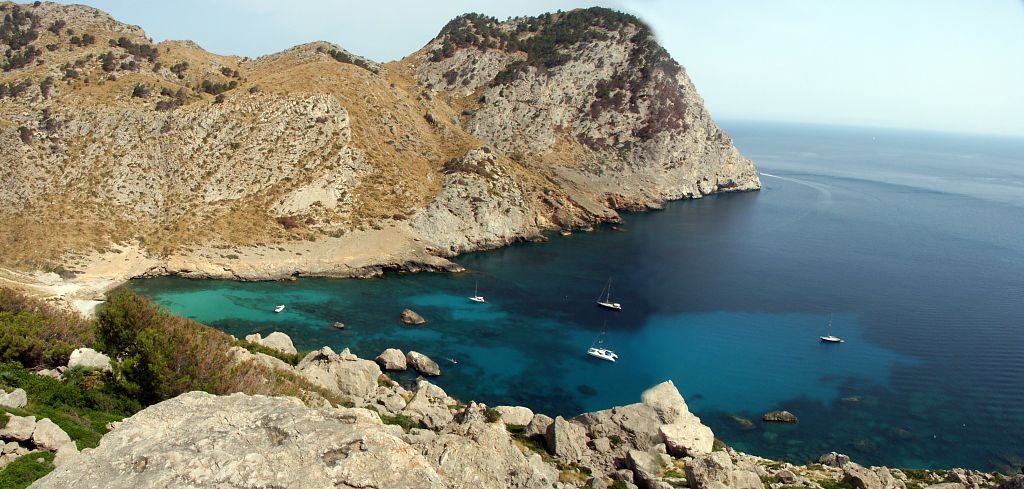
The first time I drove over the Coll de Sóller and saw the orange-growing valley open up below me, I pulled over. I had come expecting a beach island with a party reputation, and found a mountain range with a UNESCO listing, a wooden train from 1912 and a square where nobody was speaking English. Mallorca is not one place, and this Mallorca travel guide is built around that.
It is written for people planning a real trip: when to go, where to base yourself, what things actually cost in 2026, which roads are now closed to private cars, and how to see the island without hiring a car at all. Every price and rule below comes from an operator, a town hall or the Balearic government, checked in August 2026.
I have been coming here for over a decade, in every month of the year, and I still find the island reshuffles itself depending on where you stand. The south-west is yachts and marinas. The north-west is dry-stone terraces and hikers. The centre is farmland and Wednesday markets. The east is caves and coves. The Bay of Palma is a city with a cathedral that could hold a small town inside it. If you have written Mallorca off because of what you have heard about Magaluf, you are dismissing an island roughly the size of Cornwall on the basis of one square mile of it.
Mallorca travel guide: the island at a glance
| Fact | Detail |
|---|---|
| Where | Largest of Spain’s Balearic Islands, in the western Mediterranean |
| Area | Around 3,640 km², roughly 100 km east to west and 80 km north to south |
| Population | Around 949,000 (2024) |
| Coastline | Around 580 km, with somewhere between 200 and 300 named beaches and coves depending on who is counting |
| Visitors | 13.56 million tourists in 2025, up 1.4% on 2024. The Balearics as a whole passed 19 million for the first time |
| Airport | Palma de Mallorca (PMI), Son Sant Joan. 33.8 million passengers in 2025 |
| Languages | Catalan and Castilian Spanish, both official. Locals speak mallorquí, the Mallorcan variety of Catalan |
| Currency | Euro |
| Highest walkable peak | Puig de Massanella, 1,364 m. Puig Major is higher but is a military zone |
| UNESCO site | Cultural Landscape of the Serra de Tramuntana, inscribed 27 June 2011 |
| Tourist tax | €0.25 to €4.00 per person per night plus 10% VAT, depending on season and accommodation type |
| Emergency number | 112, free and multilingual |
Mallorca or Majorca?
Both are correct, and neither will get you a funny look. Mallorca is the Catalan and Spanish spelling, pronounced roughly “ma-YOR-ca”. Majorca is the English version, which is why older British guidebooks and a lot of package holiday brochures still use it. Signage on the island uses the Catalan forms throughout, so it is worth training your eye: Sóller, Pollença, Alcúdia, Valldemossa, Platja d’es Trenc. I use Mallorca in this guide because that is what is written on the road signs you will be following.
What a cala is, and why it matters
You will see the word everywhere. A cala is a small cove, usually a pocket of sand or pebble enclosed by rock or cliff, often reached down a path rather than a road. The distinction between a platja, a proper beach with a car park and a bar, and a cala, a cove that may have neither, is the most practical piece of Mallorcan vocabulary you can learn. Half the disappointment I hear from first-timers comes from turning up at a cala in a hire car at noon in August expecting the former.
When to visit Mallorca: a month-by-month breakdown
Mallorca has a long season and a short peak. The heat is manageable by Mediterranean standards, the sea stays swimmable well into October, and the mountains are best in the months when the beaches are not. The table below uses long-run averages for Palma; the coast in the north runs a degree or so cooler and the Tramuntana villages noticeably cooler again.
| Month | Avg high | Avg low | Sea temp | Rain | My verdict |
|---|---|---|---|---|---|
| January | 13.2°C | 8.8°C | 15.1°C | 35 mm | Quiet, cheap, many resorts shut. Almond blossom begins late in the month. Sant Sebastià fills Palma |
| February | 13.2°C | 8.4°C | 14.2°C | 34 mm | Coldest sea of the year. Peak almond blossom across the Pla. Cyclists start arriving |
| March | 15.6°C | 9.8°C | 14.4°C | 27 mm | Excellent hiking, wildflowers, low prices. Beach clubs begin reopening late in the month |
| April | 18.3°C | 12.1°C | 15.8°C | 37 mm | My favourite month for walking. Sea still bracing. Easter brings crowds and processions |
| May | 21.9°C | 15.1°C | 18.5°C | 31 mm | The sweet spot. Warm days, swimmable sea by late May, everything open, tolerable prices |
| June | 26.8°C | 19.1°C | 22.4°C | 16 mm | Sunniest month at around 12 hours a day. Sea properly warm. Prices climbing steeply |
| July | 29.6°C | 21.9°C | 25.6°C | 5 mm | Driest month, hottest crowds, highest prices. Mountains too hot to walk safely at midday |
| August | 29.7°C | 22.5°C | 26.7°C | 19 mm | Peak everything. Warmest sea of the year. Book beach parking and restaurants well ahead |
| September | 25.9°C | 20.2°C | 25.6°C | 41 mm | The best value in the calendar. Sea as warm as July at 25.6°C, crowds thinning after the first week |
| October | 22.3°C | 17.3°C | 23.0°C | 58 mm | Wettest month, and still lovely. Sea warmer than June. Season winds down from mid-month |
| November | 17.0°C | 13.0°C | 19.5°C | 57 mm | Wet and quiet. Good for city breaks in Palma, poor for beaches |
| December | 14.3°C | 10.2°C | 16.7°C | 42 mm | Low season. Palma at Christmas is quietly charming, the coast is largely closed |
Palma’s annual mean is 17.7°C with around 402 mm of rain, which is remarkably little, and roughly 3,396 hours of sunshine. The pattern to hold in your head is that Mallorca is dry in summer and wet in autumn: July gets 5 mm, October gets 58 mm. The rain, when it comes, tends to arrive as short heavy bursts rather than grey drizzle.
The best time to visit, by what you want
- Swimming and beach days: mid-June to mid-October. The sea does not reach 20°C until June and stays above it until early November, which surprises people who assume September is over.
- Hiking: October to May. Summer in the Tramuntana is genuinely dangerous at midday, and most of the good long routes have no shade and no water.
- Cycling: late January to April. The mild winter is exactly why professional teams hold training camps here.
- Value: late September and early October, or March. Accommodation typically runs 30% to 40% below peak in the shoulder months, and can halve again in midwinter.
- Almond blossom: late January into February, mostly across the flat central Pla rather than the mountains.
- Avoiding crowds entirely: November to February, accepting that a chunk of the coastal infrastructure is shut.
If you are weighing Mallorca against other Mediterranean options, our guide to the best time to visit Europe sets the island’s season against the wider continental picture, and the best time to visit Spain compares it with the mainland regions.
Getting to Mallorca
Palma de Mallorca Airport (PMI) is the third busiest in Spain and handled 33.8 million passengers in 2025, up 1.5% on the year before. The great majority were international, and the biggest single market is Germany, followed by the United Kingdom and Switzerland. In practice that means a dense summer network of direct flights from almost anywhere in northern Europe, and a much thinner one in winter.
| From | Approx. direct flight time |
|---|---|
| Paris (CDG/ORY) | 1 h 55 min to 2 h 10 min |
| London | Around 2 h 20 min |
| Manchester | Around 2 h 37 min |
| Berlin | Around 2 h 40 min to 2 h 45 min |
You can also arrive by sea. Baleària and Trasmed run car ferries linking Palma and Alcúdia with Barcelona, Valencia, Dénia, Ibiza and Menorca. Barcelona to Palma on a standard overnight sailing takes around 7 to 8.5 hours; Baleària’s fast ferry to Alcúdia does it in about 3.5 hours from April to October, three to five times a week. Palma to Ibiza is about 2 h 15 min. Bringing your own car across is straightforward and often cheaper than a fortnight’s hire in August, which makes the island a natural extension of a mainland European road trip. If you would rather arrive overland as far as Barcelona or Valencia, our guide to train travel in Europe covers the routes down through France and Spain.
From the airport into Palma
| Option | Cost | Time | Notes |
|---|---|---|---|
| Bus A1 (EMT) | Around €5 single, around €8 pre-paid return | 20 to 30 min | Roughly every 15 minutes. Line 21 also serves the airport. The airport lines carry their own fare and sit outside the free-travel scheme described below |
| Taxi | Around €28 daytime, around €37 at night, airport surcharge included | About 15 min | White cars, blue plates, green rooftop light. Metered |
| Uber | Variable, usually above the metered taxi fare | About 15 min | Operates on the island; the app can also book local taxis |
| Metro | Not applicable | n/a | Palma’s metro does not reach the airport. It runs from Plaça d’Espanya to the university and Marratxí only |
The hub you want for onward travel is the Estaçió Intermodal at Plaça d’Espanya in central Palma. Interurban TIB buses, SFM trains and both metro lines all leave from there, on one underground concourse.
If your hotel is not in Palma, you do not have to go via the city at all. TIB runs direct airport departures to the main resort areas in season, including the north coast towards Can Picafort, Port d’Alcúdia and Port de Pollença, the south-east towards Cala d’Or and Santanyí, and the south-west towards Palmanova, Magaluf and Santa Ponsa. Check the current line numbers on tib.org before you fly, because the seasonal routes are renumbered from time to time. It is almost always cheaper and no slower than a pre-booked transfer.
One warning about driving into Palma: the city centre has restricted-access streets, residents-only zones and a low-emission zone, and the practical answer is to leave the car in an underground car park at Parc de la Mar, Via Roma or the Estaçió Intermodal and walk. Street parking in the old town is not a realistic plan in season.
Getting around Mallorca in 2026
One fact reshapes trip planning on this island more than any other. Interurban public transport in Mallorca is free in 2026. The Balearic government has extended a 100% fare discount across TIB interurban buses, SFM trains and the Palma metro for the whole of 2026, for anyone holding a Tarjeta Única or Intermodal Card. Free travel also extends to EMT Palma city buses, with or without transfers.
The conditions are simple and easy to get wrong:
- You need the physical Tarjeta Única or Intermodal card. Tapping a bank card or buying a paper single on board gets you the normal fare, not zero.
- You must validate the card when you board and when you get off a bus, and at the turnstiles on rail. Miss the second tap and the journey does not register correctly.
- Keep a small balance on the card, around €5, even though the journeys cost nothing.
- Pick one up at TIB customer service offices in Palma, Inca, Manacor and Alcúdia, the EMT office in Palma, municipal offices in Marratxí, Llucmajor and Calvià, or order online before you fly.
Without a card, TIB runs a zonal fare system starting at €3.00 and rising to roughly €13 on the longest routes. Paying by contactless bank card rather than cash can be up to 40% cheaper than a cash single, so if you have not got the Tarjeta Única, at least tap.
Do you need a car in Mallorca?
My honest answer has changed. Five years ago I would have said yes without pausing. Now it depends on where you stay and what you want, and the free-transport situation plus the new road closures have tilted the maths.
| Your trip | Car? | Why |
|---|---|---|
| Palma city break | No | The old town is walkable, parking is expensive and awkward, and buses and trains reach Inca, Sóller, Manacor and the beaches |
| Beach week in Alcúdia, Port de Pollença or Cala d’Or | Optional | Your beach is on your doorstep. Hire for two or three days mid-stay rather than the whole week |
| Touring the Tramuntana villages | Yes, mostly | Buses connect the big names but not the small ones, and the timetables thin out on Sundays |
| Hunting remote calas | Yes | Cala Varques and similar are reached by dirt track on foot from a road with no bus |
| Cape Formentor in summer | No | The road is closed to private cars during the day from mid-May to mid-October. The bus is the only practical way in |
| Hiking the GR221 | No | Point-to-point walking. A car parked at the start is a problem, not an asset |
| Cycling trip | No | Bikes travel free on most SFM trains, though not on the Sóller train |
If you do hire, book early and expect August to hurt. Typical rates I have seen quoted for 2026:
| Season | Category | Typical daily rate |
|---|---|---|
| Winter (Jan, Nov) | Small car | Around €7 to €20 |
| Shoulder, booked ahead | Economy or compact | Around €20 to €30 |
| Year-round average at PMI, booked ahead | Economy or compact | Around €25 to €30 |
| Peak (Jul to Aug) | Economy | Around €40 to €50 |
| Peak (Jul to Aug) | Standard | Around €50 |
| Peak (Jul to Aug) | SUV | Around €70 |
August is the most expensive month by a wide margin, with rates reported at roughly 70% above the annual average. Drive on the right; the island loop road is just over 300 km and takes about six hours non-stop, so nothing is truly far away, though add half an hour to any July or August drive time you find online. For the wider picture on hire cars, trains and buses across the continent, see our guide to getting around Europe.
The Palma to Sóller wooden train
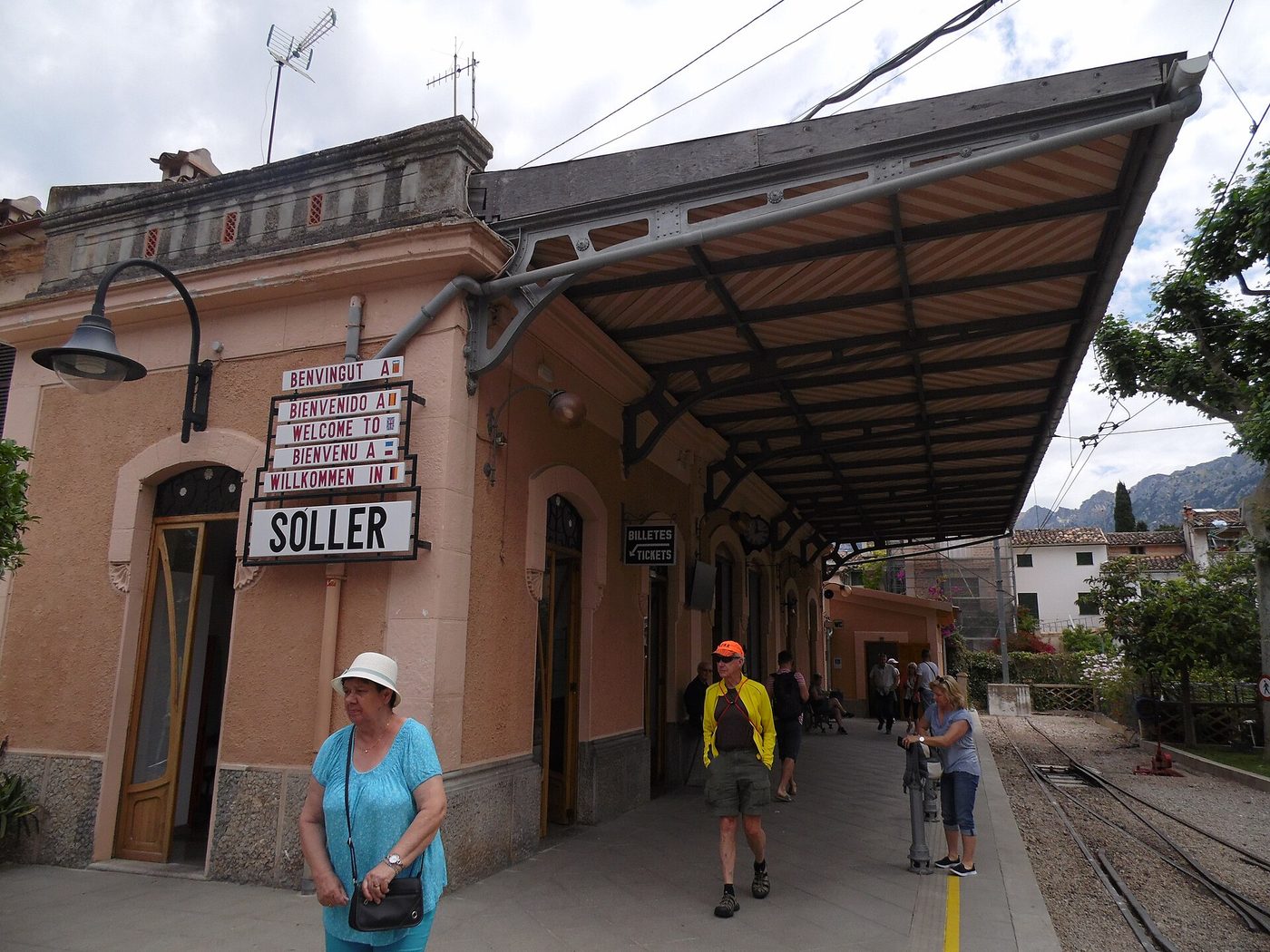
This is the one piece of transport that is also a destination. The Ferrocarril de Sóller has run since 1912 and the carriages have not changed since: varnished wood, brass fittings, sliding windows you open with a leather strap. It climbs out of Palma through 13 tunnels, the longest almost 3 km, crosses the five-arch cinc ponts viaduct, tops out at around 200 m and drops into the Sóller valley in about an hour.
The ticketing catches people out. The operator sells one product online: a combined Train and Tram return, Palma to Port de Sóller and back, at €40 standard or €32 on selected departures booked online in advance. Single fares and other combinations exist but are sold only at the ticket office on the day of travel, so plan on buying those in person. Arrive 30 minutes before departure, expect a boarding pass by email, and note that no refunds are issued once a ticket is out, though you can change the date or time until 09:00 on the day. Bicycles, e-scooters and animals other than guide dogs are not allowed on board.
Two things worth knowing that are not on the ticket. The train time is fixed but the tram down to Port de Sóller is not, so you can catch any departure. And the station building in Sóller, a 17th-century house called Can Maiol, has free Miró and Picasso exhibition rooms upstairs, run by the Tren de l’Art Foundation.
The SFM trains
Modern, air-conditioned and, in 2026, free with the card. The network runs Palma to Inca, then branches north to Sa Pobla and south-east to Manacor. Palma to Inca takes just under 40 minutes, Sa Pobla around 50, Manacor around 70 and roughly hourly. Trains run broadly hourly from about 06:10 to 22:20. Bikes travel free on most services. Manacor puts you within a short bus ride of the Coves del Drach; Sa Pobla is the gateway to s’Albufera and the north coast.
2026 road closures and access restrictions you must plan around
Mallorca has started rationing access to its most photographed places, and the rules are specific enough that turning up unprepared costs you the day.
Cap de Formentor
The Ma-2210, the corkscrewing road from Port de Pollença out to the Formentor lighthouse, is closed to private vehicles from 15 May to mid-October 2026, daily between 10:00 and 22:00. Outside those hours the road is open to everyone as normal. The end date is quoted as 18 October by the DGT and 15 October by the Consell de Mallorca, so if you are travelling in that window, check before you drive.
Within the restricted window it splits into two zones. From Port de Pollença as far as Formentor beach, limited private access is allowed until the car park, roughly 300 spaces, fills up. Beyond the beach, out to the lighthouse, the road is completely closed to private cars and motorcycles. Enforcement is by automatic number-plate recognition camera, and fines have been in the region of €100 to €200.
Who can still use it: TIB buses, taxis, permit holders, cyclists, walkers, peninsula residents with documentation, and reduced-mobility exceptions. Private-hire and VTC vehicles may go only as far as Formentor beach, not the lighthouse. Coaches are banned outright; scheduled public buses are not.
The workaround is TIB line 334, which runs Alcúdia to Port de Pollença to Formentor beach to Cala Murta and Cala Figuera, and finally the lighthouse. There are 18 daily departures from Alcúdia plus 14 more from Port de Pollença. The first leaves Alcúdia at 09:30 and the last at 20:30; the first return from the lighthouse is 10:40 and the last 21:40. Allow just over an hour from Alcúdia, around 50 minutes from Port de Pollença. My advice, if you want the lighthouse without the bus: drive it before 10:00. The light at that hour is better anyway.
Sa Calobra
The Ma-2141 down to Sa Calobra, the road with the tie-knot hairpin where it loops over itself, is not closed to private cars. It is, however, dangerously narrow and heavily overloaded in season. Coaches now have specific permitted descent and return times set by Escorca town hall, and Escorca has installed an ANPR camera at the entrance to the port to stop unauthorised vehicles parking in resident areas.
The civilised alternative is to arrive by sea. Boat services run to Sa Calobra from Port de Sóller and Can Picafort, which turns a white-knuckle drive into a scenic crossing and removes the parking problem entirely.
What this means in practice
If your plan is “hire a car and drive to the famous places at lunchtime”, 2026 will punish you. If your plan is “early starts, or the bus, or a boat”, none of these restrictions will touch you. The restrictions exist because the roads genuinely cannot cope, and they have made the places themselves considerably more pleasant.
The Mallorca tourist tax, explained properly
The Balearic sustainable tourism tax, formally the Impost sobre Estades Turístiques and universally called the ecotasa, has been in force since 2016. It is charged per person per night, collected by your accommodation, and usually appears as a separate line on the bill at check-in or check-out. It applies to holiday lets and Airbnb stays too, where the host collects it.
An increase was legislated and heavily trailed. It has not taken effect. As of August 2026 the official rate table is unchanged, and the Balearic government said in February 2026 that it no longer considers a rise necessary, citing 2025 data showing peak-season visitor growth of just 0.7% and a falling Human Pressure Index. The higher figures that circulated for 2026 described a proposal, not a law.
High season runs 1 May to 31 October; low season is 1 November to 30 April. Add 10% VAT to every figure below.
| Accommodation type | High season (per person per night) | Low season |
|---|---|---|
| 5-star, 5-star luxury and 4-star superior hotels, city hotels, apart-hotels | €4.00 | €1.00 |
| 4-star and 3-star superior hotels | €3.00 | €0.75 |
| 1, 2 and 3-star hotels, city hotels and apart-hotels | €2.00 | €0.50 |
| 4-key and 4-key superior tourist apartments | €4.00 | €1.00 |
| 3-key superior tourist apartments | €3.00 | €0.75 |
| 1, 2 and 3-key tourist apartments | €2.00 | €0.50 |
| Non-residential accommodation run by residential-tourism companies | €4.00 | €1.00 |
| Tourist holiday homes and housing let for tourist stays | €2.00 | €0.50 |
| Rural hotels, agroturisme and inland tourism accommodation | €2.00 | €0.50 |
| Hostels, guest houses, inns and campsites | €1.00 | €0.25 |
| Mountain shelters and refuges | €1.00 | €0.25 |
| Other establishments and houses used for tourism | €2.00 | €0.50 |
| Tourist cruise ships | €2.00 | €0.50 |
Three reliefs are worth knowing. Children under 16 are exempt entirely. From the ninth day of a stay in the same establishment the tax is halved. And cruise passengers whose home port is in the Balearics are exempt.
What does this actually cost you? A family of four, two adults and two children under 16, in a 4-star hotel for a week in July pays €3.00 per adult per night, so €42 plus VAT, around €46. Two adults in a rural agroturisme in March pay €0.50 each per night, so €7 plus VAT for the week. It is a real line item, and for most trips it lands somewhere between a good dinner and a tank of fuel. For how this compares with Barcelona, Venice and the rest, see our breakdown of Europe travel tips on money, safety and etiquette.
Where to stay in Mallorca: choosing a base
This decision matters more here than on most islands, because the mountains in the north-west make journeys slower than the map suggests. Port de Sóller to Cala d’Or is about an hour and a half, plus another half hour in July and August. Pick a base that matches your priorities rather than trying to split the difference.
| Base | Best for | Character | Watch out for |
|---|---|---|---|
| Palma | First-timers, city lovers, car-free trips | A real working city with a cathedral, markets, tapas bars and a 16 km seafront bike lane | Not a beach base. The city beaches are ordinary |
| Port de Sóller | Mountains, walking, the wooden train | Horseshoe bay under the Tramuntana, tram to Sóller town | Small beach, busy in season, winding roads in and out |
| Deià and Valldemossa | Couples, quiet, scenery | Stone villages on terraced hillsides, expensive and lovely | Very limited nightlife, parking is a genuine problem |
| Port de Pollença | Hikers, cyclists, relaxed families | Long beach, promenade, traditional llaüts in the harbour, gateway to the Tramuntana | Formentor access restrictions in summer |
| Alcúdia and Playa de Muro | Families with young children | Long shallow sandy bays, full resort infrastructure, walled medieval old town behind | Large hotels, package-holiday feel in places |
| Cala d’Or | Couples and families wanting coves | Relaxed east-coast base with several small calas, a marina and good restaurants | Purpose-built rather than historic |
| Santa Ponsa | Families with toddlers | Protected bay with a wide shallow beach and unusually sheltered swimming | Bland architecturally |
| Palmanova and Portals Nous | Families wanting facilities | Purpose-built, waterparks, watersports, calmer than the neighbours | Next door to Magaluf |
| Puerto Portals | Smart couples, marina crowd | The island’s most exclusive marina, superyachts and expensive dinners | Prices, and a certain amount of posturing |
| Magaluf and Playa de Palma | Nightlife, big groups | The party strips, roughly April to October, in the same vein as parts of the Costa del Sol | In the restricted-behaviour zone. See below |
| Inland fincas (Pla, Binissalem, Santa María) | Second visits, wine, quiet | Converted farmhouses among vines and almond groves, pools, real village life | You will need a car, and beaches are 30 to 40 minutes away |
For how Mallorca’s options compare with hotel, apartment and hostel choices elsewhere on the continent, our guide to where to stay in Europe covers the trade-offs by trip type.
The party-zone rules, since they catch people out
The Balearic decree on responsible tourism applies to designated zones only, not the whole island. It names four resorts across the Balearics, three of them on Mallorca: Magaluf in the municipality of Calvià, Playa de Palma, and s’Arenal in Llucmajor. The fourth is Sant Antoni de Portmany on Ibiza. Within those zones: drinking alcohol in the street and other public spaces is banned, happy hours are banned, organised pub crawls are banned, party boats are banned within one nautical mile of the designated zones, off-licences and supermarkets must stop selling alcohol at 21:30, and all-inclusive hotels are limited to six alcoholic drinks per person per day, three at lunch and three at dinner. Fines for street drinking have been reported in ranges from several hundred euros up to €3,000, and sources disagree on the ceiling, so treat the upper end as a real possibility rather than a certainty.
None of this applies in Sóller, Pollença, Palma’s old town or anywhere else on the island. The rules are targeted at three specific strips of Mallorcan coast and nothing beyond them.
Palma: the city most visitors skip
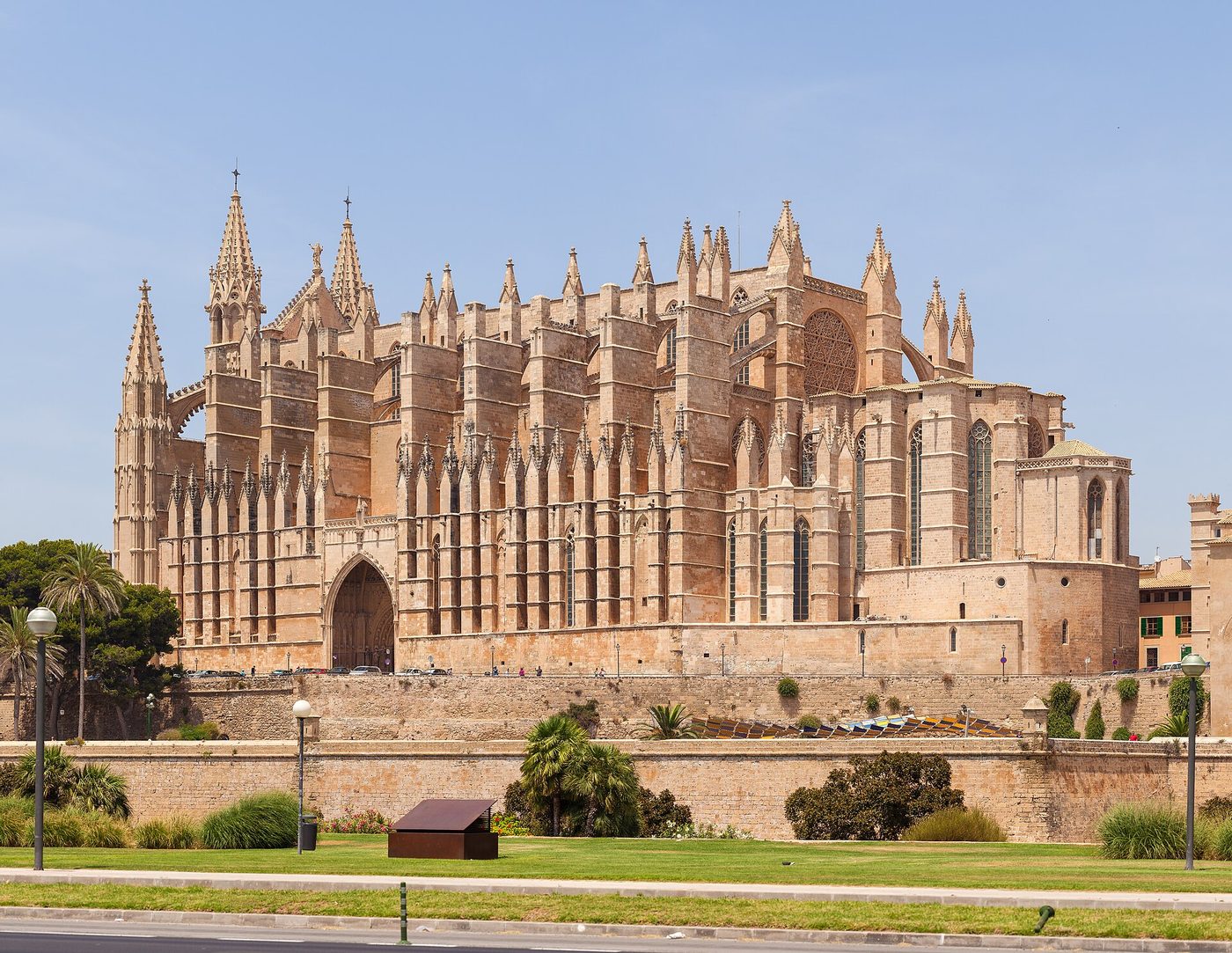
An enormous number of people fly into Palma, get straight into a transfer coach and never come back. It is the most common mistake made on this island. Palma is a Mediterranean capital with a Gothic cathedral, an Arab-influenced old town, a serious food market and one of the better contemporary art collections in Spain, and you can see the core of it on foot in a day.
La Seu, the cathedral
It is the reason the seafront looks the way it does: a vast sandstone Gothic hulk sitting directly above the water, with the largest rose window of its kind in Europe. Antoni Gaudí worked on the interior in the early 20th century, and the crown-of-thorns canopy over the altar is attributed to him; the cathedral is marking 2026 as “Any Gaudí”. The Chapel of the Holy Sacrament was reworked by the Mallorcan artist Miquel Barceló into something that looks like the sea bed, which is not what anyone expects to find in a medieval cathedral.
Visiting hours as displayed by the cathedral run 10:00 to 15:15, with worship from 08:30 to 09:45. An adult ticket bought at the door is around €14; booking the cathedral and Museum of Sacred Art online in advance brings it down to around €10. The rooftop terraces are the thing to book if you can: a combined terraces ticket is around €25, a guided sunset terrace tour around €30, and it involves roughly 215 steps up a spiral staircase on the south side. The terraces open seasonally, broadly May to October, and children under nine are not admitted. Check the cathedral’s own site for current dates before you build a day around it.
The rest of Palma
- Bellver Castle, around €4 for adults, with a reduced rate for EU citizens, free for under-14s and free on Sunday afternoons. A 14th-century circular castle, one of very few in Europe, about 3 km from the centre, with a city history museum inside and the best view back over the bay.
- Palau de l’Almudaina, around €9, with an audio guide at around €3.50. The royal palace facing the cathedral, Moorish bones under a Gothic remodelling. EU citizens get free entry on certain Wednesday and Thursday slots.
- Fundació Miró Mallorca, around €10 to €11. Joan Miró’s home and workshop for more than 30 years, including the modernist studio Josep Lluís Sert built for him and an 18th-century farmhouse he used as a second studio. Open Tuesday to Saturday 10:00 to 18:00 and Sunday 10:00 to 15:00, closed Monday. Free on the first Sunday of the month, and for under-15s.
- Es Baluard, around €6 general and €4 reduced, free for under-12s and free on Friday afternoons from 15:00 to 20:00. Modern and contemporary art inside a Renaissance bastion on the city walls.
- Mercat de l’Olivar, Palma’s main covered food market, running since 1951. Go for lunch rather than shopping: several stalls will cook what you point at.
- Santa Catalina, the old fishermen’s quarter turned into the city’s best eating and drinking neighbourhood, built around its own produce market.
Palma works beautifully as a long weekend in its own right, particularly between November and March when the coast is shut. Our guide to European city breaks and weekend getaways has more on that kind of trip, and things to do in Barcelona pairs naturally with it given the ferry link.
The Serra de Tramuntana
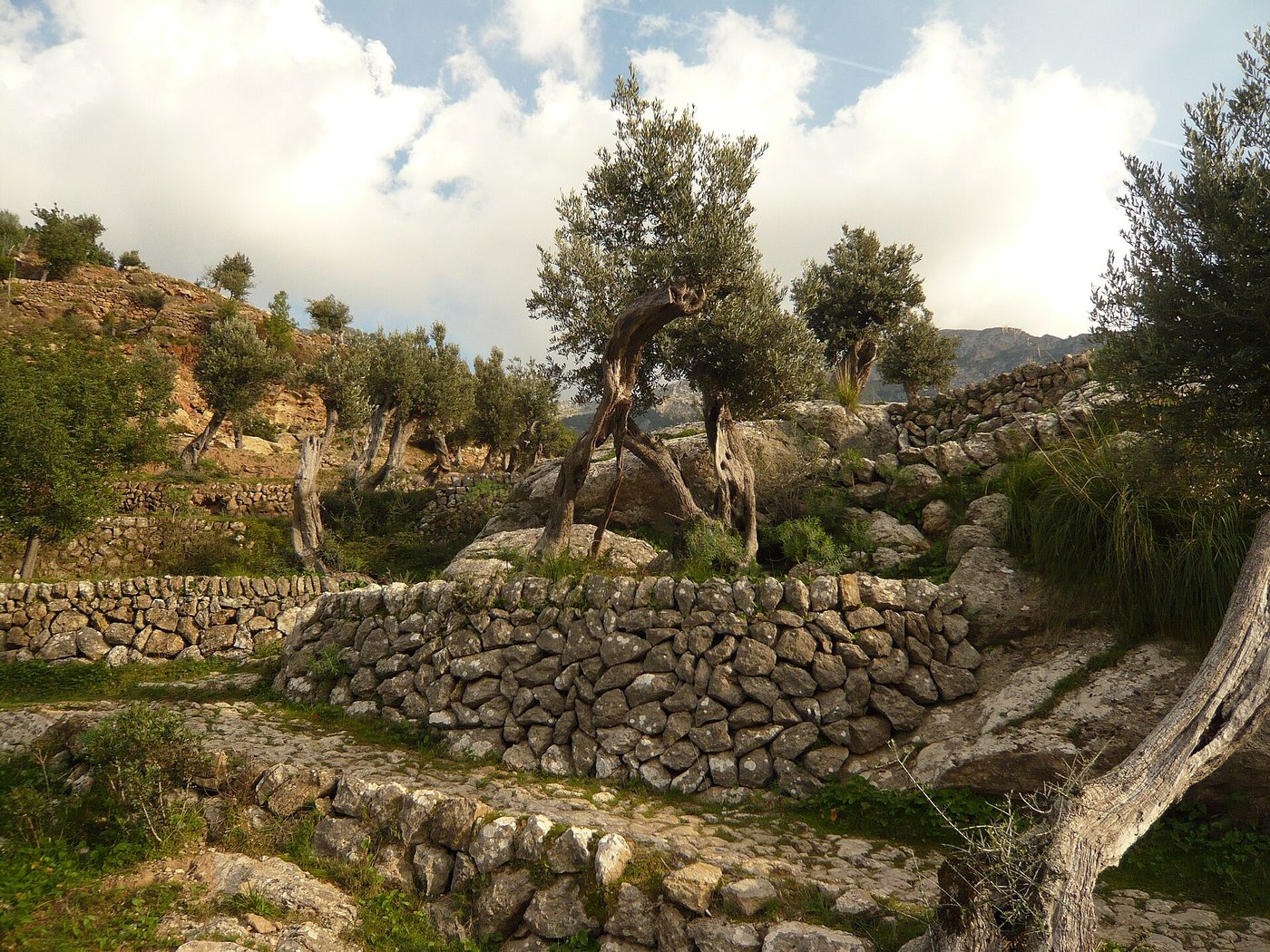
The mountain range along the north-west coast is why Mallorca is more interesting than its reputation. UNESCO inscribed it on 27 June 2011 as a Cultural Landscape, covering 30,745 hectares, under criteria (ii), (iv) and (v). The listing is not about scenery. It recognises the terraced farming held up by dry-stone walls, the marges, and the interconnected water system of qanats, canals, ditches and storage basins built up from the 13th century as a fusion of Muslim and Christian land and water management. Once you know that, the hillsides read differently: those are not natural contours, they are eight centuries of hand-stacked stone. The same Muslim-then-Christian water engineering shaped the gardens of Granada and the Alhambra, which is worth seeing alongside this if you are pairing the island with the mainland.
The range runs the length of the north-west coast, with the highest peaks approaching 1,400 m and Puig Major just above it. A second, gentler range, the Serres de Llevant, runs down the east, with the fertile agricultural plain of the Pla between them.
Valldemossa
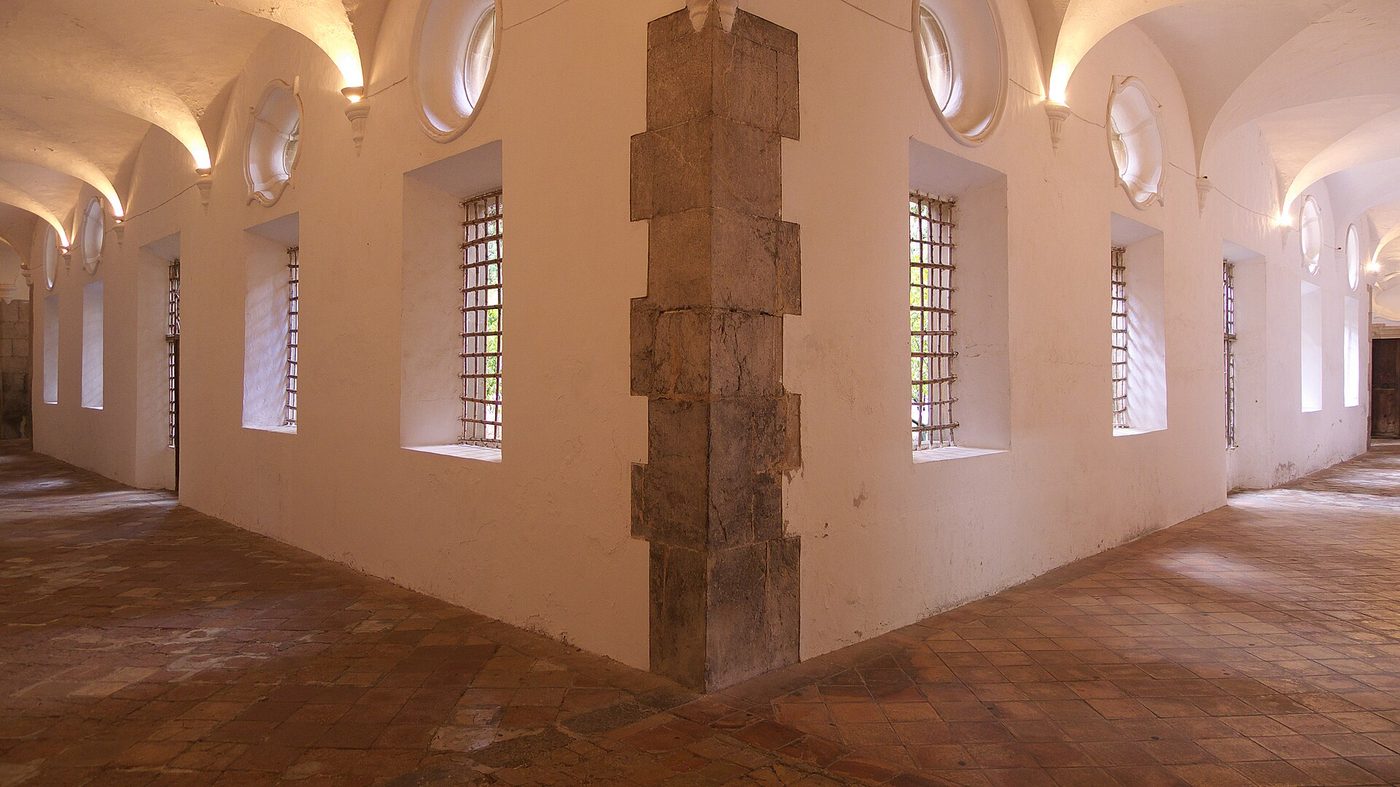
A village of ochre stone stacked up a hillside, and the most visited place in the mountains for one reason: Chopin and George Sand spent the winter of 1838 to 1839 in the Royal Charterhouse here. It did not go well for either of them, and Sand’s account of it is memorably bad-tempered, but the rooms are preserved and the setting is extraordinary.
The Cartoixa ticket prices, current for 2026:
| Ticket | Price |
|---|---|
| General admission | €12.50 |
| General plus Homenatge Tower | €15.50 |
| Student | €8.50 (€11.50 with tower) |
| Senior 65+ | €10.00 (€13.00 with tower) |
| Groups of 10 or more | €11.50 |
| VIP | €18.50 adult, €12.50 for 11 to 17-year-olds |
It opens Monday to Saturday. The ticket covers the 1750s monastery church, the apothecary, the cloisters and gardens, a royal palace tour and a 15-minute live Chopin piano recital, which is a better inclusion than it sounds. A separate Chopin festival runs at the Cartoixa in high summer. Confirm the 2026 dates with the festival directly before booking around it.
Deià
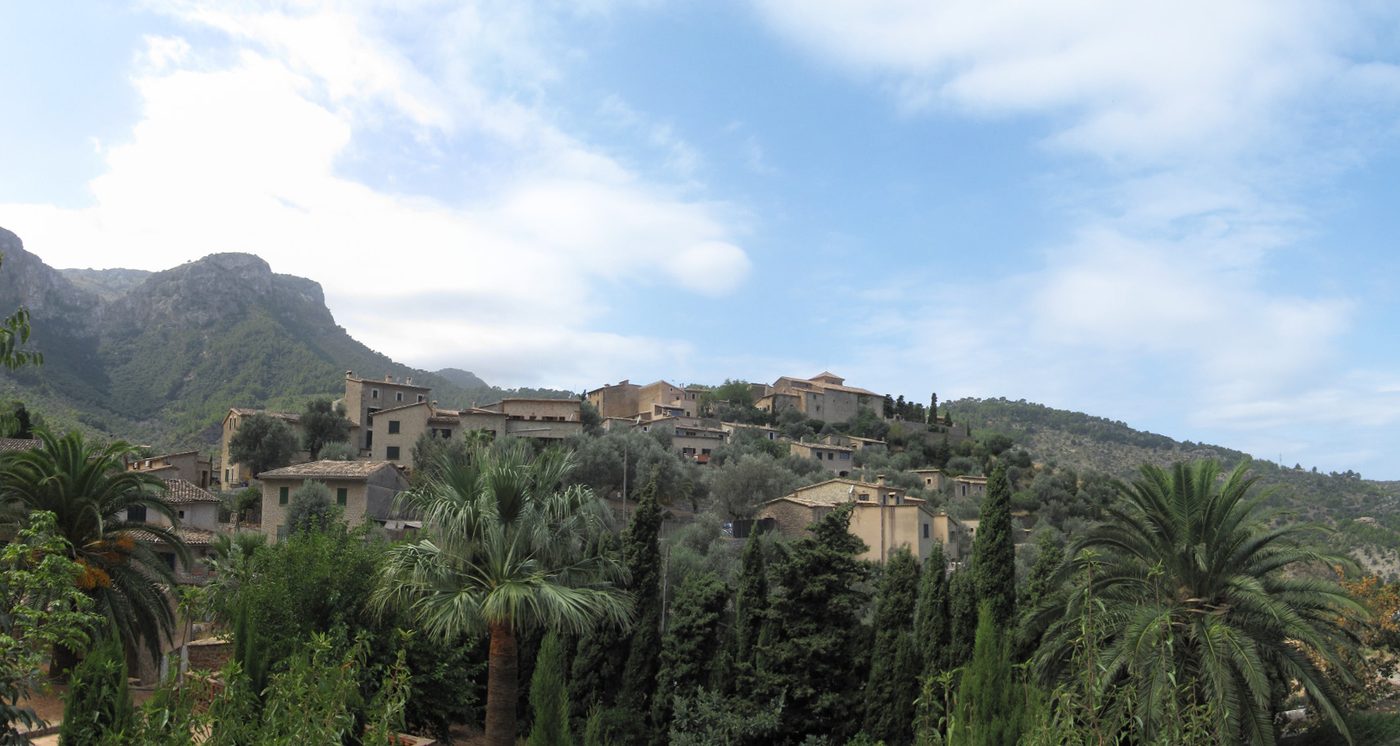
Honey-coloured houses on a steep hillside between the mountains and the sea, with a cemetery at the top where Robert Graves is buried. He lived here for most of his life and died here in 1985, and the village has been an artists’ and writers’ colony ever since. It is small, it is expensive, and it is more beautiful than photographs manage to convey.
Below it, reached by a 15-minute walk down or a narrow drivable road, is Cala Deià: a pebble cove with the Ca’s Patró March restaurant on the rocks above it, which you may recognise from television. Lunch there needs booking well in advance.
Sóller and Fornalutx
Sóller sits in a bowl of orange and lemon groves, which made it rich exporting citrus to France in the 19th century. That is why a small mountain town has modernist architecture, a grand church on Plaça Constitució and the Can Prunera museum. The tram rattles through the square on its way to Port de Sóller. Come for the market, stay for the fresh orange juice, which is not a cliche here.
Fornalutx, a few kilometres up the valley, is regularly voted among the prettiest villages in Spain: stepped lanes, painted roof tiles, mountains on three sides. There is nothing to do there. That is the appeal.
Sa Calobra and the Torrent de Pareis
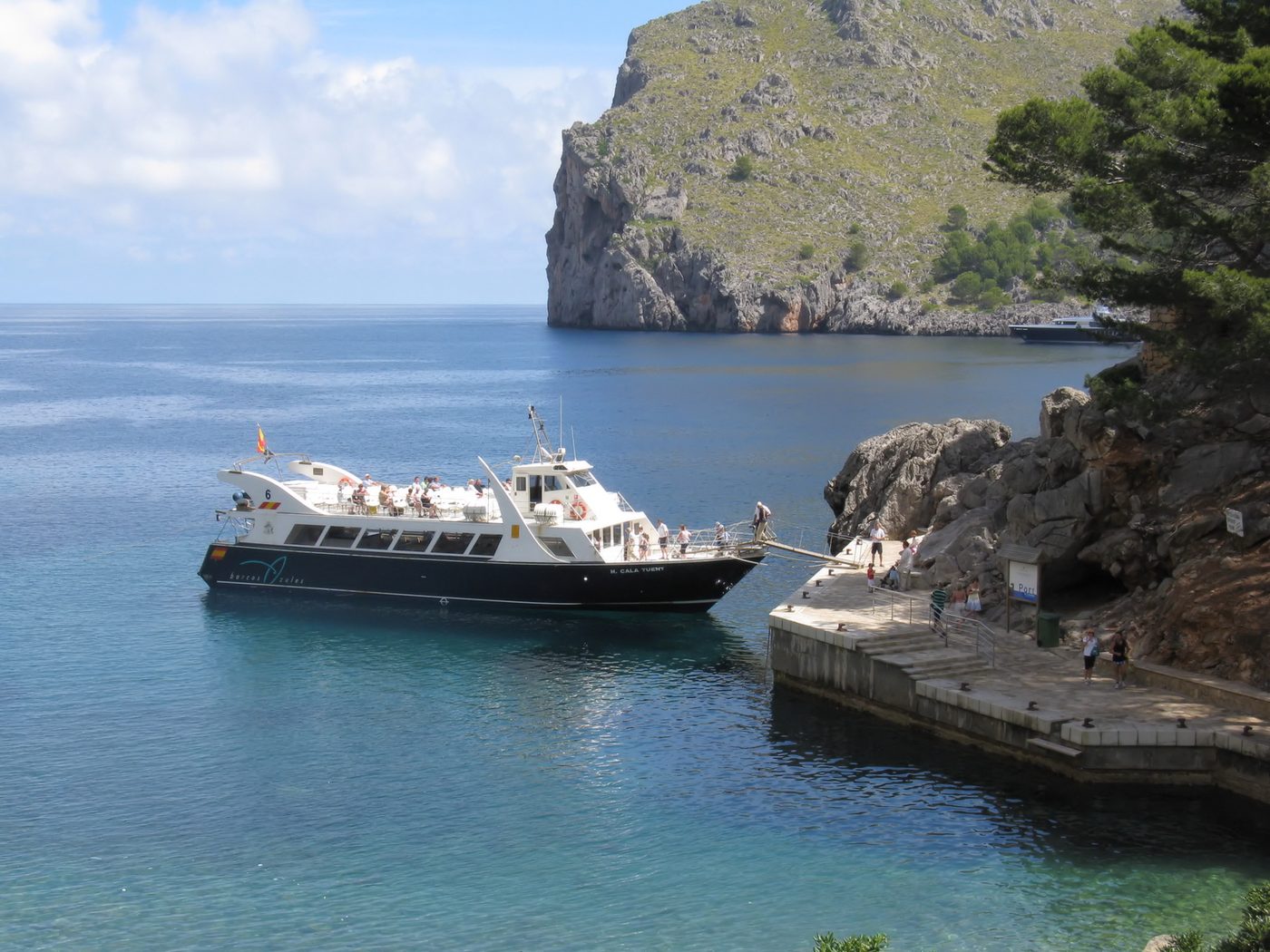
A pebble beach at the mouth of a limestone gorge, reached either by the notorious hairpin road, by boat, or on foot down the gorge itself. From the car park a short walk of around 400 m through tunnels cut into the rock brings you out at the outlet where the ravine meets the sea. The walls rise high enough on both sides that people come out of the tunnels and simply stop walking.
The north: Pollença, Alcúdia and Formentor
Pollença
An inland town with a Sunday market and the Calvari: 365 stone steps, one for each day of the year, flanked by cypresses and fourteen three-metre crosses, climbing to an oratory with a view over the whole north. Walk it early or late, not at 2pm in August. On Good Friday the town stages the Davallament, a silent candlelit descent of those same steps carrying an illuminated Christ figure by torchlight, which is one of the most striking things I have seen anywhere in Spain.
Also above the town is the Puig de Maria, a steep 30 to 45-minute climb to a former monastery with north-coast views.
Alcúdia
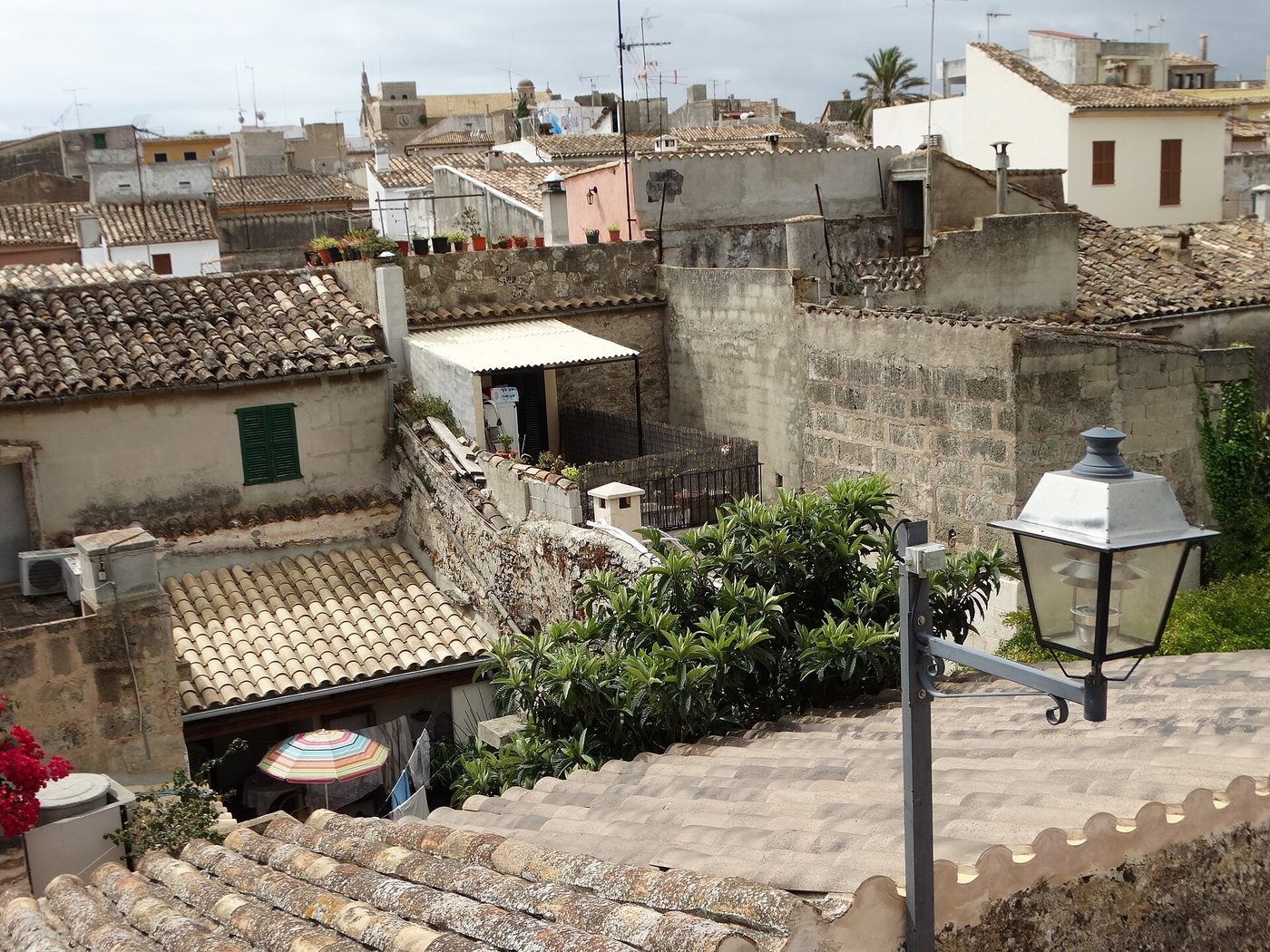
A walled medieval town with 14th-century ramparts you can walk, markets on Tuesdays and Sundays year-round, and Roman ruins at Pollèntia just outside. It is also the gateway to s’Albufera de Mallorca, the largest wetland in the Balearics and the island’s best birdwatching. Down at Port d’Alcúdia the long sandy bay runs into Playa de Muro, which together make the best stretch of family beach on the island: shallow, sandy, lifeguarded, endless.
Formentor
The peninsula that spears out from Pollença to a lighthouse on a cliff, with the Mirador es Colomer viewpoint on the way and a pine-backed sand beach at Platja de Formentor. Read the access rules above before you plan this. In the restricted window the beach is still reachable by car until the 300-space car park fills, but the lighthouse is not, and the bus becomes the sensible option.
The east, the south and the inland Pla
Coves del Drach
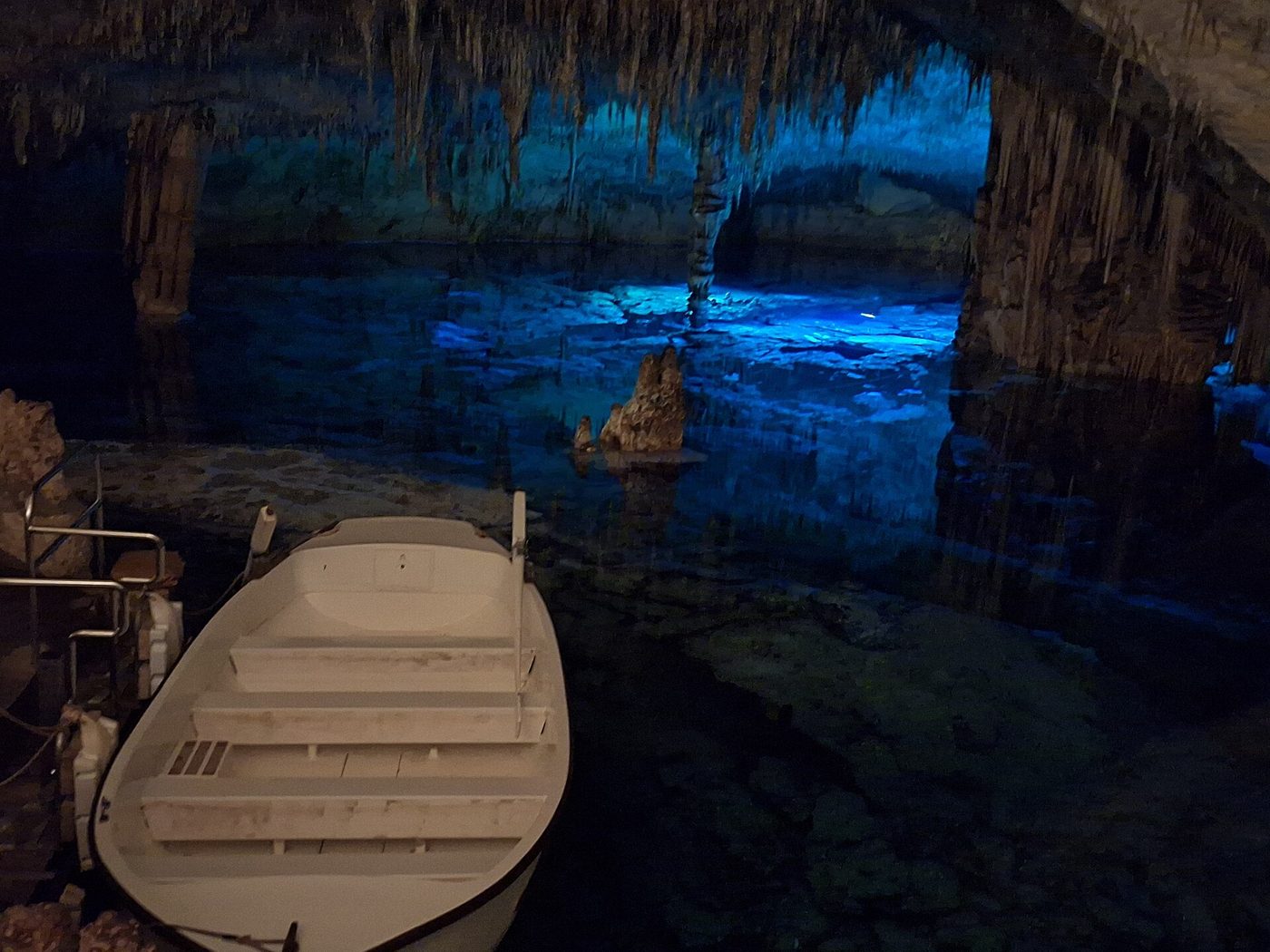
The island’s most famous caves, near Porto Cristo, built around Lake Martel, one of the larger underground lakes in Europe. The visit takes about an hour and includes a live classical concert performed by musicians in rowing boats on the water, after which you can cross the lake by boat or walk around it, at no extra cost either way. It is theatrical in a slightly old-fashioned way and children love it.
| Ticket | Online | Ticket office |
|---|---|---|
| Adult (13+) | €18.50 | €19.50 |
| Child (3 to 12) | €11.50 | €12.50 |
| Babies 0 to 2 | Free, no ticket | Free, no ticket |
Tours run at 10:00, 11:00, 12:00, 14:00, 15:00, 16:00 and 17:00 from 16 March to 31 October, and at 10:30, 12:00, 14:00 and 15:30 from 1 November to 15 March. Closed 25 December and 1 January. Booking opens 30 days ahead, parking is free and the entrance is 200 m from the car park. The caves sit between 17°C and 21°C, which makes them a good August afternoon, and the tours are grouped but not guided, so do not expect commentary.
Three alternatives if Drach is booked out: the Coves dels Hams nearby, around €17; the Cuevas de Génova just outside Palma at around €12 adult and €7 child, with under-3s free; and the Coves d’Artà in the north-east, which are less visited, more dramatically sited above the sea and have the tallest chambers of the four.
Cabrera
South of the island, the Cabrera archipelago is a national park, uninhabited apart from a small garrison and a research station, reached by boat from Colònia de Sant Jordi or Porto Petro. Numbers are capped and the crossing is weather-dependent, so book a day or two ahead and keep a spare day in reserve. It is the closest thing Mallorca has to a wilderness, and the water in the Cova Blava is an absurd shade of blue.
Artà, Sineu and the inland towns
Artà is one of the oldest towns on the island, with Bronze Age ruins at Ses Païsses on its edge and the hilltop sanctuary of Sant Salvador, reached up a walled stairway. Market day is Tuesday.
Sineu, in the middle of the Pla, holds its market on Wednesday, and it is the oldest agricultural fair on Mallorca, medieval in origin. It is still a working farmers’ market rather than a souvenir operation, and it is the easiest half-day of ordinary Mallorcan life a visitor can walk into.
Binissalem is the centre of the island’s oldest wine denomination, with bodegas open for tastings within walking distance of the SFM station at Inca or Binissalem itself, which makes a car unnecessary for a wine day. More on that below.
The best beaches and calas in Mallorca
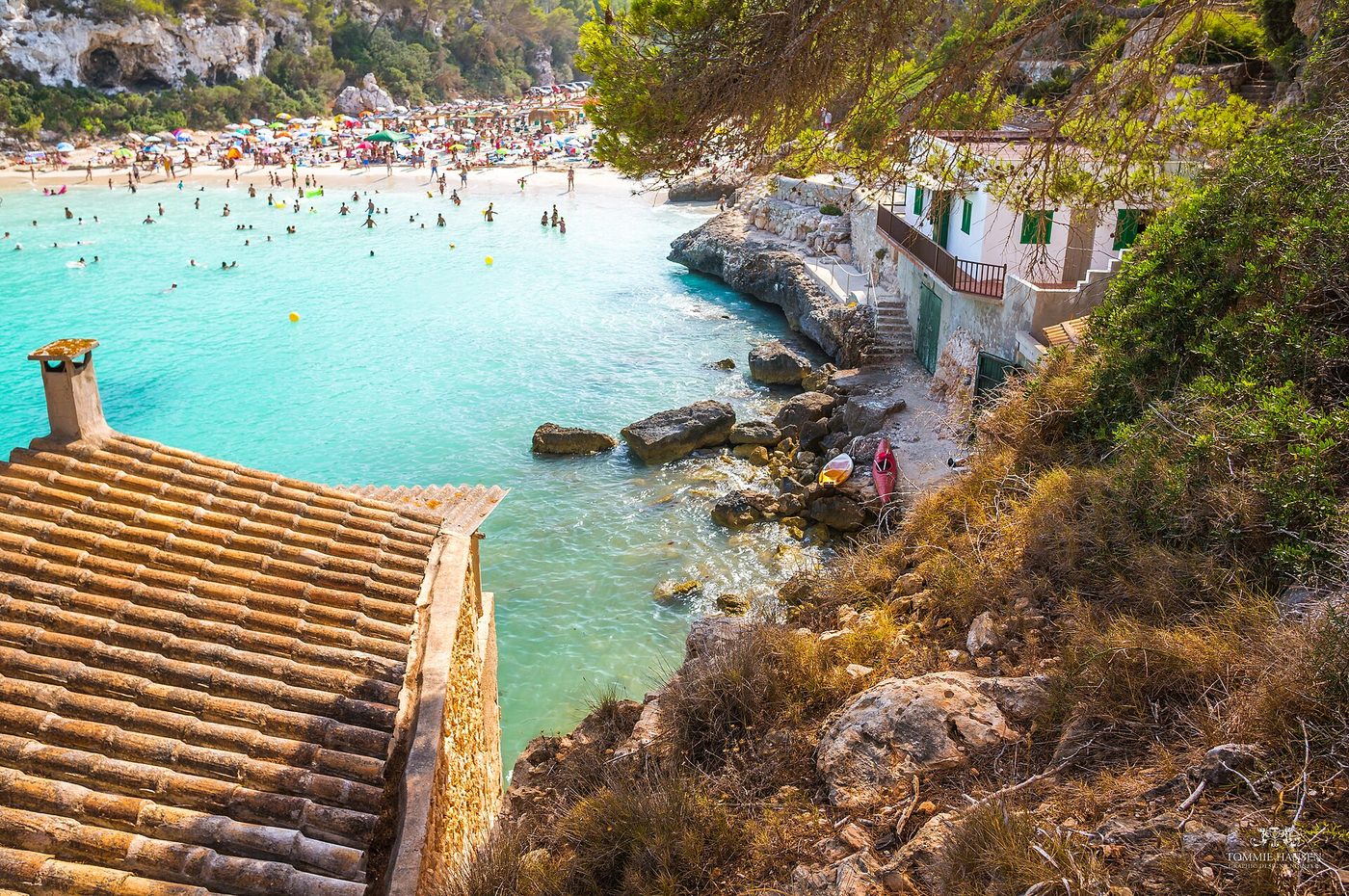
Counts vary wildly, from “more than 200 calas” to “more than 300 beaches”, depending on what gets included. The useful number is not the total but the handful you can realistically reach on a given day, and the deciding factor is almost always parking. Here is what you need to know about the ones worth the effort.
| Beach | Where | Type | Access and parking | Best for |
|---|---|---|---|---|
| Es Trenc | South coast | Around 2 km of white sand and dunes | No free parking at all. Ses Covetes car park around €5 a day; Ses Arenes car park around €7 a day, open until 21:00. Private car parks nearby charge more and some refund it against a meal | The wild-beach experience. Protected area, one bar, nudist sections |
| Playa de Muro | North, near Alcúdia | Long shallow sand | Roadside and paid car parks, generally straightforward | Families with small children. Lifeguards and full facilities |
| Alcúdia beach | North | Long sandy bay | Resort parking, easy | Everything a resort beach should do. Adjoins Playa de Muro |
| Platja de Formentor | Formentor peninsula | Pine-backed sand | Paid car park at the beach, around 300 spaces, frequently full. Road restricted 10:00 to 22:00, 15 May to mid-Oct | Views back at the Tramuntana. Go before 10:00 or take TIB 334 |
| Cala Mesquida | North-east | Wide fine sand in a protected area | Free parking nearby | Surf when there is swell, dunes, space |
| Cala Agulla | North-east, near Capdepera | Sand backed by pine | Free parking nearby, easy road access | Facilities without the resort. Toilets, sunbeds, summer lifeguards |
| Cala Llombards | South-east | Sheltered cove, very clear water | Free car park then a 20 to 25 minute walk, or a large paid car park with toilets, showers and restaurants | Swimming. Arrive before about 08:30 in season for space on the sand |
| Caló des Moro | South-east, near Santanyí | Tiny cliff-bound cove | Steep path with a passage that takes one person at a time. Village parking is very limited | The photograph. Go at dawn or not at all |
| Cala Varques | East | Undeveloped cove | 15 minutes on foot down a dirt track. No facilities of any kind | People who will carry their own water and shade |
| Cala Deià | North-west | Pebble and stone cove under cliffs | 15-minute walk down from Deià, or a narrow drivable road | A long lunch at Ca’s Patró March above the water |
| Sa Calobra / Torrent de Pareis | North-west | Pebble beach at a gorge mouth | Hairpin road plus a 400 m walk through rock tunnels, or arrive by boat | Drama. Not a lounging beach |
| Cala Mondragó and S’Amarador | South-east | Sand in a natural park | Park car parks, short walks | Beach plus a walk, inside a protected natural park |
A word about Caló des Moro
This is the cove that broke the internet and then broke itself. Overcrowding, litter, damaged vegetation and people scrambling on cliffs for photographs have all been documented, and the authorities have carried out a capacity study. You may come across claims of a paid booking system with a daily cap; I could not corroborate that from any official source, so do not turn up assuming you have booked something that may not exist. What is certain is that the sand is a thin strip that swell can wash right over, the access path is a single-file squeeze, and the only version of this cove worth having is the one at 7am.
General beach strategy
- Arrive before 09:00 or after 16:00 in July and August. Parking, not sand, is the binding constraint.
- Es Trenc has no free option. Budget €5 to €7 for the day and stop looking for one.
- A seasonal shuttle runs from Santanyí towards Cala Llombards roughly hourly for a couple of euros, which solves the south-east cove parking problem neatly.
- Coves have no shade once the sun is overhead and often no bar. Bring water.
- The north coast beaches are shallow and family-friendly; the south-east coves are deep, clear and better for swimming than paddling.
If you are choosing between Mediterranean islands, our ranking of the best beaches and islands in Europe puts Mallorca against Sardinia, the Greek islands and the Croatian coast, and our Croatia and the Adriatic guide and Greece travel guide go deeper on the two closest rivals.
Hiking in Mallorca and the GR221
The Ruta de Pedra en Sec, the Dry Stone Route, is the GR221, and it is the reason walkers come here in March rather than August. It runs along the spine of the Tramuntana from Port d’Andratx to Port de Pollença, following the old stone-paved mule tracks between villages and terraces.
The signposted network totals 261.1 km, of which the main route accounts for 150.1 km and variants make up the remaining 111 km. You will also see the main route described as around 140 km; the difference is where people start and stop counting, so plan on roughly 140 to 150 km walked in around 8 to 10 day stages.
The refuges along the route are managed by the Consell de Mallorca and booked through its own portal, not through booking sites. The booking window opens on a rolling basis roughly 130 days, about four months, ahead. A dormitory bed has been running at around €11 a night with half board reported as included, though rates and availability change, so treat that as an order of magnitude rather than a quote. Refuges fall into the tourist tax’s shelter category, so add €1.00 per person per night in high season, €0.25 in low, plus VAT.
Three walks worth doing if you are not attempting the whole route:
| Walk | Distance | Difficulty | Notes |
|---|---|---|---|
| Puig de Massanella | Around 11 km round trip, around 800 m ascent | Moderate to challenging | 1,364 m, the highest peak you can climb without a permit. Starts near Lluc. Mild scrambling and loose rock near the summit |
| Cap de Formentor lighthouse walk | Around 12 km round trip | Easy to moderate | From Mirador es Colomer along the coast. Unaffected by the road closure, since you are on foot |
| Torrent de Pareis | Full-day canyon descent to Sa Calobra | Serious | Boulders, squeezes, scrambling, poor GPS, few escape routes. Summer only, when the bed is dry. Take a guide |
Puig Major is higher than Massanella but its summit is a military installation and closed to the public, which is why Massanella is the one everybody climbs. Best hiking season is roughly October to May. For long-distance routes elsewhere on the continent, see our guide to hiking and the outdoors in Europe.
Cycling in Mallorca
Professional teams have trained here for years, and the reasons are structural rather than fashionable: a mild winter and spring when continental Europe is frozen, a rainy season concentrated into November and December, and an unusual range of terrain packed into a small island. Ineos, Movistar, Team GB, Trek-Segafredo and Canyon//SRAM have all been named among the teams that have based camps here over the years.
The signature climb is Sa Calobra, ridden from the sea upwards: about 10 km at roughly 7% average, climbing around 700 m to the Coll dels Reis, with a steepest segment averaging around 11%, a couple of dozen hairpins and the Nus de sa Corbata, the tie-knot loop where the road passes over itself. The Coll de Sóller is gentler at around 7.4 km at 5.7%. The Mallorca 312 is the mass-participation ride that circles the island over 312 km.
Practical points: bikes travel free on most SFM trains but are not allowed on the Sóller train, Palma has a seafront bike lane running around 16 km along the bay, and the best months are late January to April before the heat and the traffic arrive.
What to eat and drink in Mallorca
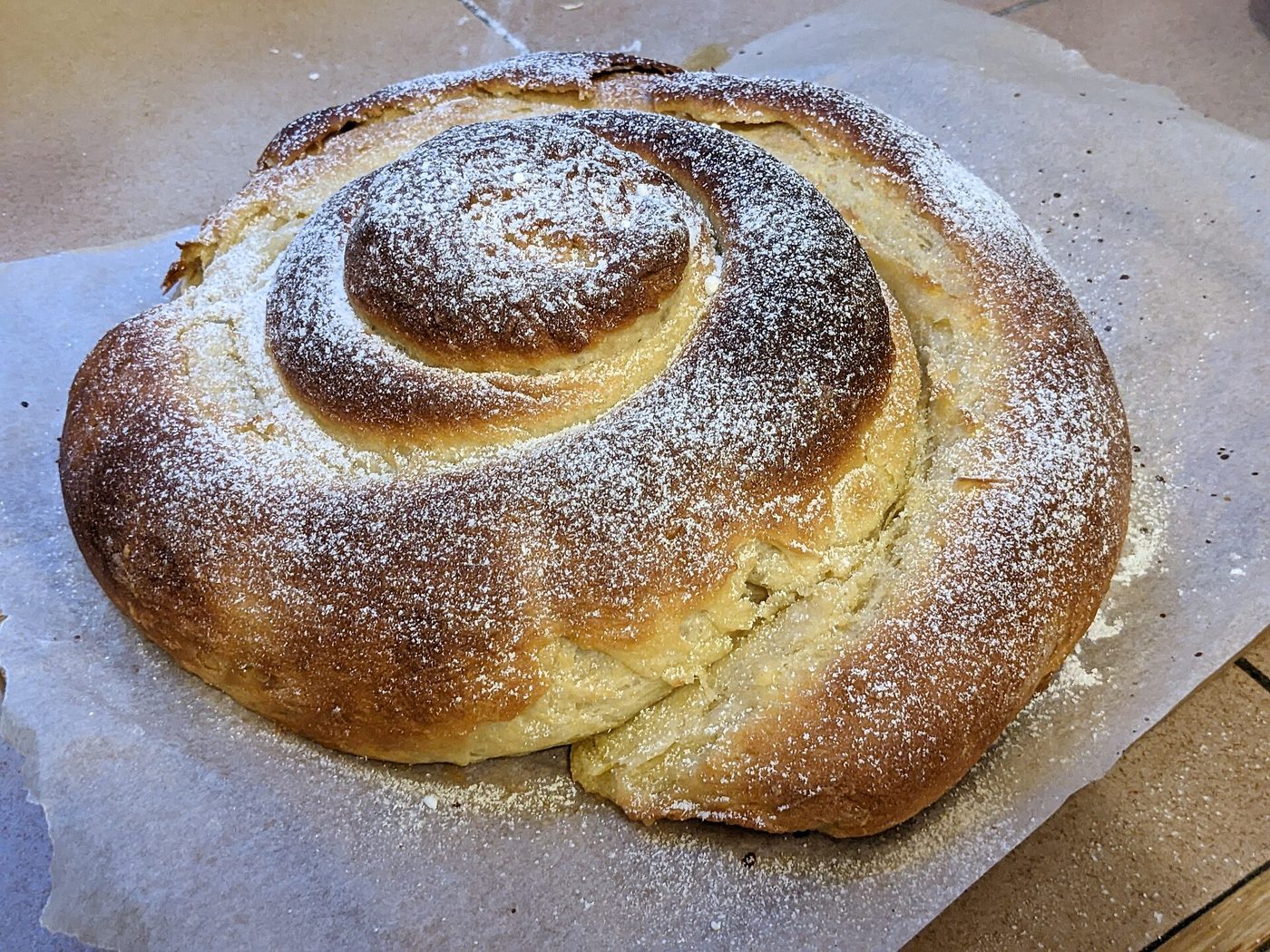
Mallorcan cooking is peasant food from a dry island: pork, bread, vegetables, olive oil, and a lot of ingenuity about what to do with leftovers. It bears very little resemblance to the international menus in the resort strips, and finding the real version is mostly a matter of walking two streets inland.
| Dish | What it is | Where to try it |
|---|---|---|
| Sobrassada | Soft, spreadable cured pork sausage heavy with paprika. Eaten on bread, sometimes with honey | Any village market. The honey version is not a gimmick |
| Ensaïmada | The island’s signature spiral pastry, made with saïm (pork lard) rather than butter, which is what gives it that flaky lightness | An old bakery in Palma, first thing, still warm |
| Pa amb oli | Rustic bread rubbed with ripe tomato, local olive oil and salt | Everywhere. The benchmark dish for judging a place |
| Tumbet | Layered potato, aubergine and red pepper in tomato sauce | Inland restaurants in summer, when the vegetables are right |
| Arròs brut | “Dirty rice”, a soupy rice stew with mixed meats and vegetables, murky from the spice blend | A finca restaurant in the Pla on a cold day |
| Frit mallorquí | Fried offal, usually lamb or pork liver, with potato and vegetables | Village bars. Order it if you like offal, skip it if you do not |
| Coca de trampó | Thin cheese-free flatbread topped with chopped tomato, pepper and onion | Bakeries, by the slice, as a mid-morning stop |
| Caldereta | Lobster stew, the special-occasion dish | Port restaurants. It is expensive and it should be |
Mallorcan wine
The island has two denominations of origin. DO Binissalem, granted in 1991, is the older and better established, on the limestone plateau around Binissalem, Santa Maria del Camí, Consell and Sencelles. Its signature red grape is Manto Negro: medium-bodied, with cherry, caramel and wild herb notes. DO Pla i Llevant, the younger of the two, covers the central plain and the east around Felanitx, Manacor, Petra and Porreres, and its signature grape is Callet, paler and lower in tannin, later-ripening with higher acidity.
Bodegas that open to visitors include José L. Ferrer, Bodegas Oliver, Celler Tianna Negre, Vins Nadal, AVA Vi and Bodegas Biniagual around Binissalem, and Macià Batlle nearby. Almost none of this wine leaves the island in quantity, which is the best possible argument for drinking it here. For the two Spanish cities that most reward eating your way through them, see San Sebastián and the Basque Country and Seville. Our guide to European food and cuisine puts Mallorcan cooking in the wider regional context.
What it costs to eat
The menú del día, the fixed-price weekday lunch, is the best value in Spanish eating and the Balearics are the most expensive region in the country for it, averaging around €16. In central Palma expect €12 to €16 for a starter, a main, bread and a drink, often with dessert or coffee included; neighbourhood places are cheaper. An inexpensive restaurant meal runs around €12 to €18 a head, and a three-course dinner for two at a mid-range place around €60 to €80. A cappuccino is around €3.10, an espresso around €1.90, a beer in a bar €3 to €5, and the same beer from a supermarket around €1.22.
Festivals and events
| When | Event | What happens |
|---|---|---|
| 19 to 20 January | Sant Sebastià, Palma | Palma’s patron saint festival and the biggest winter event in the Balearics. Bonfires across the city’s squares on the evening of the 19th, tens of thousands in Plaça Major and Passeig del Born, a correfoc, and a week-long programme around it |
| Late January to February | Almond blossom | The Pla turns white and pink. The Fira de la Flor d’Ametler is held at Son Servera |
| Late March to early April 2026 | Semana Santa | Maundy Thursday and Good Friday are the big nights. Palma’s longest procession is Holy Thursday, all brotherhoods, from behind La Misericòrdia to the cathedral at 19:00; Good Friday sets off from Sant Francesc at 19:00. Crist de la Sang is the best-known |
| Good Friday | Davallament, Pollença | Silent torchlit descent of the 365 Calvari steps |
| 23 June | Sant Joan / Nit de Foc | Bonfires, fireworks, street parties and correfocs across the island, biggest in Palma |
| Summer | Moros i Cristians, Pollença | Re-enactment of the town’s 1550 victory over Barbary raiders, staged through the old town with hundreds in costume. Dates move between late July and early August, so check the town hall calendar |
| August to September | Festival Chopin, Valldemossa | Recitals at the Cartoixa. Confirm the 2026 dates with the festival directly |
Market days are worth building a week around: Sineu on Wednesday, Alcúdia on Tuesday and Sunday, Artà on Tuesday, Pollença on Sunday.
What a trip to Mallorca really costs
Hotel rates on the island averaged around €140 a night in 2026, after an 8.1% rise in 2025. That average hides an enormous seasonal spread, which is the biggest lever you have over your budget.
| Season | Mid-range 3-star, per night | Notes |
|---|---|---|
| Winter, January to February | Around €40 to €80 | 50% to 70% below summer peaks. Many coastal hotels closed |
| Shoulder, May to June and September to October | Around €80 to €140 | Roughly 30% to 40% below peak |
| Peak, July to August | Around €120 to €200 | Resort rates often €150 to €180 and up; luxury beachfront frequently over €300 |
Reported daily spends for 2026 sit around €80 to €180 per person per day depending on season and style, which lines up with what I see on the ground. The seasonal swing is the thing to plan around: accommodation, car hire and activity prices often roughly double between low and peak.
Here is how I would build a daily budget from the components, per person, excluding flights. These are my own constructions from the individual prices above rather than a published figure, so treat them as a planning frame.
| Style | Shoulder season | Peak season | What that buys |
|---|---|---|---|
| Frugal | Around €55 to €75 | Around €85 to €110 | Hostel or shared apartment, self-catering plus one menú del día, free public transport with the card, beaches and walking |
| Comfortable | Around €100 to €140 | Around €150 to €200 | Mid-range 3-star, a restaurant dinner, one paid attraction most days, a few days of car hire |
| Generous | €200 upwards | €300 upwards | 4-star or boutique finca, proper dinners, car for the trip, boat hire, guided walks |
Add the tourist tax on top at €0.25 to €4.00 per person per night plus VAT, and remember the under-16 exemption and the halving from day nine. If Mallorca looks expensive against your budget, our guides to Europe on a budget and the cheapest places to travel in Europe put it in context, and the free-transport situation above moves the needle more than anything else.
How many days do you need, and sample itineraries
Three days shows you one corner. Five gives you two. Seven is where Mallorca starts to make sense as an island rather than a resort. Ten lets you slow down. Here is how I would spend each.
Three days, no car, based in Palma
- Day 1: Palma old town on foot. La Seu in the morning, Almudaina next door, lunch at Mercat de l’Olivar, Es Baluard in the afternoon, dinner in Santa Catalina.
- Day 2: The wooden train to Sóller, tram down to the port, lunch by the water, afternoon swim, tram and train back. Book the €32 online fare in advance.
- Day 3: Bellver Castle in the morning, then the Fundació Miró, then the seafront bike lane or a bus to a bay beach.
Five days, car for two of them, based in Port de Pollença
- Day 1: Settle in, walk the promenade, swim.
- Day 2: TIB 334 to Formentor. Beach in the morning, lighthouse in the afternoon, back by the 21:40 at the latest.
- Day 3: Alcúdia old town and its walls, then s’Albufera, then Playa de Muro for the late sun.
- Day 4: Hire car. Pollença’s Calvari steps early, then the Ma-10 down the Tramuntana to Lluc, Sa Calobra if you have the nerve.
- Day 5: Car again. Sóller, Fornalutx and Deià, lunch at Cala Deià if you booked.
Seven days, one base plus a night in the mountains
Four nights in Palma or Alcúdia, two nights in a Tramuntana village, one flexible. Add the Coves del Drach and Sineu market on the flexible day, and use the free trains and buses for everything except the mountain villages.
Ten days, two bases
Five nights north or west for mountains, walking and the wooden train; five nights south-east for the coves, the caves and Santanyí. Move on a Wednesday so you can stop at Sineu market on the way. This is the version I recommend to anyone who has been once already.
For multi-country routes that could include Mallorca as a coastal leg, see our Europe itineraries and route planning guide, or the 10-day Spain itinerary if you want to combine the island with the mainland. Most people pair Mallorca with Madrid or with a loop through Andalusia, both of which connect by a short domestic flight or the ferry plus a train.
Mallorca by traveller type
| Who you are | Where to base | What to prioritise | What to skip |
|---|---|---|---|
| Families with young children | Playa de Muro, Alcúdia or Santa Ponsa | Shallow lifeguarded beaches, Coves del Drach, the wooden train, waterparks at Palmanova | Cliff-path coves, the Tramuntana road in a hire car with car-sick children |
| Couples | Deià, Valldemossa or a Pla finca | Cala Deià lunch, cathedral terraces at sunset, bodega tastings, Fornalutx | The party zones, and August |
| Walkers | Port de Sóller or Pollença | GR221 stages, Massanella, the Formentor coast walk. October to May | July and August in the mountains, which is a real safety issue |
| Cyclists | Port de Pollença or Alcúdia | Sa Calobra, Coll de Sóller, the Cap de Formentor road. Late January to April | The Sóller train, which will not take your bike |
| City-break travellers | Palma | Cathedral, Miró, Santa Catalina, Sant Sebastià in January | Hiring a car at all |
| Solo travellers | Palma or Port de Sóller | Free public transport, walking routes, market days, and hostels in Palma if you are backpacking Europe | Remote coves with no facilities and no phone signal |
| Groups on a night out | Magaluf or Playa de Palma | Beach clubs, the Bay of Palma boat trips, and reading the zone rules before you arrive | Assuming the drinking rules are theoretical. They are enforced |
| Returning visitors | Inland, around Binissalem or Sineu | Wine, markets, the Serres de Llevant, Artà | The greatest hits you already did |
Travelling with children across the continent has its own logic; our guide to Europe with kids covers it, and solo travel in Europe is worth a read if you are going alone. Couples planning something special might start with honeymoon and romantic Europe.
Entry requirements and practicalities for 2026
Borders
Spain is in the Schengen area, so non-EU visitors from visa-exempt countries can stay up to 90 days in any 180-day period. Your passport should be valid for at least three months beyond your departure date; six is the safer margin.
Two systems are worth understanding before you fly. The EU Entry/Exit System (EES) began a progressive rollout on 12 October 2025 and reached full implementation on 10 April 2026. It is now in force at external Schengen borders, Palma included. It replaces passport stamping with a digital record of entries and exits, including a facial image and fingerprints. Member states retain the ability to partially suspend EES operation in exceptional circumstances during peak periods later in 2026, so you may find it applied inconsistently. An optional EU app, “Travel to Europe”, lets you pre-register passport data, a facial image and trip details within 72 hours of reaching an EES border, though availability still varies by country.
ETIAS is not yet live. As of August 2026 it has not launched and no confirmed start date has been published. EU authorities have said only that it will begin some months after EES, and there are credible reports that a 2026 start is no longer feasible, with a revised timeline expected in autumn 2026. When it does start, the first six months are a transitional period in which anyone may enter without an ETIAS authorisation, and the following six months are a grace period covering first-time arrivals. Our Schengen visa and ETIAS guide tracks the position as it changes.
On the ground
- Money. Euro. Cards work almost everywhere; carry a little cash for markets and roadside stalls.
- Tipping. Not obligatory. Around 5 to 10% in restaurants and rounding up a taxi fare is normal, and more is expected in the most touristy places.
- Tap water. Legally potable across most of the island, but heavily chlorinated and mineral-heavy, and plenty of locals drink bottled by preference. Fine for teeth and cooking; you may simply not enjoy a glass of it.
- Driving. On the right, overtaking on the left only.
- Siesta. Many shops and smaller businesses close roughly 14:00 to 17:00, especially inland and out of season.
- Emergencies. 112, free, 24 hours, multilingual.
- Health cover. EU visitors should carry a European Health Insurance Card, and UK visitors the GHIC that replaced it, for state-provided care on the same terms as residents. Neither covers repatriation or private clinics, and much of the treatment offered in resort areas is private, so travel insurance is not optional here. Pharmacies (farmàcia, green cross) handle a lot of minor problems without an appointment and there is a rota for out-of-hours cover posted in the window.
- Language. Catalan and Castilian Spanish are both official, and mallorquí is what you will hear in village bars. English is widely spoken in tourism. A “bon dia” rather than “buenos días” is noticed and appreciated.
Ten mistakes I see people make in Mallorca
- Landing and leaving. Transferring straight from PMI to a resort and never seeing Palma. The cathedral is 20 to 30 minutes from the airport on the A1 bus.
- Assuming you need a car for the whole stay. With interurban transport free in 2026 and August hire running around €50 a day, hiring for two or three targeted days is usually the better call.
- Not getting the Tarjeta Única. Free travel requires the physical card and two taps. Bank-card taps pay full fare.
- Driving to Formentor lighthouse in July. The road is closed to private cars 10:00 to 22:00 from 15 May to mid-October, with number-plate cameras and fines.
- Arriving at popular coves at midday. The car park fills long before the beach does. Go before 09:00 or after 16:00.
- Budgeting for a tourist tax increase that never happened. The rates are unchanged at €0.25 to €4.00 plus VAT.
- Hiking the Tramuntana in August. No shade, no water, 30°C and rising. October to May.
- Booking the Sóller train at the station on the day in August. Book the €32 online combined fare in advance instead, and note that singles are ticket-office only.
- Judging the island by Magaluf. The behaviour rules exist precisely because three strips are unlike the rest of the island.
- Writing off September and October. The sea is warmer in October than in June, and prices have dropped.
Mallorca FAQ
How many days do you need in Mallorca?
Seven is the number I would give most people. Three covers Palma and one day trip, five lets you add a second region, and seven is where the island stops feeling like a resort and starts feeling like a place with mountains, farmland and a city in it. Ten if you want two bases and no rushing.
Is Mallorca worth visiting?
Yes, and the reservations people have are usually about a small part of it. The island has a UNESCO cultural landscape, a 150 km long-distance walking route, a Gothic cathedral, two wine denominations and several hundred coves. It also has three party strips with their own legal regime. Those are separate places.
Do you need a car in Mallorca?
Less than you used to. Interurban buses, trains and the Palma metro are free in 2026 with a Tarjeta Única or Intermodal card, and they reach Palma, Inca, Sóller, Manacor, Alcúdia and Formentor. You need a car for small Tramuntana villages, remote coves and flexible touring. Hiring for two or three days mid-trip is usually smarter than a week.
Is Mallorca expensive?
It is mid-range by Western European standards and expensive by Spanish ones. The Balearics have the priciest menú del día in Spain at around €16, hotel rates averaged around €140 a night in 2026, and August car hire runs about 70% above the annual average. Move to May, September or October and accommodation can fall 30% to 40%; go in winter and it can halve.
How much does a week in Mallorca cost?
Excluding flights, my planning frame is roughly €55 to €75 per person per day frugal in shoulder season and €85 to €110 in peak; €100 to €140 comfortable in shoulder and €150 to €200 in peak. For two people in shoulder season that puts a comfortable week at roughly €1,400 to €2,000 before flights, and a frugal one at closer to €800.
What is the best time to visit Mallorca?
Late May and early June, or September into early October. You get warm sea, everything open and prices below the July and August peak. October is the wettest month at 58 mm and still has a 23°C sea. For hiking, October to May; for cycling, late January to April.
Mallorca or Majorca, which is correct?
Both. Mallorca is the Catalan and Spanish spelling and what you will see on every road sign; Majorca is the English form. This guide uses Mallorca for that reason.
Can you drink the tap water in Mallorca?
It is legally potable across most of the island, but it is heavily chlorinated and mineral-heavy, and many residents drink bottled water by choice. The official tourism information treats it as safe. Use it for teeth and cooking without concern; you may simply not enjoy drinking it.
How long is the flight to Mallorca?
Around 1 h 55 min to 2 h 10 min from Paris, about 2 h 20 min from London, about 2 h 37 min from Manchester and about 2 h 40 to 2 h 45 min from Berlin. Palma handled 33.8 million passengers in 2025, so the summer network is dense from almost anywhere in northern Europe.
What is a cala?
A small cove, usually a pocket of sand or pebble enclosed by rock or cliff, often reached on foot rather than by road. A platja is a proper beach with facilities. Mixing the two up is the most common cause of a wasted beach afternoon here.
Can you visit Mallorca without a car?
Comfortably. Base yourself in Palma, Port de Sóller, Alcúdia or Port de Pollença, get a Tarjeta Única, and use the free TIB buses and SFM trains. TIB line 334 even solves Formentor, which is now the harder place to reach by car.
What is Mallorca known for?
Beaches and coves, the Serra de Tramuntana UNESCO cultural landscape, Palma’s cathedral, road cycling, the 1912 wooden train to Sóller, ensaïmades and sobrassada, and, fairly or not, the nightlife in Magaluf.
Where should I stay in Mallorca for a first visit?
Palma if you want a city and no car, Port de Pollença if you want beach plus mountains, Alcúdia or Playa de Muro if you have small children. All three connect well by public transport, which matters more in 2026 than it used to.
Is Mallorca just Magaluf?
Magaluf, Playa de Palma and s’Arenal are the three zones on Mallorca designated under the Balearic responsible tourism decree, and the specific rules on street drinking, happy hours, pub crawls and all-inclusive drink limits apply only there. The other several thousand square kilometres of the island are unaffected.
Do children pay the tourist tax?
No. Under-16s are exempt entirely. From the ninth night of a stay in the same establishment the tax is halved for everyone.
Final thoughts
The version of Mallorca that gets argued about online, overcrowded, overpriced, overrun, exists and is easy to find. It occupies a handful of car parks between 11am and 4pm in July and August. The rest of the time, and the rest of the island, is a mountain range with stone terraces built over 800 years, a farming plain with a medieval Wednesday market, a working capital city, and a coastline you could spend a decade on.
What has changed most recently is not the island but the mechanics of visiting it. Public transport is free this year. Two of the most photographed roads now ration cars. The tourist tax rise everyone braced for did not happen. Plan around those three facts and the trip gets cheaper and calmer at the same time.
A few things I could not pin down, and I would rather say so than guess: the Sóller tram’s single fare, which the operator does not publish; the exact 2026 dates for the Chopin festival and Pollença’s Moros i Cristians, where listings contradict each other; and the Formentor beach car-park price. Check those directly with the operators before you build a day around them.
If Mallorca is one stop on a bigger trip, our complete Spain travel guide covers the mainland regions, the best places to visit in Spain ranks the alternatives, and the best places to visit in Europe sets the whole thing against the continent. For the practical scaffolding of a first European trip, start with how to plan a trip to Europe and what to pack for Europe.
About the author
Hannah Brooks has spent fifteen years travelling, living and writing across Europe, from the Arctic tip of Norway to the south of Sicily. She has planned hundreds of European itineraries for readers and is Senior Europe Editor at EuropeanTourism.org.
Photo credits
All photographs are freely licensed and used with attribution.
- Photo: sladky / Wikimedia Commons (CC BY-SA 3.0) · source
- Photo: Antekbojar / Wikimedia Commons (CC0) · source
- Photo: Thomas Wolf, www.foto-tw.de / Wikimedia Commons (CC BY-SA 3.0 de) · source
- Photo: georama / Wikimedia Commons (CC BY 3.0) · source
- Photo: José Luis Filpo Cabana / Wikimedia Commons (CC BY 3.0) · source
- Photo: Gryffindor; of this panorama, Roland Geider (Ogre) / Wikimedia Commons (CC BY-SA 3.0) · source
- Photo: Adrian Pingstone (Arpingstone) / Wikimedia Commons (Public domain) · source
- Photo: Adam Jones from Kelowna, BC, Canada / Wikimedia Commons (CC BY-SA 2.0) · source
- Photo: Steffen Mokosch / Wikimedia Commons (CC BY-SA 4.0) · source
- Photo: Tommie Hansen from Stockholm, Sweden / Wikimedia Commons (CC BY 2.0) · source
- Photo: Popo le Chien / Wikimedia Commons (CC0) · source