The 46 Best Places to Visit in France

France took 102 million international visitors in 2025, more than any country on earth, and most of them went to a handful of the same places. I have spent fifteen years watching that imbalance get worse, and the honest truth is that the crowding is fixable. Most of it comes down to going to the right place in the right month.
So here is the short version. The best places to visit in France are Paris for the museums, Provence for the light, the Cote d’Azur for the sea, the Loire Valley for chateaux, Normandy for Mont-Saint-Michel and the D-Day coast, Alsace for Christmas, Bordeaux for wine country, and Corsica when you want mountains and swimming on the same day.
That paragraph is the answer, but it is not the article. What follows is 46 places, grouped so you can route between them without doubling back, along with the practical layer that is hard to assemble yourself: what each headline site charges in 2026, which ones now price you differently depending on your passport, what the train from Paris really costs and how long it really takes, which places have introduced booking systems since last summer, and which two weeks of the year the lavender is purple.
Some of it has moved in the last twelve months. The Louvre put its non-EU adult ticket up from 22 euros to 32 euros on 14 January 2026, a 45 percent rise, and Versailles and Chambord introduced their own two-tier pricing on exactly the same date. The EU’s Entry/Exit System went fully live across Schengen on 10 April 2026 and has been producing queues of up to three hours at peak. If you are flying in from outside Europe, that is now part of your itinerary whether you planned for it or not.
How I chose these 46 best places to visit in France
Three filters. First, it has to be worth the journey on its own, not just as a stop on the way to somewhere better. Second, I have to be able to tell you when to go with more precision than “spring or autumn”, because in France the difference between the second week of June and the first week of August is the difference between a good trip and a bad one. Third, it has to survive contact with a real budget.
What that rules out: a handful of places that are lovely but need a fortnight of build-up to make sense, and several that are simply too small to absorb the traffic a list like this sends them. I have also kept the deep Massif Central, the Jura and the Vosges to passing mentions rather than full entries, which is a limit of what I could source properly rather than a verdict on any of them.
One note on how the list is organised. It is not a countdown. Ranking Carcassonne against Corsica is a category error, and a numbered order would only tell you what I like rather than what fits your trip. Instead the 46 are grouped into nine regional clusters, in the order a first-time visitor usually works through them, and from the second cluster onwards each one is routable: everything inside it can be strung together on one trip without doubling back. The first cluster is the exception, because it is a shortlist rather than a region.
All 46 best places to visit in France at a glance
Cost band is my own rough judgement of what a night plus a day’s eating costs relative to the French average, not a sourced figure: € is comfortably below average, €€ is around it, €€€ is meaningfully above. Everything else in this table is explained in the sections below.
| # | Place | Region | Best months | Nights I would give it | Getting there | Cost band |
|---|---|---|---|---|---|---|
| 1 | Paris | Ile-de-France | Apr-Jun, Sep-Oct | 3-5 | CDG/Orly; all TGV lines | €€€ |
| 2 | Versailles | Ile-de-France | Apr-May, Sep | 1 day trip | RER C from Paris, 45 min | €€€ |
| 3 | Mont-Saint-Michel | Normandy | Mar-May, Sep-Oct | 1-2 | Rennes then bus, or drive | €€ |
| 4 | The Loire Valley chateaux | Centre-Val de Loire | May-Jun, Sep | 2-3 | TGV to Tours 1h15, then car | €€ |
| 5 | Nice | Cote d’Azur | May-Jun, Sep-Oct | 3-4 | Nice airport; TGV 5h40 from Paris | €€ |
| 6 | Menton | Cote d’Azur | Feb, May, Oct | 1-2 | Train from Nice, 35 min | €€ |
| 7 | Eze | Cote d’Azur | May, Oct | Half day | Bus 82 from Nice, 25 min | €€ |
| 8 | Antibes and Cap d’Antibes | Cote d’Azur | Jun, Sep | 2 | Train from Nice, 25 min | €€ |
| 9 | Saint-Tropez | Cote d’Azur | May, Oct | 1-2 | Boat from Sainte-Maxime, or a slow drive | €€€ |
| 10 | Marseille | Provence | Apr-Jun, Sep-Oct | 2-3 | TGV 3h04 from Paris | €€ |
| 11 | Cassis and the Calanques | Provence | May-Jun, Sep | 1-2 | Train to Cassis then bus or boat | € |
| 12 | Avignon | Provence | Apr-Jun, Sep | 2 | TGV 2h39 from Paris | €€ |
| 13 | Aix-en-Provence | Provence | Apr-Jun, Sep-Oct | 2 | 30 min from Marseille | €€ |
| 14 | Gordes and the Luberon | Provence | May-Jun, Sep | 2-3 | Car essential | €€ |
| 15 | The Valensole plateau | Provence | Late Jun to mid-Jul | 1-2 | Car essential | € |
| 16 | Arles | Provence | Apr-Jun, Sep | 1-2 | Train from Avignon, 20 min | € |
| 17 | The Verdon Gorge | Provence | May-Jun, Sep | 2 | Car essential | € |
| 18 | Bordeaux | Nouvelle-Aquitaine | May-Jun, Sep-Oct | 2-3 | TGV 2h08 from Paris | €€ |
| 19 | Saint-Emilion | Nouvelle-Aquitaine | May-Jun, Sep | 1 | Train from Bordeaux, 35 min | €€ |
| 20 | Dune du Pilat and Arcachon | Nouvelle-Aquitaine | Jun, Sep | 1-2 | Train from Bordeaux, 55 min | € |
| 21 | Sarlat and the Dordogne | Nouvelle-Aquitaine | May-Jun, Sep | 3 | Car essential | € |
| 22 | Rocamadour | Occitanie | May-Jun, Sep | 1 | Car essential | € |
| 23 | Biarritz and the Basque coast | Nouvelle-Aquitaine | Jun, Sep | 2-3 | TGV from Paris, about 4h | €€ |
| 24 | Carcassonne | Occitanie | Apr-May, Oct | 1 | Train from Toulouse, 50 min | € |
| 25 | The Pont du Gard | Occitanie | Apr-Jun, Sep | Half day | Car or bus from Nimes/Avignon | € |
| 26 | Nimes | Occitanie | Apr-Jun, Sep | 1-2 | TGV from Paris, about 3h | € |
| 27 | Toulouse | Occitanie | Apr-Jun, Sep-Oct | 2 | TGV from Paris, about 4h15 | € |
| 28 | Saint-Malo | Brittany | Jun-Sep | 2 | TGV to Rennes 1h28, then 1h | € |
| 29 | Dinan | Brittany | May-Sep | 1 | 30 min from Saint-Malo | € |
| 30 | Carnac | Brittany | May-Sep | 1 | Car or bus from Auray | € |
| 31 | Ile de Re | Nouvelle-Aquitaine | Jun, Sep | 2-3 | La Rochelle then bridge | €€ |
| 32 | La Rochelle | Nouvelle-Aquitaine | Jun-Sep | 2 | TGV from Paris, about 2h30 | € |
| 33 | Etretat | Normandy | May-Jun, Sep | 1 | Car from Le Havre or Rouen | € |
| 34 | The D-Day landing beaches | Normandy | May-Jun, Sep | 2 | Car from Bayeux | € |
| 35 | Honfleur | Normandy | May-Jun, Sep | 1 | Car or bus from Le Havre | €€ |
| 36 | Rouen | Normandy | Apr-Jun, Sep | 1-2 | Train from Paris, about 1h30 | € |
| 37 | Giverny | Normandy | Apr-Jun, Sep | Half day | Train to Vernon, then shuttle | € |
| 38 | Lyon | Auvergne-Rhone-Alpes | Apr-Jun, Sep-Dec | 2-3 | TGV 1h44 from Paris | €€ |
| 39 | Strasbourg | Grand Est | May-Jun, Dec | 2 | TGV 1h45 from Paris | €€ |
| 40 | Colmar and the Alsace wine route | Grand Est | May-Jun, Sep, Dec | 2-3 | Train from Strasbourg, 30 min | €€ |
| 41 | Reims and Champagne | Grand Est | May-Jun, Sep | 1-2 | TGV 45 min from Paris | €€€ |
| 42 | Beaune and Burgundy | Bourgogne-Franche-Comte | May-Jun, Sep-Oct | 2 | TGV to Dijon, then 25 min | €€ |
| 43 | Annecy | Auvergne-Rhone-Alpes | Jun, Sep | 2 | TGV from Paris, about 3h45 | €€ |
| 44 | Chamonix and Mont Blanc | Auvergne-Rhone-Alpes | Jul-Sep, Jan-Mar | 3 | Geneva airport, 1h15 transfer | €€€ |
| 45 | The Pyrenees | Occitanie / Nouvelle-Aquitaine | Jun-Sep | 3-4 | Car from Toulouse or Pau | € |
| 46 | Corsica | Corsica | May-Jun, Sep | 5-7 | Fly to Ajaccio/Bastia, or ferry | €€ |
Start here: the five places a first trip to France is built around
If you have never been, build the trip around these five and add from the other clusters as time allows. Between them they cover the city, the coast, the countryside and the two single sights most people fly to France to see.
1. Paris
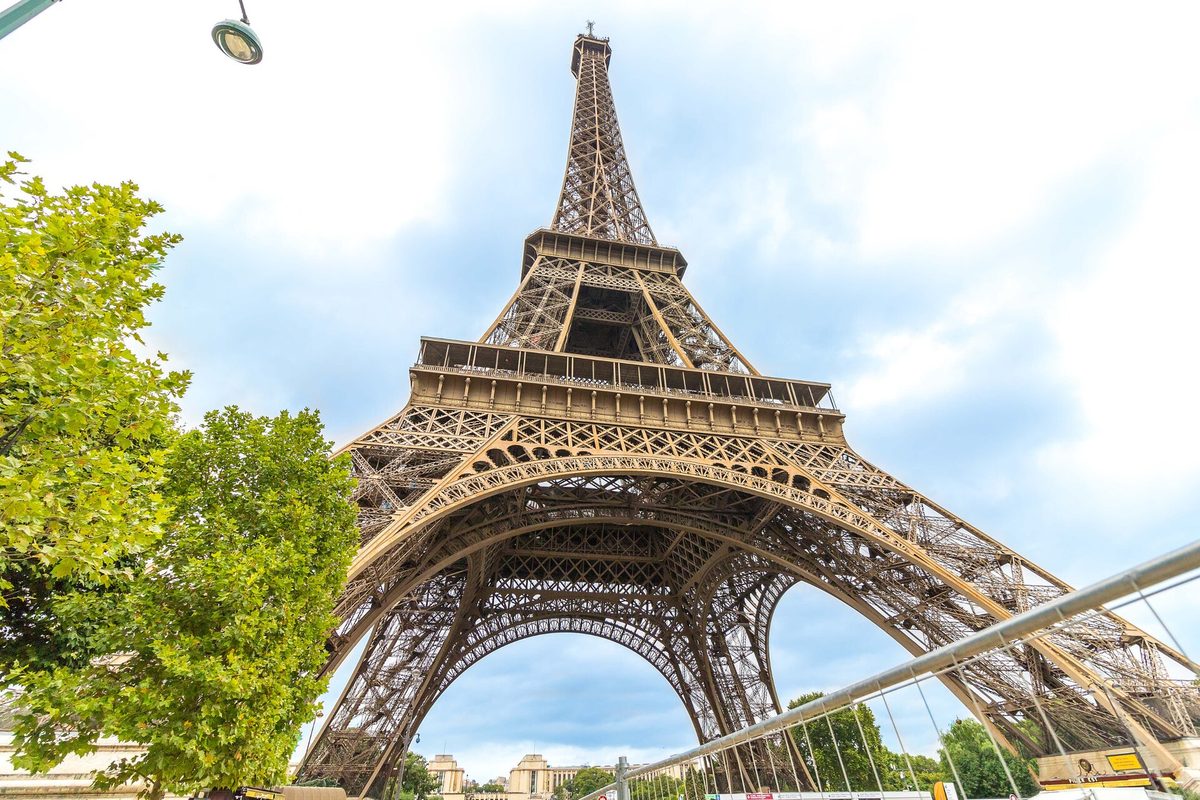
Paris is the one place on this list nobody will talk you out of, and it is also the one where the 2026 numbers matter most. The Louvre now charges 32 euros for a standard adult ticket if you hold a non-EU passport, up from 22 euros on 14 January 2026, while EU and EEA visitors still pay 22. Nine million people went in 2025, up from 8.7 million the year before, against a daily cap of 30,000 and an all-time peak of 10.2 million in 2018. Through 31 August 2026 everyone must reserve a time slot in advance, including the under-18s and under-26 EU residents who get in free.
The Eiffel Tower runs 36.70 euros to the summit by lift, 23.50 to the second floor, and 14.80 if you walk the stairs to the second floor, which is the ticket I buy. Note two changes: the tower is closed to the public on 13 July 2026 rather than the 14th, and from 29 September 2026 stairs tickets need booking in advance, which ends the old trick of turning up and joining the shorter queue.
Elsewhere, the Musee d’Orsay is 16 euros and worth more of your day than the Louvre if you only have one museum in you. Sainte-Chapelle is 22 euros for non-EEA visitors and 16 for EEA, or 30 and 23 respectively combined with the Conciergerie next door. Notre-Dame is free, with an optional free timed reservation that opens 48 hours ahead; 3.5 million people went through in the first three months after it reopened in December 2024, so take the slot.
The Apollo Gallery reopened on 22 July 2026 after the October 2025 jewel theft. The gilded ceiling and the frescoes are back on view, but the crown jewels and their cases are gone, so do not go expecting the display you have seen photographs of.
Two things I would not leave out of a first visit: Montmartre and Sacre-Coeur early in the morning, before the funicular queue forms, and an hour in the Marais with no plan at all.

Give it three to five days. Our three-day Paris itinerary is the version I would hand a first-timer, and things to do in Paris goes deeper on the individual sights.
2. Versailles
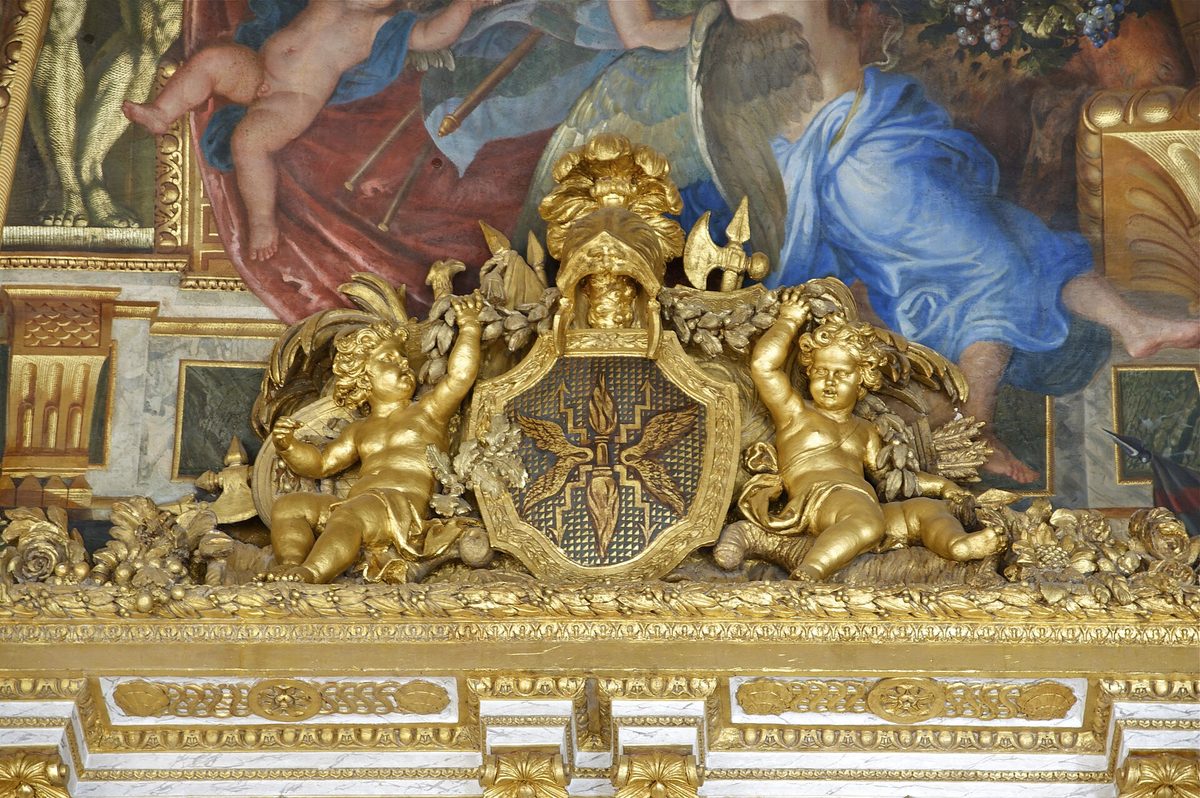
Half an hour from central Paris on the RER C, and a completely different kind of day. The Passport ticket, which covers the whole estate and is the only one that includes a timed Palace slot, costs 35 euros for non-EEA adults between 1 April and 31 October and 25 euros from 1 November to 31 March. EEA nationals and residents have had 3 euros off on proof since the middle of January 2026, so 32 and 22.
8.4 million people came in 2025, level with 2024, and almost all of them cluster in the Hall of Mirrors between 10:00 and 14:00. The Trianon estate and Marie-Antoinette’s hamlet at the far end of the gardens absorb a fraction of that. My advice: book the earliest Palace slot, do the state apartments fast, then spend the rest of the day walking north-west through the park. On a hot day it is a two-hour walk each way, so hire a bike or take the little train.
Go on a day the fountains run if you can. It costs extra and the schedule is seasonal, but the gardens were designed around moving water and they look inert without it.
3. Mont-Saint-Michel
The abbey took 1.6 million visitors in 2025 and charges 16 euros between 1 April and 30 September, 13 euros the rest of the year. Under-18s go free, as do EU citizens and lawful French residents aged 18 to 25, and entry is free on the first Sunday of each month between November and March.
The logistics catch people out more than the price. You park 2.5 km away, at roughly 12.90 euros a day rising towards 25 in high season and cheaper booked online, then take the free Passeur shuttle, which runs about every five minutes and takes twelve. Walking the causeway instead takes about 35 minutes and is the better arrival if the weather holds.
Now the part that changes your date. The bay has a tidal range of up to 14 metres, but the sea only fully surrounds the Mont when the tidal coefficient tops 90, which happens on about 25 days a year. In 2026 the big tides fall around 19 to 21 February, 20 to 22 March, 18 to 20 April, 19 to 20 May, 16 to 17 June, 16 to 17 July, 14 to 15 August, 13 to 14 September, 11 to 13 October, 10 to 11 November and 9 to 11 December. The September one carries a coefficient of 117, which is enormous. When it happens the water covers the access esplanade for roughly an hour; the footbridge stays clear and the shuttles keep running, so you are not stranded, you are just watching something remarkable.
4. The Loire Valley chateaux

Tours is 1h15 from Paris by TGV, and from there you need a car. There are minibus tours and a couple of the chateaux are reachable by train, but the Loire rewards being able to stop at the small ones, and the small ones are where the trip stops feeling like a coach itinerary.
Chambord is the one for scale: 440 rooms, a double-helix staircase, a roofline like a small city. It moved to a two-tier price in January 2026 on an experimental basis, 21 euros for EEA nationals and residents with proof and 31 euros otherwise, with a reduced rate of 18.50. Chenonceau, arched across the River Cher, is 19 euros for adults and 15 for children aged 7 to 18, free under 7, with an audioguide at 5 euros. It is the more beautiful building of the two by some distance.
Beyond those two, Villandry has the finest formal gardens in the valley, Azay-le-Rideau sits on its own island in the Indre, Amboise holds Leonardo da Vinci’s grave, and Cheverny is still lived in by the family that built it. Blois and Chaumont fill a third day comfortably.
Two or three nights is right. One is enough to see two chateaux and regret not seeing a third. If you are choosing between the Loire and anywhere else on this list for a short trip, note that it is the cluster most dependent on good weather, because half the pleasure is the gardens.
5. Nice

Nice is the only large French city where you can swim before breakfast and stand in the Alps by early afternoon. July highs average around 27 degrees, January sits around 9.6 degrees on average with daytime temperatures of roughly 5 to 14, and the city gets more than 2,700 hours of sun a year, which is more than anywhere else on this list except Corsica.
The old town is worth a morning, the Cours Saleya flower market a second one, and the Matisse and Chagall museums up in Cimiez are both better than their visitor numbers suggest. The beach is pebbles, and they are not small pebbles, so bring something to lie on.
The reason Nice earns three or four days rather than two is that it is the best base on the Mediterranean coast. Menton, Eze, Antibes and Monaco are all under 40 minutes by train or bus, the buses cost a couple of euros, and you can do the whole coast without ever hiring a car. The tourist tax across the Nice metropolitan area runs from 1.07 to 6.43 euros per adult per night in 2026 once the departmental supplement is included, depending on your accommodation category, with under-18s exempt.
The TGV from Paris takes about 5h40 with advance fares from around 19 euros. That is a long day on a train, and it is still the arrival I would choose over flying if you have the time, because the last hour along the coast is one of the best rail approaches in Europe, and it lands you a short walk from the sea.
The Mediterranean coast beyond Nice
Everything in this cluster sits within an hour of Nice, most of it on a train line that hugs the water. It is the single easiest region in France to explore without a car, and the single worst region to visit in August. For the wider picture, see our guide to the best Mediterranean destinations.
6. Menton
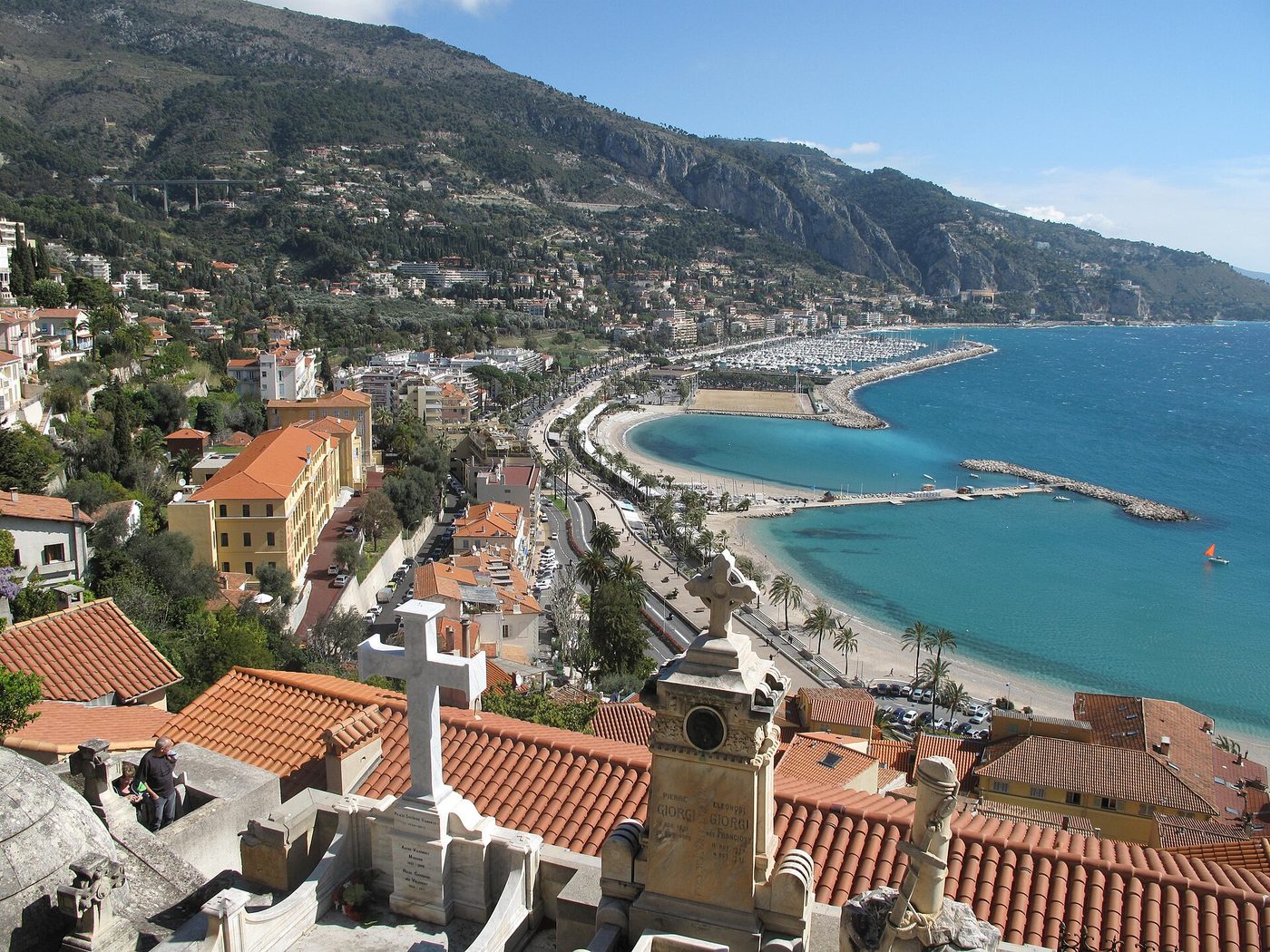
The last French town before Italy, and it looks the part: ochre and apricot houses stacked up a hillside, a baroque church at the top of a staircase, and lemon trees that survive here because the Alps block the north wind. Menton has the mildest winter on the French mainland, which is why the Lemon Festival runs in February, when the rest of the coast is shut.
Thirty-five minutes by train from Nice for a few euros. The Jean Cocteau museum, the covered market and the cemetery terraces above the old town, which have a view along the whole coast, will fill a comfortable day. Two nights if you want to walk the Serre de la Madone and Val Rahmeh gardens properly, which are among the best in France and almost never crowded.
7. Eze
Eze is a village welded to a rock 400 metres above the sea, halfway between Nice and Monaco. The medieval lanes are barely wider than your shoulders, and the exotic garden at the summit has one of the great views of the Mediterranean.
The catch is that Eze is small, famous and reachable by a single bus, so between 11:00 and 16:00 in season it is shoulder to shoulder. Take the 82 from Nice at 09:00, be done by 11:00, and the place is a different village. Alternatively walk up the Nietzsche path from Eze-sur-Mer on the coast, which takes about an hour and a quarter of steep switchbacks and arrives from below with the village above you.
8. Antibes and Cap d’Antibes
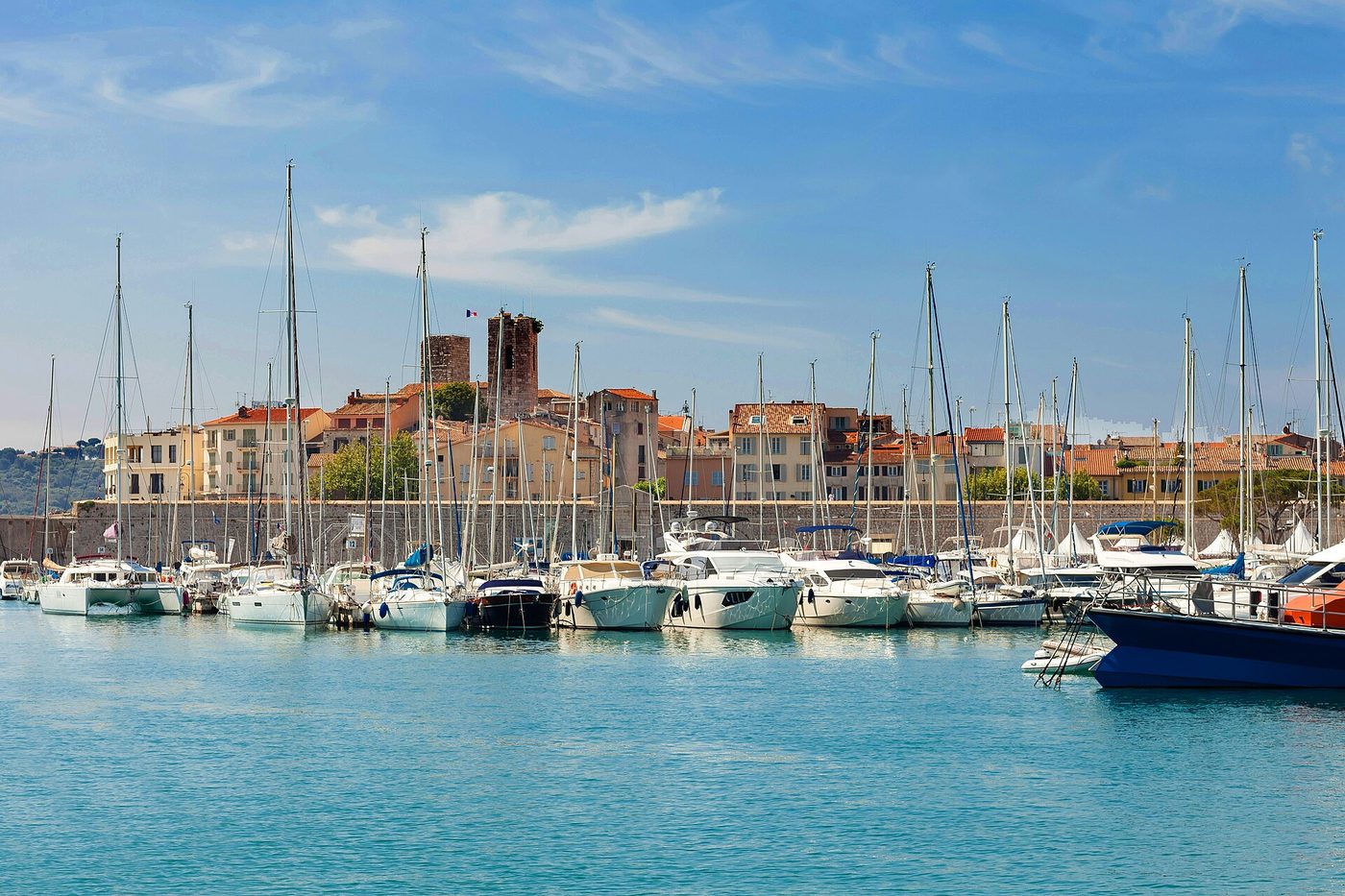
Antibes has the best daily market on the coast, the Marche Provencal under its iron roof, and a Picasso museum inside the seafront castle where he worked through the autumn of 1946. The ramparts run straight along the water. It is a real town with a real population, which after a few days of resort coast is a relief.
Then there is the Cap. The Sentier du Littoral is a coastal footpath around the headland, roughly two hours end to end, past the walls of some of the most expensive private property in Europe and down to swimming coves that are open to anyone. Wear proper shoes; the rock is sharp and the path is not a promenade. Two nights, ideally in June or September.
9. Saint-Tropez
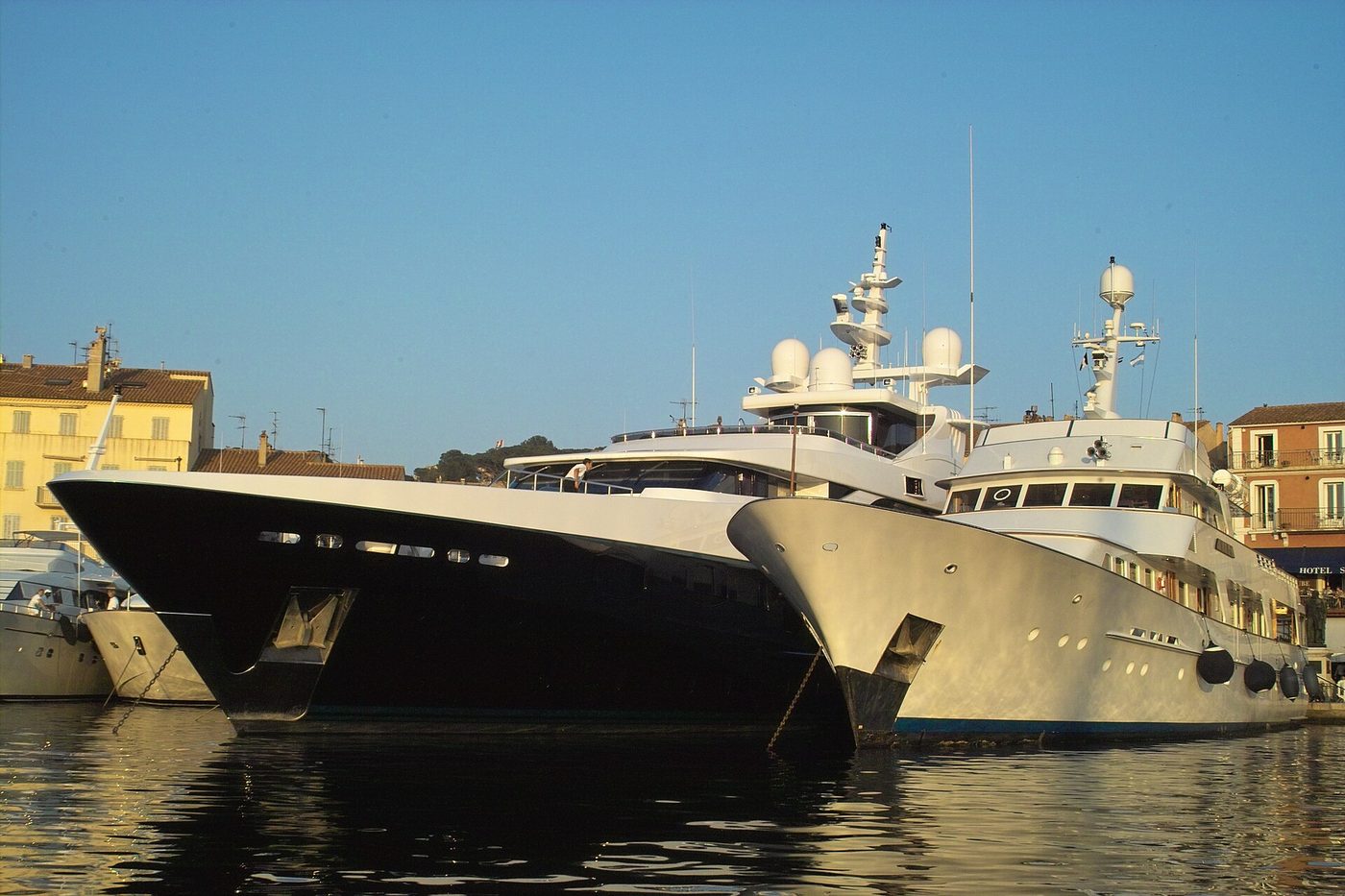
Saint-Tropez in May is a pastel fishing port with a good citadel, a Signac and Bonnard collection at the Musee de l’Annonciade, and a Wednesday and Saturday market on the Place des Lices that is one of the two or three best in Provence. Saint-Tropez in the second week of August is a traffic jam with a harbour attached, and the approach road can take two hours to cover fifteen kilometres.
The trick is the boat. There is no railway station, and the ferry from Sainte-Maxime or Saint-Raphael skips the road entirely and arrives at the pretty end. Go in May or October, stay one or two nights, and walk the Sentier du Littoral out to the Plage de Tahiti in the morning before the beach clubs open.
10. Marseille
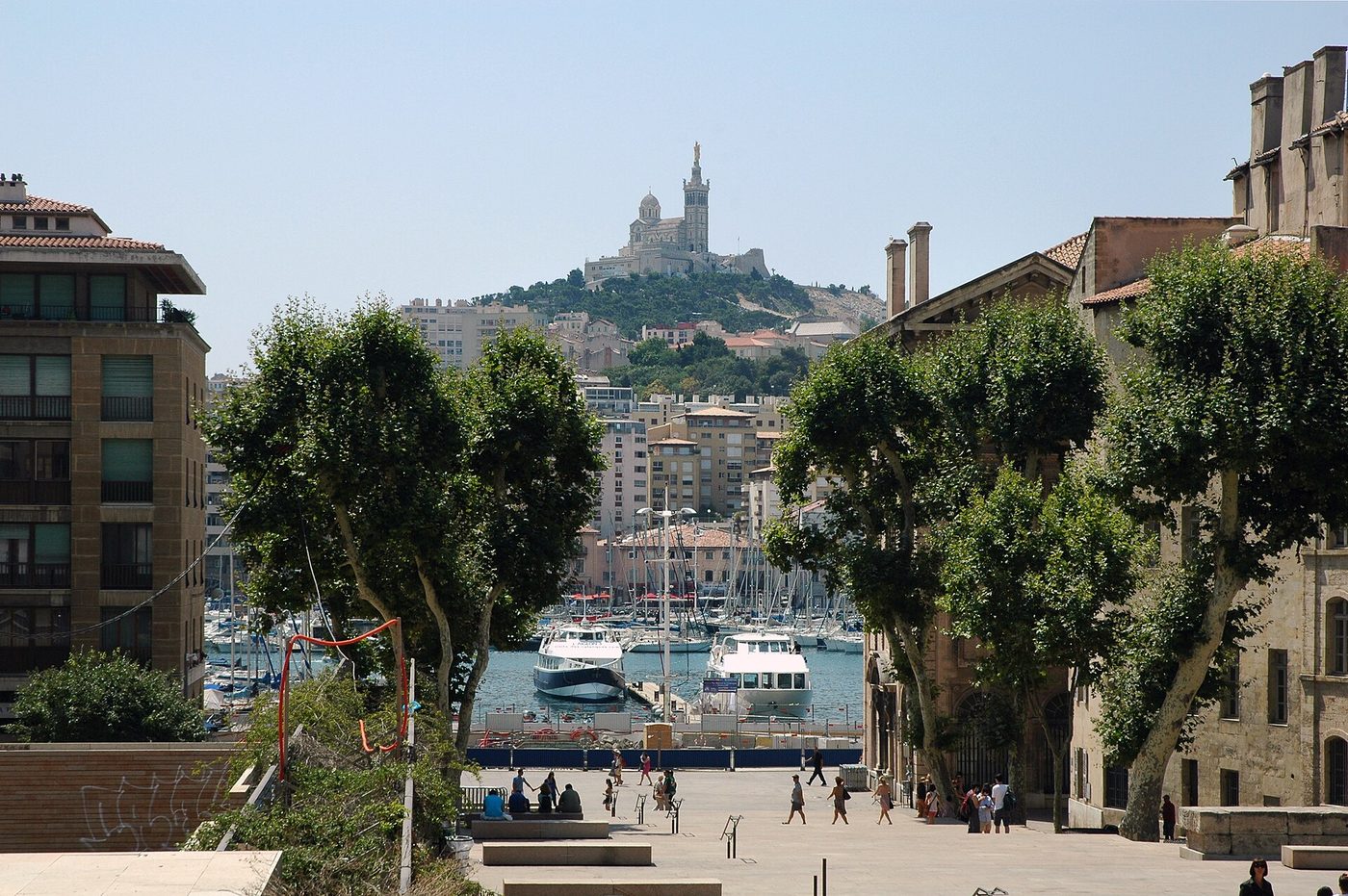
France’s oldest city, founded by Greeks around 600 BC, and its most argued-about. Marseille is loud, steep, occasionally scruffy and the most interesting large city in the south by a wide margin. The Vieux-Port still lands fish every morning. Le Panier, the old quarter above it, is all stairs and street art. MuCEM, the museum of Mediterranean civilisations, sits on the harbour mouth connected to a 17th-century fort by a footbridge, and the building alone justifies the ticket.
Eat bouillabaisse only at a place that asks you to order it a day ahead, because the real version is a two-stage ritual and the 20-euro tourist version is fish soup with ambitions. The TGV from Paris is 3h04 at its fastest with around 19 direct trains a day, and advance fares start around 21 euros. Trenitalia has run the route since June 2025 and carried more than 200,000 passengers on it in that first summer alone, which has taken some heat out of SNCF’s prices.
11. Cassis and the Calanques
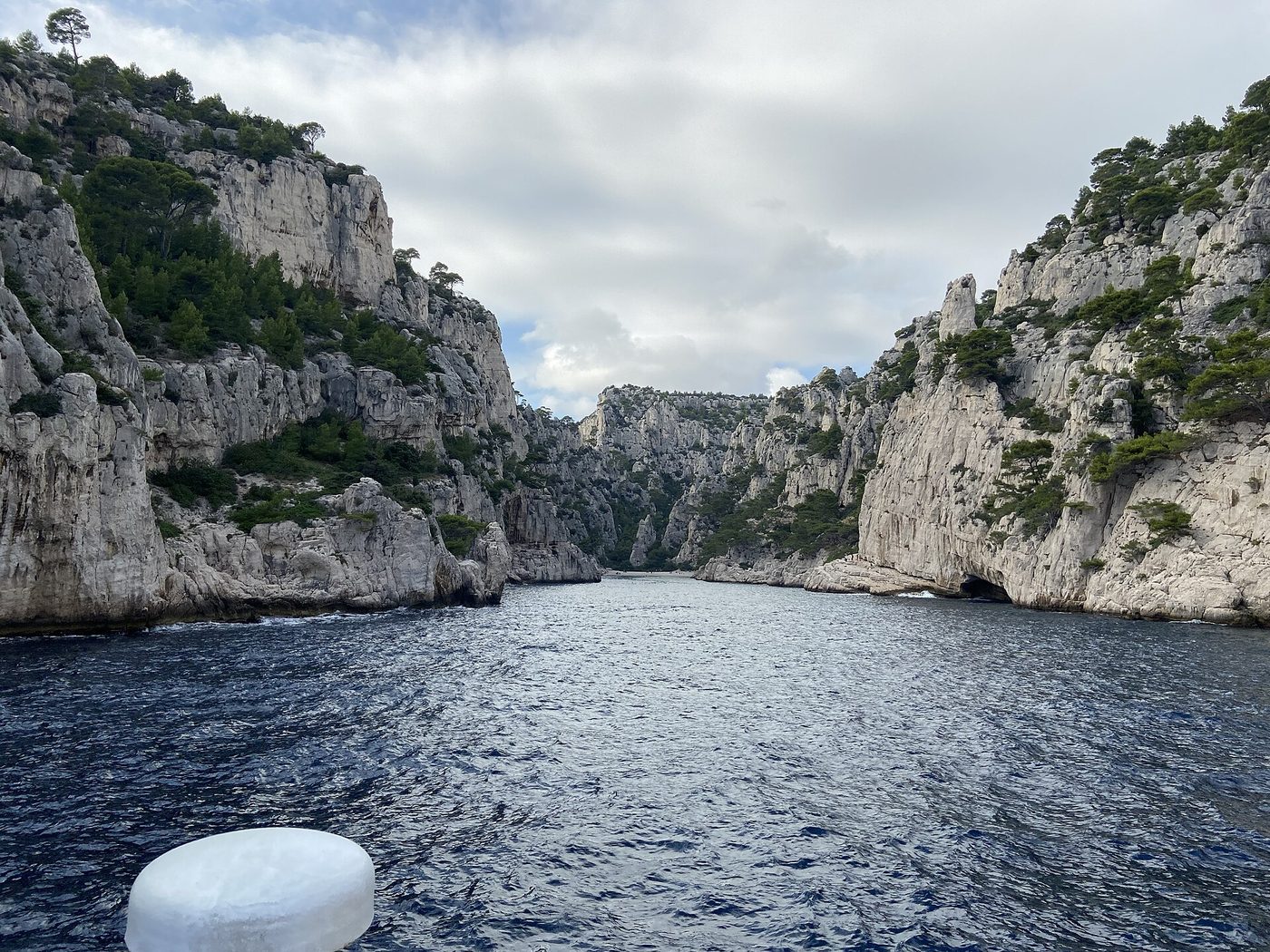
Twenty limestone inlets between Marseille and Cassis, filled with water that really is the colour it looks in photographs. Cassis itself is a small harbour town with Cap Canaille rising behind it, the highest sea cliff in France, and a corniche road along the top of it.
Here is the rule that catches everyone. To walk into the Sugiton and Pierres Tombees coves on peak dates you need a free but compulsory reservation, capped at 400 people a day. In 2026 the system runs on 20 and 21 June, every day from 27 June to 30 August, and on 5 to 6 and 12 to 13 September. Booking opens at 09:00 three days before your visit and closes at 18:00 the day before, one booking covers up to five people for one day, and a ranger scans your QR code at the trail entrance. Outside those dates access is free and unrestricted, which is the strongest argument I know for coming in May or late September.
The other calanques, En-Vau and Port-Pin among them, have no quota. En-Vau is the most beautiful and the hardest to reach: about two hours on foot from the Port-Miou car park, with a scramble at the end. Boat trips from Cassis show you the coves from the water in about 90 minutes and are the sensible option with children or in real heat.
Provence inland
Provence away from the sea is a different holiday: hotter, slower, cheaper, and almost impossible to do properly without a car once you leave Avignon and Aix. Our Provence travel guide covers the region in detail; what follows is the six places I would not leave out.
12. Avignon
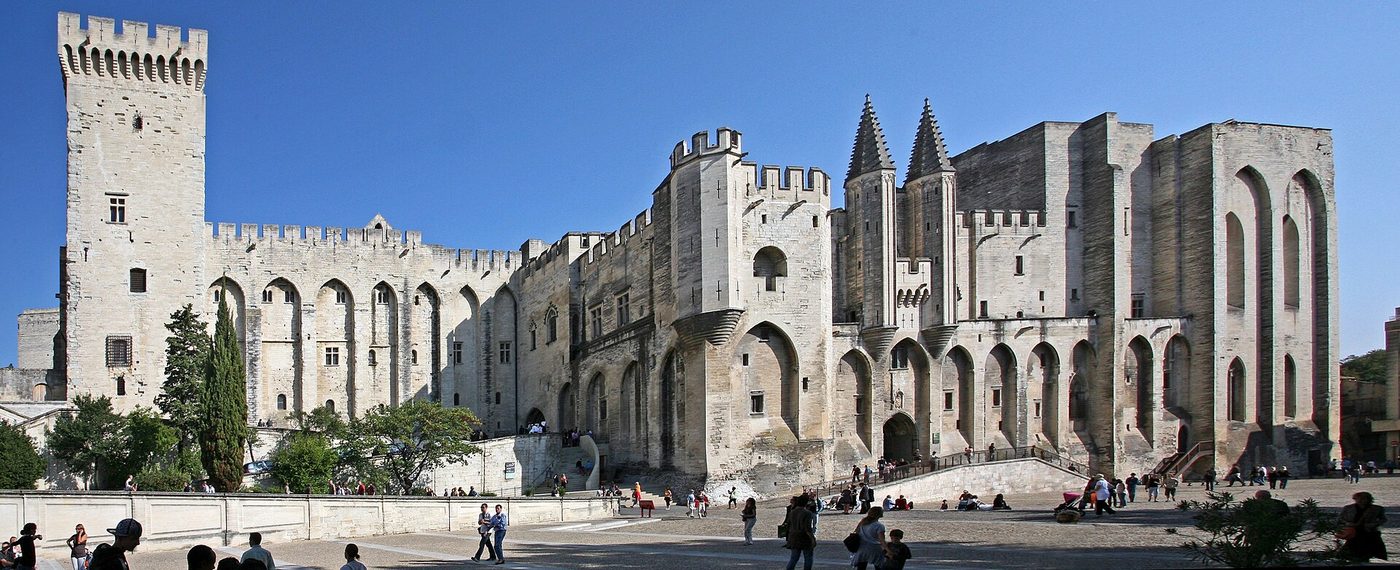
Seven decades of papacy left Avignon with the largest Gothic palace in the world and a set of walls that still enclose the whole old town. The Palais des Papes is enormous and mostly empty, which sounds like a criticism and is not: the scale is the point. The combined ticket with the Pont d’Avignon, the famous half-bridge that stops in the middle of the Rhone, is 17 euros for adults and 13 reduced, with family tickets at 43.50 euros for two adults and one child and 53 for two adults and two children, free from the third child under 18.
The TGV from Paris takes about 2h39. Come in July and the whole town turns into the Festival d’Avignon, with more than a thousand fringe shows and every doorway papered in posters. Come any other month and it is a manageable, walkable base for the whole of northern Provence.
13. Aix-en-Provence
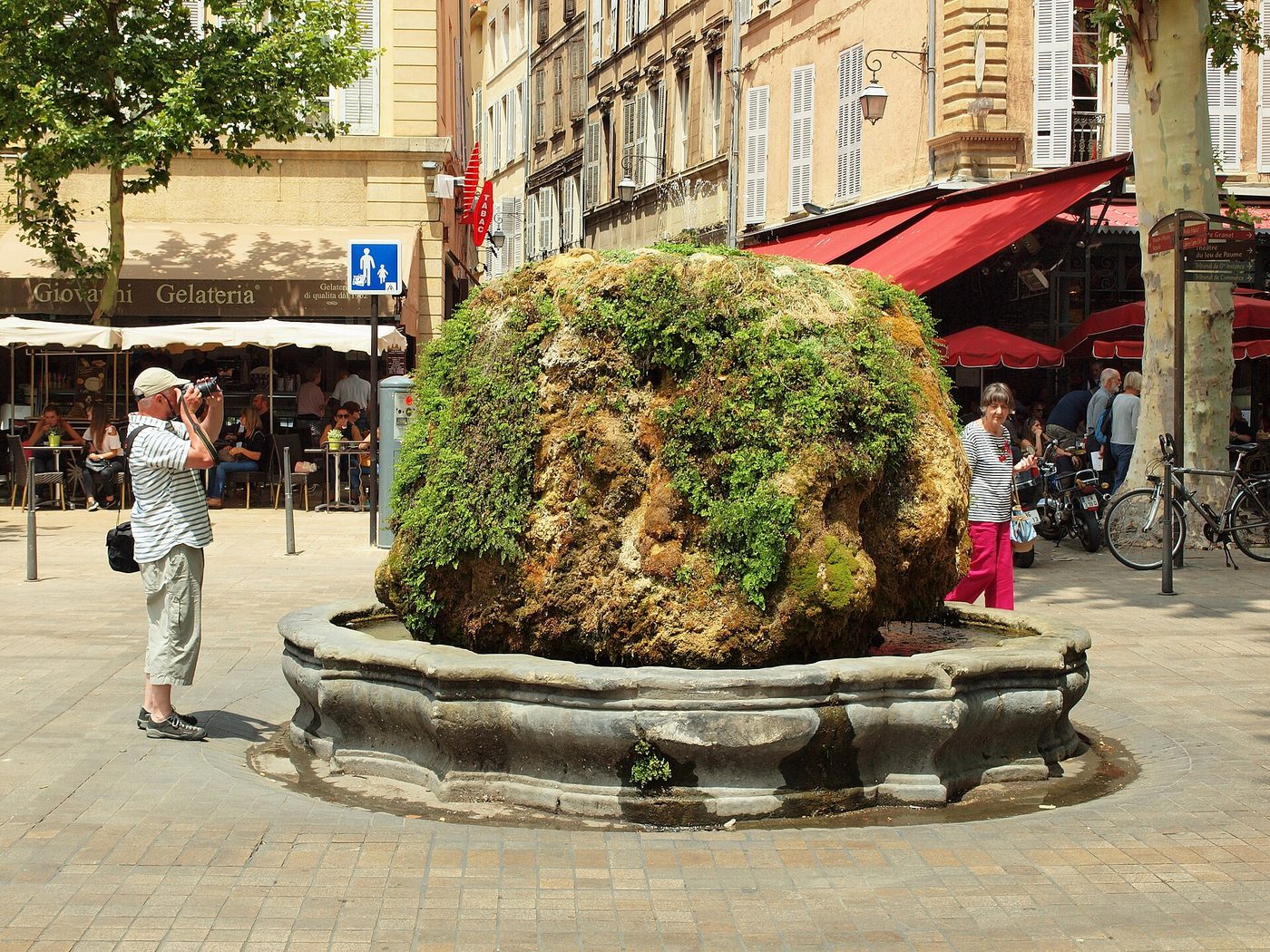
Aix is where Provence goes to be elegant. The Cours Mirabeau is a boulevard of plane trees and fountains with cafes down one side and 17th-century townhouses down the other, and the morning markets on Place Richelme and Place des Precheurs are the best argument I know for renting an apartment with a kitchen.
Cezanne was born here and painted Montagne Sainte-Victoire from every angle for forty years. His studio on the hill north of town is preserved as he left it, down to the fruit bowl. The mountain itself is an hour’s drive and a proper half-day walk if you want it. Thirty minutes from Marseille, two nights, and go in April or September rather than August when the fountains stop being enough.
14. Gordes and the Luberon

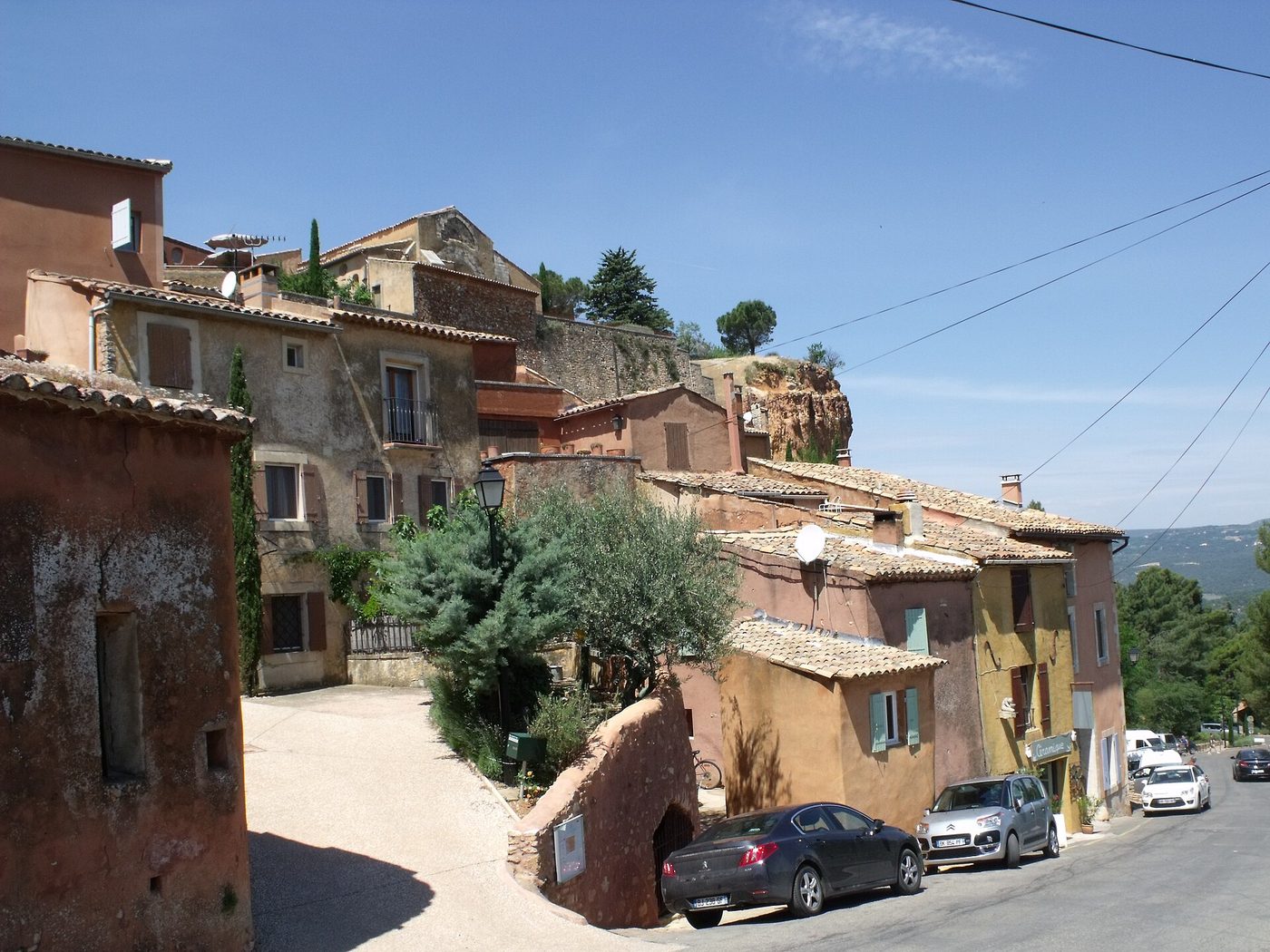
The Luberon is a low limestone ridge with perched villages spaced every few kilometres along it, and the correct way to see it is to drive slowly with no fixed plan. Gordes is the famous one, a grey stone village cascading down a bluff, best seen from the viewpoint on the D15 as you approach from Cavaillon. Roussillon is built from ochre and glows orange. Menerbes, Bonnieux, Oppede-le-Vieux and Lacoste are all within twenty minutes and all quieter.
The Abbaye de Senanque, in a fold below Gordes, is the lavender-in-front-of-an-abbey photograph, and its flowers usually peak in the last week of June and the first week of July. Two or three nights, a car, and accept that you will not tick them all off, which is the correct attitude to the Luberon anyway.
15. The Valensole plateau
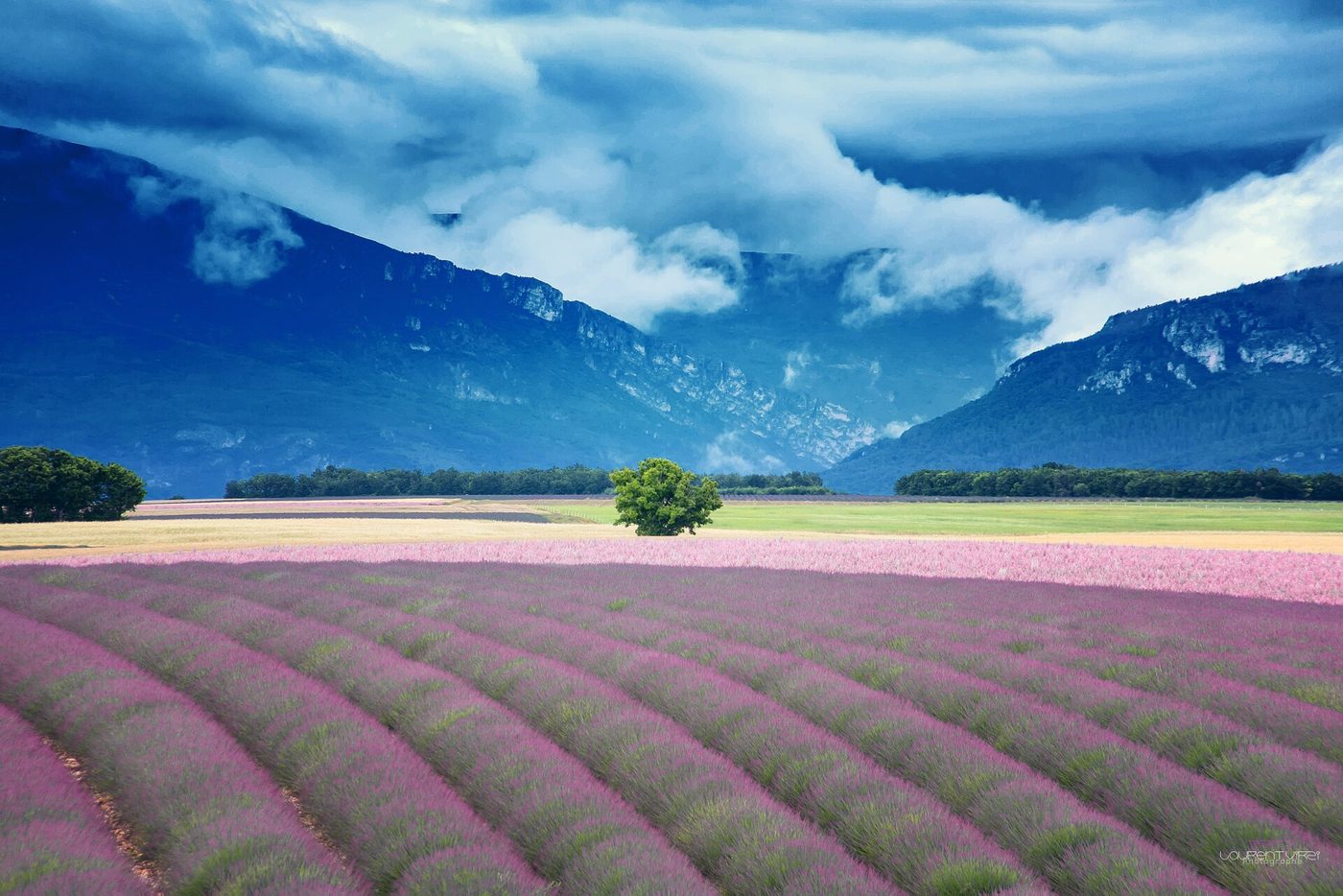
This is the lavender picture. Valensole is a high, flat plateau of wheat and lavender fields south-east of the Luberon, and the flowering window is short. Peak on Valensole is generally the last week of June through the first week of July. Harvest usually starts around mid-July, and in a hot dry year some fields are already cut by about 25 July.
If you cannot make late June, go to the Sault plateau instead. Sault sits higher and flowers later, from early July to mid-August, with mid to late July the safest bet for full rows and the harvest generally starting in the first or second week of August. That two-plateau split is the single most useful thing to know about lavender in Provence, and the reason so many people arrive in the first week of August to find brown stubble.
The Valensole Lavender Festival falls on the third Sunday of July, around 19 July 2026. One or two nights is plenty, and please park in the laybys rather than driving into the rows; these are working farms and the damage is real.
16. Arles
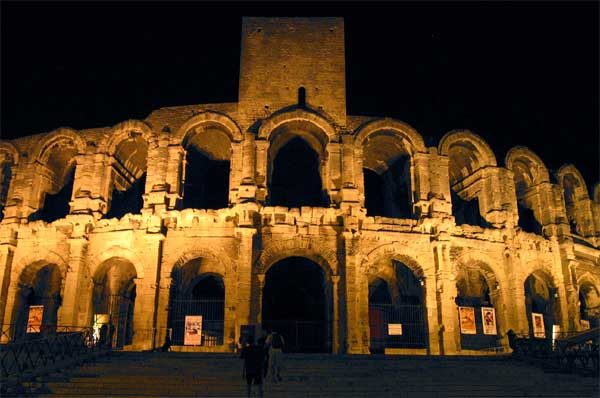
Arles has a Roman amphitheatre from around 90 AD that still holds events, a Roman theatre, cryptoporticoes under the forum, and the light that kept Van Gogh here for fifteen months and about 200 paintings. The Fondation Vincent van Gogh puts on a serious annual programme, and the Rencontres d’Arles every summer is one of the biggest photography festivals in the world.
It is twenty minutes by train from Avignon and sits on the edge of the Camargue, the delta of white horses, black bulls and pink flamingos. One or two nights in Arles, plus a half day into the Camargue by bike or on a guided ride, is a good use of the time.
17. The Verdon Gorge
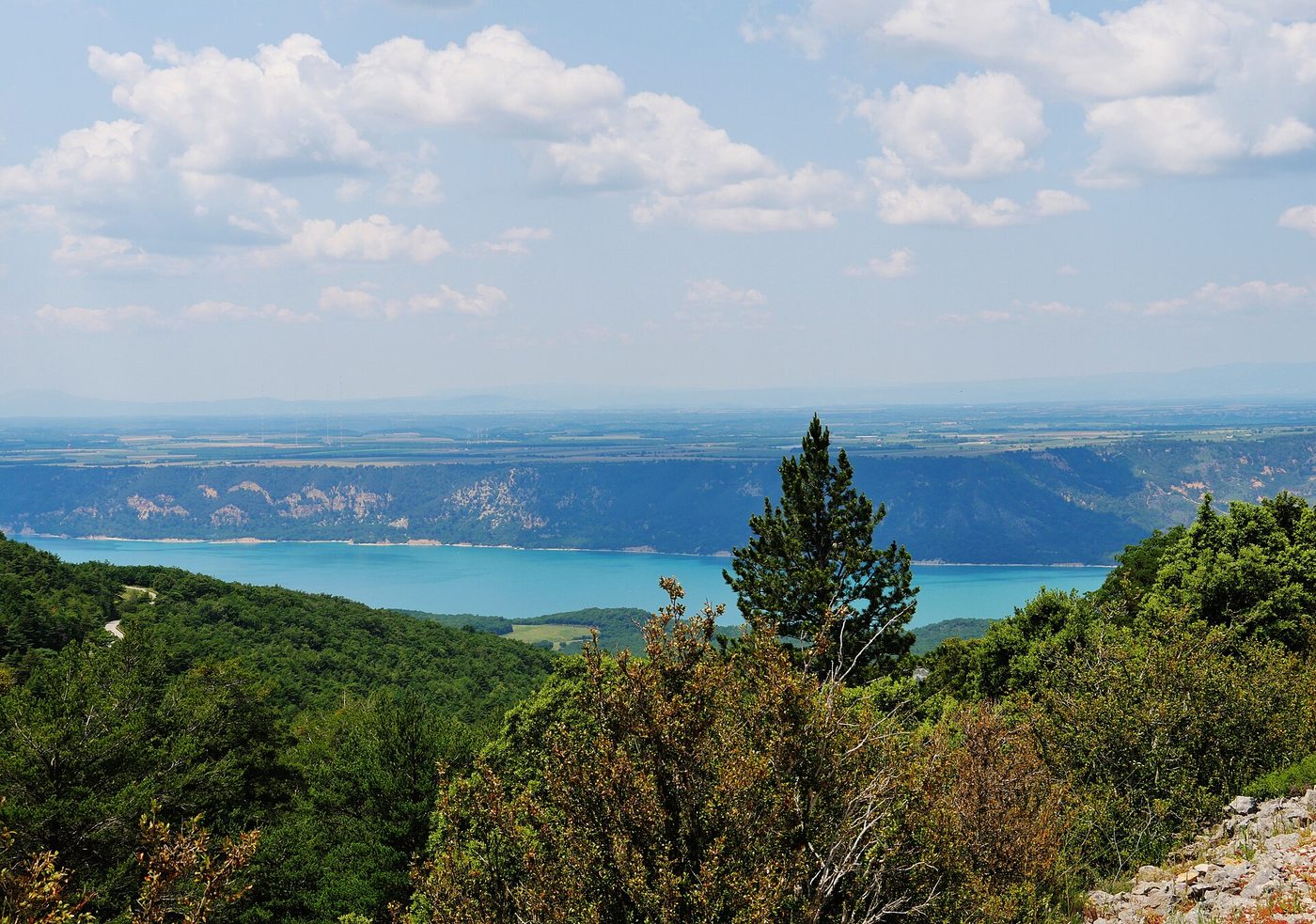
One of the deepest canyons in Europe: 700 metres at its deepest, 25 kilometres long, with water at the bottom the colour of antifreeze thanks to glacial rock flour. The Route des Cretes on the north rim is a one-way loop of viewpoints, and the drive alone justifies the detour.
Two rules to know before you go. Swimming is prohibited in the Verdon itself between Point Sublime and the Pont du Galetas, and permitted on the usual beaches of the Lac de Sainte-Croix at the western end, which is where the pedalos and kayaks launch. Boats, canoes and pedalos may only travel upstream from the lake as far as the Saint-Maurin waterfall, about 1.5 kilometres in.
The Blanc-Martel trail through the bottom of the gorge is the classic walk, and it has real requirements: a head torch is compulsory for the tunnels, dogs are banned, and it is barred to children under 8 and not advised under 10. The shuttle that makes the point-to-point logistics work runs daily until 13 September 2026. Two nights, based in Moustiers-Sainte-Marie or La Palud-sur-Verdon.
The southwest
Warmer than the north, cheaper than the Riviera, and structurally different: this is a region of rivers and vineyards rather than coast and cities. Bordeaux is the hinge everything else swings off.
18. Bordeaux

Two hours and eight minutes from Paris by TGV, which is barely longer than getting across London. Bordeaux spent twenty years scrubbing its 18th-century limestone and now has the largest UNESCO-listed urban area in the world after Venice. The Place de la Bourse and its reflecting pool, the Miroir d’Eau, are the postcard; the Saint-Pierre lanes behind it are where you end up spending the evening.
The climate helps. July highs average 27 degrees, January highs around 10, and the city gets roughly 2,040 hours of sun a year, with July the sunniest month at about 249 hours. That is a Mediterranean number on an Atlantic city.
La Cite du Vin explains wine properly rather than sentimentally, and the tram network reaches enough of the outer chateaux that you can taste seriously without hiring a car. Two or three nights, and use one of them for Saint-Emilion.
19. Saint-Emilion
Thirty-five minutes by train from Bordeaux, and one of the few great wine villages that is lovely to look at rather than merely functional. It is built on a limestone plateau riddled with quarry tunnels, and the monolithic church is carved directly down into the rock, which you can only see on a guided tour from the tourist office.
The village is small and the day-trip coaches concentrate between 11:00 and 15:00. Arrive on the first train, walk the vineyard paths that start immediately behind the houses, and have lunch after the coaches have gone. Macarons here have been made to the same convent recipe since 1620 and are worth the queue.
20. Dune du Pilat and Arcachon
The tallest sand dune in Europe, over 100 metres high and still moving inland a few metres a year, with the Atlantic on one side and pine forest on the other. Climbing it takes twenty minutes on the staircase in season or a proper struggle up the sand out of it, and the sunset from the crest is the reason to time it late.
Arcachon, 55 minutes by train from Bordeaux, is a Belle Epoque resort with a hillside quarter of extravagant 19th-century villas. The bay behind it is Europe’s oyster capital, and the ostreiculteur huts at Cap Ferret and L’Herbe will sell you a dozen and a glass of white for less than a Paris coffee costs. One or two nights.
21. Sarlat and the Dordogne
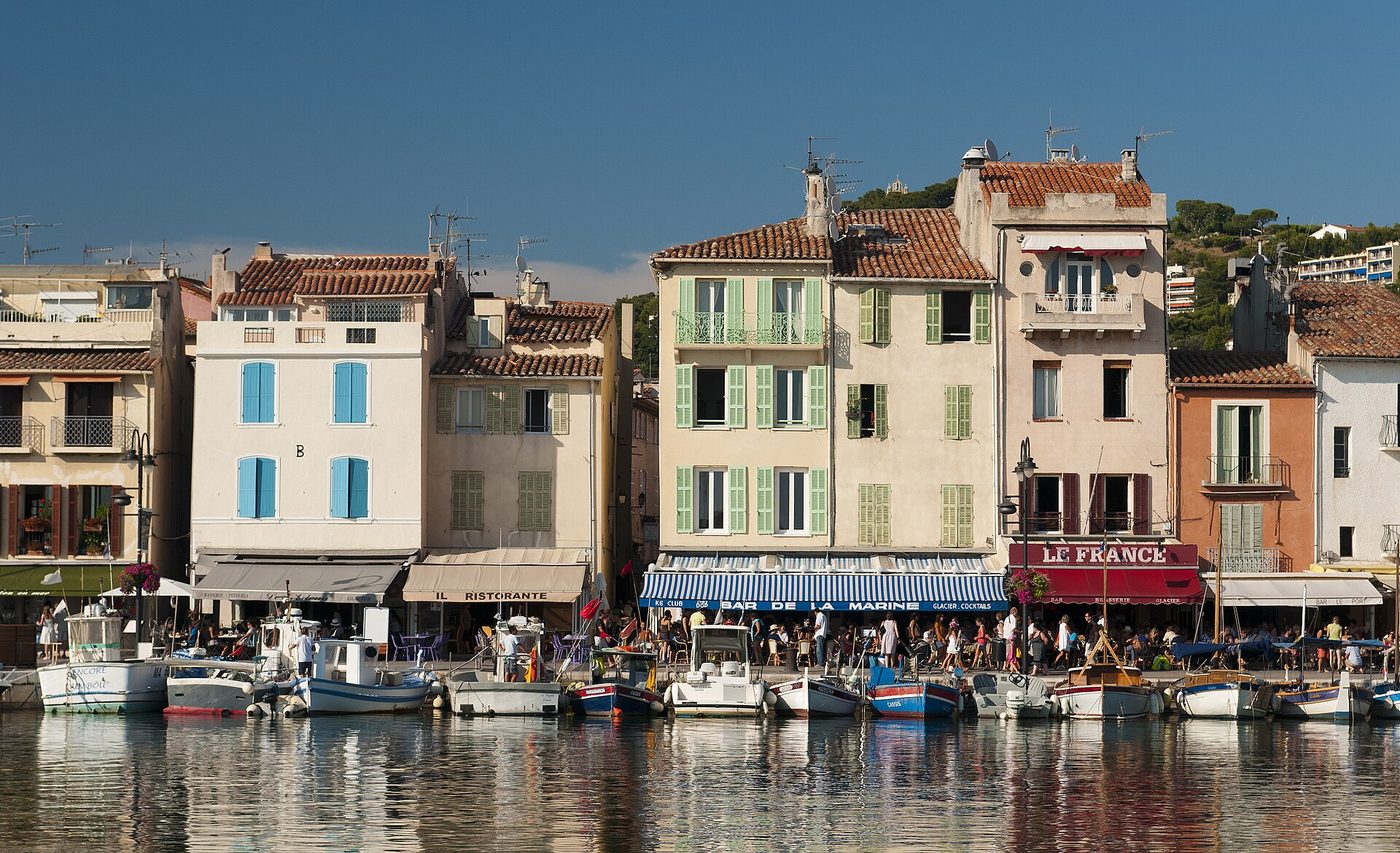
The Dordogne valley is a hundred kilometres of honey-coloured stone: castles facing each other across the river at Beynac and Castelnaud, the clifftop village of La Roque-Gageac built into the rock face, and Sarlat itself, which has one of the densest concentrations of protected medieval buildings in France and a Saturday market that takes over the entire town.
The other reason to come is underground. Lascaux IV, the full-scale facsimile of the painted cave near Montignac, costs 23 euros for adults aged 13 and over, 22 reduced, 15 for children aged 5 to 12 and free below that. The original cave has been sealed since 1963, and the replica is good enough that the distinction stops mattering about ten minutes in.
Three nights and a car. Canoeing the Dordogne between Carsac and Beynac is the best half-day in the valley, and it drifts past four castles.
22. Rocamadour
A pilgrimage town stacked vertically up a 120-metre cliff above the Alzou canyon: houses at the bottom, a cluster of sanctuaries in the middle reached by 216 steps that pilgrims once climbed on their knees, and a castle on the lip. It has been a pilgrimage site since the 12th century and it still works as one.
Approach from the L’Hospitalet side, where the road viewpoint gives you the whole thing side-on. Lifts run for anyone who does not want the steps. One night is right, and staying over means you get the lit-up town after the day visitors leave. The local goat cheese, Rocamadour AOP, is a small disc of the good stuff and appears on every menu.
23. Biarritz and the Basque coast
Biarritz is where French surfing started in the 1950s, and it still has the best beach break in the country at the Grande Plage plus a Belle Epoque skeleton left over from being Napoleon III’s resort. Water temperatures peak around 22 degrees in late summer, which is warmer than the Channel and colder than the Med.
The real reason to come is the food. Bayonne, eight kilometres inland, cures the ham; Espelette grows the pepper that flavours half of Basque cooking; and Saint-Jean-de-Luz has the best pintxos on the French side of the border. San Sebastian, arguably the best eating city in Europe, is 40 minutes further on. Two or three nights, June or September, and read our San Sebastian guide before you cross.
Occitanie and the Midi
Roman France, essentially, plus the greatest walled city in Europe. It is the cheapest cluster on this list and one of the hottest, which makes April, May and October the months to aim for.
24. Carcassonne
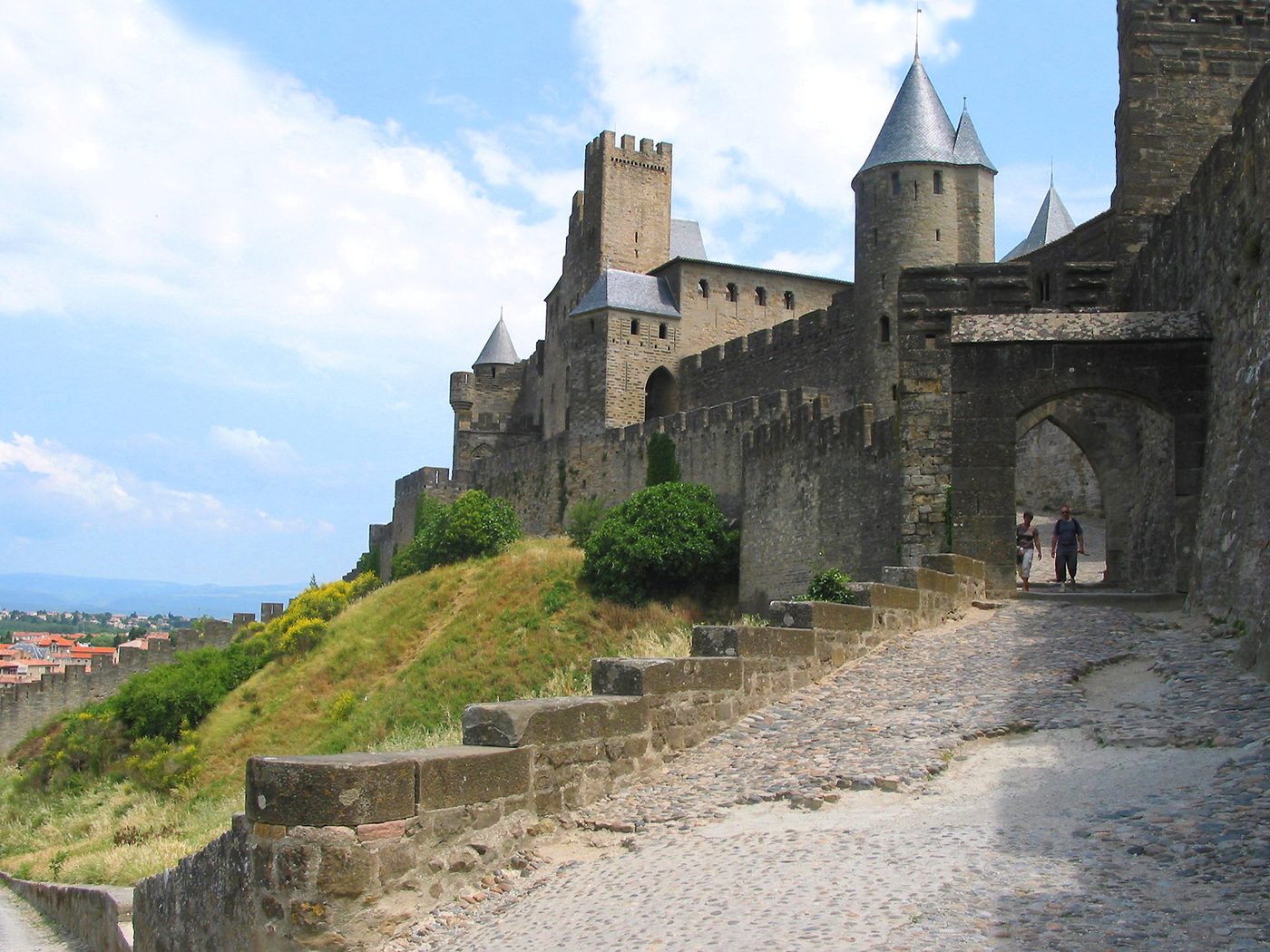
Fifty-two towers, a double ring of walls, and a restoration by Viollet-le-Duc in the 1850s that purists still argue about and everybody else finds magnificent. Walking into La Cite is free. The Chateau Comtal and the ramparts walk are 11.50 euros for adults, 9.50 reduced, free for under-18s and EU residents aged 18 to 25, free on winter first Sundays, with an audioguide at 4 euros.
The single best decision here is to sleep inside the walls. Day trippers arrive from Toulouse, 50 minutes away by train, and are gone by early evening; after 18:00 the lanes empty out and you have a medieval city largely to yourself. One night is enough, but make it the right night.
25. The Pont du Gard
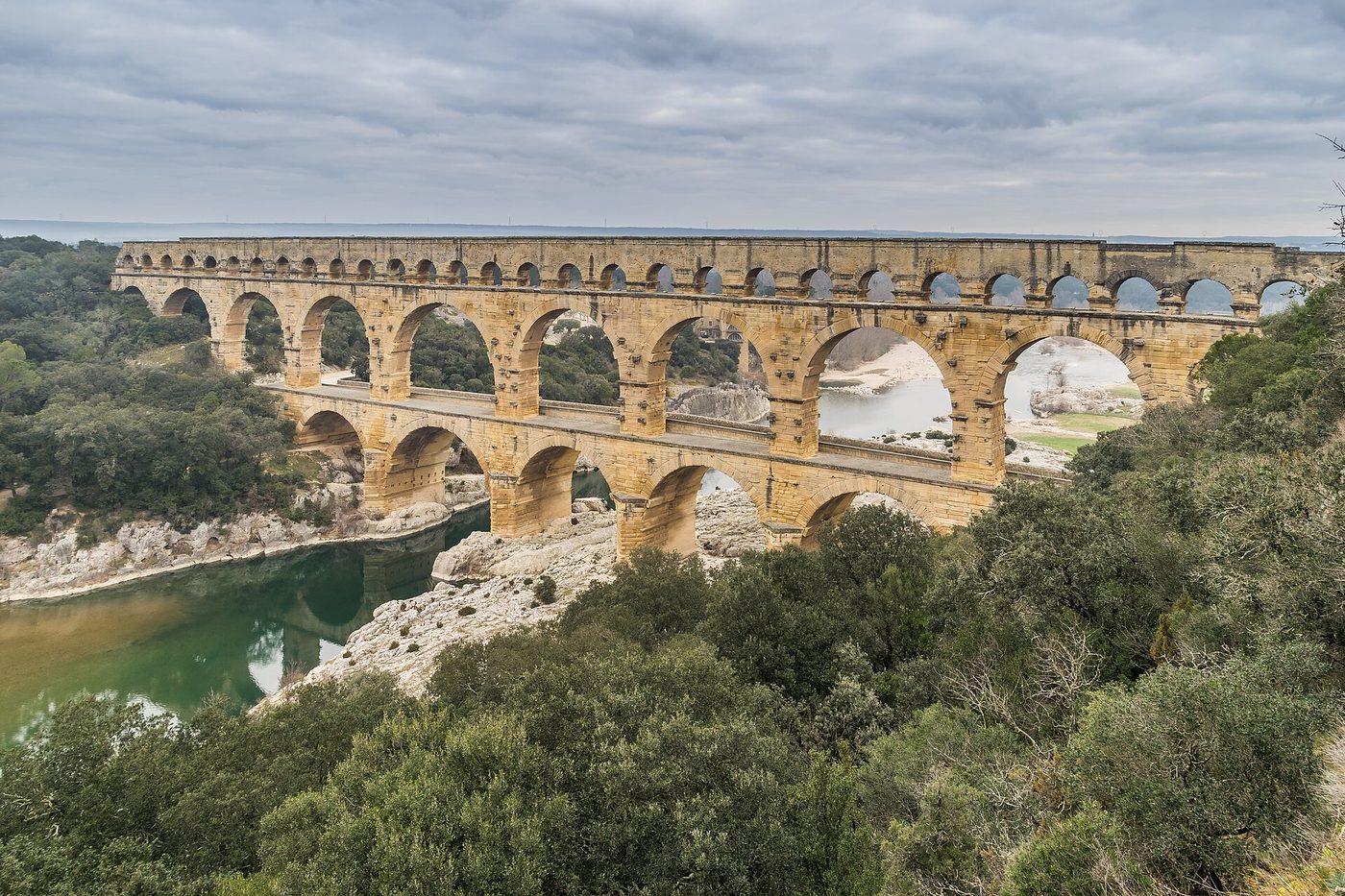
A three-tier Roman aqueduct bridge from the first century AD, 49 metres high, built without mortar, and still the tallest the Romans ever raised. Reaching it and walking across the lower tier costs nothing for pedestrians and cyclists. Parking is 9 euros per vehicle, the Discovery Spaces museum and cinema are 8 euros for adults and 6 reduced with under-18s free, and the guided Grande Odyssee tour that takes you up onto the third tier is 12 euros for adults and 6 for children aged 4 to 17.
You can swim in the Gardon underneath it, which is the detail that turns a monument into an afternoon. Bring a towel and shoes you can walk in the river with.
26. Nimes
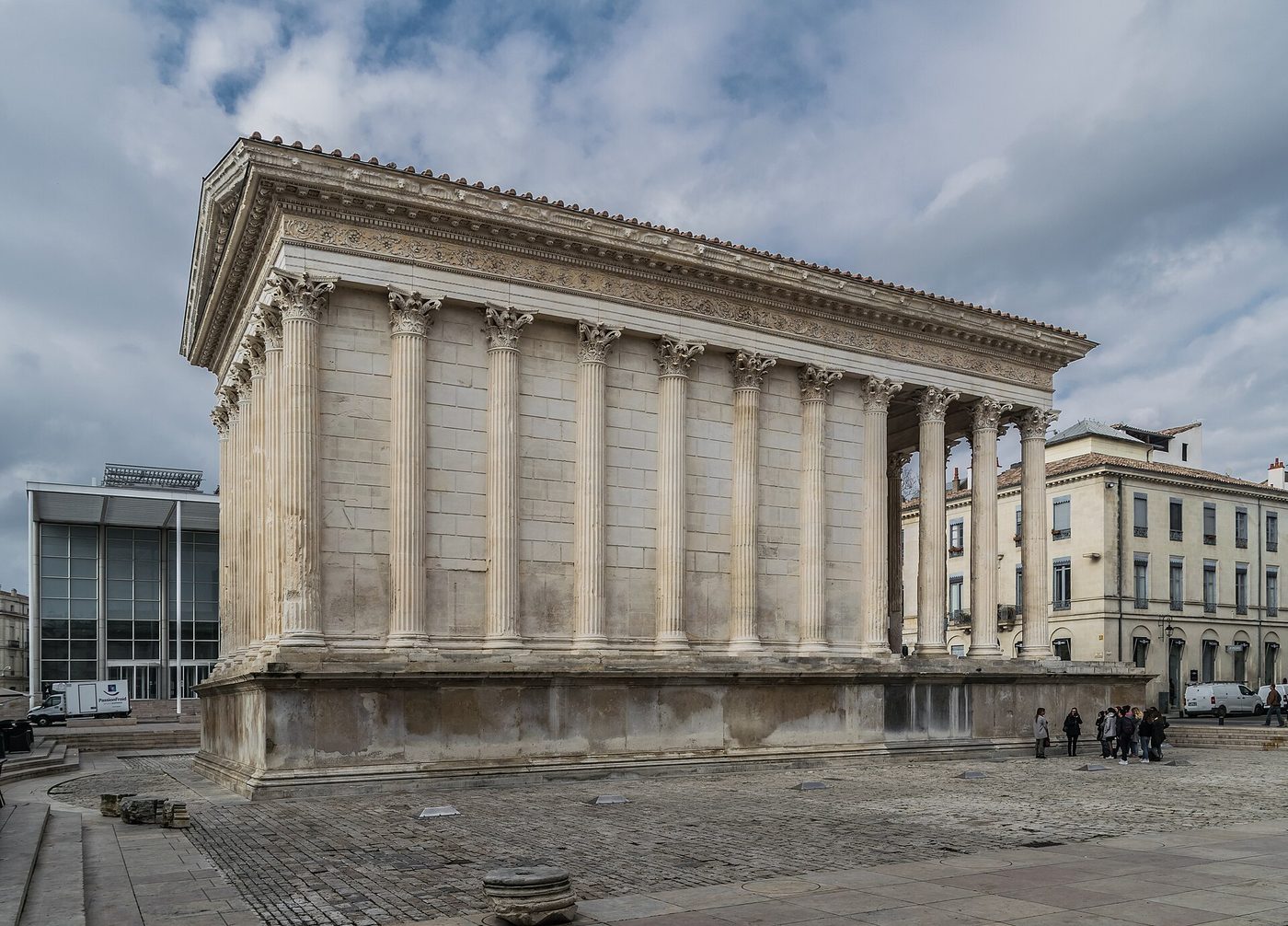
Nimes has the best-preserved Roman amphitheatre anywhere, and it is not a ruin: it holds concerts and events, roofed in winter, with the original vaulted circulation still doing the job it was designed for in 70 AD. The Maison Carree, a near-intact Roman temple in the middle of town, was added to the UNESCO list in 2023.
About three hours from Paris by TGV, and twenty minutes from the Pont du Gard by road. One or two nights, ideally pairing Nimes, the Pont du Gard and Arles into a single Roman circuit.
27. Toulouse
Pink brick everywhere, which is what gives it the ville rose nickname and a specific warm colour in late afternoon. Saint-Sernin is the largest surviving Romanesque church in Europe. The Canal du Midi starts here and runs 240 kilometres to the Mediterranean, and the towpath is flat, shaded and cyclable the whole way.
Toulouse is also Europe’s aerospace capital: Airbus assembles the A350 here and the Aeroscopia museum and the Cite de l’Espace are both properly good rather than dutiful. It has one of the largest student populations in France, which shows up in the price of dinner. Two nights, and about 4h15 from Paris on the TGV, which is the longest run to a major city west of the Rhone.
Brittany and the Atlantic
Cooler and wetter than everywhere else here, and the trade-off is worth understanding: Brest averages about 22 degrees in July and roughly 1,530 hours of sun a year against Nice’s 2,700-plus. What you get in exchange is a coastline with tides that reshape it twice a day, seafood at prices the south forgot, and space in August when the Mediterranean has none.
28. Saint-Malo
A walled corsair city on a granite headland, eighty percent destroyed in August 1944 and rebuilt stone by stone over twelve years so precisely that most visitors never realise. The rampart walk right around the top of the walls takes about 45 minutes and is free.
The tides here are among the biggest in Europe, and they are the entertainment. At low water you can walk out to the Fort National and the Grand Be, where Chateaubriand is buried; at high water both are islands and the causeways are underwater. Check the tide tables before you plan your afternoon, because people do get caught. Rennes is 1h28 from Paris by TGV and Saint-Malo an hour beyond it. Two nights.
29. Dinan
Half an hour inland from Saint-Malo, and prettier at street level: three kilometres of intact ramparts, a steep cobbled street of half-timbered houses called the Rue du Jerzual falling down to the old river port, and perhaps a third of the visitors. The Rance river between Dinan and Dinard can be done by boat when the tides allow.
One night, or a long day trip. If you are choosing between the two, Saint-Malo is the more dramatic setting and Dinan is the better town to wander.
30. Carnac
Around 3,000 standing stones in parallel rows stretching four kilometres across the Morbihan countryside, raised between roughly 4500 and 3300 BC, which makes them older than Stonehenge and older than the pyramids. The main alignments are fenced in summer to protect the ground and open to walk among from October to March, with guided access the rest of the year.
The site’s status changed recently: the Megaliths of Carnac and the Shores of Morbihan were inscribed by UNESCO on 12 July 2025, making this France’s 54th World Heritage site and the first in Brittany. Expect visitor numbers to climb from here.
Carnac also has a decent beach and a good prehistory museum. One night. Combine it with the Gulf of Morbihan and the walled town of Vannes, twenty minutes away.
31. Ile de Re
The Ile de Re is flat and whitewashed, joined to the mainland by a toll bridge, with green shutters mandated by planning rules, hollyhocks growing out of the gutters and about 100 kilometres of dedicated cycle paths. Nobody drives here if they can help it.
Saint-Martin-de-Re, the fortified main village, is UNESCO-listed as part of the Vauban fortifications. The salt marshes at the northern end still work commercially, and the fleur de sel is the good stuff. Two or three nights, June or September, and hire bikes on arrival rather than bringing a car onto the island.
32. La Rochelle
Two medieval towers still guard the mouth of the old harbour, and the arcaded streets behind it stay dry in the Atlantic weather, which was the point. It is a proper working city rather than a resort, about 2h30 from Paris by TGV, and the aquarium is the best in France by a distance. If you are working your way along the coast, our roundup of the best beaches in Europe puts the Atlantic side in context.
Two nights, and use it as the mainland base for the Ile de Re and the Ile d’Aix. The old port at dusk, with the towers lit, is one of those views that quietly justifies the trip.
Normandy
Ninety minutes to three hours from Paris, which makes it the easiest cluster to bolt onto a city trip. It is also the one place in France where a guide transforms the day, because the D-Day coast without context is a set of quiet beaches. Our complete guide to visiting Normandy covers the 2026 admission prices, the tides and the driving distances.
33. Etretat
White chalk cliffs punched through into arches, with a needle of rock standing offshore, painted obsessively by Monet and Courbet. Walk up both sides: the Falaise d’Amont to the north for the chapel and the aviators’ monument, the Falaise d’Aval to the south for the arch and the needle.
A word about the pressure. Etretat has been reported taking up to 10,000 visitors a day on the northern beach at peak against a permanent population of about 1,200, and the cliff paths show it. There is no booking system or quota in place for 2026, though the government has said it wants to redirect visitors away from saturated sites, with Etretat named among them. Go on a weekday, out of August, and stay on the marked paths. One night, ideally so you get the cliffs at sunrise.
34. The D-Day landing beaches
Eighty kilometres of coast, five beaches, and the reason many people come to France at all. Omaha and the American cemetery at Colleville-sur-Mer, the artificial Mulberry harbour remains at Arromanches, the German battery at Longues-sur-Mer with its guns still in place, and Pointe du Hoc, which is still a cratered moonscape, are the four I would not skip.
Base yourself in Bayeux, which came through 1944 undamaged. One warning: the Bayeux Tapestry museum closed on 1 September 2025 for a rebuild and is not due to reopen until October 2027, and the tapestry itself is on loan to the British Museum from September 2026 to July 2027. Do not plan the day around it. Two nights and a car, or a full-day guided tour, which is one of the few times on this list I would spend the money on a guide without hesitation.
35. Honfleur
Honfleur is a slate-fronted harbour at the mouth of the Seine, tall thin houses reflected in the water, painted by Boudin and Monet and more or less every Impressionist who could get there. Sainte-Catherine, the church behind the port, is the largest timber-built church in France, put up by shipwrights who built it like an upturned hull.
It is small and it knows it is charming, so the centre is busy from late morning. One night, arrive late afternoon, and eat mussels. The Pont de Normandie on the way in is worth the toll on its own.
36. Rouen
The cathedral Monet painted more than thirty times in different light, and the market square where Joan of Arc was burned in 1431, now marked by a modern church with a roof like a flame. The Gros-Horloge, an astronomical clock spanning the street on its own arch, has been running since the 14th century.
About an hour and a half from Paris by train, which makes it the easiest of these as a day trip, though one or two nights lets you get the Rue Saint-Romain and the old quarter without the coach parties.
37. Giverny
Monet’s house, his flower garden and the water lily pond with the green Japanese bridge, kept the way he planted them. Entry is 13 euros for adults, 7 for children aged 7 to 17 and students, 6 for disabled visitors and free under 7.
The season is fixed and short: open daily from 1 April to 1 November inclusive, 10:00 to 18:00 with last admission at 17:30, and closed from 2 November to 31 March. The water lilies are at their best in June and July. Take the train to Vernon and the shuttle from there. Half a day, and go on the first entry of the morning if you want a photograph of the bridge without twelve people on it.
Lyon and the east
The eastern corridor runs from Lyon up through Burgundy and Champagne into Alsace, and it is the cluster with the best food, the best wine and the best Christmas markets in France. It is also the one where the TGV does most of the work for you.
38. Lyon
One hour 44 minutes from Paris, and France’s eating city, and one of the best European city breaks for a long weekend. The bouchons of Vieux Lyon serve the offal-heavy, unfussy cooking the city built its reputation on, and Les Halles Paul Bocuse is a covered market of specialists rather than a food court.
Geographically it is two rivers and two hills: Fourviere with its Roman theatres and basilica on one side, Croix-Rousse and the old silk-weavers’ district on the other, and the Presqu’ile peninsula between them. The traboules, covered passageways cut through buildings so silk could be carried in the dry, are still walkable if you know the doors.
Trenitalia runs the Paris to Lyon route alongside SNCF, with lead-in fares around 23 euros when summer 2026 sales opened in March. Two or three nights. Come in December and the Fete des Lumieres puts light installations across the whole city for four nights.
39. Strasbourg

A cathedral with a 142-metre spire that was the tallest building in the world for over two centuries, a working astronomical clock inside it, and the Petite France quarter of half-timbered tanners’ houses on the canals. Strasbourg is 1h45 from Paris by TGV, which puts a German-flavoured cathedral city inside a long weekend from Paris.
July highs average about 26 degrees and January highs about 4, with roughly 1,695 hours of sun a year, so this is a cold-winter, warm-summer city rather than a mild one. December is the exception worth planning for: the Christmas market has run since 1570 and is the biggest and oldest in France. Two nights, and book accommodation months ahead for December. Our guide to Christmas markets in Europe has the December logistics.
40. Colmar and the Alsace wine route

Colmar is thirty minutes south of Strasbourg and looks like a set: painted timber houses leaning over canals in the Petite Venise quarter, and the Unterlinden museum holding the Isenheim Altarpiece, which is one of the most powerful paintings in Europe and worth going out of your way for.
South and north of Colmar the Route des Vins runs 170 kilometres past riesling and gewurztraminer villages every few kilometres: Riquewihr, Eguisheim, Kaysersberg, Ribeauville. Above them on the ridge sits the Chateau du Haut-Koenigsbourg, 12 euros for adults, 8 for children aged 6 to 17, free under 6, with an audioguide at 4 euros and free entry on winter first Sundays. Two or three nights and a car, or a bike if you are fit; the vineyard cycle routes are excellent.
41. Reims and Champagne
Almost every French king from the 12th century onward was crowned in Reims cathedral, which also has Chagall windows in the apse. Underneath the city are kilometres of Roman chalk quarries reused as champagne cellars, and the big houses run tours through them.
Reims is 45 minutes from Paris on the TGV, which makes it the shortest journey to a serious wine region anywhere in France. Book tastings weeks ahead in season; the small growers in the Montagne de Reims and the Cote des Blancs are the more interesting visits and the harder ones to arrange on the day. One or two nights. Epernay’s Avenue de Champagne, twenty minutes away, has the greatest concentration of famous names on one street.
42. Beaune and Burgundy
Beaune’s Hotel-Dieu is a 15th-century hospice with a glazed polychrome tile roof that is on more Burgundy wine labels than any other building. The town underneath is small, walled and full of cellars.
North and south of it the Cote d’Or runs through the most expensive agricultural land on earth. The Voie des Vignes cycle path links the villages, and riding from Beaune to Santenay past Pommard, Volnay and Meursault is one of the great easy bike days in France. Dijon, 25 minutes north, has the ducal palace, the mustard and a good market hall. Two nights, ideally in September during the harvest.
The Alps, the Pyrenees and Corsica
The high country and the island. This is the cluster with the biggest seasonal swings on the list, and the one where getting the month wrong costs you the most.
43. Annecy

Annecy sits at the top of a lake so clean you can see the bottom from the middle, ringed by mountains that come straight out of the water. The old town is pastel houses over arcades with the Palais de l’Isle, a 12th-century prison, marooned on its own islet in the middle of the canal.
The lake is the point. A 40-kilometre cycle path runs right around it on an old railway line, mostly flat and completely separated from traffic, and the water is warm enough to swim in from late June to September. Paragliders come off the Col de la Forclaz above the eastern shore all summer. About 3h45 from Paris by TGV. Two nights, June or September. Annecy makes most shortlists of the best lakes in Europe, and deservedly.
44. Chamonix and Mont Blanc

The Aiguille du Midi cable car climbs to 3,842 metres in two stages and puts you on a terrace looking straight at Mont Blanc, with the glaciers below and the Italian Alps behind. It runs roughly 60 to 83 euros for an adult return depending on the date, because pricing is dynamic. In July and August a time slot is compulsory, so book it before you arrive; outside those months you can usually buy at the Chamonix station subject to availability.
Chamonix is a serious mountain town rather than a resort village, with proper walking from the Grand Balcon Sud to the Tour du Mont Blanc, and skiing from January to March that is not for beginners. Geneva airport is an hour and a quarter away, which makes it one of the fastest high-mountain arrivals in Europe. Three nights. See our guides to hiking in Europe and skiing in Europe for how it compares with the Austrian and Swiss alternatives.
45. The Pyrenees
The range that most French people go to and most foreign visitors skip. The Cirque de Gavarnie is a natural amphitheatre 1,500 metres high with a waterfall down the back of it, reachable on a straightforward two-hour walk from the village. The Pic du Midi observatory has a cable car to 2,877 metres and does overnight stays at the summit for stargazing.
On the western end, Saint-Jean-Pied-de-Port is the last French town on the Camino Frances and full of pilgrims about to cross into Spain, and the Basque villages around it are as good as anything in the Alps at a fraction of the price. Three or four nights, June to September, and a car.
46. Corsica

Mountains falling straight into the Mediterranean, 1,000 kilometres of coast, and about 2,755 hours of sun a year in Ajaccio, which is the most in France. August highs average around 28 degrees and January around 12.
Bonifacio sits on white chalk cliffs above a fjord-like harbour at the southern tip. The Calanches de Piana on the west coast are red granite formations dropping into the sea. The GR20, which crosses the island’s spine, has a reputation as the hardest waymarked long-distance trail in Europe and it is deserved.
Getting there takes planning. Corsica Linea sails year-round from Marseille to Ajaccio, Bastia, L’Ile-Rousse and Propriano, and Corsica Ferries runs year-round from Nice, Toulon and Marseille, with a new ship on the mainland routes from June 2026. Marseille to Ajaccio takes roughly 11 to 13h45, Marseille to Bastia about 12 hours, and Nice to Bastia about 5h45 to 7 hours. There are dozens of sailings a day across all operators at the height of the season. Flying to Ajaccio or Bastia is faster and often cheaper, but the ferry lets you bring a car, and on Corsica you want a car. Five to seven nights.
What the best places to visit in France actually charge in 2026
Here is what the headline sites charge this year. Two things changed on 14 January 2026 that will affect what you pay: the Louvre raised its non-EU adult ticket by 45 percent, and Versailles and Chambord both introduced pricing that depends on where you are a national or resident. Bring proof of residence if you have it, because at Versailles and Chambord it is worth 3 and 10 euros respectively.
| Site | 2026 adult admission | What else to know |
|---|---|---|
| Louvre, Paris | 32 € non-EU / 22 € EU-EEA | Rose 45% on 14 Jan 2026. Timed slot compulsory for everyone to 31 Aug 2026 |
| Eiffel Tower summit, by lift | 36,70 € | 2nd floor by lift 23,50 €; stairs to 2nd floor 14,80 € |
| Musee d’Orsay, Paris | 16 € | The better museum if you only have one in you |
| Sainte-Chapelle, Paris | 22 € non-EEA / 16 € EEA | 30 € / 23 € combined with the Conciergerie |
| Notre-Dame de Paris | Free | Optional free timed reservation, slots open 48 hours ahead |
| Versailles, Passport ticket | 35 € non-EEA high season / 25 € low | EEA nationals and residents get 3 € off on proof since 14 Jan 2026 |
| Giverny, Monet’s house and gardens | 13 € | Child 7-17 and student 7 €. Open 1 Apr to 1 Nov only |
| Mont-Saint-Michel abbey | 16 € Apr-Sep / 13 € Oct-Mar | Free under 18 and for EU 18-25; free 1st Sunday of month Nov-Mar |
| Chateau de Chambord | 21 € EEA / 31 € non-EEA | Two-tier pricing introduced 14 Jan 2026 on a trial basis. Reduced 18,50 € |
| Chateau de Chenonceau | 19 € | Child 7-18 15 €, free under 7, audioguide 5 € |
| Carcassonne, castle and ramparts | 11,50 € | Entering the walled Cite is free. Reduced 9,50 €, audioguide 4 € |
| Pont du Gard, the bridge itself | Free on foot or by bike | Parking 9 € per vehicle. Museum spaces 8 €. Third-tier tour 12 € |
| Palais des Papes + Pont d’Avignon | 17 € combined | Reduced 13 €. Family 43,50 € for 2 adults + 1 child, 53 € for 2 + 2 |
| Chateau du Haut-Koenigsbourg, Alsace | 12 € | Child 6-17 8 €, free under 6, audioguide 4 € |
| Lascaux IV, Dordogne | 23 € | Child 5-12 15 €, free under 5. Reduced 22 € |
| Aiguille du Midi cable car, Chamonix | 60,20 to 83 € return | Dynamic pricing by date. Compulsory time slot in July and August |
| Calanque de Sugiton, Marseille | Free, but booked | Compulsory free reservation on peak 2026 dates, 400 people a day |
Two structural things worth knowing. Under-18s get in free to almost every state-run monument in France, and EU citizens and lawful residents aged 18 to 25 do too, which turns a family trip into a much cheaper proposition than the headline prices suggest. And most Centre des monuments nationaux sites are free on the first Sunday of the month from November to March, which is a real saving if you are travelling in winter.
On the Paris Museum Pass: it still exists in 2, 4 and 6-day versions. The most widely quoted 2026 prices are 85, 105 and 125 euros, though a second set of figures around 90, 109 and 139 euros also circulates, so check the official site before you buy. The maths is simpler than it looks. With the Louvre at 32 euros for non-EU visitors, Sainte-Chapelle at 22 and Versailles at 35, those three alone come to 89 euros, which already clears the two-day price. Add the Musee d’Orsay at 16 and you are comfortably ahead. The pass activates on your first entry and runs for consecutive days from there, so buy it on a day you will use hard.
Getting between them: what the train really costs and how long it really takes
France’s advantage over most of Europe is that the fast trains all radiate from Paris, so you can put together a two-week trip touching four regions without ever renting a car. The weakness is the same fact: getting between two provincial cities often means going back through Paris.
| Route | Fastest journey | Operators | Notes |
|---|---|---|---|
| Paris to Reims | about 45 min | TGV | Shortest hop to a serious wine region in France |
| Paris to Tours | about 1h15 | TGV | The gateway to the Loire chateaux. Hire a car here |
| Paris to Rennes | about 1h28 | TGV | Then about an hour on to Saint-Malo |
| Paris to Lyon | about 1h44 | TGV inOui and Trenitalia | Trenitalia lead-in fares around 23 € for summer 2026 |
| Paris to Strasbourg | about 1h45 | TGV inOui and OUIGO | Advance fares from about 23 € |
| Paris to Bordeaux | about 2h08 | TGV | Barely longer than crossing London at rush hour |
| Paris to La Rochelle | about 2h30 | TGV | Mainland base for the Ile de Re |
| Paris to Avignon TGV | about 2h39 | TGV | Avignon TGV station, then a shuttle into the centre |
| Paris to Marseille | about 3h04 fastest, 3h39 average | TGV inOui and Trenitalia | Around 19 direct trains a day. Advance fares from about 21 € |
| Paris to Nimes | about 3h | TGV | Twenty minutes by road from the Pont du Gard |
| Paris to Annecy | about 3h45 | TGV | Some services require a change |
| Paris to Biarritz | about 4h | TGV | Continues to the Spanish border |
| Paris to Toulouse | about 4h15 | TGV | Longest run to a major city west of the Rhone |
| Paris to Nice | about 5h40 | TGV | Advance fares from about 19 €. The last hour is the best part |

TGV inOui advance fares start from 19 euros in second class and 29 in first on selected routes, but the cheap seats are limited in number and sold first come, so booking three months out is worth real money. There is now more than one operator on the two busiest routes: Trenitalia France runs Paris to Lyon and Paris to Marseille alongside Paris to Milan, and when it opened summer 2026 sales on 4 March the lead-in fares were about 23 euros to Lyon, 27 to Marseille and 35 to Milan. It has carried real volume since launching the Marseille route in June 2025, and the competition has taken some of the edge off SNCF’s peak pricing. Two other domestic entrants, Le Train and Kevin Speed, are still not carrying passengers as of August 2026.
If you are combining France with a neighbour, the direct Paris to Barcelona TGV Duplex runs up to three times a day in about 6h50, and the direct Paris to Berlin ICE is running, with the December 2025 timetable adding Mannheim, Erfurt and Halle stops and trimming ten to fifteen minutes. Our guides to train travel in Europe and getting around Europe go into passes and booking windows properly.
If you are driving: the Crit’Air rule that catches hire cars
More than fourteen French metropolitan areas run a low-emission zone, a ZFE, including Paris, Lyon, Marseille, Bordeaux, Grenoble, Rouen, Strasbourg, Toulouse, Montpellier, Nice and Reims. Entry depends on a Crit’Air sticker, a six-tier system from Crit’Air E for electric through Crit’Air 1 to 5 based on your vehicle’s emissions class, and it applies to foreign-registered cars as well as French ones. Paris currently requires Crit’Air 2 or better, Lyon and Marseille Crit’Air 4 or better, and Grenoble Crit’Air 3.
There has been a lot of noise about the zones being abolished. Parliament did vote to scrap them on 15 April 2026 inside a broader simplification law, but the Conseil constitutionnel struck that article down on 21 May 2026 as a rider unrelated to the bill. No ZFE has been abolished, all the existing zones are still active, and removing them would need fresh dedicated legislation. If you are hiring a car, ask the rental company which sticker the vehicle carries before you drive into Lyon or Marseille.
Our Europe road trips guide covers the wider driving rules; the Dordogne, the Luberon, the Alsace wine route and the Verdon are the four places on this list where a car changes the trip completely.
Tourist tax, and the border queue that is now part of your itinerary
Tourist tax
Every French commune can levy a taxe de sejour, charged per person per night and collected by your hotel or host on top of the room rate. Under-18s are exempt nationwide, as are seasonal workers and people in emergency accommodation.
Paris is the one to watch, because it stacks in four layers. For a 4-star hotel in 2026 the communal rate is 2.60 euros per person per night, then a departmental levy of 0.26, then a regional levy at 15 percent adding 0.39, then the Ile-de-France Mobilites surcharge at 200 percent of the communal rate adding 5.20. Total: 8.45 euros per adult per night. A 3-star works out at 5.53 on the same structure, and the levy is charged per adult per night for the whole stay.
Outside Paris it is gentler. Across the Nice metropolitan area the 2026 rate runs from 1.07 to 6.43 euros per adult per night, including the departmental supplement, depending on accommodation category. For two adults over ten nights that is roughly 21 euros in a one-star or hostel and about 129 euros in a palace, and the full breakdown by star rating is in our Nice France travel guide. Children under 18 pay nothing anywhere, which is the one piece of good news in this section.
Border admin, if you are coming from outside the EU
The EU’s Entry/Exit System started a phased rollout in October 2025 and was declared fully operational across the Schengen area on 10 April 2026. It replaces passport stamping with biometric registration: fingerprints and a facial image on your first crossing, then faster checks after that. The registration itself is quick. The queues have not been.
Airports and airlines have reported waits of up to three hours at peak, with some reporting close to five at the worst moments, and member states have been given scope to partially suspend the system at exceptional peaks later in 2026. Practical response: land in the morning rather than the late-afternoon bank, do not book a same-day onward TGV with less than three hours of margin, and if you are arriving into Paris on a Friday in July, assume the worst.
Two things that have not changed and are easy to forget. France uses the euro, so no currency admin is needed if you are arriving from most of the rest of Western Europe. And the Schengen short-stay rule still applies: if you are a non-EU visitor without a visa, you get 90 days in any rolling 180-day period across the whole Schengen area, not 90 days per country. The Entry/Exit System now tracks that automatically, which means the days when a light stamping record gave you room to manoeuvre are over.
ETIAS, the separate travel authorisation, still has no confirmed start date as of August 2026. The official site has dropped its late-2026 target and now says a date will be announced several months in advance. Reporting points to 2027, with April 2027 seen as the earliest realistic launch. You do not need it yet. Our Schengen visa and ETIAS guide tracks the detail as it moves.
When to go, and where the sun actually is
France is big enough that “when to visit France” has no single answer. Nice gets more than 2,700 hours of sun a year and Brest about 1,530, which is nearly double, and it shapes what each region is for. Where you sleep matters as much as when: see where to stay in Europe for how the accommodation types compare.
| City | July average high | January average high | Annual sunshine hours | What that means |
|---|---|---|---|---|
| Nice | 27 °C | about 9,6 °C mean | more than 2,700 | Warmest winters, most sun on the mainland |
| Ajaccio, Corsica | 28 °C in August | about 12 °C | about 2,755 | The sunniest place in France |
| Bordeaux | 27 °C | 10 °C | about 2,040 | July alone gets about 249 hours of sun |
| Strasbourg | about 26 °C | 4,3 °C | about 1,695 | Cold winter, warm summer, great December |
| Paris | about 24 °C | 7,6 °C | sources disagree | Reported anywhere from 1,660 to 1,840 hours |
| Brest, Brittany | about 22 °C | about 9,3 °C | about 1,530 | Mildest winter of the north, coolest summer here |
Climate figures above come from climate aggregators rather than Meteo-France’s own 1991 to 2020 normals, so treat them as indicative rather than exact. Paris annual sunshine is the one I could not pin down: reputable sources give 1,660, 1,725 and 1,840 hours, so I have left it as a range rather than pick one.
Month by month, briefly
- February. Menton’s Lemon Festival, and the mildest corner of the mainland. Almost everything else on the coast is shut.
- April and May. The best all-round months. Provence and Occitanie are warm without being brutal, the Loire gardens are on, and prices have not turned yet.
- Late June. The narrow, precious window: Valensole lavender at peak, the Calanques quota not yet fully in force, and the sea warm enough to swim in.
- July. Sault lavender, the Avignon festival, and the Aiguille du Midi booking requirement kicks in. Everything busy, everything open.
- August. The month to avoid on the Mediterranean and the month to embrace in Brittany, Normandy and the Pyrenees, where the crowds are French and the weather is fine.
- September. My favourite. Sea still warm, harvest under way in Burgundy and Bordeaux, Corsica at its best, the Calanques quota ending mid-month.
- October. Carcassonne, Nimes, the Dordogne and the Loire without anybody in them. The coast starts to close.
- December. Strasbourg, Colmar and Lyon. Book accommodation months ahead for all three.
For a wider view across the continent, see the best time to visit Europe, plus our seasonal picks for summer and winter.
Which of these places combine: five routes that work
The most common planning mistake I see is treating a list like this as a menu rather than a map. France is 550,000 square kilometres and Nice to Brest is a thirteen-hour drive. Here are five routes where the places sit next to each other on the map.
Ten days, first trip, no car
Paris (4 nights, with a day at Versailles and a half day at Giverny), TGV to Avignon in 2h39 (3 nights, using it for Arles, the Pont du Gard and Nimes), then along the coast to Nice (3 nights, day-tripping to Menton, Eze and Antibes on local trains, and stretch it to 4 if you can spare the day). Every leg is rail, nothing needs a hire car, and you have covered a capital, Roman France and the Mediterranean.
Ten days, second trip, with a car
Fly to Bordeaux. Two nights in the city, one at Arcachon for the Dune du Pilat, then east to Sarlat for three nights covering the Dordogne castles, Lascaux IV and Rocamadour, then south to Carcassonne for one night inside the walls and out through Toulouse for the last two. Almost no backtracking and the cheapest ten days on this page.
Two weeks, the classic loop
Paris (4), TGV to Tours and a hire car for the Loire (3), drop the car and train down to Bordeaux (3), across to Provence via Toulouse and Carcassonne (2), finishing in Nice (2). Our Europe itinerary planner and best Europe travel routes have variants that push on into Italy or Spain from the Nice end.
One week, Normandy and Brittany
Train to Rouen (1 night), car from there to Etretat and Honfleur (1), Bayeux for the D-Day beaches (2), Mont-Saint-Michel timed to a big tide (1), Saint-Malo and Dinan (2). Works beautifully in August when the south does not.
One week, the east
Strasbourg (2), Colmar and the wine route with a car (3), then TGV via Paris to Reims (1) and back. In December swap the order and give Strasbourg three nights for the markets. Add Beaune and Lyon and it becomes a very good ten days.
Straight swaps: where to go instead
Every one of these substitutes a place under pressure for something within an hour that is quieter, cheaper or both. None of them is a consolation prize.
| Instead of | Try | Why |
|---|---|---|
| Eze at midday | Eze at 09:00, or the Nietzsche path up from the coast | Same village, a tenth of the people |
| Saint-Tropez in August | Saint-Tropez in May, arriving by boat | The road in is the problem, not the town |
| Gordes | Roussillon, Menerbes or Oppede-le-Vieux | Twenty minutes away, same stone, no coach park |
| Valensole lavender in August | Valensole in late June, or Sault in mid-July | In August the Valensole fields are usually cut |
| Saint-Malo | Dinan | Half an hour inland, prettier streets, far fewer people |
| The Loire by coach tour | The Loire by hire car for two nights | The small chateaux are the reason to come |
| The Louvre on a Saturday | The Musee d’Orsay any day | Half the crowd, arguably the better collection, 16 € instead of 32 |
| Etretat in August | Etretat on a weekday in May or September | Around 10,000 people a day at peak against 1,200 residents |
| Cannes | Antibes | A real town with the best market on the coast |
| Provence in August | Provence in late September | Same heat in the afternoon, harvest on, prices down |
| Chamonix in high summer | Chamonix in mid-September | Cable car slots stop being compulsory and the light is better |
| Mont-Saint-Michel at 13:00 | Mont-Saint-Michel on a big-tide evening | The tide dates are published years ahead. Use them |
Choosing by who you are travelling with
First time in France
Paris, Versailles, the Loire and Nice, in that order, and resist adding a fifth region. See our first-timer’s guide to Europe if this is also your first trip to the continent.
With children
Under-18s go free at most state monuments, which changes the arithmetic completely. The Dordogne is the best family region in France: castles, canoeing, caves and short driving distances. Arcachon and the Ile de Re both work brilliantly for beach-plus-bikes. Disneyland Paris, 40 minutes east of the city on the RER A, is France’s most-visited paid attraction and the obvious add-on if the children are the reason you are travelling. Avoid the Verdon’s Blanc-Martel trail, which is barred to under-8s and not advised under 10. Our Europe with kids guide has more.
On a budget
Occitanie, the Pyrenees and inland Brittany are the cheapest clusters here. Book TGV fares three months out, travel in May or late September, use the free first Sundays from November to March, and stay outside the Paris ring where the tourist tax alone is several euros a night lower. See Europe on a budget and the cheapest places to travel in Europe.
For food and wine
Lyon for restaurants, Bordeaux and Saint-Emilion for the easiest wine access, Burgundy for the most serious, Reims for champagne, and the Basque coast for the best eating per euro in the country. Our European food guide places France in context.
For walking and mountains
Chamonix, the Pyrenees, Corsica’s GR20 and the Verdon, in descending order of difficulty. The Calanques and the Sentier du Littoral around Cap d’Antibes are the best coastal walking.
For a couple
Menton in February, the Luberon in May, Annecy in June, Corsica in September. See our Europe honeymoon guide for the splurge version.
Travelling alone
Lyon, Bordeaux, Toulouse and Marseille are all big enough to be comfortable solo and small enough to walk. Solo travel in Europe covers the practicalities.
Eight mistakes I keep watching people make in France
- Arriving at Valensole in August. The lavender is usually cut by then. Late June on Valensole, mid-July on Sault. That is the whole trick.
- Turning up at the Calanque de Sugiton in July without a booking. It is free, it takes two minutes, and a ranger scans the QR code at the trail head. Without one you walk back.
- Booking Mont-Saint-Michel on a random date. The sea only surrounds the Mont on about 25 days a year. The 2026 dates are published. Use them.
- Assuming the Louvre is the museum to see. With the non-EU ticket now at 32 euros against Orsay’s 16, and nine million people a year going through, the calculation has changed. If you love 19th-century painting, Orsay is the better afternoon.
- Renting a car for a coastal Riviera trip. Nice to Menton is 35 minutes by train for a few euros. Parking is the most expensive and stressful part of the Cote d’Azur.
- Booking the last flight of the day into Paris in July. With the Entry/Exit System now fully live and queues running to three hours at peak, you can lose an evening at the border. Fly in the morning.
- Driving a hire car into Lyon or Marseille without checking its Crit’Air sticker. The zones survived the 2026 abolition attempt, and the fines are real.
- Trying to do the Loire, Provence and Brittany in ten days. Two clusters in ten days, three in a fortnight. Beyond that you are buying train tickets, not seeing France.
Frequently asked questions
What is the best place to visit in France?
Paris, if you have never been, because everything else on this list makes more sense once you have seen it. If you have, my own answer is Provence in late September: warm sea, harvest under way, Roman ruins, hill villages and the best food-to-price ratio in the country.
How many days do you need to visit the best places in France?
Ten days lets you do two of the nine clusters here properly. A fortnight lets you do three. Anything more ambitious than that and you spend the difference on trains. If you only have a week, pick one cluster and go deep.
Is it better to visit northern or southern France?
It depends entirely on the month. From May to July and again in September, the south wins on weather, sea and light. In August the north wins decisively, because Brittany and Normandy are pleasant and uncrowded exactly when the Mediterranean is neither. In December the east wins, for the markets.
When is the best time to visit France?
Late May and early June, or the second half of September. Both give you warm weather, open everything, and prices and crowds below the July and August peak. Late June is the only window for Valensole lavender. Our month-by-month guide to when to go to France has the temperature, sea and price data behind that.
Is France expensive?
Paris and the Cote d’Azur are expensive by European standards. Occitanie, the Pyrenees, inland Brittany and the Dordogne are not, and are cheaper than equivalent regions of Italy or Spain. The costs that surprise people are the ones outside the room rate: tourist tax at several euros per person per night in Paris, motorway tolls, and admission prices that in 2026 depend on your passport.
Can I combine multiple destinations in one trip to France?
Yes, and the rail network makes it easier than in most of Europe, but the network radiates from Paris. Two provincial cities that look close on a map often connect only via Paris. Plan along one of the TGV spokes, or hire a car for a single region rather than the whole trip.
What are 4 major attractions in France?
By visitor numbers: the Louvre at 9 million in 2025, Versailles at 8.4 million, the Eiffel Tower with more than 6.75 million paying visitors and roughly 10 million more on the free forecourt, and Mont-Saint-Michel abbey at 1.6 million.
Do I need to book anything in advance in France in 2026?
Five things. A Louvre time slot, compulsory for everyone including free-entry categories through 31 August 2026. An Aiguille du Midi slot in July and August. A Sugiton calanque reservation on the peak 2026 dates. Champagne house tastings in Reims and Epernay, weeks ahead in season. And from 29 September 2026, Eiffel Tower stairs tickets, which used to be the walk-up option.
What is the most visited area in France?
Ile-de-France, the Paris region, by a wide margin, followed by the Provence-Alpes-Cote d’Azur and Auvergne-Rhone-Alpes regions. France as a whole took 102 million international visitors in 2025, a record, generating around 77.5 billion euros in receipts.
What are the best places to visit in France at Christmas?
Strasbourg first, where the market has run since 1570 and is the largest in France, then Colmar for the prettiest setting and Lyon for the Fete des Lumieres in early December. Book all three months ahead.
What is the best beach in France?
For swimming and scenery together, the calanques between Marseille and Cassis, with En-Vau the pick if you will walk two hours for it. For sand, the Atlantic beaches around Arcachon and the Ile de Re. For surf, the Grande Plage at Biarritz. The Cote d’Azur beaches are mostly pebbles, which surprises people every year.
Final thoughts
France rewards narrowing down more than almost any country in Europe. The 46 places above are all worth the journey, but the trips that go wrong are the ones that try to touch six regions in twelve days, and the trips that go well are almost always the ones that picked two clusters and gave each of them the time it deserved.
If you take one practical thing from this page, make it the dates. Late June for Valensole, a published big-tide date for Mont-Saint-Michel, a booked slot for Sugiton and the Aiguille du Midi, September for Corsica and Burgundy, February for Menton. Get those right and France is a much less crowded, much cheaper country than its 102 million annual visitors suggest.
Start with our complete France travel guide for the country-level practicalities, then dig into things to do in Paris, travelling in the south of France and Provence for the regions you settle on. If France is one stop on a longer trip, how to plan a trip to Europe and our packing list are the next two things to read, and the most beautiful towns in Europe and best cities in Europe will tell you what else is within a train ride.
Hannah Brooks has spent fifteen years travelling, living and writing across Europe, from the Arctic tip of Norway to the south of Sicily. She has planned hundreds of European itineraries for readers and is Senior Europe Editor at EuropeanTourism.org.
Photo credits
- Rows of lavender in flower on the Valensole plateau, one of the best places to visit in France · Photo: Laurent Virzi / CC BY-SA 3.0 via Wikimedia Commons
- The Eiffel Tower seen looking up from the riverside walk in Paris · Photo: Wichien W (CC0) via Wikimedia Commons
- The Sacre-Coeur basilica above the rooftops of Montmartre in Paris · Photo: Terragio67 / CC BY-SA 4.0 via Wikimedia Commons
- Gilded cherubs and painted ceiling detail inside the Palace of Versailles · Photo: Jebulon (CC0) via Wikimedia Commons
- The abbey of Mont-Saint-Michel rising from its bay in Normandy · Photo: Jorge Láscar from Melbourne, Australia / CC BY 2.0 via Wikimedia Commons
- The Renaissance Chateau de Chambord in the Loire Valley · Photo: Carsten Steger / CC BY-SA 4.0 via Wikimedia Commons
- The Promenade des Anglais and the Baie des Anges in Nice · Photo: Lspigon (CC0) via Wikimedia Commons
- The pastel old town of Menton above its harbour near the Italian border · Photo: Tangopaso (CC0) via Wikimedia Commons
- The ramparts and old town of Antibes above the Mediterranean · Photo: Новиков Евгений Александрович / CC BY-SA 4.0 via Wikimedia Commons
- Yachts moored along the old port at Saint-Tropez · Photo: Ed g2s / CC BY-SA 3.0 via Wikimedia Commons
- Fishing boats in the Vieux-Port of Marseille below Notre-Dame-de-la-Garde · Photo: DimiTalen (CC0) via Wikimedia Commons
- Turquoise water between white limestone cliffs at Calanque d’En-Vau near Cassis · Photo: DanielMichaelPerry (CC0) via Wikimedia Commons
- The Gothic facade of the Palais des Papes in Avignon · Photo: Jean-Marc Rosier (de/from http://www.cjrosier.com + http://www.gordes-immobilier / CC BY-SA 3.0 via Wikimedia Commons
- Plane trees lining the Cours Mirabeau in Aix-en-Provence · Photo: François GOGLINS / CC BY-SA 4.0 via Wikimedia Commons
- The hilltop village of Gordes in the Luberon, Provence · Photo: Astronautilus / CC BY 2.0 via Wikimedia Commons
- The ochre cliffs and red-washed houses of Roussillon in the Luberon · Photo: Elliott Brown from Birmingham, United Kingdom / CC BY 2.0 via Wikimedia Commons
- The Roman amphitheatre in Arles, a UNESCO World Heritage monument in Provence · Photo: Rolf Süßbrich (CC0) via Wikimedia Commons
- The green water of the Verdon Gorge running between limestone cliffs · Photo: Zairon / CC BY 4.0 via Wikimedia Commons
- Place de la Bourse and the Miroir d’Eau reflecting pool in Bordeaux · Photo: Mariette (CC0) via Wikimedia Commons
- Pastel houses around the fishing harbour at Cassis in Provence · Photo: Michal Osmenda from Brussels, Belgium / CC BY-SA 2.0 via Wikimedia Commons
- The double ramparts and turrets of the medieval Cite de Carcassonne · Photo: Jean-Pol GRANDMONT / CC BY 3.0 via Wikimedia Commons
- The three tiers of the Roman Pont du Gard aqueduct spanning the Gardon · Photo: Krzysztof Golik / CC BY-SA 4.0 via Wikimedia Commons
- The Corinthian columns of the Maison Carree Roman temple in Nimes · Photo: Krzysztof Golik / CC BY-SA 4.0 via Wikimedia Commons
- The Strasbourg Christmas market at night with its illuminated tree · Photo: francois (Strasbourg) / CC BY 2.0 via Wikimedia Commons
- Half-timbered houses along a canal in Colmar, Alsace · Photo: M.Strīķis / CC BY-SA 3.0 via Wikimedia Commons
- Pastel houses along the flower-lined canals of Annecy old town · Photo: Guilhem Vellut from Annecy, France / CC BY 2.0 via Wikimedia Commons
- The Chamonix valley and the snow-capped Mont Blanc massif · Photo: Ximonic, Simo Räsänen / CC BY-SA 3.0 via Wikimedia Commons
- Pines and granite headlands around the white sand of Palombaggia beach in Corsica · Photo: dronepicr / CC BY 2.0 via Wikimedia Commons
- A TGV high-speed train, the backbone of rail travel in France · Photo: Ermell / CC BY-SA 4.0 via Wikimedia Commons