Germany Travel Guide: Castles, Cities & the Real Deutschland

The first time a BMW flashed past my rental car at 200 km/h on the A8, I understood something: Germany is a country that trusts you to handle things. The trains assume you can read a platform sign. The beer gardens assume you’ll bus your own glass. And this germany travel guide exists because the sheer range of the place — North Sea fishing villages to Alpine peaks — rewards a little homework.
Germany rewards travelers with fairy-tale castles, world-class museums, medieval towns, legendary beer culture and Europe’s best rail network. First-timers should split a week between Berlin and Bavaria, go in May–June or September–October, and budget around €120–180 per day midrange. The rest of this guide unpacks every piece of that — where to go, what it actually costs in 2026, and the practical quirks (cash, Sundays, jaywalking) that catch visitors out.
I’ve crossed Germany more times than any other country in Europe — partly because it sits in the middle of everything, and partly because I keep finding reasons to come back. This is the honest version of what I’d tell a friend planning their first (or fifth) trip.
Germany at a Glance: Where to Go
Germany is big — 84 million people, nine borders, and regions that feel like different countries. Here’s the cheat sheet I wish I’d had on my first visit:
| Region | Base yourself in | Famous for | Days needed |
|---|---|---|---|
| Berlin & the east | Berlin | History, museums, nightlife, street art | 3–4 |
| Bavaria & the Alps | Munich | Beer halls, Neuschwanstein, Alpine scenery | 3–5 |
| The Romantic Road | Rothenburg ob der Tauber | Walled medieval towns, half-timbered streets | 1–3 |
| Rhine & Moselle valleys | Bacharach or Cochem | Castles, vineyards, river cruises | 1–3 |
| Black Forest | Freiburg | Forest hikes, spa towns, cuckoo clocks, cake | 2–3 |
| Saxony | Dresden | Baroque architecture, art, Christmas markets | 1–2 |
| Hamburg & the north | Hamburg | Harbour culture, Elbphilharmonie, brick Gothic | 2–3 |
| Cologne & the west | Cologne | The Dom, Kölsch beer, Karneval | 1–2 |
If you only take one thing from this table: don’t try to do all of it in one trip. Germany is a country you eat in slices. For a deeper ranking of the individual stops, I keep a separate list of the best places to visit in Germany, and Germany features heavily in my bigger guide to the best places to visit in Europe.
Is Germany Worth Visiting?
I get this question more than you’d think — usually from people who’ve already ticked off Paris and Rome and assume Germany is all business hotels and autobahns. Short answer: yes, emphatically.
Here’s my case. Germany has 54 UNESCO World Heritage Sites — more than France. It has the castle that inspired Disney, the most serious classical music scene on the planet, and a beer culture so embedded that beer gardens count as family venues. It produced the printing press, half of Europe’s philosophy, and the bratwurst. And because most visitors still cluster in Munich and Berlin, enormous stretches of the country — the Moselle valley, the Baltic coast, almost all of Saxony outside Dresden — feel blissfully untouristed compared with Italy or France.
It’s also one of Europe’s easiest countries to travel. Trains go everywhere, English is widely spoken in cities, tap water is safe, crime is low, and prices — by Western European standards — are reasonable. Munich is cheaper than Paris, Berlin is dramatically cheaper than London, and the €63-a-month Deutschland-Ticket might be the single best public-transport deal on the continent.
What Germany is not is a one-city country. Berlin doesn’t summarize it; neither does Munich. The magic is in the contrast — riot of techno and street food one day, onion-domed Baroque church above a silent Alpine lake the next.
Berlin and the East: History You Can Touch

Berlin
Berlin is not a pretty city, and it doesn’t care. What it offers instead is the 20th century, raw and unedited: the Reichstag with its glass dome (free to visit, but register online a few days ahead), the Brandenburg Gate, the haunting Memorial to the Murdered Jews of Europe, and the longest surviving stretch of the Wall at the East Side Gallery, painted by artists from around the world in 1990 and still standing along the Spree.
Museum Island deserves a full day on its own — five world-class museums on a river island, with the bust of Nefertiti (Neues Museum) and the staggering Pergamon Altar collection as headliners. In 2026 a single museum runs €14, but the €24 day ticket covers the whole island, and the €32 Museum Pass Berlin gets you into 30+ museums over three days. Under-18s are free everywhere, which makes Berlin one of Europe’s best-value city breaks with kids.
Then there’s the other Berlin: currywurst stands and third-wave coffee, Turkish markets along the Maybachufer, techno clubs in former power stations, Sunday karaoke in Mauerpark, and 3 a.m. döner that costs €7.50 and tastes like a religious experience. Give the city at least three nights and walk everywhere — the neighbourhoods (Kreuzberg, Prenzlauer Berg, Neukölln) are the sight. I’ve packed everything into a dedicated guide to the best things to do in Berlin.
Dresden

Two hours south of Berlin by train, Dresden is the comeback story of German architecture. The Baroque old town — flattened in February 1945 — has been rebuilt stone by stone, and the Frauenkirche, reconsecrated in 2005 with its original blackened stones woven into the new sandstone, is one of the most moving buildings I’ve ever stood inside. The Zwinger palace complex and the Old Masters Gallery (Raphael’s Sistine Madonna, the one with the two bored cherubs) round out a perfect day and a half.
In December, Dresden hosts the Striezelmarkt — running since 1434, it’s Germany’s oldest Christmas market and the spiritual home of stollen. More on that magic below.
Leipzig
An hour from either Berlin or Dresden, Leipzig is where Bach worked, where the peaceful protests that brought down the GDR began, and where Berlin’s priced-out artists moved fifteen years ago. The result is a city of grand arcades, canal-side studios in old cotton mills (the Spinnerei), and the best classical music per euro in Europe — I’ve heard the Gewandhaus Orchestra for less than the price of a Munich beer tent reservation. If “Berlin in 1995” sounds appealing, come soon.
Munich and Bavaria: The Germany You Imagined

Munich
Munich is Germany’s most liveable big city and its most traditional, in an easy, prosperous way that occasionally tips into self-satisfaction. The set pieces are wonderful: the Glockenspiel jousting away over Marienplatz at 11 a.m. (and noon, March to October), the Viktualienmarkt food stalls, the Residenz palace, surfable river waves on the Eisbach in the Englischer Garten — a park bigger than Central Park, with four beer gardens inside it.

And the beer halls. Yes, the Hofbräuhaus is touristy; go anyway, once, then graduate to the Augustiner-Keller or a chestnut-shaded garden where a Maß (the one-litre mug) runs around €10 and you’re welcome to unpack your own picnic as long as you buy the beer. That custom — bring your own food, buy the drink — is centuries old and tells you everything about how Bavaria balances rules with pleasure. My full list of the best things to do in Munich covers the museums, the markets and the day trips.
Neuschwanstein and the Bavarian Alps
Two hours south of Munich by regional train, King Ludwig II’s white limestone fantasy rises out of the forest exactly the way it does in your imagination. Neuschwanstein is Germany’s most photographed building and the model for Disney’s castle, and it earns the hype — though the 35-minute interior tour is honestly the least interesting part. The views from Marienbrücke (the bridge over the gorge) are the money shot.
Practicalities, as of 2026: adult tickets are around €17.50 plus a €2.50 online booking fee, under-18s go free, and you should book through the official Hohenschwangau ticket centre site as soon as your dates firm up — summer slots vanish days ahead. Skip the horse carriage; the uphill walk takes 30–40 minutes through lovely woods.
The castle is the gateway drug to the wider Bavarian Alps: the Zugspitze (Germany’s highest peak at 2,962 m, cable car from Garmisch-Partenkirchen), the emerald Königssee near Berchtesgaden where electric boats glide to a pilgrimage chapel, and Alpine valleys that rival anything in Austria or Switzerland at two-thirds the price. I cover the whole region — castles, lakes, hikes and where to base yourself — in my Bavaria travel guide, and Salzburg is close enough (under two hours from Munich) that many travelers bolt on a night or two across the border — see my Austria travel guide for that.
The Romantic Road: Medieval Germany in Walking Shoes
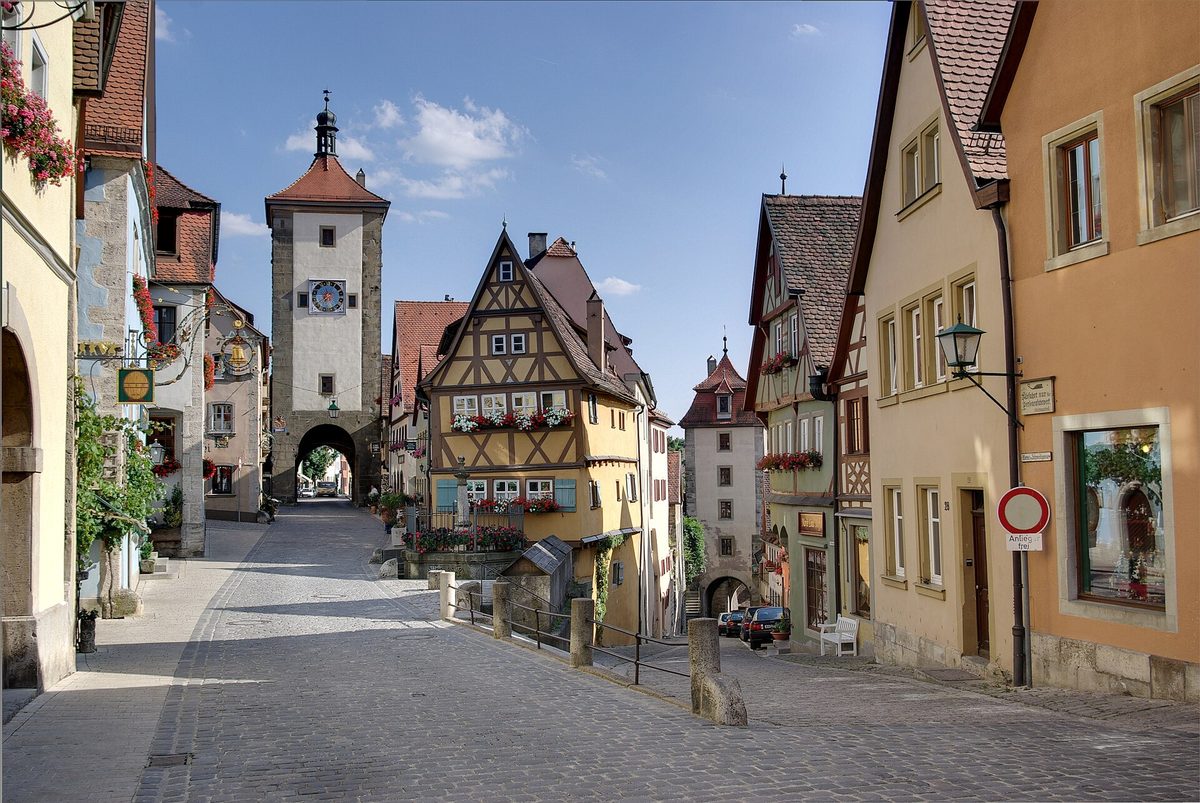
The Romantische Straße is a 350-kilometre signed route from Würzburg down to Füssen (conveniently ending at Neuschwanstein’s doorstep), invented by tourism officials in 1950 and redeemed by the fact that the towns along it are genuinely spectacular. The undisputed star is Rothenburg ob der Tauber, a complete walled medieval town where you can walk the ramparts at dawn before the day-trippers arrive and have the cobbles to yourself.
My strong advice: sleep in Rothenburg. The town between 5 p.m. and 10 a.m. is a different, better place, and the Night Watchman’s tour at 8 p.m. — equal parts history lecture and stand-up set — is the best €10 or so I’ve spent in Germany. Drive or train onward to Dinkelsbühl (Rothenburg’s quieter, arguably prettier sibling) and Nördlingen, a walled town built inside a meteorite crater.
Just off-route, two bonus towns: Bamberg, a UNESCO old town built across seven hills with nine breweries (try the smoked Rauchbier at Schlenkerla — tastes like liquid campfire, in a good way), and Nürnberg (Nuremberg), with its Imperial Castle, its sobering Nazi Rally Grounds Documentation Center, and finger-sized bratwurst served three-in-a-bun. The full route, town by town, with driving and public-transport logistics, is in my Romantic Road guide.
The Rhine and Moselle: Castles and Riesling
The Rhine Gorge
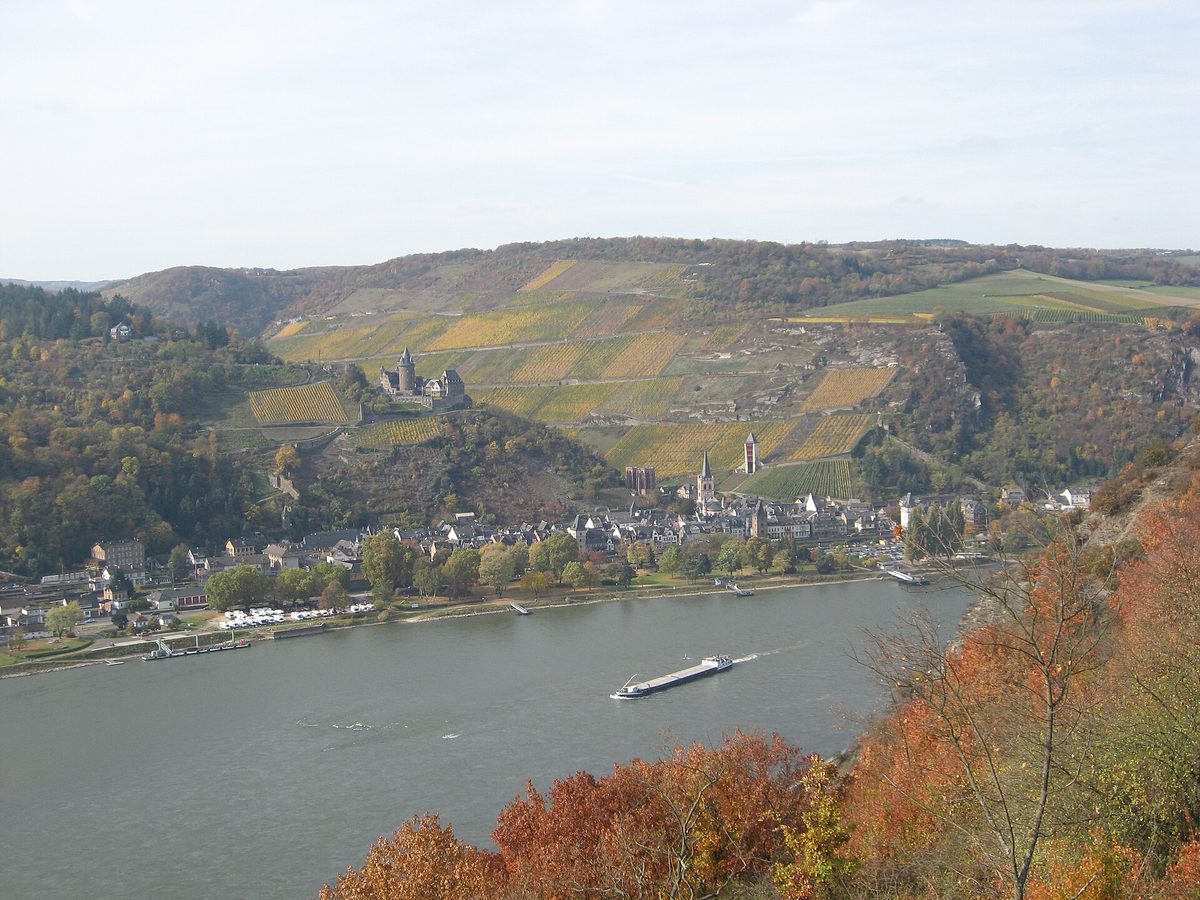
Between Bingen and Koblenz, the Rhine squeezes through a 65-kilometre gorge studded with roughly 40 castles — a density unmatched anywhere on earth. This is the UNESCO-listed Upper Middle Rhine Valley, and the way to do it is slowly: base in Bacharach or St. Goar, ride the KD boats between villages (rail passes often score discounts), climb to a castle or two — Marksburg is the only one never destroyed; Rheinfels is the most atmospheric ruin — and drink Riesling grown on slopes so steep the harvest is done by winch.
The Loreley rock, where legend says a singing maiden lured sailors to their deaths, is more impressive as a story than a stop; the view from the rock, though, is superb. One full day covers the highlights; two lets you actually exhale.
The Moselle
One valley west, the Moselle does the same act — castles, vineyards, half-timbered wine villages — at half the volume and twice the charm. Cochem with its hilltop Reichsburg, Bernkastel-Kues with its lopsided fairy-tale square, the Calmont (Europe’s steepest vineyard), and Burg Eltz, the most beautiful castle in Germany that no king ever conquered, hidden in a forested side valley and still owned by the same family after 850 years. If you have to choose between the rivers and you’ve already seen big-name sights elsewhere, choose the Moselle.
Cologne
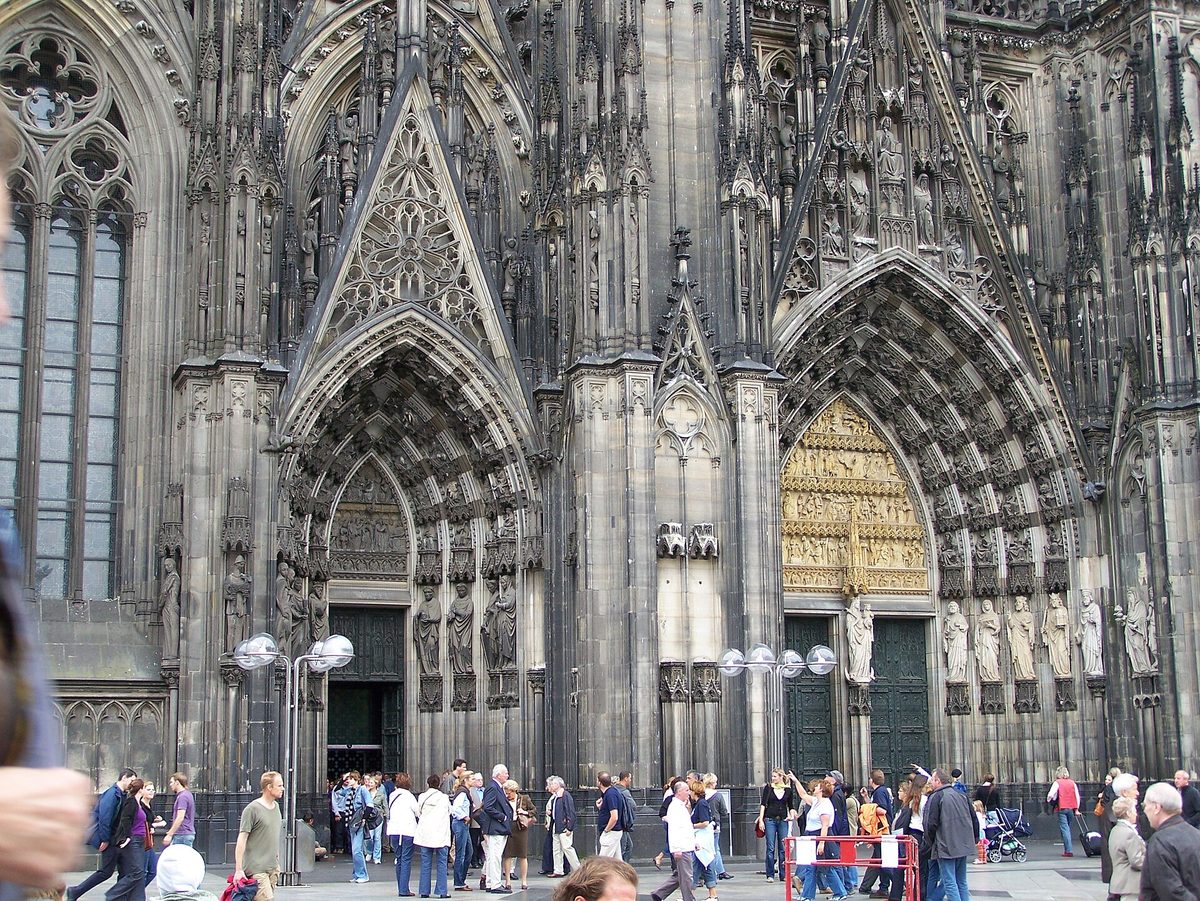
Cologne’s cathedral took 632 years to build and remains the largest Gothic church in northern Europe; stepping out of the train station directly beneath its black twin spires is one of Germany’s great arrival moments. Entry to the nave is free (the 533-step tower climb costs a few euros), and the shrine inside claims the relics of the Three Wise Men — the reason the city mattered for a thousand years.
The city around the Dom is friendly, unpretentious and built on Kölsch: pale beer served in skinny 0.2-litre glasses that the waiters (Köbes) keep replacing until you put a beermat on top. Each glass is about €2.20, the tally is pencilled on your coaster, and arguing with a Köbes is a local sport you will lose. Come in February and you’ll hit Karneval, when the entire city dresses up and drinks for six days straight.
The Black Forest: Spa Towns, Cake and Big Trees

The Schwarzwald, in Germany’s sunny southwest corner, is where the country goes to slow down. The hills are darker and rounder than the Alps, laced with some of the best-marked hiking trails in Europe, and dotted with farmhouses whose roofs sweep nearly to the ground. This is the home of the cuckoo clock, of Black Forest gateau (have a slice at Café Schäfer in Triberg, which guards the original 1915 recipe), and of Triberg’s waterfalls — Germany’s highest, tumbling 163 metres through the firs.
Freiburg, the regional capital, is Germany’s sunniest and arguably most charming small city: a Gothic minster with the finest spire in Christendom (Carl Jung’s phrase, not mine), streets threaded with tiny water channels called Bächle (legend says if you step in one, you’ll marry a local), and easy cable-car access to 1,284-metre Schauinsland. Baden-Baden, at the forest’s northern end, is the grande dame — Roman baths, a chandeliered casino Marlene Dietrich called the most beautiful in the world, and the 17-step Friedrichsbad bathing ritual (clothing not an option) that resets your nervous system for about €45. Lake Schluchsee and Titisee provide the swimming. Trails, towns, clocks and cake are all mapped out in my Black Forest travel guide.
Hamburg and the North: Salt Air and Brick Gothic

Hamburg gets criminally skipped by first-time visitors, and Hamburgers seem fine with that. Germany’s second city and biggest port is handsome in a way that sneaks up on you: the UNESCO-listed Speicherstadt warehouse district glowing red-brick over its canals at dusk, the Elbphilharmonie concert hall rising like a glass wave above the harbour (the plaza viewing level is free — book the time slot online), and more bridges than Venice and Amsterdam combined. It’s true; around 2,500 of them.
Do the harbour ferry ride on regular public-transport line 62 instead of a tourist cruise, visit Miniatur Wunderland (the world’s largest model railway, and genuinely one of Germany’s best attractions — book ahead, always), and if you’re up at 5 a.m. on a Sunday, the Altona Fischmarkt is where the night crowd and the morning crowd trade herring sandwiches. An hour northeast, Lübeck — capital of the medieval Hanseatic League — is all stepped gables, marzipan and brick Gothic churches, and makes a perfect half-day trip.
Things to Do in Germany: The Experiences That Define It
Beyond the city-by-city sights, these are the things to do in Germany that I’d actually plan a trip around:
Drink beer the German way
Germany’s roughly 1,500 breweries operate under a purity law dating to 1516, and the result is not variety for its own sake but perfection of a handful of styles. Drink Helles in Munich, Weissbier in Bamberg… actually, drink Rauchbier in Bamberg. Kölsch in Cologne, Altbier in Düsseldorf (mention one in the other city and watch faces fall), and pilsner everywhere. Beer gardens are family spaces — kids, dogs, grandmothers — and that civilised normality is the actual attraction.
Go to Oktoberfest — with a strategy
The world’s biggest festival runs 16 days; in 2026 that’s September 19 to October 4 on Munich’s Theresienwiese. It’s free to enter, the 17 big tents are free to walk into (reservations only lock tables), and a Maß of festival beer costs €14.80–15.90 this year. Go on a weekday morning, start in the Augustiner Festhalle (the locals’ pick, and the cheapest pour at €14.90), and eat a half roast chicken before your second litre, not after. Lederhosen optional but, honestly, fun. My complete Oktoberfest guide covers tents, reservations, costs and survival tactics.
Tour the castles beyond Neuschwanstein
Germany has somewhere north of 20,000 castles. The supporting cast deserves billing: Burg Eltz (the fairy-tale one), Hohenzollern (the dramatic hilltop silhouette south of Stuttgart), Wartburg (where Luther translated the New Testament while hiding under a fake name), Heidelberg’s romantic ruin above the Neckar, and Marksburg on the Rhine. You could build a two-week trip on castles alone and never repeat a style.
Walk or cycle seriously
Germans treat walking as a national pastime, and the infrastructure shows it: 200,000 km of marked hiking trails, trail-side inns that expect muddy boots, and long-distance routes like the Westweg (Black Forest) and the Rheinsteig. Cyclists get dedicated riverside paths along the Elbe, Moselle, Danube and Rhine where you pedal between wine villages with your luggage forwarded ahead. Even in cities, renting a bike is usually the best way to cover ground.
See world-class art and history museums
Berlin’s Museum Island aside, make time for Munich’s Deutsches Museum (the world’s largest science and tech museum — the mining exhibit alone swallows an hour), the Alte and Neue Pinakothek galleries, Dresden’s Old Masters, and the smaller, harder-hitting history sites: the Topography of Terror in Berlin, Dachau outside Munich, the Stasi Museum in Leipzig. Germany’s unflinching public reckoning with its own past is, itself, one of the most powerful things you’ll witness here. Note that most museums close Mondays.
Do a Christmas market crawl
Germany invented the Christmas market, and from late November to December 23 or 24 the country runs on Glühwein and gingerbread. Nürnberg’s Christkindlesmarkt is the most famous, Dresden’s Striezelmarkt the oldest, Cologne’s cathedral market the most photogenic. Mugs carry a €2–3 deposit (the Pfand — keep the mug as your souvenir), and the whole experience is gloriously analogue. I rank the German markets against the rest of the continent in my guide to the best Christmas markets in Europe.
When to Visit Germany
I’ve done Germany in every season, and my honest ranking is: late spring first, early autumn a close second, December for the markets, high summer fourth, and the grey stretch from January to March only for ski trips and museum marathons.
May to June is the sweet spot — beer gardens open, asparagus season (more on that below), long days, and prices still short of peak. September to early October brings Oktoberfest, wine festivals along the Rhine and Moselle, and golden hiking weather; shoulder-season hotel rates run 30–40% below July–August. December is its own season: cold, dark by 4:30 p.m., and utterly magical in market season. July and August are perfectly pleasant (24–28°C typically) but crowded at the headline sights, and worth booking well ahead.
If your priority is winter sun, Germany isn’t your country — that’s what Spain, Portugal and Greece are for. I break down the German seasons month by month in my best time to visit Germany guide, and you can see how the country fits into the continent’s weather picture in my best time to visit Europe overview.
How Long Do You Need? Sample Germany Itineraries
You need a minimum of five days to feel like you’ve seen Germany rather than an airport. Here’s how I’d slice different trip lengths:
5 days — one region, done well. Either Berlin plus a Dresden or Potsdam day trip, or Munich plus Neuschwanstein and Salzburg. Resist the urge to do Berlin and Munich in five days; you’d spend a full day of it on trains.
7–10 days — the classic first-timer route. Three nights Berlin → train to Nürnberg or Bamberg (one night) → Rothenburg (one night, sleep there) → Munich three nights with a castle day. That’s the route I recommend most often, and it’s the spine of my detailed 10-day Germany itinerary.
Two weeks — add texture. Extend the classic route with the Rhine or Moselle (two nights), the Black Forest (two nights), or Hamburg and Lübeck (two nights). Fourteen days covers north, south and one river valley without rushing.
Germany in a bigger Europe trip: the country borders nine others and sits on Europe’s main rail spines, so it slots naturally into longer routes — Amsterdam–Berlin–Prague, or Munich–Salzburg–Vienna, or Frankfurt down through Switzerland into Italy. If you’re stitching countries together, start with my Europe itinerary guide and the wider planning walkthrough in how to plan a trip to Europe.
Getting Around Germany

Trains: the default answer
Germany’s rail network is the densest in Europe, and despite what Germans themselves will tell you (complaining about Deutsche Bahn is the true national sport), it’s still the best way to cover the country. White ICE trains link the big cities at up to 300 km/h — Berlin to Munich in under four hours, Frankfurt to Cologne in just over one — while a lattice of regional trains reaches every small town you’d plausibly want.
The pricing system rewards planning. Flexible same-day ICE fares are painful (€100+ on main routes), but Sparpreis advance fares start around €18–20 if you book a few weeks out, and booking even three days ahead typically saves €60+ on long routes. Seat reservations are optional and around €5.50 — worth it on Friday and Sunday afternoons, when trains genuinely fill. Buy through the DB Navigator app, which also handles delays and rebooking; my deeper dive into passes, night trains and route strategy is in the train travel in Europe guide.
The Deutschland-Ticket: Germany’s best travel deal
For €63 a month (the January 2026 price), the Deutschland-Ticket gives unlimited travel on ALL regional trains, S-Bahns, U-Bahns, trams and buses nationwide. Not the fast ICE/IC trains — everything else. For slow-travel itineraries it’s absurd value: I’ve done Munich–Füssen–Garmisch–Salzburg border country on it, and the entire Romantic Road is reachable on regional trains and buses.
Two catches for visitors: it’s sold as a subscription (cancel before the 10th of the month or you’ll be charged for the next one), and it’s valid per calendar month, not per 30 days — buy it on the 20th and it still expires on the 31st. Get it through the DB Navigator app or a regional operator’s app, cancel immediately after purchase if you only need one month, and it remains valid through month’s end.
Driving and the autobahn
You don’t need a car for the cities — parking is scarce and expensive, and Berlin, Munich, Hamburg, Cologne and Frankfurt all have excellent transit. You DO want one for the Moselle, the deep Black Forest, and Alpine back roads. Rentals are plentiful (book a manual-transmission rate or pay noticeably more for automatic), fuel runs around €1.75–1.90/litre, and yes, roughly 70% of the autobahn has no fixed speed limit — just an advisory 130 km/h. The discipline is real: stay right except to pass, check your mirrors twice, and let the Porsches go. Watch for Umweltzone stickers required in many city centres; rental cars come with them.
City transport and taxis
City transit runs on trust: buy a ticket, validate it, and ride — there are no turnstiles, just plainclothes inspectors and a €60 fine for freeloading. Single rides run €3–4, day passes €8–10, and the Deutschland-Ticket covers all of it. Uber exists in big cities but is just regular taxis at regular taxi prices; short hops cost €12–18.
What Germany Costs in 2026
Germany lands mid-pack in Western Europe: pricier than Spain or Portugal, kinder than Switzerland, Scandinavia or big-city France and the UK. Here’s what I’d budget per person per day:
| Style | Per day | What that looks like |
|---|---|---|
| Backpacker | €65–90 | Hostel dorm (€25–40), supermarket breakfast, döner and Imbiss meals, Deutschland-Ticket transit, free sights |
| Midrange | €120–180 | 3-star or apartment (€90–140 double), one sit-down meal plus one casual, museums, advance-fare trains |
| Comfortable | €220–320 | 4-star (€160–240), restaurant dinners with wine, first-class rail, guided tours |
Sample prices I noted in spring 2026: espresso €2.50–3.50, bakery breakfast €4–6, döner kebab €7–8.50, hearty tavern main €14–19, half-litre of beer €4.20–5.50 (in a pub; €1 in a supermarket), Museum Island day ticket €24, mid-city hotel double in Berlin €95–130. Lunch is the structural money-saver: the Mittagstisch (weekday lunch special) gets you the same kitchen as dinner for half the price. Eastern cities — Leipzig, Dresden, Erfurt — run 20–30% cheaper than Munich across the board. For the continent-wide cost playbook, see Europe on a budget.
One cultural note on money: tipping is modest. Round up or add 5–10% at table service, tell the server the total as you pay (“Machen Sie 30” — make it 30), and never leave coins on the table after tap-to-pay; hand it over or say the number.
German Food and Drink: Better Than Its Reputation

German food suffers from a branding problem — outsiders picture one brown plate of meat and potatoes. The reality is regional, seasonal and quietly excellent. Every region guards its own specialities: finger-thin grilled bratwurst in Nürnberg (protected by EU law, like champagne), Weisswurst in Munich (eaten before noon, peeled, with sweet mustard — never with the skin, unless you enjoy concerned Bavarian stares), Maultaschen (giant ravioli allegedly invented by monks to hide meat from God during Lent) in Swabia, Labskaus and herring up north, and döner kebab in Berlin — invented there by Turkish immigrants in the 1970s and now arguably the national dish, with around 1,600 kebab shops in the capital alone.
Things worth scheduling around: Spargelzeit, the white-asparagus mania that grips the country from mid-April to June 24 (entire restaurant menus convert; join in), the autumn Federweisser season when cloudy, half-fermented young wine is drunk with onion tart in the wine regions, and Germany’s 3,000-plus registered bread varieties — the bakery culture is UNESCO-listed intangible heritage, and an Alpine sourdough Brez’n with butter is a complete breakfast.
On drink: German wine is criminally underrated abroad. Dry Mosel and Rheingau Rieslings are world-class (look for “trocken” on the label), Baden makes serious Pinot Noir (Spätburgunder), and wine taverns — Straußwirtschaften — open seasonally in growers’ own courtyards. Coffee and cake at 3 p.m. (Kaffee und Kuchen) is a national institution your itinerary should respect.
Entry Requirements and Practical Essentials (June 2026)
Germany is in the Schengen area, so Americans, Canadians, Australians, Brits and most other non-EU visitors get 90 visa-free days in any 180-day window across the whole zone. Since April 2026, the EU’s biometric Entry/Exit System (EES) photographs and fingerprints you at your first Schengen entry — allow a few extra minutes at the border. ETIAS, the €20 pre-travel authorisation, is expected to switch on in late 2026 with a grace period, so check the official EU site close to your trip. Full, current details live in my Schengen visa and ETIAS guide.
The basics: currency is the euro; plugs are the two-round-pin European type (US visitors need an adapter, UK visitors too); tap water is safe everywhere (ask for “Leitungswasser” in restaurants — ordering “water” gets you bottled, usually sparkling); pharmacies (Apotheke) handle minor ailments expertly; and the emergency number is 112. Germany is among Europe’s safest countries — exercise normal city sense around train stations late at night and you’ll be fine.
Germany Travel Tips: The Quirks Nobody Warns You About
These are the cultural mechanics that make or break first trips. Learn them and Germany runs like its own trains were supposed to:
Carry cash. Card acceptance has improved massively, but plenty of bakeries, beer gardens, market stalls and small restaurants remain “Nur Bargeld” (cash only) even in 2026. Keep €50–100 on you; girocard-only terminals sometimes reject foreign credit cards too.
Sunday is sacred. Virtually all shops — including supermarkets — close on Sundays and public holidays. Stock up Saturday. Restaurants, museums, bakeries (mornings) and train-station shops stay open. Plan Sunday as your hike/museum/beer-garden day and you’ve gone native.
Don’t jaywalk. Standing at an empty crossing at 2 a.m. waiting for the green Ampelmännchen feels absurd. Do it anyway: it’s a fineable offence, and parents will pointedly thank you for not modelling bad behaviour to their children.
The Pfand system. Most bottles and cans carry a 8–25 cent deposit refunded at supermarket reverse-vending machines. Christmas market mugs and beer-garden glasses carry €2–3. Leaving bottles beside (not in) public bins is a quiet act of charity for collectors.
Quiet hours are real. Ruhezeit — typically 10 p.m. to 6 or 7 a.m. and all day Sunday — governs noise in residential buildings. No washing machines, no hallway phone calls, no enthusiastic furniture relocation.
Punctuality is respect. For tours, restaurant bookings and meeting locals, on time means five minutes early. (Deutsche Bahn is exempt from this rule, a fact Germans find genuinely painful.)
Greet and bag-pack fast at supermarkets. Say hallo to the cashier, then pack at Formula 1 speed or hold the line. There is no bagger; bring a tote.
English works, German opens doors. In cities and tourist regions you’ll manage entirely in English. In the rural east and deep Bavaria, less so. Five words — hallo, danke, bitte, entschuldigung, tschüss — change how you’re received everywhere.
Germany by Traveler Type
First-timers should run the Berlin–Rothenburg–Munich spine with a castle day — it hits history, medieval Germany and the Alps in one arc. Families are spoiled: Miniatur Wunderland, the Deutsches Museum, castle interiors, beer gardens with playgrounds (truly), free museum entry for under-18s in Berlin, and a rail system where kids under 15 travel free with a parent. Couples should look at the Moselle in October, Baden-Baden’s baths, and small-town Christmas markets in early December — book the schnitzel… I mean, the spa, ahead. Budget travelers get Europe’s best value big-city culture in the east — Leipzig and Dresden over Munich, the €63 Deutschland-Ticket, Mittagstisch lunches and free Wall history in Berlin; pair with my budget Europe playbook. Beer and food pilgrims should build the trip around Bamberg, Cologne, Munich’s beer halls and an autumn wine festival on the Rhine — and time it to Oktoberfest only if crowds energise rather than exhaust them.
Germany Travel Guide FAQ
Is Germany worth visiting?
Absolutely. Germany packs 54 UNESCO sites, 20,000+ castles, Europe’s best rail network and its definitive beer culture into one country — with fewer crowds and lower prices than Italy or France. The mix of big-city culture (Berlin, Hamburg) and storybook scenery (Bavaria, the Rhine, the Black Forest) suits almost every kind of traveler.
How many days do you need in Germany?
Five days minimum for one region done properly; 7–10 days for the classic Berlin–Rothenburg–Munich first-timer route; two weeks to add the Rhine or Moselle, the Black Forest or Hamburg. Distances are real — Berlin to Munich is nearly four hours by ICE — so build around two or three bases rather than a new hotel nightly.
Is Germany expensive to visit?
Midrange travelers should budget €120–180 per person per day including accommodation. That’s cheaper than France, the UK, Switzerland or Scandinavia, pricier than Spain or Portugal. The big levers: advance ICE fares, the €63 Deutschland-Ticket, weekday lunch specials, and basing in eastern cities like Leipzig or Dresden, which run 20–30% cheaper than Munich.
What is the best month to visit Germany?
May and June, with September a close second. Late spring gets beer gardens, asparagus season and long days; September gets Oktoberfest, wine festivals and golden hiking light, with shoulder-season hotel prices. December is the wildcard — cold and dark but transformed by Christmas markets. January to March is the quietest, cheapest and greyest stretch.
Do people speak English in Germany?
In cities, tourist towns and with anyone under 50, yes — often excellent English. In rural eastern Germany, deep Bavaria and with older generations, noticeably less. You don’t need German to travel here, but a handful of courtesy words (danke, bitte, entschuldigung) reliably warms the temperature of every interaction.
Is cash or card better in Germany?
Carry both. Cards now work in most hotels, chains and city restaurants, but a stubborn minority of bakeries, beer gardens, market stalls and small guesthouses remain cash-only, and some terminals accept only German girocards. Keep €50–100 in cash and you’ll never be the person holding up the bratwurst queue.
Should I visit Berlin or Munich first?
If you want history, nightlife and edge, start with Berlin. If you want beauty, beer halls and Alps-and-castles Germany, start with Munich — it’s also the better base for Neuschwanstein, Salzburg and the mountains. With a week or more, do both: the four-hour ICE ride between them passes through Bamberg and Nürnberg, which make perfect stopovers.
Is Germany safe for tourists?
Yes — Germany consistently ranks among the world’s safer countries, and violent crime against visitors is rare. Use standard precautions around major train stations late at night and watch for pickpockets at Oktoberfest, Christmas markets and on busy U-Bahn lines. Solo and female travelers generally report feeling very comfortable, including after dark in most neighbourhoods.
Final Thoughts: My Honest Take on Germany
Germany was the country that taught me the difference between visiting Europe and traveling it. It doesn’t perform for you the way Paris or Venice does. It assumes you’re a capable adult, hands you the timetable and the beer garden bench, and lets you discover — at your own pace — that beneath the efficiency is one of the warmest, oddest, most rewarding countries on the continent.
Start with the classics: you genuinely cannot overrate standing on the Marienbrücke at golden hour or walking Rothenburg’s walls at dawn. But leave room in the plan for the Germany that doesn’t make brochures — a Moselle wine tavern where the grower refills your glass without asking, a Sunday hike that ends in cake, the 11 p.m. döner in Kreuzberg. That’s the country I keep coming back to, and this guide — along with the deeper regional guides linked throughout, starting with where to go in Germany — should be everything you need to plan it. Gute Reise.
Sources and further reading: the official German National Tourist Board (germany.travel), Deutsche Bahn (bahn.de) for fares and the Deutschland-Ticket, the official Oktoberfest site (oktoberfest.de) for 2026 dates and beer prices, the Bavarian Palace Administration (neuschwanstein.de) for castle tickets, the Berlin State Museums (smb.museum) for Museum Island pricing, and the EU’s official ETIAS pages for entry rules. Prices checked June 2026 — always confirm current rates before you book.
Photo Credits
- Neuschwanstein Castle — Photo: Wilfredor (CC0) via Wikimedia Commons
- Brandenburg Gate, Berlin — Photo: Norbert Nagel / CC BY-SA 3.0 via Wikimedia Commons
- Plönlein, Rothenburg ob der Tauber — Photo: Berthold Werner (CC0) via Wikimedia Commons
- Bacharach and the Rhine Valley — Photo: Prankster (CC0) via Wikimedia Commons
- Frauenkirche, Dresden — Photo: Ronny Kreutel – Kausalkette (CC0) via Wikimedia Commons
- Munich beer garden — Photo: Flo Sorg (CC0) via Wikimedia Commons
- Speicherstadt, Hamburg — Photo: Dietmar Rabich / CC BY-SA 4.0 via Wikimedia Commons
- ICE high-speed train — Photo: Joachim Seyferth / CC BY 4.0 via Wikimedia Commons
- Bratwurst with mustard — Photo: Benreis / CC BY-SA 4.0 via Wikimedia Commons
- Neues Rathaus, Munich — Photo: LBM1948 / CC BY-SA 4.0 via Wikimedia Commons
- Cologne Cathedral — Photo: T.Voekler / CC BY-SA 3.0 via Wikimedia Commons
- Schluchsee, Black Forest — Photo: Alexander Migl / CC BY-SA 4.0 via Wikimedia Commons
1 comment