High-Speed Trains in Europe
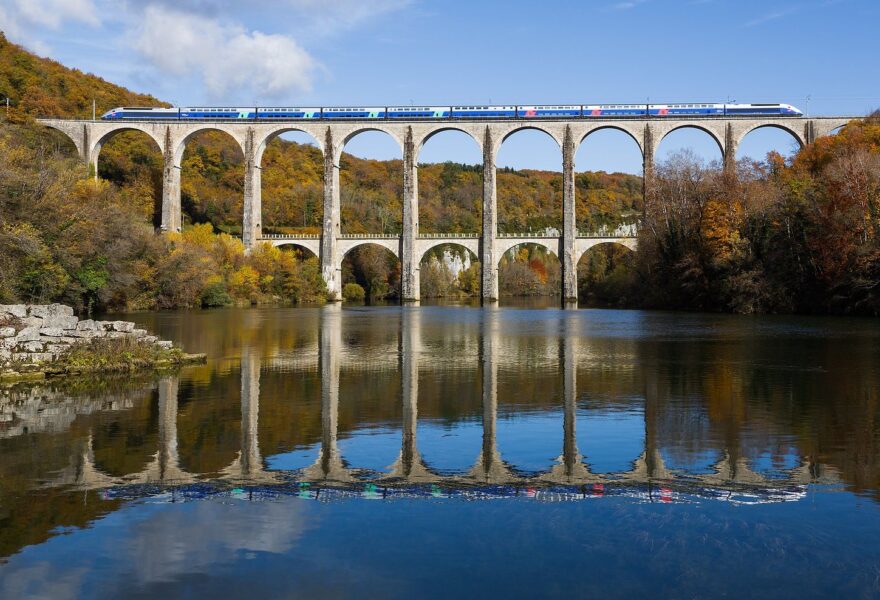
The high speed trains Europe runs link most big cities from London and Berlin down to Naples and Seville: Eurostar under the Channel, TGV and OUIGO in France, ICE in Germany, Frecciarossa and Italo in Italy, and AVE, iryo and OUIGO in Spain. Under about four hours, they usually beat flying door to door.
They’re the fast spine of train travel in Europe, and this guide is for anyone stringing cities together who wants to know which train runs where, what it costs and when to book it. One caveat before the numbers: fares move like airline fares, so every price below is a floor, not a promise. Checked against official sources in September 2026.
| At a glance | |
|---|---|
| Cost | From €9 on OUIGO in Spain, €10 in France and £39 on Eurostar’s London–Paris if you book early; walk-up fares on busy routes pass €150 |
| Time needed | 1–4 hours between neighbouring big cities: London–Paris 2h16 and Milan–Rome 2h50 at best; Madrid–Barcelona about 2h30 to just over 3h, depending on the train |
| Top speed | 300 km/h or more on the main high-speed lines in France, Spain, Italy and Germany; 230 km/h on Austria’s Railjets |
| Best for | City pairs roughly 300–700 km apart, where the train beats the trek out to the airport |
| Book ahead | As early as your dates allow: Eurostar sells 10–11 months ahead, and other operators’ windows vary by route |
| Rail passes | Valid on most, with reservations from €3 to €45 depending on the train, route and class; not valid on Italo, Avlo or OUIGO España |
What counts as a high-speed train in Europe?
There’s a formal answer and a useful one. The formal answer comes from EU rail law, which counts both purpose-built new lines and upgraded older ones, with a lower speed threshold for the upgrades. The useful answer sorts the trains you’ll ride into three tiers.
- True high-speed. Trains running at 300–320 km/h on dedicated lines: TGV and OUIGO, Eurostar, ICE, Frecciarossa, Italo, AVE and iryo.
- Fast conventional. Trains at 200–230 km/h, often tilting or pulled by a locomotive, sharing their tracks with freight and local services: Austria’s Railjets, Sweden’s SJ high-speed trains (the old X2000), Portugal’s Alfa Pendular and Poland’s Pendolinos.
- Everything else. Conventional intercity trains, which serve the many routes that have no dedicated high-speed line.
The gap shows up in your timetable. Eurostar advertises London–Paris in 2h16. On a busy mixed-traffic line, the same distance takes much longer.
Italy opened the first stretch of its Rome–Florence Direttissima in 1977, and the TGV began running Paris–Lyon in 1981. Germany’s ICE followed in 1991, Spain’s AVE opened Madrid–Seville in 1992 and Eurostar started crossing the Channel in 1994. A test TGV set the wheeled-train speed record of 574.8 km/h in 2007, on the line east of Paris. With passengers on board, nothing in Europe runs faster than 320 km/h.
You’ll see Italo’s AGV credited with 360 km/h in speed rankings. It was designed for that, like Trenitalia’s Frecciarossa 1000, but Italian lines cap both at 300 km/h. Here are the main trains, who runs them and how fast they go in service:
| Train | Operator | Main routes | Top speed in service |
|---|---|---|---|
| TGV INOUI | SNCF | Paris to Lyon, Marseille, Bordeaux, Strasbourg and Lille; Paris–Barcelona and Paris–Milan | 320 km/h |
| OUIGO | SNCF’s low-cost brand | Paris to Lyon, Marseille, Bordeaux, Toulouse and Strasbourg | 320 km/h |
| Eurostar | Eurostar | London to Paris, Lille, Brussels, Rotterdam and Amsterdam; Paris–Brussels–Amsterdam and Cologne | 300 km/h |
| ICE | Deutsche Bahn | Berlin–Munich, Cologne–Frankfurt, Hamburg–Frankfurt; to Amsterdam, Brussels and Paris | 300 km/h (320 on French lines) |
| Frecciarossa | Trenitalia | Turin–Milan–Rome–Naples and Venice; Paris–Lyon–Milan and Paris–Marseille | 300 km/h |
| Italo | Italo (NTV) | Turin and Milan to Rome and Naples; Venice–Rome | 300 km/h |
| AVE | Renfe | Madrid to Barcelona, Seville, Málaga and Valencia; Barcelona–Seville | 300 km/h |
| iryo | iryo (part-owned by Trenitalia) | Madrid to Barcelona, Valencia, Seville and Málaga | 300 km/h |
| OUIGO España | SNCF’s Spanish arm | Madrid to Barcelona, Valencia, Seville and Málaga | 300 km/h |
| Railjet | ÖBB, with Czech Railways | Vienna to Salzburg, Munich, Zurich, Budapest, Prague and Graz; Munich–Verona–Venice | 230 km/h |
| SJ high-speed (X2000) | SJ | Stockholm–Gothenburg and Stockholm–Malmö | 200 km/h |
| Alfa Pendular | CP | Braga and Porto to Lisbon and Faro | 220 km/h |
The high speed trains Europe runs, country by country
Every network has its own habits: how far ahead fares open, whether a seat reservation is compulsory, which station you’ll leave from. The tables give the fastest scheduled times and the lowest fares seen in August and September 2026.
France: TGV INOUI, OUIGO and an Italian rival
Almost every French high-speed route starts at a Paris terminus, and trains between the regions skirt the capital via Marne-la-Vallée and Charles de Gaulle airport. The top speed is the highest in Europe: 320 km/h on the newer lines to Strasbourg and Bordeaux.
SNCF sells two products on the same tracks. TGV INOUI is the full-service train, with a bar coach, first class and exchangeable fares. OUIGO runs double-deck TGVs at low-cost prices, from €10 for the earliest bookers, and charges for luggage beyond a small allowance. Those prices have crept up, though: the average OUIGO ticket in 2026 costs about €35, three-quarters more than seven years earlier, and the top fare now reaches €119.
Trenitalia’s Frecciarossa is the third name on the departure boards. Since June 2025 it has run Paris–Marseille four times a day each way, stopping at Lyon Saint-Exupéry, Avignon TGV and Aix-en-Provence TGV, alongside its Paris–Lyon–Milan trains.
| Route | Fastest | Worth knowing |
|---|---|---|
| Paris–Lyon | about 2h | frequent SNCF trains, plus Trenitalia’s |
| Paris–Marseille | 3h04 | OUIGO from €16; Frecciarossa four times a day |
| Paris–Bordeaux | 2h04 | advance fares from about €13–€20 |
| Paris–Strasbourg | about 1h45 | TGV INOUI and OUIGO on the 320 km/h LGV Est |
| Paris–Lille | just over 1h | frequent trains through the day |
| Paris–Toulouse | about 4h30 | high-speed only as far as Bordeaux |
| Paris–Nice | about 6h | high-speed to Marseille, then the classic line along the Riviera |
Verdict: OUIGO for price if you travel light and book early; TGV INOUI when you have bags, might change plans or are travelling on a Friday evening. On Paris–Lyon and Paris–Marseille, check Trenitalia’s fares as well.
Spain: AVE, iryo and OUIGO on Europe’s longest network
Spain has more high-speed track than any other European country, and since 2021 it has had real competition on it. Renfe’s AVE shares the busiest corridors with OUIGO España, SNCF’s Spanish arm, and iryo, a joint venture part-owned by Trenitalia that runs Frecciarossa 1000s. Renfe pulled its own no-frills brand, Avlo, off Madrid–Barcelona in September 2025, and those services now run as AVE. Avlo survives on routes from Madrid to Valencia, Alicante, Seville, Málaga, Murcia and Gijón, with fares from €7.
| Route | Fastest | Worth knowing |
|---|---|---|
| Madrid–Barcelona | 3h02 until December 2026, normally 2h30 | 621 km; around 34 direct trains a day on AVE, iryo and OUIGO; OUIGO from €9 booked ahead |
| Madrid–Seville | varies by train | compare Renfe, iryo and OUIGO for your date |
| Madrid–Málaga | 2h56 on average with OUIGO | via Córdoba |
| Madrid–Valencia | about 1h50 | iryo and OUIGO compete with Renfe |
| Barcelona–Seville | 5h18 | direct AVE, no change in Madrid |
| Córdoba–Seville | about 40–45 min | an easy day trip by train |
Madrid–Barcelona can take longer than its reputation suggests. The route is sold on about 2h30, but OUIGO’s direct trains are timetabled at 3h02 in November 2026, so check the times for your date on OUIGO’s or Renfe’s site before you plan a connection at the far end.
Bilbao is the big gap. It isn’t on the AVE network yet, so trains from Madrid are slower Alvia and Intercity services.
Two Spanish habits are worth knowing. Bags go through an X-ray scanner before you reach the platform, and a Renfe long-distance ticket includes a free Cercanías suburban-train ride to the station at the start of your journey.
On 18 January 2026 a derailment and collision near Adamuz, in Córdoba province, killed dozens of people and halted through trains between Madrid and Andalusia. The line through Adamuz reopened on 17 February, but direct Madrid–Málaga trains resumed only on 30 April, after a separate landslip at Álora.
Verdict: on Madrid–Barcelona and the Andalusia routes, compare all three operators before you book. OUIGO is usually cheapest if you can live with its luggage rules; AVE and iryo accept rail passes, OUIGO doesn’t.
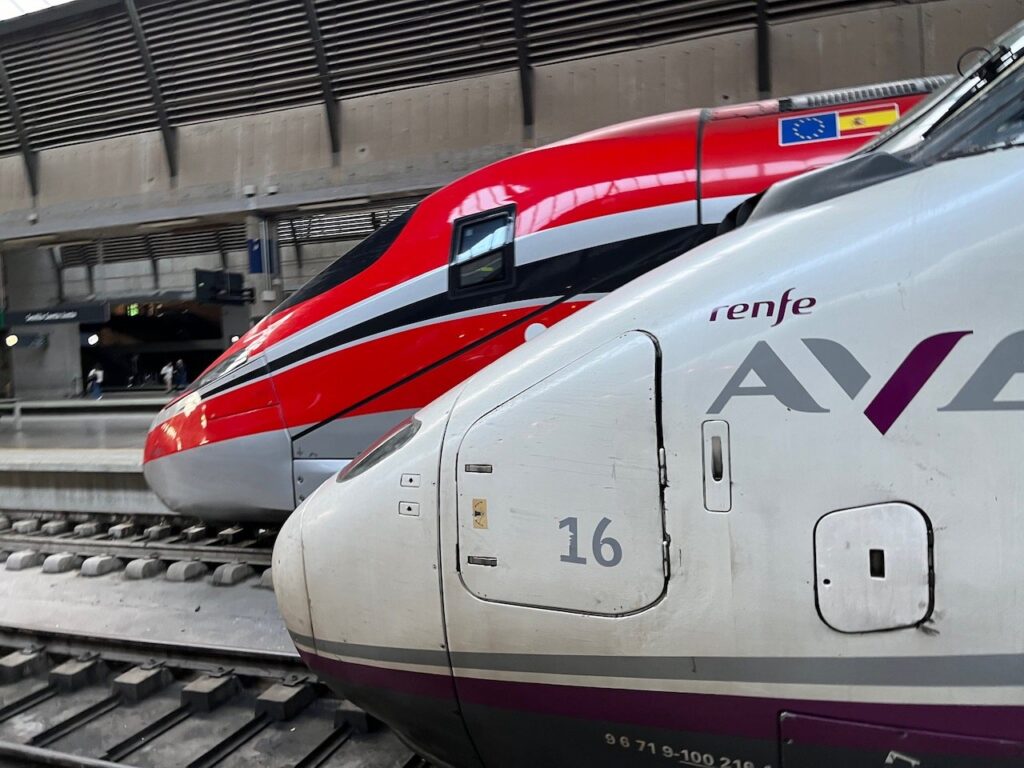
Italy: Frecciarossa against Italo
In Italy two companies go head to head on the same Turin–Milan–Bologna–Florence–Rome–Naples spine, often a few minutes apart, at up to 300 km/h on its dedicated high-speed sections. Trenitalia’s Frecciarossa reaches more places and is the one a rail pass covers. Italo is private, refuses passes, and its advance fares are often the lower of the two.
| Route | Fastest | Worth knowing |
|---|---|---|
| Milan–Rome | 2h50 non-stop on Frecciarossa, 2h52 on Italo | longer with Bologna and Florence stops; Italo from €29.90 |
| Rome–Florence | 1h25–1h30 | Italo from €14.90; Trenitalia from €19.90, and its flexible Base fare varies by train |
| Rome–Naples | about 55 min non-stop on Italo | Frecciarossa and Italo both run it |
| Milan–Florence | about 1h45 | Italo from €17.90 |
| Florence–Venice | about 2h | from €18.90 on Italo, €19.90 on Trenitalia |
| Rome–Venice | from 3h58 | via Florence and Bologna |
| Milan–Naples | about 4h10 | Italo from €34.90 |
Trenitalia’s cheapest Super Economy tickets can’t be changed or refunded, so buy them only once your dates are fixed. The same trains slot neatly into a 10-day Italy itinerary, where Rome is about 1h30 from Florence and Florence 2h15 from Venice.
Verdict: check both operators for every journey. With a pass, Frecciarossa costs you only the €13 reservation; without one, take whichever is cheaper for your train.
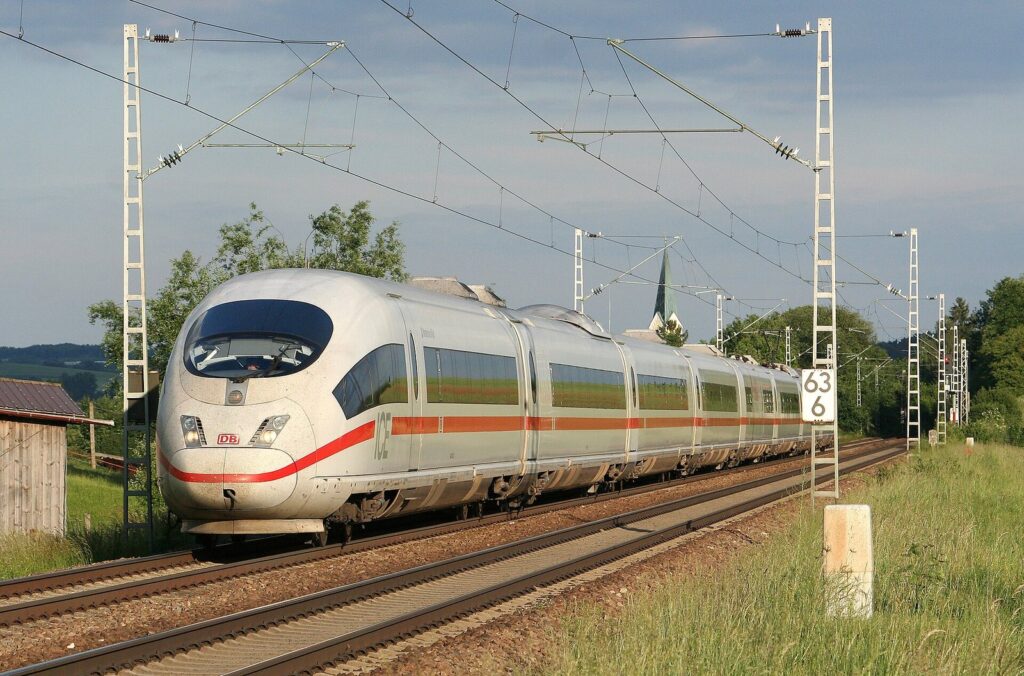
Germany: ICE on a network under repair
Germany’s network is dense rather than fast. Only some stretches are built for 300 km/h, chiefly Cologne–Frankfurt and the lines through Erfurt that carry Berlin–Munich trains. On that flagship run, journey times vary from train to train, so compare them in DB’s planner before you book.
Advance Sparpreis fares start at €21.99 in second class and €29.99 in first, subject to availability. Buy on the day and the flexible fare runs past €150. Seat reservations are optional on German long-distance trains, but I’d book one on Fridays, Sundays and around holidays, when anyone without one can end up standing in the vestibule. The Deutschland-Ticket covers regional trains only, not ICE or IC.
Punctuality is the weak point, and major rebuilding work on the busiest routes brings closures and diversions. Check DB’s international site for diversions before you book, and treat any German connection under an hour as a gamble.
Verdict: book Sparpreis early, reserve a seat anyway, and never plan a tight ICE connection before a Eurostar or a flight.
Eurostar and the Benelux
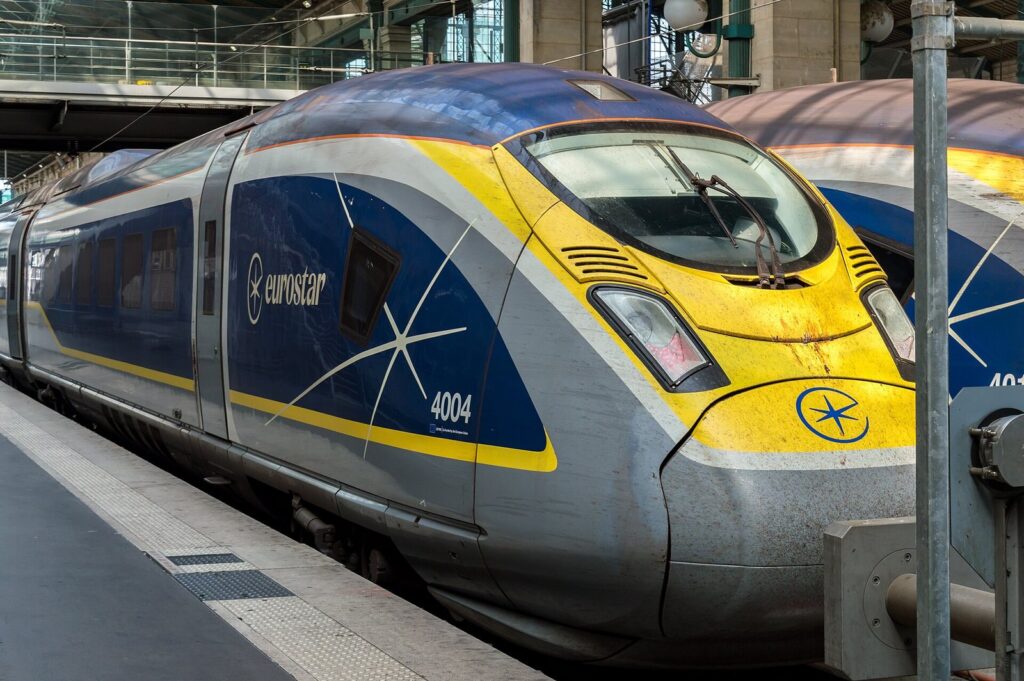
Since Thalys took the Eurostar name in 2023, Eurostar has meant two networks: the blue-and-yellow trains from London St Pancras to Paris, Lille, Brussels, Rotterdam and Amsterdam, and the red ex-Thalys trains linking Paris, Brussels, Amsterdam and Cologne. No other operator runs passenger trains from London to the continent, so there’s no cheaper rival to fall back on.
| Route | Fastest | Worth knowing |
|---|---|---|
| London–Paris | 2h16 | from £39 booked early; regularly over £150 close to departure |
| Paris–Brussels | 1h22 | OUIGO Train Classique also runs the route |
| Paris–Amsterdam | 3h20 | from €35; check the timetable for your date |
| Brussels–Amsterdam | 1h52 | NS and SNCB’s Eurocity Direct takes 2h08 to Amsterdam Zuid |
| Brussels–Cologne | 1h50 on Eurostar | Eurostar and DB’s ICE both run it |
Build in the check-in. Standard and Plus passengers must be through the gates 30 minutes before departure, and at St Pancras you go through passport and security checks before boarding, including the EU’s Entry/Exit System (EES) for those it applies to. The red continental trains have no check-in at all. Our Eurostar guide covers classes, luggage and stations in detail.
Verdict: book London trains as soon as your dates are fixed. Eurostar opens sales 10–11 months ahead, though engineering work can change when some dates open, and pass-holder reservations open up to six months ahead.
Austria and Switzerland: fast, frequent, below 300 km/h
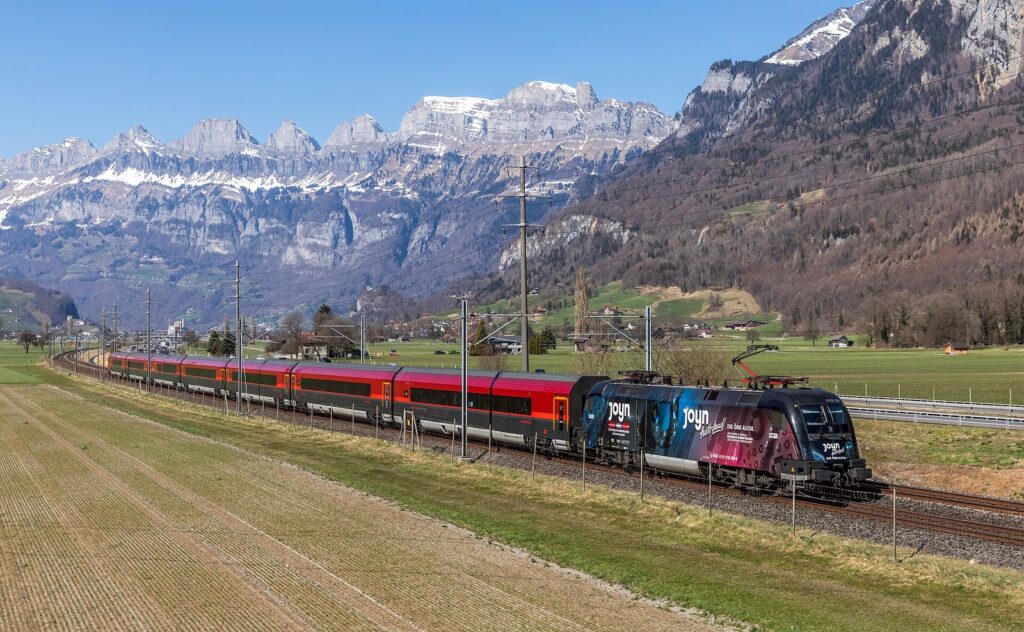
Neither country is built for 300 km/h, and neither needs to be. ÖBB’s Railjets run at up to 230 km/h. Vienna has two direct trains an hour to Salzburg, and Budapest is about 2h40 away; check ÖBB’s timetable for the times on your date. In December 2025 the new Koralmbahn cut Graz–Klagenfurt to 41 minutes through the world’s sixth-longest railway tunnel.
Direct Railjets link Munich and Venice in about seven hours over the Brenner Pass, scenic rather than fast. Switzerland’s showpiece is the Gotthard Base Tunnel, which brings Zurich–Milan down to 3h17 at best. For the slow mountain lines, see our pick of scenic train rides in Europe.
Verdict: don’t judge these trains by top speed. On Vienna–Budapest or Munich–Salzburg the Railjet is the obvious choice, and rail pass holders need only an optional €3 seat reservation inside Austria.
Beyond the core: Scandinavia, Portugal and the east
North and east of the main network, “high-speed” usually means a 200 km/h train sharing its tracks with everything else.
- Sweden. SJ’s high-speed trains, the old X2000, run on the main intercity routes out of Stockholm; pass holders pay a compulsory €6.50 in second class or €14.40 in first.
- Portugal. The Alfa Pendular links Lisbon and Porto for €35.70 in second class (Turística) at full fare, with promo fares from about €16 on sale up to 60 days ahead.
- Poland. PKP Intercity’s Pendolinos, sold as Express InterCity Premium, link Warsaw with Kraków, Katowice, Wrocław and Gdańsk.
- Czechia. Czech and Austrian Railjets and RegioJet trains connect Prague and Vienna, from €12.90 booked ahead.
- The Baltics. Rail Baltica, the planned line from Tallinn to the Lithuania–Poland border, won’t carry passengers before 2030.
- Britain. The only true high-speed line is HS1, Eurostar’s route from London to the Channel Tunnel; HS2 won’t open this decade.
Verdict: worth riding where they fit your route, but don’t build a trip around them. For long hops in these regions, a night train or a short flight often makes more sense.
Cross-border high-speed routes
The international links are where high-speed travel gets interesting, and where the timetables thin out. Several routes have only a handful of trains a day, so book these first.
| Route | Train | Fastest | Worth knowing |
|---|---|---|---|
| London–Paris | Eurostar | 2h16 | also to Lille, Brussels, Rotterdam and Amsterdam |
| Paris–Brussels | Eurostar | 1h22 | continues to Amsterdam (3h20 from Paris) or Cologne |
| Brussels–Cologne | Eurostar, ICE | 1h50 on Eurostar | the ICEs continue to Frankfurt |
| Paris–Berlin | ICE | roughly 8h | one direct train a day each way |
| Paris–Zurich | TGV Lyria | 4h04 | Lyria also serves Basel, Geneva and Lausanne |
| Paris–Milan | TGV INOUI, Frecciarossa | about 7h | via Lyon, Chambéry and Turin; reopened in spring 2025 |
| Paris–Barcelona | TGV INOUI | about 6h50 | two direct trains a day in November 2026, run by SNCF |
| Zurich–Milan | EuroCity | 3h17 | through the Gotthard Base Tunnel |
| Munich–Vienna | Railjet | about 4h | roughly hourly, via Salzburg |
| Vienna–Budapest | Railjet | about 2h40 | hourly, by Railjet or EuroCity |
| Munich–Venice | Railjet | about 7h | over the Brenner Pass via Innsbruck and Verona |
Verdict: anything over six hours is a day spent on the train. That’s fine when the ride is part of the trip, as on Paris–Milan through the Alps or Munich–Venice over the Brenner; otherwise compare a night train or a flight. Our pick of the best train routes in Europe covers the journeys worth giving a day to.
Paris–Barcelona
In November 2026, two direct TGV INOUI trains a day run from Paris Gare de Lyon to Barcelona Sants via Figueres and Girona, covering about 1,080 km in about 6h50. SNCF runs them on its own since its partnership with Renfe ended in 2022, and Renfe has shelved its plans for trains of its own to Paris; its AVEs reach France only on Barcelona–Lyon and Madrid–Marseille, one train a day each. Sales open up to six months ahead, often later, and pass holders pay a compulsory €35. It’s a long day, but a centre-to-centre one, and the run along the Languedoc coast into Catalonia is the best part of it.
Paris–Milan
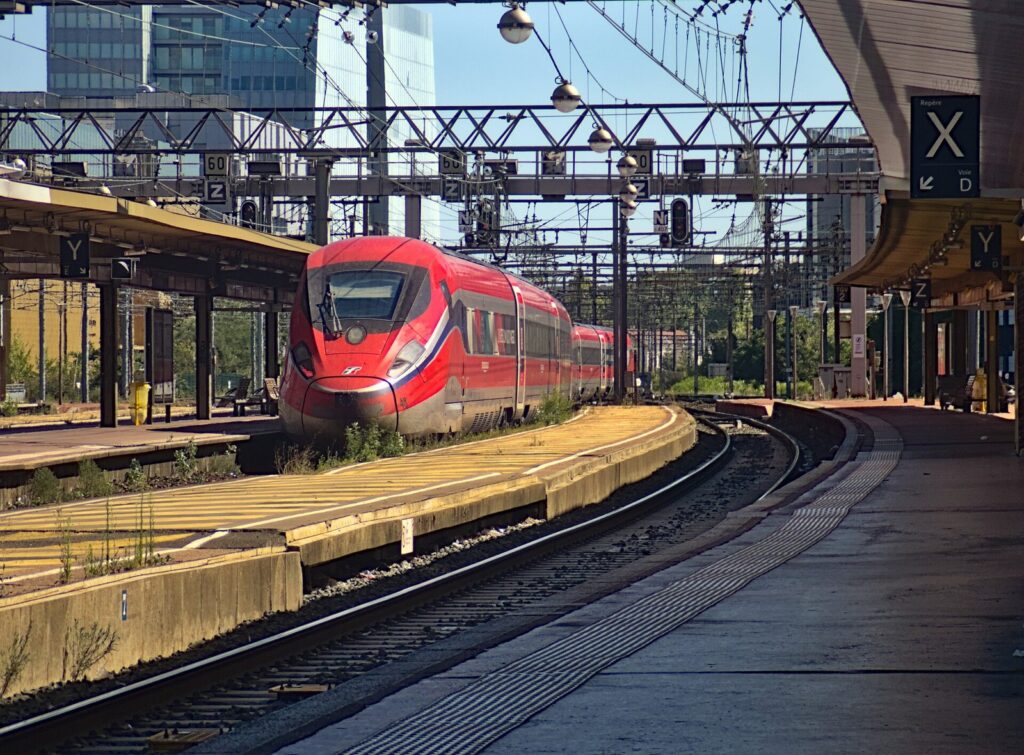
The Alpine route via Lyon, Chambéry, Modane and Turin takes about seven hours, and it reopened in spring 2025 after a landslide closed it in August 2023. Until 12 December 2026, Trenitalia’s Frecciarossa runs it twice a day each way: from Paris at 06:30 on weekdays (07:30 at weekends) and 15:25, and from Milan at 06:25 and 15:53. Check Trenitalia’s timetable for later dates. SNCF runs TGVs too. With a rail pass, the Frecciarossa costs a €13 reservation against €31–€45 on the TGV, which makes the choice easy.
Paris to Germany
Joint SNCF and DB services, a mix of TGVs and ICEs, run from the Gare de l’Est to Frankfurt, Stuttgart and Munich. Pass holders pay a compulsory €19 on them, and an ordinary €5.50 German seat reservation isn’t valid. The direct Paris–Berlin ICE, launched in December 2024, is suspended for now, with its trains running only between Paris and Frankfurt, so plan on a change at Frankfurt or Mannheim. To make the same trip asleep, take European Sleeper’s Paris–Berlin train, which runs three times a week.
Zurich–Milan through the Gotthard
SBB and Trenitalia’s EuroCity trains thread the base tunnel, and pass holders must reserve on them, at €13–€17 in either class. If you’d rather see the mountains than bore beneath them, the Gotthard Panorama Express follows the old line from Lucerne to Lugano, with a boat leg on Lake Lucerne, between April and October.
Is the train faster than flying?
For most trips under four hours, yes, once you count the whole journey. Most trains leave from city-centre stations, you board far closer to departure than at an airport (Eurostar aside), and your bags travel with you. Airports sit out of town, want you there early and add a transfer at the far end. Between four and six hours it comes down to fares and where you’re staying. Beyond six, fly or sleep on the way.
| Route | Fastest train | My call |
|---|---|---|
| London–Paris | 2h16 | Train, easily |
| Madrid–Barcelona | 2h30–3h02, depending on the train | Train |
| Madrid–Seville | varies by train | Train |
| Milan–Rome | 2h50 | Train |
| Paris–Marseille | 3h04 | Train |
| Paris–Amsterdam | 3h20 | Train |
| Berlin–Munich | about 4h | Train, unless the flight is far cheaper |
| Munich–Vienna | about 4h | Train |
| Paris–Barcelona | about 6h50 | Either: fly for time, take the train for the ride |
| Paris–Milan | about 7h | Train for the Alps, otherwise fly |
| Paris–Berlin | roughly 8h | Fly, or take European Sleeper’s night train, three times a week |
The four-hour rule holds up well enough that I’d only break it for a big fare difference or a very early start at the other end. For buses, ferries and budget flights as well, see our guide to getting around Europe.
How much do high-speed trains in Europe cost?
Prices behave like airline fares on almost every network: cheap when sales open, dearer as the train fills, highest on the day. Flexible tickets cost far more but can be changed or refunded. These were the lowest advance fares and typical flexible or late prices in August and September 2026:
| Route | Operator | Cheapest advance fare | Flexible or late |
|---|---|---|---|
| London–Paris | Eurostar | £39 | regularly over £150 |
| Paris–Amsterdam | Eurostar | from €35 | – |
| Paris–Marseille | OUIGO | €16 | – |
| Paris–Bordeaux | SNCF | about €13–€20 | about €50–€150 |
| Madrid–Barcelona | OUIGO, iryo, Renfe | €9 on OUIGO | €94.90 Renfe standard fare |
| Rome–Florence | Italo, Trenitalia | €14.90 Italo, €19.90 Trenitalia | €55 Trenitalia Base |
| Milan–Rome | Italo | €29.90 | – |
| Berlin–Munich | Deutsche Bahn | Sparpreis from €21.99 second class, €29.99 first | over €150 on the day |
| Munich–Vienna | ÖBB, DB | €19.99 | about €46 flexible on a Railjet, second class |
| Lisbon–Porto | CP | about €16 | €35.70 second class, €49.90 first |
| Prague–Vienna | ČD, ÖBB, RegioJet | €12.90 | – |
Three things move the price more than the choice of operator: how early you book, the day and hour (Friday and Sunday afternoons cost most), and the fare rules. The cheapest tickets are tied to one train and usually can’t be refunded.
The low-cost brands carry the headline fares, so read the small print before you celebrate. OUIGO and Avlo ration luggage like budget airlines, with extra bags paid for when you book (€5 each on OUIGO’s basic Madrid–Barcelona fare), and the cheapest iryo fare includes one case of 55 × 35 × 25 cm. A €16 OUIGO seat plus two paid bags can end up close to the TGV INOUI price, so compare the totals for the same day before you book.
Verdict: €20–€40 is a normal high-speed fare on a competitive route booked a month or more ahead. Paying €150 usually means you booked late or chose a flexible fare you didn’t need.
Can you use a rail pass on high-speed trains?
Yes, on almost all of them, but the pass is only half the ticket. Most high-speed trains need a reservation on top, and on the busiest routes the fees add up. Italo, Renfe’s Avlo and OUIGO España don’t accept passes at all. These are the 2026 fees for Eurail and Interrail holders:
| Train | Pass-holder reservation |
|---|---|
| Eurostar London–Paris, Lille or Brussels | €35 Standard, €40 Plus |
| Eurostar London–Rotterdam or Amsterdam | €35 Standard, €43 Plus |
| Eurostar Paris–Brussels / Paris–Amsterdam | €27–€32 / €32–€37 |
| TGV INOUI within France | €10–€20, compulsory |
| TGV Paris–Barcelona | €35, compulsory |
| TGV Paris–Turin or Milan | €31 second class, €45 first |
| Frecciarossa Paris–Lyon–Turin–Milan | €13, compulsory, Standard or Business |
| TGV and ICE France–Germany | €19, compulsory |
| Frecciarossa within Italy | €13, compulsory |
| AVE | €10 Elige, €13 Elige Confort, €23.50 Premium with a meal |
| iryo | €10 second class, €13 first |
| ICE within Germany | optional: €5.50 second class, €6.90 first |
| Railjet within Austria | optional: €3 |
| Railjet Munich–Verona–Venice | €10 second class, €15 first, Italian supplement included |
| SJ high-speed, Sweden | €6.50 second class, €14.40 first |
| Alfa Pendular, Portugal | €5, bought locally |
| Italo, Avlo, OUIGO España | not valid |
Summer adds a twist: reservations were compulsory on the Amsterdam–Berlin and Amsterdam–Frankfurt ICEs from 26 June to 31 August 2026, so check before a July or August trip.
A pass earns its keep where fees are low or zero, as in Germany, Austria, Switzerland and the Benelux. It loses on a short trip built around Eurostar and French TGVs, where fees are high and Eurostar’s pass-holder seats are limited. Our comparison of Eurail vs Interrail explains which pass you qualify for, the Eurail cost breakdown runs the numbers, and the guide to using an Interrail pass shows how to book the reservations.
Verdict: price the trip as point-to-point tickets first, reservations included, and buy the pass only if it clearly wins.
Stations, security and boarding
Eurostar to and from London: passport control before you board
On Eurostar, it’s the trains to and from London that have passport control before boarding. At London St Pancras you go through passport and security checks, with EES registration for those who need it, and the gates close 30 minutes before departure for Standard and Plus, 15 minutes for Premier. One tip for pass holders: take the departure time from your Eurostar reservation rather than the Rail Planner app’s listing.
Spain: scanners at the door
Spanish high-speed stations X-ray your bags before the platform, and boarding closes a couple of minutes before departure. Allow 20–30 minutes at Madrid Puerta de Atocha or Barcelona Sants, and check whether your Madrid train leaves from Atocha or Chamartín.
Italy: platform gates, no stamping
At Roma Termini, Milano Centrale and Firenze Santa Maria Novella you need a ticket to pass the gates to the platforms. Frecciarossa and Italo tickets name a train and a seat, so there’s nothing to validate; the green stamping machines are for regional tickets.
France: the right Paris station, and the right TGV station
Paris has a terminus for each direction: Gare du Nord for Lille, Brussels, Amsterdam and London; Gare de l’Est for Strasbourg and Germany; Gare de Lyon for Lyon, Marseille, the Alps, Switzerland, Italy and Barcelona; Montparnasse for Bordeaux, Brittany and Toulouse. Some TGV stations sit well outside the towns they’re named after: Aix-en-Provence TGV, for one, is 15 km from Aix, so check before you book a hotel near “the station”.
Germany: find your coach first
German platforms are divided into lettered sections, and a display shows where each coach should stop. Trains sometimes arrive the other way round, so watch the board and be ready to move.
Delays, missed connections and your rights
EU rules give you 25 per cent of the ticket price back if you arrive 60–119 minutes late, and 50 per cent for two hours or more. Railways can refuse compensation when extraordinary circumstances such as extreme weather cause the delay, but a strike by their own staff doesn’t count as one.
The protection covers one booking. Miss a connection between two separate tickets and the second operator owes you nothing by law, although some will put you on the next train anyway. My rule: at least an hour between separate tickets, two before a Eurostar or a flight, and more in Germany.
Planning a high-speed trip: when to book, what to book ahead, what to skip
When tickets go on sale
| Operator | Sales open | Book at |
|---|---|---|
| Eurostar, London routes | 10–11 months ahead, sometimes later where engineering works intervene; pass-holder seats up to 6 months out | eurostar.com |
| Eurostar, Paris–Brussels–Amsterdam and Cologne | 10–11 months, Eurostar says, though works on the line can hold some dates back | eurostar.com |
| SNCF: TGV INOUI and OUIGO | TGV INOUI normally 4 months, with seasonal releases; OUIGO opens further out, with trains to 2 July 2027 on sale since 30 September 2026 | SNCF Connect, OUIGO |
| TGV Lyria, Paris–Barcelona, Paris–Milan | up to 6 months, often less | SNCF Connect |
| Deutsche Bahn | up to 12 months within Germany and to or from Belgium, Luxembourg, the Netherlands and Switzerland; up to 6 months to Austria, Croatia, Czechia, Denmark, France, Hungary, Italy, Poland, Slovakia, Slovenia and Sweden | int.bahn.de |
| Trenitalia | varies by departure | trenitalia.com |
| Italo | check the calendar for your date | italotreno.com |
| Renfe | no fixed window: tickets go on sale once Renfe releases them, so check your route and dates | renfe.com |
| CP, Portugal | promo fares up to 60 days ahead | cp.pt |
What to book ahead
- Eurostar, the moment your dates are fixed.
- Routes with few direct trains: Paris–Barcelona, Paris–Milan and Paris–Berlin.
- The cheapest OUIGO, Italo and Sparpreis fares, a month or more out.
- Peak dates: Spanish trains at Easter and in August, Italian trains on summer Fridays and Sundays, German ICE seats around public holidays.
- Pass reservations on Eurostar, where pass-holder seats are limited and may appear only about six months before departure.
What to skip
- First class on short hops. Under 90 minutes it rarely earns its price, unless the difference is a few euros.
- Flexible fares you won’t use. A saver fare you might lose often still costs less than a flexible one you never change.
- Buying at the station. On most networks the on-the-day fare is the top fare.
- A rail pass for two or three high-speed legs. Point-to-point tickets usually win.
- Resellers’ booking fees. Comparison sites are handy for seeing every operator at once, but some add a fee, and the operator’s own site sells the same seat. Our guide to booking European train tickets goes operator by operator.
Getting there
Two big airports have high-speed stations of their own, Paris-Charles de Gaulle and Frankfurt Airport, so you can step off a long-haul flight onto a TGV or ICE. Lyon’s airport has one too. For routes that stitch these trains into a trip, see our Europe train itinerary and the Western Europe itinerary; if you’re new to rail, start with Europe by train for beginners.
What’s new in 2025–2026, and what’s still years away
- Paris–Berlin by day. The direct ICE began in December 2024 but has been suspended, its trains running only between Paris and Frankfurt, so the trip now needs a change at Frankfurt or Mannheim.
- Frecciarossa in France. Trenitalia added Paris–Marseille in June 2025, and its Paris–Milan trains now take rail passes, with a €13 reservation.
- The Koralmbahn. Graz–Klagenfurt has taken 41 minutes since December 2025.
- More fast Berlin–Munich trains. DB lists 16 ICE Sprinter services a day in each direction on the Berlin–Halle–Erfurt–Nuremberg–Munich corridor; the planner gives each one’s journey time.
- Spanish reshuffles. Avlo left Madrid–Barcelona in September 2025, Renfe has shelved its own Paris trains, and iryo now takes Eurail and Interrail passes, with a compulsory reservation.
- New French challengers. Le Train (western France, expected 2027–2028), Kevin Speed (from 2028, with off-peak fares from €15) and Proxima all plan to take on SNCF.
- Still years away. Rail Baltica (a first phase in 2030 at the earliest), HS2 in Britain (not this decade) and the Alpine base tunnels under the Brenner and between Lyon and Turin (the 2030s).
None of the big projects will help a trip in the next couple of years, so plan around what runs now.
Frequently asked questions about high-speed trains in Europe
What is the fastest train in Europe?
In passenger service, France’s TGVs are quickest, at up to 320 km/h on newer lines such as Paris–Strasbourg and Tours–Bordeaux, and German ICEs match that on French track. Most others, from Eurostar to AVE, top out at 300 km/h. Italo’s AGV and the Frecciarossa 1000 were designed for 360 km/h, but Italian lines cap them at 300. A test TGV holds the wheeled-train record: 574.8 km/h in 2007.
Do I need a seat reservation on European high-speed trains?
On most, yes: in France, Spain and Italy, and on Eurostar, a high-speed ticket is usually sold for one train with a seat included. Germany’s ICE and Austria’s Railjet are the main exceptions, where a reservation is optional but worth a few euros at busy times. Rail pass holders pay the reservation separately, from €3 on a Railjet to €45 for a first-class TGV to Milan.
Are high-speed trains cheaper than flying in Europe?
Often, if you book early and count everything. Italo sells Rome–Florence from €14.90, and DB’s second-class Sparpreis starts at €21.99, subject to availability; add bags and airport transfers to the flight’s price before you compare. Late bookings are another story: Eurostar and ICE tickets bought close to departure can pass €150, and then a budget flight may be cheaper, if less pleasant.
Can I use a Eurail or Interrail pass on high-speed trains?
Yes, on most, with a reservation on top: €13 on Frecciarossa, €10–€20 on French TGVs, €35–€43 on Eurostar from London and €10–€23.50 on AVE. Germany’s ICE and Austria’s Railjet need no reservation at all. Italo, Renfe’s Avlo and OUIGO España don’t accept passes, so buy ordinary tickets for those.
How far ahead should I book high-speed train tickets?
Book early for Eurostar, OUIGO and routes with few trains, such as Paris–Barcelona. Eurostar sells London trains 10–11 months ahead and SNCF’s TGV INOUI normally opens four months out, while Trenitalia’s and Renfe’s windows vary, so check each one for your dates. For most other journeys, booking one to three months ahead gets a fair price.
Is there a high-speed train from London to mainland Europe?
Yes. Eurostar runs from London St Pancras to Paris in as little as 2h16, and to Lille, Brussels, Rotterdam and Amsterdam, with advance fares from £39 to Paris. Standard and Plus gates close 30 minutes before departure (15 for Premier), and passport and EES checks, where they apply, take place in London before you board. Change in Paris or Brussels for TGVs, ICEs and Frecciarossas heading south and east.
Are there high-speed trains in eastern Europe?
Not on dedicated 300 km/h lines yet. East of Germany and Austria, the fastest options are Poland’s Pendolinos and the Railjets linking Vienna with Prague and Budapest, running on upgraded conventional track. Rail Baltica, the planned line from Tallinn towards Poland, won’t carry passengers before 2030. For long hops across the region, a night train is often the better tool.
Final thoughts
High-speed rail is the best way to travel between most big cities in western Europe, and the savings come from booking early and comparing operators wherever they compete. Treat anything over six hours as a day on the train, and switch to a night train or a flight when that day isn’t worth it. For how these trains fit a wider trip, start with our complete guide to European rail travel.
Related Europe guides
- Best Train Routes in Europe: 33 Journeys Worth the Fare: the rail journeys worth building a trip around
- Night Trains in Europe: sleepers for the legs over six hours
- Eurail vs Interrail: Which Pass to Get: which pass covers the high-speed reservations
- Is the Eurail Pass Worth It? A 2026 Cost Breakdown: when a pass beats point-to-point high-speed fares
- Europe Train Itinerary: 12 Routes With Times and Costs: a route that strings the fast lines together
- How to Get Around Europe: Trains, Planes, Buses & Cars (2026): trains against flights, buses and ferries
Sources and verification
Prices, timetables and rules in this guide were checked on 26 September 2026 against the official sources below. It is compiled from those sources rather than from other travel lists, and it does not describe first-hand visits. Fares, opening hours and entry rules change, so confirm with the operator before you book.
- Deutsche Bahn: 2026 timetable changes for long-distance trains in Bavaria
- Eurail: domestic train reservation fees
- Eurail: international train reservation fees
- Eurostar: how far in advance you can book
- OUIGO España: Madrid to Barcelona trains and timetable
- Spain.info: exploring Spain on high-speed trains
- National Transport Authority: EU rail passenger rights
- City of Graz: opening of the Koralmbahn
Hannah Brooks has spent fifteen years travelling, living and writing across Europe, from the Arctic tip of Norway to the south of Sicily. She has planned hundreds of European itineraries for readers and is Senior Europe Editor at EuropeanTourism.org.
Photo credits
- A TGV Duplex, one of the high speed trains Europe runs, crossing the Cize–Bolozon viaduct in autumn (top photo): photo by Kabelleger / David Gubler, Wikimedia Commons (CC BY-SA 4.0)
- Red iryo Frecciarossa beside a white Renfe AVE at Sevilla Santa Justa station: photo by Jon Worth from Germany, Wikimedia Commons (CC BY 2.0)
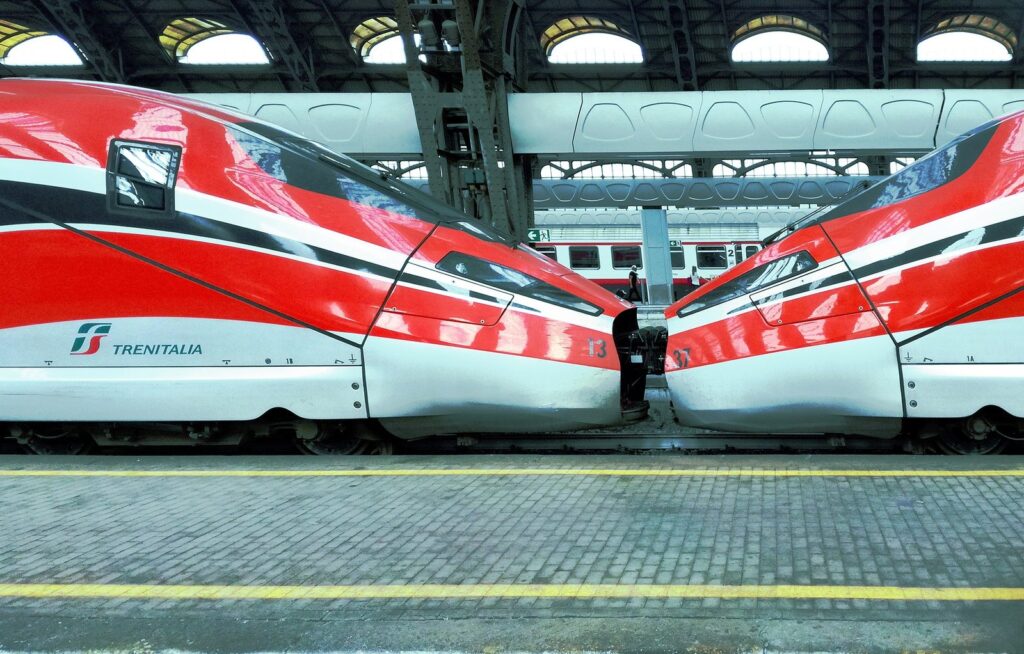
- Two red Frecciarossa 1000 trains coupled nose to nose at Milano Centrale: photo by Sabas88, Wikimedia Commons (CC BY-SA 4.0)
- White ICE 3 train with a red stripe running through countryside near Fahlenbach, Bavaria: photo by Sebastian Terfloth User:Sese_Ingolstadt, Wikimedia Commons (CC BY-SA 2.5)
- Blue and yellow Eurostar e320 train at a platform in Paris Gare du Nord: photo by RAIL P (RAIL.PHOTOGRAPHY), Wikimedia Commons (CC0)
- Red ÖBB Railjet pushed by a Taurus locomotive below snowy peaks near Mels, Switzerland: photo by Kabelleger, Wikimedia Commons (CC BY-SA 4.0)
- Red Frecciarossa 1000 train leaving Lyon Part-Dieu station under overhead wires: photo by PtiBzh, Wikimedia Commons (CC0)