Eurostar Guide: London to Paris by Train
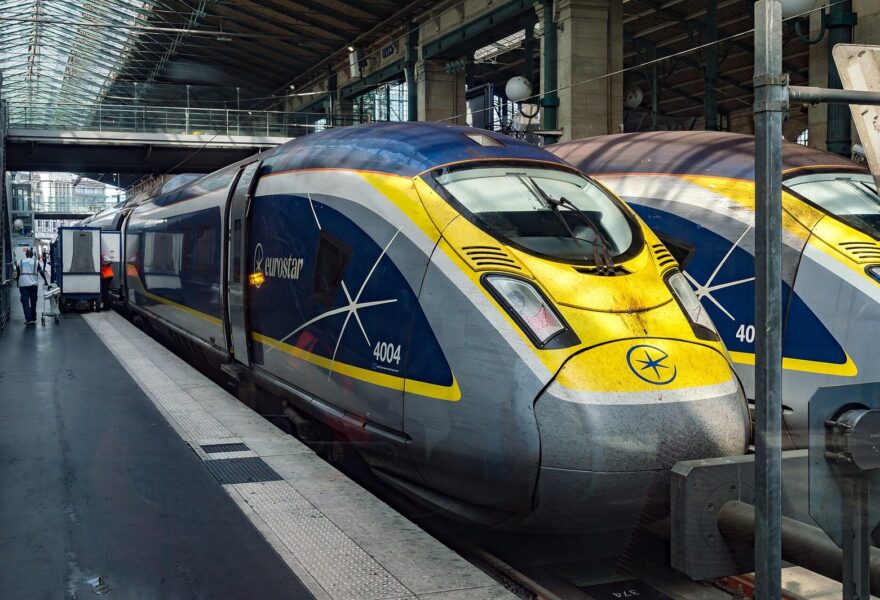
Eurostar links central London with central Paris: it runs 16 return trains a day between St Pancras and Gare du Nord, and the fastest make the trip in 2 hours 16 minutes. This Eurostar guide covers fares, classes, check-in, luggage, border rules and what to do when you step off in Paris.
It’s written for first-timers, for families and for anyone using the train as the opening leg of a longer trip; the wider picture, from rail passes to sleeper trains, is in our complete guide to train travel in Europe. The one caveat that matters: Eurostar prices its seats like an airline, so the cheapest ones on popular dates go early. Checked against official sources in September 2026.
| Item | Details |
|---|---|
| Journey time | 2h16 on the fastest trains; some take up to 2h37 |
| Trains per day | 16 return trains a day; check the timetable for your date |
| Cost | From £39 one way in Standard, booked well ahead; same-week fares regularly pass £150 |
| Time needed at the station | Allow for security and French passport control; Eurostar’s check-in page gives the recommended arrival time |
| Best for | Central London to central Paris, travellers with luggage, anyone carrying on by rail |
| Book ahead | Sales open 10–11 months out; book early and compare dates for the lowest price |
| Border checks | French passport control happens at St Pancras, before you board |
| Luggage | Two large bags plus one small bag in Standard and Plus; three plus one in Premier |
What is Eurostar, and where does it go from London?
Eurostar is the high-speed train through the Channel Tunnel. From London it runs to Paris, Lille, Brussels, Rotterdam and Amsterdam, all from the same platforms at St Pancras International, and it’s the only international passenger train operator using the tunnel. Talk of rival operators comes and goes; in 2026 none of them is selling tickets.
The company is bigger than its London trains. Since 2023 the red trains that used to run as Thalys between Paris, Brussels, Amsterdam and Cologne have carried the Eurostar name too. They’re handy once you’re on the continent, but they never come to London, so this guide sticks to the blue-and-yellow trains that go under the Channel.
Three dates that explain the Eurostar
1994. The Channel Tunnel opened, and that November the first passenger trains left London Waterloo for Paris and Brussels. On the English side they shared ordinary commuter tracks through Kent and only really picked up speed once they reached France.
2007. High Speed 1, Britain’s first purpose-built high-speed line, was finished and the London terminal moved to St Pancras. The fastest Paris journeys dropped to around two and a quarter hours, which is roughly where they still sit.
2023. Eurostar and Thalys came together under one brand and the classes were renamed. If an older blog or forum post mentions Standard Premier or Business Premier, read them as today’s Eurostar Plus and Eurostar Premier.
London to Paris
This is the route most people mean when they say “the Eurostar”. Trains run from St Pancras to Gare du Nord, and the fastest cover it in 2h16. The timetable lists 16 return trains a day; look up your travel date to see the first and last departures. Most Paris trains don’t stop anywhere on the way, which is part of why the journey feels shorter than the clock says.
Gare du Nord sits in the 10th arrondissement, on the northern edge of central Paris, with two Metro lines and two RER lines underneath it. Nothing about arriving there is complicated, and a later section walks through it one step at a time.
London to Lille and Brussels
Lille Europe sits on the line to Brussels, and Lille is a short hop from London: as little as 1 hour 22 minutes from St Pancras. Brussels-Midi (Bruxelles-Midi in French, Brussel-Zuid in Dutch) is about two hours away.
Lille matters for another reason. It’s the handiest place to change onto French high-speed trains heading south without crossing Paris, and it’s where Eurostar now sends people bound for Disneyland Paris. From Brussels, the ex-Thalys Eurostar trains run on to Cologne, so London to Germany takes a single change. Our guide to high-speed trains in Europe covers those continental lines in more depth.
London to Rotterdam and Amsterdam
Amsterdam trains call at Brussels and Rotterdam and take roughly four hours end to end, a few minutes either side depending on the service. That’s long enough for the flight comparison to get closer, but the train still suits anyone who dislikes airports: Amsterdam Centraal is a short walk from the canal ring, and you haven’t spent the morning on a shuttle bus. Rail pass reservations cost a little more on this route in Plus (€43, against €40 to Paris).
Disneyland Paris, the Alps and the south of France
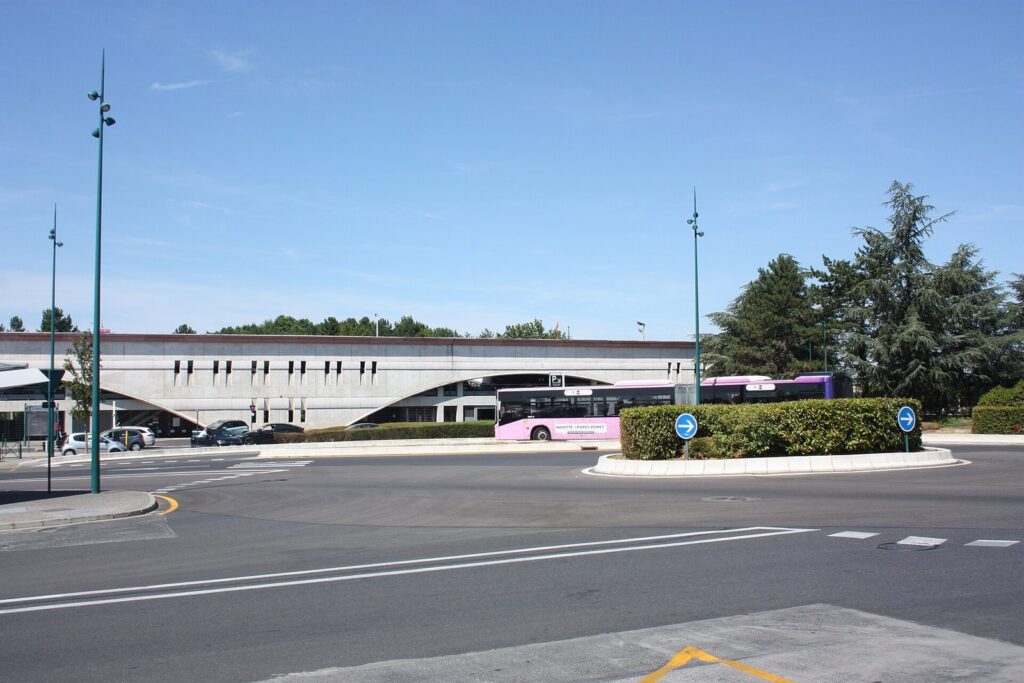
There’s no direct Eurostar to Disneyland Paris any more. Eurostar sells the journey with a change at Lille, and those tickets usually go on sale about four months ahead. That’s a shorter window than the rest of the network, so a family that has been told to “book the Eurostar a year out” can log on and find nothing there. It isn’t sold out. It just hasn’t opened yet.
In winter a dedicated ski service, the Snow Train, runs to the French Alps. Eurostar says its tickets usually go on sale in July, which is earlier than most skiers start thinking about the season. Further south, Eurostar’s answer is a connection: it sells connecting TGV INOUI journeys in France, usually up to 120 days ahead.
What about Ebbsfleet and Ashford?
Eurostar stopped calling at Ebbsfleet International and Ashford International in 2020 and hasn’t been back. On 26 September 2025 Kent County Council and local partners signed a memorandum of understanding to press for the return of international services to Ashford and Ebbsfleet. Until something changes, Kent travellers ride Southeastern’s high-speed trains into St Pancras and start there, so build that extra leg into your plans.
| Destination | Station | Fastest journey from London | Direct? | Worth knowing |
|---|---|---|---|---|
| Paris | Gare du Nord | 2h16 | Yes | 16 return trains a day |
| Lille | Lille Europe | Under 1h30 | Yes | The easiest place to change for TGVs heading south |
| Brussels | Brussels-Midi | About 2h | Yes | Change here for Cologne |
| Rotterdam | Rotterdam Centraal | About 3h | Yes | Amsterdam trains call here |
| Amsterdam | Amsterdam Centraal | About 4h | Yes | Rail pass reservation €35 in Standard, €43 in Plus |
| Disneyland Paris | Marne-la-Vallée–Chessy | Varies | No, change at Lille | Usually on sale about four months ahead |
| French Alps | Snow Train stations | Seasonal | Winter only | Usually on sale from July |
| Cologne | Köln Hauptbahnhof | Varies | No, change at Brussels | Onward on the ex-Thalys Eurostar |
How long does the Eurostar take from London to Paris?
The fastest trains take 2 hours 16 minutes from St Pancras to Gare du Nord. Most do it in that time, and the slowest take up to 2h37. A few minutes either way rarely matters. What matters far more is the time you spend at each end, which is where the train quietly beats the plane.
On the ground, the trip splits into three. High Speed 1 carries you through east London and across Kent to the tunnel portal near Folkestone. The tunnel is about 50 kilometres long, around 38 of them under the sea, and trains are held to 160 km/h inside it, so the dark stretch lasts about 20 minutes. Then the LGV Nord, France’s northern high-speed line, runs you through Pas-de-Calais and Picardy at up to 300 km/h and into Paris.
The timetable across a day
There are 16 return trains a day between London and Paris, and Eurostar’s timetable for your date shows when the first and last ones leave. Early weekday trains lean towards business travellers, which is exactly who Premier is built for. Weekends and peak periods are the times to book early, while Tuesday and Wednesday trains usually carry the cheapest fares.
Timetables shift with the seasons and around engineering work, and Eurostar’s own help pages warn that the booking window can vary for the same reason. If a date 10 months out shows nothing, check again in a week or two before assuming something has gone wrong.
The hour you lose on the way out
Paris is an hour ahead of London all year, because France and the UK change their clocks on the same weekends. A 2h16 train that leaves St Pancras at 10:01 reaches Gare du Nord at 13:17 local time, so a mid-morning departure is really a lunchtime arrival. On the way home you get the hour back.
It sounds trivial. It’s also the most common reason people misjudge an onward connection, a restaurant booking or a hotel check-in, so do the sums in local time.
Door to door: is Eurostar faster than flying?
| Stage | Eurostar | Flight from Heathrow or Gatwick to Charles de Gaulle |
|---|---|---|
| Getting to the start | St Pancras is in central London, on six Underground lines and Thameslink | Heathrow and Gatwick are well outside the centre |
| Time before departure | Enough for security and French passport control | Set by your airline, and usually far longer |
| Time moving | 2h16 to 2h37 | A little over an hour in the air, plus taxiing |
| Arrival | Gare du Nord, 10th arrondissement, on Metro 4 and 5 and RER B and D | Charles de Gaulle, then about 30–40 minutes on RER B to Gare du Nord |
| Getting into town | A €2.55 Metro-Train-RER ticket covers central Paris | The Paris Region to airports ticket costs €14 |
| Luggage | Two large bags and a small one included; no weight limit, no liquids rule | Depends on the fare; liquids rules at security |
| Passport checks | Done in London before you board | Done on arrival in Paris |
The flight wins only on the part that matters least: the time in the air. Add the airport at each end and the train is usually quicker for anyone starting in central London, and far calmer.
Verdict: for city-centre to city-centre trips, Eurostar beats flying on time, comfort and hassle. A flight only makes sense if you live near an airport and a long way from St Pancras, or you’ve found a fare the train can’t get near on a peak date.
How much does Eurostar cost?
Eurostar fares start at £39 one way in Standard and climb as trains fill. Each train is sold in roughly a dozen price buckets: when the cheapest bucket has gone, the next one up is what you pay, and prices rarely fall back as the date approaches. Every direction is priced on its own, so a return is simply two one-way fares added together. That’s useful, because you can go out in Plus on a Friday and come back in Standard on a Tuesday without any penalty.
What moves the price
- How far ahead you book. This matters more than anything else. The lowest fares go first, and on the busiest trains they can go months before departure.
- The day of the week. Eurostar’s own advice is that Tuesdays and Wednesdays are the cheapest days to travel. Friday and Sunday afternoons are the dearest.
- The season. Summer, Christmas, Easter and school half-terms push demand up across the network, and those trains sell out quickly.
- The time of day. Fares differ from train to train on the same day, so compare departures across the day you want.
- The class. Plus and Premier are priced separately from Standard, and the gap between them moves with demand.
What you’ll actually pay in 2026
| Ticket | Typical one-way price, 2026 | Worth knowing |
|---|---|---|
| Standard, lowest fare | From £39 | Midweek, booked well ahead |
| Standard, 4–8 weeks out | £59–£79 | For convenient daytime departures |
| Standard, same week | Often over £150 | Peak trains can reach about £245 |
| Eurostar Plus | Varies with demand | Always compare it with Standard on the same train |
| Eurostar Premier | About £270–£395 | Fully flexible, with lounge access and a meal |
| Rail pass reservation | €35 Standard, €40 Plus | Interrail or Eurail Global Pass only; limited places |
| Snap | Discounted, variable | Sold up to 10 days ahead; no exchanges or refunds |
These are sampled bands, not promises. The same seat can cost several times as much a week before departure as it did when sales opened, and the only reliable way to see today’s price is to search for the exact date you want.
When to book: Eurostar’s booking windows
| What you’re booking | When it goes on sale, or the best time to buy |
|---|---|
| Eurostar tickets on all routes | 10–11 months ahead, according to Eurostar |
| Best value for most trips | Book early and compare nearby dates |
| Rail pass reservations | Places may only appear about six months ahead |
| London to Disneyland Paris via Lille | Usually about four months ahead |
| Snow Train to the Alps | Usually from July |
| TGV INOUI and Lyria connections sold by Eurostar | Usually up to 120 days ahead |
| Belgian SNCB connections sold by Eurostar | Four to eight months ahead |
| Deutsche Bahn ICE connections sold by Eurostar | Usually up to 90 days ahead |
| UK National Rail connections sold by Eurostar | Around 84 days ahead |
| Snap | Up to 10 days before travel |
The practical rule is simple. If you’re travelling at Christmas, at Easter, in the school holidays or on a summer Friday, book the day your dates are fixed. On a Tuesday in February you can afford to wait a while, though the cheap buckets still won’t last indefinitely.
Seven ways to pay less
- Book as soon as your dates are firm. Standard tickets can be exchanged for free up to an hour before departure (you pay any difference in fare), so there’s little risk in grabbing a cheap seat early and moving it later if you have to.
- Travel on a Tuesday or Wednesday. It’s Eurostar’s own tip, and the easiest saving there is.
- Price each direction separately. An early train out and a late train back can undercut a matching pair of convenient departures by a wide margin.
- Check Plus before you dismiss it. The gap moves with demand, and when it’s small the meal alone can cover the difference.
- Look at Snap if your plans are loose. It’s sold up to 10 days ahead and can’t be changed or refunded, so it suits a spontaneous weekend rather than a trip built around fixed bookings.
- Use a pass reservation if you already hold a Global Pass. At €35 in Standard it’s hard to beat on a peak date.
- Watch for Eurostar’s sales, but don’t wait for them. They come round now and then, and they’re rarely on the dates everyone wants.
Snap: cheap seats for flexible travellers
Snap is Eurostar’s route to a cheap seat at short notice. The tickets are sold up to 10 days before travel and, unlike the regular fares, they can’t be exchanged, refunded or transferred. Snap works differently from a normal booking, so read the terms at the point of sale before you pay. It’s a good fit for a last-minute Paris weekend with nothing else booked. It’s a poor fit for anyone with a non-refundable hotel, a dinner reservation or a connecting train to catch.
Can you use a rail pass on Eurostar?
Yes, if it’s an Interrail or Eurail Global Pass. Plenty of pages still say Eurostar isn’t covered by rail passes; it is, at a special passholder fare, with a limited number of places on each train. One Country Passes don’t qualify.
The details:
- The fare. London to Paris, Lille or Brussels costs €35 in Standard and €40 in Plus; London to Rotterdam or Amsterdam costs €35 and €43. Premier isn’t available on a pass.
- The class. A second-class pass gets you Standard only; a first-class pass can book Standard or Plus.
- The quota. Passholder places are limited on every train, and a train can be sold out for passholders while it’s still selling ordinary tickets. A useful test: if the normal Eurostar price for your train is €143 or less, €35 passholder places should still be there; at €160 or more, there won’t be any.
- The timing. Eurostar opens sales 10–11 months out, but passholder places may only appear about six months before departure.
- Changes. Passholder bookings can be changed for free until seven days before departure. After that the fee is £10 or €15 in Standard and £15 or €20 in Plus.
- Children. A free Child Pass still leaves the passholder fare to pay, as reservations aren’t included in any pass, so check the child rate when you book. Under-4s travel free.
- UK residents. If you live in Britain, the Eurostar counts as a journey in your home country and uses one of your two outbound and inbound travel days.
For how the passes compare, and when one pays for itself, see Eurail vs Interrail and our 2026 cost breakdown of the Eurail pass. If you’ve already bought one, how to use the Interrail pass shows how to add the Eurostar leg to your trip in the app.
Verdict: the best-value ticket for most people is a Standard fare booked well ahead for a Tuesday or Wednesday. If you’re travelling on a peak Friday in August, book the day sales open or accept that you’ll pay well over £100 each way.
When is the best time to take the Eurostar?
For price, January and February are the cheapest months to travel, and Tuesdays and Wednesdays are the cheapest days in any month. For Paris itself, late spring and early autumn are hard to beat: the fares sit in the middle of the range, the days are long enough for proper sightseeing and the city isn’t at its summer peak. Here’s how demand moves through the year.
| When | Demand and fares | What’s happening | Booking advice |
|---|---|---|---|
| January and February | The quietest and cheapest months | The January sales; fashion week at the end of February | Midweek trips can be booked a few weeks out; February half-term needs more notice |
| March to May | Rising, with spikes at Easter and May half-term | Spring in the parks; Roland-Garros begins in late May | Book Easter and half-term dates as soon as they’re fixed |
| June to August | The peak; summer seats sell out quickly | Fête de la Musique on 21 June, Bastille Day on 14 July, Paris Plages by the river | Book school-holiday dates as early as you can |
| September and October | Busy in early September, then steadier | Fashion week from late September; October half-term | Book early, and earliest of all for October half-term |
| November and December | A quiet November, then the Christmas rush | Christmas lights and markets from late November | Book pre-Christmas weekends and the days after Christmas early |
Your dates drive the fare, and the school calendar on both sides of the Channel shapes which dates are busy. British half-terms and holidays fill the London departures, French holidays fill the trains coming the other way, and the weeks when both overlap are the ones to avoid if you have a choice. For a low fare, look midweek: Eurostar’s cheapest tickets are usually on Tuesday and Wednesday trains.
Eurostar Standard, Plus or Premier: which class should you book?
Eurostar has three classes: Standard, Plus and Premier. What changes between them is space, food, flexibility and how long you spend at the station. The train, the speed and the arrival time are identical, which is worth remembering when the fare for the top class appears on screen.
| Eurostar Standard | Eurostar Plus | Eurostar Premier | |
|---|---|---|---|
| Seats | Two either side of the aisle | Extra space, one and two across | Extra space, one and two across |
| Food and drink | Buy from the café-bar or bring your own | A light meal and drinks served at your seat | Fine dining and drinks served at your seat |
| Lounge | No | No | Yes, in London, Paris and Brussels |
| Ticket gates | Standard gates | Standard gates | Priority gates |
| Luggage | Two large bags and one small | Two large bags and one small | Three large bags and one small |
| Wi-Fi and power | Free Wi-Fi; UK and EU sockets on London routes | The same, plus free magazines | The same, plus newspapers and magazines |
| Exchanges | Free up to 1 hour before departure; pay any fare difference | As Standard | Free up to 2 days after departure |
| Refunds | Up to 7 days before departure, minus £25 | As Standard | Free up to 2 days after departure |
| Extras | Club Eurostar points | Club Eurostar points | Same-day boarding guarantee; Club Eurostar points |
Eurostar Standard
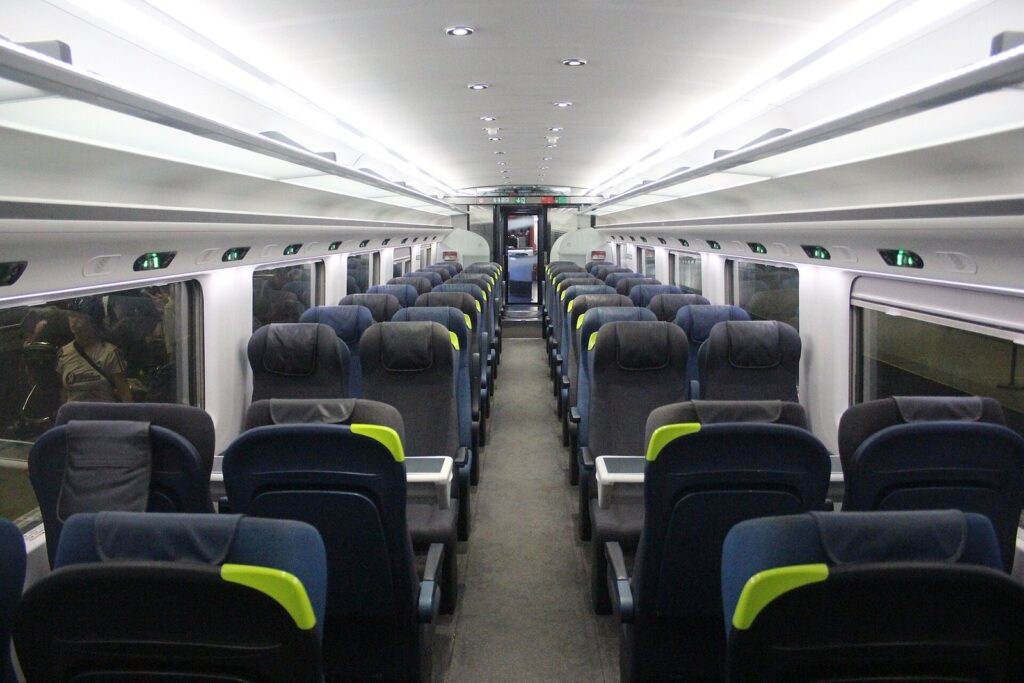
Standard is the class most people should book. The seats sit two either side of the aisle, some facing each other around tables, and the trip is short enough that the gap to Plus is more about treats than comfort. You get free Wi-Fi, UK and European sockets on London trains, the same luggage allowance as Plus and a café-bar coach for coffee and sandwiches. Bringing your own food is completely normal; there’s no liquids rule and nobody will blink at a picnic.
The ticket rules are kinder than most people expect. You can exchange a Standard ticket as many times as you like until an hour before departure, paying only any difference in fare, and you can get a refund until seven days before travel, minus a £25 fee.
Verdict: Standard is the default for families, budget trips and anyone happy to bring a sandwich. I’d only move up if the fare gap is small or the trip is a treat.
Eurostar Plus
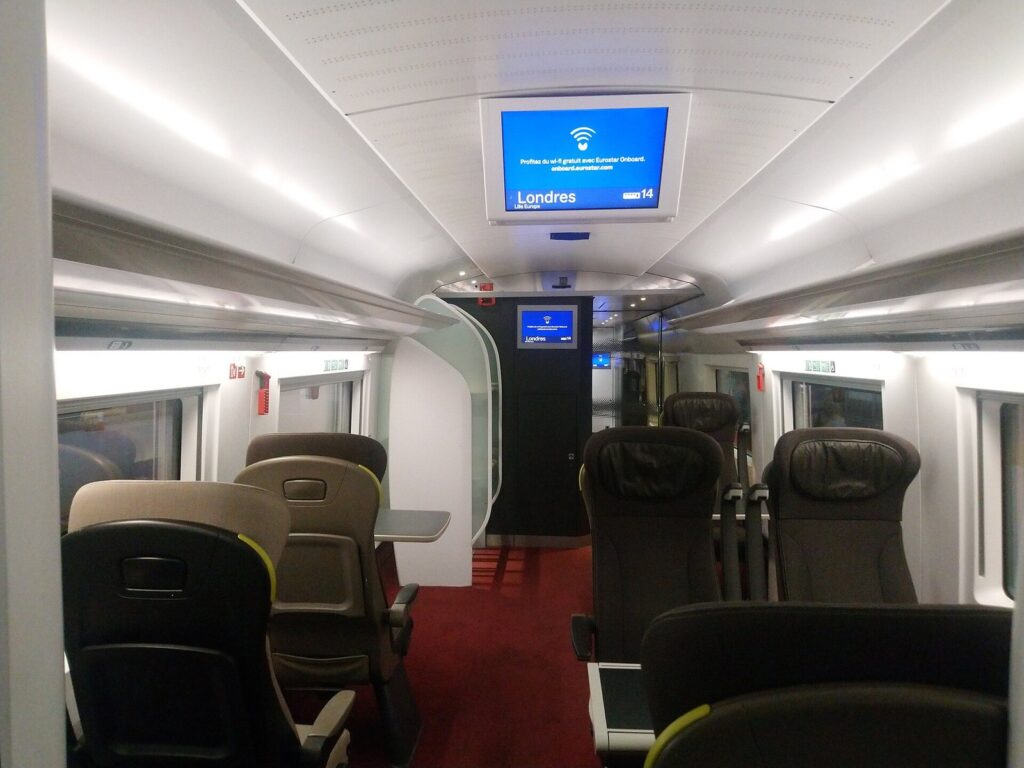
Plus is the old Standard Premier under a new name. The seats are wider and set out one and two across the aisle, the coaches feel roomier because they hold fewer seats, and a light meal with drinks is brought to you. There are free magazines on board, and the luggage allowance and ticket rules match Standard’s exactly.
Its value swings with the fare. When Plus costs only a little more than Standard, it’s the easy upgrade: breakfast or lunch is covered and you get a proper workspace for two hours. When the gap is closer to the price of a good lunch in Paris, the meal alone won’t justify it.
Verdict: my pick for a first Eurostar trip if the gap is modest, and for anyone who needs to work on the way.
Eurostar Premier
Premier, once Business Premier, is built for business travellers and priced for them: 2026 samples ran from about £270 to £395 one way. For that you get the lounges at St Pancras, Gare du Nord and Brussels-Midi, priority ticket gates, a fine-dining meal and drinks at your seat, newspapers, a third large bag and what Eurostar calls a same-day boarding guarantee. Premier passengers can also turn up later: the gates stay open for them until 15 minutes before departure, against 30 in the other classes.
The real product is flexibility. A Premier ticket can be exchanged or refunded with no fee up to two days after departure, which makes it close to risk-free for a meeting that might move.
For a leisure trip, it’s rarely worth it. A lounge and a fine-dining tray are pleasant extras, but neither is worth three or four Standard fares on a journey that lasts two and a quarter hours.
Verdict: book Premier when someone else is paying or when full flexibility is worth real money to you. Otherwise, spend the difference in Paris.
What the ticket rules mean in practice
- Plans change a month before travel. In Standard or Plus, exchange for free and pay any higher fare, or take a refund minus £25 per person per leg. Refunds stay open until seven days before departure, exchanges until an hour before, but a ticket you exchange within seven days of travel can no longer be refunded.
- Plans change three days before travel. The refund window has closed in Standard and Plus, but you can still exchange for free until an hour before departure.
- You’re running late on the day. Change the booking before the one-hour cut-off rather than gambling on the gates. Once you’re inside that hour, the Standard and Plus rules no longer help.
- You’re travelling in Premier. Change or cancel with no fee until two days after the train has left.
- You bought Snap. No exchanges, no refunds, no transfers. Treat the money as spent.
- You booked with a rail pass. Free changes until seven days before departure; after that it’s £10 (€15) in Standard and £15 (€20) in Plus.
Verdict: Standard or Plus, with free exchanges, is flexible enough for almost everyone. Premier’s extra flexibility only earns its price if your plans are genuinely likely to move at the last minute.
What does a Eurostar weekend in Paris cost?
The ticket is the biggest variable in a Paris weekend, and it’s the one you control by booking early. Here’s how the train and the city transport add up for two adults travelling in Standard, at 2026 prices, with eight Metro or RER journeys each.
| Scenario | Eurostar, two adults, return | Paris transport, two people | Total before hotel and food |
|---|---|---|---|
| Booked early for midweek, lowest fares | 4 × £39 = £156 | Two Navigo Easy cards (€4) and 16 single tickets (€40.80) | £156 plus about €45 |
| Booked 4–8 weeks out, convenient trains | 4 × £59–£79 = £236–£316 | About €45, as above | £236–£316 plus about €45 |
| Booked in the same week | 4 × £150 or more = £600+ | About €45, as above | £600+ plus about €45 |
The pattern is hard to miss. Timing moves the total far more than anything else you control: the same weekend can cost nearly four times as much if you leave the booking to the last week. Upgrading both legs to Plus adds whatever the fare gap is on your trains, but it also covers a light meal each way, so set that against what you’d otherwise spend at the café-bar.
Hotels sit on top, and they follow the same logic as the train. Book early for peak weekends, expect prices to jump during trade fairs, fashion weeks and big sporting events, and look midweek for the best value.
How do you book Eurostar tickets?
Booking a Eurostar is closer to buying a flight than a British rail ticket: you pick a specific train, a class and usually a seat, and the price is fixed at the moment you pay. Where you book matters less than when, but it isn’t irrelevant.
Booking direct with Eurostar
Eurostar’s own website and app are where I’d book a straightforward London–Paris trip. You see the full range of prices for each train, you choose your seat from a seat map, and the manage-booking tools handle exchanges and refunds without a middleman in the way. Tickets arrive as a barcode you can keep on your phone or print, and every class earns Club Eurostar points.
Eurostar also sells onward and feeder trains on the same booking: TGV INOUI and Lyria services in France and Switzerland, SNCB trains in Belgium, Deutsche Bahn ICEs in Germany and National Rail trains in Britain, each on its own sales window (see the booking-windows table above). It sells train-and-hotel packages too. For a short Paris break it’s worth pricing one against booking the two separately, because the answer changes from date to date.
Other places that sell Eurostar tickets
- SNCF Connect, the French railway’s website and app, sells Eurostar trains alongside French domestic tickets, which is handy if your trip carries on by TGV.
- Trainline and other resellers show Eurostar fares next to everything else, but some add a booking fee for the convenience.
- Rail pass reservations go through the official Interrail or Eurail reservation service (€2 per person), Rail Europe (€2 per person, free if you bought the pass there), Allaboard.eu (€2 in total for up to three people) or B-Europe, the Belgian railway’s international arm (€4 per booking).
If you book through the Interrail or Eurail websites or the Rail Planner app, check the train’s own departure time on your reservation, and plan your journey to St Pancras around that.
Our step-by-step guide to booking European train tickets covers the continental operators if the Eurostar is only your first leg.
Choosing your seat
The booking lets you pick from a seat map, and it’s worth the extra minute. Seats face both ways, so roughly half of them travel backwards; some sit in groups of four around a table, others in airline-style rows. Couples should look for pairs, families for a table, and anyone planning to work for a seat with a table in front of it.
On a first trip, I’d take a forward-facing window seat. Kent and northern France aren’t the most dramatic scenery in Europe, but a view makes the two hours go faster, and you’ll want to see the moment the train comes out of the tunnel into France. If scenery is the whole point of your trip, our list of the most scenic train journeys in Europe is where to look instead.
A step-by-step Eurostar guide to check-in at St Pancras
Checking in for the Eurostar is closer to an airport than to a normal train, but quicker and calmer. You scan your ticket at the gates, put yourself and your bags through security, then pass French passport control, all before you set foot on the platform. Here’s how it works from the moment you leave home.
Getting to St Pancras International
St Pancras is in central London, on six Underground lines and Thameslink, which is half the reason the Eurostar beats flying.
- The Underground. King’s Cross St Pancras is served by six lines: Circle, Hammersmith & City, Metropolitan, Northern, Piccadilly and Victoria. Follow the signs for St Pancras International rather than King’s Cross once you’re above ground.
- Thameslink. Thameslink trains run underneath St Pancras, direct from Gatwick Airport, Luton Airport Parkway, Brighton and Bedford.
- From Heathrow. The Piccadilly line runs direct to King’s Cross St Pancras, though it’s a long ride. The quicker option is usually the Elizabeth line to Farringdon, then Thameslink one stop to St Pancras International.
- From Stansted. Take the Stansted Express to Tottenham Hale and change onto the Victoria line.
- From elsewhere in Britain. East Midlands Railway trains terminate at St Pancras itself, King’s Cross next door handles trains from Yorkshire, the north-east and Scotland, and Euston is a short walk to the west.
- From Kent. Southeastern’s high-speed trains run from Ashford and Ebbsfleet into St Pancras.
| Coming from | London terminus | Onward to St Pancras International |
|---|---|---|
| Sheffield, Nottingham, Leicester, Derby | St Pancras | You’re already there |
| Leeds, York, Newcastle, Edinburgh | King’s Cross | Across the road |
| Birmingham, Manchester, Liverpool, Glasgow | Euston | A short walk, or one stop on the Victoria or Northern line |
| Bristol, Bath, Cardiff, Oxford | Paddington | Circle or Hammersmith & City line direct to King’s Cross St Pancras |
| Norwich, Ipswich, Colchester | Liverpool Street | Circle, Hammersmith & City or Metropolitan line direct |
| Brighton, Gatwick, Luton, Bedford | St Pancras on Thameslink | You’re already there, one level down |
| Southampton, Bournemouth, Portsmouth | Waterloo | Jubilee line to Green Park, then the Victoria line |
| Ashford, Ebbsfleet and the rest of Kent | St Pancras on Southeastern high-speed | You’re already there |
If you’re coming in from outside London on the morning of travel, Eurostar can sell the National Rail leg on the same booking, usually around 84 days ahead. Leave a generous gap between the two trains: a late connection into London is a far bigger problem than a long coffee at St Pancras.
When should you arrive for the Eurostar?
Follow Eurostar’s recommended arrival time. It allows for the ticket gates, security and border checks, including registration for the EU’s Entry/Exit System, rather than simply getting you there before the gates shut. Once the gates have closed, you won’t be let through.
In practice, the right buffer depends on the day. I’d allow extra time on Friday afternoons, during school holidays and on any trip where someone in your group is registering for EES for the first time, and a little less on a quiet Tuesday morning when everyone has done it before. If you’re stuck on a delayed train or in traffic, change your booking before the one-hour cut-off. Turning up after the gates have shut gets you nothing.
Early? Time to spare at St Pancras
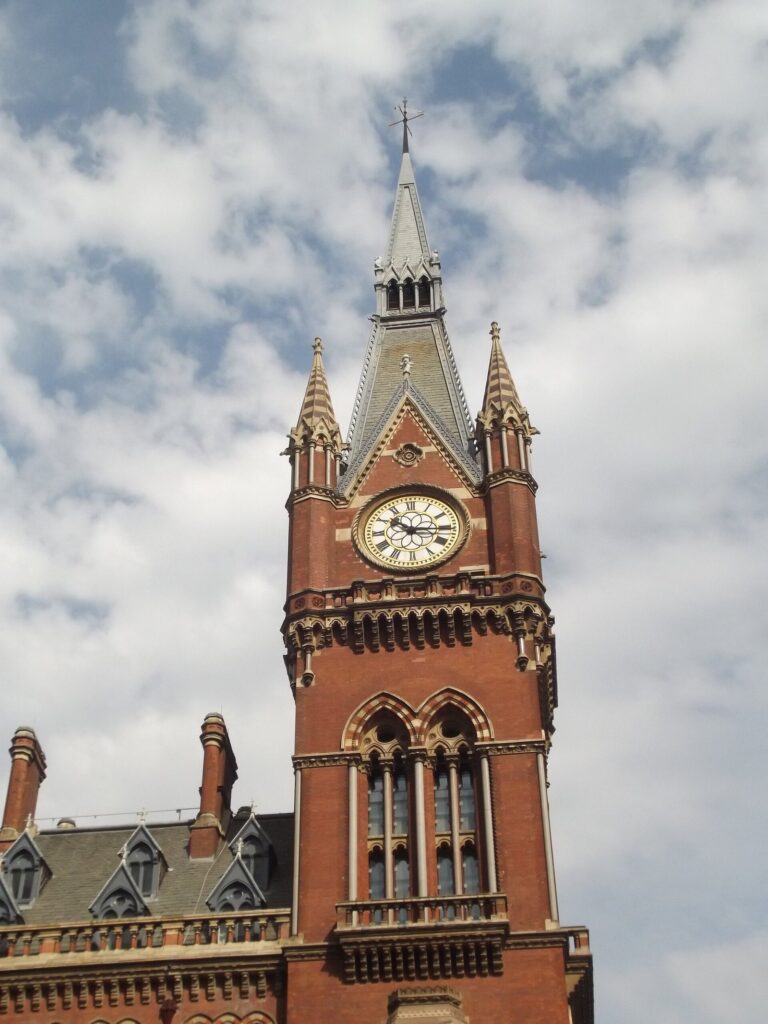
St Pancras is a good station to be early in, as long as you spend the time before check-in rather than after it. The upper concourse, under William Barlow’s great iron-and-glass shed, is open to everyone. The Eurostars wait under the old roof, there’s a long champagne bar beside their platforms, and two well-known statues hold court: The Meeting Place, a 9-metre bronze of a couple embracing, and John Betjeman, the poet who campaigned to save the station from demolition in the 1960s. There are public pianos on the concourse, too.
If you have an hour or more, walk out of the station. King’s Cross, a few minutes to the north, has been regenerated, and its new streets have far better food than a station sandwich. The British Library is next door on Euston Road, and its Treasures gallery, free to enter, is a better way to spend an hour than a departure lounge.
Ticket gates and security
Scan the barcode on your ticket at the automatic gates and you’re into security. It’s airport-style: bags through the scanner, you through the arch. The big difference is liquids. There’s no limit, so water bottles, full-size toiletries and a bottle of wine can stay in your bag, although Eurostar does restrict how much alcohol you carry. Eurostar’s prohibited-items list covers specified knives, tools and flammable substances, with exceptions such as certain small non-locking pocketknives, nail polish and hairspray; check it before packing if you’re travelling with tools, camping gear or sports kit.
Allow for queues at passport control as well. A first-time EES registration, with fingerprints and a photo, takes longer than a glance at a passport, and on a busy afternoon several hundred people are doing it for the same train.
Passports, EES and ETIAS at St Pancras
After security comes French passport control. Because Britain and France run juxtaposed border controls, you enter the Schengen area at St Pancras rather than in Paris, and you walk off the train at Gare du Nord without another queue. It’s worth keeping Europe’s three clubs straight here: the UK is outside the EU, Schengen and the eurozone, while France is inside all three, so you’re changing border regime and currency in the same two hours.
What you need depends on your passport.
- British passports. Your passport must have been issued less than 10 years before the day you arrive in the Schengen area and be valid for at least three months after the day you plan to leave. Short visits are capped at 90 days in any 180; time spent in the UK and Ireland doesn’t count towards that total.
- EU, EEA and Swiss citizens. A quick document check and you’re through. The Entry/Exit System doesn’t apply to you.
- Everyone else. Americans, Canadians, Australians and other visa-free visitors can stay up to 90 days in any 180-day period, the same limit British travellers have. If your nationality needs a Schengen visa, you’ll need it before you board.
The Entry/Exit System (EES). Since 10 April 2026, the EU’s Entry/Exit System has been fully operational at every Schengen external border, including the French controls at St Pancras. It replaces passport stamps with a digital record. The first time you cross, visa-free non-EU travellers, British included, register their fingerprints and a photo of their face; children under 12 don’t give fingerprints. Short-stay visa holders have only their photo stored in EES, as their fingerprints are already held with the visa, and holders of long-stay visas and residence permits are exempt. There’s no fee. Each entry and exit record is normally kept for three years, and your file as a whole for three years and a day after your last exit if you don’t come back in that time, so a regular traveller’s file stays on record between trips. St Pancras has EES kiosks, and Eurostar’s recommended arrival time is meant to cover the registration.
ETIAS. The EU’s planned online travel authorisation for visa-free visitors, British travellers included, isn’t running yet. It was pencilled in for the last quarter of 2026, but as of late September 2026 no start date has been set: the EU’s official ETIAS pages say only that the date will be announced several months in advance, and industry reports point to 2027. When it does arrive, it will cost €20 (free for under-18s and over-70s) and last three years or until your passport expires, and there will be a transition period of at least six months in which you can still enter without one. Apply only through the official EU website when the time comes: the French foreign ministry already warns about fraudulent ETIAS sites.
Inside the departure lounge
Once you’re through passport control, you’re in the departure lounge, with seating, cafés, shops and toilets. Seating fills up before busy departures, so don’t count on chairs for the whole group. When your train is ready, boarding is announced and you head up to the platform. The trains are long, so check your coach number on the ticket before you start walking.
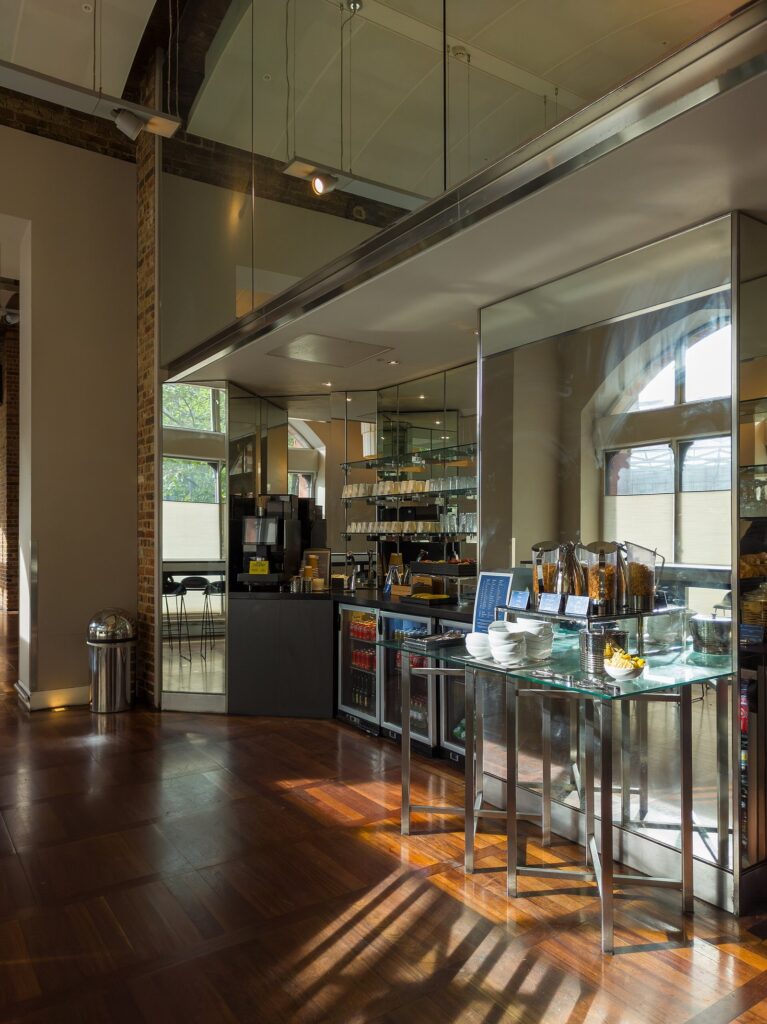
Premier passengers wait in Eurostar’s own lounge instead. Everyone else should do their food shopping before check-in: the station’s shopping arcade has far more choice than the departure area, and a picnic bought there costs less than the café-bar on board.
Left luggage and last-minute errands
If you’re filling a day in London before an evening train, St Pancras has a left-luggage service: expect about £10 for up to three hours and £15 for up to 24 hours. It’s also a good moment to sort out Paris transport tickets. Paper Metro tickets are no longer sold, and the official apps let you load tickets onto a compatible phone, which saves a queue at the machines at Gare du Nord.
| When | What to do |
|---|---|
| A week before | Check passport issue and expiry dates; confirm your ticket and seats |
| The day before | Check Eurostar’s travel updates for strikes or engineering work; download your ticket |
| Eurostar’s recommended arrival time | Arrive at St Pancras International |
| After the ticket gates | Security, then French passport control and EES registration if it applies to you |
| Before departure | Ticket gates close; once they have, you won’t be let through |
| Boarding announcement | Head up to the platform and find your coach |
What can you take on the Eurostar?
Eurostar’s luggage rules are the most generous way to cross the Channel short of driving: no weight limit, no liquids rule and a proper suitcase allowance in every class.
| Allowance | Standard | Plus | Premier |
|---|---|---|---|
| Large bags | 2 | 2 | 3 |
| Small bag or daypack | 1 | 1 | 1 |
| Maximum length per bag, London routes | 85 cm | 85 cm | 85 cm |
| Weight limit | None | None | None |
| Liquids | No restriction | No restriction | No restriction |
The 85 cm limit applies on routes to and from London; on Eurostar’s continental routes it’s 75 cm. There’s no weight limit, but you’ll be lifting your own bags onto the racks, so pack for your arms rather than for a scale. Label every bag with your name before you leave; on a full train, three identical black suitcases can easily end up side by side.
Extra bags, bikes, instruments and sports kit
On London routes, anything beyond the allowance is booked and paid for separately. When booked at least 48 hours ahead, the 2026 charges are:
| Item | Charge on London routes, booked 48+ hours ahead |
|---|---|
| Extra bag | £35 |
| Oversized item | £60 |
| Bike | From £45 |
| Musical instrument | From £35 |
| Registered sports equipment (skis and snowboards can count as one of your normal bags instead) | From £45 |
On Eurostar’s continental routes, extra items cost €30 each and are paid on the day. A folding bike that packs down into a bag within the 85 cm limit travels as ordinary luggage, which makes it the cheapest way to take a bike to Paris.
Food, drink and alcohol
Bring whatever you like to eat. There’s no liquids rule, and a picnic from the St Pancras shops is cheaper, and usually better, than anything from the café-bar. Alcohol is the exception to the free-for-all: Eurostar limits how much you can carry, so check the current allowance before packing more than a bottle to share on board.
Pets and assistance dogs
Pets can’t travel on Eurostar trains to or from London, though they’re welcome on many of its continental routes, and registered assistance dogs and cats are accepted if you meet Eurostar’s requirements and arrange it in advance. If the dog is coming to France too, the usual answer is to drive and cross on Le Shuttle, which takes pets travelling in cars with the right paperwork.
Verdict: pack as you would for a train, not a budget airline: two proper bags, a daypack and whatever liquids you want, as long as you can lift it all yourself.
What is the Eurostar journey like?
Two and a quarter hours is short enough that nobody needs a plan for it, but knowing what’s on board helps you decide what to bring and where to sit.
Seats, sockets and Wi-Fi
Wi-Fi is free in every class, and London trains have both UK and European sockets, so you don’t need an adaptor for your phone or laptop on board. Treat the Wi-Fi as a bonus rather than something to build a working day around, and download anything important before you leave St Pancras: tickets for onward trains, your hotel’s address and a map of the Metro.
Big cases go in the luggage racks; keep yours within sight of your seat if you can, and put valuables in the bag that stays with you. Coats and small bags fit on the overhead shelf.
Food and drink on board
In Standard, food and drink come from the café-bar coach, or from whatever you’ve brought with you. Plus brings a light meal and drinks to your seat, and Premier serves fine dining with drinks at your seat. Nobody needs a formal lunch on a train this short, but a coffee and a sandwich at a table, with the French countryside going past at 300 km/h, is a pleasant way to arrive.
The route, stage by stage
The Eurostar is no scenic railway, but the route has a few moments worth looking up for.
Leaving London. Trains slip into a tunnel soon after they clear the St Pancras train shed, pass through Stratford without stopping, surface on the Essex marshes and then cross under the Thames into Kent.
Kent. The line passes Ebbsfleet (no stop), crosses the Medway Viaduct near Rochester and goes through the North Downs Tunnel, before running alongside the motorway past Ashford towards Folkestone. The Medway crossing, with the river spread out below, is the best view on the English side.
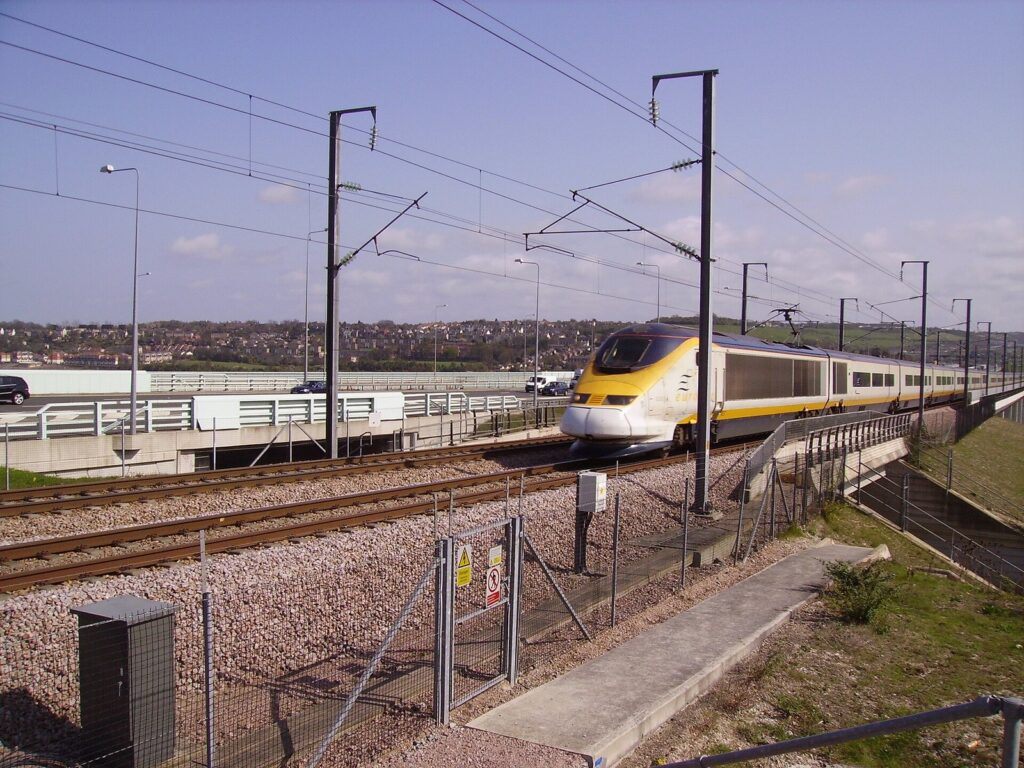
The tunnel. The portal is just outside Folkestone. Inside, the train keeps to 160 km/h, the windows go black, and about 20 minutes later you’re back in daylight at Coquelles, near Calais.
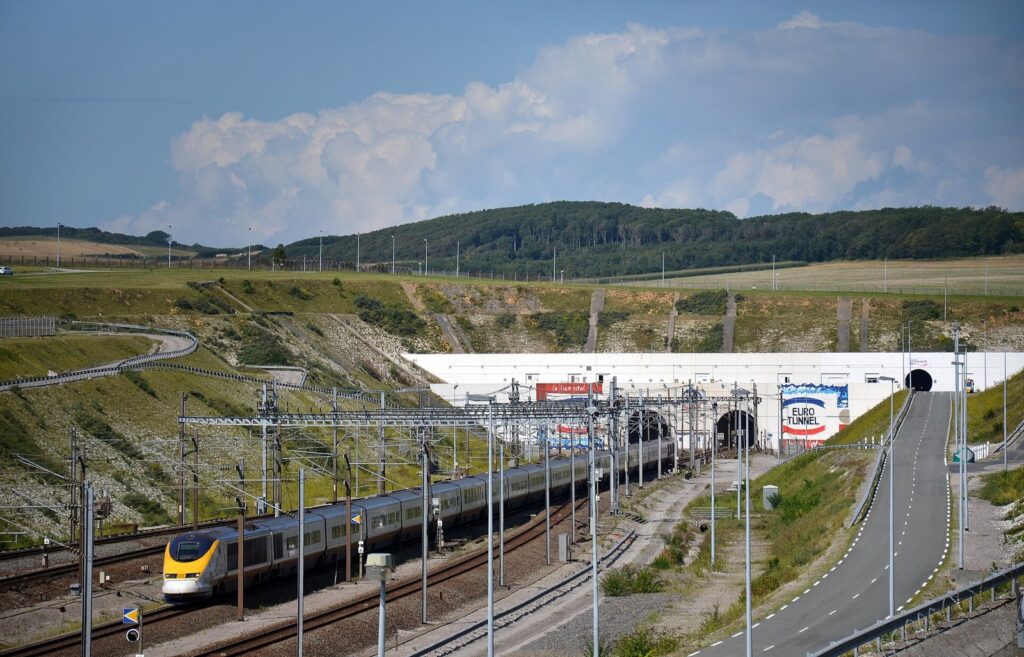
France. The line cuts inland towards Lille, swings south past Arras and runs across the open farmland of Picardy, where the speed climbs back to 300 km/h. The last stretch passes the Stade de France at Saint-Denis before the train slows through the northern suburbs into Gare du Nord.
London to Paris makes our list of the best train routes in Europe for its convenience rather than its views, and that’s the right way to think about it: this is a train for arriving somewhere, not for gazing out of the window.
Which train will you get?
Two types of train run between London and Paris, and you can’t choose between them when you book.
- The e320. Built by Siemens and in service since 2015, these are the newer trains, in the blue-and-yellow livery, with a brighter, more modern interior.
- The e300. The original Eurostar fleet from the 1990s, since refurbished inside and repainted. The journey time is the same.
The red ex-Thalys trains you’ll see at Gare du Nord and in Brussels never run to London. The seat map at booking shows the layout of the train you’ve been given, which is the easiest way to tell which type you’re on.
Travelling with children
The Eurostar is one of the easiest ways to take children abroad: no weight limit on the bags, no liquids rule for the milk and snacks, room to stretch their legs and tables for colouring books.
- Fares. Children under 4 travel free on an adult’s lap, and child fares apply from 4 to 11. If you want a seat for a toddler, book one.
- Passports. Every child needs their own passport. Under-12s are photographed for EES but aren’t fingerprinted.
- The way home. If your children don’t hold British or Irish passports, each one needs their own UK ETA to enter Britain, babies included; the return-journey section below has the details.
- Disneyland Paris. Remember the four-month sales window and the change at Lille, and plan the day around the connection.
Accessibility and assistance
Eurostar offers assistance at its stations for travellers with reduced mobility and sells dedicated wheelchair-user fares, so book both in advance rather than on the day. If you’re continuing across Paris or beyond, book assistance for the onward train with that operator as well, and check how the handover between the two will work before you travel.
Can you do Paris as a day trip on the Eurostar?
Yes, but it’s a long day. Take the first train from St Pancras; the timetable for your date shows when it reaches Gare du Nord, and remember that Paris is an hour ahead. Then work back from the evening: allow for security and passport checks before your train home and for the Metro back to the station, and you have most of a day in Paris rather than all of it.
How to make it work:
- Pick one area. A day is enough for the Louvre and the Tuileries, or Montmartre and the Canal Saint-Martin, or the Left Bank. Adding the Eiffel Tower to any of them is how a day trip turns into a Metro marathon.
- Book both trains early. A day trip needs two fixed departures, and early Standard fares cost a fraction of same-week ones. The free exchange up to an hour before departure is your safety net if the day runs long, provided you change before the cut-off and a later train has seats.
- Leave a margin at the end. Know when the last train home leaves: missing it can mean a night in Paris, and whether you need a new ticket depends on your fare’s conditions and why you missed it. Aim to be at Gare du Nord by Eurostar’s recommended arrival time, not a minute later.
- Travel light. If everything fits in a daypack, you won’t need left luggage, and security is quicker.
Verdict: a day trip is fine for a single museum, a birthday lunch or a first taste of the city. One night makes a far better trip, though: you get the evening, a slower morning and a much less frantic journey home. If the fares allow it, I’d always book the night.
Arriving at Paris Gare du Nord
Because the French checks happened in London, arriving is the easy part. You step off the train, walk the length of the platform and you’re in Paris, with no passport queue waiting. Customs officers can stop anyone they choose, but most people walk straight out.
Gare du Nord is one of the busiest stations in Europe, and on a first visit it can feel like a lot at once: commuter trains, regional services, the red ex-Thalys trains to Brussels and Amsterdam, and crowds who all seem to know exactly where they’re going. The signage is good, though, and everything you need is either underneath the station or a few minutes’ walk away.
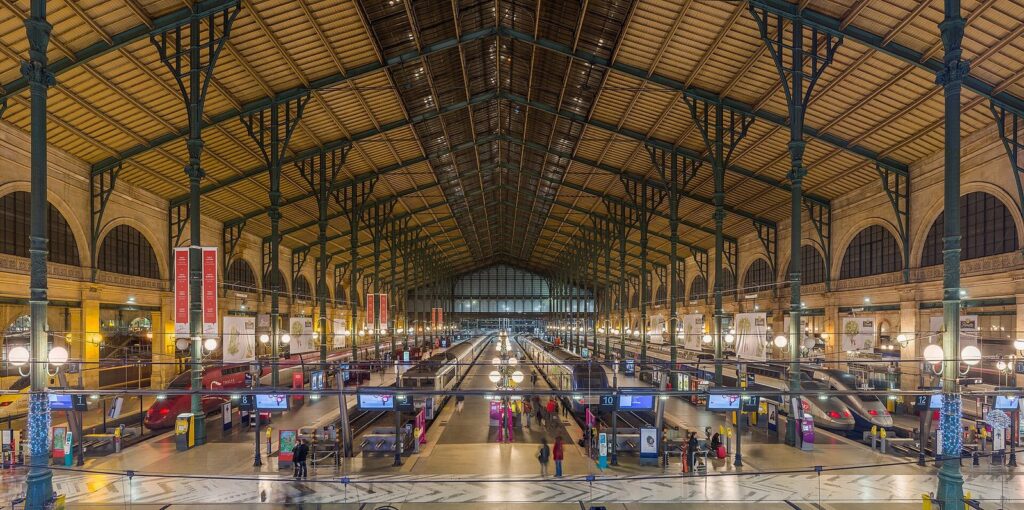
Finding your way out of Gare du Nord
- Metro lines 4 and 5 and RER lines B and D run underneath the station. Follow the M and RER signs down from the concourse.
- RER E stops at Magenta, linked to Gare du Nord by underground passages.
- Metro line 2 stops at La Chapelle, a short walk away, and runs to Montmartre.
- Gare de l’Est is a few minutes’ walk to the south-east, for Metro line 7 and for trains to eastern France and Germany.
- Taxis wait at the official rank; follow the Taxis signs. Licensed Paris taxis carry a “TAXI PARISIEN” sign on the roof.
Paris transport tickets in 2026
Paris overhauled its public transport tickets in 2025, so advice from a few years ago about paper t+ tickets no longer applies. The new system is simpler.
| Ticket | Price in 2026 | Best for |
|---|---|---|
| Metro-Train-RER single | €2.55 | Any Metro, RER or suburban train journey in Île-de-France, except to and from the airports |
| Bus-Tram single | €2.05 | Buses and trams |
| Paris Region to airports | €14 | RER B to Charles de Gaulle and Metro 14 to Orly |
| Navigo Easy card | €2 | Holding single tickets and day passes; paper tickets stopped on 1 November 2025 |
| Navigo Jour | €12.30 | Five or more journeys in a day, across all zones |
| Navigo Semaine | €32.40, plus €5 for the card | Stays that line up with a Monday-to-Sunday week; needs a passport-style photo |
The single ticket is a flat fare, so a ride from Gare du Nord out to Versailles or Disneyland costs the same €2.55 as a two-stop hop, as long as you’re travelling by Metro, RER or train. For a three- or four-day stay, I’d pick up a Navigo Easy card (or use the official app on a compatible phone) and load single tickets as you go; the day pass only pays off on days when you’re criss-crossing the city.
From Gare du Nord to your hotel
| Heading for | Easiest route from Gare du Nord | Worth knowing |
|---|---|---|
| Louvre and the Tuileries | Walk to Gare de l’Est, then Metro 7 to Palais Royal–Musée du Louvre | No change of train; or Metro 4 to Châtelet, then Line 1 |
| Le Marais | Metro 4 to Châtelet, then Line 1 to Hôtel de Ville or Saint-Paul | Or RER B or D one stop to Châtelet–Les Halles and walk east |
| Saint-Germain-des-Prés | Metro 4, no change | Line 4 also serves Odéon and Saint-Sulpice |
| Latin Quarter | RER B to Saint-Michel Notre-Dame or Luxembourg | Two or three stops |
| Eiffel Tower | RER B to Saint-Michel Notre-Dame, then RER C to Champ de Mars–Tour Eiffel | One change |
| Montmartre | Metro 2 from La Chapelle to Anvers, or walk uphill | Sacré-Cœur is a steep climb from Anvers |
| Opéra and the department stores | Walk to Gare de l’Est for Metro 7 to Chaussée d’Antin–La Fayette or Opéra | Or RER E from Magenta to Haussmann–Saint-Lazare |
| Bastille | Metro 5, no change | Line 5 also stops at République |
| Canal Saint-Martin | Walk | The canal runs just east of Gare de l’Est |
| Montparnasse | Metro 4, no change | For trains to Bordeaux and Brittany |
| Charles de Gaulle airport | RER B, no change | €14 airport ticket; 25–35 minutes |
If you’re hauling heavy bags south of the river, a taxi from the official rank can be worth the money. For almost everywhere else, the Metro is quicker than it looks on the map.
Flying on from Paris: Gare du Nord to the airports
Gare du Nord is the best-placed station in Paris for Charles de Gaulle. RER B runs direct to the airport in 30 to 40 minutes, on the €14 Paris Region to airports ticket, which lets you transfer onto connecting Metro or RER trains within two hours. For Orly, take RER B or D one stop to Châtelet–Les Halles and change onto Metro line 14, which now runs to the airport on the same €14 ticket. The long-promised CDG Express, a dedicated airport train from Gare de l’Est, isn’t open yet; it’s due to open on 28 March 2027.
If you’re flying straight off the Eurostar, be generous with the margin. A late train, a slow RER and airport security add up quickly, and a missed flight costs far more than a missed Metro.
Should you stay near Gare du Nord?
The streets around Gare du Nord and Gare de l’Est are convenient rather than pretty. Rue de Dunkerque and the boulevard de Magenta are lined with budget hotels, cafés and people wheeling suitcases, and the immediate area can feel scruffy after dark. It makes sense for one night before an early train home; it isn’t the Paris most people come for.
For a longer stay, the 9th arrondissement around rue des Martyrs, or the Canal Saint-Martin side of the 10th, keeps you within walking distance of the station and in far more pleasant surroundings. Hotel prices in all of these areas follow the calendar more than the postcode: trade fairs, big sporting events and the summer holidays push them up, and midweek winter stays are the cheapest.
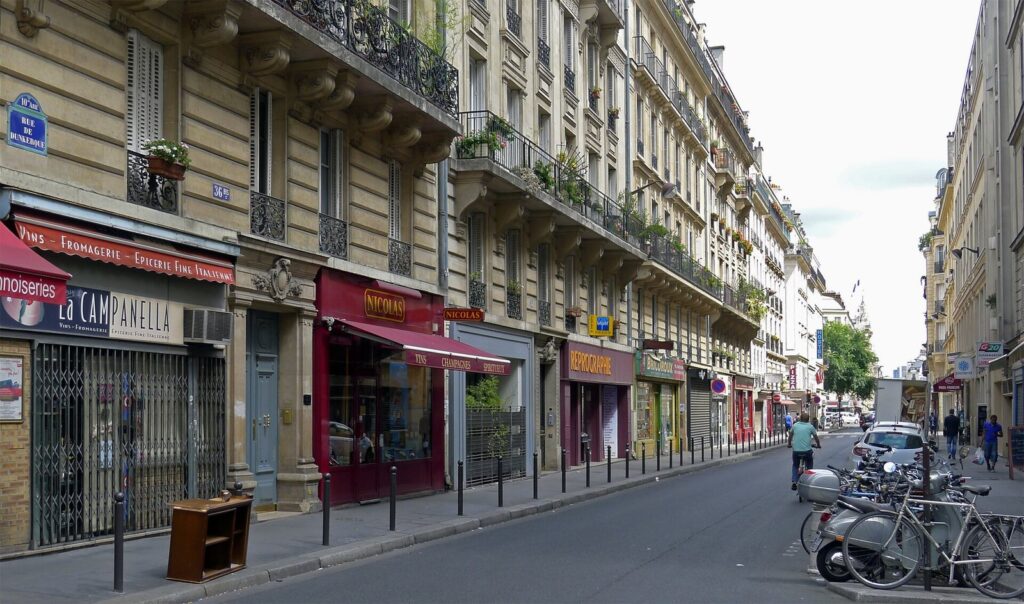
For what to do once your bags are down, see our guide to the best things to do in Paris; for a long weekend, our 3-day Paris itinerary fits neatly around a Eurostar there and back.
Scams and safety at Gare du Nord
- Taxi touts. People offering a “taxi” inside the station or at the end of the platform are not licensed drivers. Walk past them to the official rank.
- Ticket-machine helpers. Someone offering to help you buy a ticket at the machines usually expects to be paid, or worse. Use the app, or the machine, yourself.
- Clipboards and petitions. A request for a signature is usually the opening move in a request for money. A polite “non, merci” and keep walking.
- Pickpockets. Crowded RER B and D trains and the station concourse are prime territory. Keep your phone and wallet in a zipped pocket and your bag in front of you on the escalators.
None of this is unique to Gare du Nord. It’s simply one of Europe’s busiest stations, and busy stations attract people who work the crowds.
Going beyond Paris by train
Paris has six big mainline stations, and most onward trains leave from one of the other five, so carrying on south, east or west usually means crossing the city. Treat that crossing as a separate journey with its own buffer.
| Station | Getting there from Gare du Nord | Where the trains go |
|---|---|---|
| Gare du Nord | You’re already there | Brussels, Amsterdam and Cologne on the ex-Thalys Eurostar; Lille and the rest of northern France |
| Gare de l’Est | A few minutes’ walk | Strasbourg, Reims, Luxembourg, Frankfurt and Stuttgart |
| Gare de Lyon | RER D, two stops | Lyon, Provence, the Riviera, the Alps, Geneva, Lausanne, Basel and Zurich, Turin and Milan, Barcelona |
| Gare Montparnasse | Metro 4, no change | Bordeaux, Brittany, the Loire valley and the Basque coast |
| Gare d’Austerlitz | Metro 5, no change | Orléans, Limoges and Toulouse, plus French night trains to the Pyrenees and the Alps |
| Gare Saint-Lazare | RER E from Magenta, one stop | Normandy, including Rouen, Caen and Le Havre |
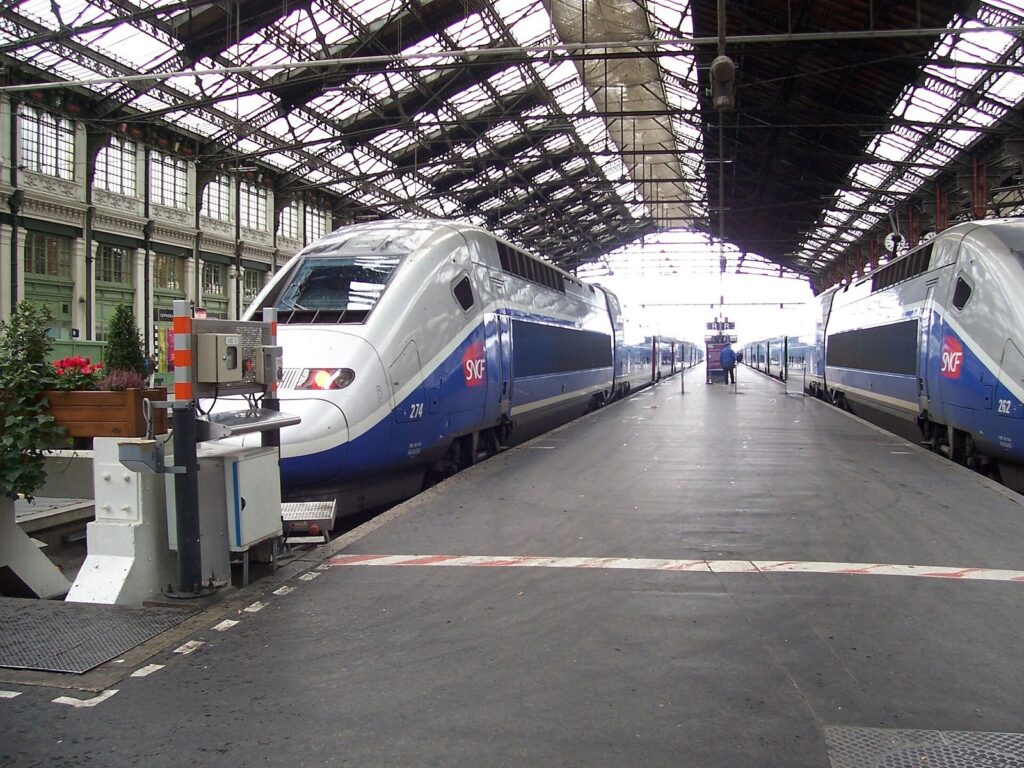
How much time to leave between trains
If your onward train leaves from Gare du Nord itself, an hour between the Eurostar’s scheduled arrival and your departure is enough on most days. If you’re changing stations, I’d leave at least 90 minutes, and two hours if it’s the last train of the day, if you’re travelling in the rush hour or if you’ve got heavy luggage. That sounds generous until your Eurostar is 40 minutes late and the RER is crawling.
French timetables run on French time. Check the arrival time on your Eurostar ticket against Paris time before you plan the next leg, because it’s easy to slip back into London time on your phone.
What if a late Eurostar makes you miss a connection?
It depends on how you booked.
- One through booking. Eurostar sells TGV INOUI, Lyria, SNCB and Deutsche Bahn connections on the same booking. Before you buy, check whether it’s sold as one through journey; if it is, a late Eurostar becomes the railway’s problem to solve rather than yours.
- Separate tickets. The Agreement on Journey Continuation, a voluntary scheme coordinated by the European rail association CER, can help. Its members include SNCF, SNCB, Deutsche Bahn, SBB, Trenitalia and Renfe, and Eurostar appears on the list as THI Factory/Eurostar. If a late train makes you miss a member’s service, ask for a delay or cancellation confirmation and show it, with your tickets, to staff of the operator whose train you missed.
- The catch. The agreement doesn’t pay for hotels, taxis or meals, and it doesn’t cover compensation. If a missed connection would cost you a night in Paris, a through booking or travel insurance is the safer bet.
Combining Paris, Brussels and Amsterdam in one trip
Eurostar’s network makes a neat loop without a single flight: London to Paris, on to Brussels and Amsterdam on the ex-Thalys trains, then straight back to London from Amsterdam. It’s one of the easiest multi-city trips in Europe, and every leg runs from city centre to city centre.
| Leg | Train | Journey time | Fares and fees |
|---|---|---|---|
| London to Paris | Eurostar | 2h16 fastest | From £39 in Standard; rail pass reservation €35 |
| Paris to Brussels | Eurostar (ex-Thalys) | Under 1h30 | Rail pass reservation €27 in Standard, €32 in Plus |
| Brussels to Amsterdam | Eurostar (ex-Thalys) | About 1h50 | Rail pass reservation €22 in Standard, €27 in Plus |
| Brussels to Amsterdam, the relaxed way | EuroCity Direct | 2h08 | Hourly; no reservation needed with a pass |
| Paris to Amsterdam, direct | Eurostar (ex-Thalys) | 3h20 | From €35 one way, subject to availability; rail pass reservation €32 in Standard, €37 in Plus |
| Amsterdam to London | Eurostar | 4h19 | Rail pass reservation €35 in Standard, €43 in Plus |
The direct Paris–Amsterdam trains run nine or ten times a day and call at Brussels and Rotterdam, so you can stop off or go straight through. Two things catch people out. The ex-Thalys trains need a ticket with a reservation, so you can’t simply turn up and board. And passholders face a quota here too: places are often gone today but back tomorrow, so don’t plan on booking on the day. The hourly EuroCity Direct between Brussels and Amsterdam is the easy-going alternative, with no reservation to worry about if you hold a pass. It takes 2h08 to Amsterdam Zuid, against around 1h52 to Amsterdam Centraal on the Eurostar, so compare the whole journey to where you’re staying.
For a longer version with more stops, see our western Europe itinerary.
If Paris is only the first stop, the rest of the network opens up from here. Our Europe train itinerary shows how to string the big cities together by rail, and if Italy is next, the 10-day Italy itinerary picks up from there. Sleepers get their own guide in night trains in Europe, and our guide to Interrail routes maps the pass-friendly ways onward. For passes, booking rules and everything in between, our Europe-wide rail planning guide brings it all together.
Paris to London: the return journey
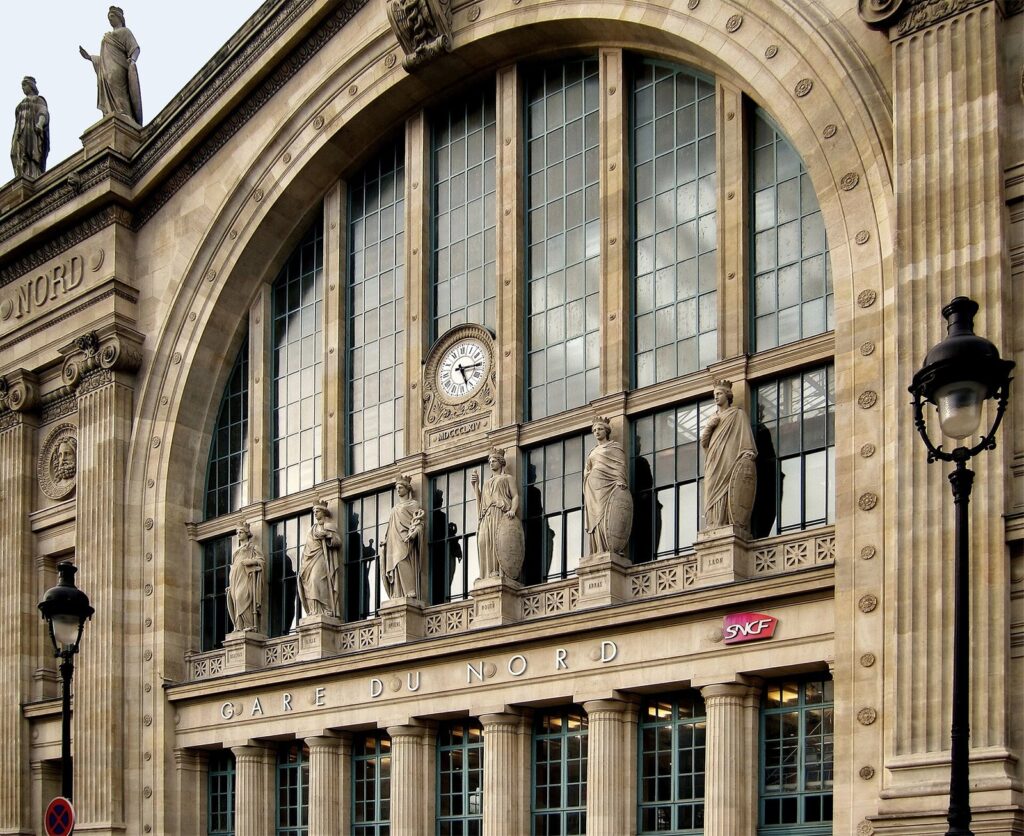
A last afternoon near Gare du Nord
An evening train home leaves the afternoon free, and there’s no need to spend it dragging a suitcase across the city. Luggage-storage shops cluster around the station, and a short walk or a couple of Metro stops takes you somewhere worth your time:
- Canal Saint-Martin. Iron footbridges, locks and canal-side cafés, just east of Gare de l’Est.
- Marché Saint-Quentin. A 19th-century covered market on the boulevard de Magenta, good for cheese, bread and wine to take home or to eat on the train.
- Passage Brady. A narrow covered arcade near Strasbourg–Saint-Denis lined with Indian and Pakistani restaurants, and one of the best-value lunches in central Paris.
- Montmartre. Uphill from Anvers, with Sacré-Cœur at the top and the whole city below. Leave more time than you think for getting back down.
- The department stores. Metro 7 from Gare de l’Est runs to Chaussée d’Antin–La Fayette for a last look under the Galeries Lafayette dome.
Whatever you choose, work backwards from the recommended arrival time on your ticket rather than the departure time, and add a margin for the Metro.
Checking in at Gare du Nord
The Eurostar terminal at Gare du Nord is upstairs, on the level above the main concourse; follow the signs for London. The process mirrors St Pancras in reverse: ticket gates, security, then two sets of border checks, both before you board. French officers check you out of the Schengen area first, recording your exit in EES if the system covers you (Schengen long-term residents, for one, are exempt), and then UK Border Force checks you into Britain. When you reach St Pancras, there’s no passport queue.
The Paris terminal is tighter than St Pancras and queues build quickly before busy trains, so arrive in good time and don’t cut it fine. As in London, the gates shut before departure and nobody gets through late. Buy food before you go upstairs; a sandwich from one of the bakeries around the station beats most of what’s on offer inside.
Do you need a UK ETA?
If you’re not British or Irish, almost certainly. The UK’s Electronic Travel Authorisation is now required for most visitors who don’t need a visa, including EU citizens, Americans, Canadians and Australians.
- Who needs one. Most visa-free visitors. British and Irish passport holders don’t, and nor does anyone with permission to live, work or study in the UK.
- The cost. £20.
- Children. Every traveller needs their own ETA, including babies and children.
- What it covers. Visits of up to six months to the UK, Jersey, Guernsey or the Isle of Man for tourism and certain other reasons, for multiple trips over two years or until your passport expires, if that’s sooner.
- Transit. You need one even if you’re only passing through UK border control on the way somewhere else.
- No guarantee. An ETA doesn’t guarantee entry; the Border Force officer still decides.
- Where to apply. Only through GOV.UK or the official UK ETA app. GOV.UK warns that other websites may charge more.
EU citizens should also note that the UK no longer accepts most national ID cards for entry: bring a passport.
Arriving at St Pancras
Step off, walk the platform and head out through the customs channels into the station. From there the whole of London’s transport network is under your feet, and trains to the rest of Britain leave from St Pancras itself, from King’s Cross across the road and from Euston, a short walk away.
Delays, strikes and cancellations: what are your rights?
Most Eurostar days are uneventful. When things do go wrong, they tend to go wrong for everyone at once: a failed train in the tunnel, a strike or a heatwave can disrupt a whole day’s timetable, and extreme heat has cancelled Eurostar trains in recent summers. Knowing your rights makes those days cheaper.
| Arrival delay at your destination | Compensation |
|---|---|
| Under 60 minutes | None |
| 60 to 119 minutes | 25 per cent of the ticket price |
| 120 minutes or more | 50 per cent of the ticket price |
Those are the minimum rates under EU rail passenger rights, and compensation has to be paid within a month of your request. Claims go through Eurostar’s own compensation page.
When compensation doesn’t apply
The EU rules exclude delays caused by extreme weather, major natural disasters, pandemics, people on the tracks, cable theft, emergencies on board, police activity, sabotage and terrorism. Strikes by the railway’s own staff are a different matter: they don’t count as extraordinary circumstances, so compensation still applies.
Cancellations and long delays
If your train is cancelled, or you’re expected to arrive at least an hour late, EU rules let you choose between a refund, carrying on with your journey or being re-routed later at a time that suits you. On strike days, check Eurostar’s travel updates before you set off for the station rather than finding out at the gates.
Travel insurance
Compensation covers a share of your ticket, not the knock-on costs: a lost hotel night, a missed flight home or an expensive last-minute TGV. That’s what travel insurance is for, and it’s worth checking that yours covers strikes and missed connections before you book anything non-refundable at the other end.
What are the alternatives to Eurostar?
| Option | Journey time, central London to central Paris | Best for | The catch |
|---|---|---|---|
| Eurostar | 2h16–2h37 on board, plus check-in | Almost everyone | Peak fares climb fast |
| Flying | A little over an hour in the air, plus airports at both ends | People who live near an airport | Transfers at both ends, liquids rules |
| Coach | Most of a day, or overnight | Tight budgets | Long hours, with a ferry or Le Shuttle crossing |
| Train, ferry and train | A long day | Slow travel, Normandy | Foot-passenger options are limited |
| Driving, via Le Shuttle | 35-minute crossing, then a few hours’ drive to Paris | Families with lots of kit, dog owners | Paris traffic and parking |
Flying
Flights from Heathrow, Gatwick, London City and the other London airports are sometimes cheaper than a late-booked Eurostar, and they make sense if you live near an airport or you’re connecting onto a long-haul flight at Charles de Gaulle. Watch where you land. Charles de Gaulle is on RER B and Orly is now on Metro line 14, but Paris Beauvais is a long coach ride from the city.
Coach
Coaches run from London to Paris with operators such as FlixBus, crossing the Channel by ferry or on Le Shuttle. The trip takes many hours longer than the train, and price is the reason to choose one. On a date when the Eurostar is expensive and your budget isn’t, it’s a legitimate option; on any other date, the train’s extra cost buys back most of a day.
Ferry and train
The slow way still works. The Newhaven–Dieppe crossing links trains from London with trains from Dieppe towards Rouen and Paris, and Brittany Ferries sails from Portsmouth to Caen for Normandy. Foot-passenger options on the short Dover–Calais crossings are limited, so check before you plan a trip around them. It makes sense if you’re heading for Normandy anyway, or you like the idea of arriving by sea; as a quick way to reach Paris, it doesn’t.
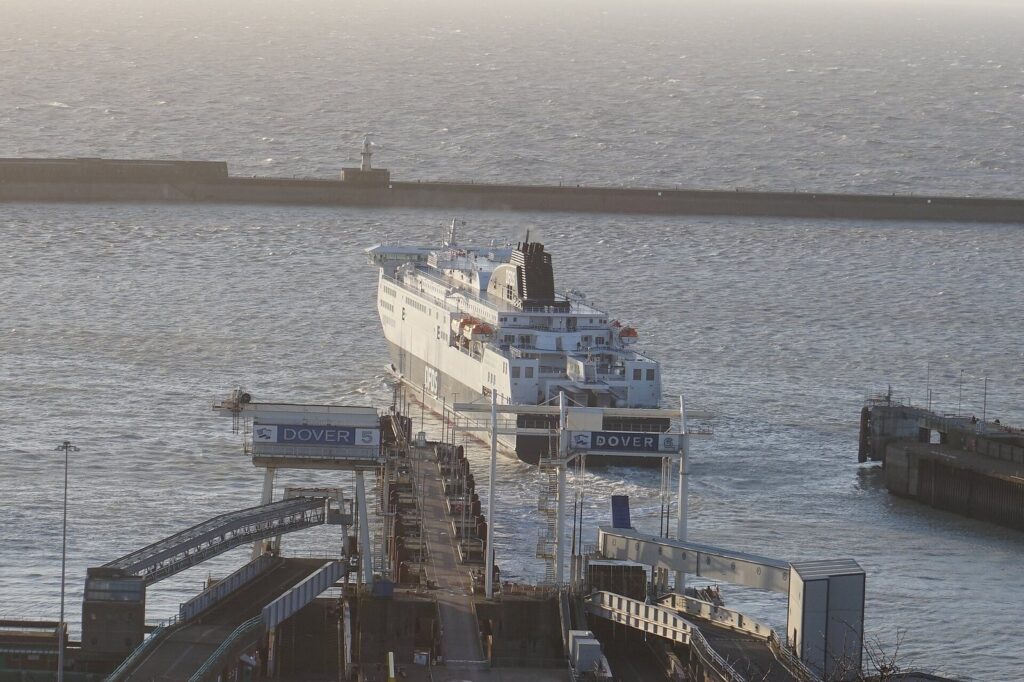
Driving with Le Shuttle
Le Shuttle carries cars from Folkestone to Calais in 35 minutes, and from Calais, Paris is a drive of a few hours. It’s the answer for families with a boot full of kit and for anyone travelling with a dog. It’s the wrong answer for a Paris city break: you’ll need a Crit’Air clean-air sticker to drive in the city, parking is expensive, and the Metro is faster than your car.
For the bigger picture on moving around the continent by train, bus and plane, see our guide to getting around Europe.
Verdict: for nine trips in ten, the Eurostar is the right answer. Drive if the dog or the kit is coming; fly if the airport is on your doorstep and the train is expensive; take the coach only if every pound counts and your time doesn’t.
Eurostar mistakes to avoid
- Treating the departure time as your arrival time. Security and French passport control both come before the platform, and the gates shut before the train leaves. Plan your journey to St Pancras around Eurostar’s recommended arrival time, not around the train.
- Missing the 10-year passport rule. British passports must have been issued less than 10 years before you arrive in the Schengen area, as well as having three months’ validity left after you leave. Check the issue date, not just the expiry.
- Paying a lookalike website. ETIAS isn’t running yet, and the UK ETA costs £20 through GOV.UK or the official app. Sites charging more are, at best, a middleman.
- Assuming a rail pass means a free seat. Passholders still pay for a reservation, from €35 in Standard on London routes, and the quota can sell out even when the train has space.
- Leaving too little time in Paris. Changing stations with luggage takes longer than the map suggests. Give it 90 minutes at least.
- Forgetting the time difference. Paris is an hour ahead of London. Onward connections, hotel check-ins and dinner reservations all run on French time.
- Buying Snap with fixed plans. It can’t be exchanged or refunded. If there’s a non-refundable hotel at the other end, buy a normal Standard fare.
- Packing a bag longer than 85 cm. On London routes, bigger items generally need an oversized-luggage booking, from £60 if you request it more than 48 hours ahead, and Eurostar has separate rules for instruments, skis and other special items.
- Taking a taxi from a stranger at Gare du Nord. Use the official rank, or the Metro.
- Waiting for a sale on a peak date. Christmas, Easter and summer Fridays sell out at rising prices. The best time to book those trains is the day you know your dates.
Planning your Eurostar trip: what to book ahead and what to skip
| When | Book or do |
|---|---|
| As soon as your dates are fixed, up to 10–11 months ahead | Eurostar tickets for peak dates |
| As early as you can | Eurostar tickets for everyday trips; compare a few dates for the best chance of a low fare |
| About six months ahead | Rail pass reservations, if you hold a Global Pass |
| About four months ahead | Disneyland Paris tickets via Lille |
| Up to 120 days ahead | TGV INOUI or Lyria connections, if Paris isn’t the end of the line |
| Well before you travel | A UK ETA for anyone heading to London who isn’t British or Irish |
| Seven days before | Last chance to refund a Standard or Plus ticket, minus £25 |
| The day before | Check travel updates; download tickets; set up Paris transport tickets on a Navigo Easy card or your phone |
| On the day | Arrive at St Pancras at Eurostar’s recommended arrival time for your ticket |
Worth skipping:
- Premier for a leisure trip, unless the flexibility is worth real money to you.
- Third-party booking fees on a simple London–Paris ticket; Eurostar sells the same trains directly.
- A taxi from Gare du Nord if you’re travelling light; the Metro and RER start right under the station.
- A Navigo Semaine for a short stay that doesn’t line up with a Monday-to-Sunday week.
- The café-bar for a full meal. Bring a picnic in Standard, or book Plus if you want to be fed.
- An ETIAS application before the EU switches the system on. There’s nothing to buy yet.
Frequently asked questions about the Eurostar
How early should I arrive for the Eurostar?
Eurostar publishes a recommended arrival time on its check-in page, set to allow for security and border checks, including first-time EES registration for non-EU travellers. Once the ticket gates have closed, you can’t board. On Friday afternoons and in school holidays, I’d add a little extra on top.
Do I need a passport for the Eurostar?
Yes. British travellers need a passport issued less than 10 years before they arrive in the Schengen area and valid for at least three months after they plan to leave. EU citizens can show a national ID card at the French check, but most need a passport to get back into the UK. Non-EU travellers also register with the EU’s Entry/Exit System.
How long does the Eurostar take from London to Paris?
The fastest trains take 2 hours 16 minutes from St Pancras to Gare du Nord, and some take up to 2h37. Add your time at St Pancras before departure, and remember that Paris is an hour ahead: a 2h16 train that leaves London at 10:01 arrives at 13:17 local time.
How far in advance should I book the Eurostar?
Eurostar says tickets go on sale 10–11 months ahead. For most trips, book early and compare nearby dates, and for Christmas, Easter, school holidays and summer Fridays I’d book as soon as your dates are fixed. Rail pass places may appear only about six months out, and Disneyland tickets via Lille about four.
Is Eurostar Plus worth it?
Sometimes. Plus gives you a wider seat in a less crowded coach and a light meal with drinks brought to you, with the same luggage allowance and ticket rules as Standard. It’s worth it when the fare gap is small or you need to work on the way. When it costs much more than Standard, the meal alone won’t justify the difference.
Can I take food and drink on the Eurostar?
Yes. There’s no liquids rule at Eurostar security, so you can bring water, coffee, a picnic and toiletries of any size. Standard passengers can also buy snacks and drinks from the café-bar coach, while Plus and Premier include food at your seat. Alcohol is the exception: Eurostar limits how much you can carry, so check before packing extra bottles.
Can I use an Interrail or Eurail pass on the Eurostar?
Yes, with a Global Pass, by paying a passholder fare: €35 in Standard and €40 in Plus from London to Paris, Lille or Brussels, and €35 or €43 to Rotterdam and Amsterdam. Places are limited by quota and sell out on busy trains, so book early. Premier isn’t available on a pass, and One Country Passes don’t qualify.
What is the luggage allowance on the Eurostar?
Standard and Plus passengers can take two large bags plus one small bag, and Premier passengers three plus one. On London routes each bag can be up to 85 cm long. There’s no weight limit and no liquids rule, but you’ll lift your own bags onto the racks. Extra bags cost £35 each on London routes if booked 48 hours ahead.
What happens if my Eurostar is delayed?
If you reach your destination 60 to 119 minutes late, EU rail passenger rights entitle you to 25 per cent of the ticket price; at two hours or more, it’s 50 per cent. Compensation must be paid within a month of your claim. Extreme weather, people on the track and similar events are excluded, but strikes by the railway’s own staff are not.
Does the Eurostar have Wi-Fi and plug sockets?
Yes. Wi-Fi is free in every class, and trains on London routes have both UK and European sockets, so you don’t need an adaptor on board. Treat the Wi-Fi as a bonus rather than a guarantee, and download anything important, from onward tickets to a Metro map, before you leave St Pancras.
Final thoughts
The Eurostar is at its best when you treat it like a train rather than a flight: book early, pick Standard unless the gap to Plus is small, arrive at the recommended time on your ticket and let Gare du Nord do the rest. Its real advantage isn’t the 2h16 on board but the hours it saves at each end, and the way it drops you straight onto the Metro. If this is your first trip across the Channel, our first-time Europe itinerary and two-week Europe itinerary are good places to plan what comes next. Once you’re in Paris, the rest of Europe’s rail network is only a Metro ride away.
Related Europe guides
- How to Book European Train Tickets: booking the continental trains after the Eurostar
- Eurail vs Interrail: Which Pass to Get: which pass covers the Eurostar passholder fare
- High-Speed Trains in Europe: the TGVs and ICEs you can connect to in Paris
- Things to Do in Paris: what to do once you are off the train
- Europe by Train for Beginners: rail basics for a first trip beyond the Channel
Sources and verification
Prices, timetables and rules in this guide were checked on 27 September 2026 against the official sources below. It is compiled from those sources rather than from other travel lists, and it does not describe first-hand visits. Fares, opening hours and entry rules change, so confirm with the operator before you book.
- Eurostar Help Centre: features and ticket conditions of the three travel classes
- Eurostar Help Centre: how far in advance you can book
- EU: official ETIAS website, frequently asked questions
- GOV.UK: apply for an electronic travel authorisation (ETA)
- RATP: the Metro-Train-RER ticket
- Your Europe: rail passenger rights
- CER: Agreement on Journey Continuation
- Ashford Borough Council: Bring Back Eurostar campaign
Hannah Brooks has spent fifteen years travelling, living and writing across Europe, from the Arctic tip of Norway to the south of Sicily. She has planned hundreds of European itineraries for readers and is Senior Europe Editor at EuropeanTourism.org.
Photo credits
- Eurostar guide: two blue and yellow e320 trains side by side at the platforms of Paris Gare du Nord (top photo): photo by RAIL P (RAIL.PHOTOGRAPHY), Wikimedia Commons (CC0)
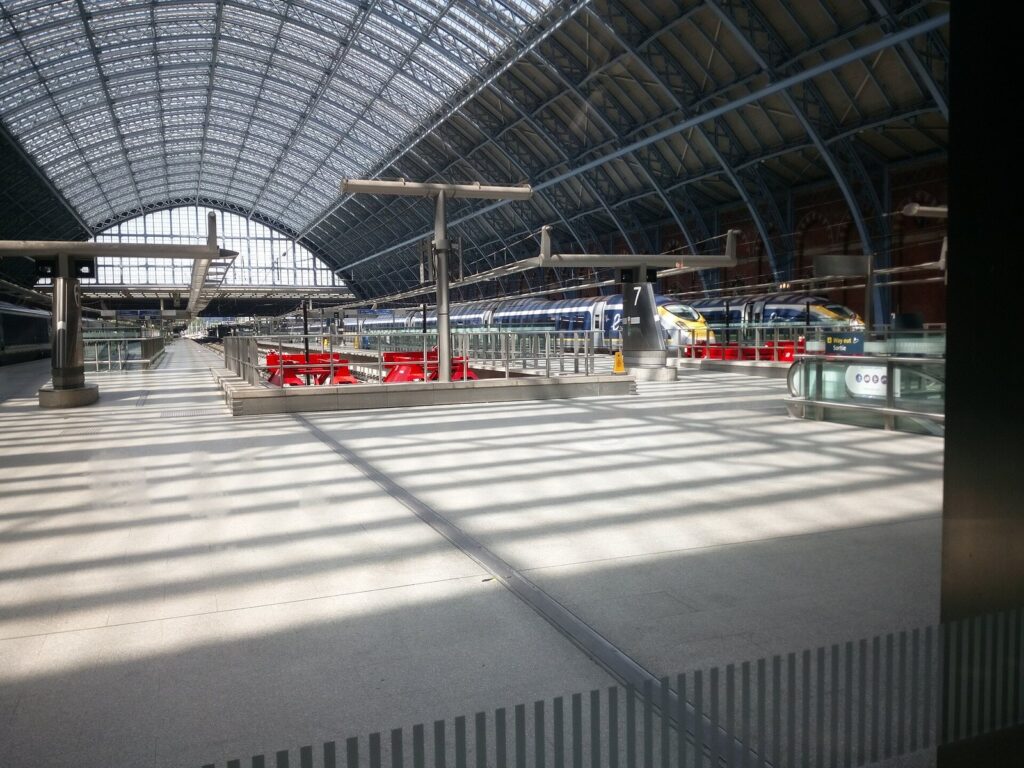
- Eurostar trains waiting under the Victorian iron and glass train shed at St Pancras International: photo by Someone Not Awful, Wikimedia Commons (CC BY-SA 4.0)
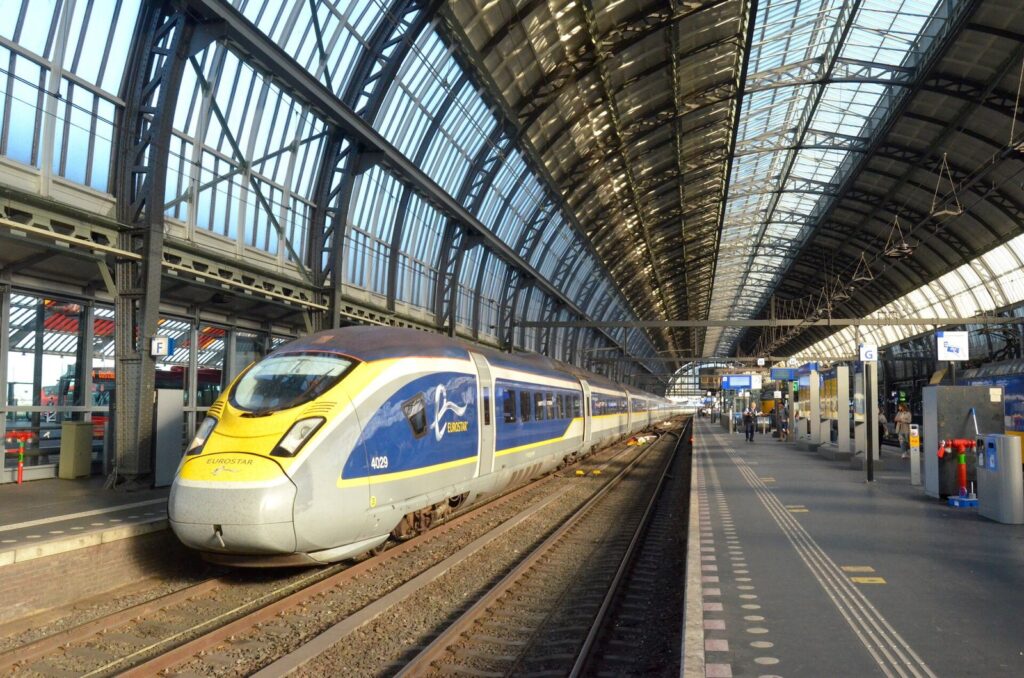
- A blue and yellow Eurostar e320 under the arched glass roof of Amsterdam Centraal: photo by Eriksw, Wikimedia Commons (CC BY-SA 4.0)
- Station building of Marne-la-Vallée–Chessy, the stop for Disneyland Paris, on a sunny day: photo by Sneeuwvlakte, Wikimedia Commons (CC BY-SA 4.0)
- Rows of grey Standard seats with lime-green headrests in a refurbished Eurostar e300 coach: photo by Superalbs, Wikimedia Commons (CC BY-SA 4.0)
- Wide leather-look seats in single and paired rows in a first-class coach of a Eurostar e320: photo by MaxEmanuel, Wikimedia Commons (CC0)
- Bar counter, coffee machines and seating inside the Eurostar lounge at St Pancras International: photo by Matti Blume, Wikimedia Commons (CC BY-SA 4.0)
- Red-brick Gothic clock tower of St Pancras station against a cloudy London sky: photo by Elliott Brown from Birmingham, United Kingdom, Wikimedia Commons (CC BY-SA 2.0)
- Eurostar train in the old white and yellow livery coming off the Medway Viaduct in Kent: photo by Kenneth Yarham, Wikimedia Commons (CC BY-SA 2.0)
- Eurostar train emerging from the Channel Tunnel portal at Coquelles, near Calais: photo by Billy69150 (voir les conditions d’utilisation / see, Wikimedia Commons (CC BY-SA 4.0)
- Wide view of the Gare du Nord concourse and platforms, seen from the balcony level: photo by Diliff, Wikimedia Commons (CC BY-SA 3.0)
- Shops, cafés and Parisian apartment blocks along rue de Dunkerque in the 9th arrondissement: photo by Mbzt, Wikimedia Commons (CC BY-SA 4.0)
- Double-deck TGV trains at the platforms under the roof of Paris Gare de Lyon: photo by Nelson Pérez, Wikimedia Commons (CC BY-SA 3.0)
- Stone facade of Gare du Nord with statues along the roofline and a tall arched window: photo by Velvet, Wikimedia Commons (CC BY-SA 3.0)
- White DFDS ferry sailing out of the Port of Dover past the harbour wall: photo by Ian S, Wikimedia Commons (CC BY-SA 2.0)