Most Scenic Train Journeys in Europe
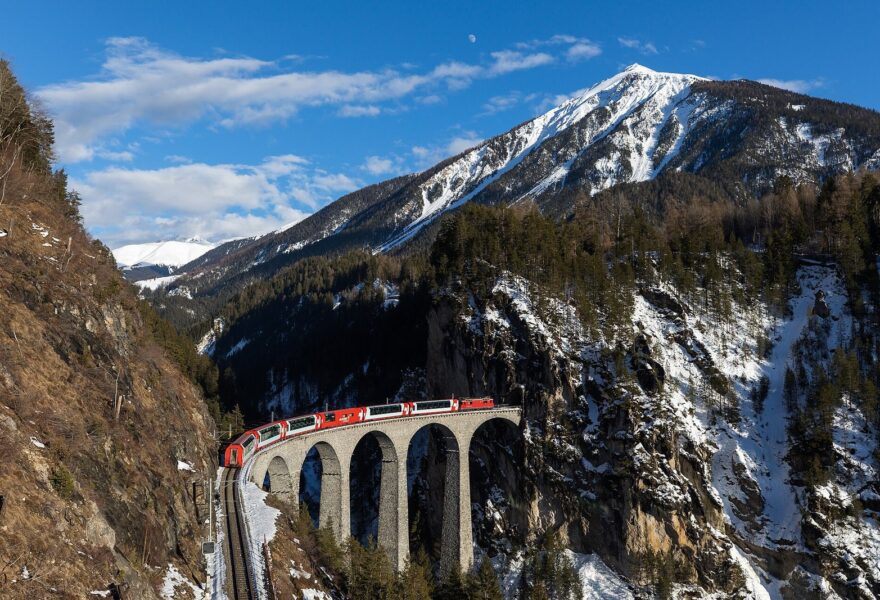
The finest scenic train rides Europe has to offer run over the Alps on the Bernina line to Tirano, across Norway’s Hardangervidda on the Bergen Railway, through the West Highlands to Mallaig and up Portugal’s Douro valley. Most are ordinary timetabled trains, so the view comes at a normal fare rather than a tour price.
This guide is for travellers who want the window to be the point of the trip: one famous panoramic train, or a fortnight of mountain lines strung together on a rail pass. If you’re new to European rail, start with our complete guide to train travel in Europe. The caveat that matters is the calendar, because several of these trains are seasonal and late autumn is when they rest. Checked against official sources in September 2026.
Here’s the shortlist I’d start from, with 2026 prices.
| Journey | Route | Time | Cost (2026) | Best for | Book ahead? |
|---|---|---|---|---|---|
| Bernina Express | Chur–Tirano | about 4h | CHF 66 in 2nd class plus a CHF 40–44 reservation | glacier to Italian vineyards in a morning | yes, May to October |
| Glacier Express | Zermatt–St. Moritz | about 8h | CHF 220 in 2nd class, reservation included | the full Alpine crossing | yes; seats open 93 days ahead |
| GoldenPass Express | Montreux–Interlaken Ost | 3h15 | from CHF 76 | lakes, pasture and chalets | in summer |
| Centovalli Railway | Locarno–Domodossola | 1h45–2h | CHF 47 single | gorges on a short detour | no |
| Bergen Railway | Oslo–Bergen | 6h30–7h30 | Lowfare tickets if booked early | a whole day across a high plateau | yes, as early as you can in summer |
| Flåm Railway | Myrdal–Flåm | about 1h | roughly NOK 400–540 one way | a fjord valley in an hour | 2–3 weeks in summer |
| West Highland Line | Glasgow–Mallaig | about 5h20 | advance fares from £19.50 | moor, lochs and Glenfinnan | for the cheap fares |
| Linha do Douro | Porto–Pocinho | 3h20 | €15.10 single | river and vineyards on a budget | no |
| Middle Rhine | Cologne–Koblenz–Mainz | about 3h | regional fare or Deutschland-Ticket | castles, hop on and off | no |
| Belgrade–Bar | Belgrade–Bar | 11h | €23.80 in 2nd class | canyons and giant viaducts | buy at the station |
Which is the most scenic train ride in Europe?
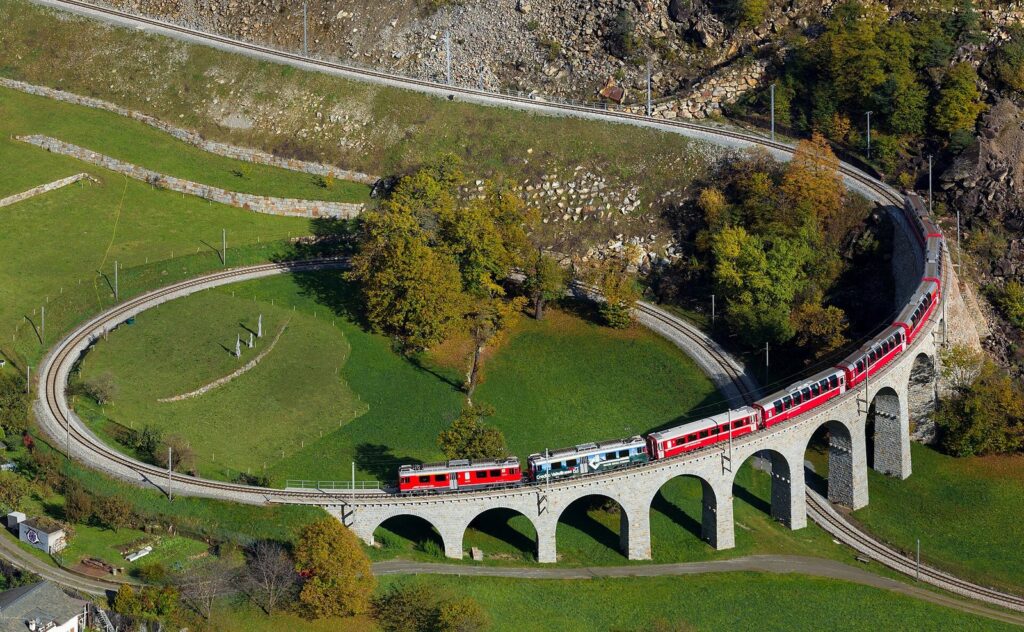
If I could ride only one line, it would be the Bernina, from St. Moritz down to Tirano. The train climbs past the Morteratsch glacier to Ospizio Bernina, 2,253 metres up, skirts Lago Bianco, looks across to the Palü glacier from Alp Grüm and then corkscrews down steep gradients to the Brusio spiral viaduct and the vineyards of the Valtellina. No other line in Europe packs that much change into a single morning. And you can ride it on an ordinary regional train.
The rest comes down to what you want from the window.
| If you want | Ride | Why |
|---|---|---|
| the most drama in a morning | Bernina line, St. Moritz–Tirano | glacier to vineyard on a single line |
| a full day of changing scenery | Bergen Railway, Oslo–Bergen | forest, bare plateau and western valleys in 6h30–7h30 |
| the best value | Linha do Douro, Porto–Pocinho | 3h20 of river and terraced vineyards for €15.10 |
| Britain’s best | West Highland Line to Mallaig | Rannoch Moor, sea lochs and the Glenfinnan Viaduct |
| a short detour | Centovalli, Locarno–Domodossola | gorges and bridges in under two hours |
| something raw | Belgrade–Bar | 254 tunnels and 435 bridges in 11h |
| no planning at all | Middle Rhine or Semmering | ordinary trains, no reservations |
| snow | Glacier Express or Bergen Railway in winter | white country outside, a heated carriage inside |
How I chose: every journey here earns its place on what you see from the seat, not on the dining car or the paintwork. I’ve weighed the view per hour against the cost, and flagged every line where a branded panoramic train and an ordinary one share the same rails. Luxury and heritage trains get their own sections, with a straight answer on whether they’re worth the money.
This isn’t a list of the fastest ways between cities. For those, see our 33 best train routes in Europe and the guide to high-speed trains in Europe. Sleepers have their own page on night trains in Europe, which is just as well: most of the scenery below would be wasted in the dark.
Switzerland: the scenic train rides Europe does best
Swiss mountain railways were built to climb, not to hurry. Four of them are sold as branded panoramic trains, and the reservation rules differ from one to the next: the GoldenPass Express, for one, can be ridden in first or second class with no reservation at all, just without a guaranteed seat. Every one of those lines also carries ordinary trains that cost less. Know which one you’re paying for before you book.
| Train | Route | Time | Full fare, 2026 | Reservation | Season |
|---|---|---|---|---|---|
| Glacier Express | Zermatt–St. Moritz | about 8h | CHF 166 (2nd), CHF 284 (1st) | compulsory: CHF 54, or CHF 590 Excellence | none from 11 October to 4 December 2026 |
| Bernina Express | Chur–Tirano | about 4h | CHF 66 (2nd), CHF 113 (1st) | compulsory: CHF 40 low season, CHF 44 peak; CHF 32 on St. Moritz–Tirano trains | all year |
| GoldenPass Express | Montreux–Interlaken Ost | 3h15 | from CHF 76 | Prestige class only, CHF 49 | check the timetable |
| Gotthard Panorama Express | Lucerne–Lugano | about 5h30 | from CHF 164 | compulsory: CHF 24 in 2026, CHF 28 in 2027; second-class Swiss Travel Pass holders also need an upgrade | 17 April–17 October 2027 |
| Centovalli Railway | Locarno–Domodossola | 1h45–2h | CHF 47 single | usually none; €1.50 supplement on listed panorama trains | all year |
| Jungfrau Railway | Interlaken Ost–Jungfraujoch | – | CHF 224.40 return, 1 November–12 December 2026 | compulsory 1 May–31 October 2027: CHF 10 return | all year |
Bernina Express: Chur or St. Moritz to Tirano
The Rhaetian Railway (RhB) runs the Bernina Express from Chur, Davos and St. Moritz over the Bernina Pass to Tirano, just across the Italian border. From Chur it takes about four hours over 144 km. The trains cross 196 bridges and pass through 55 tunnels, and the Albula and Bernina lines have been a UNESCO World Heritage site since July 2008. There’s no rack: those steep gradients are climbed on adhesion alone, which is why they look so unlikely from the window.
From Chur you get the Albula section first. The Landwasser Viaduct runs straight into a tunnel in a cliff face, then the line spirals up through tunnels above Bergün and drops into the Engadine. After St. Moritz comes the high ground, and then the long fall through the Poschiavo valley to the Brusio spiral viaduct.
The panoramic cars need a seat reservation on top of the fare, and in 2026 it’s priced by train rather than by distance. On the long-route trains from Chur it costs CHF 40 in low season and CHF 44 in peak season (2 May–25 October), as of September 2026; on the short-route trains from St. Moritz it’s CHF 32 all year. The fares themselves are CHF 66 in second class or CHF 113 in first from Chur to Tirano, and CHF 33 or CHF 57 from St. Moritz. Children under 6 travel free and those aged 6 to 16 pay half the fare, but everyone pays the reservation in full, Swiss Travel Pass, GA, Eurail and Interrail holders included. If you want the occasion rather than the glass, RhB’s Pullman Class uses 1930s-style coaches with personal service, capped at 32 passengers a journey.
Two warnings. The Bernina Express Bus from Tirano to Lugano is a coach, not a train, whatever the name suggests. And from Thursday 29 October to Friday 13 November 2026, engineering work diverts trains 951 and 952 through the Vereina Tunnel instead of over the Albula line, so those departures miss the Landwasser Viaduct. If the viaduct is the point, pick other dates.
Onward travel is easy. Trenord’s regional trains from Tirano to Milan cost €12.50 in second class and €19 in first, bought on the day.
Verdict: the finest mountain railway in Europe. Ride it southbound in the morning, and read the panoramic-versus-regional section below before paying for the glass.
Glacier Express: Zermatt to St. Moritz
Run jointly by the Matterhorn Gotthard Bahn and the Rhaetian Railway, the Glacier Express takes about eight hours from Zermatt to St. Moritz, covering 291 km over 291 bridges and through 91 tunnels. Meals are cooked on board and served at your seat. The high points, literally, are the climb from Andermatt to the Oberalp Pass and the Rhine Gorge (Ruinaulta) between Ilanz and Reichenau; the Albula section and the Landwasser Viaduct come near the end.
The full route costs CHF 166 in second class or CHF 284 in first, plus a compulsory CHF 54 reservation in either class, so CHF 220 all in for second. The reservation stays at CHF 54 however short the ride, which makes short sections poor value: Brig–Zermatt is CHF 41 and Chur–Zermatt CHF 129 before it, and the Brig–Zermatt hop is sold only on selected summer trains. Excellence Class adds a CHF 590 reservation, with a five-course menu, to a first-class ticket or pass. Children under 6 travel free, and those aged 6 to 16 pay half the fare but the full reservation. Rail passes don’t get you out of it either: Swiss Travel Pass, Eurail and Interrail holders all pay the same CHF 54, whatever the length of the journey.
Tickets go on sale 180 days ahead and seat reservations 93 days ahead. For July and August, book four to six weeks out at the latest; in winter, three to four weeks usually works. Skis, golf bags, bicycles, e-scooters and oversized luggage aren’t carried, so send big cases ahead by luggage service.
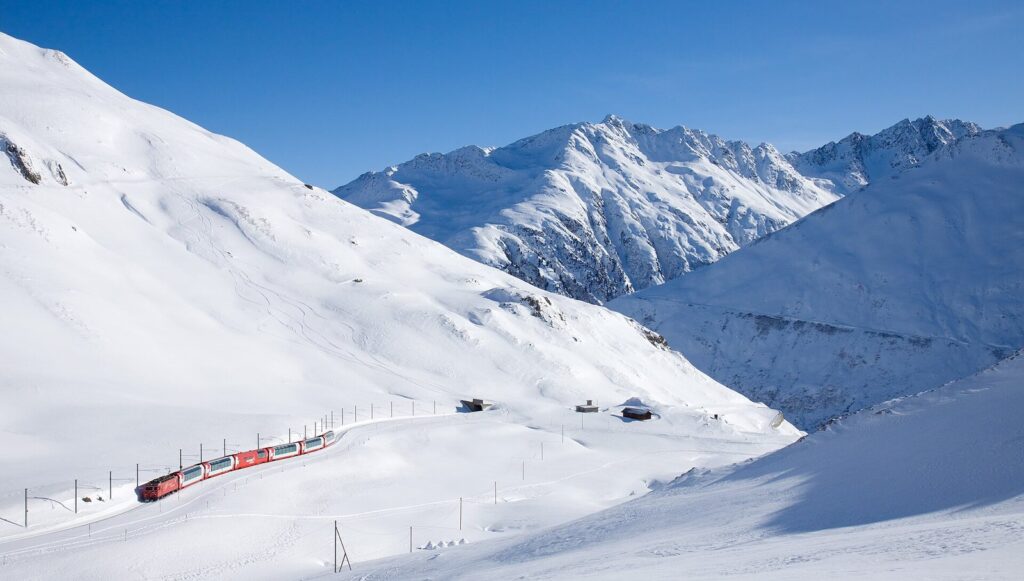
Now the calendar. There’s no Glacier Express at all from 11 October to 4 December 2026. The winter season runs from 5 December 2026 to 7 May 2027, with extra trains (the 920 and 905) from 12 December to 3 January and from 30 January to 7 May; engineering works affect some April dates, so check the timetable before you book. July to September gives snow-free passes; January to March gives deep snow.
Verdict: worth doing once, in high summer or deep winter, if eight hours in one seat sounds like a treat. If it doesn’t, take regional trains over the best sections and spend the saving on a night in Zermatt.
GoldenPass Express: Montreux to Interlaken
For more than a century this trip meant changing trains at Zweisimmen, where the metre-gauge MOB met the standard-gauge BLS. The GoldenPass Express ended that with variable-gauge bogies, so one train now runs through from Montreux to Interlaken Ost in 3h15, via the Pays-d’Enhaut and Gstaad. There are four departures a day, in three classes: Prestige, first and second.
Expect lake views, pasture and chalets rather than glaciers: the climb above Lake Geneva out of Montreux, the Saane valley around Gstaad, then Lake Thun from Spiez. Point-to-point singles start at CHF 76 and go on sale up to six months before the journey. Only Prestige needs a reservation, at CHF 49 between Interlaken and Montreux. Swiss Travel Pass holders ride the rest of the train free, and Eurail and Interrail holders pay a fee of €4.40–24.40.
To make a full day of it, carry on from Interlaken over the Brünig line to Lucerne, which completes the whole GoldenPass route between Lucerne and Montreux on several trains.
Verdict: the gentlest Swiss panoramic ride and the easiest to fit between Geneva and the Bernese Oberland. I’d skip Prestige; second class looks at the same lakes.
Gotthard Panorama Express: Lucerne to Lugano by boat and train
This one starts on the water. A lake boat takes you from Lucerne to Flüelen at the far end of Lake Lucerne, where a first-class panoramic train picks up the old Gotthard mountain line. It loops around Wassen, whose church you see three times from three different levels, then drops into Ticino for Bellinzona and Lugano. In 2026 the boat left Lucerne at 11:12 and reached Flüelen at 13:55; the train left at 14:09 and pulled into Lugano at 16:41. Northbound, it left Lugano at 09:18.
The whole trip takes about 5h30. In 2026 the adult fare was CHF 164 plus a compulsory CHF 24 reservation, so CHF 188 in all; for 2027 the reservation goes up to CHF 28. A first-class Swiss Travel Pass covered both legs, leaving only the reservation to pay, while second-class passholders also paid a CHF 31.50 upgrade. First-class Eurail and Interrail holders paid CHF 41 on top of the reservation. The 2026 season ran daily from 18 April to 18 October, and the next one runs from 17 April to 17 October 2027.
Verdict: a lovely day when the weather’s clear, but a slow and pricey way over the Alps. On a budget, take a regular Lake Lucerne boat and then SOB’s ordinary Treno Gottardo over the same mountain line, in second class.
Centovalli Railway: Locarno to Domodossola
The Vigezzina-Centovalli line links Locarno, on Lake Maggiore, with Domodossola in Italy: 52 km of narrow gauge through the Centovalli, the “hundred valleys”, and the Val Vigezzo, in about 1h45 to 2 hours. Expect gorges, chestnut woods and high bridges, on ordinary regional trains or panorama trains. A second-class single costs CHF 47, and the Vigezzina-Centovalli tourist return starts at CHF 31. The Swiss Travel Pass and GA cover the line, even on the Italian section; listed panorama departures add a €1.50 supplement, and any seat reservation charge is still payable.
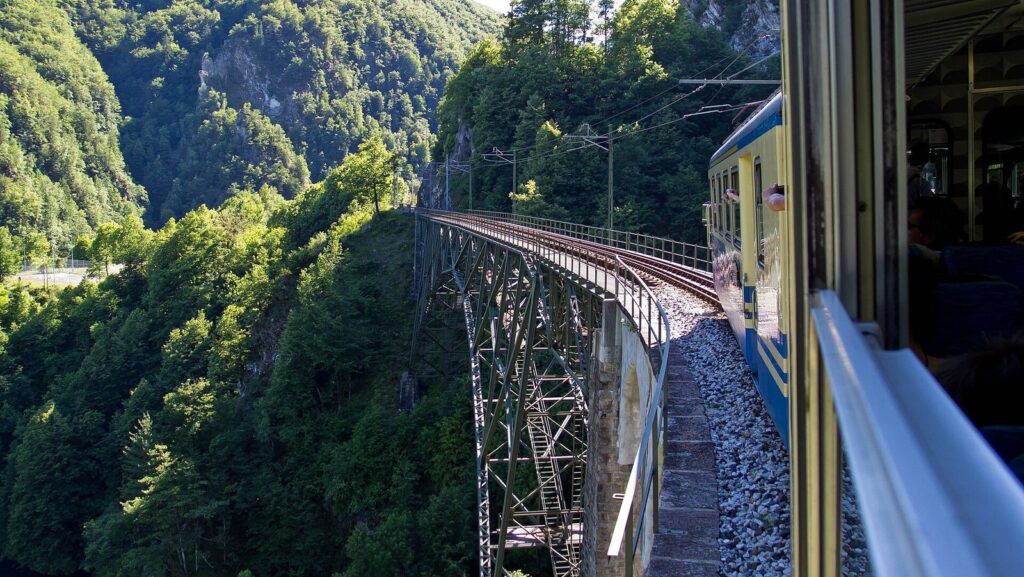
Because it links the Gotthard and Simplon main lines, it makes a loop possible: Lucerne to Locarno via the Gotthard, the Centovalli to Domodossola, then the Simplon line to Brig for Zermatt or Lake Geneva.
Verdict: the best short scenic ride in Switzerland for the money, and the ordinary trains need no booking at all.
Jungfrau Railway: Interlaken to the Jungfraujoch
From Kleine Scheidegg, the rack railway tunnels up through the Eiger and the Mönch to the Jungfraujoch, at 3,454 metres the highest railway station in Europe. In the 2026 summer season an adult return cost CHF 261.20 from Interlaken Ost or CHF 239.20 from Grindelwald or Wengen, and from 1 November to 12 December 2026 the return from Interlaken Ost is CHF 224.40. From 1 May to 31 October a CHF 10 return seat reservation is compulsory between Kleine Scheidegg and the Jungfraujoch.
The saving is the Good Morning Ticket: 20% off, valid only on the first two connections up and for a descent by the 13:17 at the latest, and it can’t be combined with Half Fare reductions. Its 2026 season ended on 31 October, so check jungfrau.ch for next season’s dates and fares. Eurail and Interrail holders get 25% off. Most of the final climb is inside the mountain, so the scenery is on the way up to Kleine Scheidegg and at the top.
Verdict: go only on a clear day, and look at the summit webcam before you pay. Otherwise the Wengernalp railway to Kleine Scheidegg gives you the Eiger, Mönch and Jungfrau for much less.
Is a panoramic train worth the supplement?
Often not. On every Swiss line above, an ordinary train runs on the same rails, and RhB’s own comparison makes the case plainly. Regional trains on the Bernina line run on the normal timetable with more departures, a seat reservation is optional at CHF 5 per person and route, and their windows, fitted with sun shades, can be opened. The Bernina Express runs on selected departures only, with panoramic windows, free Wi-Fi, a minibar and on-board information. A Swiss Travel Pass, GA or day pass covers both; on the panoramic train you pay the reservation as well.
| Line | Branded train | Ordinary alternative | You give up | You gain |
|---|---|---|---|---|
| Bernina | Bernina Express, CHF 32–44 reservation | RhB regional trains, optional CHF 5 reservation | roof-high glass, minibar, commentary | opening windows, more departures, stops where you like |
| Glacier | Glacier Express, CHF 54 reservation | MGB and RhB regional trains, in stages | one through train, meals at your seat | a night in Andermatt or Disentis, a lower bill |
| GoldenPass | Prestige class, CHF 49 reservation | first or second class on the same train | Prestige seats and service | CHF 49 |
| Gotthard | Gotthard Panorama Express, CHF 164 plus a CHF 24 reservation in 2026 | Lake Lucerne boat, then the Treno Gottardo | a first-class panorama coach | second-class fares |
My rule: ride the branded train once, on the line you care about most, and use regional trains for everything else. Photographers should take the regional trains anyway. On a sunny day panoramic glass reflects the carriage back at you; an open window doesn’t.
If you’re travelling on a rail pass, the full Glacier and Bernina routes are covered and only these supplements cost extra; the pass section further down has the details.
Austria and Germany: mountain passes and castle valleys
Austria and Germany have no Glacier Express, and they don’t need one. Their best scenic lines are ordinary routes on ordinary fares, which makes them the easiest in Europe to ride on a whim.
| Line | Route | Reservation | Cost | Best for |
|---|---|---|---|---|
| Semmering Railway | Gloggnitz–Mürzzuschlag | none | normal ÖBB fare | 19th-century engineering |
| Salzkammergut line | Stainach-Irdning–Attnang-Puchheim | none | normal ÖBB fare | lakes and Hallstatt |
| Arlberg line | Innsbruck–Bludenz | optional | Railjet fare | a scenic Vienna–Zurich trip |
| Brenner line | Innsbruck–Bolzano | optional | EuroCity fare | the Alps on the way to Italy |
| Middle Rhine | Koblenz–Bingen | none | €15–25 day ticket or Deutschland-Ticket | castles, hop on and off |
| Black Forest Railway | Offenburg–Konstanz | none | regional fare or Deutschland-Ticket | loops and tunnels |
| Brocken Railway | Wernigerode–Brocken | – | HSB fare | steam |
Semmering Railway: Gloggnitz to Mürzzuschlag
Carl Ritter von Ghega built the Semmering line between 1848 and 1854, and in 1998 it became the first railway on the UNESCO World Heritage list. From Gloggnitz, at 436 metres, it climbs to a summit of 895 metres in 29 km, then drops to Mürzzuschlag at 677 metres: 41 km in all, with 14 tunnels, 16 viaducts and more than 100 curved stone bridges. The two-storey Kalte Rinne viaduct is the view everyone waits for.
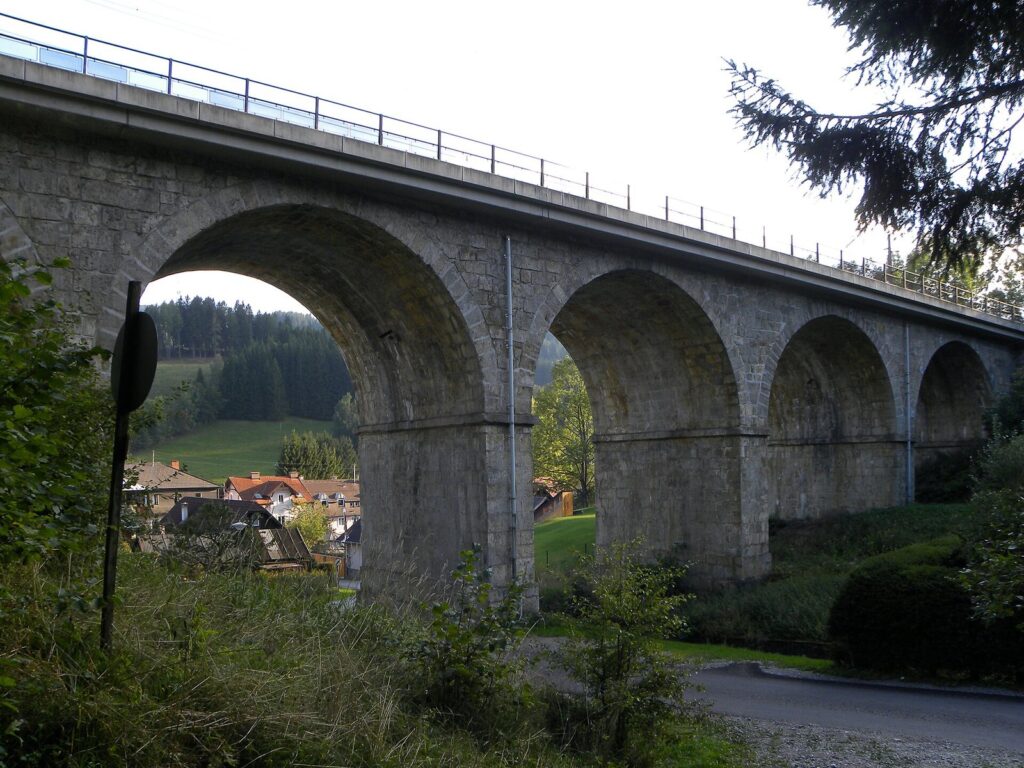
There’s no tourist train to book. ÖBB’s ordinary trains between Vienna and Graz run over the pass, so a normal ticket and a window seat are all you need. If the weather’s fine, get off at Semmering station, where a waymarked railway trail follows the line past the best viewpoints.
Verdict: Austria’s best-value mountain railway and an easy half day from Vienna. Go before the Semmering Base Tunnel opens and the fast trains disappear underground.
Salzkammergut line: Hallstatt by train and ferry
The line from Stainach-Irdning to Attnang-Puchheim runs through Austria’s lake district, past Bad Aussee, the Hallstätter See and Bad Ischl. Hallstatt station stands on the opposite shore from the village, and a small ferry carries you across.
Verdict: arrive by train and ferry rather than by coach; it’s by far the prettiest way into Hallstatt. For more places like it, see our pick of the most beautiful towns in Europe.
Brenner and Arlberg: Austria’s main-line passes
Two of Austria’s best scenic rides are plain main lines. West of Innsbruck, the Arlberg line crosses the Trisanna Bridge below Wiesberg Castle on its way to Bludenz, and the Railjets between Vienna and Zurich use it. South of Innsbruck, the Brenner line climbs the Wipp valley to the Italian border at the Brenner Pass, then runs down the Isarco valley to Bolzano and Verona, and EuroCity trains from Munich take this route.
Verdict: not worth a special trip. Route a Vienna–Zurich or Munich–Verona journey this way in daylight and you get Alpine scenery at ordinary fares.
Middle Rhine: Koblenz to Bingen
The West Rhine Railway runs from Cologne via Bonn and Koblenz to Mainz, and between Koblenz and Bingen it follows the Upper Middle Rhine Valley, a UNESCO World Heritage region with about 40 castles, palaces, fortresses and ruins. The RB26 MittelrheinBahn covers the scenic stretch roughly hourly and takes about three hours end to end. There’s nothing to reserve: regional day tickets cost roughly €15–25, and the Deutschland-Ticket (€63 a month from 1 January 2026) covers it.
Heading upstream from Koblenz, sit on the left, the river side. Bacharach and Oberwesel slide past on your own bank, and the Loreley rock rises from the far shore; the east-bank line tunnels right under it, so you see it better from the west.
Verdict: the easiest scenic ride in Germany. No reservations, hourly trains, and you can hop off for a castle and catch the next one.
Black Forest Railway: Offenburg to Konstanz
The Schwarzwaldbahn runs from Offenburg to Konstanz on Lake Constance, and the part to watch is between Hornberg and Donaueschingen, where the line loops and tunnels its way up past Triberg. The trains are regional double-deckers with unreserved seats, so head straight upstairs.
Verdict: a far better way to reach Lake Constance than the motorway, and the Deutschland-Ticket covers it.
Harz narrow gauge: steam to the Brocken
The Harzer Schmalspurbahnen run steam trains from Wernigerode up the Brocken, at 1,141 metres the highest summit in northern Germany.
Verdict: a steam day out rather than a journey. Pair it with a night in Wernigerode’s half-timbered old town.
Italy and France: coast lines and a Pyrenean classic
The scenery comes in shorter doses here: coast lines you ride for an hour or so, and one narrow-gauge line high in the eastern Pyrenees.
| Line | Route | Time | Fare (2026) | Reservation |
|---|---|---|---|---|
| Cinque Terre Express | La Spezia–Levanto | – | €5–10 a ride in the 2026 Express season (to 1 November); Liguria regional fares from 2 November 2026 to 19 March 2027 | none |
| TER coast line | Cannes–Ventimiglia | about 1h30 | from €14.30 | none |
| Train Jaune | Villefranche-Vernet-les-Bains–Latour-de-Carol | – | covered by Interrail | – |
| Circumetnea | round Mount Etna | – | – | Catania end replaced by buses |
Cinque Terre line: La Spezia to Levanto
The seasonal Cinque Terre Express ran from 14 March to 1 November in 2026, adding trains about every half-hour between La Spezia and Levanto by way of Riomaggiore, Manarola, Corniglia, Vernazza and Monterosso. A single between any two stations cost €5, €8 or €10 depending on the season band, and children aged 4 to 11 paid half. Regional trains keep running along the coast in winter, and from 2 November 2026 to 19 March 2027 they charge ordinary Liguria regional fares, which depend on the journey: check Trenitalia’s timetable and fare for yours. The Cinque Terre Treno MS Card adds unlimited regional trains, the paid trails and the village buses. It cost €22–35 a day from 14 March to 1 November 2026; from 2 November to 31 December 2026 an adult card is €17.30 for one day, €29 for two consecutive days and €34 for three.
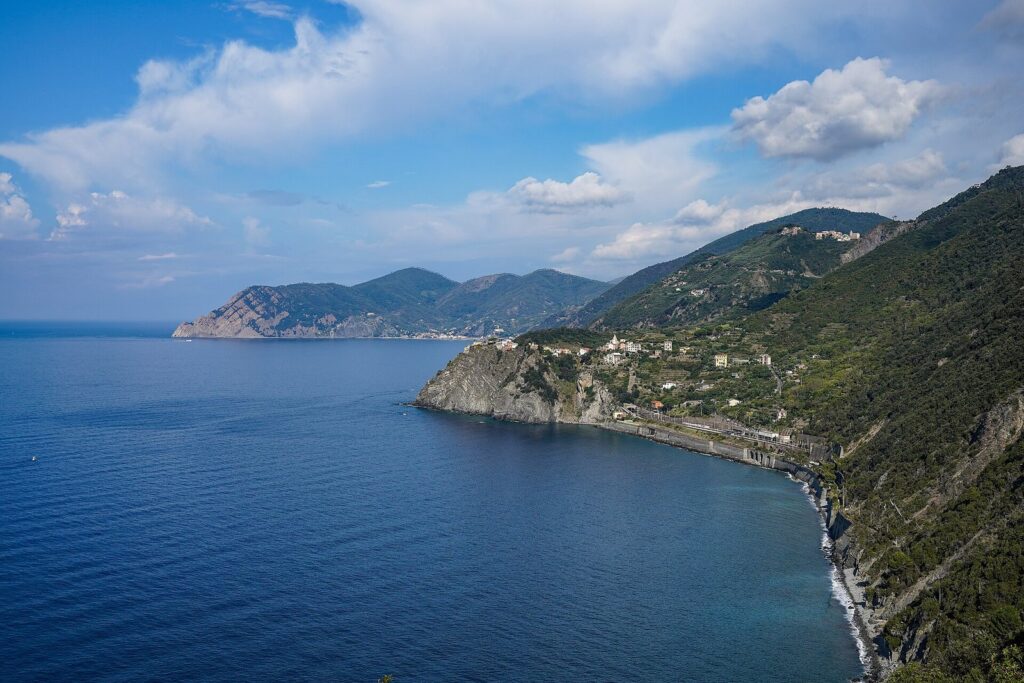
Be clear about what this is: a commuter shuttle that spends most of its time in tunnels. The views come in flashes between them and from the platforms at Manarola, Corniglia and Vernazza. It’s how you get between the villages, not a scenic ride in its own right.
Verdict: use it, but don’t plan a day around it. See the coast from a trail or the ferry, and fit the villages into a longer trip like our 10-day Italy itinerary; summer crowds are heavy, so check the best time to visit Italy first.
Cannes to Ventimiglia: the Riviera by double-decker
The TER coast line from Cannes to Ventimiglia, just over the Italian border, takes about 1h30 with departures through the day, and one-way fares start at €14.30; SNCF Connect shows the fare for your train. It’s an ordinary double-deck commuter train, and that’s its appeal. Sit upstairs on the right from Cannes for the sea side, past Antibes, Nice, Villefranche-sur-Mer and Menton. Monaco’s station is underground, so that stretch goes dark.
Verdict: the cheapest Mediterranean view on rails. Travel mid-morning, once the commuters have gone.
Train Jaune: the Pyrenees’ little yellow train
The metre-gauge Train Jaune climbs from Villefranche-Vernet-les-Bains, below the walled town of Villefranche-de-Conflent, to Latour-de-Carol in the Cerdagne. On the way it crosses the stone Pont Séjourné and the Gisclard suspension bridge and calls at Bolquère-Eyne, at 1,593 metres the highest station on the SNCF network. In summer it runs open-top carriages. The Interrail Pass covers it in full, but engineering works are frequent, so check the timetable on ter.sncf.com before planning a day around it.
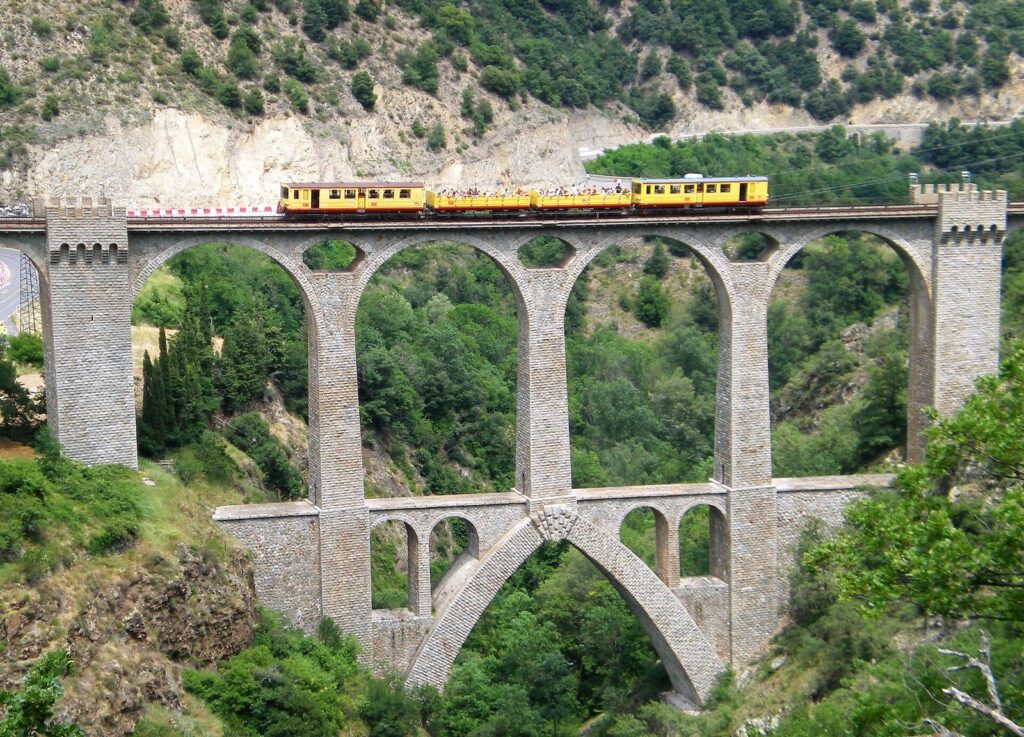
Verdict: one of Europe’s great small railways. Take the open carriage on a dry summer day, and bring a layer for the plateau.
Circumetnea: check before you go
The narrow-gauge line around Mount Etna has lost its Catania end. Rail service between Catania and Paternò was suspended on 17 June 2024 for metro construction, and replacement buses connect with the trains at Paternò and Adrano. Until the new metro stations open, any trip round the volcano starts on a bus, so check which sections are running on the operator’s site before you commit a day.
Verdict: for Etna enthusiasts with a flexible plan; everyone else can wait for the metro.
Spain and Portugal: vineyards, gorges and a wooden train
| Line | Route | Time | Fare (2026) | Pass |
|---|---|---|---|---|
| Linha do Douro | Porto São Bento–Pocinho | 3h20 | €15.10 single, €27.20 return | – |
| Gaitanes gorge line | Málaga–El Chorro | varies by train | normal Renfe fare | – |
| Ferrocarril de Sóller | Palma–Sóller | about 1h | €40 return with the tram to the port | – |
| Beira Alta line | Pampilhosa do Botão–Guarda | – | normal CP fare | – |
Linha do Douro: Porto to Pocinho
Comboios de Portugal (CP) runs five trains a day up the Douro line from Porto Campanhã into port-wine country; from Porto São Bento, the station with the blue-and-white tiled hall, some journeys need a change at Campanhã. Allow about 2h20 to Pinhão and 3h20 to Pocinho at the end of the line. In 2026 the Inter-Regional fare from São Bento to Pocinho is €15.10 single or €27.20 return, and Pinhão costs roughly €11–15 depending on the train.
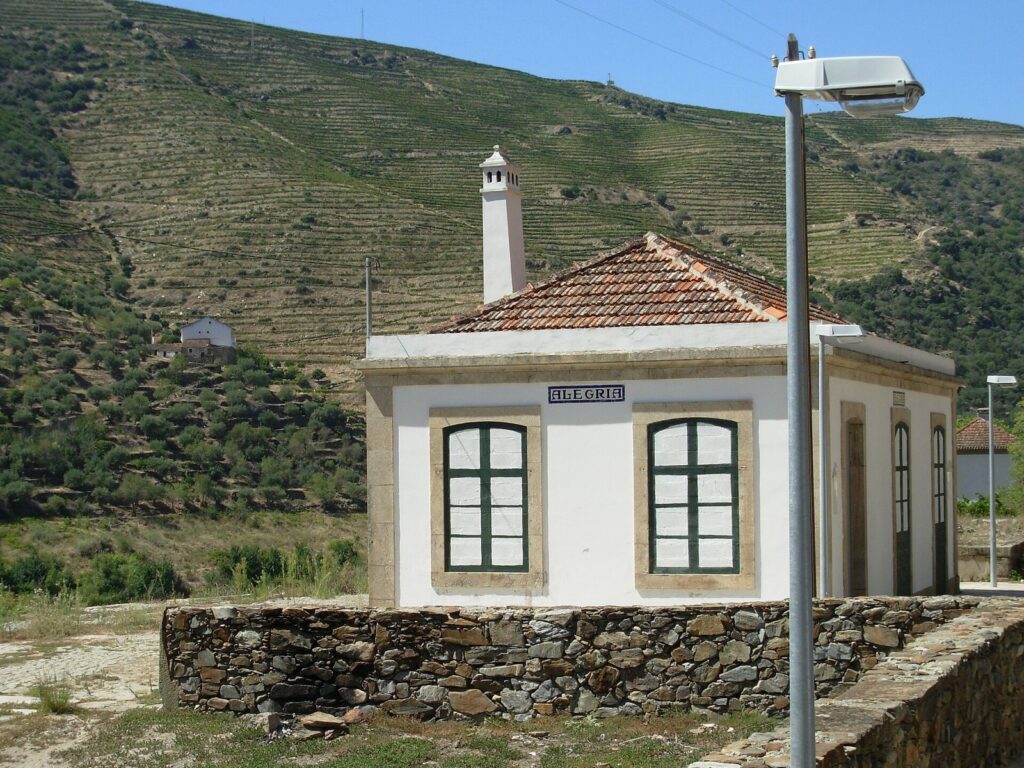
Sit on the right from Porto for most of the river section. The one thing to plan is the way back: the last daily train leaves Pocinho at 19:26 and Pinhão at 20:24, reaching Porto São Bento at 23:40, so check the timetable before you set out or stay the night in Pinhão. In summer a heritage steam train runs in the valley as well.
Verdict: the best-value scenic ride in western Europe. A day return to Pocinho works in summer, when the light lasts; in winter I’d stop at Pinhão.
Málaga to El Chorro and the Gaitanes gorge
Renfe’s regional trains run from Málaga to El Chorro, and the journey time depends on the service, so check Renfe’s timetable for yours. North of the station the line threads the Desfiladero de los Gaitanes, in and out of tunnels beside the Caminito del Rey walkway, on its way towards Ronda.
Verdict: a short, cheap ride. The real reason to come is walking the Caminito del Rey, which you book separately.
Ferrocarril de Sóller: Palma to Sóller
Mallorca’s wooden train has run between Palma and Sóller since 1912. The trip takes about an hour, tunnelling through the Serra de Tramuntana and dropping into Sóller’s valley of orange and lemon groves. A combined train-and-tram return from Palma to Port de Sóller costs €40 in standard class.
Verdict: pricey for an hour, and a heritage attraction rather than transport, but the descent into the orange groves is lovely. Once is enough.
Beira Alta line: Portugal’s reopened mountain route
The Beira Alta line fully reopened at the end of September 2025 after modernisation, running from Pampilhosa do Botão, near Coimbra, across the Beira Alta hills towards the Serra da Estrela and Guarda. It’s a working main line, not a tourist train.
Verdict: worth riding if you’re heading inland from Coimbra; not yet a reason to travel on its own.
Norway and Sweden: fjords, plateaux and the Arctic Circle
Scandinavia’s scenic railways are long, mostly ordinary services, and all but one run through the winter, when snow makes them better still.
| Line | Route | Time | Operator | Season |
|---|---|---|---|---|
| Bergen Railway | Oslo S–Bergen | 6h30–7h30 | Vy | all year |
| Flåm Railway | Myrdal–Flåm | about 1h | Flåmsbana (Vy and Norway’s Best) | all year |
| Rauma Line | Dombås–Åndalsnes | about 1h20 | SJ Norge | all year |
| Nordland Line | Trondheim–Bodø | about 10h | SJ Norge | all year; check for replacement buses |
| Inlandsbanan | Mora–Östersund–Gällivare | several days with stops | Inlandsbanan | summer only; dates on inlandsbanan.se |
Bergen Railway: Oslo to Bergen
Vy runs 6–7 trains a day between Oslo S and Bergen, taking 6h30 to 7h30 depending on the service. The middle of the journey is the reason to go. Above the tree line the train crosses the Hardangervidda plateau and stops at Finse, at 1,222 metres the highest station on the Norwegian network, where snow can lie well into summer. For the plateau, sit on the left leaving Oslo (on the right from Bergen); for the valleys and fjord glimpses in the west, sit on the right from Oslo (left from Bergen).
Tickets come in several types, including Lowfare, Plus, compartments and a family carriage, and the cheapest go first. Sales normally open 115 days ahead, though engineering work and timetable changes can shorten that; in summer, book as early as you can. There’s a night train too, but it crosses the plateau in darkness for most of the year.
Verdict: my pick for a full day of rail scenery anywhere in Europe. Take a morning departure and book early.
Flåm Railway: Myrdal down to the fjord
The Flåm Railway drops from Myrdal, a junction on the Bergen line at 867 metres, to Flåm at the head of the Aurlandsfjord: 20 km and about 55 minutes each way. The train pauses at the Kjosfossen waterfall for photographs and runs through tunnels dug by hand.
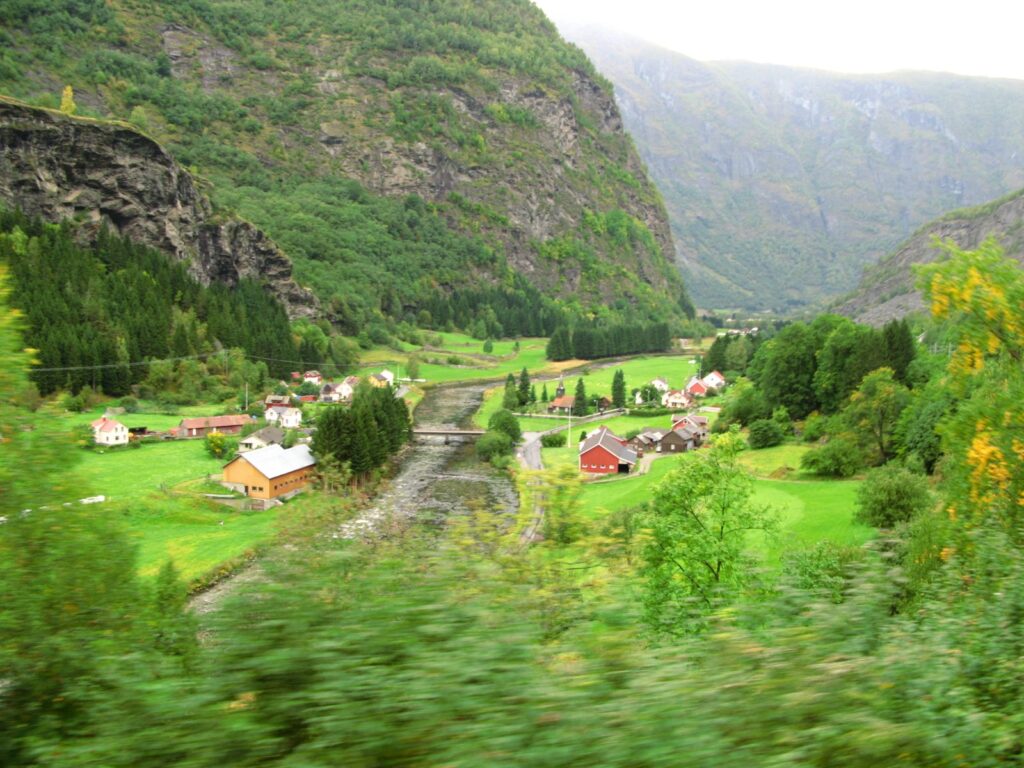
Fares vary by season and by where you buy. In 2026 one-way prices ran from about NOK 400 in winter to a little over NOK 500 in summer, and Interrail and Eurail give 30% off rather than free travel. From June to August, book two to three weeks ahead; from October to April you can usually buy on the day.
The classic day out is Norway in a Nutshell: the Bergen line to Myrdal, the Flåm Railway down, a boat through the Nærøyfjord to Gudvangen and a bus onwards, all of which fits into one long day from Oslo to Bergen, with timings set by the departure you pick. The packaged version is convenient, but every leg is a public service you can book yourself.
Verdict: short, steep and busy. In summer take the first or last train of the day, and don’t buy a return if you’re leaving Flåm by boat.
Rauma Line: Dombås to Åndalsnes
SJ Norge runs the Rauma Line all year: 114 km from Dombås, on the Oslo–Trondheim line, down the Romsdalen valley to Åndalsnes in about 1h20. It passes below the Trollveggen rock wall and crosses the stone Kylling bridge near Verma.
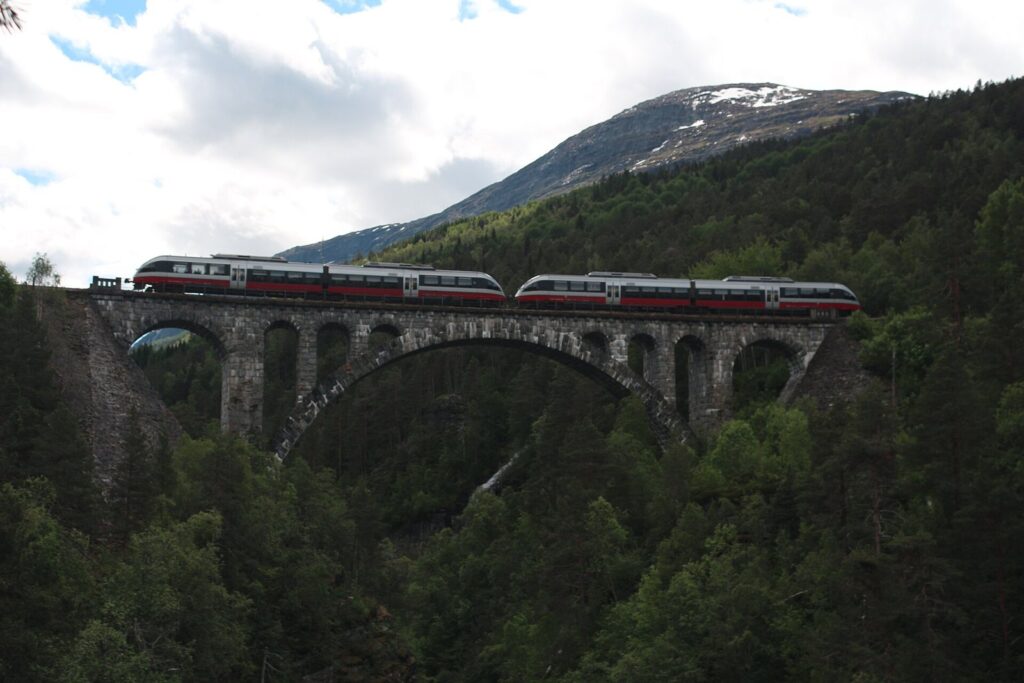
Verdict: the most underrated rail ride in Scandinavia. Add it to an Oslo–Trondheim trip by changing at Dombås; Åndalsnes makes a good base for the fjords of Møre og Romsdal.
Nordland Line: Trondheim to Bodø
Norway’s longest line runs 729 km from Trondheim to Bodø in about ten hours. The normal through service is two trains a day each way, one of them a night train, but SJ has suspended the night trains for now and expects them back during January 2027, so check the current departures before you book. The day train crosses the Arctic Circle on the bare Saltfjellet plateau. Construction work brought rail-replacement buses to parts of the line through summer 2026, so check that your booking shows a train end to end.
Verdict: ride north by day in summer to cross the Arctic Circle in daylight; take the sleeper when time matters more than the view.
Inlandsbanan: Sweden’s summer-only interior line
The Inlandsbanan runs about 1,300 km from Kristinehamn and Mora via Östersund to Gällivare, through forest and lake country and across the Arctic Circle. It’s a summer tourist service: daily departures ran from 16 June to 12 August in 2026. A 14-day pass cost SEK 2,645 in 2026; Mora–Östersund was SEK 596 and Östersund–Gällivare SEK 1,378.
Verdict: slow by design. It suits an unhurried fortnight in Swedish Lapland, not a tight schedule.
Britain: Highlands, Dales and Welsh narrow gauge
The UK sits outside the EU and Schengen, but Interrail and Eurail passes are valid on its railways. From the Continent, the Eurostar brings you to London, and the Highland lines start in Glasgow and Inverness.
| Line | Route | Time | Fare or season | Operator |
|---|---|---|---|---|
| West Highland Line | Glasgow Queen Street–Mallaig | about 5h20 | advance fares from £19.50 | ScotRail |
| The Jacobite | Fort William–Mallaig | return trip | 2027 dates and fares on the operator’s site | West Coast Railways |
| Kyle line | Inverness–Kyle of Lochalsh | – | from £17.40 one way | ScotRail |
| Settle–Carlisle | Leeds–Settle–Carlisle | – | daily except 25 and 26 December | Northern |
| Ffestiniog Railway | Porthmadog Harbour–Blaenau Ffestiniog | – | winter and Christmas trains in 2026; full calendar on festrail.co.uk | Ffestiniog & Welsh Highland Railways |
West Highland Line: Glasgow to Fort William and Mallaig
ScotRail’s West Highland Line leaves Glasgow Queen Street and splits, one branch running to Oban and the other to Fort William and Mallaig. Fort William takes about 3h45 to 4 hours and Mallaig about 5h20; advance fares start around £19.50, and you’ll pay a good deal more on the day. After Loch Lomond the line crosses the bog and lochans of Rannoch Moor and calls at Corrour, at 408 metres the highest main-line station in Britain, then runs from Fort William over the Glenfinnan Viaduct to the sea at Mallaig.
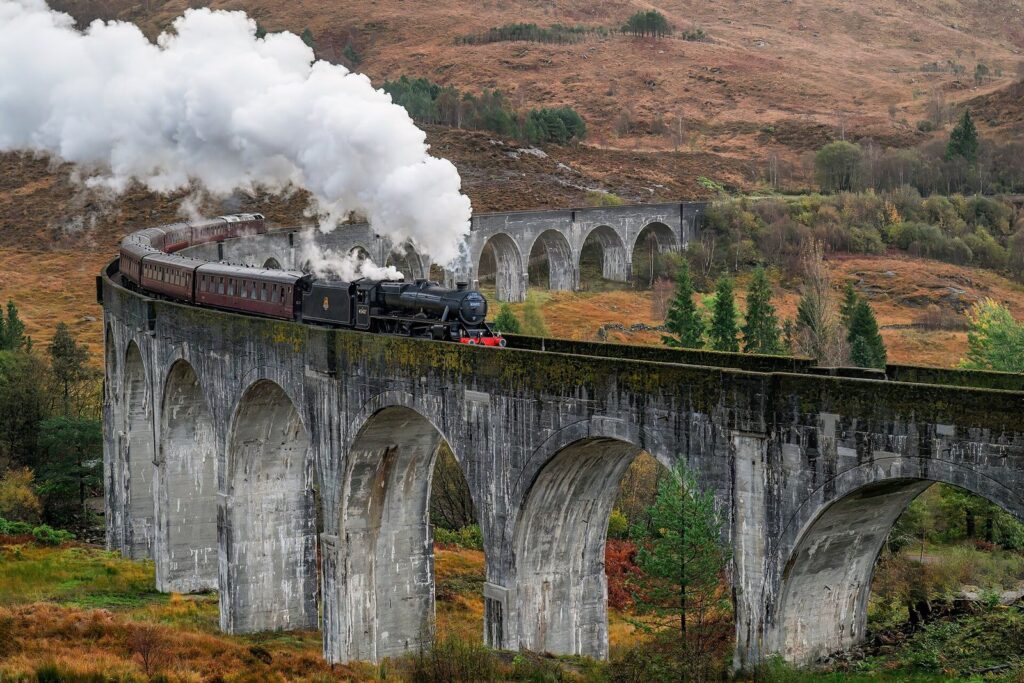
Verdict: Britain’s finest railway journey. Take the ordinary train unless steam is the whole point.
The Jacobite steam train
West Coast Railways’ Jacobite runs Fort William–Mallaig as a return trip. Check its website for the 2027 dates, fares and timings before you plan any connections, and register there for booking updates. Bookings usually open in January, and July and August sell out weeks or months ahead.
Verdict: worth it for the steam, not the view. ScotRail’s trains cross the same Glenfinnan Viaduct for much less, and they run all year.
Kyle of Lochalsh line: Inverness to the Skye bridge
ScotRail’s trains run from Inverness past Achnasheen and along Loch Carron to Plockton and Kyle of Lochalsh, beside the Skye Bridge. Fares start at £17.40 one way, based on a return, but services are sparse, so check the day’s timetable on scotrail.co.uk before you set out.
Put it together with the West Highland Line and you have a loop: train from Glasgow to Mallaig, ferry to Skye, across the island to Kyle, then the train to Inverness.
Verdict: quieter than the West Highland and nearly as good. The last hour along Loch Carron is the best of it.
Settle–Carlisle: over the Ribblehead Viaduct
Northern runs trains between Leeds and Carlisle via Settle and Appleby every day except Christmas Day and Boxing Day. The scenic core is the climb through the Yorkshire Dales: over the 24-arch Ribblehead Viaduct, 440 yards (about 400 metres) long and 100 feet (30 metres) high above Batty Moss, past Dent, the highest operational main-line station in England, and down the Eden valley to Carlisle.
Verdict: England’s best scenic railway, on an ordinary ticket. Pair it with a Dales walk from Ribblehead or Dent.
Ffestiniog and Welsh Highland: narrow gauge in Eryri
The Ffestiniog Railway climbs 13.5 miles from Porthmadog Harbour to the slate town of Blaenau Ffestiniog, and its sister Welsh Highland Railway runs from Porthmadog through the Aberglaslyn Pass to Caernarfon, beneath Yr Wyddfa (Snowdon). Both run pre-booked, named excursions, among them the Mountain Spirit, the Aberglaslyn and the Victorian, rather than hop-on trains. In 2026 Ffestiniog services started on 21 March and Welsh Highland services on 28 March, and the railways’ train-services page lists the winter and Christmas journeys. The Ffestiniog topped a 2022 Which? ranking of Europe’s scenic railways.
Verdict: a heritage day out in its own right; book well ahead in the school holidays.
The Balkans and eastern Europe: the wild ones
Slower, cheaper and rougher round the edges, with some of the most dramatic scenery in this guide. Mind the currencies: Montenegro uses the euro, Serbia the dinar, Bosnia and Herzegovina the convertible mark, Romania the leu, and Bulgaria has used the euro since 1 January 2026.
| Line | Route | Time | Fare (2026) | Tickets |
|---|---|---|---|---|
| Belgrade–Bar | Beograd Centar–Bar | 11h overnight | €23.80 (2nd), €35.60 (1st), plus €3 seat | station or agent, not online |
| Sarajevo–Mostar | Sarajevo–Mostar | about 2h | about €7–9, paid in marks | – |
| Bohinj Railway | Jesenice–Nova Gorica | – | normal SŽ fare | – |
| Oravița–Anina | Oravița–Anina | just under 2h | – | seat reservation compulsory |
| Rhodope line | Septemvri–Dobrinishte | – | a few euros | – |
Belgrade–Bar: Serbia to the Montenegrin coast
Opened in 1976, the line from Belgrade to the port of Bar has 254 tunnels and 435 bridges, including the Mala Rijeka viaduct, one of the tallest railway viaducts in Europe. Railways of Montenegro (ŽPCG) lists an overnight train, the 433, leaving Beograd Centar at 19:54 and reaching Bar at 06:54, 11 hours later. Near the end, the line crosses Lake Skadar.
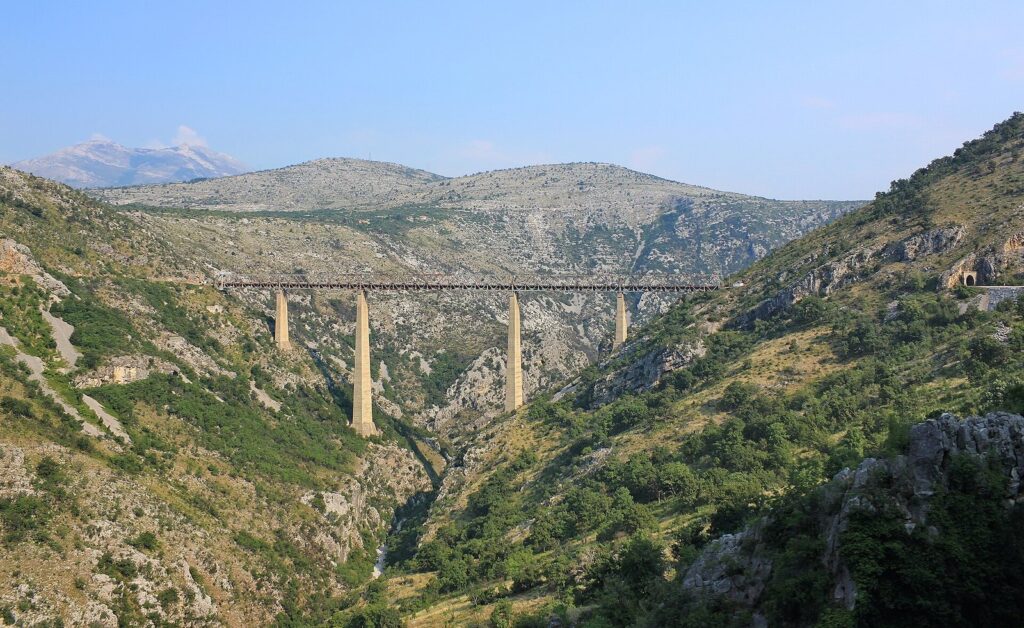
Fares in 2026 are €23.80 in second class and €35.60 in first, plus €3 for a seat reservation; a couchette berth adds €6 and a sleeper €15–20 per person. You can’t buy online, so get tickets at the station in Belgrade or through an agent. The overnight train passes the best southern section in darkness, so check ŽPCG’s timetable for a day train on your date.
Verdict: the most dramatic railway in south-east Europe, and one of the cheapest. Go by day and take food and water.
Sarajevo–Mostar: down the Neretva
Two trains a day leave Sarajevo on the line through Mostar to Čapljina, at 07:15 and 16:46; in 2026 extra seasonal trains to Ploče ran on Fridays, Saturdays and Sundays from 26 June to 27 September. The line drops out of the mountains to Jablanica and follows the Neretva gorge into Mostar. Fares come to about €7–9, paid in convertible marks.
Verdict: two hours of the best river scenery in the Balkans, and the easiest ride in this section to fit into a trip.
Bohinj Railway: Slovenia’s line through the Julian Alps
Slovenian Railways (SŽ) runs ordinary trains on the Bohinj Railway from Jesenice via Bled Jezero and Bohinjska Bistrica, through the Bohinj tunnel and down the Soča valley to Nova Gorica. Near the end it crosses the Solkan Bridge, whose 85-metre stone arch is the longest on any railway bridge in the world. Car-carrying shuttle trains also run through the Bohinj tunnel.
Verdict: the gentlest ride in this section, and an easy add-on to a stay at Lake Bled.
Oravița–Anina: the Semmering of the Banat
In service since 15 December 1863, the mountain line from Oravița climbs through tunnels and over viaducts to Anina. It’s known as the Semmering of the Banat. In 2026 CFR Călători ran two trains a day, the 11:15 from Oravița (arriving 13:17) and the 14:40 back from Anina (arriving 16:42), and seat reservations are compulsory. Don’t confuse it with the Transalpina, which is a mountain road, not a railway.
Verdict: remote, but a neat day trip if you’re in western Romania; the timetable leaves you about an hour and twenty minutes in Anina.
Rhodope narrow gauge: Septemvri to Dobrinishte
Bulgaria’s last narrow-gauge line runs from Septemvri, easily reached from Sofia, up through Velingrad and the ski town of Bansko to Dobrinishte, calling at Avramovo, at 1,267 metres the highest station in the Balkans. A ticket for the whole route costs only a few euros; check bdz.bg for the current timetable and fares.
Verdict: the cheapest scenic ride in this guide by a distance. Allow a full day end to end and pack a picnic.
Are luxury scenic trains worth it?
| Train | Route | Format | Price |
|---|---|---|---|
| Glacier Express Excellence Class | Zermatt–St. Moritz | day train with a five-course menu | CHF 590 reservation plus a first-class ticket or pass |
| Venice Simplon-Orient-Express | London or Paris to Venice, among others | overnight, all meals included | Paris–Venice from £4,275 per adult in a Historic Cabin in 2026; via Amsterdam or Brussels from €4,640 in 2027, depending on departure |
| El Transcantábrico Gran Lujo | San Sebastián–Santiago de Compostela | several days, sleeping on board | – |
| El Tren Al Ándalus | Seville–Madrid, new for 2026 | 7 days, 6 nights in historic lounge and sleeping cars built 1928–1930 | – |
Belmond runs the Venice Simplon-Orient-Express roughly weekly between London and Venice from about mid-March to November. From London you ride the British Pullman to Folkestone and a coach across the Channel, joining the train at Calais. Meals, afternoon tea and a champagne reception are included, rail passes aren’t valid, and Grand Suites start at £8,400 (€9,800) per person. In Spain, El Transcantábrico Gran Lujo spends several days on the green north coast, and the Al Ándalus added a Seville–Madrid itinerary in 2026 with stops in Cádiz, Jerez, Córdoba, Mérida and Aranjuez.
Verdict: these are hotels on rails, and the view from the window is no better than from a second-class seat. Book one for an anniversary, not for the scenery.
How do you get the best views from the train?
Five habits make more difference than the class of ticket:
- Travel by day. The night trains on the Bergen and Belgrade–Bar lines cross their best sections in darkness for most of the year.
- Pick your side. On coast and river lines it’s the difference between the view and a rock face; the table below covers the lines where it matters most.
- Look for windows that open. RhB’s regional trains have them; panoramic cars don’t, and their glass throws back reflections on sunny days.
- Go early in summer. Morning trains are quieter, and you keep the afternoon for a walk at the far end.
- Use the stairs and the doors. On double-deckers, sit upstairs; on unreserved regional trains, the door windows are often the best place for photographs.
| Route | Direction | Sit | For |
|---|---|---|---|
| Bergen Railway | Oslo to Bergen | left | the Hardangervidda plateau |
| Bergen Railway | Oslo to Bergen | right | western valleys and fjord glimpses |
| Middle Rhine, west bank | Koblenz to Bingen | left | the river and castles |
| Cannes–Ventimiglia | Cannes to Ventimiglia | right, upper deck | the sea |
| Linha do Douro | Porto to Pocinho | right | the river, for most of the valley |
| Black Forest Railway | either way | upper deck | loops and valleys |
Travelling the other way? Swap sides.
When is the best time for a scenic train trip?
| Season | Why go | Watch out for |
|---|---|---|
| Spring (April–May) | snow on the peaks above green valleys; quieter trains | high plateaux still snowbound; seasonal trains only starting up |
| Summer (June–August) | everything runs, including the seasonal Jacobite and Inlandsbanan; long northern days | sell-outs on the Bernina, Glacier, Flåm and Jacobite; crowds at the Cinque Terre |
| Autumn (September–October) | golden larches in the Engadine; the grape harvest in the Douro | closures: in 2026 the Gotthard Panorama Express ended on 18 October and the Glacier Express paused from 11 October to 4 December, and the Jacobite stops for the winter |
| Winter (December–March) | snow on the Bernina, Glacier and Bergen lines | short days in Norway and Scotland; one Glacier Express each way a day |
My favourite months are June and September: nearly everything I’d want to ride is running, and the light lasts into the evening. If you’re travelling in November 2026, the Bernina line and the Bergen Railway still run (mind the Bernina diversion until 13 November), and the Glacier Express returns on 5 December.
Rail passes and scenic trains
A pass covers more of this list than you might expect, but rarely all of it.
| Train | With a Eurail or Interrail pass |
|---|---|
| Glacier Express | covered; CHF 54 reservation, short or long |
| Bernina Express | covered; the CHF 32–44 reservation is paid in full |
| GoldenPass Express | covered; fee of €4.40–24.40 |
| Gotthard Panorama Express | CHF 24 reservation in 2026 (CHF 28 in 2027); first-class holders also paid CHF 41, second-class CHF 75 |
| Jungfrau Railway | 25% off |
| Flåm Railway | 30% off |
| Linha do Douro | check with CP when you book |
| Train Jaune | covered |
| Middle Rhine | covered; the Deutschland-Ticket also works |
| Venice Simplon-Orient-Express | not valid |
A Swiss Travel Pass covers the Glacier Express fare (you pay the CHF 54 reservation), the GoldenPass Express outside Prestige, both legs of the Gotthard Panorama Express (plus a CHF 14–20 reservation) and the Centovalli line, even on its Italian section.
A pass rarely pays for itself on scenic lines alone: Flåm gives 30% off, the Jungfrau 25%, and the Swiss panoramic trains still charge their reservations. It pays when the scenery sits inside a longer trip with expensive long-distance legs. Our Eurail cost breakdown runs the numbers, Eurail vs Interrail settles which one you’re eligible for, and how to use an Interrail pass explains the reservations.
Planning a scenic rail trip: booking windows, what to book and what to skip
Most of these lines start from a main-line station you can reach fast: Chur and St. Moritz from Zurich, Tirano from Milan, Myrdal on the Bergen line, Fort William and Mallaig from Glasgow. For booking mechanics, from operator sites to seat reservations, see how to book European train tickets, and if it’s your first rail trip, Europe by train for beginners.
| Train | Sales open | When to book |
|---|---|---|
| Glacier Express | tickets 180 days ahead, seats 93 days ahead | as early as you can; demand is high |
| Bernina Express | months ahead | as soon as your summer dates are fixed |
| GoldenPass Express | up to six months ahead | once your dates are firm |
| Bergen Railway | normally 115 days ahead, sometimes less | early in summer for Lowfare |
| Flåm Railway | – | early for June–August |
| Jacobite | January, for the whole season | weeks or months ahead for July–August |
| Belgrade–Bar | in person or through an agent | before the day, at Beograd Centar |
| Douro, Cinque Terre, Middle Rhine, Semmering | on the day | no need |
Book ahead for the Swiss panoramic seats in summer, the Flåm Railway from June to August, the Jacobite, Lowfare on the Bergen Railway and Ffestiniog excursions in school holidays. Everything else can wait until you’re standing on the platform. RhB also advertises last-minute Bernina Express deals from CHF 79, worth a look if your plans are loose.
Mistakes I’d avoid:
- Booking the “Bernina Express to Lugano” and expecting a train: Tirano to Lugano is a bus.
- Planning the Glacier Express between 11 October and 4 December 2026.
- Taking the Belgrade–Bar night train for the views.
- Looking for a Transalpina train: the Transalpina is a Romanian mountain road, and the rail alternative is Oravița–Anina.
- Expecting a pass to make the Flåm Railway free: it’s 30% off.
- Missing the last Douro train down: 19:26 from Pocinho, 20:24 from Pinhão.
- Starting the Circumetnea in central Catania: that section is now a bus.
A few combinations that work well:
| Trip | Route | Days |
|---|---|---|
| Alpine classic | Zurich to Chur; the Bernina line to Tirano; regional train to Milan | 1–2 |
| Three-pass loop | Lucerne to Locarno over the Gotthard; Centovalli to Domodossola; Simplon line to Brig and Zermatt | 2–3 |
| Norway in a day | Oslo to Myrdal; Flåm Railway; Nærøyfjord boat; bus and train to Bergen | 1 |
| Highland loop | Glasgow to Mallaig; ferry to Skye; Kyle of Lochalsh to Inverness | 3 |
| Balkan pair | Belgrade–Bar by day; Sarajevo–Mostar on a separate leg | 3–4 |
For a longer plan, our Europe train itinerary strings several of these together, and our guide to Interrail routes has pass-friendly versions.
Frequently asked questions about scenic train rides in Europe
What is the most scenic train ride in Europe?
For most people it’s the Bernina line between St. Moritz and Tirano: from glaciers at 2,253 metres down to Italian vineyards, on a UNESCO-listed railway. The Bergen Railway is the best full-day ride and Portugal’s Douro line the best value. In Britain, the West Highland Line to Mallaig beats everything else.
Do I need to book scenic trains in advance?
Only the branded ones. The Glacier Express, Bernina Express and Gotthard Panorama Express need seat reservations that sell out in summer, and the Jacobite sells out weeks ahead. Ordinary trains on the same Swiss lines, the Douro line, the Middle Rhine, the Semmering and the Cinque Terre shuttle need no booking: buy a ticket and board.
Are scenic trains covered by Eurail and Interrail?
Most are. The passes cover the full Glacier and Bernina routes, the Train Jaune and ordinary trains almost everywhere, but you still pay the panoramic reservations: CHF 54 on the Glacier Express and CHF 32–44 on the Bernina Express. Private lines give discounts instead, such as 30% off ordinary single tickets on the Flåm Railway and 25% on the Jungfrau.
Is the Glacier Express worth it?
Once, for a traveller who loves long train days. It costs CHF 220 in second class, reservation included, for about eight hours. If you’d rather see the best bits and stop along the way, regional trains cover the same rails for less, and the Bernina line packs more drama into half the time.
Which scenic trains run in winter?
Most ordinary lines run all year, including the Bernina line, the Bergen and Flåm railways, the West Highland Line and the Semmering. The Glacier Express has a winter season from 5 December 2026 to 7 May 2027, with extra trains from 12 December to 3 January and from 30 January to 7 May. The Gotthard Panorama Express, the Jacobite and the Inlandsbanan are seasonal and stop for the winter.
What is the cheapest scenic train ride in Europe?
Bulgaria’s Rhodope narrow-gauge line costs a few euros for the whole route from Septemvri to Dobrinishte. In western Europe, the Douro line from Porto to Pocinho costs €15.10 single for 3h20 of river views, and the Middle Rhine is covered by the €63 monthly Deutschland-Ticket. Belgrade–Bar is €23.80 in second class, plus €3 for a seat, for 11 hours overnight.
Can I do Norway in a Nutshell without a tour?
Yes. Every leg is a public service: Vy’s Bergen line to Myrdal, the Flåm Railway down to Flåm, a boat through the Nærøyfjord to Gudvangen and a bus onwards. Booking the legs yourself takes more effort but lets you stay a night in Flåm. You can do the whole thing from Oslo to Bergen in one day; check the connections for your date.
Which side of the train should I sit on?
It depends on the line. On the Bergen Railway from Oslo, sit on the left for the Hardangervidda plateau and on the right for the western valleys. From Cannes to Ventimiglia, sit upstairs on the right for the sea, and heading south from Koblenz on the Middle Rhine, sit on the left. Reverse the side on the way back.
Final thoughts
Europe’s best rail scenery doesn’t need a luxury ticket. Pick one branded train for the line you care about most, then ride ordinary trains over the rest, by day and on the right side. Watch the calendar, because the seasonal trains stop in autumn. For tickets, stations and passes, our Europe train travel guide has the rest.
Related Europe guides
- Best Train Routes in Europe: 33 Journeys Worth the Fare: 33 city-to-city routes, from high-speed lines to slow scenic ones
- Night Trains in Europe: sleepers for the long legs between the scenic lines
- Eurail vs Interrail: Which Pass to Get: which pass covers the panoramic trains and their supplements
- How to Book European Train Tickets: booking windows and seat reservations, operator by operator
- Europe Train Itinerary: 12 Routes With Times and Costs: a full rail route that links several of these lines
Sources and verification
Prices, timetables and rules in this guide were checked on 26 September 2026 against the official sources below. It is compiled from those sources rather than from other travel lists, and it does not describe first-hand visits. Fares, opening hours and entry rules change, so confirm with the operator before you book.
- Rhaetian Railway: Bernina Express
- Rhaetian Railway: Bernina Express or regional train?
- Glacier Express: timetable and prices
- Vy: Bergen Line and Flåm Railway tickets
- ScotRail: West Highland and Kyle lines
- Settle-Carlisle Railway: plan your journey
- Comboios de Portugal: Douro line
- UNESCO World Heritage: Semmering Railway
Hannah Brooks has spent fifteen years travelling, living and writing across Europe, from the Arctic tip of Norway to the south of Sicily. She has planned hundreds of European itineraries for readers and is Senior Europe Editor at EuropeanTourism.org.
Photo credits
- Glacier Express crossing the Landwasser Viaduct below snowy peaks, one of the finest scenic train rides Europe offers (top photo): photo by Kabelleger / David Gubler, Wikimedia Commons (CC BY-SA 4.0)
- Red Rhaetian Railway regional train circling the stone Brusio spiral viaduct above green meadows: photo by Kabelleger / David Gubler (http://www.bahnbilder.ch), Wikimedia Commons (CC BY 3.0)
- View from a Centovalli train window as it crosses a steel bridge over a wooded gorge: photo by Ed Webster, Wikimedia Commons (CC BY 2.0)
- Stone arches of the Steinhaus viaduct on the Semmering Railway above a road and rooftops: photo by Häferl, Wikimedia Commons (CC BY-SA 3.0 at)
- Ligurian coast north-west of Manarola, with Corniglia and its seaside station below terraced hills: photo by This Photo was taken by Timothy A. Gonsalves. Feel free to, Wikimedia Commons (CC BY-SA 4.0)
- Yellow Train Jaune crossing the two-tier stone Pont Séjourné over a wooded Pyrenean gorge: photo by Thierry Llansades from la rochelle/ Vernet dels banys /, Wikimedia Commons (CC BY-SA 2.0)
- Small white station building at Alegria halt on the Douro line, with terraced vineyards behind: photo by Maria Lemos from Porto, Portugal, Wikimedia Commons (CC BY-SA 2.0)
- Flåm church and farms beside the Flåmselvi river, seen from the Flåm Railway: photo by Christopher Macsurak, Wikimedia Commons (CC BY 2.0)
- Two-car train crossing the stone arch Kylling bridge in the Rauma valley near Verma: photo by Sundgot, Wikimedia Commons (CC BY-SA 4.0)
- Jacobite steam train crossing the curving Glenfinnan Viaduct between autumn hillsides: photo by Eric Kilby, Wikimedia Commons (CC BY-SA 4.0)
- Mala Rijeka viaduct on tall piers spanning a dry, scrub-covered Montenegrin canyon: photo by Marcin Konsek, Wikimedia Commons (CC BY-SA 4.0)
- Red Glacier Express train crossing deep snow on the climb to the Oberalp Pass: photo by Kabelleger / David Gubler (http://www.bahnbilder.ch), Wikimedia Commons (CC BY-SA 3.0)